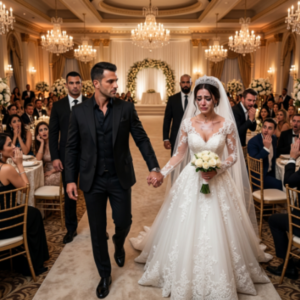
“Shut Up or I’ll Make You” — Her Husband Threatened, Unaware the Mafia Boss Was At The Next Table

I stared at the wine spreading across the white tablecloth like blood seeping through gauze, my hand still frozen around the empty glass. The crimson stain crept toward Ryan’s side of the table, reaching his pressed shirt sleeve before I could even think to grab a napkin.
My husband’s jaw tightened, that muscle near his ear twitching the way it always did right before everything went wrong. “I’m sorry,” I whispered, already reaching for the cloth napkins stacked near the bread basket. My voice sounded thin even to my own ears, barely audible over the soft jazz playing through the restaurant’s sound system.
“It was an accident, I didn’t mean to—” “Of course you didn’t mean to.” Ryan’s voice was pleasant, almost warm, the tone he used when we were in public and he needed to maintain the illusion that we were a happy couple celebrating three years of marriage. But his hand shot across the table and wrapped around my wrist with bruising force, his fingers digging into the exact spot where last week’s grip marks had finally started to fade from purple to that sickly yellow-green. “You never mean to do anything, Megan. You’re just clumsy. Careless. Useless.”
Each word was punctuated by his thumb pressing harder against the tender skin of my inner wrist, and I bit down on my lower lip to keep from making a sound. Making a scene would only make things worse when we got home. It always made things worse. The restaurant around us continued its elegant performance—the soft clink of silverware against china, the murmur of conversation from other tables, the rain that had started falling an hour ago now drumming steadily against the tall windows overlooking the street. No one was paying attention to us. No one ever did.
“It’s just wine,” I said quietly, trying to pull my hand back, but Ryan’s grip only tightened. “I’ll pay for the dry cleaning.” “With what money?” He smiled then, and if anyone had been watching, they would have thought he was being charming, maybe even flirting with his wife.
“You don’t have any money, remember? You barely make four hundred dollars a week doing those pathetic translation jobs. That doesn’t even cover your half of the rent.” My half of the rent. As if I hadn’t given up my savings account, my credit cards, my entire financial independence when he’d convinced me to consolidate everything under his name two years ago.
As if I hadn’t stopped seeing my best friend Ashley because he said she was a bad influence. As if I had any life left outside the carefully controlled box he’d built around me. “Ryan, please.” My voice cracked slightly, and I hated myself for the weakness. “People are looking.” “No one’s looking, sweetheart.
” But he released my wrist anyway, sitting back in his chair with that same pleasant smile fixed on his face. “Try not to embarrass me again tonight. This place isn’t cheap, and I’m paying for it, so the least you can do is act grateful.” I nodded, cradling my wrist against my stomach under the table where he couldn’t see.
The restaurant really wasn’t cheap—Rossi’s was one of those places where the menu didn’t list prices and the waitstaff moved with the kind of silent efficiency that suggested they’d been trained at establishments far more exclusive than this. Dark wood paneling, cream-colored walls decorated with original artwork, tables spaced far enough apart that conversations remained private.
Soft lighting from antique-looking sconces made everyone appear softer, more attractive than they probably were in daylight. Ryan had chosen it for our anniversary dinner, though I suspected it had less to do with celebrating our marriage and more to do with the fact that several of his business associates frequented the place.
He’d been on edge all week, snapping at me more than usual, staying out late without explanation. Money had been tight—or at least that’s what he told me when I’d asked why my freelance payments were being deposited into his account instead of the joint one we supposedly shared. When I’d pressed the issue this morning, he’d shoved me hard enough that I’d hit the kitchen counter, and then he’d smiled and told me to wear something nice because we were going out.
So here I sat, wearing the navy dress he’d laid out on the bed for me, my hair styled the way he preferred it, my makeup carefully applied to hide the shadows under my eyes that came from too many nights lying awake and wondering how my life had become this small, this suffocating. Twenty-seven years old, and I felt like I’d aged a decade in the three years since I’d married him.
The waiter appeared with fresh napkins and quietly cleared away the wine-stained cloth without comment, professional enough not to acknowledge the tension at our table. Ryan ordered another bottle of wine—expensive, red, something with a French name I didn’t recognize—and leaned back in his chair, finally releasing me from the weight of his attention as he scanned the restaurant.
I used the moment to breathe, really breathe, letting air fill my lungs properly for the first time since we’d walked through the door. My wrist throbbed dully, and I knew without looking that there would be new bruises tomorrow to match the old ones. Long sleeves for the rest of the week. Maybe I’d tell Ashley I was sick again if she tried to stop by.
Maybe— My gaze drifted past Ryan’s shoulder to the table directly behind him, and I froze. Two men sat there, engaged in what appeared to be a business dinner of their own, though their conversation had paused when Ryan had grabbed my wrist. The younger of the two was watching us with unconcealed interest, his expression somewhere between concern and calculation.
He looked like he was in his early thirties, dark-haired, handsome in a sharp-edged way that suggested he spent a lot of time in the gym. But it was the other man who held my attention. He was older, maybe mid-thirties, with black hair styled away from a face that could have been carved from stone for all the emotion it showed.
Dark eyes—brown, I thought, though the lighting made it hard to tell—fixed on our table with an intensity that made my skin prickle. He wore a black dress shirt with the sleeves rolled to his elbows, revealing forearms covered in intricate tattoos that disappeared beneath the fabric. Expensive watch. Heavy rings on three fingers of his right hand.
And despite the casual way he sat, one arm draped over the back of his chair, there was something about him that screamed danger. Our eyes met across the space between tables, and I felt my breath catch. He wasn’t just watching our table anymore—he was watching me, specifically, and the weight of his gaze made me feel simultaneously exposed and protected in a way I couldn’t explain.
For a long moment, neither of us looked away, and I had the strange sensation of being truly seen for the first time in years. Not as Ryan’s disappointing wife, not as the woman who couldn’t do anything right, but as a person with thoughts and feelings and a right to exist without fear. Then Ryan shifted in his seat, breaking the spell, and I quickly looked down at my plate.
“I need to use the restroom,” Ryan announced, standing abruptly. He leaned down close enough that his breath ghosted across my ear. “Don’t move. Don’t talk to anyone. And for God’s sake, try not to spill anything else while I’m gone.” I nodded, and he walked away, weaving between tables toward the back of the restaurant where the restrooms were located.
The moment he disappeared around the corner, I felt some of the tension leave my shoulders, my body recognizing his absence before my mind fully processed it. These brief respites when he left me alone in public places were the closest thing I had to peace anymore. “Excuse me.” The voice was deep, cultured, with the faintest trace of an accent I couldn’t quite place.
I looked up to find the dark-haired man from the next table standing beside mine, his presence somehow both threatening and reassuring. Up close, he was even more imposing—easily over six feet tall, built like someone who could handle himself in any situation, with a face that belonged on old Roman coins. Beautiful and terrifying in equal measure.
“I’m sorry to interrupt your evening,” he continued, his voice low enough that no one else could hear, “but I noticed your husband was somewhat… aggressive earlier.” Heat flooded my face. Of course someone had noticed. Of course someone had been watching.
And now I’d have to make excuses, explain it away, pretend everything was fine because that’s what I always did. That’s what Ryan expected. “It was nothing,” I said automatically, the lie smooth and practiced after years of repetition. “Just a small disagreement. Married couples argue sometimes.” “Argument.” He repeated the word as if testing its weight.
“Is that what you call it when a man grabs his wife hard enough to leave marks?” My hand instinctively moved to cover my wrist, but it was too late. He’d already seen. I’d been so focused on hiding the bruises on my arms that I hadn’t thought about new ones forming right there in public, visible to anyone who cared to look. And this man—this dangerous, intense stranger—had definitely been looking.
“I don’t know what you think you saw—” I started, but he held up one hand, silencing me. “I saw enough.” He reached into his pocket and pulled out a small cream-colored business card, placing it carefully on the table beside my untouched wine glass. “My name is Franco Pellagrini.
If you ever need help getting out of a difficult situation, you can reach me at that number. Day or night. No questions asked, no strings attached.” I stared at the card, my heart hammering against my ribs. No phone number jumped out at me immediately—the card seemed to contain only a simple series of digits embossed in dark gold, elegant and minimal. “Why would you—I don’t understand. You don’t even know me.
” “I don’t need to know you to recognize when someone needs help.” His dark eyes held mine, and I saw something in them that looked almost like anger, though it wasn’t directed at me. “And I need to know that you have options, that you understand you’re not as trapped as he wants you to believe.
” “My husband will be back any second,” I whispered, glancing toward the hallway where Ryan had disappeared. “If he sees you talking to me—” “Then take the card and put it somewhere safe where he won’t find it.” Franco’s voice was still low, still calm, but there was steel underneath the courtesy. “Please.
” Something about that single word, spoken with such quiet intensity, made me reach for the card before I could think better of it. My fingers closed around the thick paper, and I tucked it quickly into the small clutch purse I’d brought, the one Ryan had bought me last Christmas with the zipper compartment inside that he probably didn’t know about. Franco watched the movement with approval, then nodded once.
“One more thing,” he said, and this time his voice carried a warning that made the hair on the back of my neck stand up. “Whatever he tells you in the car on the way home, whatever threats he makes—remember that there are people who can help. People who won’t let him hurt you again if you don’t want them to.
” “Are you saying—” I stopped, not sure what I was trying to ask. Was he offering to help? Was he threatening Ryan? Was this some kind of elaborate setup that would make everything worse? “I’m saying you have choices.” He straightened, adjusting his watch with casual precision.
“And sometimes the hardest choice is believing you deserve better than what you’ve been settling for.” Then he walked back to his table without another word, settling into his chair and resuming his conversation with the younger man as if nothing had happened. I sat frozen, the weight of the business card in my purse feeling heavier than it should, my mind racing with questions I didn’t dare ask.
Who was Franco Pellagrini? Why had he noticed me? And more importantly, why had his offer of help felt more genuine than anything anyone had said to me in years? Ryan returned a minute later, his mood apparently improved by whatever he’d done in the bathroom. He smiled as he sat down, reaching across the table to pat my hand in what probably looked like an affectionate gesture to anyone watching.
“Ready to order, sweetheart?” I nodded, managing a smile that felt like it might crack my face in half. Through the rest of dinner, I felt Franco’s presence at the neighboring table like a physical weight, though I didn’t dare look in his direction again. Ryan talked about his work—something involving accounts and transfers that he never explained in detail—and I made the appropriate noises of interest while pushing food around my plate and trying not to think about the card hidden in my purse.
When the check finally came, Ryan paid in cash, counting out bills with the same careful precision he used for everything involving money. Then he stood, buttoned his jacket, and held out his arm for me in a parody of gentlemanly behavior that made my stomach turn.
I took it because refusing would cause a scene, and we walked together toward the exit, Ryan’s hand possessively tight on my elbow. The rain had intensified while we’d been inside, sheets of water cascading from the awning over the restaurant entrance and turning the street beyond into a blur of reflected headlights and neon signs.
Ryan’s car was parked two blocks away, and he hadn’t brought an umbrella because he hadn’t checked the weather and blamed me for not reminding him. We stood under the awning while he fumed about having to walk in the rain, his mood darkening with each passing second. “This is your fault,” he muttered, loud enough that I could hear but not so loud that the valet standing nearby would register the words.
“If you hadn’t spilled that wine, we would have been out of here twenty minutes ago before it really started coming down.” “I said I was sorry.” My voice was small, defeated, exactly what he wanted to hear. “Sorry doesn’t mean anything when you keep doing stupid things.” He grabbed my arm, his fingers finding the bruises from earlier with unerring accuracy, and started pulling me toward the street. “Come on. Let’s get this over with.
” We made it half a block before he started in earnest. The words came fast and vicious, hissed into my ear as we walked through the downpour, each one calculated to hurt in a way that wouldn’t leave visible marks. I was worthless. I was lucky he put up with me. No one else would want me.
I should be grateful he’d married me at all because God knows I wasn’t pretty enough or smart enough or useful enough to deserve him. By the time we reached the car, I was soaking wet and shaking, though whether from cold or fear or the delayed reaction to everything that had happened, I couldn’t say. Ryan unlocked the doors and shoved me toward the passenger side, and I climbed in mechanically, my body going through the motions while my mind retreated to that quiet place where his words couldn’t quite reach.
He got in beside me, slamming his door hard enough to make the whole car shudder. For a moment, he just sat there, hands gripping the steering wheel, breathing hard through his nose. Then he turned to look at me, and the expression on his face made my blood run cold. “Shut up or I’ll make you,” he said, his voice deadly quiet.
“When we get home, you’re going to pay for embarrassing me tonight. Do you understand?” I understood. I understood perfectly. This was the threat he always made, the promise of violence that hung over every interaction, every perceived slight, every moment of my existence in his presence.
And there was nothing I could do about it except endure and hope that this time wouldn’t be as bad as last time, that maybe he’d just yell and shove instead of using his fists. But as Ryan started the car and pulled into traffic, I felt the card in my purse pressing against my leg through the thin fabric, a small weight that felt like possibility. Franco Pellagrini’s dark eyes had seen me—really seen me—and he’d offered help without expecting anything in return.
Was it real? Could I trust a stranger who looked that dangerous, who carried himself with that kind of barely restrained power? I didn’t know. But for the first time in three years, I had something I hadn’t had before: a choice. And maybe that was worth holding onto, even if I wasn’t brave enough to use it yet. Back at the restaurant, Franco Pellagrini watched the couple disappear into the rain-soaked night, his expression thoughtful.
His brother Joseph leaned forward, lowering his voice even though the nearest table was several feet away and the ambient noise of the restaurant provided natural cover. “You gave her your card,” Joseph observed, his tone carefully neutral. “Personal number and everything. That’s unusual for you.” “She needs help.
” Franco’s jaw tightened, and he reached for his wine glass, draining the remaining contents in one swallow. “And her husband is going to kill her eventually if someone doesn’t intervene.” “Her husband who works for the Russos,” Joseph added, pulling out his phone and scrolling through something on the screen. “Ryan Mitchell, thirty years old, mid-level money launderer for their East Coast operations.
Moves cash through dummy accounts at three different banks. He’s not important enough to be well-protected, but he’s connected enough that making him disappear would attract attention.” “I didn’t ask you to make him disappear.” Though Franco’s tone suggested he wouldn’t object if it happened.
“I asked you to find out who she is and what her situation looks like. Facts, not solutions. Not yet.” Joseph tapped his screen a few more times, then turned the phone so Franco could see. A driver’s license photo filled the display—the same woman from the next table, though the picture had clearly been taken on a better day.
No shadows under her eyes, no haunted expression, just a normal twenty-seven-year-old woman named Megan Collins with an address in Queens and an unrestricted status. “Megan Collins,” Joseph read from his phone. “Twenty-seven, freelance translator, specializes in Spanish and Portuguese. No criminal record, not even a parking ticket.
Parents died in a car accident five years ago—drunk driver ran a red light on the Long Island Expressway. No siblings. One close friend named Ashley Turner who works as a nurse at Mount Sinai. Married to Mitchell three years ago in a small civil ceremony. No social media presence, no recent photographs, nothing that suggests she has much of a life outside her marriage.
” “Isolated,” Franco said quietly. “Classic pattern. He’s cut her off from everyone and everything, made her financially dependent, probably convinced her no one else would help even if she asked.” “Are you sure you want to get involved?” Joseph pocketed his phone, his expression serious. “The Russos already don’t like us.
Taking one of their employee’s wives, even if it’s for her protection, could be interpreted as an act of aggression.” “I don’t care what the Russos think.” Franco’s voice carried the kind of absolute certainty that had made him one of the most respected and feared men in their organization. “And Mitchell isn’t important enough for them to start a war over. If they push back, we’ll handle it.
But that woman deserves a chance to escape, and I’m going to make sure she has one.” Joseph studied his brother for a long moment, then nodded slowly. “All right. What do you want me to do?” “Keep tabs on her. Discreetly. I want to know if Mitchell escalates, if she tries to leave on her own, or if she calls that number. And Joseph?” Franco’s dark eyes were hard as stone.
“If he puts her in the hospital or worse, I want to know immediately. Before the Russos even find out.” “Understood.” Joseph raised his wine glass in a silent toast. “To choices and the courage to make them.” Franco clinked his glass against his brother’s, though his gaze had already returned to the rain-streaked windows and the street beyond, where somewhere in the city a woman named Megan Collins was probably wondering if the card in her purse was a lifeline or just another way to drown.
Three days. That’s how long the card stayed hidden in my purse before everything fell apart. I’d almost convinced myself I wouldn’t need it. Ryan had been surprisingly calm after the restaurant incident, absorbed in his work, barely speaking to me except to issue basic instructions about meals and laundry.
I moved through our apartment like a ghost, translating documents at my laptop in the corner of the living room while he sat at the dining table with his own computer, typing furiously and taking hushed phone calls in another room. But on the third night, I made a mistake. “Ryan,” I said during dinner, my voice tentative as I pushed pasta around my plate. “I noticed some charges on the credit card statement that came today.
Almost eight thousand dollars at a place called Meridian Holdings? I don’t remember us buying anything—” The fork clattered against his plate before I could finish. His head snapped up, and the look in his eyes made my blood turn to ice. “You went through my mail?” His voice was deadly quiet. “It was our joint card, I thought—” “You thought.” He stood slowly, deliberately, like a predator rising before an attack.
“You thought you had the right to question how I spend money? Money that I earn while you sit at home doing your pathetic little translation jobs that barely cover groceries?” I stood too, instinct screaming at me to run, but there was nowhere to go in our small apartment.
“I wasn’t questioning, I was just asking—” His fist connected with my cheekbone before I saw it coming, the impact sending me stumbling backward into the kitchen counter. Pain exploded through my skull, white and blinding, and I tasted copper on my tongue. Before I could catch my breath, he grabbed a fistful of my hair and slammed my head against the cabinet behind me.
“You don’t ask questions!” His face was inches from mine, spittle flying as he shouted. “You don’t go through my things, you don’t question my decisions, you don’t do anything except what I tell you to do!” He shoved me hard, and I crashed to the floor, my hip taking the brunt of the fall.
Through the ringing in my ears, I heard him moving around the kitchen, opening drawers, and terror flooded through me. I scrambled to my feet and ran for the bathroom, the only room in the apartment with a lock on the door. I made it inside and slammed the door just as Ryan’s footsteps pounded down the hallway. My shaking hands fumbled with the lock, finally getting it to click into place a second before he hit the door from the other side, the wood shuddering under the impact.
“Open this door, Megan!” His fist hammered against it, making the frame rattle. “Open it right now or I swear to God—” I backed away until I hit the far wall, sliding down to sit on the cold tile floor, my whole body trembling.
Blood dripped from my nose onto my shirt, and my cheekbone throbbed with each heartbeat. Through the door, I could hear Ryan screaming threats, each one more violent than the last, describing in graphic detail what he was going to do to me when I came out. If I came out. My purse. Where was my purse? I’d dropped it somewhere in the living room when I’d run. My phone was in there, along with Franco Pellagrini’s card.
But there was no way to get to it without opening the door, and opening the door meant— Wait. My old phone. The one Ryan had made me stop using six months ago, claiming the plan was too expensive. I’d hidden it in the bathroom cabinet behind the spare towels, keeping it charged with the charger I’d tucked in there too, some desperate part of me knowing I might need it someday.
Ryan’s pounding intensified, and I heard something crack in the doorframe. He was going to break through. Maybe not tonight, but eventually. I crawled to the cabinet, pulled out the phone, and turned it on. The screen lit up after a moment, showing a nearly full battery and no service—Ryan had canceled the plan.
But it still had WiFi capability. I connected to our home network with fingers that barely worked, then opened the browser and pulled up a new email account I’d created months ago, just in case. The card. I needed that number. Think, Megan. Think.
I’d memorized it, hadn’t I? Those three nights lying awake, staring at the ceiling while Ryan snored beside me, running the digits through my mind like a prayer. Yes. I remembered. I dialed the number through a calling app, praying it would work, praying someone would answer, praying this wasn’t all a terrible mistake. It rang twice before a voice answered.
“Hello?” Franco. Even through the app’s tinny connection, I recognized that deep, cultured voice. “It’s Megan,” I whispered, too terrified to speak louder. “Megan Collins. You gave me your card at the restaurant three days ago. I need—” Another crash against the door cut me off. The frame splintered visibly this time.
“Where are you?” Franco’s voice changed instantly, becoming sharp and focused. “Exactly.” I rattled off my address in Queens, my words tumbling over each other. “He’s trying to break down the bathroom door. I don’t know how much longer—” “Lock yourself in. Don’t come out for anyone except me or my people. We’re ten minutes away.
” “How did you—” “I’ve had someone watching your building since you left the restaurant. I’ll explain later. Do not open that door.” The line went dead, and I clutched the phone to my chest, trying to breathe through the panic. Ryan had gone quiet on the other side of the door, which was somehow worse than the screaming.
I could hear him moving around, opening drawers, and I knew he was looking for tools to break the lock. Seven minutes passed. Each one felt like an hour. Then I heard new voices in the apartment, deep and commanding. Men I didn’t recognize. There was a brief scuffle, the sound of something heavy hitting the floor, and then Ryan’s voice, high and panicked, saying words I couldn’t make out.
A knock at the bathroom door, gentle this time. “Megan.” Franco’s voice, calm and steady. “It’s safe now. Open the door.” My legs barely held me as I stood and unlocked it. The door swung open to reveal Franco standing there in dark clothes, his expression carefully neutral as he took in my appearance—the blood on my face, the bruise already forming on my cheek, the way I was holding my ribs.
Behind him, two large men had Ryan pinned against the living room wall. My husband’s face was pale, his eyes wide with something that looked like genuine fear for the first time in years. “Get her things,” Franco said without taking his eyes off me. “Everything she’ll need. Documents, personal items. Five minutes.
” One of the men disappeared into the bedroom. Franco stepped closer, his hand hovering near my shoulder but not quite touching. “Can you walk?” I nodded, though I wasn’t sure it was true. “There’s a doctor waiting at a secure location. He’ll examine you, treat your injuries, and document everything for legal purposes.
If you don’t want to press charges, you don’t have to, but I strongly suggest you let him photograph the damage your husband did.” “Husband?” Ryan’s voice cracked. “Who the hell are you? You can’t just break into my apartment—” “Your apartment?” Franco finally turned to look at him, and something in his expression made Ryan go quiet. “This apartment is leased under both names. Your wife called for help.
We provided it. If you’d like to dispute that with the police, I’m happy to call them. I’m sure they’d be very interested in your financial activities, given that you work for the Russos.” Ryan went even paler. “I don’t know what you’re talking about.” “Of course you don’t.” Franco’s voice dripped with contempt. He turned back to me.
“Ready?” The man returned from the bedroom with a backpack stuffed with my clothes and another bag with my laptop and documents. Everything I owned that mattered, condensed into two bags. Three years of marriage, and this was all I was taking with me. Franco guided me out of the apartment, one hand at my elbow, steadying me when my legs threatened to give out. We passed Ryan without a word, and I couldn’t bring myself to look at him.
Down the stairs, out into the night air where a black SUV waited at the curb with the engine running. The last thing I heard before the door closed was Franco saying something to one of his men in Italian, his tone cold and final. Then we were moving through the city, and I was safe for the first time in three years.
The apartment they took me to was clean and modern, furnished but impersonal, like a high-end hotel suite. A man in his fifties with kind eyes and a medical bag was waiting, introducing himself as Dr. Castillo. He examined me with gentle efficiency while Franco waited in the next room, close but respectful of my space.
“Bruised ribs, possible mild concussion, facial contusions,” Dr. Castillo said as he worked. “You’re lucky he didn’t break anything this time. Has it been like this for a while?” “Three years.” He didn’t say anything, just photographed the injuries from multiple angles and gave me pain medication that started dulling the worst of the throbbing.
When he finished, Franco returned. He sat in the chair across from me, maintaining distance, his expression serious. “I need you to understand what’s happening,” he said. “Your husband launders money for the Russos, a criminal organization that’s currently in conflict with my family.
That makes you potentially valuable to me as a source of information about their operations. But it also makes you a target if they find out you’re under my protection.” “I don’t know anything about his work,” I said, my voice hoarse. “He never told me anything.” “You know more than you think.
Account numbers, names mentioned in phone calls, patterns of behavior. All of that is useful.” He leaned forward slightly. “I’m offering you protection in exchange for whatever information you can provide. I’ve also arranged for a lawyer—one of the best divorce attorneys in the state—to start emergency proceedings. Given the documented violence, we can fast-track a restraining order and separation agreement.
” “Why?” The question came out as barely more than a whisper. “Why are you doing this?” Franco was quiet for a moment. “Because no one should live in fear of the person who’s supposed to protect them. And because I have the resources to help, so I will.” It was the simplest, most honest answer anyone had given me in years.
“There’s one more thing,” I said, suddenly remembering. “My friend Ashley. She’s a nurse at Mount Sinai. If Ryan thinks she knows where I am—” “I’ll have someone watching her,” Franco assured me. “Discretely. She won’t even know they’re there unless Ryan tries something.” Relief flooded through me, mixing with exhaustion and pain until I felt like I might collapse. Franco must have seen it because he stood, gesturing toward the bedroom.
“Rest. Everything else can wait until tomorrow. You’re safe here, and you’re not going back to him.” After he left, I managed to call Ashley using my old phone. She answered on the second ring, her voice tight with worry. “Megan? Where are you? I tried calling earlier and Ryan said you were asleep, but something felt wrong—” “I left him,” I said, and saying it out loud made it real in a way it hadn’t been before.
“I can’t explain everything right now, but I’m safe. There are people helping me.” “What people? Meg, you’re scaring me.” “Good people. I promise I’ll explain everything when I can. But Ashley, if Ryan contacts you, don’t tell him anything. Don’t let him know where I am or who I’m with.
Can you do that?” There was a long pause. Then: “Of course. Whatever you need. Just… be careful, okay?” After we hung up, I sat in the unfamiliar apartment, surrounded by expensive furniture and the promise of safety, and let myself cry for the first time in months. Not quiet tears designed to go unnoticed, but deep, wrenching sobs that came from somewhere I’d kept locked away for too long.
I’d made a choice. I’d called a dangerous stranger for help, and now I was in his debt. But I was also alive, and for tonight, that was something worth holding onto. Two weeks in the loft, and I was starting to remember what it felt like to breathe without counting the cost. The space Franco had arranged for me was nothing like the cramped Queens apartment I’d shared with Ryan.
Floor-to-ceiling windows overlooked a tree-lined street in what I assumed was Brooklyn, though I hadn’t asked and Franco hadn’t volunteered the information. The furniture was clean and modern without being sterile—a comfortable sofa in charcoal gray, a dining table that actually had room for more than two people, a bedroom with sheets that felt expensive against my skin. There was even a small desk where I could set up my laptop and work.
Work. I’d almost forgotten what it felt like to focus on something productive, to use my brain for translation instead of calculating escape routes or predicting Ryan’s moods. The divorce lawyer Franco had connected me with—a sharp-eyed woman named Patricia Hale who spoke in clipped, efficient sentences—had helped me retrieve access to the freelance accounts Ryan had hijacked.
Turns out when you have the right legal team and documentation of financial abuse, banks are surprisingly cooperative about restoring access. Within a week, I had three translation projects lined up. Spanish to English, Portuguese to English, nothing particularly exciting but enough to make me feel human again. Enough to start rebuilding the financial independence Ryan had systematically destroyed.
Franco visited on the third day, ostensibly to check that I had everything I needed. He arrived in the afternoon carrying takeout from a Thai restaurant and a practiced expression of casual concern that didn’t quite mask the intensity in his dark eyes. “How are you settling in?” he asked, setting the food on the kitchen counter.
“It’s good. More than good.” I gestured vaguely at the apartment, aware of how inadequate the words were. “Thank you. For all of this.” “You don’t need to keep thanking me.” He started unpacking containers, the movements precise and controlled. “Have you eaten today?” The question caught me off guard. “I had coffee this morning.
” His jaw tightened slightly. “Coffee isn’t food. Sit. We’re eating.” Something about the command should have set off alarm bells—Ryan had always controlled when and what I ate, using food as another tool of manipulation. But Franco’s tone lacked Ryan’s cruel edge.
This felt less like control and more like someone who’d noticed I was neglecting basic self-care and decided to intervene. We ate at the small dining table, and Franco asked questions about my work, my translation projects, whether I needed anything for the apartment. Simple, practical questions that gradually eased into something more personal.
He mentioned a book he’d been reading—some dense philosophical text I’d never heard of—and I found myself admitting I’d studied literature before marrying Ryan. “Studied where?” he asked. “City College. I was working toward a degree in comparative literature, focusing on South American authors. García Márquez, Allende, Borges.” The names felt strange on my tongue after so long. “I had to drop out after my parents died.
The insurance money barely covered funeral expenses, and Ryan convinced me to focus on work instead of school.” Franco’s expression darkened. “He convinced you to give up your education.” “He said it was practical. That we needed the income more than I needed a degree.” I pushed food around my plate.
“Looking back, I think he just didn’t want me to have something that was mine. Something he couldn’t touch.” “Education is power,” Franco said quietly. “And power is the last thing men like him want their victims to have.” The word ‘victim’ hung between us, uncomfortable and accurate. I’d spent three years avoiding that label, telling myself I was just in a bad situation, that it wasn’t really abuse if he didn’t hit me every day, if I could still function.
But sitting across from Franco, seeing the recognition in his eyes, I couldn’t maintain the denial. “Tell me about your parents,” he said, changing the subject with surprising gentleness. So I did. I told him about the car accident five years ago, the drunk driver who’d run a red light on the Long Island Expressway and taken both of them in an instant.
How I’d been twenty-two and completely unprepared for the weight of funeral arrangements and estate settlements. How Ashley had been the only person who’d helped me through it, bringing food and handling phone calls when I couldn’t form sentences. “And Ryan?” Franco asked. “I met him six months after they died.
He seemed stable, reliable, like exactly what I needed when everything felt chaotic.” I laughed, the sound bitter. “He was good at that—sensing what people needed and becoming it long enough to trap them.” Franco listened without interrupting, and when I finished, he simply nodded. “My mother died when I was seventeen. Cancer. It took eight months from diagnosis to the end.
” The admission surprised me. Franco didn’t seem like someone who shared personal information easily, yet here he was, offering pieces of himself like an exchange of vulnerabilities. “I’m sorry,” I said. “She made me promise to use whatever resources I had to protect people who couldn’t protect themselves.” His voice was steady, matter-of-fact.
“At the time, I didn’t understand what that would mean. What resources I’d have access to, what kind of life I’d lead. But I’ve tried to honor that promise.” “Is that why you helped me?” “Partly.” He met my gaze directly. “Also because watching him hurt you and doing nothing would have made me complicit. I don’t accept complicity.
” The visits became more frequent after that. Franco would stop by every few days, usually bringing something—coffee from a place that apparently made it the way I liked, books he thought I might enjoy based on our conversations, once a plant because he’d noticed the apartment felt sterile. Small gestures that somehow didn’t feel invasive, just thoughtful.
I started noticing details about him. The way he listened with complete attention, as if whatever I was saying mattered more than anything else happening in his world. How he was different around me than around the security personnel who occasionally checked the apartment—softer somehow, less guarded.
The scar on his left hand that he never mentioned. The watch he wore that looked older than him, probably inherited. On the eleventh day, I did something impulsive. I cooked dinner. The loft’s kitchen was well-stocked, and I had ingredients for pasta carbonara—not fancy, but something I could make without thinking too hard.
When Franco arrived for his usual check-in, I met him at the door with a nervous smile. “I made dinner. If you want to stay.” He looked surprised, then pleased. “I’d like that.” We sat at the dining table with plates of pasta and glasses of wine Franco had brought weeks ago and I’d been too nervous to open.
The conversation flowed easier than it should have between a woman fleeing abuse and the crime boss protecting her. We talked about food, about cities we’d visited, about the weird comfort of rainy afternoons. Eventually, the conversation turned deeper. Franco told me about growing up in a world where violence was currency, where loyalty meant everything and trust was earned in blood.
He spoke about his brother Joseph, about the family business that was both protection and prison. “Do you ever want out?” I asked. “Sometimes. Then I remember that leaving would mean abandoning the people who depend on me, and I can’t do that.” He swirled wine in his glass. “We don’t always get to choose the lives we’re born into. We just choose what we do with them.
” “I chose Ryan,” I said quietly. “I chose wrong.” “You chose based on limited information and grief and vulnerability. That doesn’t make you responsible for what he did with that choice.” Franco leaned forward slightly. “Megan, you need to understand something. What happened to you wasn’t your fault.
Not the isolation, not the financial abuse, not the violence. None of it.” Tears stung my eyes before I could stop them. “Everyone says that. But I stayed. For three years, I stayed.” “Leaving an abuser is the most dangerous time for a victim. Statistics show the highest risk of lethal violence occurs within the first few weeks after separation.
You stayed because some part of you knew leaving could get you killed.” His voice was gentle but firm. “That’s not weakness. That’s survival instinct.” “How do you know all this?” “Because I’ve dealt with men like Ryan before. In my line of work, you see patterns. You learn to recognize predators.” His expression hardened.
“And you learn to remove them before they can do more damage.” The implication was clear, and I should have been disturbed by how little it bothered me. But Ryan had destroyed three years of my life, and knowing Franco had the capability and will to ensure he never hurt anyone else again felt more like justice than threat.
“Do you regret helping me?” I asked. “It’s complicated your situation with the Russos.” “No.” The answer was immediate and absolute. “The Russos have been a problem for years. If protecting you accelerates that conflict, so be it. Some things are worth the complication.” We finished dinner in comfortable silence, and when Franco left, he paused at the door.
“You’re doing well, Megan. Rebuilding takes time, but you’re stronger than you think.” After he left, I stood at the window watching the street below, feeling something unfamiliar stirring in my chest. Not just gratitude or relief, but something warmer. Something dangerous given the circumstances.
I was starting to care about Franco Pellagrini in ways that had nothing to do with the protection he offered. Ashley visited on day fourteen, finally able to take a few hours away from her nursing shifts. Franco had approved the visit, sending a car to pick her up and ensuring she understood the security protocols.
She arrived looking equal parts worried and relieved, pulling me into a hug the moment the door closed. “Oh my God, Meg. I’ve been so scared.” “I’m okay. I’m safe.” She pulled back, studying my face. The bruises had faded to yellow-green, barely visible under makeup. “Has Ryan tried to contact you?” “The restraining order is in effect. If he tries anything, Franco’s people will know immediately.
” “Franco.” Ashley repeated the name with obvious skepticism. “The guy who’s housing you. What exactly does he do, Meg?” “He’s in security.” The lie tasted wrong, but I couldn’t explain the full truth. “He has resources, connections. He can keep me safe in ways the police can’t.” “And what does he want in return?” I’d expected the question, but it still stung. “Information about Ryan’s work. That’s it.
” Ashley didn’t look convinced, but she didn’t push. Instead, she looked around the apartment, taking in the expensive furniture and the view. “This is a nice place.” “It’s temporary.” “Is it?” She met my eyes. “Meg, I’m glad you’re out. I’m glad you’re safe. But be careful, okay? Men who have this kind of power, who can just make problems disappear—they’re not safe either.
” “He’s not Ryan.” “I know. But that doesn’t mean he’s good for you.” She squeezed my hand. “Just promise me you’ll be careful. Don’t trade one cage for another.” After she left, I thought about her words. Was I trading cages? Franco had given me freedom—freedom to work, to move around the apartment, to make my own decisions.
But I was still under his protection, still dependent on his resources, still living in his property. The difference was that Franco’s cage came with kindness and respect, with books and conversations and the space to heal. And maybe that’s what scared me most. Not that Franco was dangerous—I’d known that from the moment I saw him at the restaurant.
But that I was starting to want to stay in this particular cage, even after the threat was gone. That somewhere in the past two weeks, Franco Pellagrini had become more than my protector. He’d become someone I looked forward to seeing, someone whose opinion mattered, someone who made me feel seen in ways I’d forgotten were possible. I wasn’t sure what that meant for either of us.
But as I returned to my laptop and the translation work waiting there, I couldn’t shake the feeling that the next chapter of my life was going to be far more complicated than simple survival. One month after I’d fled my apartment in Queens, Patricia called with news that should have felt more triumphant than it did. “The restraining order is holding,” she said, her voice brisk and efficient through the phone speaker.
“Ryan hasn’t violated it once, which suggests he’s either taking it seriously or someone has convinced him that approaching you would be a very bad idea. Additionally, the federal investigation into his employer’s financial activities is progressing rapidly. Your ex-husband is going to have bigger problems than a divorce very soon.” “That’s good,” I said, though the words felt hollow.
Good didn’t begin to cover the complicated relief of knowing Ryan was being held accountable, that his crimes were finally catching up with him. “The divorce proceedings are moving forward. Given the documented abuse, financial control, and ongoing criminal investigation, I expect we’ll have preliminary agreements within six weeks. You’re doing everything right, Megan.
” After we hung up, I sat at the loft’s window, watching people move through the street below. A month. Four weeks since that terrible night when I’d locked myself in the bathroom and called a stranger for help. Four weeks of healing, working, slowly rebuilding the pieces of myself that Ryan had systematically dismantled.
And four weeks of Franco visiting regularly, bringing books and coffee and conversations that made me remember what it felt like to be treated like a person instead of a possession. I was restless. The loft was comfortable, safe, but it was also starting to feel like another kind of cage—gentler than Ryan’s apartment, but still confining.
I needed to go somewhere, do something normal, prove to myself that I could exist in the world again without falling apart. The bookstore. There was one I’d loved before marrying Ryan, a small independent place in the Village that specialized in used books and had comfortable reading chairs scattered between the stacks.
I hadn’t been there in three years, but I could still remember the smell of old paper and coffee, the way afternoon light filtered through the front windows. When Franco arrived that afternoon for his usual check-in, I was already wearing my jacket. “I need to go out,” I announced before he could say hello. “To a bookstore. I know there’s security protocols and risks and whatever else, but Franco, I’ve been in this apartment for a month and I’m going insane. I need to do something normal.
” He studied me for a long moment, his dark eyes unreadable. Then he nodded. “All right. I’ll take you.” “You don’t have to—” “I want to.” He gestured toward the door. “And if you’re going to venture out for the first time, I’d prefer to be there personally. Humor me.” The drive to the Village took twenty minutes, and I spent most of it pressed against the window like a kid on a road trip, drinking in the sight of people going about their ordinary lives.
Franco sat beside me in the back seat, quiet but present, occasionally pointing out changes to the neighborhood since I’d last been out. The bookstore was exactly as I remembered it—cramped and cluttered and perfect. The owner, an older woman with wild gray hair, looked up when we entered and broke into a smile.
“Megan Collins! I haven’t seen you in years. Where have you been hiding?” “Life got complicated,” I said, the understatement of the century. “But I’m back now.” Franco followed me through the narrow aisles, his large frame somehow managing not to knock over the precariously stacked books.
I ran my fingers along spines, pulling out titles randomly and reading back cover descriptions. He did the same, occasionally showing me something and raising an eyebrow in question. “‘Love’s Dangerous Embrace,'” I read from one particularly lurid romance novel he’d found. “Listen to this description: ‘She was a simple farm girl. He was a billionaire CEO with a dark secret.
Their love would either save them both or destroy everything they held dear.’ Oh my God, that’s terrible.” “Terrible?” Franco’s lips twitched. “I think it sounds very dramatic. Maybe we should buy it.” “Absolutely not.” “I’m curious now about the dark secret. What if it’s actually well-written?” “It’s not.” “You haven’t read it.
” I laughed, actually laughed, and the sound felt foreign in my own throat. When was the last time I’d laughed like that? “Fine. Buy it if you want. But I’m not reading it.” He tucked the book under his arm with exaggerated solemnity. “I’ll read it and report back.” We spent an hour browsing, debating the merits of various authors, building small stacks of books that grew steadily larger.
Franco had surprisingly good taste—he gravitated toward philosophy and history, but also picked up a poetry collection that made me reassess my assumptions about mob bosses and their reading habits. “Coffee?” the bookstore owner called from the small café area at the back. “On the house for my long-lost customer.” We settled into worn armchairs with cups of hot chocolate—the café didn’t actually serve coffee, just various chocolate drinks and tea—and I felt something in my chest loosen.
This was normal. This was what people did on ordinary afternoons. Read books, drank hot chocolate, talked about nothing important. “Thank you,” I said quietly. “For bringing me here. For not making me feel like I’m being paranoid or demanding by wanting to leave the apartment.” “You’re not paranoid. You’re healing.” Franco set down his cup.
“And healing requires more than just physical safety. You need to remember what it feels like to live, not just survive.” The afternoon stretched into early evening, the light outside fading to that particular golden quality that only happened in autumn. Eventually, we paid for our books—Franco insisting on buying everything despite my protests—and headed back to the car.
Light rain had started falling while we were inside, nothing heavy, just a fine mist that made the sidewalk glisten. I wasn’t paying attention to where I was walking, too busy laughing at something Franco had said about the romance novel tucked in his bag, and my foot hit a patch of wet leaves.
I stumbled, my balance completely gone, and strong hands caught me before I could fall. Franco’s arms wrapped around me, steadying me, and suddenly we were pressed together on the sidewalk, his face inches from mine. Time did something strange. Slowed down or sped up, I couldn’t tell which.
All I knew was that I could feel the warmth of him through my jacket, could see the exact moment his expression shifted from concern to something else entirely. His eyes dropped to my mouth, and I felt my breath catch. He was going to kiss me. I wanted him to kiss me.
The realization crashed through me with startling clarity—this wasn’t gratitude or dependence or any of the complicated things I’d been worried about. This was real attraction, genuine desire for the man who’d somehow become the most important person in my carefully reconstructed life. But Franco didn’t close the distance.
Instead, he pulled back slightly, though his hands remained at my waist, steadying me. “Careful,” he said, his voice rough. “The sidewalk is slippery.” “Franco—” “You should choose when you’re ready,” he continued, his dark eyes intense. “When you’re truly free, not just legally but emotionally. When you can be certain that what you feel isn’t just gratitude or trauma bonding or any of the other things that happen when someone helps you escape danger.” He released me slowly, putting proper distance between us. “You deserve
that choice, Megan. And I won’t take it from you by rushing something you might regret later.” I wanted to argue that I was ready, that I knew what I felt, but the words stuck in my throat. Because maybe he was right. Maybe I couldn’t be completely certain yet, couldn’t separate rescue from genuine connection when everything was still so raw and new.
But God, the frustration of wanting something and having it denied for my own good was almost unbearable. “What if I don’t want to wait?” I asked quietly. “Then you tell me that when you’re free. When the divorce is final, when Ryan is no longer a threat, when you’ve had time to build a life that isn’t defined by running from him.
” Franco’s expression was gentle but firm. “I’m not going anywhere, Megan. I’ll wait.” We drove back to the loft in silence, but it wasn’t uncomfortable. It was charged, full of possibility and restraint and the weight of things unsaid. When we arrived, Franco walked me to the door with his usual courtesy, carrying the bags of books.
“Thank you,” I said again. “For today. For all of it.” “Anytime.” He handed me the bags. “And Megan? For what it’s worth, I’m waiting because you matter. Not because I don’t want this.” After he left, I sat on the couch surrounded by new books, my lips still tingling from a kiss that hadn’t happened, and admitted something to myself that I’d been avoiding for weeks.
I was falling in love with Franco Pellagrini. Not because he’d saved me, not because he provided protection and resources, but because he was kind and thoughtful and treated me like an equal. Because he made me laugh and challenged me to think and respected my autonomy even when it meant denying himself something he wanted.
This wasn’t gratitude. This was real, and terrifying, and completely beyond my control. That night, across the city in his own home, Franco sat in his study with a glass of whiskey and tried to focus on the financial reports Joseph had left for review. But his mind kept returning to that moment on the sidewalk, to the look in Megan’s eyes when she’d stumbled into his arms.
Joseph appeared in the doorway without knocking, which meant he’d been lurking and waiting for an opportunity to intrude. “So,” his brother said, settling into the chair across from Franco’s desk without invitation. “You took her to a bookstore.” “She needed to get out of the apartment.” “You could have sent guards. Instead, you went yourself. Again.
” Joseph’s expression was knowing. “Franco, I’ve worked with you for fifteen years. I’ve seen you handle business negotiations, territory disputes, family politics. I’ve never seen you like this with anyone.” “Like what?” “Careful. Gentle. Like you’re terrified of breaking something precious.” Joseph leaned forward. “You’re in love with her.
” Franco didn’t bother denying it. “It doesn’t matter what I feel. She needs time, space, freedom to figure out who she is outside of trauma and survival. I won’t complicate that by pushing for something she’s not ready for.” “And if she is ready?” “Then I’ll still wait. Because she deserves to be certain.
” Franco drained his whiskey. “The Russos are already a problem. Ryan’s investigation will likely implicate higher-level members of their organization. If Megan and I become involved, she becomes an even bigger target. I won’t risk her for my own wants.” “Noble,” Joseph observed. “Also stupid.
Life doesn’t wait for perfect timing, Franco. Sometimes you have to take what you want when it’s offered.” “Not this time.” Franco’s voice was final. “Not with her. She gets to choose, on her terms, when she’s ready. End of discussion.” But after Joseph left, Franco sat alone in his study and acknowledged the truth he’d been avoiding.
Megan Collins had become more important to him than any strategic advantage against the Russos, more valuable than any business deal or territory expansion. She mattered in a way that scared him, and he would do whatever it took to ensure she had the freedom to choose her own future—even if that future didn’t include him. Six weeks after I’d left Ryan, he found me.
I was working on a translation project at my laptop, completely absorbed in converting a Portuguese legal document into English, when I heard shouting from the street below. At first, I ignored it—this was New York, after all. People shouted all the time. But then I heard my name, slurred and furious, and my blood turned to ice.
I moved to the window carefully, staying back from the glass, and looked down. Ryan stood on the sidewalk outside the building, his shirt untucked and his face red with alcohol or rage or both. Two of Franco’s security guards had positioned themselves between him and the entrance, their postures calm but ready.
“Megan!” Ryan screamed again, his voice carrying up to my third-floor window. “I know you’re in there! You can’t hide from me forever!” My hands shook as I pulled out my phone and called Franco. He answered on the first ring. “I’m already on my way,” he said before I could speak. “Stay away from the windows. Lock the door. I’ll handle this.
” “How did he find me?” My voice came out as barely more than a whisper. “We’ll discuss that after I deal with your ex-husband.” The line went dead, and I moved away from the window, pressing my back against the wall and trying to control my breathing. This was supposed to be safe.
This building, this apartment, this new life—it was all supposed to be protected. But Ryan had found me anyway, and now he was here, and all the progress I’d made over the past six weeks felt like it was crumbling. Ten minutes passed. I heard a car arrive, heard new voices joining the chaos below. Then silence. Terrible, complete silence that somehow felt worse than the shouting.
A knock at my door made me jump. “Megan, it’s Franco. Open up.” I unlocked the door with trembling fingers. Franco stood there looking completely composed except for his eyes, which burned with barely controlled fury. Behind him, I could see one of his guards stationed in the hallway. “Is he gone?” I asked.
“He’s being escorted back to Queens with a very clear message about what will happen if he attempts this again.” Franco stepped inside, closing the door behind him. “Are you all right?” “Patricia will make sure what he did out there is recorded as a violation of the restraining order,” Franco added, his voice flat.
“If he tries anything like that again, the police will have grounds to act immediately.” “I’m fine. Shaken, but fine.” I wrapped my arms around myself. “How did he find me?” “The Russos have been conducting surveillance. Street cameras, license plate tracking, standard observation techniques.
They must have spotted one of my cars and traced it back to this building.” His expression was grim. “I should have anticipated this. I’m sorry.” “It’s not your fault. Ryan works for them. Of course they’d be looking.” I moved to the couch, my legs suddenly unreliable. “What happens now?” “Now I adjust security protocols and move you somewhere they can’t track as easily.” He sat beside me, maintaining a respectful distance.
“Joseph is already working on identifying how extensive their surveillance has been and shutting it down. We’ll make sure this doesn’t happen again.” I should have felt relieved. Franco was handling everything, protecting me the way he’d promised. But all I felt was exhausted and angry and something else I couldn’t quite name.
For six weeks, I’d been rebuilding myself, reclaiming pieces of my life that Ryan had taken. And now he’d violated even this safe space, reminded me that no matter how far I ran, he could still reach me. “I want to see you deal with them,” I said suddenly. “The Russos. I want to understand what you actually do, who you really are beyond the man who brings me coffee and talks about books.
” Franco was quiet for a long moment. “That’s not a side of me I wanted you to see.” “I don’t care what you wanted. I care about the truth.” I turned to face him directly. “You’ve been protecting me, giving me space to heal, treating me like I’m fragile. But Franco, I’m not fragile. I survived three years with Ryan.
I’m stronger than you think, and I need to understand exactly who I’m trusting with my life.” Something shifted in his expression. “All right. Come with me tonight. I have a meeting with some associates about the Russian situation. You can observe, ask questions afterward. But Megan, once you see that part of my world, you can’t unsee it.
Are you certain?” “I’m certain.” That evening, Franco took me to a building I’d never been to before—nondescript from the outside, but clearly a hub of his operations inside. We went to an office on the top floor where Joseph and three other men I didn’t recognize were waiting. Maps covered one wall, along with photographs I didn’t look at too closely.
I sat in a corner while they discussed strategy in a mix of English and Italian, their voices low and businesslike. They were planning how to neutralize the Russian surveillance, how to send a message that would make them back off without starting an open war. The conversation was practical, almost boring in its tactical details, but underneath it all, I could hear the threat of violence.
These were men who could make problems disappear, and they were discussing it like other people discussed quarterly reports. Franco was different here. Still controlled, still intelligent, but harder somehow. When he spoke, everyone listened. When he made a decision, no one questioned it. This was the mob boss Ryan had been terrified of, the man whose reputation preceded him in whispers.
And watching him, I didn’t feel afraid. I felt protected. The meeting ended around ten. Joseph and the others left, but Franco stayed, turning to where I sat quietly observing. “Questions?” “You’re going after the people who helped Ryan find me.” “Yes. Carefully, strategically, but yes.
They crossed a line when they targeted you.” He moved closer. “Does that disturb you?” “It should,” I admitted. “But it doesn’t. Does that make me a terrible person?” “It makes you someone who understands that sometimes the only way to stop predators is to be more dangerous than they are.” He studied my face. “You’re not afraid of me.
” “No. I’ve seen what fear looks like—I lived with it for three years. This isn’t that.” I stood, closing the distance between us. “Thank you for letting me see this. For not pretending to be something you’re not.” “Megan—” “I know what you’re going to say.
That I should wait, that I need more time, that I might be confusing gratitude with something else.” I reached up and placed my hand against his chest, feeling his heartbeat quicken. “But I’ve had six weeks to think about this. Six weeks to figure out who I am outside of Ryan’s control. And Franco, I’m choosing this. I’m choosing you. Not because you saved me, but because you make me feel alive again.
” His hand covered mine, warm and steady. “You’re certain?” “Stop asking me that.” I pulled him down and kissed him before he could protest further. For a heartbeat, he held still, giving me one last chance to change my mind. Then his control broke, and he kissed me back with an intensity that stole my breath.
His arms wrapped around me, pulling me close, and I felt safer and more wanted than I had in years. We barely made it to the private room attached to his office before the rest of our clothes became an impediment. Franco was gentle despite the urgency, checking with me at every stage, making sure I was truly there with him and not lost in bad memories.
When we finally came together, it felt like reclaiming something I’d thought was lost forever—not just physical pleasure, but genuine connection with someone who saw me as an equal. Afterward, we lay tangled together on the sofa, my head on his chest, his fingers tracing lazy patterns on my shoulder. “I love you,” he said quietly into the darkness. “I’ve been trying not to, but I do.
” “I love you too.” The words felt both terrifying and inevitable. Morning came too soon. Joseph knocked on the door around seven, his timing suggesting he knew exactly what had happened but was too professional to comment. Franco dressed quickly and let his brother in while I stayed wrapped in his jacket, watching them discuss the surveillance situation.
“We identified the cameras,” Joseph reported. “Russians have been tracking vehicle movements in and out of this building for two weeks. They also have someone watching from an apartment across the street. We’ve shut down the cameras and convinced the watcher to relocate.” “Convinced?” I asked. Joseph’s expression was bland. “Persuaded. Firmly.
” “The loft isn’t secure anymore,” Franco said, turning to me. “I’m moving you to my primary residence. The estate has better security, more controlled access points. You’ll be safer there while we deal with the Russian problem.” “Your house?” I wasn’t sure how I felt about that.
Living in the loft had maintained some illusion of independence. Moving into Franco’s actual home felt different, more permanent. “Just until this is resolved,” he assured me. “Unless you want to stay longer. The choice is yours.” Everything with Franco came back to choice. He gave me options where Ryan had given ultimatums, offered protection where Ryan had imposed control. The difference was staggering.
“All right,” I agreed. “Let’s go see this estate of yours.” As we prepared to leave, Franco pulled me aside one more time. “Last night changes things,” he said seriously. “Not just between us, but strategically. If the Russos realize you’re more than just a refugee I’m sheltering, you become an even bigger target.
Are you prepared for that?” I thought about Ryan’s face twisted with rage on the sidewalk, about the fear I’d lived with for three years, about the choice between safety and happiness. Then I looked at Franco—this dangerous, complicated man who’d given me back my life—and knew my answer. “I’m prepared. Whatever comes next, we face it together.
” He kissed my forehead, then my lips, lingering for a moment. “Together, then. Let’s go home.” Five days after moving into Franco’s estate, I was still discovering new rooms. The property wasn’t what I’d expected. No gaudy displays of wealth, no marble statues or gold fixtures screaming mob money.
Instead, it was a sprawling stone house set back from the road behind high walls and mature trees, elegant in a way that suggested old family money rather than criminal enterprise. The interior matched—hardwood floors worn smooth by decades of use, furniture that looked comfortable before it looked expensive, walls decorated with family photographs instead of just art.
“Miss Megan, breakfast is ready whenever you’d like.” The voice came from behind me, warm and slightly accented. I turned to find a woman in her sixties with silver-streaked dark hair pulled into a neat bun, wearing simple black pants and a cream blouse. Her face was kind, the sort that looked like it smiled often.
“You must be Sofia,” I said, remembering Franco mentioning his housekeeper. “I am. And you must be the woman who’s turned this house upside down in the best possible way.” She gestured toward the kitchen. “Come, sit. You’re too thin. We need to fix that.” Something about her maternal tone made me relax instantly.
I followed her to a kitchen that was clearly the heart of the home—large but cozy, with copper pots hanging from hooks and the smell of fresh bread filling the air. A plate appeared in front of me loaded with eggs, toast, fruit, and pastries I couldn’t name. “Sofia, this is too much—” “Nonsense. Eat.
” She poured coffee without asking if I wanted any, somehow knowing I took it black. “Mr. Franco tells me you’ve had a difficult time. Food helps. Trust me, I’ve been feeding this family for fifteen years. I know what helps.” I ate while she moved around the kitchen with practiced efficiency, and we talked.
She told me about Franco’s mother, about how she’d hired Sofia when Franco was just nineteen and already taking on more responsibility than any teenager should carry. How she’d watched him grow into the man he was now—harder than his mother would have wanted, but still carrying her kindness underneath all that carefully maintained control. “He’s different with you,” Sofia observed, refilling my coffee. “Lighter somehow.
Like he remembers there’s more to life than duty and obligation.” Before I could respond, Joseph appeared in the doorway, his hair still damp from a shower. “Sofia, please tell me you made those almond pastries—yes, you did, you’re a saint.” He grabbed one from the counter and turned to me with a grin.
“Morning, Megan. Sleep okay? The walls are thick here, so you shouldn’t hear Franco pacing at three in the morning like he does when he’s working through problems.” “Joseph,” Sofia chided, but she was smiling. “What? She should know what she’s getting into.” He sat beside me, stealing a piece of fruit from my plate. “Franco’s habit of thinking out loud at unreasonable hours.
His weird thing about organizing books by color instead of author. The way he gets obsessive about pasta sauce and will literally stand at the stove for two hours getting it perfect.” Despite myself, I laughed. Joseph had a way of making everything feel normal, like living in a mob boss’s fortified estate was just regular Tuesday morning conversation.
“Don’t let him fool you,” Sofia said, pointing a wooden spoon at Joseph. “This one is just as particular about his espresso. God forbid anyone use the wrong grind setting.” “That’s different. Espresso is science.” “And pasta sauce isn’t?” I listened to them bicker affectionately and felt something warm settle in my chest. This was family.
Not the toxic, controlling version I’d known with Ryan, but genuine care and connection. They were including me effortlessly, making space for me in their dynamic without making a production of it. Franco found us like that an hour later, still sitting around the kitchen table while Joseph told increasingly ridiculous stories about security mishaps and Sofia pretended to be scandalized.
He stood in the doorway for a moment, just watching, and when our eyes met, I saw satisfaction in his expression. He’d wanted me here, in his home, surrounded by the people he trusted. And now I was. The days took on a rhythm. Mornings in the kitchen with Sofia, who taught me her pasta recipes while sharing stories about Franco’s childhood.
Afternoons working on my translations in the study Franco had set up for me, complete with a massive desk and a view of the garden. Evenings when Franco would find me wherever I’d settled, carrying books or wine or just his presence, and we’d talk for hours about everything and nothing. I saw different sides of him here.
The leader who commanded absolute respect when his people came to the house for meetings, his voice carrying authority that made grown men straighten their spines. But also the private Franco who read philosophy books in the garden, who made breakfast on Sofia’s day off with surprising skill, who woke gasping from nightmares he wouldn’t discuss but that left him shaken until I held him.
Two weeks into living at the estate, we had the conversation I’d been both anticipating and dreading. We were in his study late at night, the house quiet around us. Franco sat behind his desk reviewing documents while I curled in the leather chair across from him with a novel.
Comfortable silence, the kind that came from being genuinely at ease with someone. Then he set down his pen and looked at me directly. “I need to tell you something,” he said. “And I need you to really hear it.” My stomach tightened. “Okay.” “I never expected this. You. Us.” He gestured between us. “I’ve spent fifteen years building walls, keeping distance, making sure I never cared about anyone enough that losing them would destroy me. And then you walked into my restaurant, and all of that careful control became worthless.
” “Franco—” “Let me finish. Please.” He stood, moving around the desk to lean against it, closer but still maintaining space. “My world is dangerous. Not just occasionally, not just when things go wrong. Constantly, inevitably dangerous. People I care about become targets. Relationships become leverage.
And I’m terrified that bringing you into this, letting you matter to me the way you do, will get you killed.” The raw honesty in his voice made my throat tight. “Then why did you bring me here?” “Because keeping you at arm’s length was killing me anyway. And because you deserve to choose your own risks instead of having them chosen for you.” He ran a hand through his hair, frustrated.
“I’m being selfish. I know that. I want you here, in my home, in my life. But I need you to understand what that means.” I set down my book and stood, crossing to where he leaned against the desk. “I understand better than you think.
I spent three years with a man who used fear as currency, who made every day about survival. You’re dangerous, Franco, but not to me. Never to me. And yes, your enemies might see me as leverage, but that’s a risk I’m choosing to take.” “Why?” The question was almost desperate. “Why would you choose this?” “Because you treat me like an equal, not a possession.
Because you give me choices instead of ultimatums. Because when you look at me, you see a person with thoughts and dreams and autonomy, not just something to control.” I placed my hand on his chest, feeling his heartbeat quicken. “I love you, Franco. Not the protection you offer, not the safety or resources. You.
The man who brings me coffee and argues about books and makes terrible jokes to see me smile. That’s who I’m choosing.” His hands came up to frame my face, gentle despite their strength. “I love you too. More than is probably wise. More than is certainly safe.” “Then we’ll be unwise and unsafe together.” I pulled him down into a kiss that was both promise and surrender.
When we finally broke apart, Franco rested his forehead against mine. “My family needs to know. Officially. That you’re not just under my protection, that this is real.” “Are you sure?” “I’ve never been more certain of anything.” The announcement happened at dinner two nights later.
The entire family was there—Joseph, Sofia, three of Franco’s cousins who helped run various operations, and two men I’d been introduced to as advisors. We ate at the massive dining room table, and conversation flowed easily until Franco cleared his throat. “I have something to announce,” he said, his voice carrying authority even in this casual setting. “Megan and I are together. Officially.
She’s not just a guest in this house—she’s family now. I expect everyone to treat her accordingly.” The table went quiet for a heartbeat. Then Joseph raised his wine glass with a knowing grin. “About damn time. I was wondering how long you were going to dance around it.” Sofia beamed. “This is wonderful news.
We need more women in this house to balance out all the testosterone.” The others murmured congratulations, and I saw acceptance in their faces. Relief, even, as if Franco being in a relationship somehow made him more human in their eyes. Later that week, Ashley visited. Franco had arranged for a car to bring her from the hospital after her shift, complete with security that she absolutely noticed.
“Meg, this is insane,” she whispered as we walked through the garden, far from where anyone could overhear. “This place looks like something from a movie. And those guards at the gate? They had assault rifles.” “I know it’s a lot—” “A lot? You’re living with a mob boss in his fortress.” But her expression was more concerned than judgmental.
“Are you okay? Really okay?” I thought about how to answer honestly. “I’m happy, Ash. Happier than I’ve been in years. Franco treats me with respect, gives me freedom, supports me in ways Ryan never did. Yes, his world is dangerous. But I’m making an informed choice.” Ashley studied my face for a long moment. “You love him.
” “I do.” “And he loves you? Like, genuinely, not in a possessive way?” “He walked away from kissing me once because he wanted to make sure I was choosing him for the right reasons, not just because I was grateful for the rescue.” I squeezed her hand. “He’s nothing like Ryan. I promise.” She pulled me into a hug. “Okay. Okay, if you’re happy, then I support you.
But Meg, if anything changes, if you ever feel unsafe or trapped, you call me immediately. Deal?” “Deal.” That night, lying in Franco’s bed with his arm around me and moonlight streaming through the windows, I felt something I hadn’t experienced in years: peace. Not just safety or security, but genuine contentment.
The future was uncertain, possibly dangerous, definitely complicated. But I was facing it with someone who saw me as a partner, who valued my choices, who loved me not despite my flaws but including them. “What are you thinking about?” Franco murmured, his voice drowsy. “That I never expected to be here. In your home, in your life, in love with someone like you.
” “Someone like me meaning what? Dangerous? Criminal?” “Someone extraordinary.” I turned to face him in the darkness. “Someone who makes me want to be brave.” His arms tightened around me, and I felt his lips press against my forehead. “You’ve always been brave, Megan. You just needed the space to remember it.
” We fell asleep like that, tangled together, and for the first time since my parents died five years ago, I felt like I truly belonged somewhere. Not because of obligation or fear, but because I’d chosen it. And that choice, that simple act of deciding my own future, meant everything. Two months had passed since Franco announced our relationship to his family.
Two months of learning what it meant to be loved without conditions, to be treated as a partner instead of property. I’d settled into the rhythm of life at the estate—mornings translating documents in my study, afternoons helping Sofia in the garden, evenings with Franco discussing everything from philosophy to the mundane details of daily life. Then Agent Cooper appeared, and everything became complicated again.
He contacted me through Patricia, my divorce attorney, requesting a meeting to discuss Ryan’s ongoing criminal case. Patricia was present when I met him at her office downtown, Franco’s security waiting outside with strict instructions not to interfere unless I signaled distress. Agent Cooper was younger than I expected, maybe forty, with tired eyes and the kind of methodical demeanor that suggested years of building cases brick by brick. He laid out his proposition with practiced efficiency.
“Mrs. Collins—excuse me, Ms. Collins—the federal investigation into the Russian organization your ex-husband works for has reached a critical stage. We have financial records, surveillance, testimony from lower-level operatives. What we need is someone who can connect Ryan Mitchell directly to specific money laundering operations.
Someone who lived with him, who might have overheard conversations or seen documents.” “I already gave you everything I know,” I said carefully. “When I first left Ryan, I provided information to Franco’s people about account numbers, names I’d heard.” “And that information was helpful. But Ms. Collins, we need you to testify.
In court, under oath, about what you witnessed during your marriage.” He leaned forward slightly. “I understand this is asking a lot. But Ryan Mitchell and the people he works for have destroyed countless lives. Your testimony could help us dismantle their entire East Coast operation.” My stomach tightened.
“And what about Franco? His organization?” Agent Cooper’s expression didn’t change. “Our investigation is focused on the Russian syndicate and their financial crimes. Mr. Pellagrini’s activities, while certainly of interest to law enforcement, are not part of this particular case. Your testimony would be limited to what you know about Ryan Mitchell’s work for the Russos. Nothing more.
” “You’re asking me to put a target on my back.” “We’re offering you immunity, witness protection if necessary, and our full resources to keep you safe during and after the trial.” His voice remained professional, pragmatic. “I won’t lie to you, Ms. Collins. There is risk involved.
The Russos don’t take kindly to witnesses. But with proper precautions, we can minimize that risk significantly.” “I need time to think about it.” “Of course. But Ms. Collins? The grand jury convenes in three weeks. I need your answer within seven days.” I left Patricia’s office with my mind spinning, Franco’s security immediately surrounding me for the drive back to the estate.
They must have reported the meeting immediately because Franco was waiting when I arrived, his expression carefully neutral. “We need to talk,” he said, gesturing toward his study. Once the door closed, I told him everything. Every word Cooper had said, every implication, every promise and threat.
Franco listened without interrupting, but I could see the tension building in his shoulders, the tightness around his eyes. “You can’t do this,” he said when I finished. “It’s too dangerous. The Russos will come after you, immunity or not.” “I know it’s risky—” “Risky?” He stood abruptly, pacing. “Megan, they kill witnesses. That’s not hyperbole or exaggeration.
They have people inside law enforcement, inside the justice system. Testifying against them is essentially signing your own death warrant.” “So I just let Ryan walk free? Let the Russos keep destroying lives?” “You let the FBI build their case another way!” His voice rose, frustration breaking through his usual control. “There are other witnesses, other evidence.
You don’t have to be the one who—” “Franco.” I stood, moving into his path. “I appreciate that you want to protect me. But this is my choice to make.” “A choice that could get you killed.” “A choice that’s mine.” We stared at each other, and I saw the war happening behind his eyes—his need to keep me safe battling against his respect for my autonomy.
Before either of us could speak again, Joseph appeared in the doorway. “Sorry to interrupt, but I could hear you two from the hallway.” He closed the door behind him and looked at his brother seriously. “Franco, you’re doing it again.” “Doing what?” “Trying to make decisions for her.” Joseph crossed his arms. “Megan’s an adult.
She survived Ryan, built a new life, chose to be with you knowing all the risks that entails. She’s not fragile, and she’s not yours to control.” “I’m not trying to control her—” “Then stop telling her what she can and can’t do.” Joseph’s voice was firm but not unkind. “You’re scared. I get it. But that doesn’t give you the right to take away her voice.
” Franco’s jaw clenched, and for a moment I thought he’d argue. Then his shoulders dropped slightly, and he turned to me. “You’re right. Both of you.” He ran a hand through his hair. “I’m sorry, Megan. That was out of line.” “You were scared,” I said softly. “I understand that.” “Fear doesn’t justify taking away your choice.
” He moved closer, taking my hands. “What do you want to do?” I’d been thinking about it since leaving Patricia’s office, weighing the risks against the possibility of finally holding Ryan accountable for everything he’d done—not just to me, but to all the people his money laundering had hurt. “I want to testify.
But only about Ryan and what I witnessed directly. Nothing about you or your family.” Franco nodded slowly. “Then we’ll make sure that’s exactly what happens. I’ll have my lawyers coordinate with the prosecution, establish clear boundaries about what topics are admissible. And we’ll arrange security that satisfies both the FBI and my own people.
” “The Russos will retaliate,” Joseph pointed out. “Then we’ll be ready for them.” Franco’s voice carried absolute certainty. “If Megan’s testifying against Ryan, she’s doing it with every protection we can provide.” The next week was a blur of meetings with lawyers, prosecutors, and security personnel.
Franco’s legal team negotiated the scope of my testimony down to specific incidents related to Ryan’s work, with strict prohibitions against questions about Franco or his organization. The FBI agreed reluctantly, apparently deciding limited testimony was better than none. Preparation sessions were exhausting.
Patricia and Cooper walked me through potential questions, taught me how to answer clearly without volunteering extra information, explained courtroom procedures. Franco sat in on several sessions, his presence both comforting and slightly intimidating as he evaluated every aspect of the FBI’s protection plan. Two days before I was scheduled to testify, the Russos made their move.
I was leaving Patricia’s office after a final prep session when three men approached on the sidewalk—not obviously threatening, just moving with purpose toward where I stood with Franco’s guards. One of them called my name, and I saw his hand reaching into his jacket. Franco’s security reacted instantly, positioning themselves between me and the men while pushing me toward the car.
Shouts, movement too fast to follow, and then I was in the SUV with the door slamming shut and the engine already running. “Are you hurt?” the driver asked, pulling into traffic. “No, I’m fine. What just happened?” “Intimidation attempt. They wanted you to know they could reach you.” His voice was calm, professional. “Mr. Pellagrini has been notified. We’re taking you directly to the estate.
” Franco met me at the door, his expression carefully controlled until he pulled me into his arms, holding me tight enough that I felt his heartbeat racing against my chest. “I’m okay,” I whispered. “I know. I know you are.” He pulled back, framing my face with his hands. “But Megan, if you want to back out, no one would blame you.
” “I’m not backing out.” My voice was steadier than I felt. “They’re trying to scare me. I won’t let them win.” The testimony itself was anticlimactic compared to the build-up. I sat in a witness box for three hours, answering questions about conversations I’d overheard, documents I’d seen, Ryan’s work patterns and unexplained income.
The defense attorney tried to rattle me, suggested I was lying for revenge or money, but Patricia had prepared me well. I stuck to facts, answered only what was asked, and never mentioned Franco’s name once. Ryan was there, seated at the defense table, and when our eyes met, I saw none of the rage I expected. Just defeat. He knew he was going down, and he knew I was the one delivering the final blow.
Two weeks later, Patricia called with the verdict. Guilty on fifteen counts of money laundering and conspiracy. Ryan was sentenced to fifteen years in federal prison. “You did it,” Franco said when I told him, pulling me close. “You got justice.” “We did it,” I corrected. “I couldn’t have done this without you, without your family.
” “Yes, you could have. You’re stronger than you give yourself credit for.” That night, we sat on the terrace overlooking the garden, drinking wine and watching the sunset. Joseph joined us, raising his glass in a toast. “To Megan, who proved that even the Russos can’t silence someone brave enough to speak.
” “And to the end of that particular problem,” Franco added. “The investigation Patricia mentioned hit the Russos hard. Their leadership is fragmenting, operations shutting down. They’re no longer a threat.” I leaned against Franco’s shoulder, feeling exhaustion and relief in equal measure. It was over.
Ryan was in prison, the organization he’d worked for was crumbling, and I was finally, truly free. “What happens now?” I asked. Franco kissed the top of my head. “Now we live. No more running, no more looking over our shoulders. Just life, together.” And for the first time since that rainy night at the restaurant months ago, I believed him completely.
Four months after Ryan’s sentencing, Patricia called with the final paperwork. The divorce was complete—officially, legally, permanently over. I held the documents in my hands and felt nothing except relief. No anger, no residual fear, just the quiet satisfaction of a chapter definitively closed.
Ryan was serving his fifteen-year sentence at a federal facility upstate. I’d requested no contact, and apparently he’d honored it. Whether from genuine remorse or just exhaustion, I didn’t know and didn’t particularly care. He was someone else’s problem now, and I was free to build the life I’d only dreamed about during those terrible years.
The first thing I did was return to school. City College accepted my transfer credits and readmitted me into the comparative literature program I’d abandoned when my parents died. Walking onto campus that first day felt surreal—twenty-seven years old, surrounded by students barely past their teens, carrying notebooks instead of the weight of constant vigilance.
But Professor Martinez welcomed me warmly, and within weeks I’d settled into the rhythm of lectures, essays, and passionate debates about García Márquez’s magical realism versus Borges’s philosophical complexity. Franco supported my decision without hesitation. He arranged his schedule around my classes, insisted I use the estate’s library for studying, and listened patiently when I rambled about obscure literary theory at dinner.
Once, I found him reading one of my assigned novels—a dense analysis of postcolonial Latin American fiction—just so he could discuss it with me later. “You don’t have to do this,” I told him, touched and slightly amused. “I want to understand what matters to you,” he replied simply. “Besides, it’s interesting. I never had time for this kind of education when I was younger.
” My translation work evolved too. I still took freelance projects, but increasingly I worked with Franco’s legal team, helping navigate contracts for his expanding legitimate operations. He’d been serious about transitioning away from his family’s darker enterprises, and watching him systematically dismantle questionable ventures and replace them with clean businesses was fascinating.
Restaurants, import companies, tech startups—each carefully vetted, properly licensed, completely legal. “It’s slower money,” Joseph observed one evening over dinner, discussing a shipping contract. “But it actually sleeps at night.” “You sleep better too,” Sofia added pointedly, looking at Franco. “No more three AM phone calls about problems that need immediate attention.
” She was right. Franco seemed lighter somehow, less burdened by the constant calculation required to maintain power through fear. He still commanded respect—that was inherent to who he was—but now it came from competence and fairness rather than implied threats. Ashley became a regular fixture at the estate, arriving most Sundays for dinner and staying late to argue with Joseph about everything from politics to the correct way to make tiramisu.
Watching my best friend banter with Franco’s brother while Sofia refereed from the kitchen felt like the family I’d lost when my parents died, rebuilt from unexpected pieces. “I still can’t believe this is your life,” Ashley whispered one night while we helped Sofia with dishes. “From Queens apartment with Ryan to this. It’s like a completely different universe.
” “Sometimes I can’t believe it either,” I admitted. “But it’s real. I wake up every morning and choose it, and it keeps being real.” Three months into the semester, Franco suggested we take a trip. “Italy,” he said. “Florence, where you studied abroad. Rome, where my mother’s family is from.
I want to show you where I came from, and I want to see the places that made you love Italian literature.” We went in October when the tourist crowds thinned and the air turned crisp. Franco’s family in Rome welcomed me like I’d always belonged—cousins and aunts and uncles who spoke rapid Italian and insisted I eat far too much pasta and told embarrassing stories about Franco’s childhood that made him groan but also smile.
In Florence, we walked streets I’d traversed years ago as a student. I showed Franco the café where I’d spent hours reading Dante, the small bookshop where I’d discovered Calvino, the piazza where I’d first understood what it meant to fall in love with a language. And he showed me the neighborhood where his mother grew up, the church where she’d been baptized, the stories she’d told him about a life before she’d married into his father’s world.
“She wanted something different for me,” Franco said quietly as we stood in front of her childhood home. “She made my father promise I’d have choices, that I wouldn’t be forced into the life if I didn’t want it.” “But you chose it anyway.” “I was seventeen when she died.
My father needed help, the family needed leadership, and I was good at it.” He took my hand. “But she’d be happy about this—about the changes I’m making. About you.” On our last night in Rome, we ate at a small restaurant his cousin recommended, tucked into a quiet neighborhood far from tourist areas. The food was extraordinary, the wine even better, and halfway through our meal Franco reached across the table and took both my hands.
“I need to tell you something,” he said, his expression serious. “And I need you to really listen.” My heart stuttered, old instincts flaring briefly before I reminded myself this was Franco, not Ryan. This was safety, not threat. “Okay,” I said carefully. “I don’t want this to be temporary.
The life we’re building—it’s not something I’m doing until you get back on your feet or until the threat passes or until you decide you want something else.” His dark eyes held mine with familiar intensity. “I want you in my life permanently. As my partner, my equal, the person I come home to every night and wake up beside every morning.” “Franco—” “I’m not asking you to marry me. Not yet.” A small smile touched his lips.
“We’ve both learned that rushing major decisions leads to mistakes. But I’m asking if you can see that future. If you want it the way I do.” I thought about the life I’d built over the past months. My classes, my work, the family dinners and late-night conversations and quiet mornings reading in the garden.
I thought about Ashley’s laughter mixing with Joseph’s, about Sofia teaching me recipes that had been passed down through generations, about Franco’s careful respect for my autonomy even as he loved me fiercely. “I can see it,” I said, my voice steady despite the emotion swelling in my chest. “I want it. With you, with this complicated, beautiful life we’re building together.
” His relief was visible, tangible. He brought my hands to his lips, kissed my knuckles gently. “Then we’ll keep building it. One choice at a time.” We returned to New York refreshed, and life continued its evolution. I excelled in my classes, earning praise from Professor Martinez and an invitation to present at a small academic conference.
Franco finalized the sale of his last questionable operation and reinvested the proceeds into a clean energy startup. Ashley started dating Joseph, which somehow felt inevitable and perfect. Sofia hired an assistant so she could spend more time in her own garden instead of just maintaining Franco’s. Six months after the divorce was finalized, I graduated.
The ceremony was small, but my people were there—Ashley cheering loudly, Joseph whistling, Sofia wiping tears, and Franco sitting in the front row looking prouder than my own father had at my high school graduation. That evening, we went back to Rossi’s. Franco had purchased it months ago, kept the original staff and menu but updated the management.
The owner who’d sold it to him had been ready to retire, and Franco had made sure everyone kept their jobs with better pay and benefits. We sat at the same table where I’d spilled wine on Ryan all those months ago. The same table where Franco had first noticed my fear and decided to do something about it. But now we sat side by side instead of separated by threats, our hands intertwined on the white tablecloth.
“To new beginnings,” Franco said, raising his glass. “And to the woman who chose to stay when running would have been easier.” “To the man who gave me choices,” I countered. “And to building something better than what came before.” We clinked glasses and drank, and through the window I could see the city lights reflecting off wet pavement.
It was raining, just like that first night, but now the sound was soothing instead of ominous. Outside was possibility and future and the life I’d fought to claim. And sitting beside me was the man who’d helped me remember I was strong, I was worthy, I deserved more than survival. I deserved happiness, and for the first time in years, I had it.