“Mister… Can you fix my toy It was our last gift from Dad.”A Girl Told the Mafia Boss at the Cafe
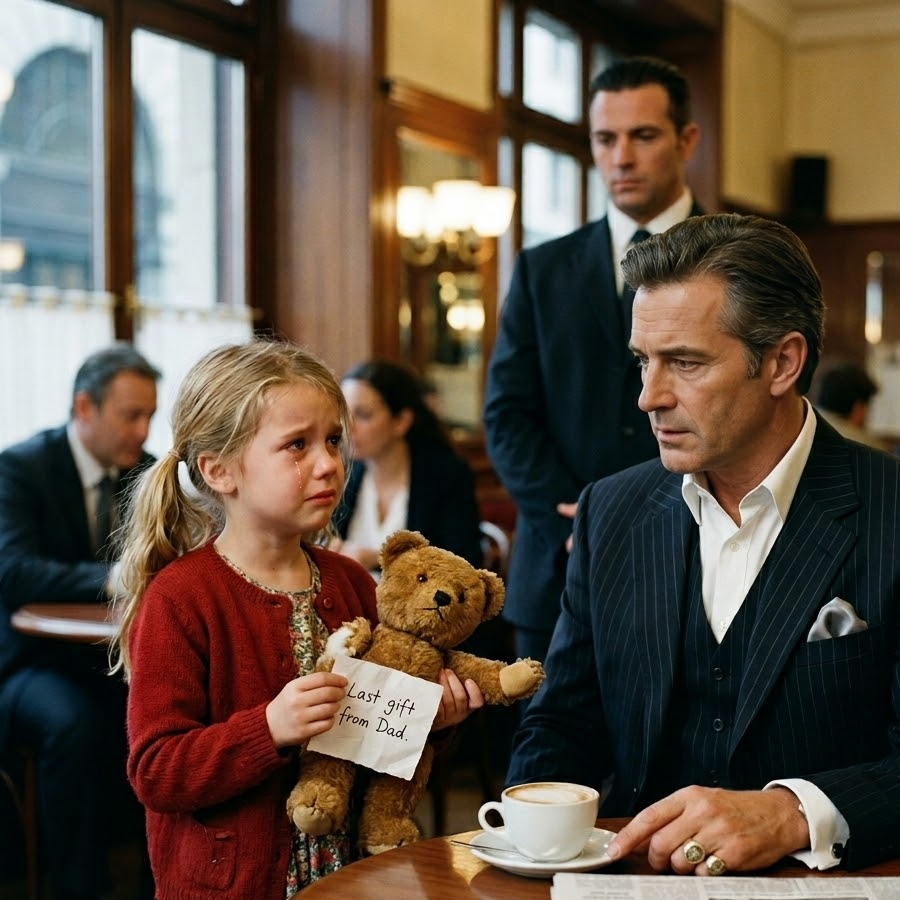
Mister, can you fix my toy? It was our last gift from Dad. The small voice cut through the cafe’s quiet atmosphere like a bell, clear and impossibly hopeful. Brooks Valley looked up from investment reports he’d been pretending to read, his dark eyes finding the source, a little girl with golden curls and a face radiating innocent trust.
She held a battered teddy bear with one ear hanging by threads, brown fabric worn pale from years of constant embrace. The cafe had become his Saturday ritual over the past 6 months, a pocket of anonymity where nobody recognized the name Valley or understood what it meant in certain circles of power.
Rain streaked down tall windows overlooking the quiet neighborhood street, creating shifting patterns of light across wooden tables and brick walls. Jazz played softly through hidden speakers, mixing with the hiss of the espresso machine and low murmur of scattered conversations. Brooks came here specifically because it was the opposite of everything his life usually demanded, glass towers, calculated meanings, decisions that moved money and influenced outcomes.
The child stood beside his corner table with complete confidence, as though approaching strangers in expensive suits was perfectly natural behavior that always yielded positive results. Her yellow coat was bright against the cafe’s muted earth tones, small fingers gripping the damaged bear with fierce protectiveness of someone guarding treasure beyond price.
Behind her, a woman in a gray coat rushed over with mortification written across her young face, already forming apologies before she’d covered half the distance. Brooks found himself staring at the toy with an intensity that surprised him, noticing details his business-trained mind automatically cataloged and assessed. The bear was old, but clean, clearly cherished rather than forgotten in some toy box, with stitching showing multiple previous repairs done with careful if amateur hands.
One glass eye had been replaced with a mismatched button, and the paw pads were nearly threadbare, evidence of a childhood companion that had traveled everywhere. Zuzu, no. The woman reached them breathless, her hand gentle but firm on the child’s shoulder as she tried to pull her back from Brooks’ table. Her blond hair was scraped into a practical ponytail, and exhaustion lined her eyes despite her youth, the kind of tiredness that came from working too many hours.
I’m so sorry, sir. She just ran over before I could stop her. We’ll leave you alone. Her voice carried genuine distress at the intrusion, not the calculated deference Brooks usually heard. The little girl, Zuzu, didn’t budge despite her mother’s attempts at extraction, her enormous eyes fixed on Brooks with the unshakable certainty of someone who’d already decided he was the solution.
She held up the bear higher, making sure he could see the dangling ear clearly, as though the severity of the injury might not be apparent. Please? Mommy tried to fix it, but the thread keeps breaking. You look like you know how to fix important things. Her logic was somehow both childish and disarmingly astute.
Brooks should have politely declined, should have returned to his reports, and let them disappear back into their Saturday afternoon without further interaction or complication. Everything about his life required maintaining distance from situations exactly like this, random encounters that could become loose threads someone might pull to unravel carefully maintained boundaries.
His uncle’s voice echoed in his head with warnings about exposure, about maintaining the separation between legitimate business operations and the family legacy he’d inherited. Yet his hand was already reaching for the briefcase beside his chair. I might be able to help. The words came out before he’d consciously decided to speak them, his voice quieter than the commanding tone he used in boardrooms and private meetings.
He pulled the leather briefcase onto the table, the expensive Italian craftsmanship obvious in every detail, and opened it to reveal the usual contents, documents, tablet, pens, but tucked into a side pocket with something that had no business being there, a small sewing kit he’d carried since childhood. His grandmother had insisted he learn basic repairs, claiming men who couldn’t care for their own belongings would never properly care for anything else.
The mother, he didn’t know her name yet, froze with her hand still on Zuzu’s shoulder, surprise replacing embarrassment as she watched him extract the compact kit. Her eyes tracked the movement with the careful attention of someone accustomed to evaluating whether situations were safe or threatening, whether generosity had strings attached.
You don’t have to do that. Really, we’ve already interrupted your afternoon enough. Her protest was automatic, but lacked conviction, undermined by the way her daughter’s face had lit up with hope. Brooks set the sewing kit on the table and held out his hand toward Zuzu, palm up, an invitation rather than demand for the bear.
The child looked to her mother for permission, a good sign that despite her boldness, she understood boundaries and respected authority. When the woman gave a small nod, Zuzu carefully placed the damaged toy into Brooks’ waiting hand, treating the transfer with the solemnity of a sacred trust. The bear was lighter than expected, stuffing compressed from years of hugging, and it carried the faint scent of lavender laundry detergent mixed with something indefinably sweet that probably came from the child.
Brooks examined the hanging ear closely, noting how the original stitching had given way completely, leaving only a few stubborn threads holding it in place. The fabric around the attachment point was worn thin, which explained why previous repair attempts had failed. The mother had been trying to reattach it to material that couldn’t hold stitches anymore.
The fabric’s too weak here. Brooks spoke directly to Zuzu, treating her as a client deserving explanation rather than a child to be patronized or dismissed. He pointed to the worn spot with his finger, letting her see the problem clearly. If I just sew it back on, it’ll fall off again in a week. I need to reinforce it first with a patch underneath.
His tone was serious, professional, the same one he used when explaining complex financial restructuring to business partners. Zuzu nodded with grave understanding, as though he’d just explained quantum physics rather than basic sewing technique. Her small face solemn with the weight of important decisions. Will it hurt Mister Bear? The question was asked with complete sincerity, no irony or playfulness, genuine concern for the toy’s well-being evident in her expression.
Behind her, the mother made a small sound that might have been a suppressed laugh, or possibly something closer to tears. Brooks found the corner of his mouth twitching, an unfamiliar sensation that took him a moment to identify as the beginning of a smile, something that rarely appeared outside calculated business performances.
No, Mister Bear won’t feel a thing. I promise. He selected brown thread that matched the bear’s worn fabric, threading the needle with steady hands that negotiated million-dollar deals. The cafe sounds faded into background noise as he focused on the small repair. His usual razor-sharp attention to detail now directed at something that carried zero financial value.
The mother slowly lowered herself into the chair across from Brooks, her movement hesitant, as though she might bolt at any second if the situation turned uncomfortable or demanded something she wasn’t willing to give. She kept Zuzu close beside her, one arm loosely around the child’s waist, protective without being smothering. I’m Morgan.
The introduction was quiet, offered like a test to see how he’d respond to basic human connection beyond the transactional repair currently happening. Brooks. He didn’t offer his last name, didn’t want to trigger potential recognition that might change how she looked at him or interpreted this moment. His fingers worked methodically, cutting a small reinforcement patch from felt in his kit, positioning it behind the weak fabric where the ear needed to reattach.
The work was meditative, requiring presence and precision that left no room for the usual calculations and strategic thinking that dominated his waking hours. Rain continued its steady percussion against the windows, creating a cocoon of sound that made the corner table feel separate from the rest Zuzu watched his every movement with the intensity of a scientist observing a crucial experiment, her breathing barely audible as she tracked the needle’s path through fabric and stuffing.
She didn’t fidget or lose interest, didn’t demand entertainment or constant reassurance, just maintained her vigil with patience unusual for someone her age. When Brooks glanced up briefly, he found Morgan watching him rather than the repair, her expression unreadable but no longer defensive or suspicious.
Daddy gave me Mister Bear before he went to heaven. Zuzu’s voice was matter-of-fact, delivering information without seeking pity or dramatic reaction, simply explaining relevant history. Mommy says he picked it special because the brown matches my eyes when the sun hits them right. He said Mister Bear would keep me safe when he couldn’t be there anymore.
The words carried weight beyond their simple construction, a child’s understanding of permanence and loss that was both heartbreaking and remarkably healthy. Brooks’ hands stilled for just a fraction of a second before resuming their steady rhythm, the only outward sign that Zuzu’s words had landed with more impact than casual conversation deserved.
He’d handled negotiations with dangerous people, had sat across tables from individuals who could end lives with a phone call, yet this small child’s simple honesty about loss cut through defenses he hadn’t known were engaged. The needle pushed through the reinforced fabric, creating small, even stitches that would hold against years of future adventures and nighttime comfort.
Morgan’s posture had shifted at her daughter’s declaration, shoulders tensing as though preparing for the inevitable awkwardness that usually followed mentions of dead husbands and absent fathers. Her hand moved to stroke Zuzu’s curls, an unconscious gesture of comfort and connection that spoke of practice at navigating these moments.
Zuzu, Mister Brooks doesn’t need to hear about She started the deflection automatically, the social script designed to spare strangers from uncomfortable truths about tragedy and single parenthood. It’s all right. Brooks interrupted gently, surprising himself with the intervention as much as he seemed to surprise Morgan, whose eyes widened slightly at his easy acceptance.
He positioned the ear carefully against the reinforced patch, checking the angle to ensure it sat naturally rather than askew or twisted. Mr. Bear has an important job then. That’s why we need to fix him properly. He directed the comment to Zuzu, acknowledging her father’s gift without diminishing its significance with empty platitudes about time healing wounds or loved ones watching from above.
The child’s face brightened with relief as though she’d been holding her breath, waiting to see if he’d treat her truth as something shameful or burdensome that should be hidden. She leaned closer to watch his progress, her small hands resting on the table edge, yellow coat sleeves riding up to reveal a cheerful pink dress underneath.
How do you know how to sew? Mommy says most boys don’t learn that stuff. The question carried no judgement, just curiosity about information that didn’t fit her understanding of how the world worked. Brooks threaded the needle through the ear’s base, beginning the actual attachment process with careful precision that would distribute stress across multiple anchor points rather than relying on a few vulnerable stitches.
My grandmother taught me when I was about your age. She said being able to fix things yourself meant you never had to depend on others to solve your problems. The memory surfaced unexpectedly clear. Afternoon light in a room that smelled of vanilla and old books. Patient hands guiding his smaller ones through basic stitches. His grandmother had been the only person in the family who treated him like a child rather than a future asset to be developed and deployed.
Morgan made a small sound of acknowledgement, her expression softening slightly as she processed this glimpse into his history, probably trying to reconcile the image of a small boy learning to sew with the man in the custom suit and Italian leather shoes. The cafe around them continued its Saturday rhythm. Other patrons lost in their own conversations and laptops, baristas calling out orders in friendly voices.
Someone laughed at a nearby table. The sound bright and uncomplicated. The kind of genuine amusement Brooks rarely encountered in spaces where everyone was performing calculated versions of themselves. That’s smart. Zuzu pronounced judgement on his grandmother’s philosophy with the absolute certainty of a four-year-old who just heard wisdom worth remembering and repeating.
She shifted her weight from foot to foot, a small release of energy that suggested her patience, while impressive, wasn’t infinite. Can you teach me? Then I could fix Mr. Bear next time instead of bothering people in cafes. The matter-of-fact acknowledgement of her own behavior made Morgan close her eyes briefly, embarrassment coloring her cheeks pink.
Brooks completed another stitch, the ear now securely attached at two points with several more to go before the repair would be complete and reliable. You’re not bothering me. And yes, if your mom says it’s okay, I could show you some basic stitches. The offer came naturally without the internal calculation that usually preceded his commitments of time or resources.
He glanced up at Morgan, meeting her eyes directly for the first time since she’d sat down, giving her clear opportunity to decline on her daughter’s behalf without making the child feel rejected. Morgan’s expression cycled through several emotions too quickly to name individually. Surprise, suspicion, cautious interest, protective evaluation, and finally something that might have been tentative hope.
Her fingers drummed once against the table, a nervous gesture immediately suppressed before she spoke carefully. That’s very kind. But we’ve already taken up enough of your time. I’m sure you have better things to do on a Saturday than give sewing lessons to a four-year-old. The refusal was polite, automatic, the kind of decline that left room for insistence if the offer was genuine rather than empty courtesy. I don’t, actually.
Brooks finished the third anchor point and rotated the bear slightly to access the best angle for the remaining stitches. His movements practiced despite how long it had been since he’d last done this kind of careful handwork. Saturday afternoons are specifically set aside for nothing important. That’s the entire point.
He kept his tone casual, not pushing, simply correcting her assumption without making her wrong for having made it. Zuzu’s eyes darted between the two adults, reading the subtext with the uncanny perception children often demonstrated when their own interests were at stake in adult negotiations. She remained quiet though, instinctively understanding that this was her mother’s decision to make, that pushing would probably result in the answer Morgan was already leaning toward.
The child’s restraint was remarkable, evidence of parenting that taught patience and respect for boundaries even when wanting something badly. The rain outside intensified, drops hitting the window with increased force that created percussion rhythms against the glass, and someone entering the cafe brought in the scent of wet pavement and ozone.
Brooks tied off the final stitch and examined his work critically, turning the bear in the light to check the ear from multiple angles. The repair was solid, maybe even better than the original construction, reinforced way that would withstand years of love and attention. He pulled a small pair of scissors from the kit and trimmed the excess thread, then handed the bear back to Zuzu with both hands, a formal return of something valuable temporarily entrusted. Zuzu accepted Mr.
Bear with reverence, immediately hugging him close and examining the repaired ear with careful attention. Small fingers testing the attachment gently to confirm it was truly fixed. Her face transformed with joy, pure and uncomplicated happiness that most adults had forgotten how to access or express. It’s perfect.
Look, Mommy, the ear stays on even when I wiggle it. She demonstrated enthusiastically, making Morgan wince slightly at the stress test being applied to fresh stitching. Gentle, baby. Let’s not break it again 5 minutes after Mr. Brooks fixed it. Morgan’s voice carried amused exasperation, the tone of a parent who’d given similar warnings countless times with varying degrees of success.
She looked at Brooks with genuine gratitude warming her tired eyes, the kind of thanks that went beyond simple politeness. Really, thank you. You have no idea what this means to her. The unspoken addition hung in the air, what it meant to Morgan herself to see her daughter happy, to have someone show kindness without apparent motive.
Brooks gathered his sewing kit and returned it to the briefcase. The familiar action of organizing his space giving his hand something to do while he processed the unexpected satisfaction warming his chest. It was my pleasure, honestly. He meant it in a way that surprised him, realizing he’d enjoyed the last 20 minutes more than entire weeks of his usual routine.
The simple act of fixing something broken, of solving a problem with immediate visible results and genuine appreciation, created stark contrast his normal work where success was measured in percentage points and abstract market movements. Zuzu clutched Mr. Bear and looked at Brooks with solemn intensity, her small face serious as she prepared to deliver something important.
You’re nice, not scary like Mommy’s boss at her night job who yells all the time. The observation was delivered with complete innocence, unaware of what she’d just revealed about their circumstances, that Morgan worked multiple jobs, that at least one involved a hostile environment. Morgan’s face flushed darker, her hand moving to Zuzu’s shoulder with gentle pressure that communicated later discussions about appropriate sharing.
Brooks kept his expression neutral despite new information clicking into place. The exhaustion in Morgan’s eyes, the careful way she devaluated his offer of help, the quality of their clothes which were clean and well maintained but clearly budget-conscious choices. Well, I’m glad I could help fix Mr. Bear. Maybe I’ll see you both here again sometime.
He phrased it as casual possibility rather than plan or expectation, leaving them free to avoid the cafe if they preferred not to risk another encounter. Morgan stood, gathering the small purse she’d set on the table, and helping Zuzu into a proper standing position rather than the half-lean the child had adopted while watching the repair. Maybe.
We come here sometimes on Saturdays when I have a break between jobs. Zuzu likes their hot chocolate. The information was offered tentatively, testing whether he actually meant the casual suggestion or was just being polite. Her hand found her daughter’s, fingers interlacing with the practiced ease of constant physical connection.
They do make excellent hot chocolate. Brooks agreed easily, not pushing for commitment or clarification, simply acknowledging the information as though it were weather commentary rather than potential future plans. He watched them prepare to leave, noting how Morgan automatically adjusted Zuzu’s coat and checked that Mr.
Bear was secure in the child’s grip. The mothering gestures were unconscious, born from repetition and genuine care rather than performance for an audience. The following Saturday arrived with the same gray drizzle that seemed to be the season’s default setting, turning the city into soft focus watercolor of muted tones and reflected light.
Brooks sat at his usual corner table 20 minutes before his normal arrival time, a fact he refused to examine too closely or assign meaning beyond simple schedule adjustment. His espresso sat untouched again, cooling while he pretended to review quarterly reports that his actual attention kept sliding past without retaining information.
The cafe door opened at 2:15, admitting wind and moisture along with a small figure in a now familiar yellow coat whose face immediately began scanning the space with clear purpose. Zuzu spotted him within seconds, her expression lighting up with recognition and something that looked remarkably like relief as though she’d been uncertain he’d actually be there.
Morgan followed her daughter inside, shaking rain from her coat, her movements showing the heavy tiredness of someone already hours into a long day. Brooks raised his hand in a small wave, acknowledging their presence without presumption, letting them make the choice about whether to approach or simply collect their hot chocolate and find a different table.
Zuzu made the decision for both of them, tugging her mother’s hand and heading directly toward his corner with determination that suggested she’d been thinking about this all week. Mr. Bear was visible in her other hand, the repaired ear standing proud and intact. “You came back.” Zuzu announced this with satisfaction, as though his presence confirmed something she’d argued and been vindicated.
She stopped beside his table without invitation, though with slightly more restraint than the previous week, glancing at her mother for the permission she’d skipped last time. “Can we sit?” “Mommy’s really tired and all the other chairs have people.” The explanation was practical rather than presumptuous, offering justification that had the benefit of being obviously true.
Morgan looked like she wanted to refuse, to protect whatever boundaries she’d drawn around accepting help or kindness from strangers regardless of how benign they appeared, but exhaustion won, and she managed a tired smile. “If you’re sure we’re not intruding on your work?” The question gave him clear exit if he wanted to take it, a chance to politely reclaim his solitude without causing offense. “Please sit.
” Brooks gestured to the empty chairs, closing his tablet to make clear they had his attention rather than competing with whatever business he was pretending to conduct. Morgan lowered herself into the chair across from him with poorly concealed relief, her body language broadcasting the kind of tiredness that came from too many hours on her feet.
Zuzu climbed into the seat beside her mother, immediately placing Mr. Bear on the table where the toy could presumably participate in whatever conversation followed. An awkward silence stretched for perhaps 10 seconds before Zuzu filled it with the conversational fearlessness that seemed to be her default setting around him.
“Mommy says I should thank you properly for fixing Mr. Bear, not just run away like last time.” She delivered this with the careful pronunciation of someone repeating coached phrases, her enormous eyes serious. “So, thank you very much for taking time out of your busy day to help someone you didn’t even know.
” The formal language sounded rehearsed but sincere. “You’re very welcome, Zuzu.” “How’s Mr. Bear holding up?” Brooks addressed the child but included the toy in his glance, maintaining the fiction that the bear’s well-being was worth serious inquiry and attention. His grandmother would have approved, he realized.
She’d always insisted that dismissing children’s concerns taught them their feelings didn’t matter, created adults who couldn’t identify or express emotion appropriately. Zuzu picked up Mr. Bear and demonstrated the ear’s continued attachment with gentle manipulation, showing that it survived her constant companionship without damage. “Perfect.
” “I told everyone at daycare about the sewing man at the cafe who fixed him. Miss Rachel says you must be very patient.” She delivered this intelligence as though his reputation among daycare staff was information of obvious interest. “Can you really teach me to sew like you promised? Mommy says I have to ask politely, and you can say no if you want.
” Morgan’s expression held resignation mixed with apology, clearly aware her daughter was about to test boundaries, but unable to head it off without making things worse. “Zuzu, we talked about this. Mr. Brooks was being nice last week. That doesn’t mean She tried to create space for him to decline without disappointing her daughter too sharply. “I meant it.
” Brooks interrupted the deflection for the second time, beginning to see a pattern in how Morgan protected herself and Zuzu from disappointment by preemptively lowering expectations. “If you want to learn some basic stitches, I can show you. It’s not complicated.” He addressed Zuzu directly, then shifted his attention to Morgan.
“If that’s all right with you, of course. I have the sewing kit here.” He gestured toward his briefcase, demonstrating preparedness that suggested he’d anticipated this conversation. Morgan studied him with the careful evaluation of someone accustomed to identifying ulterior motives and hidden costs, trying to understand what he gained from offering time and attention to her daughter.
Whatever she saw in his expression must have passed some internal test because she gave a slow nod. “That’s very generous. Say thank you, Zuzu.” Her voice carried cautious permission layered with protective attention to how this interaction unfolded. Brooks retrieved the sewing kit and selected two needles, thread, and scraps of fabric he’d brought specifically for this possibility, not examining too closely why he’d prepared teaching materials for a child he’d met once.
He threaded one needle and handed it to Zuzu along with two fabric pieces. “First rule, always respect the needle. It’s sharp, it can hurt, so we move slowly and pay attention.” His tone was serious, treating the lesson as legitimate skill transfer rather than entertainment to humor a small child. Zuzu accepted the needle with appropriate reverence, her small face concentrating intensely as she held the fabric pieces together the way Brooks demonstrated.
Her tongue poked out slightly at the corner of her mouth, a physical manifestation of focus that made her look even younger. “Like this?” She positioned the needle at the fabric edge, glancing up for confirmation before pushing it through. “Exactly like that. Now, bring it up through both pieces about this far away.” Brooks indicated the distance with his fingers, watching as she worked the needle through with careful deliberation.
Her motor control was good for her age, movements precise if slow, evidence of a child who practiced patience and attention to detail. Morgan watched her daughter with an expression that mixed pride, love, and something more complex, perhaps recognition that Zuzu was growing up, learning skills that marked progression toward independence.
The next 20 minutes passed in quiet concentration, broken only by Brooks’s occasional instruction and Zuzu’s questions about technique and why thread had to go in particular directions. Other cafe patrons glanced over occasionally, faces showing mild curiosity at the unusual tableau, well-dressed businessman giving sewing lessons to a small child while her tired mother watched, but the Saturday crowd generally minded their own business, respecting the unspoken cafe culture of mutual privacy. “I did it.” Zuzu held up
her fabric pieces now connected by a line of stitches that were uneven and loose but fundamentally sound, demonstrating grasp of the basic concept if not yet mastery of execution. Her face radiated accomplishment, the pride of someone who’d achieved something difficult through sustained effort. “Look, Mommy, I sewed.
” She waved the fabric toward Morgan, who accepted it with genuine admiration, examining the stitches as though they were museum-quality craftsmanship. “That’s wonderful, baby. You worked really hard on that.” Morgan’s voice was warm, free of the exhaustion that had weighted it earlier, temporarily lifted by her daughter’s joy.
She looked at Brooks with gratitude that went beyond thanks for a simple lesson. “You’re very good with her. Do you have children?” The question was casual but carried layers, trying to understand him, to place him in context that made sense of his behavior toward them. “No. No children.” Brooks’s response was simple, offering no elaboration about whether that absence was by choice or circumstance, whether he wanted them or preferred his life without such complications.
He collected the sewing materials and returned them to his kit with practiced efficiency. “But my grandmother believed everyone should learn to create and repair things regardless of gender or social position, said it kept you humble and connected to the physical world.” The explanation offered context for his skill and willingness to teach without making himself too vulnerable through personal revelation.
Morgan absorbed this information with the careful attention of someone collecting puzzle pieces, trying to assemble understanding of a person who didn’t fit expected patterns or familiar categories. “Your grandmother sounds like she was wise. Is she?” The question trailed off, leaving space for him to fill in whether his grandmother was still living or part of his past. “She passed away 5 years ago.
” Brooks kept his tone neutral, stating fact without demanding sympathy or closing the door on further conversation. “Cancer. She was the best person I’ve ever known.” The addition came unexpectedly, more personal than he’d intended, but somehow this tired woman and her bright daughter created space where normal guards felt less necessary or appropriate.
Zuzu looked up from admiring her stitching, her face solemn with the recognition that they’d touched on loss again, common ground between her experience and Brooks’s. “Do you miss her lots?” The question carried the weight of someone who understood missing people who were gone, who knew that ache of permanent absence.
“I miss Daddy lots still, even though Mommy says it’s okay if I forget what he looked like.” Her small voice carried confusion about that particular permission. Brooks felt something in his chest tighten at the child’s honesty, her willingness to exist in vulnerability without shame or self-protection.
“I miss her every day, and I don’t think we ever really forget people we love, even if we can’t remember all the details. The important parts stay with us.” He spoke directly to Zuzu, but saw Morgan’s eyes glisten slightly, her hand moving to cover her mouth briefly before she recovered composure. The moment stretched, held by the weight of shared understanding about grief and continuity, about how people shaped us even after they were gone.
Rain continued its steady rhythm against the windows, the cafe warm and dry around them, creating cocoon against the gray day outside. The espresso machine hissed, someone laughed, jazz played, and Brooks realized he’d been sitting here for nearly an hour without checking his phone or thinking about the deals waiting for his attention on Monday morning.
The third Saturday arrived with unexpected sunshine breaking through the perpetual gray, transforming the cafe’s atmosphere into something brighter and more optimistic than the previous rain-soaked encounters. Brooks had stopped pretending he came here for the coffee or the quiet, accepting that he specifically chose this table and this time because a 4-year-old with golden curls had decided he was worth befriending.
His briefcase sat beside him mostly ignored, containing work he’d already completed during the week rather than actual tasks requiring Saturday attention. Zuzu burst through the door at 2:10 with energy that suggested she’d been counting hours until this moment. Mr. Bear tucked under one arm and something clutched in her other hand.
Morgan followed at a more measured pace, though Brooks noticed she looked slightly less exhausted today. Hair down instead of pulled back. Wearing a blue sweater that softened her features. The change was subtle but significant, suggesting perhaps she’d managed actual rest or at least one less shift than usual. Brooks, look what I made.
Zuzu arrived at his table without preamble, thrusting a piece of paper toward him with the pride of an artist unveiling a masterpiece. The drawing showed three stick figures at a table, rendered in enthusiastic crayon with wildly disproportionate heads and limbs. One figure wore what appeared to be a black suit, another had yellow scribbles indicating long hair, and the smallest figure held a brown blob that was presumably Mr. Bear.
Brooks accepted the drawing with appropriate gravity, studying it as though evaluating a business proposal rather than a child’s artwork, noting the details she’d included. Cups on the table, a window showing rain, even his briefcase rendered as a brown rectangle. This is excellent work, Zuzu. You captured the cafe perfectly.
He looked up at Morgan, who’d reached the table. May I keep this? The question was directed to both of them, seeking permission to claim something the child had created. Morgan’s expression flickered with surprise, clearly not expecting him to want a crayon drawing from someone he’d known for 3 weeks. Trying to assess whether he was being genuinely appreciative or simply polite.
If Zuzu wants to give it to you, of course. Baby, are you sure? You worked really hard on that. She gave her daughter the opportunity to reconsider, to keep her creation rather than surrender it to relative stranger. I made it for Brooks. Zuzu stated this as obvious fact, her tone suggesting confusion about why anyone would question the drawing’s intended recipient. He fixed Mr.
Bear and taught me sewing. That’s what you do when people are nice. You make them something. Her logic was straightforward, operating from a worldview where kindness was currency that should be reciprocated with tangible appreciation. Plus, I can make more pictures. I only have one Brooks. The casual possessiveness in that final statement, I only have one Brooks, landed with unexpected weight, carrying implications about how this child had categorized him in her mental landscape of important people.
Brooks carefully placed the drawing in his briefcase, sliding it into a protective folder usually reserved for contracts and legal documents. Thank you, Zuzu. I’ll put this somewhere safe. He meant it in ways that probably weren’t entirely appropriate given their brief acquaintance. Morgan settled into her usual chair with visible relief, and Brooks noticed she carried only her purse today, rather than the overstuffed bag that had accompanied her previous visits.
No work today? He asked the question casually, not wanting to pry but curious about the change in pattern that allowed her to arrive looking less like she might collapse from exhaustion at any moment. My afternoon job gave me the day off. Their daughter’s visiting and wanted to help with cleaning. Morgan’s voice carried complicated emotions, gratitude for the break but also concern about lost income, the constant calculation of someone living close to financial margins.
So, Zuzu and I are having an actual Saturday together for once. We went to the park this morning, fed the ducks. Her smile was genuine, the first truly unguarded expression he’d seen on her face. Zuzu climbed into her chair and immediately launched into detailed narration of the park visit, complete with hand gestures and sound effects, describing ducks fighting over bread and a dog that had tried to join their picnic.
Her storytelling had the breathless enthusiasm of someone for whom every experience was new and worthy of complete attention. Brooks found himself actually listening rather than pretending, genuinely interested in this small person’s perspective on the world. And then this really old lady said I had beautiful manners and gave me a quarter.
Zuzu produced the coin from her pocket as evidence, holding it up to catch the light. I’m saving it for something special, but I don’t know what yet. Mommy says I should think carefully about important purchases. She delivered this wisdom with the seriousness of someone discussing investment strategy rather than 25 cents.
Brooks caught Morgan’s eye over Zuzu’s head, seeing affection and slight embarrassment there. Pride in teaching her daughter financial responsibility mixed with awareness of how their circumstances must appear to someone who probably spent more than a quarter on his morning coffee. That’s very wise. My grandmother always said money saved is opportunity preserved.
He offered the comment to validate Zuzu’s approach without drawing attention to the vast difference in their financial realities. The conversation flowed more easily than previous weeks, as though they’d established enough familiarity that silence didn’t feel awkward and topics didn’t require careful navigation around potential discomfort.
Morgan asked about his work in careful general terms, and he explained the legitimate investment business without mentioning the family legacy that came with it. She talked about Zuzu’s daycare and the small apartment they’d moved to after her husband died, sharing details that painted picture of life built from careful choices and constant adaptation.
Daddy worked construction. Zuzu contributed this information unprompted. Her small face suddenly serious in the way children’s expressions shifted when discussing absent parents. He was building a big building downtown and something fell. Mommy says it was an accident and nobody was being bad or careless.
The explanation had the quality of something repeated often enough to be memorized, probably Morgan’s attempt to ensure her daughter didn’t develop anger toward faceless responsible parties. Brooks felt his chest tighten at this glimpse into the specific tragedy that had reshaped their lives, the random mechanical failure or structural flaw that had left a woman widowed and a baby fatherless.
I’m sorry that happened to your family. Your daddy sounds like he was a hard-working man. He kept his condolences simple, not attempting to fill the moment with platitudes about time or healing or silver linings. Morgan’s hand moved to cover Zuzu’s smaller one on the table, fingers interlacing in gesture that was both comfort and connection, grounding them both in present moment rather than painful past.
He was. He would have loved seeing her grow up. Her voice held steady despite the grief that flickered across her face, the constant companion of widows who’d lost partners too young. But we’re doing okay. It’s been 3 years and we’ve figured out our rhythm. The assertion of okayness was both true and not true, Brooks recognized.
They were surviving, clearly, building life from what remained, but the exhaustion in Morgan’s eyes and the carefully maintained clothes and the fact that a day off from one job felt like luxury all contradicted the completeness of okay. He didn’t challenge the statement, though, understanding that people needed to claim victories even when the war continued.
Zuzu’s attention had already shifted to the next topic, her ability to move between heavy and light subjects demonstrating either resilience or a 4-year-old’s natural protection against dwelling too long in sadness. Brooks, do you know how to make paper airplanes? Tommy at daycare makes them but won’t teach me because he says girls can’t throw right.
Her indignation at this injustice was evident in her scrunched face and crossed arms. Tommy is incorrect. Brooks stated this with the firm authority of someone delivering a legal verdict, his tone making clear this was established fact rather than opinion open to debate. And yes, I know how to make paper airplanes.
Would you like to learn? He was already reaching for a napkin from the dispenser, recognizing an opportunity to impart another skill while simultaneously proving Tommy’s theory wrong. Morgan watched this exchange with an expression that had evolved over their three meetings from suspicious to cautious to something approaching trust, though questions still lingered in her eyes about what motivated this well-dressed stranger to spend Saturday afternoons teaching her daughter random skills.
You really don’t have to. She began the automatic protest, the deflection that had become her default response to offers of help or attention. I know I don’t have to. Brooks interrupted gently, meeting her eyes with steady directness that communicated sincerity without demanding she accept it. I want to. Zuzu’s good company.
And honestly, I enjoy teaching her things. It’s refreshing to interact with someone who’s genuinely curious about learning rather than just looking for what they can extract from a situation. The honesty surprised him as much as it seemed to surprise Morgan, revealing more about his usual world than he typically shared.
The fourth Saturday brought Morgan and Zuzu through the cafe door at exactly 2:00. Their arrival time now consistent enough that Brooks had started thinking of it as an appointment rather than chance encounter. Zuzu carried a small backpack today, rainbow colored and decorated with cartoon characters, suggesting she’d come prepared for extended stay.
Brooks had claimed their usual corner table an hour earlier, abandoning any pretense that he had other Saturday plans competing for his attention. Brooks, I brought my stitching to show you. Zuzu announced her purpose before even reaching the table, already unzipping her backpack to extract the fabric pieces she’d been working with during their previous lesson.
The stitches had multiplied since last week, lines of thread creating geometric patterns that showed practice and increasing confidence. Several stitches were still loose or uneven, but the improvement was obvious to anyone who knew what to look for. Morgan carried two cups this time, setting one in front of Brooks without asking if he wanted it.
Hot chocolate with whipped cream, the cafe’s specialty that Zuzu had praised during one of their conversations. You keep buying us drinks, so turn about is fair play. Her tone was light, but carried undertone of someone who needed to maintain reciprocity, who couldn’t accept kindness without offering something in return, even if the exchange was materially unequal.
Brooks accepted the cup with genuine pleasure, recognizing the gesture’s significance beyond the simple beverage exchange, understanding that Morgan was establishing them as something closer to friends than stranger helping struggling mother. Thank you. That’s very thoughtful. He tasted the hot chocolate, finding it exactly as sweet and rich as Zuzu had promised.
Probably more sugar than he typically consumed in a week. Zuzu wasn’t exaggerating about the quality. The child beamed at this vindication of her recommendation, already spreading her stitching work across the table for inspection and feedback. “Miss Rachel at daycare says I’m getting really good, and maybe I can help repair the dress-up clothes when they get ripped.
She says I have steady hands.” The pride in her voice was evident, confidence blooming from recognition of developing skill and the possibility of contributing meaningfully to her community. Brooks examined her work with the attention he’d give to any portfolio crossing his desk, noting techniques she’d mastered and areas still needing refinement.
“Miss Rachel is right. Your tension is much better than last week. See how these stitches are all the same tightness?” He pointed to a section where her consistency had improved dramatically. That takes practice and patience. You should be proud. His praise was specific rather than generic, acknowledging actual achievement rather than offering empty encouragement.
Morgan watched this interaction with soft expression that suggested she was seeing something in Brooks that pleased or surprised her, though she didn’t voice whatever thought was forming behind her eyes. She sipped her own coffee, black, no sugar, the choice of someone who drank it for function rather than pleasure, and seemed to be gathering courage for something she wanted to say.
The hesitation was visible in how she opened her mouth twice before actually speaking. “I wanted to thank you properly for spending time with Zuzu these past few weeks.” Morgan’s words came carefully chosen, her fingers wrapped around the cup like it provided necessary warmth or comfort. “She talks about you constantly at home, about the things you teach her and how you listen when she talks.
Her father was like that, present, actually interested in what she had to say. She’s missed having that kind of attention from” And she trailed off, seeming to realize she’d ventured into territory more personal than she’d intended. From a man. Brooks finished the thought gently, not making her say what was obvious from context and the slight flush coloring her cheeks.
“I understand, and you don’t need to thank me, Morgan. I genuinely look forward to Saturdays now. Zuzu reminds me there are things worth caring about beyond quarterly earnings and market projections.” The admission revealed more about his dissatisfaction with his usual existence than he’d consciously acknowledged even to himself.
Zuzu had been only partially listening to the adult conversation, more focused on threading her needle for a new practice piece, but she looked up at her name with the sudden attention children deployed when sensing they were the subject of important discussion. “Are we friends now? Like real friends, not just cafe people?” She directed the question at Brooks with the straightforward need for clarity that characterized her approach to relationships and social categorization.
“Yes, Zuzu, we’re real friends.” Brooks confirmed this without hesitation, recognizing that the classification was already accurate regardless of the unconventional circumstances of their friendship. He glanced at Morgan, including her in the statement with a slight raise of his eyebrow, a silent question about whether she agreed with this designation, and was comfortable with the implications of ongoing connection beyond casual acquaintance.
Morgan held his gaze for a long moment, something shifting in her expression that suggested internal barriers being reconsidered or cautiously lowered. “Real friends,” she agreed quietly, the words carrying weight of decision rather than simple acknowledgement. “Which means you should probably know that I’m actively looking for a third job.
The rent on our apartment increased, and I’m coming up short about $300 a month.” The information was delivered matter-of-factly, without self-pity or request for help, simply sharing reality the way friends did when building actual relationships rather than performing pleasant surfaces. Brooks felt something twist in his chest at the image this painted, Morgan already working two jobs, already stretched thin, now searching for additional hours to sacrifice in exchange for barely enough money to maintain basic housing for her
daughter. “What kind of work are you looking for?” He asked the question carefully, trying to gauge whether she was mentioning this as veiled request for assistance or simply sharing a burden the way she’d said, as friends did. His business mind was already calculating possibilities, filtering through connections and opportunities that might provide legitimate employment rather than charity disguised as job offer.
Morgan seemed to read his calculation, her expression shifting to something firmer, more defensive, as though preparing to establish boundaries around what she would accept versus what crossed into territory that compromised her independence. “Anything, really. Evening or weekend hours preferably, since that’s when Zuzu’s with my neighbor who watches her during my night shifts.
Cleaning, retail, waitressing, I’m not particular. I just need enough to cover the gap without sacrificing time with Zuzu more than absolutely necessary.” Zuzu’s hands had stilled on her stitching, her small face scrunched with the concentration of someone trying to understand adult problems that existed just beyond her comprehension. “Is that why you’re always tired, Mommy? Because you work too much to pay for our house?” The question was asked with the innocent directness that characterized all her inquiries, seeking information rather than expressing complaint. “I
work because that’s what grown-ups do, baby, and I’m not too tired to spend time with you.” Morgan’s reassurance was automatic, the reflexive protection parents offered children from adult stresses and complications. She stroked Zuzu’s curls with gentle fingers, the gesture both comfort and distraction. “Everything’s going to be fine.
We always figure it out, don’t we?” The confidence in her voice was perhaps more performed than felt, but convincing enough for a four-year-old’s purposes. Brooks recognized the moment as delicate. Offering help could insult Morgan’s pride and self-sufficiency, but remaining silent while knowing he could easily solve a problem that was causing her family genuine stress felt wrong in ways that violated something fundamental about who he wanted to be.
“My investment company has been looking for someone to handle administrative organization, filing, appointment scheduling, basic correspondence. The position’s legitimate, standard market rate for administrative work.” He kept his tone neutral, presenting information rather than making offer, leaving her space to dismiss it if she chose.
Morgan’s eyes narrowed slightly, her expression shifting through suspicion, hope, and stubborn independence in rapid succession before settling on cautious interest mixed with resistance. “Brooks, I appreciate the thought, but I’m not going to be someone’s charity case. I know you mean well, but” She was already building the refusal, constructing walls that protected her dignity even at the cost of practical solutions to immediate problems.
“It’s not charity,” Brooks interrupted firmly, his voice carrying the authority he used in boardrooms when establishing non-negotiable terms, though gentler than his usual business negotiations. “I’m genuinely describing a position that needs filling. My current administrative assistant is overwhelmed handling both my schedule and the company’s operational paperwork.
We’ve been discussing hiring support for 3 months. You’d be doing me a favor by filling a legitimate need.” The assertion hung between them, and Brooks could see Morgan evaluating its truth, trying to determine if he was manufacturing a job to help her or actually describing real circumstances that happened to align with her needs.
Zuzu looked between the two adults, sensing the tension in their exchange, even if she couldn’t fully parse the underlying dynamics of pride and help and the complicated mathematics of obligation. “What would the hours be?” Morgan asked finally, the question itself a small surrender, an acknowledgement that she was at least considering the possibility even while maintaining wariness about its implications.
Her fingers drummed against her coffee cup, nervous energy seeking outlet while she processed this unexpected development in what should have been simple Saturday afternoon at the cafe. Brooks outlined the position’s parameters carefully, keeping his description factual and professional rather than sales pitch, presenting the opportunity as legitimate business proposition rather than rescue operation disguised as employment.
“Morning hours, Monday through Friday, office located in the business district accessible by public transportation, standard administrative rate that probably matched what she currently earned across both her existing jobs.” Morgan listened with the focused attention of someone evaluating contract terms, asking practical questions about responsibilities and expectations that demonstrated she took work seriously regardless of the source.
Zuzu had returned to her stitching during this discussion, seeming to understand on some instinctive level that the adults needed space to negotiate something important. Her small hands moved with increasing confidence through the familiar motions Brooks had taught her, creating lines of thread that would never hold actual seams together but served as practice ground for building muscle memory and precision.
Occasionally, she glanced up to gauge the emotional temperature of the conversation, her enormous eyes tracking between her mother and Brooks with the careful attention of someone fluent in adult tension. “I’d need to give 2 weeks’ notice to my current morning job.” Morgan stated this as though testing whether this condition would be deal breaker, her voice carrying the firmness of someone with professional standards regardless of desperate circumstances.
“I don’t just disappear on people who’ve employed me, and I’d want to come by the office first, see the actual work environment before committing.” Her requirements established boundaries, insisted on maintaining agency in the decision rather than simply accepting rescue because it was offered. “Of course, that’s completely reasonable.
” Brooks pulled a business card from his wallet and slid it across the table. The embossed cardstock reading Valley Investments with an address and phone number below. Come by Monday morning around 9:00 if that works for you. I’ll introduce you to Sarah, my current assistant, and she can walk you through what the position would actually involve. No obligation.
If it doesn’t feel like the right fit, we part as friends without any awkwardness. Morgan accepted the card with careful fingers, studying it as though the simple rectangle of paper contained messages requiring translation and interpretation. Brooks watched her eyes track across his name, wondering if Valley meant anything to her, if she’d heard stories or rumors about the family that had built empire on both legitimate business and less legal foundations.
Her expression remained neutral though, suggesting either ignorance of his background or decision not to hold family history against him personally. Valley. She tested the name aloud, her pronunciation slightly un- certain about where stress belonged in the two syllables. Italian? The question was casual, seeking basic information rather than probing for deeper meaning or suspicious connections.
She looked up from the card to meet his eyes. Her expression open enough that he could have revealed more about his heritage and the complicated legacy that came with it. My grandfather immigrated in the ’50s, started with a small import business that grew into what the company is now. Brooks offered the sanitized version, the official history that omitted the protection and gambling operations that had funded early expansion, the connections to organized power that still influence certain business dealings despite his attempts to legitimize everything. I
inherited the operation when my father passed 5 years ago. Trying to take it in slightly different direction than previous leadership preferred. The admission contained layers Zuzu couldn’t parse, but that Morgan seemed to catch. Her eyes sharpening with recognition that he’d just shared something significant.
Some conflict between inherited obligation and personal preference that paralleled her own struggle between survival necessity and desired life. Different how? She asked the question softly, genuine curiosity rather than polite small talk, actually wanting to understand the complication she’d glimpsed in his carefully neutral phrasing.
Brooks considered how much to reveal, how honest to be about his discomfort with the empire he’d inherited, and the expectations that came with the Valley name in certain circles. More focus on legitimate investment and business development, less attention to the enterprises my grandfather and father built their reputation on.
Some family members feel I’m abandoning tradition. I feel I’m trying to build something I can be proud of without compromising who I want to be. The confession surprised him as much as it seemed to surprise Morgan, revealing depths of internal conflict he rarely acknowledged even privately, certainly never shared with relative strangers in cafe conversations over cooling drinks.
Zuzu had looked up from her stitching at the seriousness in his tone. Her small face solemn as she absorbed the emotional weight of the exchange, even if the specific content remained beyond her understanding. That sounds hard. Zuzu offered this observation with the uncomplicated empathy children sometimes demonstrated, cutting through adult complexity to identify the essential emotional truth.
Like when Mommy says I have to eat vegetables even though I want cookies. You want cookies, but you’re eating vegetables. Her metaphor was imperfect, but captured something accurate about choosing difficult right over easy wrong, about discipline and delayed gratification, and building toward better futures.
Brooks found himself laughing, genuine amusement breaking through the heavy moment, charmed by this child’s ability to translate complex ethical struggles into terms that made immediate sense. Yes, Zuzu, exactly like that. I’m eating a lot of vegetables right now. He caught Morgan’s eye over her daughter’s head, seeing answering amusement there mixed with something warmer, appreciation perhaps for his willingness to exist in vulnerability rather than maintaining perfect professional surface.
Morgan’s expression softened further, some final barrier seeming to lower as she reached decision about trust and risk, and whether accepting help from this particular person compromised her independence or simply acknowledged that humans weren’t meant to navigate life completely alone. All right, I’ll come by Monday morning.
But Brooks, she paused, making sure she had his full attention before continuing. If this doesn’t work out, if I get there and the job isn’t what you’re describing, or if I can’t handle the work, we end the professional relationship but stay friends. I need that separation to exist or I can’t accept the offer. Agreed. Brooks extended his hand across the table, formalizing the understanding with physical gesture that transformed their arrangement from casual offer into actual agreement with terms and boundaries. Morgan’s hand was smaller
than his, roughened by the physical labor of her current jobs, but her grip was firm and confident. They shook once, sealing the deal, and something shifted in the space between them. A new chapter beginning that neither could fully predict or control. Zuzu clapped her small hands together, delighted by this development even if she didn’t completely understand its implications for her daily life and her mother’s schedule.
Does this mean I’ll get to see where Brooks works? Can I visit sometimes? The questions tumbled out with her characteristic enthusiasm, already imagining adventures in new locations with expanded access to her friend’s world. Mr. Bear sat on the table beside her stitching, silent witness to the evolving relationship that had started with a simple repair request. Maybe occasionally.
Morgan tempered her daughter’s expectations with gentle reality, not wanting to promise regular office visits that might prove impractical or inappropriate depending on the actual work environment. But mostly this means Mommy will have different work hours and will have more time together in the evenings. Would you like that? She redirected Zuzu’s attention toward the practical benefits rather than the exciting possibilities.
Zuzu’s face lit up with understanding and joy, recognizing immediately that different work hours meant more Mommy time, the currency she valued above all others. Really? Like we could have dinner together every night? And you could help with my bath and read stories before bed? The questions revealed what had been sacrificed to Morgan’s current schedule, the ordinary routines of childhood that became luxuries when parents worked multiple jobs to maintain basic housing.
Yes, baby, all of that. Morgan’s voice caught slightly, emotion tightening her throat as she confronted the reality of what her survival strategy had cost her daughter in everyday presence and routine connection. She pulled Zuzu close, pressing a kiss to the top of her head, holding her perhaps a moment longer than the gesture required.
Things are going to get a little easier now. We’re going to be okay. Brooks watched this moment of connection between mother and daughter, feeling simultaneously like intruder witnessing something private and participant in something meaningful. His decision to offer legitimate employment creating ripple effects he hadn’t fully considered.
The Saturday cafe crowd continued around them, oblivious to the small transformation happening at the corner table, unaware that what looked like casual conversation had just rearranged three people’s lives in ways none of them could have predicted 4 weeks earlier when a child asked a stranger to fix her broken toy.
Monday morning arrived with Morgan standing outside the glass tower that housed Valley Investments. Her reflection staring back from the building’s polished surface like a question she hadn’t fully answered. She’d worn her best clothes, navy slacks and white blouse purchased for her husband’s funeral 3 years ago, rarely worn since because most of her work involved getting dirty.
The professional outfit felt like costume, armor she was trying on to see if it fit the person she was attempting to become through accepting Brooks’s offer. The lobby was all marble and modern art, the kind of space designed to communicate wealth and power to anyone entering, making clear that important decisions happened within these walls.
Morgan approached the security desk with her shoulders squared, refusing to let intimidation show even as she felt completely out of place among the polished professionals moving through the space with confident familiarity. She gave Brooks’s name to the guard, who checked his list and directed her toward elevators that probably cost more than her annual rent.
The 20th floor reception area continued the theme of understated luxury, leather furniture, abstract paintings, fresh flowers in crystal vases that were replaced daily whether they’d wilted or not. Sarah, Brooks’s current assistant, greeted Morgan with genuine warmth that immediately eased some of the tension knotting her shoulders.
The woman was perhaps 40, competent and organized in ways that radiated from her efficient movements and the perfectly maintained desk that somehow contained no visible clutter despite obvious workload. Brooks has told me so much about you and Zuzu. Sarah’s smile was knowing, suggesting Brooks had shared more than just professional reasons for creating this position.
I’m honestly relieved you’re considering this. I’ve been drowning in paperwork for months, and he finally listened when I said we needed help. Her candidness established immediate credibility. This wasn’t manufactured job, but actual operational need that happened to align with Morgan’s circumstances. The tour of the office revealed legitimate business operations, conference rooms where investment strategies were debated, cubicles where analysts tracked market movements, Brooks’s corner office with view of the city that probably inspired either
ambition or vertigo depending on perspective. Sarah explained the administrative work with practical detail that made clear the position was real, describing filing systems and scheduling protocols and correspondence that needed managing with actual organizational skill rather than just warm body filling space.
Brooks appeared midway through the tour, emerging from a meeting with three men in expensive suits who radiated the kind of authority that came from controlling significant resources. He exchanged brief words with them at the conference room door, his body language shifting into something harder and more commanding than the gentle patience he demonstrated at the cafe.
Morgan glimpsed a different version of him in that moment, the businessman who’d inherited empire and wielded power in ways she probably couldn’t fully comprehend. Morgan. He approached with a smile that transformed his face back into the person she recognized. The tension in his shoulders easing as he left whatever discussion had occurred in the conference room behind.
Sarah’s been showing you around? His tone was professionally friendly, maintaining appropriate boundaries in the office environment, even as his eyes communicated warmth that suggested their Saturday cafe friendship existed independently of this potential working relationship. She has. The position sounds legitimate. Morgan kept her voice neutral, not quite ready to commit, but acknowledging that her suspicions about manufactured charity had been somewhat unfounded.
More work than I expected, actually. Sarah wasn’t exaggerating about being overwhelmed. The observation was both compliment to Sarah’s honesty and acknowledgement that this job would require actual competence rather than simply showing up and looking busy. Sarah laughed at this assessment, the sound genuine and slightly exhausted. I’ve been telling him for 3 months that I needed help.
He kept saying he’d handle it, then never actually did anything until She stopped abruptly, seeming to realize she was about to reveal that Morgan’s appearance had been the catalyst for finally addressing the staffing need. The unfinished sentence hung awkwardly in the air between the three of them. Brooks didn’t look embarrassed by this near revelation, simply nodded as though confirming what they all understood.
Yes, meeting Morgan and Zuzu had prompted him to action on something he’d been avoiding, but that didn’t make the need any less real. Sometimes the right person appearing makes you stop procrastinating unnecessary changes. His explanation was diplomatic, acknowledging the personal motivation without pretending it was purely coincidental business timing.
Morgan studied him for a long moment, trying to reconcile her need for independence with the reality that accepting help from friends wasn’t the same as accepting charity from strangers. That sometimes survival meant allowing people who cared to offer solutions to problems you couldn’t solve alone. When would you need me to start? The question was acceptance, tentative commitment wrapped in practical logistics that let her maintain the illusion of control over circumstances that had already essentially been decided the moment
she’d walked into the building. Two weeks, you said? After you give proper notice to your current employer. Brooks’ expression remained professionally neutral, but something in his eyes suggested he understood the significance of this moment, recognized that Morgan was choosing trust over pride in ways that probably cost her more than he could fully appreciate.
That works perfectly. Sarah can use the time to prepare training materials and organize the workspace. The administrative details were settled quickly. Start date, salary that was indeed standard market rate rather than inflated charity, benefits package that included health insurance Morgan hadn’t had since her husband’s death.
Sarah provided paperwork to complete, tax forms, and direct deposit information and emergency contacts that transformed the nebulous possibility into concrete reality. Morgan filled everything out with careful handwriting, her signatures making commitments that would reshape her daily existence and Zuzu’s routine in ways both practical and symbolic.
An hour later, Morgan stood on the sidewalk outside the glass tower with signed employment contract in her purse, feeling simultaneously relieved and terrified by what she’d just agreed to. Leaving the familiar struggle of multiple low-paying jobs for the unknown territory of single position that paid enough to cover expenses felt like stepping off a cliff and hoping the ground would appear before she landed.
Her phone buzzed with a text from her neighbor confirming Zuzu was fine, playing happily, unaware that her mother had just accepted help that might finally let them breathe. Brooks had walked her to the elevator, maintaining professional distance in the office environment, but allowing himself a moment of genuine smile when the elevator doors closed them into temporary privacy from observing staff.
You’re going to be great at this, Morgan. Sarah’s genuinely excited to have competent help and I’m He paused, seeming to search for appropriate words that balanced professional boundaries with personal feelings. I’m glad you’ll be here. It’ll be nice seeing you more than just Saturdays. The admission hung between them during the elevator’s descent, words that contained implications neither was quite ready to examine too closely or name explicitly.
Morgan had simply nodded, not trusting her voice to remain steady if she tried to respond to the warmth in his eyes or acknowledge the shift happening between them. The elevator reached the lobby, doors opening onto the marble expanse, and she’d stepped out into her future with nothing more than a small wave.
Goodbye. Now, standing on the sidewalk with city noise surrounding her and lunch hour crowds streaming past, Morgan pulled out her phone and called her morning job to give official 2 weeks notice. The manager was disappointed but understanding, had known Morgan was overextended and couldn’t sustain the pace indefinitely.
The conversation was brief and professional, severing one thread of her current life with the efficiency of someone who’d survived worse losses and knew how to keep moving forward. Her afternoon job was next, another call and another notice given. This one slightly easier because the family she cleaned for had mentioned potentially reducing hours due to their own budget constraints.
They wished her well, asked her to stay in touch, offered to provide references if needed. Morgan thanked them with genuine appreciation for the months of steady work that had kept her and Zuzu housed and fed, even while draining her completely. Two more weeks of the exhausting double schedule, then a new chapter that felt both like surrender and victory, accepting help while also claiming better circumstances through legitimate work rather than grinding herself into dust trying to do everything alone.
Morgan looked up at the glass tower where Brooks worked, where she would soon work, and allowed herself a moment of cautious hope that maybe, possibly, things were actually going to get easier like she’d promised Zuzu. Three months into her position at Valley Investments, Morgan had developed competence that impressed even herself, discovering abilities she hadn’t known she possessed when the work involved more than physical labor and following simple instructions.
The filing systems she’d implemented were more efficient than the previous chaos. The scheduling protocols she’d established prevented the double bookings that used to plague Brooks’ calendar. Sarah had started joking that Morgan was making her look bad, though the comment carried genuine appreciation rather than competitive resentment.
Saturday afternoons at the cafe had continued despite now seeing Brooks daily at the office. The ritual maintained as something separate and sacred, time that belonged to their friendship rather than their professional relationship. Zuzu had grown more confident over the months, her vocabulary expanding and her sewing skills developing to the point where she’d actually repaired a torn dress at daycare under teacher supervision.
The child’s attachment to Brooks had deepened into something that looked remarkably like the relationship between child and trusted adult family member. Brooks arrived at the cafe table today with tension visible in his shoulders, the kind of stress that came from conflicts money couldn’t solve and power couldn’t prevent.
He managed to smile when Zuzu launched into enthusiastic description of the butterfly she’d seen that morning, but Morgan noticed the tightness around his eyes, the way his fingers drummed against the table in unconscious rhythm that betrayed agitation beneath his calm surface. Everything okay? Morgan asked quietly while Zuzu was distracted examining Mr.
Bear’s ears to confirm they remained securely attached months after the original repair. She kept her tone neutral, not pushing but offering opening if he wanted to share whatever was creating visible strain in normally composed demeanor. Working together had taught her to read his moods, recognize when something was bothering him beneath professional facade.
Brooks glanced at Zuzu, seeming to calculate what could be discussed in present company versus what required more privacy or complete omission. Family disagreement. Nothing that concerns you or affects your position. The reassurance was automatic, immediate protection of her job security, but his expression suggested the disagreement was significant enough to warrant the tension she’d observed.
My uncle has opinions about certain business decisions I’ve made recently. The conversation at the office earlier that week had been particularly pointed, his uncle cornering him after a board meeting to express concerns that went beyond simple business disagreement into territory of family reputation and legacy preservation.
The older man had spoken in coded language about maintaining appropriate distance from employees, about how previous generations had understood the importance of clear hierarchies that prevented complications. Brooks had listened with jaw clenched, recognizing the subtext beneath every carefully chosen word, understanding that his uncle viewed Morgan and Zuzu not as people deserving respect, but as potential vulnerabilities that could be exploited by enemies or used to manipulate him into decisions that served others’ interests rather than his
own judgement. What his uncle hadn’t understood, couldn’t comprehend through his worldview built on transaction and leverage, was that Morgan and Zuzu had become the reason Brooks finally cared about building something worth protecting rather than simply managing inherited empire out of duty. Before them, he’d been going through motions of legitimizing family operations without real investment in the outcome, performing responsibility without passion because there’d been nothing personal at stake beyond abstract
principles about right and wrong. Now he had specific faces attached to his choices, a child who looked at him with trust and a woman who’d taken risk on believing in his character despite every reason to maintain protective distance. His uncle had concluded the conversation with thinly veiled warning about how attachments could be used against him, how people he cared about might find themselves facing pressure from competitors or old family enemies who saw weakness in affection.
The threat had been delivered with grandfather’s concern coding what was essentially intimidation. Attempt to make Brooks reconsider his priorities by introducing fear for Morgan and Zuzu’s safety. Instead of achieving intended effect, the warning had crystallized Brooks’s resolve. Made him recognize that backing away now would be exactly the wrong lesson to teach himself about courage and commitment.
Would confirm his uncle’s philosophy that caring about people made you controllable rather than stronger through connection. He’d increased security measures quietly after that conversation. Hired protection for Zuzu’s daycare and arranged for someone to casually monitor Morgan’s routes between home and office. Taking precautions without alarming them or making his concern visible enough to validate his uncle’s tactics.
The balance between keeping them safe and maintaining their normal lives required careful management. But Brooks had learned from watching his father that visible paranoia created more problems than it solved. That the best protection often looked like coincidence rather than deliberate strategy. His grandmother would have been proud of this approach he thought.
Protecting what mattered without letting fear dictate the shape of daily existence or poison the relationships worth preserving. Morgan heard what he wasn’t saying. That those business decisions probably included hiring her. That his uncle likely disapproved of Brooks developing personal connections outside whatever circles the Valley family traditionally operated within.
She’d learned enough over three months to understand the family had complicated history. That Brooks’s attempts to legitimize operations and distance himself from previous generations methods created friction with relatives who saw those methods as tradition worth preserving rather than legacy worth escaping.
Is my working for you causing problems? Morgan asked the question directly needing to know if her presence had created complications that might ultimately make the situation untenable for everyone involved. She kept her voice low not wanting Zuzu to pick up on adult concerns that might worry her or make her feel responsible for tensions she couldn’t understand or control. No.
Brooks’s response was immediate and firm. His eyes meeting hers with intensity that communicated absolute conviction behind the single syllable. You’re excellent at your job. Sarah constantly praises your work and my uncle’s opinions about my personal life are not factors in legitimate business decisions.
The declaration was protective establishing clear boundaries between family pressure and professional choices. But Morgan noticed he’d shifted from business decisions to personal life midway through the statement. Zuzu had finished her examination of Mr. Bear and now looked between the two adults with the perception children developed when sensing important conversations happening in code above their comprehension level.
Is someone being mean to Brooks? She asked the question with the straightforward concern of someone for whom meanness was the worst transgression imaginable. Her small face scrunched with worry and protective indignation on behalf of her friend. Not mean exactly. Just disagreeing about grown-up things. Brooks softened his expression not wanting his stress to transfer to the child who’d somehow become central to his Saturday happiness and general life satisfaction.
Sometimes people who care about you have different ideas about what’s best and you have to figure out whose opinion matters most. Hmm. His explanation was honest without being frightening. Treating Zuzu’s concern as valid rather than dismissing it as childish misunderstanding. Morgan recognized this moment as significant.
Understanding that Brooks was essentially declaring that his uncle’s disapproval wouldn’t change his choices about maintaining relationships with her and Zuzu. That whatever family pressure existed wouldn’t alter course he’d set for himself. The realization created warmth in her chest mixed with anxiety about what opposing his family might cost him.
Whether she had the right to be the reason he faced conflict with people who’d known him his entire life. My uncle believes people should stay within certain boundaries. Brooks continued. His voice dropping slightly as though acknowledging the ugliness beneath the euphemistic phrasing. He thinks forming connections outside those boundaries leads to complications and divided loyalties.
I think those boundaries are outdated constructs designed to maintain power structures that don’t serve anyone’s actual well-being. The statement was more honest than he’d probably intended revealing philosophical differences that went far beyond simply hiring an assistant or spending Saturday afternoons with friends.
Zuzu processed this with the careful attention she applied to all information that seemed important even when the details remained fuzzy around the edges. That’s silly. Friends are friends. It doesn’t matter where they come from. Her pronouncement carried the absolute certainty of someone who hadn’t yet learned that the world operated according to complicated rules that often contradicted simple logic and basic kindness.
Right Mommy? You always say people are people and that’s what matters. That’s right baby. Morgan confirmed though her voice carried complexity her daughter couldn’t hear. Awareness that the principle she taught Zuzu existed in tension with realities of class and power and the way society actually functioned beneath its egalitarian ideals.
She looked at Brooks seeing something vulnerable in his expression. Recognition perhaps that he was choosing them over family approval in ways that carried real costs and uncertain outcomes. The cafe sounds continued around them. Espresso machine hissing. Conversations murmuring. Jazz playing its familiar Saturday soundtrack.
But their corner table felt isolated from the ambient normalcy suspended in a moment where unspoken things were being acknowledged and decisions were being made without explicit discussion or formal declarations. Brooks reached across the table. His hand palm up in invitation rather than demand. Giving Morgan choice about whether to accept the gesture and everything it implied.
Morgan stared at his offered hand for several heartbeats. Aware that Zuzu was watching with bright-eyed interest. Understanding that accepting this touch in front of her daughter communicated something about where they were heading and what they were becoming beyond employer and employee. Beyond casual friends sharing Saturday afternoons.
Her fingers moved almost independently of conscious decision. Sliding across the table to rest in his palm. Feeling the warmth and strength there. The careful way he closed his hand around hers without gripping too tightly or demanding more than she was ready to give. The shift in their relationship had been gradual enough that Morgan couldn’t identify a single moment when friendship had transformed into something deeper.
When professional respect had evolved into emotional dependence that went beyond gratitude for improved circumstances. She’d catch herself thinking about Brooks during her morning commute. Wondering what challenges he’d face in meetings that day. Hoping the stress lines around his eyes might ease when he laughed at something Zuzu said.
The realization that she was falling in love had arrived not as dramatic revelation but as quiet acknowledgement of what had already happened. Recognition that somewhere between the sewing lessons and the job offer and the countless small kindnesses he’d become essential to her vision of future rather than temporary helper in present crisis.
What scared her most wasn’t the feeling itself but the vulnerability it created. The way caring about someone gave them power to hurt you that was proportional to how much space they occupied in your heart and daily thoughts. Her husband’s death had taught her that loving people meant accepting the possibility of devastating loss.
That opening yourself to connection meant signing up for potential grief that could break you completely if circumstances turned cruel. She’d spent three years building walls against that kind of exposure. Protecting herself and Zuzu from depending too heavily on anyone who might disappear through death or departure or simple change of heart about what they wanted from life.
But Brooks had been patient with those walls. Never demanding she dismantle them faster than felt safe. Never treating her caution as insult or her hesitation as rejection of what he offered. He’d shown up consistently. Proved his reliability through months of steady presence. Demonstrated that his care for them wasn’t performance or temporary fascination but genuine commitment that survived the mundane reality of daily life together.
The walls were still there Morgan recognized. But they’d developed doors that she was learning to open deliberately rather than keeping perpetually locked against all possibility of hurt or disappointment. Zuzu had been less conflicted. Accepting Brooks into their small family unit with the uncomplicated enthusiasm of someone too young to have learned that trust was dangerous or that people who seemed good might prove otherwise given time and opportunity.
Her daughter’s faith in him had been both reassuring and terrifying. Confirmation that Brooks was genuinely safe while also raising stakes about what would happen if Morgan’s adult caution proved more accurate than a child’s instinctive reading of character. But watching them together over months. The gentle way he corrected Zuzu when necessary.
The serious attention he gave her questions. The patience he showed with her four-year-old logic and endless curiosity had gradually convinced Morgan that her daughter’s judgment was sound. That this man could be trusted with the hearts they were both offering whether he fully understood the weight of that gift. Tea or not.
We’re going to be okay. Brooks said it quietly. The words directed at both of them but carrying weight of promise rather than simple reassurance. Commitment to weather whatever complications arose from choosing connection over convenience. Relationship over appropriate professional distance. All three of us. Whatever my uncle or anyone else thinks about it.
We’re going to figure this out together. Zuzu clapped her hands together with delight at this declaration. Reading it as the happy ending she’d been hoping for even if she couldn’t articulate exactly what problem was being solved or what future was being promised. Like a family? She asked the question with hope bright in her voice.
Wanting confirmation that the thing she’d been sensing and wishing for was actually taking shape in the adult world of complicated decisions and careful negotiations. Morgan felt her breath catch at her daughter’s bold question, torn between wanting to correct the assumption and recognizing that Zuzu had named what was happening more clearly than either adult had been willing to acknowledge.
She looked at Brooks expecting him to deflect or offer gentle correction that established more appropriate boundaries, but instead found him looking at Zuzu with expression of such tender certainty that her chest tightened with emotions she wasn’t quite ready to examine. Yes, Zuzu, like a family. Like that.
Brooks confirmed what the child had intuited, making declaration that shifted their relationship from undefined possibility to acknowledge direction, from careful friendship to something more intentional and committed. His eyes moved to Morgan’s face, checking that this answer didn’t overstep or presume too much, giving her space to object if his categorization moved too fast or claimed too much too soon.
Morgan found herself nodding, unable to speak around the emotion clogging her throat, accepting this redefinition of their relationship even while knowing it complicated everything and made Brooks’s family conflict more serious, made her position more precarious if things went wrong. But Zuzu’s joy was radiant, pure happiness at having her wishes confirmed and her small family expanded to include the person who’d fixed Mr.
Bear and taught her sewing and listened when she talked like her words mattered. Six months had passed since that Saturday declaration, time marked by gradual integration of their lives in ways both practical and profound that transformed three separate existences into something resembling actual family unit.
Brooks had been patient with the pace, never pushing for more than Morgan was ready to give, understanding that she was learning to trust again after years of surviving alone with defenses built from necessity rather than preference. Zuzu had adapted with the easy flexibility of childhood, accepting Brooks’s increasing presence in their lives as natural evolution rather than dramatic change.
Morgan’s apartment lease was ending and the conversation about next steps had been inevitable, arriving one evening after Zuzu had fallen asleep on Brooks’s couch during a movie they’d been watching together. He’d carried the child to his guest room with practiced ease, tucking her in with Mr. Bear and adjusting the blanket with care that demonstrated how thoroughly he’d learned the rituals of caring for this particular four-year-old.
When he’d returned to the living room, Morgan had been staring at her phone, apartment listings open, exhaustion visible in the way her shoulders slumped. The decision carried weight beyond simple logistics of where they would sleep and store their belongings, representing Morgan’s choice to fully trust someone after 3 years of carrying every burden alone and proving she didn’t need rescue to survive.
She’d built a life from wreckage through sheer determination, had shown herself capable of providing for Zuzu without depending on anyone’s charity or conditional support, and accepting Brooks’s offer meant acknowledging that choosing partnership didn’t diminish those achievements or make her less strong. The apartment she’d be leaving had been her proof of independence, the first place she’d rented after her husband’s death, where every piece of furniture and kitchen item represented her ability to create home through her own labor and careful
budgeting. And walking away from that symbol felt like releasing part of her identity even while reaching toward something potentially better. Brooks had understood this internal struggle without her needing to explain it, had given her space to process without interpreting her hesitation as rejection or doubt about their relationship’s future, demonstrating the emotional intelligence that had made her fall in love with him in the first place.
He’d continued showing up for Saturday cafe visits during those 3 days of consideration, maintained their normal rhythms without pressure or obvious anxiety about her decision, trusting that she would choose what felt right rather than what felt easiest or most immediately gratifying. When she’d finally said yes, his relief had been visible but controlled, celebration tempered by respect for the magnitude of what she was agreeing to and recognition that this next phase would require continued patience as she adjusted to
sharing space and decisions and daily life with someone whose presence was permanent rather than visiting. Move in with me. Brooks had said it simply, sitting beside her on the couch, close enough that their shoulders touched but not crowding her space or demanding immediate response. Not as pressure or obligation, but as practical next step that makes sense for all of us.
This place has three bedrooms. Zuzu already has clothes in the guest room closet and you’re here most evenings anyway. His logic was sound, removing romantic pressure from what could be framed as sensible cohabitation that happened to include growing emotional commitment. Morgan had taken 3 days to consider the proposal, weighing independence against partnership, pride against practicality, the life she’d built alone against the possibility of building something new with someone who’d proven his reliability over months of consistent
presence and genuine care. She’d discussed it with Zuzu in age-appropriate terms, asking how she’d feel about living with Brooks, receiving enthusiastic approval that made the decision simultaneously easier and more frightening because now another person’s happiness depended on this working out. The move had happened gradually over 2 weeks, their belongings integrating into Brooks’s space that slowly became their shared home through accumulated presence and renegotiated routines.
Zuzu had claimed the guest room officially, decorating it with her artwork and stuffed animals, creating space that reflected her personality while maintaining connection to the life they’d built before Brooks entered it. Morgan had been more cautious with her integration, maintaining some separateness even while acknowledging they were building something real and committed.
Brooks’s uncle had made his disapproval known through pointed silence at family gatherings and conspicuous absence from events where Morgan and Zuzu were present, creating tension that Brooks navigated with quiet determination, never apologizing for his choices but also never forcing confrontation that might fracture family relationships beyond repair.
Other family members had been more accepting, curious about the woman and child who’d somehow captured Brooks’s attention and loyalty, cautiously welcoming once they recognized the relationship was serious rather than temporary fascination. Today marked a different kind of milestone, small ceremony at the same cafe where everything had started, gathering of the people who mattered most to celebrate commitment being made official and permanent.
Brooks had proposed properly 2 months ago, down on one knee with ring that was expensive but not ostentatious, asking Morgan to marry him with Zuzu sitting between them as witness and co-conspirator since he’d asked the child’s permission first. The wedding planning had been deliberately simple, neither of them interested in elaborate production when the substance of their commitment mattered more than the performance of it.
The cafe had been closed to regular customers for the afternoon, decorated with simple elegance that honored the space where broken toy had led to repaired lives and unexpected family formation. 20 guests sat at the tables, Sarah and other colleagues from the office, Morgan’s neighbor who’d watched Zuzu during those exhausting months of multiple jobs, Brooks’s grandmother’s sister who’d been his only family ally during the conflicts about his choices, Zuzu’s daycare teacher who’d witnessed the child’s transformation over the months
of having stable, loving attention from two devoted a- dults. Zuzu stood beside her mother as flower girl, yellow coat worn over white dress because she’d insisted on honoring the outfit from their first cafe visit. Mr. Bear held carefully in one arm with his perfectly intact ears, testament to that first encounter’s lasting impact.
The child’s role in the ceremony had been carefully considered and included, recognition that this marriage wasn’t just joining two adults but creating family that acknowledged her central importance in bringing everyone together and her continued place in what they were building. The ceremony itself was brief and heartfelt, officiated by a judge Brooks knew from business dealings who’d agreed to perform the service in the unconventional venue because the story behind the location choice had appealed to his romantic sensibilities.
Traditional vows were exchanged with additions that spoke to their specific journey, promises about patience and trust, about building life that honored where they’d each come from while creating something new together, about maintaining the Saturday tradition that had started everything even when life got complicated or busy.
When the judge pronounced them married, Brooks kissed Morgan with gentle reverence that communicated the significance of this moment, the distance traveled from separate, struggling existences to this point of chosen partnership and mutual commitment. Zuzu cheered loudly enough that several guests laughed, the child’s unreserved joy at this formalization of what she’d been calling family for months, infectious in its pure enthusiasm.
Applause filled the small cafe, warm and genuine, celebrating not just a wedding but a story of unexpected connection and courage to choose love over convenience or appropriate social boundaries. The reception was casual affair, cake and coffee and conversation at the cafe tables, stories shared by guests about witnessing various stages of this relationship’s development, toasts that ranged from sincerely emotional to humorously observant about how a four-year-old and a teddy bear had orchestrated what two adults might never have initiated without that catalyst.
Sarah told the story of Brooks bringing Zuzu’s drawing to the office and carefully placing it in his briefcase like it was important contract, revealing the moment she’d known this was serious rather than passing kindness. As the afternoon stretched into early evening and guests began departing with hugs and well wishes, Brooks found himself standing at their original corner table with Morgan beside him and Zuzu between them, looking at the space that had become sacred ground in their shared history. The cafe owner
had agreed to keep the table marked with small plaque reading, “Where it started.” Romantic gesture that acknowledged this location’s role in their story while also creating minor tourist attraction for customers who enjoyed being part of continuing narrative. Think we’ll still come here on Saturdays? Morgan asked the question lightly, though Brooks heard the real concern beneath, that marriage might change the traditions that had built their foundation, that formalizing their relationship might somehow diminish the
elements that had made it special. Her hand found his, fingers interlacing with the natural ease of months of practice, physical connection that no longer required thought or permission. Absolutely, Brooks confirmed without hesitation, pulling both Morgan and Zuzu close in embrace that enclosed their small family unit in moment of quiet gratitude for the series of choices and chances that had led them here.
This is where we became us. Why would we stop coming to the place where everything good started? His voice carried certainty that this tradition would survive marriage and whatever changes came with formal commitment, that some rituals were too important to abandon regardless of life’s evolution. Zuzu hugged Mr.
Bear tighter, the toy that had started everything still her constant companion despite offers of newer, fancier replacements that missed the point entirely about what made things valuable. Can I bring my husband here someday and tell him about how you fixed Mr. Bear and that’s how our family happened? Emily She asked the question with the innocent forward thinking of childhood that imagined her own adult future while still firmly rooted in present reality.
Brooks laughed and kissed the top of her head, her golden curls soft against his lips. This child who’d somehow become his daughter through the simple process of showing up consistently and choosing to love her without reservation or condition. Yes, Zuzu, you can bring whoever you want here and tell them our story about how a broken toy and a little girl’s faith that a stranger could fix it led to fixing a lot more than just a teddy bear’s ear.
Morgan rested her head on Brooks’s shoulder, exhaustion of wedding planning and emotional intensity of the day catching up with her, but the tiredness was different from the bone deep weariness that had defined her existence before. This was the satisfied tiredness of someone who’d invested in something worthwhile and seen it come to fruition, who’d taken risks on trust and been proven right about the safety of vulnerability.
Around them, the cafe was returning to normal operations, staff cleaning up from the ceremony, regular customers being allowed back in for evening coffee runs. They stood there a few minutes longer, three people who’d become family through combination of chance encounter and deliberate choice, honoring the space where random Saturday afternoon had transformed into something neither adult had been looking for but both desperately needed.
Outside the cafe windows, the city continued its perpetual motion, thousands of stories intersecting and diverging, but this particular corner of the world had become anchor point, the place where broken things got fixed and lonely people found each other and a child’s simple faith in kindness had proven justified by reality.
Thank you all for following this story. If it touched your heart or reminded you that unexpected kindness can transform lives, write in the comments where you’re watching from. I’d love to know this story reached you. Please don’t forget to like, subscribe, and share this video. Your support means everything and helps me continue bringing these stories to life.
Every connection matters, just like the one that started in a small cafe on a rainy Saturday afternoon.