“Just A Medic?” – When The Quiet One Becomes The Last Line
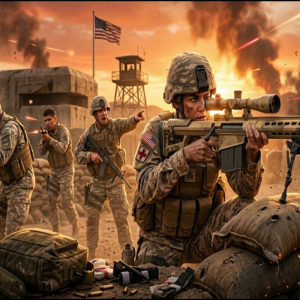
The heat sensor flickered. Border outpost ridge 7 sat 30 miles east of the Big Ben crossing where Texas dirt met Stone. And the only thing separating two nations was a fence that rattled in the wind. The outpost was not much to look at. Concrete bunkers half buried in Kishi soil. Rusted antenna arrays. A water tower that groaned when the temperature dropped.
12 soldiers called it home. None of them wanted to be there. Captain Daniel Shaw stood in the tactical operations center, staring at the thermal display. The screen glowed green and black, a digital ghost world rendered in heat signatures. 12 shapes moved across the southern quadrant. Humans sized, humanpaced, moving north toward the fence line.
Shocked’s radio tone flat professional contact south sector 12 signatures range 400 m. The response came fast. Boots on concrete, gear rattling, voices clipping short as men shifted from boredom to action in the space of a heartbeat. Master Sergeant Cole Briggs appeared beside Shaw, forearms like knotted rope, jaw set in a permanent scowl.
Standard intercept. Shaw nodded. Briggs moved. The kind of man who did not need orders twice. Outside the night was cold. Desert cold. The kind that crept through body armor and settled in the bones. The fence line stretched into darkness, chain link topped with razor wire, catching starlight in jagged glints. Four soldiers took position.
Rifles up, night vision active, breathing controlled. The 12 signatures kept moving, steady, predictable. Then they vanished. Not scattered, not running, gone. Shaw leaned closer to the thermal display, eyes narrowing. The screen showed empty ground. No heat, no movement, nothing. What the hell? Brig’s voice came through the radio, rough and low. They were right there.
Shaw toggle between modes. Infrared, motion detection, standard optical. Every feed showed the same thing. Empty desert. No tracks in the dust. No shapes in the shadows. 12 people did not just disappear. Pull back. Regroup at the wire. The soldiers withdrew, rifles still raised, eyes scanning darkness that suddenly felt heavier.
Briggs returned to the TOC, sweat beating on his temple despite the cold. Sir, I’ve seen coyotes move groups across. I’ve seen cartel runners. I’ve never seen anything like that. Shaw said nothing. He rewound the footage. Watch the 12 signatures approach. Watch them blink out of existence like someone flipped a switch. No explanation, no sense.
He saved the file, tagged it priority, sent it up the chain. Then he leaned back in his chair and stared at the ceiling, listening to the wind scrape across the outpost like something trying to get in. 3 days earlier, the transport truck rolled through the gate at 0800 hours. Dust plume trailing behind it like a dirty contrail.
Ridge 7 did not get much traffic. Resupply convoys came once a week. Personnel rotations every 6 months. Visitors almost never. Shaw stood outside the command bunker, coffee mug in hand, watching the truck slow to a stop near the vehicle depot. The driver climbed out, stretched, said nothing. A second figure emerged from the passenger side.
Woman, early 30s, lean build, maybe 5’6. Desert camouflage utilities. No name tape visible from this distance. A large medical ruck slung over one shoulder. Standard issue, but worn in. The fabric faded in a way that suggested years of use. She moved with economy. No wasted motion. No hesitation. Shaw walked over.
The driver handed him a clipboard. Transfer paperwork. Standard forms. Sergeant Maya Reeves, combat medic. Routine rotation. Shaw glanced at the woman. She stood near the tailgate, scanning the outpost with eyes that did not settle on anything for long. Taking it in. Cataloging. Sergeant Reeves. She turned. Saluted. Clean. Correct. Sir.
Her voice carried weight without volume. The kind that did not need to be raised to be heard. Welcome to Ridge 7. You’ll bunk in building three. Master Sergeant Briggs will show you around. Understood, sir. Briggs appeared from the motorpool, wiping grease from his hands with a rag that only spread it around.
[snorts] He looked at Maya the way a man looks at a stray dog. Suspicion mixed with inconvenience. Another medic. Shaw raised an eyebrow. You have a problem with medical personnel, Master Sergeant. Brig shrugged. No, sir. Just seems like we get a lot of pencil pushers with medb bags lately. Maya said nothing. Her face remained still, unreadable.
She shouldered her ruck and followed Briggs toward the living quarters, boots crunching on gravel. Shaw watched her go. Something about the way she moved. Smooth, deliberate, like someone who had walked through worse places than this and come out the other side. He went back to his coffee. Building 3 smelled like disinfectant and old sweat.
concrete walls, metal bunks, a single window with bars across it, not to keep people out, but to keep the glass from shattering during the dust storms that rolled through every few weeks. Maya set her ruck on the bunk near the back, unzipped it, began unpacking. Medical supplies came out first. Gauze, tourniquets, IV kits, hemostatic powder, chest seals, everything organized in clear plastic cases labeled in neat block letters.
She placed them on a metal shelf bolted to the wall. Then books, three of them, field medical manuals. She stacked them beside the supplies. Then a locked case, dark polymer, roughly 3 ft long, heavy, judging by the way she set it down. Careful, deliberate. She did not open it. Briggs stood in the doorway, arms crossed. You settling in? Okay.
Yes, Master Sergeant. Good. Chow is at 1200. Formation at 1,800. Medical bay is in building 2 if you need to set up. Understood. Briggs turned to leave, then paused. You’ve been deployed before? Mia looked at him. Yes. Where? Iraq. Afghanistan. See much action? Mia’s response came measured. Enough. Briggs studied her for a moment.
Then he nodded. Welcome to the rear echelon, Sergeant. Out here, the most dangerous thing you’ll face is boredom. He left. Maya finished unpacking, placed a small framed photo on the shelf. a younger version of herself in dress blues, standing beside an older man in marine fatigues. The man had sergeant chevrons and a weather-beaten face that suggested he had seen everything twice.
She touched the frame once, light, quick. Then she locked her foot locker and walked outside. The outpost was laid out in a rough grid, command bunker at the center, living quarters on the west side, motorpool and maintenance sheds to the east. The TOC sat elevated on a small rise, giving a clear view of the fence line in the desert beyond.
Maya walked the perimeter, not aimlessly, measuring, her eyes tracked sightelines, gaps in the concertina wire, dead zones where the flood lights did not reach. She paused near an unmanned M240 machine gun mounted on a tripod. The barrel angled toward the southern in approach. The traverse was stiff.
Rust on the feed tray. She knelt, worked the mechanism, loosened the pivot, wiped dust from the optics. A voice behind her. You know how to use that? She turned. A young soldier stood there. Maybe 21, 22. Private chevrons. Name tape read Knox. He had the kind of face that still looked surprised by the world. I’m a medic. I know how people get hurt. Knox grinned.
Fair enough. He offered his hand. She shook it. His grip was firm, but unsure. the grip of someone still learning how to hold authority. You need anything, Sergeant. Just ask. Most of us are pretty bored out here. Happy to help. Appreciate it, private. He walked away. Maya returned to the machine gun, adjusted the headsp space, checked the belt feed, left it better than she found it.
Then she turned and looked south toward the fence line toward the empty desert beyond where heat shimmerred even in winter. Her lips moved, silent, counting something. From the TOC window, Lieutenant Sarah Chen watched. Chen was 28, intelligence officer, too smart for this posting, and everyone knew it. She had narrow eyes that missed nothing and a tablet that never left her hand.
She took a photo of Maya standing near the machine gun, zoomed in, saved it. Then she opened an encrypted message app and typed. Asset arrived, confirming ID. She sent it. The reply came 30 seconds later. Observe. Do not engage. Report deviations. Chen closed the app. Looked back outside. Maya was gone. That evening, Private Tyler Knox twisted his ankle during a routine perimeter patrol, stepped wrong on loose rock, went down hard.
By the time he limped back to the outpost, the joint was swollen and hot to the touch. He sat outside the medical bay, boot unlaced, grimacing every time he moved. Maya appeared in the doorway, saw him, did not ask questions, just knelt and placed her hands on either side of the ankle, fingers pressing gently, testing for fractures.
“Can you rotate it?” Knox tried, hissed through his teeth a little. She pulled a compression wrap from her kid, began binding the joint with smooth practice motions. Firm pressure, even tension. “You’ve done this before. I’m a medic. It’s the job.” She finished the wrap, secured it with metal clips, stood ice for 20 minutes every 2 hours.
Elevate when you sleep. If it’s not better in 3 days, tell me. Yes, Sergeant. Knox paused. Thanks. Maya nodded and walked back inside. Knox sat there staring at the rap. Something about the way she moved, the certainty, like she had done this a thousand times in a thousand worse places. He pulled his boot back on, limped toward the barracks.
From across the compound, Chen watched, took another photo, saved it. Day one passed into night. The temperature dropped. Wind picked up, carrying dust that scraped against every surface. The soldiers of Ridge 7 settled into routines older than memory. Guard rotations, equipment checks, card games in the recck room.
Maya sat alone in her bunk, reading a field manual by the light of a small LED lantern. The lock case rested on the floor beside her bed, untouched. Outside the desert stretched in every direction, vast and empty and indifferent. And somewhere in that emptiness, 12 signatures had vanished. Day one evening, the shot came at 1945 hours.
Private Hrix was on tower duty, scanning the southern approach through thermal binoculars, half asleep on his feet. The round hit the sandbag 2 in from his head. He dropped. Instinct training terror. The crack of the rifle followed a half second later. Distant, sharp contact south. Ridge 7 exploded into motion. Sirens, shouts, soldiers pouring from barracks with rifles and body armor half-fastened.
Shaw burst from the command bunker already king as radio. Citrep Hrix still flat on the tower platform, voice shaking. Sniper fire. South Ridge, single shot. Casualties negative. Near miss. Shaw scanned the ridge line through his own optics. Nothing visible. Just rock and shadow and a sky turning purple with twilight. Briggs appeared at his elbow.
Suppression fire. Negative. One shot. Could be random. Could be probing. We return fire. We give away positions. Smart. Briggs did not like it, but he understood. The soldiers spread out. Defensive positions. Eyes on the southern perimeter. Minutes passed. Silence. Then a second shot. This one hit the radio antenna mounted on the TOC roof 800 m away.
The antenna sheared clean, sparks flying as the coaxial cable snapped. Shaw felt something cold settle in his gut. That was not random. That was precision. All personnel, take cover. We have a trained shooter. The team pulled back, filtering into hardened positions. Briggs moved low and fast. Years of muscle memory taking over.
He slid into a bunker, pressed his back against the concrete, breathing hard. Maya was already there. She knelt near the firing slit. medical bag opened beside her, but her eyes were not on the bag. They were on the desert, fixed, [snorts] unmoving. Briggs stared at her. “You should be in the aid station.” Maya’s gaze remained locked on the ridge line.
“That’s not random fire. That’s probing.” Briggs blinked. “How would you know?” She finally turned. Her expression remained neutral, controlled. I read the afteraction reports. Briggs wanted to say something, did not. Something in her eyes stopped him. Shaw’s voice crackled over the radio. All stations, hold fire.
Maintain defensive posture. Wait for my command. Maya stood, walked to the bunker entrance. Where are you going? I need air. Briggs almost stopped her. Almost. [snorts] But she moved with the kind of authority that made rank irrelevant. He let her go. Outside, Maya walked 20 ft from the bunker. Stopped. Turned south.
The ridgeel line was a dark smudge against a darkening sky. No movement, no shapes. Her lips moved again, silent counting. Her eyes tracked invisible lines across the terrain. Distance, elevation, wind. From the TOC, Chen watched through a telephoto camera, zoomed in on Mia’s face, captured the moment her expression shifted, just slightly, recognition.
Chen switched to thermal imaging, scanned the ridge line where Mia was looking, saw nothing, but she saved the angle, marked it on the map. Mia turned and walked back inside. Her hand, hanging loose at her side, trembled once. Just once. Then it was still. Hrix was brought down from the tower, shaking, pale.
Maya met him at the medical bay. Shoulder wound. The round had clipped him after all, tearing through the outer deltoid. Not deep, not fatal, but bleeding. She cut his uniform away, packed the wound, applied pressure. Her hands moved with mechanical precision. No hesitation, no wasted motion. Hendrick stared at the ceiling, jaw clenched.
Is it bad? You’ll live. She irrigated the wound, sutured it closed. 12 stitches neat and even, dressed it with gauze and tape. Hendrickx watched her work. You’ve done this a lot. My offered no response. She finished the dressing, administered antibiotics, wrote notes on a medical chart. Keep it clean. Change the dressing every 12 hours.
If you see red streaks or feel heat, tell me immediately. Yes, Sergeant. She stood, walked to the sink, washed blood from her hands. The water ran pink, then clear. Briggs appeared in the doorway. How is he? Stable. He can return to light duty in 48 hours. Good. Briggs looked at Maya. That was fast work. It’s the job. Briggs nodded slowly.
Then he left. Mia dried her hands, stared at her reflection in the small mirror above the sink. The face looking back was tired, older than 32, eyes that had seen things they could not unsee. She turned away. That night, Shaw called a briefing. The key personnel gathered in the TOC Briggs, Chen, Knox, three others.
Maps spread across the table. Coffee going cold in styrofoam cups. Shaw pointed to the ridge line on the map. Two shots, both precision. 800 meter range, low light conditions. This is not cartel harassment. This is professional. Chen stood. I have intel. All eyes turned to her.
She pulled up satellite imagery on her tablet, showed the group cartel compound 15 km south of the border, heavy presence, fortified structures, and according to a classified source, possible P holding. Shaw leaned closer. Ps are people unconfirmed. Could be bait. Briggs crossed his arms. How did you get this intel, Lieutenant Chen met his gaze? Classified source. Silence.
The kind of silence that carried weight. Shaw straighten. We report this up the chain. Wait for orders. No one moves without authorization. The group dispersed. Chen stayed behind, tapping on her tablet. Shaw watched her. You want to tell me what you’re really looking at? Chen hesitated, then turned the tablet toward him.
A file heavily redacted, a name visible at the top. Phantom protocol. Shaw read the visible lines. His expression did not change, but his jaw tightened. Does she know? You know. Chen shook her head. Not yet. Keep it that way. Chen closed the file, walked out. Shaw sat alone in the TOC, staring at the maps, staring at the rgeline, staring at the compound 15 km into Mexico, where someone might be holding American prisoners.
He poured himself more coffee. It was cold. He drank it anyway. Maya lay in her bunk, staring at the ceiling. The locked case sat on the floor within arms reach. She had not opened it, had not touched it, but she knew what was inside. Outside, the wind picked up. Dust rattled against the windows.
Somewhere in the distance, a coyote called. Another answered. The desert had its own language. Maya had learned it years ago. Learned to read the silences between sounds. Learned to feel danger before it arrived. She closed her eyes, tried to sleep, saw a face, young, male, 8 years old, blood on a small shirt, dust on small hands.
Her eyes opened. Sleep would not come tonight. She sat up, pulled on boots, walked outside. The compound was quiet, a single guard on the tower. Flood lights casting harsh shadows. She walked to the fence line, stood there, hands in pockets, staring south. Knox appeared beside her. Could not sleep either. Mia shook her head.
They stood in silence for a while. Then Knox spoke, voice low. That’s Sniper. You think he’ll come back? Mia took her time answering, then barely above a whisper. Yes. How do you know? because I would. Knox looked at her. There was something in her tone, something that made him not ask more questions. They stood together at the fence line, two soldiers in the dark, waiting for something neither could name.
And far to the south, on a ridge 800 m away, a man lowered his rifle, pressed his eye to the scope one more time, studied the compound, studied the shapes moving inside, studied one shape in particular, he smiled. Then he spoke into a radio, his accent barely detectable. Spanish inflection on certain vowels. Ridge 7, I’m watching. He paused. Tell Phantom I’m waiting.
Static answered. He slung his rifle. Melted into the darkness. Gone like smoke. Shaw heard the radio transmission. Played it back three times. The voice was calm, controlled, male, accent suggesting Mexican origin. He called Briggs. Chen, gathered them in the TOC, played the recording. Phantom. Who the hell is Phantom? Briggs shook his head.
No call sign on our roster matches that. Chen said nothing, but her fingers moved across her tablet, opening files, cross- referencing. Shaw looked at both of them. If someone out there knows that name, and if they’re targeting this outpost, I need to know why. He waited. Chen finally spoke. I’ll look into it. You do that, Lieutenant.
The briefing ended. Shaw stayed at the radio, listening to static, listening for another transmission that did not come. Outside, Maya walked back to her bunk, passed the TOC, saw the lights on inside, saw shadows moving against the windows. She did not stop, reached her quarters, closed the door, locked it, knelt beside the polymer case.
Her hand rested on the latch, trembling, not from fear, from something older, something deeper. She did not open it. Not yet. She stood, returned to her bunk, lay down fully dressed, boots still on, stared at the ceiling, waited for Dawn. But dawn was still hours away. And in those hours, the world could change, had changed, was changing.
Somewhere in the dark, a clock was ticking, counting down to something none of them could see. Something that had started 6 months ago, something that had traveled thousands of miles to arrive here at this forgotten outpost, at this thin line between nations. The wind howled. The fence rattled.
And Maya Reeves, who had once been someone else, who had once carried a different name, who had once pulled triggers instead of saving lives, closed her eyes and waited for the ghost to arrive. Because ghosts always came back, always. The compound fell silent. Guard shift changed. New faces on the tower, old faces in bunks. The cycle continued.
And in that silence, a question hung unspoken. Who was Phantom? By morning, some of them would know. By evening, all of them would wish they didn’t. But for now, in the deep hours before dawn, when the desert held its breath and the stars burned cold and distant, Ridge 7 slept. All except one.
Maya sat up, reached for the case. Her hand closed around the latch. Stopped. She whispered to the empty room. “Not yet.” She lay back down. Outside, something moved in the darkness. A shape, a shadow. It paused at the fence line, studied the compound, counted the guards, measured the distances. Then it turned and walked back into the desert, boots leaving no prince in the dust.
And on the wind, carried from some impossible distance, a whisper. Soon the first part of the story ended there, in the dark, in the waiting, in the moment before everything changed. Ridge 7 did not know it yet, but the ghost had arrived, and it was patient. Very patient. The kind of patience that came from years of hunting, years of watching, years of waiting for the perfect moment to strike. That moment was coming.
3 days, 72 hours, and then the world would learn what happens when a ghost meets a phantom. When the hunter becomes the hunted, when the past catches up to those who thought they had buried it. The story had only just begun. Dawn came slow and red. The sun clawed its way over the eastern horizon, painting the desert in shades of rust and blood.
Ridge 7 looked different in daylight, harsher, more exposed. The fence line cast long shadows that pointed south like accusing fingers. Maya stood outside the medical bay, coffee mug in hand, watching the sunrise. She had not slept, had not tried. Sleep meant dreams, and dreams meant faces she could not save. Boots on gravel. She turned.
Shaw approached, uniform crisp despite the early hour. His face was drawn, eyes red rimmed. He had not slept either. Sergeant Reeves, we need to talk. She waited. Shaw glanced around. Confirmed they were alone. Then he spoke. Voice low. that transmission last night. Phantom, you know what that means? Mia’s expression did not change.
It’s a call sign. Shaw studied her. Anyone you know use that call sign? Mia met his eyes, long pause, then quietly. Used to. Shaw nodded slowly. Like a man confirming something he already suspected. You were deployed as what exactly? Before you became a medic. Maya looked back at the sunrise. The question hung between them, heavy and sharp. Infantry.
Shaw waited, knew there was more. Maya took a breath. Scout sniper, Marine Corps, 2017 to 2020. The words landed like stones in still water, ripples spreading outward. Shaw’s jaw tightened and the call sign phantom. She said it without emotion, without pride, like naming something dead. Shaw was quiet for a long moment.
Then he asked the question that mattered. Why did you leave? Maya turned to face him fully. Because I killed someone I shouldn’t have. and I decided [clears throat] I’d rather save lives than take them.” Shawn nodded. No judgment in his eyes, just calculation, professional assessment. “That sniper on the ridge, you think he knows who you are?” Ma looked south toward the ridgeeline, toward the empty desert beyond.
“Yes, how? I don’t know yet.” Shaw exhaled slowly. “All right, for now, you’re still my medic. But if this becomes a problem, if that shooter out there is targeting you specifically, I need to know.” Understood, sir. Shaw turned to leave. stopped. “One more thing. Chen has been asking questions about you, about your background.
If you want my advice, you’ll talk to her before she digs up something you’d rather stay buried.” Maya nodded. Shaw walked away. She stood alone, watching the sun climb higher, feeling the weight of old ghosts pressing down on her shoulders. The day unfolded in routine intention. Patrols rotated, equipment checked, meals eaten in silence.
Everyone on edge, waiting for another shot that did not come. Chen found Maya in the medical bay organizing supplies. The lieutenant stood in the doorway, tablet under one arm, expression neutral. Sergeant, got a minute? Maya turned. Of course. Chen stepped inside, closed the door. The click of the latch sounded loud in the small space.
I’ve been reviewing personnel files, standard security protocol, and yours is interesting. Maya [clears throat] continued sorting gauze packages. How so? It’s thin. Three deployments, commendations for medical valor. But before 2020, there’s almost nothing. Like you didn’t exist. Everyone has a pass.
Lieutenant Chen sat on the exam table, legs dangling. That’s just it. You don’t. Or at least not one I can access. which means either you’re nobody important or you’re somebody very important who got scrubbed. Maya placed the last package on the shelf, turned to face Chen fully. What do you want to know? Chen leaned forward. I want to know why a combat medic has the situational awareness of a forward observer.
Why you move like someone who spent time in hostile territory? Why you looked at that ridge line last night and knew exactly where the shooter was positioned? Ma’s face remained calm. Training Chen’s voice stayed level. Professional. I was an analyst before I was an officer. I know how to read data. And you, Sergeant Reeves, don’t add up.
Silence stretched between them. Outside, someone shouted orders. A truck engine turned over. Finally, Maya spoke. If you have a specific question, ask it. Chen pulled out her tablet, opened a file, turned it toward Maya. The screen showed a photograph. Grainy thermal imaging. A figure in a ghillie suit on a rooftop. Rifle extended.
The timestamp read 2019 location Fallujah. Chen zoomed in on a detail in the corner, barely visible. A call sign stencled on the rifle stock. Phantom. Chen looked up. That’s you, isn’t it? Maya stared at the image, her hands resting at her sides, clenched once. Released. Where did you get this? Classified a database.
Took some digging. She paused. You were Marine scout sniper. Confirmed kills in Iraq and Afghanistan. specialty long range interdiction. And then in 2020, you requested transfer to medical corps. No explanation given. Maya took the tablet, studied the photo like it was a stranger’s face. That person doesn’t exist anymore.
But the shooter on that ridge thinks she does. Chen stood. Look, I’m not here to jam you up. I’m here because if there’s a threat to this outpost, I need to understand it. And right now, you’re the only one who might know what we’re dealing with. Maya handed the tablet back. His name is Diego Vargas, former Mexican Marine. He served as a military liaison embedded with Iraqi forces in 2019.
That’s where our paths crossed. Chen’s eyes narrowed. He was in Fallujah. Yes. Maya’s tone remained even. He witnessed something. Something I did and now he’s here. What did you do? Mia looked away. I followed orders and someone died who shouldn’t have. Chen absorbed this. Someone he cared about. Yes. Chen nodded slowly.
Then we need to figure out his endgame, and we need to do it before he makes another move. She left. Maya stood alone in the medical bay, surrounded by supplies meant to heal, haunted by a past built on different skills. That afternoon, the radio crackled to life. A woman’s voice strained, breaking up through static. This is Dr.
Isabelle Navaro, Archaeological Research Station. If anyone can hear this, we need immediate assistance. Shaw grabbed the handset. This is Ridge 7. What’s your situation? The station collapsed. I’m trapped. My leg is pinned. Please, I need help. Shaw looked at the map. The research station was marked 3 km east of the outpost.
Close enough to reach. Far enough to be dangerous. He keyed the mic. How many in your party? Just me. Everyone else evacuated before the collapse. I stayed to secure equipment. Shaw exchanged glances with Briggs. A rescue mission. Simple on paper, deadly in execution. We’re coming. Hold tight. He turned to his team.
Briggs, Knox, Chen, and two others. Gear up. We move in 20 minutes. Maya appeared in the doorway. I’m going. Shaw shook his head. I need you here in case there are casualties when we return. Sir, with respect, you’ll need a medic on site. If her injuries are severe, moving her without stabilization could kill her. Shaw considered.
She was right. He knew it. Briggs knew it. Fine. Grab your aid bag. Maya moved. Fast, efficient. Chen pulled Shaw aside. You sure about this? Taking her outside the wire? Shaw’s voice dropped. If that sniper is out there, he’s going to make a move whether she’s here or in the field. At least out there, we can see him coming.
Chen did not look convinced, but she nodded. 20 minutes later, the team assembled at the gate. Six soldiers, full combat load. Maya carried her medical ruck, now visibly heavier. Shawn noticed, but said nothing. The gate opened. They moved out. The desert stretched out before them, empty and vast. Heat already rising in waves despite the morning hour.
They moved in a tactical column, spacing tight, eyes scanning. Maya walked behind Knox in front of Chen. Her gaze swept the terrain in methodical arcs, left to right, near to far, reading the ground like a language. Knox glanced back at her. You’ve done this before. Field movement. Maya did not answer, just kept walking. Knox wanted to say more.
Wanted to ask how a medic moved like infantry. But something in her silence told him to wait, to watch, to learn. They covered the first kilometer without incident. The research station appeared in the distance. A cluster of prefab buildings and excavation tents. One structure had partially collapsed, support beams jutting at wrong angles.
Shaw raised a fist. The column halted. He glassed the area through binoculars. No movement, no vehicles, no signs of life except the occasional flutter of torn canvas in the wind. Looks clear. Briggs knock set security. Chen Reeves, you’re with me. They advanced, slow, careful, weapons up.
The collapsed building groaned as they approached. Metal stressed beyond its limits. Maya moved to the debris field, scanning for the voice they had heard on the radio. Dr. Navaro, here weak to the left. Maya shifted toward the sound. Found her. Isabelle Navaro was mid30s. Dark hair matted with dust and blood. A support beam lay across her lower leg.
The limb was bent at an unnatural angle. Compound fracture, bone visible through torn fabric. Shawn knelt beside her. We’re going to get you out. Navaro’s eyes were glassy with shock. Thank you. I thought I was going to die here. Maya opened her medical ruck, pulled out IV supplies, splinting material, morphine, started an IV line with practiced efficiency.
Chen helped lift the beam. Shaw pulled Navaro free. She screamed. The sound echoed across the desert. Maya administered morphine, waited for it to take effect, then began splinting the leg. Her hands moved with absolute certainty. Immobilize, stabilize, prevent further damage. Knox’s voice crackled over the radio. Movement. South Ridge.
Same position as last night. Shaw’s head snapped up. How many? One. Stationary. Could be observation. Maya did not stop working. Finished the splint. Secured it. Checked Navaro’s vitals. She’s stable to move, but we need to do it now. Shaw nodded. Briggs knocks. Prepare to displace. We’re coming to you. They lifted Navaro onto an improvised litter, started moving back toward the column.
That’s when the shot came. The round hit the ground 5 feet in front of Shaw. Dust exploded upward. The crack followed instantly. Contact. The team dropped. Weapons oriented south. Returned fire erupted. Controlled bursts. Suppression. Maya dragged Navaro behind cover. A low wall of sandbags someone had stacked months ago. She checked the IV line.
Still flowing. Checked the splint. Secure. Another shot. This one closer. Deliberate. Walking rounds inward. Shaw’s radio. Ridge 7, this is Shaw. Taking effective fire. Request QRF. The response was immediate. QRF dispatched. ETA. 12 minutes. 12 minutes was a lifetime. Briggs fired three round bursts toward the ridge.
Knox did the same, but the shooter was dug in, invisible, only muzzle flash giving away position. Knox’s hands shook slightly as he reloaded. He had been in firefights before, but this was different. This was personal. Someone out there wanted them dead. Wanted Maya dead. He glanced at her. She worked on Navara with absolute focus.
No fear in her eyes, just determination. How does she do that? He thought, “How does she stay so calm?” My low crawled to Shaw. Sir, I can suppress. Shaw looked at her. With what? Maya pulled her ruck closer, unzipped a hidden compartment. Inside, disassembled, was a rifle. Not standard issue. McMillan TAC50 bolt action 50 caliber. Shaw stared.
Where the hell did you get that? I never turned it in. Maya’s tone was matter of fact. When I transferred out of scout sniper, they let me keep my personal weapon. I just never mentioned I still had it. Shaw made a decision in half a second. Do it. Maya assembled the rifle. Smooth mechanical muscle memory taking over. Stock barrel, scope, magazine, bolt.
30 seconds. Fully operational, she moved to the edge of the sandbag wall, settled into a prone position, pressed her eye to the scope. The world narrowed, became nothing but reticle and target. She found the ridge, found the position, saw a glint, metal scope lens, range 900 m, wind left to right, 5 mph, elevation adjust.
Her breathing slowed, heart rate dropped. The chaos around her faded to white noise. She saw him. Not his face, but his silhouette, his shape against the rock. She could take the shot. Center mass. Kill. Her finger rested on the trigger. 2 lb of pressure. That’s all it would take. But she did not fire. Instead, she adjusted aim. 6 in right.
Fired. The 50 caliber round punched through the air with a sound like thunder. Downrange. Rock exploded exactly where she aimed, 6 in from the target’s position. The return fire stopped. Maya fired again. Different angle. Warning shot. Same message. I see you. I can kill you. I’m choosing not to. Silence. Then movement.
The figure on the ridge withdrew. Disappeared. Maya safe. The rifle began disassembling. Same speed, same efficiency. Shaw stared at her. That was a 900 meter shot in wind under fire. Mia did not look up and I missed on purpose. Briggs crawled over. Why you had him? Because killing him solves nothing. Maya packed the rifle away and I don’t kill anymore.
Knox watched this exchange, his mind racing. She could have ended it. Could have saved them all the trouble. But she chose mercy. Why? What kind of soldier chooses mercy in the middle of a firefight? The kind, he realized who had seen too much death. Who carried too much weight? The kind he wanted to become. The QRF arrived.
Armored vehicles, additional personnel. They loaded Navaro and extracted the team without further incident. On the ride back to Ridge 7, Chen sat across from Maya, studying her, calculating. You could have ended this. Why didn’t you? Mia looked out the window at the passing desert. Because I’ve ended enough. Knock sat beside Maya, silent, thinking.
He had joined the army to make a difference, to help people. But [snorts] he had always thought that meant carrying a rifle, fighting enemies. Watching Maya, he realized there were other ways to fight, other ways to make a difference. Maybe the strongest soldiers were the ones who knew when not to pull the trigger.
That night, Shaw called an emergency briefing. Command bunker. Doors closed. Only key personnel. He stood at the head of the table. His face was grim. Resolved. I just got off the phone with JSOC, Joint Special Operations Command. They’ve confirmed actionable intelligence on a cartel compound 15 km south of here. Chen pulled up satellite imagery on the main screen.
The compound appeared, fortified, multiple buildings, guard towers. Shaw continued. Four American citizens, border patrol agents captured 3 weeks ago during a routine interdiction. They’re being held here. Briggs leaned forward. What’s the timeline? Task Force Greystone is coordinating extraction, but they need 72 hours to stage assets, get approval through channels. Knock spoke up.
What do we do in the meantime? Shaw looked at Maya. We keep the cartel occupied, keep them from executing those prisoners while we wait for the cavalry. And how do we do that? Briggs asked. Shaw pulled up helmet cam footage from the rescue operation. Showed Maya’s shots. The precision, the restraint. We have something they want.
Someone they want, he gestured to Maya. Sergeant Reeves, or as the shooter knows her, Phantom. The room went silent. Chen was the first to speak. You want to use her as bait. Not bait. Distraction. Shaw’s voice was firm. Diego Vargas is hunting her specifically. If we position her strategically, make him think she’s vulnerable, he’ll focus on her instead of those hostages.
That’s a suicide mission, Briggs said flatly. Shaw shook his head. It’s calculated risk. Sergeant Reeves has proven she can hold her own against Vargas. She’s the only one here who can match him shot forshot. We use that by time. Keep him occupied until task force arrives. Ma had been quiet. Now she spoke. I’ll do it.
Shaw looked at her. You understand what I’m asking? Yes, sir. You’re asking me to be the target instead of those agents. To draw fire, to keep Vargas focused on me. Exactly. Maya nodded. Then I’m in. Knox stood. I’m going with her. Shaw started to object. Maya cut him off. I work better with a spotter. If Private Knox is willing, I’ll take him.
Shaw studied Knox. The young soldier met his gaze. Steady. No hesitation. Knox felt his heart pounding. He was volunteering to walk into danger, to put himself between Maya and a professional killer. But he had made his choice. He would not let her face this alone. All right. Shaw’s voice cut through Knox’s thoughts.
You two are forward observation. Briggs, coordinate defensive positions here. Chen, maintain comms with task force command. We hold for 72 hours, then this is over. The briefing ended. People filed out. Maya stayed behind. Shaw approached her. This is voluntary. You can say no. I know. Then why say yes? Maya looked at the satellite image still on the screen.
The compound, the guard towers, four people trapped inside. Because 6 years ago, I killed someone I shouldn’t have. And every day since I’ve been trying to make up for it. She turned to Shaw. If I can save four lives by risking one, that’s a trade I’ll make. Shaw nodded. Understood. Just make sure you come back.
Mia did not promise anything. Just walked out. Knox caught up with her outside. Sergeant, why’d you agree to this? Maya kept walking. Because it’s the right thing to do, even if it gets you killed. Especially then, Knox fell into step beside her. You know something? For a medic, you’ve got a pretty messed up sense of self-preservation.
Ma’s lips twitched, almost a smile. Welcome to the infantry, private. They walked in silence toward the armory, began prepping gear for the next morning. Knox’s mind would not stop racing. He was scared, terrified if he was honest, but he was also determined. He thought about his family back home, his mother, his younger sister.
What would they think if they knew what he was about to do? Would they be proud, or would they think he was a fool? He did not know, but he knew one thing. Maya Reeves was willing to die to save people she had never met. That was the kind of soldier he wanted to be. That was the kind of man he wanted to become.
Chen found Maya an hour later outside alone, staring south. Can I ask you something? Maya turned. Go ahead. That shot today, 900 m. Wind under fire. That’s not something you learn in basic medic training. No, it’s not. Chen stepped a closer. I pulled your full file. Took some doing. Black ink everywhere. But I found enough. She paused.
You weren’t just scout sniper. You were top of your class. Instructor level marksman recommended for advanced schools. Maya said nothing. And then in 2020, you walked away. requested immediate march transfer. No explanation, just gone. Chen watched her face. What happened in Fallujah? Maya was quiet for a long time.
When she spoke, her voice was distant. I took a shot I thought was righteous. Thought I was saving lives. Turns out I was wrong. Chen waited. Mia continued, “The target was supposed to be a bomb maker. High value. Lots of American blood on his hands. Intel said he was using a child as a human shield. Standard procedure was to engage.
Did you? Mia nodded. One shot. Killed them both. Chen absorbed this, but it wasn’t a human shield number. Mia’s voice was barely audible. The building was collapsing. He was trying to save the boy. I killed them for trying to survive. Silence stretched between them. Chen spoke carefully. That’s why you won’t kill Vargas, even though he’s hunting you. Maya met her eyes.
I’ve taken enough lives. I won’t add to that count unless there’s absolutely no other choice. Shen nodded slowly. For what it’s worth, I think you’re doing the right thing. Not many people would choose mercy over survival. Mercy isn’t survival. Maya turned back toward the south. It’s atonement. Chen left her there, alone with the desert and the stars and the weight of six years worth of ghosts.
Far to the south, on the ridge under the same sky, Diego Vargas lay prone behind his rifle. Scope trained on ridge 7, watching. He had seen the warning shots. Felt them pass within inches of his position. Understood the message. She could have killed me. Chose not to. He spoken to his radio. Spanish low. The compound status. The reply came back.
Four prisoners secured. No issues. Good. Increase guard rotation. Americans will move within 72 hours. Understood. Vargas lowered the radio, returned his eye to the scope, found the small figure standing outside the medical bay, too far to see her face, but he knew it was her. Phantom after all these years, he remembered Fallujah.
Remembered serving as liaison to Iraqi forces. Remembered his friend Khaled, a good man, a contractor, not a fighter. Remembered the day Khaled died, the rooftop, the shot, the child falling. Remembered holding Khaled’s hand as he bled out. listening to him whisper about his nephew, about Omar, about how he had tried to save the boy from the collapsing building, remembered the rage, the grief, the burning need for justice.
He had spent six years tracking her, learning her movements, waiting for the right moment. And now here she was, offering herself as a target, as bait. He smiled, not with joy, with something colder. You think you can save them? You think sacrifice will erase what you did? He adjusted his scope. breathe slow, but some debts can’t be repaid.
Some blood can’t be washed away. He settled in, prepared to wait, patient, professional, because tomorrow the real hunt would begin. And this time, mercy would not be an option. The night deepened, temperature dropped, wind picked up, carrying dust and the smell of creassote. Maya finally went inside, lay on her bunk, did not sleep.
Knox lay in the bunk across from her, eyes open, staring at the ceiling. “You awake?” he asked quietly. Yeah. You scared? Maya thought about it, terrified. Knox turned his head, looked at her. Me, too. Good. Fear keeps you sharp. They lay in silence. Then Knox spoke again. That story you told Chen about Fallujah, the kid.
What about it? You think Vargas knew them? The people you shot? Maya closed her eyes. I think he did. I think that’s why he’s here. So, this is personal for him, for both of us. Knox processed this. If it comes down to it tomorrow, if you have to choose between your life and his, what will you do? Mai opened her eyes, stared at the dark ceiling. I don’t know. You should know.
I know I should, but I don’t. Knox nodded. Then I guess we’ll find out together. Yeah, I guess we will. They fell silent. Outside, the guard changed. Boots on gravel, radio chatter, the normal sounds of a military outpost at night. But nothing felt normal anymore. Something had shifted. Something had changed. The hunt was on.
And by morning, someone would bleed. The only question was who. Maya finally drifted into uneasy sleep. Dreamed of rooftops and dust and small bodies falling. Woke before dawn, sweating, heart racing. Knox was already up, gear packed, rifle cleaned. He looked at her, ready. Maya sat up, pulled on boots, checked her medical bag, checked the case with the McMillan. Ready as I’ll ever be.
They walked out together. The sky was starting to lighten, gray becoming blue, stars fading. Briggs met them at the motorpool. Humvey loaded. Chen in the passenger seat with a tactical radio. Shaw appeared, handed Maya a frequency card. Command net. You get in trouble, you call. We’ll come running. Maya took the card. Appreciate it, sir.
Shaw looked at both of them. 72 hours. That’s all we need. You hold out that long. Task force handles the rest. And if Vargas makes a move before then, Knox asked. Then you do what you have to do. Shaw’s voice was firm. But you come back alive, both of you. They loaded up. Briggs drove 30 minutes east to a series of low hills Shaw had identified as good overwatch positions.
The terrain was rough, rocky, good concealment, multiple egress routes. They unloaded. Briggs and Chen helped carry gear to the final position. Then they left. Maya and Knox were alone. They dug in. Sandbags, camouflage netting, just enough to break up their silhouette against the skyline. Maya set up the McMillan 50 caliber effective range over a mile.
Knox set up a spotting scope. M151 20 power magnification. By midday they were set. Knox glass the southern approach. Saw nothing but heat shimmer and empty ground. How long do we wait? Maya settled behind her rifle. As long as it takes. Hours crawled by. Sun climbed. Temperature rose. They drank water. Ate Marz. Spoke little.
The desert stretched in all directions, vast and different, beautiful in its cruelty. Knox broke the silence. Can I ask you something? Maya kept her eye to the scope. Sure. That call sign. Phantom, how’d you get it? Maya was quiet then, because I was good at disappearing. Fire and vanish. That was my method.
Take the shot. Gone before anyone knew where it came from. Sounds lonely. It was. She paused. That’s why I left. Couldn’t stand being invisible anymore. And now, Knox asked. Now you’re back to it. No, now I’m visible. I’m choosing to be seen. Choosing to stand between people in danger instead of hiding in shadows. Knox nodded.
Went back to a spotting scope. The afternoon wore on. Shadows lengthened. Wind picked up. Then Knox saw it. Contact. South Ridge. Single figure. 1,200 m. Maya swung her rifle. Found the position. Saw him. Diego Vargas stood on the ridge line. Not hiding, not concealed, just standing there looking directly at their position.
He raised one hand, slow, deliberate, a wave. Then he lifted a radio. Mia’s radio crackled, his voice calm, almost friendly. Phantom, it’s been a long time. Mia picked up her handset. Vargas, why are you doing this? His laugh was soft. You know why, Fallujah? You took everything from me. Now I take everything from you. I didn’t know the intelligence was wrong.
Intelligence is always wrong, Phantom. But bullets are forever. Maya’s grip tightened on the rifle. What do you want? Vargas was quiet for a moment. Then I want you to understand what it feels like to lose someone you care about. To be powerless to stop it. The hostages, Vargas continued, four good people, families waiting, and in 60 hours, unless you do exactly what I say, they die.
One every 15 hours, starting with the woman. She’s 5 months pregnant. Knox looked at Maya. Her face was stone. What do you want? Maya repeated. I want you to come to me alone. unarmed. Trade yourself for them. Vargas paused. You have 12 hours to decide. After that, the first one dies and their blood is on your hands. The radio went silent.
Maya lowered the handset, stared at the ridge. Vargas was gone. Knox spoke quietly. You’re not actually considering it. Mia did not answer. They packed up, returned to Ridge 7. Shaw was waiting in the TOC. Mia briefed him. Shaw’s face darkened with each word. He’s bluffing. Maybe. Maya’s voice was flat.
Or maybe four people die because I won’t face what I did. Chen pulled up drone footage, thermal imaging of the compound, four heat signatures in a single room, bound, guarded. They’re real. The hostages are real. Shaw slammed his fist on the table. We have 72 hours. Task force is moving assets. We can’t accelerate that.
Vargas is giving us 12. Then we negotiate. We stall. We buy time. He won’t negotiate. Maya’s voice cut through. This isn’t about the hostages. It’s about me. About Khaled? About Omar? The room went silent. Briggs spoke up. Who are Khaled and Omar? Maya turned to him. People I killed in Fallujah. People Vargas cared about. Chen’s eyes widened.
He was there. Maya nodded. He saw it happen. And now he wants payment. Shaw stood. We don’t negotiate with terrorists and we don’t sacrifice our people. You stay here. We wait for task force. And if they die, waiting. Mia’s voice was quiet but firm. Then that’s on command, not on you. Mia looked at each of them.
Good soldiers, good people trying to do right in an impossible situation. She nodded. Understood, sir. Shaw dismissed them. Mia walked to her quarters, sat on her bunk, stared at the locked case. Knox appeared in the doorway. You’re going anyway. Mia looked up. I don’t have a choice. Knock stepped inside.
Closed closed the door. Yes, you do. You can stay here. Let task force handle it. That’s a smart play. And if they’re too late, then that’s not on you. Maya shook her head. You don’t understand. I’ve been carrying this for six years. Every night I see that boy’s face. Every day I wonder if there was another way.
She stood. This is my chance to make it right. By getting yourself killed. By saving people I can actually save. Knox, move closer. Look, I get it. You feel guilty, but walking into a cartel compound won’t fix that. It’ll just add your name to the list of people who died for nothing. Maya met his eyes. Maybe that’s what I deserve.
Knox grabbed her shoulders. No, you deserve to live. To keep being the person who saves people, not the person who throws their life away because they can’t forgive themselves. Maya pulled away. You don’t get to decide that. Neither do you. Knox’s voice rose. You think you’re the only one who’s made mistakes, who’s killed the wrong person.
You’re not special. You’re just human. And humans get second chances. Maya sat back down, put her head in her hands. Knock sat beside her. If you go, I’m coming with you. No. Yes. His voice was firm. You said you work better with a spotter, so I’m your spotter. That’s the deal. You’ll die. Maybe.
Or maybe we both walk out. But either way, you don’t go alone. Maya looked at him, saw determination, loyalty, the same thing she had seen in her old spotter, Sergeant Hail, years ago. She nodded slowly. All right. If it comes to that, you’re with me. Knox stood, then get some rest. We’ve got a long night ahead. He left.
Maya lay back, stared at the ceiling, made her decision. By dawn, everything would change. Outside, the desert night deepened. Stars emerged. Cold air settled, and somewhere in that darkness, Diego Vargas prepared, cleaned his rifle, loaded fresh magazines, spoke to his men in clipped Spanish. Tomorrow, the ghost would come to him, and tomorrow, one way or another, the debt would be paid. The clock kept ticking.
12 hours then blood. The clock read 0400 hours when Maya opened her eyes. She had not been asleep, just lying still. Waiting for the moment when waiting became action. Knock sat on the edge of his bunk across the room, lacing boots in the dark. He looked up when she moved. You sure about this? Ma swung her legs over the side, reached for her own boots.
I’ve never been less sure of anything in my life. Then why? Because being sure doesn’t matter. Doing what’s right does. They dressed in silence. Combat utilities, body armor, loadbearing vests, magazines, medical supplies, water. Everything they would need for what came next. Maya opened the locket case. The McMillan TAC50 gleamed dull in the pre-dawn light.
She assembled it with practiced hands. Muscle memory older than her decision to stop killing. Knox watched. You really think he’ll let them go? Maya loaded the magazine, racked the bolt. I think he’ll honor his word. Whatever else he is, Vargas is a professional. And if he doesn’t, then we adapt.
Knox pulled on his helmet, adjusted the chin strap. That’s not much of a plan. Maya slung the rifle, looked at him. It’s the only plan we have. They moved through this compound like shadows. Everyone else was asleep. Guard rotations changed at 0500. They had 30 minutes. The Humvey sat in the motorpool, keys in the ignition.
Standard practice in case of emergency. Thisqualified. Maya climbed into the driver’s seat. Knox took passenger side with his rifle and spotting scope. She turned the key. Engine rumbled to life. The gate guard heard it, stepped out of his shack, saw the Humvey moving, raised his radio.
Maya keyed the push to talk on the command frequency. Tell Shaw we had to move early. Vargas accelerated the timeline. We’re going to get those people back. She did not wait for a response, just drove. The gate opened. They passed through into the desert, into the dark. Behind them, lights came on in the TOC, voices shouting, but by then they were already gone.
The drive took 40 minutes south, then east. Following coordinates, Vargas had transmitted the night before. The sun began to rise, red light spilling across the horizon, painting everything in shades of blood and rust. Maya stopped the Humvey 300 meters from the coordinates, killed the engine. They sat in silence for a moment, listening.
The desert was quiet. No birds, no wind, just stillness. Knox glassed the area through his scope. I see the compound, two buildings, guard towers, maybe 20 hostiles visible. Maya pulled out her binoculars, studied the layout, memorized distances, angles, dead zones. There, Knox pointed. South building, second floor, four signatures through thermal. The hostages.
Maya lowered the binoculars. Looked at Knox. You don’t have to do this. You can drive back. Tell Shaw what happened. Knock shook his head. I’m your spotter. Where you go, I go. Maya wanted to argue, wanted to tell him to save himself, but she saw the set of his jaw, the determination in his eyes. She nodded.
All right, let’s finish this. They exited the Humvey, moved on foot, low and slow, using terrain for concealment. 200 m out, a voice called from the compound. English, accented. Stop there, Phantom. Come. No closer. Maya halted, raised her hands, empty. The rifle slung across her back. I’m here. Like you asked. Let them go.
Silence. Then a door opened. Four figures emerged. Hands bound, hoods over heads, stumbling, disoriented. Border Patrol uniforms. One woman, three men. The woman’s midsection showed the slight swell of early pregnancy. Guards pushed them forward. Rough, uncaring. Maya’s hands clenched, forced herself to stay calm.
Vargas appeared, tall, lean, dark hair going gray at the temples. He carried a rifle, not aimed, just held ready. He looked at Maya across the distance, recognition in his eyes. 6 years. You look different. So do you. Vargas smiled, not warmly. We both carry our scars. He gestured to the hostages. They walk. You stay. Fair trade. How do I know you’ll honor it? Vargas tilted his head.
Because unlike your government, I keep my word. The guards cut the bindings, pushed the hostages forward. They stumbled, started walking, uncertain, [clears throat] afraid. Maya watched them come. Counted steps. 100 m, 75, 50. The woman looked up, saw Maya. Hope flickered in her eyes. Keep walking, Maya said quietly. Don’t stop.
Don’t look back. The hostages passed her, kept moving toward the Humvey. Knox met them, helped them inside, started the engine. Mia stood alone now, facing Vargas, facing 20 armed men, facing the weight of six years. “Your turn,” Vargas called. “Walk forward.” Slowly, Mia took a step, then another.
Each one felt like walking toward a cliff edge. Behind her, the Humvey engine revved. Knox was leaving, taking the hostages to safety. “Good, that was good.” She kept walking. 50 meters from the compound. Vargas raised his hand. Stop. Maya stopped. Vargas studied her. You came alone. I didn’t think you would. I gave you my word. Words are cheap. Actions matter.
He lowered his rifle slightly. Why didn’t you kill me yesterday? You had the shot. Maya met his gaze. Because I’ve killed enough people. I won’t add to that count unless there’s no other choice. Even when the person wants you dead, especially then. Vargas was quiet. Then he spoke, his tone shifting, softer.
Khaled was my friend, my brother. We served together in the Mexican Marines before I left, before circumstances brought him to Iraq. Maya’s breath caught. You were there. Vargas nodded. I was serving as military liaison, embedded with Iraqi forces in Fallujah, 2019. I was there the day he died. The pieces fell into place. Maya felt the weight of it settling over her.
I didn’t know. The words felt hollow, inadequate. Number Vargas agreed. You didn’t. You followed orders. That’s what soldiers do. Following orders doesn’t absolve me. No, it doesn’t. Silence stretched between them. The sun climbed higher. Heat already building. Vargas spoke again.
Do you know how Omar died? Maya shook her head. I saw him fall. Saw the blood. I assumed the worst. Vargas looked away. Toward the horizon. His voice became distant. He lived three more days in a field hospital. The building collapse had caused internal bleeding. Massive trauma. The doctor said he was dying from the moment the structure came down.
Maya felt her chest tighten. Vargas continued. Your bullet hit Khaled’s shoulder. A through and through, non-fatal. The medics could have saved him easily. He paused, but Khaled refused treatment. He stayed with Omar, held his hand, told him stories, sang to him. Oh god. Mia’s voice broke. He bled out slowly. Over those three days, he chose to spend Omar’s last hours with him instead of saving himself. Mia’s legs nearly gave out.
So, I didn’t kill Omar, but I killed Khaled. Vargas looked back at her. You pulled a trigger based on false intelligence. Khaled was not a bomb maker. He was a civilian contractor. A good man, wrong place, wrong time. Like Omar, like all of us. Vargas voice hardened. The war killed them, but you were the weapon it used. Maya felt tears burning, falling.
I’m sorry. I know it doesn’t change anything, but I’m sorry. Vargas raised his rifle, aimed at her chest, range 20 m. Impossible to miss. Sorry doesn’t bring them back. Maya did not move, did not raise her hands, did not beg. I know. Vargas’ finger moved to the trigger. Mia watched, waited, accepted. This was the price. This was the debt.
She closed her eyes. A shot rang out. Maya flinched, waited for pain, for darkness. Neither came. She opened her eyes. Vargas stood with his rifle lowered, smoke drifting from the barrel. The round had hit the ground at Maya’s feet. He looked at her with something that might have been respect. Khaled made me promise something before he died.
He said, “If I ever met the soldier who shot him, I should ask one question. What question? Are you the kind of soldier who kills without thinking or the kind who carries every death?” Maya’s voice was barely a whisper. I carry them all. Vargas nodded slowly. Then you’ve already paid your debt. Living with that weight is punishment enough.
He lowered his rifle completely, turned to his men, spoke in Spanish, sharp, final. Let her go. The guards looked confused. Vargas repeated the order. They lowered their weapons. Maya stared. You’re letting me walk away. Vargas reached into his pocket, pulled out something small, walked forward, stopped three feet from Maya. He held out his hand.
In his palm was a folded piece of paper, old worn. Omar drew this. 2 days before he died, Mia took it, unfolded it with shaking hands. A child’s drawing crayon, simple, a figure in uniform with a red cross on the chest. Below it, Arabic text. What does it say? Maya’s voice broke. Vargas translated the soldier who tried to help.
Maya stared at the drawing, at the careful lines, at the color choices. Red for the medic cross, blue for the sky. I don’t understand. Vargas explained. After you fired, after they fell, your team moved in. One of your medics tried to help. Omar, tried to stop the bleeding. The boy was conscious. He saw the uniform, the red cross.
He thought you were trying to save him, but I was the one who shot him. He didn’t know that. Vargas’s voice was gentle now. He died thinking soldiers came to help, not to hurt. Maya fell to her knees, the drawing clutched to her chest. Sobs came. Deep, wrenching. Six years of grief pouring out. Vargas watched. Did not move. Did not speak.
Just let her grieve. Finally, Mia looked up. Why are you showing me this? Because you need to stop punishing yourself. Varga’s voice was firm. Omar forgave you before he even knew there was anything to forgive. He saw a soldier with a med cross and believed in help. That’s what he carried in his last days.
Not anger, not blame, hope. Maya stood on shaking legs. But Khaled Khaled told me something too in those last hours. Vargas met her eyes. He said the war made us all victims. Soldiers, civilians, children, everyone. and he said the only way to beat the war is to choose something better. What did he choose? Love.
Vargas voice cracked slightly. He chose to spend his last hours loving his nephew instead of hating his enemy. Maya folded the drawing carefully, put it in her pocket. What do I do now? Vargas shouldered his rifle. You live. You keep being the person who saves people instead of killing them. That’s how you honor them. Not by dying, by living better.
Maya nodded, turned, started walking. Each step felt lighter, like chains falling away. She made it 20 feet before Vargas called out. Phantom, she turned. If we meet again, it won’t be as enemies. Mia [clears throat] almost smiled. Then what? Vargas looked at her for a long moment. Two ghosts who chose to live. Maya nodded, turned, walked away.
Behind her, Vargas watched until she disappeared into the desert. Then he spoke quietly in Spanish to his second in command. Pack up. We’re moving north. There are other battles to fight. Better ones. The compound began to dismantle. Organized, efficient. Within an hour, they would be gone. Maya walked until she saw the Humvey.
Knock stood beside it, binoculars raised, watching her approach. When she got close enough, he lowered them. You’re alive. Apparently, the hostages safe, already on the road back to Ridge 7. Chen sent a recovery team. Maya nodded, climbed into the passenger seat, suddenly exhausted. Knox got in, started driving. After a few minutes, he spoke.
What happened back there? Maya touched the pocket where the drawing rested. I got something I didn’t know I needed, which was forgiveness. Knox wanted to ask more, but he saw the look on her face. The peace, the release. He had followed her into danger, expecting to witness violence. Instead, he had witnessed something rarer. Mercy on both sides.
That he realized took more courage than any firefight. They reached Ridge 7 2 hours later. The gate opened. Shaw stood waiting. Maya climbed out, faced him, ready for consequences. Shaw’s expression was unreadable. The hostages made it back. All four safe, healthy. That woman is going to have her baby. Good. JSOC is asking questions.
Why we launched an unauthorized rescue? Why we deviated from the plan? What did you tell them? Shaw almost smiled. I told them two of my soldiers saw an opportunity and took it. That they followed their training and their conscience. and that four American citizens are alive because of it and and they’re recommending you both for commendation. Shaw paused.
They’re also recommending I write you up for insubordination. Fair. Shaw handed her a piece of paper. Official looking. Lots of stamps. Maya read it. Reprimand for unauthorized engagement. Formal counseling note. No rank reduction. No brig time. Could have been worse. Much worse. Shaw agreed. You also saved four lives and prevented an international incident. That counts for something.
Maya folded the paper. Put it in her pocket next to the drawing. Understood, sir. Shaw looked at Knox. Private hell of a first month. Knox nodded. Yes, sir. Get some rest. Both of you. Shaw turned to leave. Stopped. One more thing. Chen pulled satellite footage from the compound after you left.
Vargas and his men moved north across the border. Intel thinks they’re going after a different cartel. The ones who were holding our people. Maya absorbed this. He’s cleaning house. Looks like it. Shaw studied her. You made an impression. Or he just decided revenge wasn’t worth the cost. Shaw nodded. Either way, this is over. Vargas is gone.
The hostages are safe and you’re still here. He walked away. Maya stood in the compound, feeling the sun on her face, the wind in her hair. Alive, present. Knox approached. you okay? Maya nodded. Yeah, I think I am. Knock smiled. For what it’s worth, I learned something today. What’s that? That the strongest soldiers aren’t the ones who never hesitate to kill.
They’re the ones who know when not to. Mia looked at him. You’re going to make a good medic, Knox. He straightened. I put in the paperwork this morning. Medical training. If they approve it, they will. Mia’s voice was certain. I’ll make sure of it. That night, Mia sat in her bunk. The drawing spread on her lap. She studied every line, every color choice.
A child had forgiven her, had seen her not as a killer, but as someone who tried to help. That changed everything. Chen appeared in the doorway, knocked softly. “Come in.” Chen entered, sat on the edge of the bunk, handed Mia a tablet. “Thought you should see this.” The screen showed a classified file, recently declassified.
“Details about the Fallujah operation,” Mia read, her eyes widened. The intelligence that identified Khaled as a bomb maker had been fabricated, planted by a rival insurgent group to eliminate competition. The United States had acted on false information. Chen spoke quietly. You were set up. So was Khaled. The whole operation was based on a lie.
Maya set down the tablet. So I killed an innocent man because someone wanted him dead and used us to do it. Chen nodded. I thought you should know. It wasn’t your fault. Not really. Maya was quiet for a long time. Then it doesn’t change the fact that I pulled the trigger, that a child lost his family because of my actions.
Number Chen’s voice was gentle, but it means you were as much a victim as they were. Maya looked at the drawing at the soldier with the red cross. Maybe. [snorts] Or maybe we’re all just doing our best in impossible situations. Chen stood. For what it’s worth, I think what you did today took more courage than any shot you’ve ever made.
Maya looked up. Why? Because you chose mercy over revenge, grace over justice. That’s harder than killing. Chen paused at the door. Get some sleep, Sergeant. Tomorrow we start over. She left. Maya lay back, held the drawing against her chest, closed her eyes. For the first time in 6 years, she slept without nightmares.
6 months later, Ridge 7 had new personnel. Shaw rotated out. Briggs promoted. Chen transferred to a better posting. Maya stayed, requested extension. They granted it. She stood in the medical bay training three new medics. Young, eager, Knox among them. He had been accepted into medical training, excelled at it.
She taught them trauma care, tourniquet placement, airway management, the skills that saved lives. One of the new medics raised his hand. Specialist Carter, 19 years old, freshfaced. Sergeant, is it true you were a sniper? Maya paused, looked at him. Long time ago, different life. Do you miss it? Every day.
She placed a training mannequin on the table. But I’d rather save lives than take them. This is harder work, more important work. Why is it harder? Carter asked. Maya considered her answer carefully. Because killing is simple. You identify a threat, you eliminate it. But saving someone that requires patience, skill, compassion.
You have to fight against chaos in biology and time, and sometimes you lose. Anyway, the class was quiet, listening. Mia continued, “Any fool can learn to shoot. It takes strength to heal.” Knox spoke up. “It also takes strength to know when not to shoot.” Maya met his eyes, nodded. The class continued. Maya demonstrated techniques, corrected mistakes, encouraged questions.
When it ended, Knox stayed behind. Package came for you, handed it to Maya. Unmarked box, no return address. Light. Maya opened it carefully. Inside was a spent rifle casing. 50 caliber, the kind fired from a rifle like hers. Engraved on the side in careful letters. Phantom, the best enemy I never killed.
Also inside was a photograph. Omar, smiling, alive, playing with a ball in a dusty yard. Khaled in the background, watching with a father’s pride. On the back, handwriting in Spanish. Maya recognized it from intelligence briefings. Vargas’ handwriting. He forgave you before he died. Now I do too. Find peace, soldier. You’ve earned it. Signed simply, D.
Maya set the photo on her shelf next to the drawing next to the framed picture of Sergeant Hail. Her history, her ghosts, her reasons to keep going. Knox looked at the display. You keep all of them. The painful memories. Maya nodded. They remind me why I chose this path. Why mercy matters.
Why every life is worth saving. Even the ones that want you dead, especially those. Knox thought about this. Then you think you’ll ever see him again? Vargas. Maya looked out the window toward the fence line, toward the desert, toward Mexico. I hope not. But if I do, it won’t be his enemies. What will it be? Maya touched the rifle casing.
Two people who survived the war and chose to do something better. That evening, Mia walked the perimeter. Habit now, checking positions, verifying security. She stopped at the fence, looked south. Somewhere out there, Vargas was doing his own work, fighting his own battles, carrying his own ghosts. She hoped he found peace, too. A voice behind her.
Briggs, now the senior enlisted adviser, running the outpost operations. You good, Reeves? Maya turned. Yeah, just thinking about second chances. Whether we deserve them, Briggs stepped beside her. Looked south. You saved four lives. Let four families stay whole. That’s worth something. So is taking two lives that didn’t deserve to die. Briggs was quiet.
Then I don’t know much about theology, but I know this. You can’t change the past. You can only choose what you do with the present. Maya nodded. That’s what I’m trying to do. Then you’re doing fine. Briggs turned to leave. By the way, new orders came through. They want you to help develop advanced combat medicine curriculum.
Training the next generation at the schoolhouse. Maya looked at him. They want me to teach permanently. You’re the best we have. Makes sense. Plus, Knox put in a recommendation. Said you taught him more in six months than he learned in a year of formal training. Ma smiled. Knox talks too much. Briggs laughed. Kids loyal.
That counts for something. Maya thought about it. Teaching full-time, passing on not just skills, but wisdom. Not just how to save lives, but why it mattered. I’ll do it. Good. Briggs smiled. World needs more people who know when to fight and when to heal. He walked away. Maya [clears throat] stood at the fence a while longer.
Then she turned, walked back toward the medical bay. Inside, the McMillan T850 sat in its case, cleaned, maintained, ready. She looked at it, ran her hand along the case. Then she closed it, locked it, pushed it under the bunk. Not forgotten, not abandoned, just set aside because there were other tools now, other skills, other ways to fight.
She picked up a medical bag, checked supplies, restocked what was low. This was her weapon now. This was her fight, and she was winning one life at a time. The next morning, Maya stood in front of a classroom. 20 young soldiers, all training to be combat medics. She looked at their faces, saw herself years ago, eager, uncertain, wanting to make a difference. She began to speak.
You’re here to learn how to save lives. That’s noble work, necessary work, but it’s also hard work. You’ll see things you can’t unsee. Lose people you couldn’t save. Carry weight that never gets lighter. The room was silent, listening. Maya continued. Some of you might have been other things before this.
Infantry, artillery. Some might have skills you think you’ve left behind. She paused. I’m here to tell you those skills aren’t wasted. They inform how you see threats, how you protect your patients, how you survive long enough to save the next person. She walked between the desks, met their eyes.
But the most important skill you’ll learn here is this. Mercy. The ability to see someone as a human being instead of a problem to solve. The ability to choose healing over harm, even when harm would be easier. A hand raised. Specialist Carter. Sergeant, what if the person you’re trying to save is the enemy? Maya smiled. Faint. Sad.
Then you save them anyway. Because once you start deciding who deserves to live based on what uniform they wear, you’ve lost something you can’t get back. Carter nodded, wrote notes. Maya returned to the front of the class. You’ll make mistakes. We all do. The question is what you do after. Do you let the mistakes define you, or do you learn from them and become better? She touched the pocket where Omar’s drawing rested. Always there now, always close.
I’ve made mistakes. Big ones. Mistakes that cost lives. And for a long time, I thought the only way to make up for them was to die trying. The class was motionless, breathing quiet. But I was wrong. The way to make up for mistakes is to live, to keep showing up, to keep trying to do better, to save one more person than you hurt.
She picked up a training mannequin, set it on the table. Now, let’s get to work. The class began. Mia taught, corrected, encouraged. And somewhere inside her, the ghosts were quiet. Not gone, never gone, but resting, forgiven. That night, Mia wrote a letter, pen and paper, old-fashioned. She addressed it to no one, or maybe to everyone, to Khaled, to Omar, to Vargas, to herself.
She wrote about guilt and forgiveness, about mistakes and redemption, about choosing every day to be better than the worst thing you’ve ever done. She wrote until her hand cramped until the words ran out. Then she folded the letter, put it in an envelope, did not seal it because it wasn’t finished. This story, this journey, there would be more chapters, more struggles, more chances to choose mercy over violence.
And she would keep choosing, keep trying, keep saving. Because that’s what soldiers did. The real ones, the ones who understood that the hardest battles weren’t fought with rifles. They were fought with choices, with compassion, with the decision to keep going even when giving up would be easier. Maya set the letter aside, picked up Omar’s drawing one more time.
The soldier who tried to help. That’s who she was now. Not Phantom. Not the ghost who disappeared. Just Maya Reeves, combat medic, teacher, survivor, someone who had learned that the real courage wasn’t in pulling the trigger. It was in choosing not to. She placed the drawing back on the shelf, turned off the light, lay down, and for the first time in six years, Maya Reeves felt something she thought she had lost forever. Hope.
Not the bright burning kind, the quiet kind. The kind that whispered that tomorrow might be better than today, that she might save one more life, that she might earn one more day of peace, that she might eventually forgive herself completely. The desert night settled over ridge 7. Stars emerged. Wind whispered across the fence line.
And somewhere in that vast darkness, both north and south of the border, two soldiers who had once been enemies, slept under the same sky. Both haunted, both healing, both trying to be better than the wars that had made them. The ghosts would never fully leave. But they didn’t have to because some ghosts weren’t meant to be exercised.
They were meant to be carried, remembered, honored, as long as they didn’t stop you from moving forward. Maya Reeves had learned that lesson the hard way, but she had learned it and that made all the difference. The story ended there, not with glory or medals or parades, but with a woman in a bunk in a desert outpost, holding a child’s drawing, choosing to wake up tomorrow and save another life. That was enough.
That was everything. Some debts can never be repaid. Some ghosts can never rest. But some warriors choose to save more than they destroy. That choice is the real victory. And for Maya Reeves, combat medic, former sniper, keeper of ghosts, that victory was just beginning. What haunts me most about Maya’s story isn’t the 900 meter shot.
It’s the one she didn’t take. At 32, carrying six years of guilt, she faced her demon. Rifle loaded, enemy in sights, four hostages depending on her. She chose something harder than revenge. She chose to live and keep healing. Veterans, I need your wisdom. Have you faced a moment where not acting took more courage than acting? If this story moved you, subscribe.
Every tale I tell honors the quiet professionals who choose the harder right. What would you have done at 900 meters?






