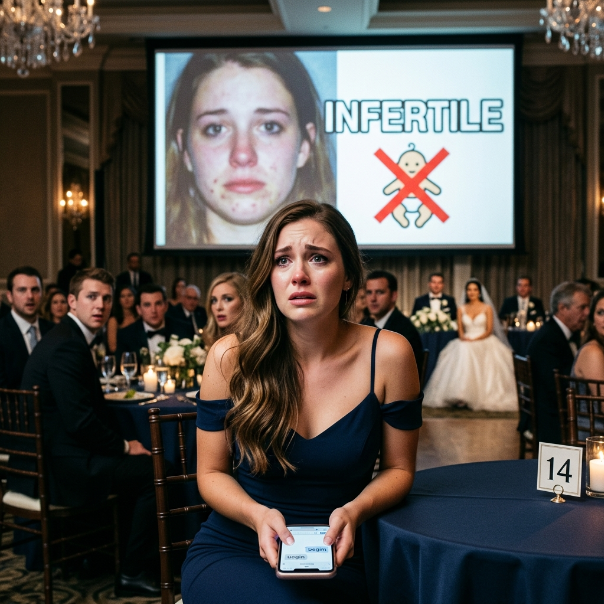
The words glowed on a 10-foot screen at my sister’s wedding reception — “infertile, divorced, failure” — and 200 guests laughed while my father smiled and said, “Just a joke, sweetheart.”
My mother swirled her wine like she was watching dinner theater, and my sister leaned into the microphone and said, “Don’t laugh too hard, she might actually cry” — but I didn’t cry.
I picked up my phone, typed one word — “begin” — and the room went so silent you could hear the ice cracking in my mother’s glass, and what happened next dismantled 16 years of lies and the family reputation built on top of them.
The Call That Started Everything
My name is Thea. I’m 34 years old. And four weeks before my sister’s wedding, I got the phone call that started everything.
It’s 11 p.m. on a Thursday. I’m at my desk in Richmond, elevation drawings for a historic courthouse renovation spread across my workspace. Coffee’s cold. Back aches. Normal Thursday.
My phone lights up. Unknown number. Virginia area code, but not Richmond. Somewhere smaller. Somewhere I used to know.
I answer.
“Thea?” A woman’s voice. Careful, professional. “My name is Dolores Vargas. I’m a nurse at Shenandoah Hills Care Center. Your grandmother asked me to call you.”
My hand tightens around the phone. Grandma Ruth. 84 years old. The only person in my family who ever made me feel like I belonged in it.
“She’s scheduled for hip replacement surgery in three weeks,” Dolores says. “Her health is stable, but at her age, there are risks. She’s been asking for you.”
I closed my eyes. Two years since I last saw her. I’d snuck into the facility on a Tuesday afternoon when I knew my father wouldn’t be there. We sat together for forty minutes. She held my hand and told me about her garden.
Then a staff member mentioned my visit to my father’s office. And Harold Lyndon made sure the front desk had instructions: Thea is not on the approved visitor list.
“There’s something else,” Dolores says. Her voice drops. “Your father told Ruth that you can visit, but only if you attend your sister’s wedding first. It’s in three weeks.”
Of course. Everything with Harold comes with conditions.
“And Miss Lyndon, your grandmother wanted me to tell you one more thing.” A pause. “She said they’re planning something at the reception. Something about you. She wanted you to be ready.”
I look up from my phone. On the wall across from my desk hangs a framed certificate: Virginia Emerging Architect of the Year.
Five years of silence. And the first voice I hear from that town isn’t my mother’s. It’s a nurse’s.
The Leaving
To understand what happened next, I need to go back further. Sixteen years further.
I’m eighteen. Senior year, sitting at the kitchen table in my parents’ house in Millbrook, Virginia — a town where everybody knows your last name and what your father’s worth.
Harold Lyndon slides a document across the table. A land transfer form. The property is a two-acre parcel on the edge of town. Rolling grass, a creek, one old oak tree. My grandmother Ruth gave it to me on my sixteenth birthday. Signed it over legally. Said, “This is yours, Thea. No matter what.”
“I need this parcel for the Oakdale project,” my father says. “Sign it.”
I look at my mother. Vivian Lyndon sits at the end of the table, flipping through a home decor magazine. She doesn’t look up. Doesn’t say a word. The sound of pages turning fills the silence.
I don’t sign.
Three days later, my father cancels my college tuition fund. The account he’d been setting aside since I was born — gone. Redirected. I find out when the registrar’s office sends a letter.
One week after that, Harold stands in the foyer with his arms crossed. “You walk out that door, you don’t come back.”
My little sister, Paige, eleven years old, watches from the top of the stairs. She doesn’t say anything either. She just watches.
I leave with one duffel bag and $43 in my checking account. That night, Harold tells the neighbors she dropped out, ran off with some boy, broke her mother’s heart.
None of it was true. But in Millbrook, my father’s word was the only one that mattered.
The Building
After the door closed behind me, I slept in my car for two weeks. Worked the counter at a gas station outside Charlottesville. Got my GED at nineteen while waitressing double shifts at a diner that smelled like bacon grease and bleach.
Applied to community college. Transferred to Virginia Commonwealth University on a need-based scholarship. Studied architecture because I liked the idea of building things that lasted — things that couldn’t be taken away with a signature.
I graduated at twenty-three. Nobody came to the ceremony. I wore my cap and gown, walked across the stage, and shook the dean’s hand. Then I went home to my studio apartment and ate takeout on the floor.
At twenty-four, I married Drew Halpern. He was twelve years older, charming in public, suffocating in private. He managed my bank account, screened my phone calls, and told me which friends I was allowed to keep. A smaller, quieter version of my father.
I got out at twenty-seven.
At twenty-eight, a doctor told me I couldn’t have children. I processed it alone in a clinic waiting room with fluorescent lights and a two-year-old magazine.
Now I’m thirty-four. Senior architect at Mercer and Hollis in Richmond. I design restorations of historic buildings — courthouses, libraries, theaters. My professional name is T. Mercer Lindon. I kept Drew’s name hyphenated because the architecture world already knew it.
Nobody in Millbrook knows any of this.
The Plan
The morning after Dolores’s call, I sit in my office with the door closed. Through the glass wall, I can see my colleague Marcus Cole at his desk. Thirty-six, ex-Army IT, and the most unflappable person I’ve ever met. He’s also the closest thing I have to family.
I call Dolores back.
“How bad is the surgery risk?” I ask.
“At eighty-four with her bone density, the surgeon said there’s a real chance of complications. She’s strong, but she’s not young.” Dolores pauses. “She cries your name some nights. She keeps your letters under her pillow.”
My grandmother hiding my letters under her pillow like contraband. Because in that family, loving me is something you have to do in secret.
I have two options: go to the wedding, endure whatever Paige and my parents have planned, see Grandma Ruth — or stay in Richmond, stay safe, and maybe never see her again.
I knock on Marcus’s glass wall. He pulls off his headphones.
“I need a favor.”
He listens to everything. The wedding, the warning, the nursing home ultimatum. When I’m done, he leans back and says, “If you go, you go with a plan. Not with hope.”
“I know.”
“And you’re going. She’s eighty-four, Marcus. She might not make it through surgery.”
He nods. Doesn’t argue. “Then we make sure you’re not walking in blind.”
That night, I book a hotel in Millbrook. I pull out a dress I bought myself — navy blue, well-cut, professional. Not the one my mother will try to hand me.
Marcus said, “Go with a plan.” So I started making one.
And for the first time in sixteen years, I was glad my family underestimated me.
The Dinner
Three weeks before the wedding, Harold requires a family dinner — his condition before he’ll clear my name at the nursing home front desk. So I drive two hours to Millbrook.
The house hasn’t changed. White columns, manicured lawn, American flag by the door. The performance of respectability down to the last trimmed hedge.
Nobody hugs me at the door. Vivian looks me over. “You look thin. Are you eating?”
“I’m not thin. I run three miles every morning and I eat plenty.”
But this is how my mother operates. Concern as a weapon wrapped in a question nobody expects you to answer honestly.
Harold sits at the head of the table. Same chair, same posture. “So, what are you doing with yourself these days?”
“I work at a design firm.”
“Answering phones, I assume.”
I pick up my fork. Don’t correct him.
Paige arrives late, trailing perfume and self-importance. She flashes a four-carat engagement ring under the dining room light. Then she pulls me aside in the hallway.
“I need you to wear something understated at the wedding. Garrett’s family is very particular.” She tilts her head. “You still alone? No one?”
I say nothing.
She smiles. “Some people just aren’t meant for that, I guess.”
Before I leave, Vivian hands me a garment bag. Inside, a pale beige dress. Shapeless. Two sizes too large.
“This will be perfect for you.”
At the door, Harold puts his hand on my shoulder. “The Whitmores are old money. They judge. One wrong move and this deal dies. Don’t embarrass us.”
I drive back toward the highway. And then the name hits me. Whitmore. I know that name. Not from Paige’s ring. Not from Harold’s business talk. I know it from a project file sitting in my office in Richmond.
The Discovery
Back at my desk Monday morning, I pull up the client database. Whitmore Heritage Foundation.
There it is. Our firm has been contracted for the Millbrook Heritage Restoration Project — converting a Civil War-era textile mill into a community arts center. The foundation is funding the entire thing. The client contact: Eleanor Whitmore, chair of the foundation. Garrett Whitmore’s mother.
I’ve been the lead architect on this project for six months. We’ve exchanged dozens of emails, three video calls. She knows my work, my design philosophy, my project timeline. She knows T. Mercer Lindon.
She does not know my face. We’ve never met in person.
I sit with this for a long time. I don’t plan to use it. I’m not Harold. I don’t weaponize connections. But I file it away. If everything falls apart in Millbrook, I am not a stranger to the most powerful family in the room.
That evening, Marcus does his own research. He calls me at nine.
“The reception venue — Millbrook Country Club. They’ve hired a local AV company to run a projector and sound system. Slideshow, toasts, the usual.” He pauses. “And guess what? The AV company is short-staffed. They just posted looking for a freelance tech for the event.”
“Marcus—”
“I already applied. Got a call back in twenty minutes.”
“You don’t have to do this.”
“Thea, you’re walking into a room where your family has already loaded a weapon. I’m just making sure you have access to the safety switch.”
By Wednesday, Marcus is confirmed as a freelance AV technician for the wedding reception. He’ll have direct access to the projector system, the USB inputs, and the soundboard.
I prepare a short presentation. Not an attack — just the truth. Photos, degrees, awards, my actual life. Title slide: The Real Thea Lindon.
I save it to a USB drive and hand it to Marcus on Thursday.
“You’re not going to war, Thea,” he says. “You’re going to a wedding. But if they fire the first shot, you’ll be ready to fire the last.”
The Grandmother
One week before the wedding, Harold clears my name at the front desk. Thirty minutes supervised. Vivian will accompany me.
Shenandoah Hills smells like hand sanitizer and boiled vegetables. Vivian parks herself in a chair in the hallway, already texting. She doesn’t come in.
Grandma Ruth is smaller than I remember. Her white hair is thinner. Her hands shake. But her eyes — those sharp, knowing eyes — haven’t changed.
She grabs my hand the second I sit down. “Let me look at you.” She studies my face. “You’re healthy. You’re strong. I can tell.”
“I’m good, Grandma.”
“Don’t let them break you again.” Her grip tightens. “You’re the strongest one in this family. You always were.”
She reaches under her pillow and pulls out a small envelope. Dolores helped her hide it from the staff. Harold pays to keep tabs.
Inside, a photocopy of a property deed. The two-acre parcel. My name clear as day.
“That land is yours,” Ruth says. “It always was. Your father never got it transferred. He’s been furious about it ever since.”
I stare at the document. For sixteen years, I assumed Harold had found some legal way around my refusal. Some technicality, some forged signature. He hadn’t. The land was still mine.
“He tells people it’s part of Lyndon Properties,” Ruth whispers. “But it’s not. He never had the right.”
A knock on the door. Vivian’s voice, clipped. “Time’s up.”
I fold the envelope into my jacket pocket. I lean down and kiss Ruth’s forehead.
“That’s my girl,” she murmurs.
I walk out past my mother, who doesn’t ask how Ruth is doing. She checks her lipstick and her phone screen and says, “Let’s go. I have a fitting.”
I leave the nursing home with two things: a grandmother’s blessing and proof that my father had been lying about more than just me.
The Slideshow
Six days before the wedding. My apartment in Richmond. Marcus sits on my couch with his laptop open.
On the screen, the slideshow I’ve built.
Slide one: A photo of me in my cap and gown at graduation. Alone, smiling anyway. Caption: No one came to my graduation. I went anyway.
Slide two: My architecture license framed on my office wall. Licensed Architect, Commonwealth of Virginia.
Slide three: Me on a job site, hard hat on, blueprints in hand. Senior Architect, Mercer and Hollis.
Slide four: The award plaque. Virginia Emerging Architect of the Year.
Slide five: A simple text screen — white letters on black. You called me a dropout. I have a master’s degree. You called me broke. I own my home. You called me a failure. I design buildings for a living.
Marcus scrolls through, nods. “Clean. Factual. No insults. Just the record.”
“That’s the point. I don’t want to attack them. I want the truth to be louder than their joke.”
He closes the laptop. “You sure you don’t want to add the part about your dad’s Oakdale problem? The land?”
“No. I’m not him. I don’t turn information into ammunition.”
“Then what’s the trigger?”
I show him. A text message pre-typed on my phone. One word: begin.
When I send it, Marcus switches the USB on the projector from Paige’s slideshow to mine. He’s already tested the system during setup at the venue. The swap takes three seconds.
“And if their slideshow turns out to be harmless?” he asks.
“Then I never send it. We leave. I visit Ruth. We drive back to Richmond.”
Marcus looks at me for a long time. “You know they won’t keep it harmless.”
“I know. But I need to give them the chance. One last chance to be decent. Because when this is over, I want to be sure — completely sure — that I didn’t fire first.”
The Wedding
The wedding day arrives under a clear October sky. Millbrook Community Church, white clapboard, steeple catching the morning sun. The parking lot is full of BMWs and Land Rovers. This is the social event of the season.
I wear my navy dress. Not the beige sack my mother picked out. I’d left it hanging in the hotel closet without a second thought.
Inside the church, 200 guests fill the pews. Millbrook’s business community, country club members, town council acquaintances. And in the front row, the Whitmores. Eleanor in a deep green jacket, silver hair pinned back. Her husband Richard beside her.
I sit in the last pew. No one greets me. No one offers to scoot over.
Harold works the center aisle like a campaign trail. “So proud of my little girl.” He doesn’t mean me.
Vivian floats near the altar in a custom ivory dress. “Both my daughters are here today. Even the difficult one.” She laughs lightly. The friend glances toward the back.
I pretend not to notice.
An older woman I don’t recognize sits two rows ahead of me. White hair, floral dress, reading glasses on a chain. She looks at me once, then back toward the altar.
The ceremony begins. Garrett speaks his vows with a tremor in his voice. Paige speaks hers louder, longer, mostly about herself.
Across the church, I spot Marcus near the side entrance wearing a black polo with the AV company’s logo. He adjusts a microphone cable. Our eyes meet for half a second. He gives the smallest nod.
Table 14
The reception is at Millbrook Country Club. Crystal chandeliers, round tables draped in white linen, a 10×6-foot projection screen behind the head table. The smell of gardenias and money.
Table 14 is where I’m seated. Back corner, next to the kitchen door. Every time a server pushes through, a blast of clattering dishes and shouted orders hits my back.
My tablemates are distant cousins who’ve clearly been told nothing about me, and an elderly couple who spend the entire appetizer course discussing their recent cruise.
A woman across the table leans in. “And what do you do, dear?”
“I’m an architect.”
“Oh, how nice.” She turns to the man beside her and starts talking about kitchen renovations.
On stage, Paige takes the microphone for the first toast. She thanks her parents. She thanks the Whitmores. She thanks her college friends, her wedding planner, her florist.
Then she looks toward the back of the room. Toward me.
“And my sister Thea, who — well — who managed to show up today. That’s something, right?”
Scattered laughter. The polite kind. The kind where people aren’t sure if they’re supposed to laugh, so they do anyway.
Harold clinks glasses at the head table with Richard Whitmore. They’re leaning close, talking numbers.
My mother appears at my elbow. Her perfume arrives before she does. “Don’t drink too much,” she whispers. “Don’t talk about yourself. And for God’s sake, smile.”
I smile. Not because she told me to. Because in twenty minutes, the slideshow is scheduled to play, and I know exactly what’s on it.
The Punchline
The lights dim. Paige’s maid of honor takes the microphone with a grin that tells me she’s been rehearsing this all week.
“And now — a special presentation from the Lyndon family.”
The screen flickers to life. Soft piano music plays through the speakers. Baby photos of Paige. Gap-toothed smile. Ballet recital. Prom. Paige and Harold fishing on a lake. Paige blowing out birthday candles.
I’m not in a single photo.
The room coos. Aww. Eleanor Whitmore smiles politely.
Then come the couple photos. Paige and Garrett at a vineyard. At a football game. At Christmas dinner with the Whitmores. Each one earns soft applause.
The music shifts. Playful. A drum roll sound effect.
The screen reads: “And now — let’s meet the rest of the family.”
Paige grins from the head table. She catches my eye across the room and wiggles her fingers in a little wave.
My stomach drops. Not from fear. From certainty. Because I know what comes next.
Under the table, my phone is already in my hand. The message to Marcus is typed and ready. One word: begin.
My thumb hovers over the send button. I make myself a promise. If the next slide is harmless — if it’s an old photo with a gentle caption, if it’s a real toast, if there’s even a scrap of decency in what they’ve prepared — I won’t press it.
I’ll take the joke. I’ll go home. I’ll let them have their night.
I give them one last chance to be decent.
The screen changes. My face fills the frame. An old photo from high school. Grainy, unflattering. Across the bottom, bold white letters: High School Dropout. Check mark.
Nervous laughter ripples through the room. A few people glance at me.
I keep my face still.
Next slide. A cracked heart emoji beside my name. Divorced.
The laughter grows louder. The kind that feeds on itself.
Next. An animated cartoon of an empty wallet flapping open. Broke.
Someone at table six snorts into their champagne.
Next. A photo of a single place setting. One chair, one plate. Alone.
Paige is laughing from the head table. Vivian sips her wine, watching the room like she’s scoring the performance.
Then the final slide loads. A clip art baby with a red X stamped across it.
Infertile.
The word fills the 10-foot screen. For a moment, the room goes quiet. The shocked kind — where people realize they’ve been laughing at something they shouldn’t have.
Then a few more laughs break through. Uncomfortable, but following the leader.
Paige leans into the microphone. “Don’t laugh too hard. She might actually cry.”
Vivian swirls her wine. Half-smile. Eyes on me.
Harold catches my gaze from the head table. “Just a joke, sweetheart. Lighten up.”
Eleanor Whitmore is not laughing.
I see it clearly from across the room. She sets her glass down on the table with a quiet click. Her jaw tightens. She looks at Harold, then at the screen, then at me.
I feel the blood rush into my face. My hands shake. My vision narrows to one word on that screen.
Infertile. My medical history. My private grief. Projected for 200 strangers to laugh at.
That was the line. And they didn’t just cross it. They broadcasted it in 10-foot letters.
I look around the room. 200 faces — some laughing, some looking away, some pretending to check their phones.
Paige is beaming. This is her favorite part of her own wedding. Not the vows, not the first dance. But this: watching me sit in the wreckage of my own humiliation.
Vivian raises her glass slightly — a silent toast to her own cruelty.
Harold has already turned back to Richard Whitmore, resuming their conversation as if nothing happened. As if putting “infertile” on a screen for 200 people is the social equivalent of a knock-knock joke.
I look down at my phone. The message is still there. One word: begin.
I think about Ruth. About her hands shaking when she gave me that envelope. About the way she said, “Don’t let them break you again.”
I’m not breaking.
My thumb presses send.
👉 [Tap here for the Next Part ] 👈