PART ONE: THE HALLWAY
There is a particular kind of hallway that exists in very expensive private schools. Wide, sunlit, lined with tall windows and polished floors, built to feel like possibility itself. And yet some children walk through hallways like that every single day and still feel, inside themselves, as though the walls are pressing closer than anyone realizes.
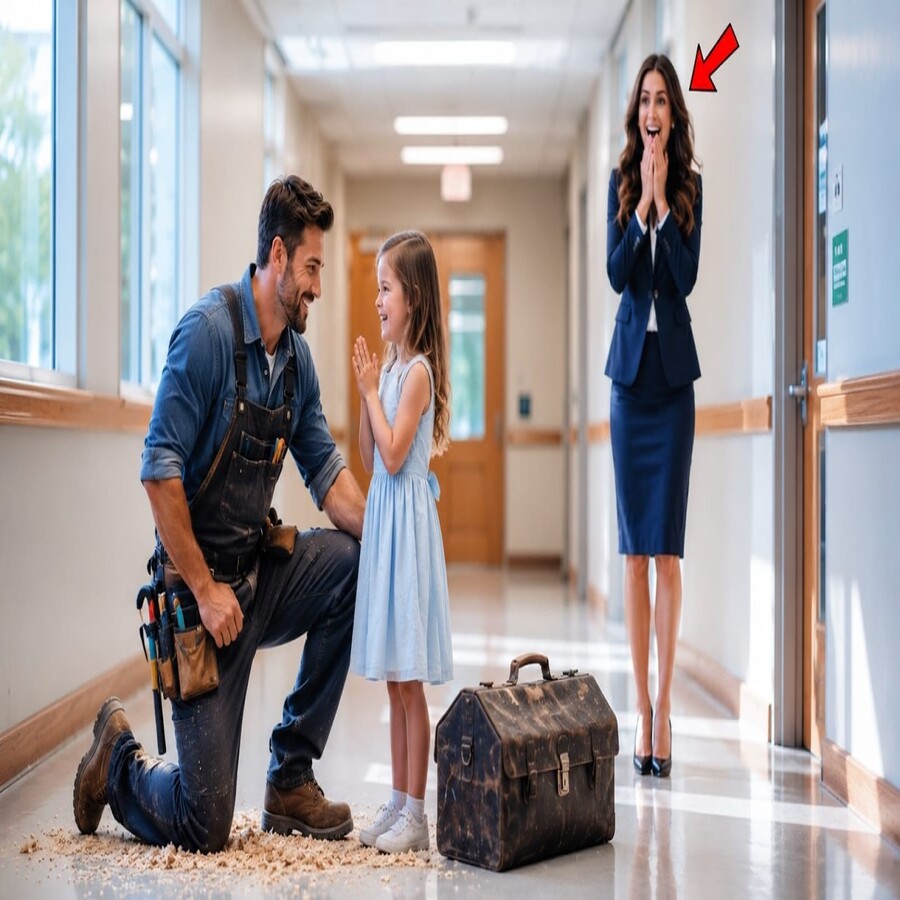
It was in a hallway exactly like that one, on a Wednesday afternoon in early spring, that a man kneeling on the floor amid a scatter of wood shavings did something that would be talked about at Brookhaven Preparatory Academy for years afterward. Not because it was dramatic, but because of what it revealed, quietly and without ceremony, about a little girl who had not spoken a single word since the day she was born.
Her name was Lila Vandermeer. She was seven years old with long, soft brown hair and pale blue eyes that seemed to take in everything around her with a careful, watchful intensity that unsettled some adults and fascinated others. She was the only daughter of Camille Vandermeer, the founder and CEO of Vandermeer Holdings, a venture capital firm with a portfolio spanning technology, healthcare, and renewable energy. She was one of the wealthiest women on the Eastern Seaboard.
Lila had never spoken. Not as an infant, not through the babbling stage that typically precedes language, not through years of careful evaluation by some of the most respected pediatric specialists in the country. Extensive testing had ruled out hearing loss. Her hearing was, in fact, exceptionally acute. It had ruled out most structural or neurological explanations doctors could identify.
What remained was a diagnosis that frustrated everyone involved precisely because it offered no clear path forward. A profound and persistent form of selective mutism, compounded, the specialists believed, by something they could not fully name. Perhaps trauma, perhaps temperament, perhaps some combination neither medicine nor patience had yet untangled.
Camille had spent a small fortune over seven years on therapists, specialists, alternative communication devices, sign language tutors, and every reasonable intervention recommended to her. Lila had made progress in small, halting ways. She communicated through gestures, through a tablet loaded with communication software, through careful drawings she left for her mother to interpret.
But actual spoken words, the simple sound of her daughter’s voice, remained, after seven years, entirely out of reach. Camille had grieved this in private, almost obsessively, for years. Not because Lila was somehow incomplete without speech, she would have insisted to anyone who asked, but because she feared, quietly and persistently, that her daughter carried something painful inside her that she had no way of releasing.
On this particular Wednesday, Camille had come to Brookhaven Preparatory for a routine parent conference. Dressed in a sharp navy suit, her heels clicking against the polished hallway floor as she made her way toward the headmistress’s office. She rounded a corner and stopped abruptly.
There, kneeling on the floor amid a scattering of wood shavings, was a man in worn denim overalls and a tool belt. A battered leather toolbox open beside him. Clearly the school’s contracted carpenter, brought in, as Camille vaguely recalled being told, to repair some damaged cabinetry in the science wing. And kneeling across from him, her small hands pressed together in front of her chest, her face lit with an expression Camille had not seen in years, was Lila.
The carpenter’s name was Walter Hayes. He was thirty-nine years old, a widowed single father raising his own daughter, Maren, who was nine and attended Brookhaven on a partial scholarship that Walter supplemented through steady, careful work. Carpentry, repairs, small renovation projects for the school and for families throughout the district who valued his quiet, meticulous craftsmanship.
Walter had been working in the hallway outside the science wing for the better part of the morning, repairing a built-in cabinet that had warped over the winter. Lila, who had wandered out of her classroom during a transition period, drawn by the particular rhythmic sound of sanding wood, had stopped to watch him work with the same intense, careful focus she brought to most things that interested her.
Walter had noticed her standing a respectful distance away. Rather than shooing her back toward her classroom, he had simply continued his work, occasionally glancing up to offer a small, unhurried smile. The way a person acknowledges someone’s presence without demanding anything from them in return. After several minutes, he had set down his sandpaper and held up a small offcut of wood. A scrap, really. Nothing of consequence. He offered it to her.
She had taken it carefully, turning it over in her small hands, feeling its smooth edges. Walter had watched her do this with the particular patient attention of someone who understood, instinctively, that some children communicate entirely through their hands and their eyes long before or instead of their voices.
It was at this point, several minutes into their wordless exchange, that Walter had done something that none of the specialists, therapists, or well-meaning adults in Lila’s life had thought to try in quite this particular way.
He had not asked her to speak. He had not encouraged her, gently or otherwise, to try saying a word, the way so many adults reflexively did when they learned of her condition. As though enough gentle encouragement might simply unlock something that years of careful professional intervention had not.
Instead, he had simply talked to her easily, naturally, the way he might talk to his own daughter or to any other child curious about his work. Describing what he was doing, why certain cuts needed to be made a particular way, what kind of wood worked best for cabinetry exposed to humidity. He had not required anything from her in return.
He had simply included her, fully and without condition, in the ordinary texture of his work and his attention. And then, watching her examine the wood scrap with such careful absorption, he had said something simple and direct, the kind of small observation that asked nothing of her at all.
“You’ve got good hands for this,” he said. “Careful hands. That matters more than people think in this kind of work.”
Lila had looked up at him. And then, for the first time in seven years, she had opened her mouth, and a single word had emerged. Quiet, halting, slightly unpracticed in the particular way a voice sounds when it has simply never had occasion to form sounds before.
“Careful,” she had said.
Walter had not made a sound. He had not gasped, had not reacted with the kind of overwhelming emotional display that might have startled her back into silence. He had simply nodded, calmly, as though this were the most ordinary exchange in the world.
“That’s right,” he said gently. “Careful hands.”
👉 [Tap here for the Next Part ] 👈
Disclaimer : This content may be created by AI for entertainment purposes. Any resemblance to real persons, events, or places is coincidental.