Her husband died 6 months ago, mining accident, left her alone with two small children and a farm she had been fighting to keep ever since. She was doing everything right, every payment, every month, never missed one. Then one Thursday morning, a man walked into the restaurant, dropped a paper beside her coffee, and said it loud enough for everyone to hear, “You’ve got 3 days, Mrs. Holt, $700 or we take the farm.
” She didn’t cry, didn’t argue, just looked at her hands, the hands of a woman who had been holding everything together alone since the day Thomas didn’t come home. Nobody in that room said a word, nobody moved, almost nobody, because at the far end of the counter, a stranger had just picked up that paper, read it once, and set down his coffee.
And the man who delivered that notice had no idea that the most expensive mistake of his life had just been made in a small restaurant on a Thursday morning in Greystone. Before we begin, if stories like this mean something to you, subscribe to the channel right now and drop your country in the comments, just one word. I read every single one. Now, let’s ride.
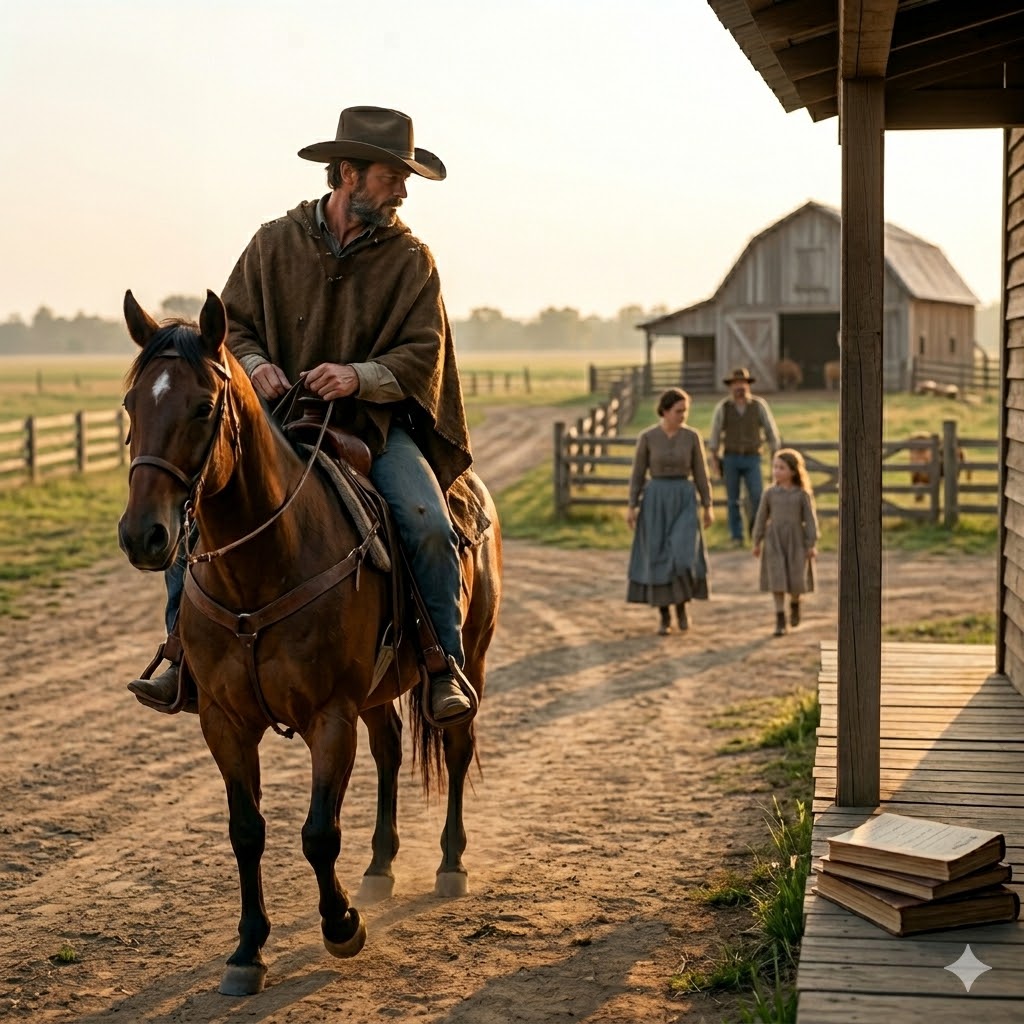
Scout came into Greystone at an easy walk, ears neutral, reading the town the way he always read new towns, not with alarm, just attention, the slow, careful assessment of an animal that had learned over years of difficult mornings that the difference between a safe town and a dangerous one was rarely obvious from the outside and almost always obvious within the first 2 minutes if you were paying the right kind of attention.
The gunslinger tied him at the far end of the main street, away from the other horses, in the spot that gave Scout visibility in three directions. He put one hand on the horse’s neck before walking away. Scout’s ears had moved forward slightly toward the bank building at the center of town and stayed there.
The gunslinger noticed, filed it, walked toward the restaurant at the near end of the street, and ordered coffee. He was halfway through it when the door opened and a man walked in who did not belong to the restaurant. He belonged to the bank, you could tell by the way he dressed, by the leather case under his arm, by the specific confidence of someone who had been sent to deliver something unpleasant and had done it enough times to have stopped feeling unpleasant about it.
He moved through the small room without looking at anyone except the young woman sitting two seats down from the gunslinger. And when he found her, he dropped a paper beside her coffee and said it loud enough for the whole room to hear, “You’ve got 3 days, Mrs. Holt, $700 or we take the farm.” Then he turned around and walked back out into the morning like he had delivered a weather report and had three more stops before noon.
Sarah Holt looked at her hands on the counter, not at the paper, just at her hands, the hands of a woman who had been holding everything together alone since the morning 6 months ago when two men knocked on her door and told her that Thomas wasn’t coming home from the mine. She didn’t cry, didn’t argue, didn’t say a single word.
She just sat there for a moment with that specific stillness of someone absorbing something that has no good answer. And then she gathered herself and stood and picked up her coat. The gunslinger picked up the paper she left beside her coffee and read it. Then he read it again because the number on it didn’t match the payment history of a woman who had been managing a working farm alone for 6 months and keeping herself together well enough to sit that still in a public room when a man delivered news like that.
He called her at the door. One question, did she have her payment receipts? She looked at him the fast-assessing way that people look at strangers who ask unexpected questions, deciding in about 3 seconds whether the question deserves an answer. Then she said, “Yes, every one, 3 years of them.
” Thomas had kept every receipt in a drawer in the kitchen. The gunslinger asked to see them. She asked why. He said because the number on that paper doesn’t come from a woman who has been making payments for 3 years and keeping the proof of every one. She studied him for a moment longer, the worn poncho, the hat, the expression that didn’t ask for her trust but somehow communicated that it could be given without being wasted.
“Come to the farm this afternoon,” she said, and she walked out into the street. He paid for his coffee and followed a minute later. On the way past the bank, he noticed that Scout had shifted at the hitching post, not dramatically, just a quarter turn, enough to put both ears directly on the bank’s side door, which was open just slightly, just enough for someone standing inside to watch the direction Sarah Holt had walked without being seen doing it.
The gunslinger didn’t slow his pace, didn’t look at the door, just noted it and kept walking, filing it alongside the number on the paper and the 3 years of receipts in a kitchen drawer, building the shape of something he didn’t yet have a name for, but recognized the outline of the way you recognize a storm from the quality of light before the clouds arrive.
The Holt farm sat 3 miles south of Greystone at the end of a dirt road that told its own story, maintained fences, organized pasture, a barn that had been repaired recently and repaired correctly. The kitchen garden beside the house still producing into the late season because someone had been tending it with the specific care of a person who understood that a kitchen garden in winter is not a comfort, it is a necessity.
This was not the farm of a woman who had been missing payments. This was the farm of a woman who had been doing everything right. He sat at the kitchen table and read every receipt in Thomas Holt’s careful handwriting, 3 years of payments, every date and every amount. And then he set them beside the bank notice and looked at what they told him together.
The $700 debt on that paper had not been created by missed payments. It had been created by someone who had gone into the bank’s records after the payments were made and removed them. Jacob appeared in the kitchen doorway, 7 years old, dark, serious eyes that had seen 6 months of his mother holding things together and had quietly decided to help hold them.
He looked at the receipts spread across the table, then at the stranger sitting across from his mother, then directly at the gunslinger with the specific directness of a child who has learned that indirect questions don’t get useful answers. “Can you fix it?” he asked, not hopefully, just directly.
The gunslinger looked at the boy, then at the receipts, then at the notice beside them. “I’m going to look into something first,” he said. “What I find will determine what comes next.” Jacob nodded once, the nod of someone filing information in the place where important things go. “Look fast,” he said quietly, “we’ve only got 3 days.
” He spent the next morning moving through Greystone the way he moved through every town that was hiding something not directly, not at the obvious places, but around the edges where people talk without knowing what they are actually telling you. The feed store, the telegraph office, the barber shop where men sit and wait and fill the waiting with conversation that carries more truth than they intend.
What he found built slowly at first and then arrived all at once the way truth tends to arrive when you have been collecting enough of its pieces in the right order. Eight farm sales in the Greystone Valley in the past 2 years, all small operations, all carrying loans from the same bank, all with the same pattern, sudden payment gaps appearing in the bank’s records that the former owners swore had never existed.
All sold to the same land-holding company at prices well below what the land was actually worth. And 3 weeks ago, a surveying crew had been working the north end of the valley, not road surveyors, mineral surveyors, the kind that appear in a valley when someone already knows something about that valley that the people living in it don’t.
Here is something worth knowing about frontier banking in 1883 that rarely gets said plainly. A bank’s internal records were the legal truth of a loan status in any territorial court. A borrower’s personal receipts were meaningful but secondary, the kind of evidence that a good lawyer could argue around given enough time and the right judge.
A bank whose ledger showed a default would almost always prevail over a widow with a handwritten receipt book because the assumption built into territorial law was that banks kept accurate records and individuals made mistakes. Men who understood this gap could manufacture a default that was legally almost impossible to challenge from the outside.
All it required was a bookkeeper willing to make precise adjustments to precise records at precisely the right moments. Edmund Foss had understood this for 2 years. He had a very precise bookkeeper and he had been using both of them with the patience of someone who had already decided how this was going to end before anyone else knew the game had started.
He sent a telegram to his contact in the territorial records office before noon. The land-holding company that had purchased all eight farms connected to Edmund Foss through two intermediary registrations, the kind of careful corporate layering that takes a lawyer and deliberate intent to construct. Foss had been filing land acquisition paperwork on the valley corridor for 18 months and a senior Kansas Pacific land agent had been receiving quarterly payments from a holding company sharing a registered address with Foss’s bank.
Foss didn’t guess about the railroad route, he was told. 16 months before the public announcement, every family in that valley had been losing their land to information they were never given and a man who had used that information like a weapon from the moment he received it. He found Foss at the bank at midmorning, 55 years old, silver-haired, the careful grooming of a man who understood that appearance was a professional instrument, as important as any contract.
20 years of legitimate banking in Greystone had given him a specific kind of community gravity, the accumulated trust of a man who had been present and reliable for two decades and had learned exactly how much that trust could carry if it needed to. Foss received the gunslinger pleasantly, expressed genuine sympathy for Mrs. Holt’s situation, explained the payment gap with the smooth precision of someone who had explained it before and found the explanation sufficient and offered a 30-day extension with additional interest as an act of goodwill. All of
it delivered in the tone of a reasonable man doing a difficult job responsibly. None of it true. And the gunslinger let him believe the pleasantness was landing the way it was supposed to because what Foss didn’t know was that a receipt book in a kitchen drawer had already made the pleasantness irrelevant.
On his way out of the bank, he passed the back room where a thin precise nice man sat at a desk surrounded by ledgers with the specific posture of someone who had been doing detailed work for long enough that the detail had become its own kind of prison. The bookkeeper looked up when the gunslinger passed the open doorway, held eye contact for 1 second too long.
Not guilt exactly, something more complicated than guilt. The expression of a man who has been carrying something heavy for 18 months and has just looked at the first person who might be strong enough to take some of the weight. The gunslinger filed that look the way he filed everything because a man who holds eye contact 1 second too long with a stranger in a bank hallway is a man who has been waiting for a reason to say something he hasn’t said yet.
Before we go any further, I want to ask you something and I want you to answer honestly in the comments. Have you ever paid what you owed every single payment on time with proof and still been told you hadn’t? A receipt in your hand and someone telling you it didn’t count? Because that is exactly what Sarah Holt was facing.
Not a debt, a manufactured story about a debt. Drop your answer below. No judgment here, none at all. Because more people have been in that position than anyone ever says out loud and tonight I want to hear from them. Scout was at the Hitching Post at the far end of the main street when the gunslinger came out of the bank and the horse had positioned himself the way he positioned himself when something in the environment had shifted not alarm, just the heightened attentiveness of an animal that had recalibrated its assessment of a situation and wanted its
rider to know. The gunslinger read him without stopping his stride. Then he saw why. The thin man from the bank’s back room was standing at the mouth of the side alley 30 yards ahead, not moving, waiting with the specific purposeful stillness of someone who has made a decision and is holding it in place until the moment arrives to act on it.
He had come out the bank’s back door and walked around the building and waited. That kind of effort meant whatever he had come to say was something he had been deciding to say for a long time. He stopped in front of the gunslinger and said it without preamble because men who have been building towards something for 18 months don’t waste the moment with small talk. “The receipt book is right.
” Sims said. His voice was quiet and precise, the voice of a man who measured his words the same way he measured ledger entries, carefully and without excess. “Every payment was made. I adjusted 18 months of records on Mr. Foss’s instruction.” A pause that carried the weight of every farm, every family, every adjusted entry in it.
“I kept the original ledger before the adjustments were made.” The gunslinger looked at him steadily in the afternoon light at the tired eyes of a man who had been doing something he knew was wrong for long enough that the knowing of it had worn him down to something quieter and more honest than the man he had been when he started.
“Where is it?” the gunslinger asked. Sims told him and everything Edmund Foss had spent 2 years building carefully in the dark was standing at that moment directly in the path of the light. They retrieved the ledger before dawn while Greystone was still dark and the only sound on the street was Scout’s breathing at the hitching post outside Sims’s boardinghouse.
The ledger was under the floorboard beneath Sims’s bed, not dramatically hidden, just stored the way a man stores something he knows is dangerous and cannot bring himself to destroy because destroying it would mean admitting to himself that the thing he did was permanent and could never be accounted for. The gunslinger went through it by lamplight while Sims stood at the window watching the empty street below.
What the ledger contained was more complete than expected and more damning than anything a territorial court could argue around. Not just the adjusted entries, Sims’s own handwritten notes alongside every adjustment dates, original amounts, the specific payment records that were removed or altered, and the name and date of each farm affected.
Nine farms, nine families, all documented in the same careful hand that had been used to destroy them. The man who made the adjustments had kept a record of everyone. Perhaps because some part of him had always understood that a record was the only thing that stood between what he had done and what he might still be able to do about it.
Here is something worth knowing about railroad announcements and land value in the frontier territories of 1883 that tends to get lost in the broader history. When a railroad announced a route, land prices along that corridor could increase anywhere from 5 to 20 times their previous value almost immediately.
A farm worth $3,000 at farming value could be worth 30,000 or more the week after the announcement depending on its position relative to the planned track. The families living on that land had no way of knowing this was coming, no access to the survey information, no railroad contacts, no mechanism for understanding that the ground beneath their feet had quietly become worth 10 times what they believed.
Edmund Foss had known for 16 months. He had a contact. He had a plan. And he had a bookkeeper precise enough to execute it without leaving anything visible on the surface. Nine families had fallen through the gap between his information and theirs without ever understanding what the gap actually was. He brought the ledger to the Holt farm before the children woke.
Sarah sat at the kitchen table in the early gray light and read it every adjusted entry, every manufactured gap, the specific documentation of how Thomas’s 3 years of careful payments had been erased from the record after he died in the months when Sarah was managing grief and two children and a working farm and had no reason to suspect that the bank she had been trusting was quietly rewriting the history of everything her husband had paid. She read without speaking.
When she finished, she closed the ledger and placed both hands flat on the cover and sat that way for a moment in the gray kitchen light. Then she looked up. Her eyes were dry. Her jaw was set. “Thomas paid everyone.” she said. Not for the gunslinger, just for the record. Just to say it out loud in the kitchen where Thomas used to sit with his coffee before the morning started. “I know.
” the gunslinger said. She nodded once. Then she stood and started making coffee because there was work to do and 2 days left on the clock and sitting still had never been something Sarah Holt was built for. What happened next was something nobody asked for and nobody could have stopped. While the gunslinger was at the land office filing the formal territorial review request, the original ledger copied and submitted, the Holt receipt book attached, everything dated and witnessed by the land office clerk Jacob Holt, rode to two of the
neighboring farms on the farm horse. The farms whose families had already sold but hadn’t yet moved. He told them what he knew, that someone was reading the real ledger, that the sales might be challengeable, that they should not move their families off the land until they heard more.
He was 7 years old and he did this alone and was back at the farm before noon with the specific quiet satisfaction of a boy who has done something he decided needed doing and doesn’t require anyone’s approval of the same and decision. The gunslinger found out from the land office clerk who saw him ride past.
He said nothing about it to anyone but it stayed with him in the place where things stay when they mean more than you expect them to. Foss found out about the ledger before noon. He had someone watching Sims’s boardinghouse, a man who checked in every morning because a careful operation monitors its vulnerabilities and Sims with his original notes and his increasingly tired eyes had been a vulnerability Foss had been watching for 6 months.
By the time the gunslinger left the land office, Foss knew the ledger was gone and knew where it had gone. What he did next was the most revealing thing Edmund Foss did in the entire story. He didn’t send men to the land office. He didn’t confront the gunslinger directly. He sent three men to the road between the land office and the Holt farm with instructions to retrieve the documents before they could be used further.
Not to harm anyone, just to retrieve the documents. Because in Foss’s world, paper was always the weapon and paper was always the solution and the idea that something other than paper might have already changed the situation had not yet occurred to him. Scout smelled them in the tree line 40 yards before the road narrowed at the creek crossing.
The specific stillness of horses told to wait in a position they wouldn’t naturally choose, the kind of stillness that reads differently from resting stillness if you have learned to tell the difference, which Scout had across more difficult roads than this one. The gunslinger read the horse, read the narrowing road, read the high banks on both sides of the crossing and made two decisions simultaneously.
The first was to take the creek bed route 20 yards upstream where the banks dropped and the geometry of the ambush stopped working. The second was that the filed copy of the ledger was already with the land office clerk and the original was in his coat and neither of those facts was going to change regardless of what the three men in the tree line believed they were about to accomplish.
Two shots, one warning. Three men who discovered the documents were not worth what this particular morning was starting to cost them. He rode back into Greystone as the afternoon light dropped low and found something he had expected but had hoped would take longer to arrive. Foss was standing outside the bank with Sheriff Heck beside him, a man who had been carefully, professionally neutral for 2 years and had now, at the precise moment when neutrality stopped being safe, chosen his side and four deputies behind them, and a territorial injunction in
Foss’s hand, obtained in 4 hours through his lawyer from a judge whose name appeared twice in Sims’s original notes. The injunction ordered the suspension of all land office filings connected to the Holt matter pending territorial review. Foss looked at the gunslinger across the street with the expression of a man who has just remembered where his real power has always lived, not in hired men, not in force, but in paper, in relationships, in 20 years of knowing which levers existed and exactly how to reach them from a position of
respectability. “The territorial court will handle this properly,” Foss said, pleasant as always, confident as always. The gunslinger looked at him, then at the sheriff, then at Sarah standing in the doorway of the land office behind him with Jacob at her side and May holding her hand and 1 day left on a 3-day clock that Foss had set and believed he still controlled.
“Time,” the gunslinger said quietly, “is the one thing you have already run out of.” Foss smiled the smile of a man who didn’t understand what that meant yet. By morning, he would understand it completely, and the smile would be gone. What Foss didn’t know, what his lawyer hadn’t thought to find out, was that the gunslinger had sent his own telegram the evening before any of this morning’s events had begun, not to the territorial capital, directly to a federal banking examiner named Coles, who been building against irregular foreclosure patterns
across three territorial banking districts for 8 months and had been waiting, without knowing he was waiting, for one documented case with original records clean enough to make everything actionable. The original ledger that Sims had kept under his floorboard for 18 months was that case, complete, detailed. Nine farms.
Every adjustment documented in the hand of the man who made them. Coles’s federal banking inquiry opened before Foss’s territorial injunction was 12 hours old. Federal banking authority doesn’t negotiate with territorial court orders. It supersedes them the way a river supersedes a fence built across it, not dramatically, not with announcement, just with the quiet certainty of something that was always going to win.
Foss’s judge couldn’t help him. His lawyer couldn’t help him. 20 years of institutional relationships in Greystone had just run into something they were never constructed to handle. Sims appeared at the land office at dawn of the second day. He had spent the night writing a full signed confession, 18 months of it.
Every adjustment, every instruction from Foss, every farm, every amount, the complete chain from Foss’s approval down through every level of the operation, witnessed and dated by two people whose names had no connection to anyone in this story. He handed it to the gunslinger without ceremony or explanation, the way a man hands over something he has been carrying too long and has finally decided the carrying is finished.
The gunslinger looked at the confession, then at Sims, the thin precise man with the tired eyes who had kept a secret record of everything he did wrong so that one day he could account for it. “Where will you go?” the gunslinger asked. Sims looked at the bank across the street for a long moment, at the window where he had sat for 18 months.
“Somewhere I don’t have to be precise about the wrong things,” he said quietly. He rode east before the town finished waking. Some men, when they finally put something down, need to already be somewhere else before they can breathe again. The gunslinger walked into Foss’s office and placed four things on the desk without announcement.
The original ledger, the federal inquiry notice bearing Coles’s official seal, Sims’s signed confession, and Sarah Holt’s receipt book, 3 years of Thomas Holt’s careful payments in his own handwriting, every date, every amount, the record of a man who took his obligation seriously and honored every one of them. Foss looked at the four items for a long time without touching any of them.
The silver hair, the 20 years of careful reputation, all of it present and none of it useful anymore. “The adjustments were a bookkeeping error,” he said finally, reaching for the last available explanation like a man reaching for something in the dark that isn’t there. The gunslinger looked at him across the desk.
“18 months of the same error,” he said, “across nine farms, along the same railroad route.” Foss closed his eyes for 1 second. When he opened them, the gunslinger was already at the door and there was nothing left in that room worth saying. The federal inquiry moved fast because Coles had been waiting for exactly this.
Within a week, the Holt debt was formally canceled. Eight completed sales flagged for full review and fair compensation. Foss’s banking license suspended pending investigation. The land holding company frozen by court order. The railroad route announced 3 weeks later the valley land Edmund Foss had spent 2 years acquiring at desperate prices now worth exactly what he had calculated it would be worth.
He didn’t own any of it anymore. There is a particular justice in that which no court ordered and no law required. It simply happened, the way certain things happen when the truth arrives in the right hands at the right moment and the people holding it refuse to put it down. The morning the gunslinger left, May was in the yard before anyone else was awake, the way 5-year-olds are sometimes awake before the world has decided to start.
She had her cloth rabbit under one arm and she was standing in the early light watching the way she had been watching him every morning since the first day, with the specific patient attention of a child who has decided she understands something about that horse that the adults around her haven’t figured out yet. Scout dropped his head for her the moment she appeared slow and deliberate, the invitation he reserved for people he had placed in the category of things worth being gentle around, a category he did not expand easily.
She walked right up and put her small hand flat on his nose. Scout went completely still. “Is he nice?” she asked without looking up. “To the right people,” the gunslinger said. She thought about this with the gravity it deserved. Then she looked up at him with the direct eyes of a 5-year-old who has one more question and intends to ask it regardless of whether the answer is comfortable.
“Are you coming back?” He looked at her, the honest version, not the comfortable one. “I ride north,” he said, “but north is a long road.” May patted Scout’s nose once more and walked back to the house with her rabbit and the particular unhurried dignity of a child who has decided that answer was sufficient.
Jacob was at the fence line doing the morning check, the same check his father used to do, now done by a 7-year-old with the seriousness of someone who understood that the work didn’t stop because the person who taught you stopped. He looked up when Scout passed. “Did you fix it?” Same question, same directness. Three days later and not a word of it changed.
The gunslinger stopped Scout and looked at the boy and at the farm behind him, the fenced pasture, the organized barn, the kitchen garden, all of it still standing, still Sarah’s, still the Holt farm the way Thomas built it. “Your father fixed it,” he said. “Three years of receipts in a kitchen drawer, that’s what fixed it.
” Jacob looked at the farm for a moment, then back. “He knew someone would come?” The gunslinger thought about Thomas Holt paying every payment, keeping every receipt, the specific quiet faith of a man who believed that doing right and keeping the record of it was enough, even if he never lived to see it proven. He knew the truth would matter.
The gunslinger said, “If someone was paying attention.” Jacob nodded, filed it in the place where important things go. The gunslinger rode north. Scout moved easy beneath him, covering ground the way he Ears reading the country ahead with the calm attentiveness of an animal that had learned to recognize what was coming before it arrived.
The farm disappeared behind the first rise. The receipt book was in a kitchen drawer where it belonged. Two children were on land that was theirs, and somewhere in a bank office in Greystone, four items sat on a desk that had just told a man what 20 years of careful building had actually cost the people around him. I think about Jacob’s question more than I probably should.
Did he know someone would come? Thomas Holt didn’t know anything except that he had paid what he owed and that the proof of it deserved to be kept. That’s all. A man doing right and keeping the record of it in a kitchen drawer because he believed it mattered. It shouldn’t have been enough. In most places, it wouldn’t have been.
But Scout moved north and the farm was still there and May was still asking her questions and Jacob was still doing the morning check and Thomas Holt’s name was still on the deed. He paid everyone. That mattered. It always does. If stories like this still mean something to you, if you believe that one person paying attention at the right moment can change more than they will ever know, then stay with us and subscribe to the channel.
The trail is long and there is always another story waiting at the end of it. We will see you there.