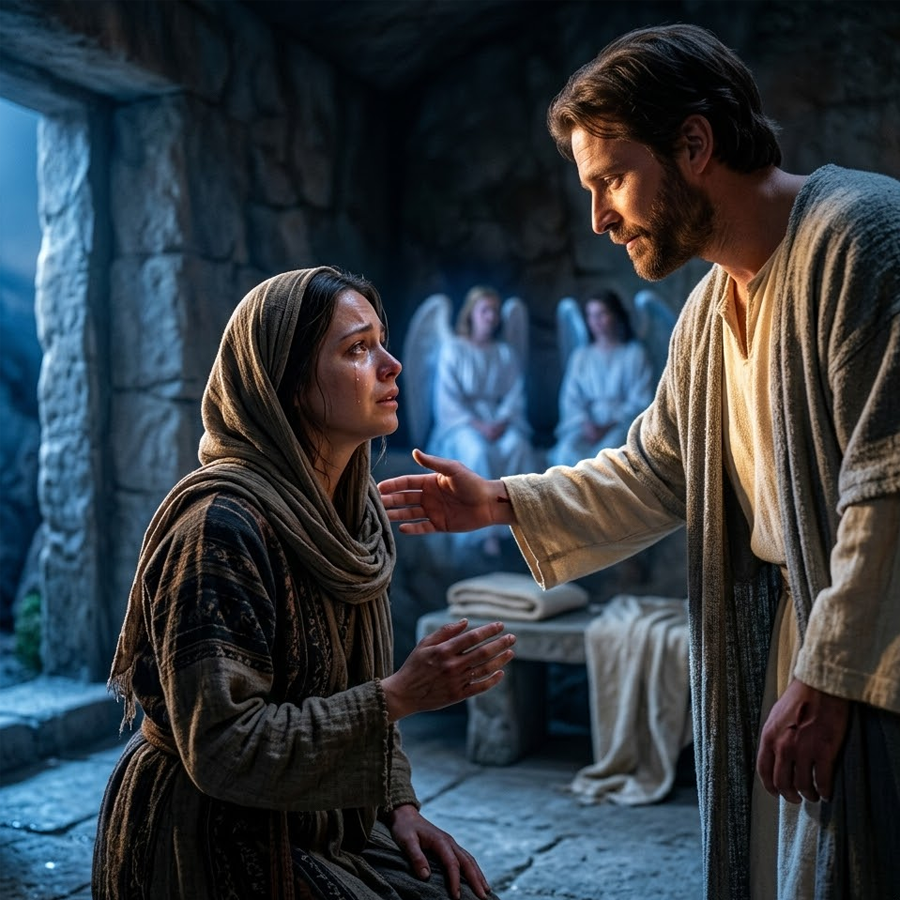
It was still dark when Mary Magdalene arrived at the tomb.
The kind of darkness that feels heavier than night itself—thick with grief, weighted with unanswered questions, pressing against the chest until breathing becomes something you have to remember how to do. The world had not yet caught up to what had happened. The sun had not risen. The air was still. But inside Mary, everything had already shattered.
Three days earlier, she had watched Him die.
Not from a distance. Not as a rumor passed between strangers. She had been there. She had seen the nails. She had heard the final breath. She had felt the ground shift beneath her as hope itself seemed to collapse into silence. Jesus—her teacher, her healer, the one who had called her out of darkness and given her a life she never imagined possible—was gone.
And now she stood outside His tomb, weeping.
This was not the quiet kind of crying that can be hidden behind composed eyes. This was the kind that breaks out of a person, uncontrolled and raw. The kind that comes when loss is too large to carry with dignity. She wept because everything she had known with Him seemed finished. The future she thought she understood had dissolved, and all that remained was absence.
When she bent down to look into the tomb, she saw something she did not expect.
Two angels.
They were seated where His body had been—one at the head and one at the feet. It should have been overwhelming. It should have stopped her breath, shaken her into awareness, forced her to reconsider everything she thought she knew about reality.
But grief has a way of narrowing vision.
“Woman, why are you weeping?” they asked her.
The question almost feels unnecessary. Of course she was weeping. The one she loved was gone. The world had lost its center. What else was there to do?
“They have taken away my Lord,” she said, “and I do not know where they have laid Him.”
Even in her answer, you can hear it—the instinct to hold onto what she had lost. She did not say, “He is gone forever.” She said, “They have taken Him.” Somewhere in her mind, there was still the possibility of finding Him again, of reclaiming what had been taken, of restoring what had been broken.
Then she turned around.
And she saw Him.
Jesus was standing there.
Alive.
But she did not recognize Him.
That detail matters more than we often realize. Because it reveals something about the moment that goes beyond simple confusion. This was not just a case of poor lighting or tear-blurred vision. Mary was looking directly at the answer to her grief, and she could not see it for what it was.
“How often does that happen?” we might ask ourselves.
How often does hope stand right in front of us while we are still interpreting the world through the lens of loss?
Jesus spoke.
“Woman, why are you weeping? Whom are you seeking?”
The question echoed the one the angels had asked, but now it carried a deeper weight. Not just why are you crying, but who are you looking for? What are you expecting to find?
Still unable to recognize Him, Mary assumed He was the gardener.
“Sir,” she said, “if you have carried Him away, tell me where you have laid Him, and I will take Him away.”
There is something profoundly human in that response. She is still trying to fix what has been broken using the only framework she understands. If the body has been moved, she will retrieve it. If something has been lost, she will find it. Her love is driving her to act, even if the action itself cannot restore what she truly longs for.
And then everything changes.
Jesus says one word.
“Mary.”
Not a speech. Not an explanation. Not a grand declaration of resurrection power.
Just her name.
And in that instant, recognition floods in.
“Rabboni!” she cries out—Teacher.
The one she thought was gone is now standing alive in front of her.
The grief that had defined her morning collapses under the weight of a single moment of revelation. The darkness that seemed so final is pierced by the simplest and most personal form of connection: being known, being called, being seen.
This is not just recognition. This is awakening.
Everything shifts.
Naturally, her response is to hold onto Him.
Of course it is. Anyone who has ever lost something precious and then suddenly found it again understands that instinct. When something you love slips through your fingers once, the next time you touch it, you hold tighter. You cling. You refuse to let go.
Mary is not just reaching for Jesus.
She is reaching for the version of life she had before the cross.
She is reaching for the security of having Him physically near her again, the comfort of being able to see Him, hear Him, walk beside Him. She is reaching for restoration as she understands it—a return to what was.
And then Jesus says something unexpected.
“Do not cling to Me, for I have not yet ascended to the Father.”
At first, this feels almost jarring.
Why would He say that?
Why, in the moment of reunion, would He draw a boundary? Why, after conquering death, would He tell someone who loves Him not to hold onto Him?
But this is not rejection.
It is revelation.
Jesus is not pushing Mary away.
He is inviting her forward.
What she is reaching for is real, but it is incomplete. What she is trying to hold onto is meaningful, but it belongs to a form of relationship that is about to be transformed.
Before the cross, access to Jesus was physical.
It was limited by location, by time, by proximity. If you were near Him, you could experience Him. If you were far from Him, you could not. His presence was tangible, but it was also localized.
Mary’s instinct to hold onto Him makes perfect sense in that context. She does not want to lose Him again. She does not want to go back to absence. She is trying to secure what has been restored.
But Jesus knows something she does not yet understand.
The resurrection is not about returning to the old way of relating.
It is about introducing a new one.
When He says, “Do not cling to Me,” He is not saying, “Do not come close.”
He is saying, “Do not limit Me to what I used to be to you.”
Because if she holds onto Him in that way, she keeps Him within the boundaries of her previous experience. She defines Him by what she has known, rather than stepping into what He is becoming.
And what He is becoming is far greater.
“I am ascending to My Father and your Father, to My God and your God,” He tells her.
This is the shift.
This is the moment where access is redefined.
Through His death and resurrection, Jesus is not just overcoming death. He is opening a new way of relationship between humanity and God. The connection He has with the Father is no longer something observed from a distance. It is something extended, shared, made available.
What was once external is becoming internal.
What was once limited is becoming universal.
What was once experienced by a few is becoming accessible to all.
Mary thinks she is losing proximity.
In reality, she is gaining something far greater.
She is moving from a relationship where Jesus is beside her to one where He will be within her.
That is the deeper revelation of this moment.
What looks like distance is actually expansion.
What feels like letting go is actually stepping into fullness.
This is what Jesus had been preparing His disciples for all along, even if they did not fully understand it at the time.
“I will not leave you as orphans,” He had told them. “You will know that I am in My Father, and you in Me, and I in you.”
At the time, those words may have felt abstract. Difficult to grasp. Easy to overlook in the face of more immediate concerns.
But now, after the resurrection, they begin to take shape.
Jesus is not returning to simply walk alongside His followers again.
He is preparing to dwell within them.
And this changes everything.
After the ascension, this reality is made possible through the Holy Spirit. The presence of Jesus is no longer confined to a physical body in a specific place. It becomes a living reality within every believer.
“You are not in the flesh but in the Spirit,” Paul later writes, “if indeed the Spirit of God dwells in you… Christ is in you.”
This is the fulfillment of what began in that moment with Mary.
Access is no longer about reaching.
It is about recognizing.
It is no longer about proximity.
It is about union.
This has profound implications for how we understand our relationship with God today.
Because if Jesus is truly within us, then the way we approach Him changes completely.
We are not trying to get closer.
We are not striving to bridge a gap.
We are not waiting for access to be granted.
We already have it.
In everyday life, this truth often gets lost.
We still think in terms of distance. We still speak as if God is somewhere else—waiting to be found, waiting to be reached, waiting to respond if we say the right words or feel the right emotions.
But the reality of the resurrection challenges that mindset.
You are never distant from God.
You are never outside His presence.
You are never trying to reach Him across a divide.
Through Jesus, that divide has already been removed.
In your car, in your home, at your workplace, in your moments of clarity and in your moments of confusion—He is present.
Not as a distant observer.
But as an indwelling reality.
This means prayer changes.
It is no longer an attempt to send words upward into the unknown.
It becomes a conversation with the One who is already within.
It means worship changes.
It is no longer about trying to get God’s attention.
It becomes a response to His presence that is already there.
It means your understanding of closeness changes.
You are not moving toward God.
You are living in Him.
And He in you.
Learning to live in that truth requires a kind of letting go.
Just like Mary had to release her grip on the way she knew Jesus before, we often have to release our attachment to old ways of relating to God.
We cling to what is familiar.
Moments of emotional intensity.
Specific environments where we feel something.
Patterns that make us feel like we are “getting closer.”
But Jesus invites us into something deeper.
Not occasional encounters.
But continual access.
Not external closeness.
But internal union.
This is not about diminishing the value of experience.
It is about expanding our understanding of reality.
Because if we only recognize God when we feel something specific, we limit Him to moments instead of living in His presence consistently.
Mary’s moment at the tomb is not just a personal story.
It is a turning point.
It marks the transition from one way of relating to Jesus to another.
From physical presence to spiritual indwelling.
From limited access to universal availability.
From reaching to resting.
And that is why it matters so much.
Especially when we consider what the resurrection represents.
The resurrection is not just proof that Jesus is alive.
It is the foundation for a completely transformed relationship between God and humanity.
What was once distant is now near.
What was once restricted is now open.
What was once external is now internal.
Mary walked to the tomb expecting to grieve.
She left carrying a revelation that would reshape the world.
And it all began with a single word.
Her name.
That moment still echoes.
Because in many ways, the same invitation remains.
To move beyond clinging to what we think we need.
To step into what has already been given.
To recognize that what feels like letting go might actually be the doorway into something greater.
To understand that access is no longer something we are trying to obtain.
It is something we have already received.
And to live, not as people searching for God from a distance, but as people who have been brought into union with Him.
This is the reality the resurrection opens.
This is the shift Jesus was pointing Mary toward.
And this is the truth that continues to transform lives.
Because once you understand that you are not reaching for Him—but living in Him—everything changes.