The hostess at Harrove didn’t look up when the door opened. She was busy busy in the way people who work expensive restaurants learn to be busy. A pen pressed to a clipboard, eyes fixed on a reservation list that didn’t actually need reviewing. Posture arranged just so to communicate that her attention was a resource that had to be earned.
The ambient noise of the dining room filled the lobby like warm water silverware against porcelain. The low hum of a string quartet positioned near the bar. the careful laughter of people who wanted other people to hear them laughing. When she finally did look up, her expression shifted in the way expressions do when the math doesn’t add up. The man standing in front of her was somewhere in his late 30s.
Brown hair, slightly longer than fashionable, touched with the beginning of gray at the temples. He wore a dark navy jacket, the kind you buy years ago, and keep because it still fits, not because it’s still in style. No tie, clean hands, a watch that was neither expensive nor cheap, just present on his wrist, the way watches are when a man wears one out of habit rather than statement. Good evening, he said. Table for one, please.
His voice was quiet, not shy. Quiet was different from shy. Shy meant shrinking. This man simply didn’t see any reason to be louder than the situation required. The hostess, whose name tag read Brittany, glanced past him toward the door as though checking whether he was the advance party for someone more interesting.
Do you have a reservation, sir? I don’t, she tilted her head with practice sympathy. We’re fully booked this evening. Friday nights, there’s a table in the east corner, he said. Near the service corridor. It’s held every Friday for late walk-ins who don’t stay more than 40 minutes. has been for years. He paused. I’ll take that one. Britney looked at him for a moment. Really looked, then checked her clipboard. The corner table was there.
Unoccupied. She had no logical grounds for refusal. So, she gathered two menus and said, “Right this way.” In a tone that made clear she was extending a favor. He followed her through the dining room without looking at the other guests. He looked at everything else. The baseboard’s immaculate, which was good.
The light fixtures above table 121 bulb running slightly warm, casting a yellowish halo that didn’t match the rest of the room, which was bad. The server near the bar, who was clearing a table with one hand while checking something in her apron pocket with the other, efficient, multitasking, admirable. the bus boy near the kitchen entrance who was moving too fast, carrying too much. The kind of hurry that ended in broken glasswear and quiet write-offs that never made it into any report.
Daniel Carter sat down at the corner table and placed his jacket over the back of the chair. He had opened Harrove 11 years ago in a building that used to be a hat factory in the Midtown district. Exposed brick, high ceilings, the kind of bones that cost more to demolish than to preserve.
He had named it for his grandfather who had run a diner in rural Virginia for 30 years and believed with the kind of conviction that doesn’t require articulation that feeding people well was a form of dignity, not charity, not performance. Dignity. For the first four years, Daniel had been here almost every night. He knew the suppliers by first name.
He knew which prep cook was working his way through culinary school and which line cook was sending money home to his mother. He knew that the third stall in the men’s restroom had a hinge that squeaked on cold nights and that table 7 caught a draft when the kitchen doors were propped open in summer. Then his wife had gotten sick and then she had died. And then he had a six-year-old daughter named Grace who woke up every morning in a house that was too quiet.
and the restaurant had stopped being the place he poured himself into and started being the thing he kept at a distance so he could pour himself into her instead. He had hired Walter Collins 18 months ago to run the floor. References from two other establishments, both well- reggarded, a manner that read as confident and organized in an interview, a handshake that was slightly too firm.
Daniel had rationalized all of it at the time. He was rationalizing less tonight. He picked up the menu. His menu, the one he’d spent three weeks designing the layout for the one that used to open with a single sentence about his grandfather and noticed the sentence was gone, replaced by a generic tagline that could have belonged to any restaurant in any city in the country.
He set the menu down and ordered water. Then he waited and he watched. His daughter Grace was nine now. He thought about her most nights when he was in places she wasn’t, which given the way the last three years had moved. Was not often. She was at home with Mrs. Alderman, their neighbor, who was 72 and retired, and had, without ever being asked, simply begun appearing at the house when Daniel had somewhere to be. She brought crossword puzzles and heated soup, and had a gift for sitting in companionable silence that Daniel had come to rely on more than he could say.
Grace had asked him that morning where he was going, “Just checking on something,” he told her. She had given him a look that said she was nine, not four, and then gone back to her book. The dining room of Harrove moved around him, the way rivers move around, stones continuous, adaptive, indifferent to the obstacle. He watched a server named Marcus, according to the small pin on his jacket.
Navigate three tables simultaneously with the kind of practiced grace that took years to develop. He watched a woman near the window send back her entree the lamb, he noted, and saw the server’s face perform the appropriate sequence of apology and resolution while something else passed briefly across his eyes. Not resentment.
Exhaustion. the specific exhaustion of people who have been performing patients for so long that they’ve forgotten what it costs. Daniel had managed a restaurant long enough to know that exhaustion. He also knew it shouldn’t look like that, that tight braced quality, like a person waiting for a blow rather than a complaint.
He ordered a starter he didn’t intend to finish the beef tartar, which arrived with the garnish placed slightly off center, a detail that meant nothing to most diners and meant something precise to him. and he thought about Walter Collins. Collins had grown the revenue. That was true. The quarterly reports showed it in clean, satisfying lines. Covers up 14%. Beverage sales up 20. A write up in a regional magazine that used words like sophisticated and elevated.
On paper, the man was doing exactly what he’d been hired to do. But Daniel had learned in 11 years of running a restaurant and three years of running a household alone that what showed on paper and what happened in rooms were not always the same document.
He had started noticing things in the financial summaries 4 months ago. Small things, the kind that required context to flag as anomalies. The linen supplier changed which lowered costs but was a vendor Daniel knew had a reputation for cutting corners on quality. After the initial contract period, the portion reporting on protein entre had been quietly adjusted in a way that reduced per plate cost, but didn’t appear anywhere in the customer-f facing menu pricing.
Tips were being pulled, which was legal, but the distribution formula had been altered in a way that slightly favored front of house senior staff over junior servers and back of house staff. Each individual thing was defensible. together. They added up to a picture of a place being managed for the benefit of its numbers rather than the people inside it.
He had not called Collins. He had not sent an auditor. He had come here himself in an old jacket on a Friday night to see what his grandfather’s restaurant looked like from a stool in the corner when nobody knew who he was. His grandfather would have done exactly the same thing. Across the dining room near the mahogany bar with its row of backlit bottles arranged in what Daniel recognized as a configuration he had never approved purely aesthetic designed to impress rather than to facilitate efficient service. Walter Collins appeared. He was
51 years old, silver-haired, and moved through the dining room the way certain men move through spaces they believe belong to them. With ownership that was performed rather than felt, hands clasped loosely behind his back, chin at the precise angle that communicated authority without effort.
He stopped at a table near the window, a large party, clearly regulars or VIPs, and deployed a smile that was genuinely impressive in its precision. Then his phone vibrated. He glanced at it, and the smile downshifted into something thinner, and he moved toward the service corridor with the stride of a man who had been interrupted. Daniel watched him go. He did not signal for the check. He was not finished. He heard her before he saw her.
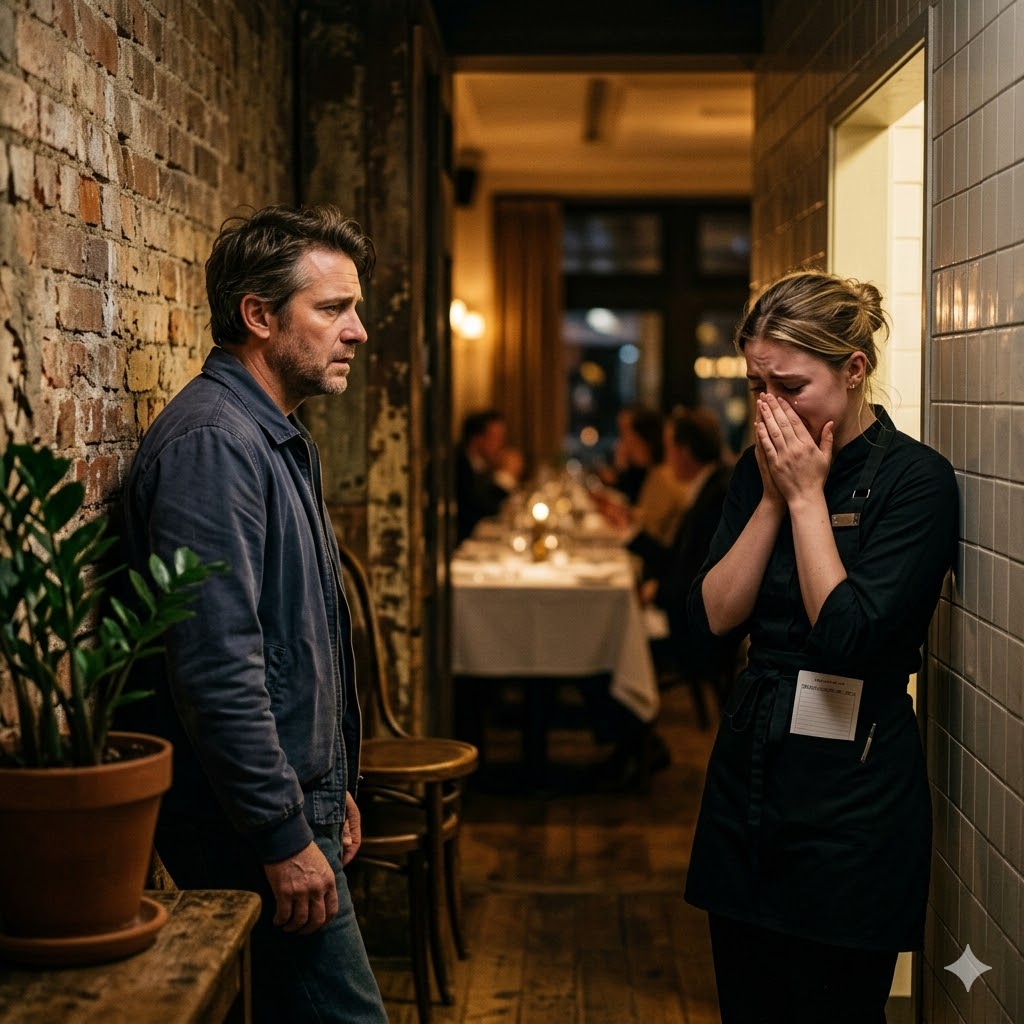
He had moved quietly, unremarkably, the way a man can move through a crowded space when he doesn’t announce himself to a small al cove near the service corridor entrance. The kind of architectural dead zone that exists in old buildings and gets furnished eventually with a single chair and a potted plant and used by no one in particular. From here he could see the corridor entrance and here imperfectly but adequately what happened near it.
The voice he heard first was Collins. I don’t have time for this conversation right now. Emma, Mr. Collins, I just need 2 hours. The second voice was younger controlled but barely the control of someone who has practiced keeping emotion out of their voice so many times that the practice itself has become audible. My mother’s appointment is at 9:00.
I’ve already arranged for Clare to cover the last of my section. Clare has her own section. I know. She agreed to. I don’t care what you two arranged between yourselves. A pause. The sound of something set down too firmly on a hard surface. I set the schedule. I don’t renegotiate the schedule based on personal situations that you should have planned around.
I didn’t know about the appointment when the schedule was posted. Emma, the name like a period. This is the third time this month. It’s the second time. I’m being generous with my count. The temperature in his voice dropped several degrees without rising in volume. The particular coldness of authority that has learned restraint as a form of control. You’re a good worker.
I’d like to keep you, but I need people who are here mentally and physically when they’re scheduled to be here. If your personal life is affecting your reliability, it’s not affecting my reliability. Something cracked in the control briefly. I have never missed a shift. I have never been late.
I covered for Marcus when his car broke down in January and I didn’t ask for anything in exchange. I am asking for 2 hours silence. Then the request is denied. You’ll work your full shift. Any deviation will be documented and will affect your quarterly review which as I think you’re aware impacts the tip pool tier assignment footsteps.
The corridor door swung open and then shut and then in the al cove not 12 ft from where Daniel sat. Emma Lawson pressed her back against the wall and pressed her hand over her mouth and cried. She was perhaps 24 or 25. Dark blonde hair pinned up in the restaurant’s required style. a few strands loose at the temples. The uniform was pressed and neat.
She was the kind of tired that didn’t show in posture. She was standing perfectly straight, but showed in the eyes, which were the eyes of someone who had been managing multiple crises for a long time, and had gotten very good at managing them in sequence rather than resolving any of them. She cried for approximately 45 seconds. Then she straightened, pressed the heels of her hands against her eyes, took three measured breaths, and pulled her order pad from her apron pocket.
Daniel watched this and understood that it was not a performance of resilience. It was the real thing, the kind you develop, not because you are exceptional, but because you don’t have the option of not developing it, because someone is depending on you and the rent is due. And the tip pool tier assignment actually matters because it represents real money that covers real prescriptions. He returned to his table before she came back through the door.
When Emma appeared at his table 3 minutes later, there was no evidence in her face of what had just happened. Her eyes were clear, her expression attentive, her voice steady. “Can I get you anything else this evening, sir?” “Chef special tonight is the pan roasted duck breast. It’s been very popular.” “Thank you,” Daniel said. “I’d like a coffee, please.” And he paused. “Are you all right?” She looked at him, a brief recalibration behind her eyes.
I’m fine, thank you. I’ll get your coffee. I’m not asking as a complaint, he said. I’m asking because I heard part of what happened in the corridor and I wanted to make sure you were okay. She went very still for a moment. The kind of stillness that precedes a decision. I’m fine, she said again. But the word was different this time.
Not a deflection, more like a declaration she was making to herself as much as to him. Good, he said. That’s all I wanted to know. She brought him coffee. He drank it slowly. She came back once, refilled it without being asked, and he noticed that she did the same for three other tables without prompting.
He noticed that she remembered, without writing it down, that the man at table 8 had asked for his sauce on the side, and that the elderly couple near the window had declined the dessert menu, but would probably accept a complimentary petite four if it was offered without fanfare. She was, by every measure he knew, exceptional at this job. He thought about what Collins had said to her.
Personal life affecting your reliability. He set down his cup. He stayed for another hour. This was not something he had planned. He had come expecting to observe for perhaps 45 minutes and leave with enough information to make a decision. But the longer he sat, the more the picture assembled itself, and the picture required looking at Marcus, the server he’d noted earlier, was working a section that was two large seven tables on a Friday peak service when the standard he had set 11 years ago was five because five was the number at which a server could maintain the quality of attention that justified Hargrove’s pricing. Marcus was moving
fast, managing it, not dropping anything literally or figuratively. But Daniel could see the corners being cut. The moment where a table got water 30 seconds later than it should have. The moment where Marcus had to choose between checking in on a couple who’d been waiting for their check and catching a food runner who was about to deliver the wrong plate to table six. He caught the food runner error.
He missed the couple with the check. The woman’s expression, as she finally flagged down a passing bus boy, was one Daniel had seen before. The expression of a person who has calculated that they were not, despite the price on the menu, being treated like their presence mattered.
At the bar, a group of four men in suits occupied the corner stools with the ease of people who came here often and were treated accordingly. Collins appeared twice to speak with them. He was solicitous, warm, leaning in with the body language of genuine pleasure. He brought them a round of drinks Daniel saw no record of on the bar tab display comped presumably, but comped from what account and under what authorization was a question for the books and the food.
He had ordered a main course, the roasted chicken, a dish he knew intimately, a dish he had spent three weeks with the original chef calibrating, adjusting the brine time and the resting period until the skin was exactly right. What arrived at his table was a good dish, a competent dish. The skin was correctly crisped. The juss was adequate, but the chicken was smaller, noticeably smaller.
The portion reduction was the kind that required comparison to detect you had to have eaten the original to know the new version was diminished, but it was there. A nearby server, young, early 20s, with the slightly startled look of someone still in their first months on the floor, paused near Daniel’s table to refill water. His name tag said Tyler.
Excuse me, Daniel said quietly. Has the portion size on the chicken changed recently? Tyler glanced toward the corridor, reflexive, involuntary, then back. I uh I’m not sure, sir. I can check with all right, Daniel said. You don’t need to check. I just wanted to know. Tyler moved on, and Daniel saw him a minute later say something quietly to Emma.
Emma looked at Daniel’s table with an expression that was carefully neutral. At 9:40, he watched Collins move through the dining room again and stopped near the service station where Emma was updating her order tickets. He said something brief to her too low to hear, and she nodded without looking at him.
After Collins moved on, she stood at the service station for a moment with her hands flat on the surface and her eyes fixed on the middle distance. Then she straightened and went back to her section.
One of the other servers, a woman in her 30s whose name tag Daniel couldn’t read at this distance, appeared at Emma’s elbow and said something. Emma shook her head. The other server pressed her lips together and looked in the direction Collins had gone. Daniel had heard a version of what the other server said next, spoken in different words by different people in different industries. More times than he could count. There’s no point. That’s just how it works here.
He signaled for his check. He had seen enough. Emma brought the check. He paid it in cash, something almost no one did anymore. A detail that caused Brittany at the host stand to look at him again when he passed on the way out. A look that tried and failed to locate him in a category, but he didn’t leave.
He waited near the small bench by the coat check, a bench that existed for waiting companions, not for lone men in old jackets who had paid their bill. And he waited for the right moment. He was not entirely sure what the right moment would look like. He recognized it when it appeared, which was 20 minutes later. When Emma came through the corridor door on what was evidently a short break, moving with the slightly deflated posture of someone allowed 5 minutes to stop performing, she saw him and stopped. “Sir, is there something wrong with your meal? I can get a manager.”
Nothing was wrong, Daniel said. I wanted to ask you something. If you have a moment, she looked at him the way women working difficult jobs look at unknown men who want a moment of their time with a calculation behind the eyes that is not hostile. Only precise. One moment, she said. How long have you worked here? 14 months. And in those 14 months, have the conditions always been what they are now? A pause. A real one.
I’m not sure what you mean. The section sizes, the tip distribution, the scheduling. He said each thing plainly without inflection. The way requests get handled. She looked at him for a long moment. Are you from the health department? No. Corporate? No. Then I’m sorry, sir. I’m not sure I should be. You asked for 2 hours tonight, he said.
For a medical appointment. She went very still. I’m not trying to embarrass you. He said, I’m not trying to put you in a difficult position. I heard what happened in the corridor and I am asking you directly. Is tonight typical? Another long pause. She looked past him toward the dining room, toward the corridor, toward the door in the sequence of someone calculating costs.
Then she looked at him. My mother has stage 2 kidney disease, she said. Her voice was even. She had clearly said this sentence many times to insurance representatives and billing departments and scheduling clerks. and she had learned to say it the way you learn to say anything that starts as a wound and has to become a fact.
She has dialysis three times a week. I cover the cost difference between what insurance pays and what it doesn’t, which is more than you’d think. I’ve asked twice in 14 months to adjust my schedule slightly around her appointments. Both times were denied. She paused. I’m not the only one.
Tyler’s wife had a baby 6 weeks ago and his request for a single weekend shift modification was denied in writing. Denied in writing like he needed to understand there was a paper trail. She stopped. I shouldn’t have said any of that. She said why? Because I need this job. Daniel nodded. He had known walking in what he expected to find in the aggregate.
He had not been prepared entirely for the specific weight of it. You’ll be all right,” he said. It was a strange thing to say. He was aware of that. It was not a reassurance in the ordinary sense. It was something more like a statement of intent that she had no way to interpret as such, which made it sound, he supposed, like the kind of thing people said when they didn’t have anything useful to offer.
She gave him a brief, polite smile and went back inside. He stood by the coat check for another moment. Then he took out his phone and made a call. Richard, he said when the line connected. I need you tomorrow morning. Bring Helena and bring the operating agreements and tell her to bring whoever she needs from the audit team. A pause. No, tonight actually. Can you be there in an hour? He listened.
Good. He said, “Come to the restaurant. Use the side entrance.” He went back inside. Brittany at the host stand looked at him with undisguised confusion. He had paid. He had left. He was not on the reservation list, but before she could formulate an objection, he had moved past the host stand and into the dining room. And there was something in how he moved that made her pause before following.
He found a position near the bar standing, which no one did in a restaurant like this without purpose, and waited. It was close to 10:00. The dining room was beginning to thin. The early parties had settled into after-dinner drinks. The later reservations were finishing main courses. The quartet had paused between pieces.
The ambient noise was lower, more intimate. The kind of quiet that in a well-run restaurant felt like luxury, and in a badly run one felt like exposure. He watched Emma move through her section. She was working table 12, a couple in their 60s who had taken their time with everything. the pleasant, unhurried pace of people who had somewhere comfortable to be afterward.
And she was describing the dessert menu with a specific, detailed warmth that indicated she had learned which items were actually good and communicated this through tone rather than explicit recommendation. The woman was laughing at something Emma had said. The man was nodding.
Emma said a small complimentary piece of chocolate beside the woman’s water glass. not build, not asked for, just present and moved to the next table. Then Collins appeared. He emerged from the corridor door at the particular speed of a man who has been building toward confrontation and arrived at it slightly ahead of his own preparation. His eyes found Emma immediately. He crossed the dining room in 11 strides.
Daniel counted and stopped at her elbow while she was at table 14, a family of four mid dessert. A word, Colin said. The tone was quiet but not private. Several nearby tables registered it. Emma turned. I’m with guests at the moment. The moment can wait. He said it to her. He did not acknowledge the family at table 14, which was itself a statement about the kind of space they occupied in his calculations. I need you to take on Marcus’s section. He’s running behind. Emma looked at him steadily.
I’m already at capacity. If I take Marcus’ section, you’ll manage. Mr. Collins, I’m covering seven tables at 8 effective immediately. He said it the way people say things when they’ve decided that the saying of them constitutes a decision. If that’s a problem, we can discuss it after service. It’s a problem now, Emma said.
The dining room noise did not stop, but it dimmed the subtle dimming that happens in public spaces when something private breaks the surface. When people don’t want to look directly, but also do not look away, Collins’s face shifted into the specific expression of a man who has been contradicted publicly and has decided that the contradiction itself is the offense. I’m sorry, he said. I’m saying it’s a problem now.
Emma’s voice was steady, completely steady, which under the circumstances was remarkable. I’ve been asked to do the work of two servers tonight without additional compensation, and I’m saying directly that I can’t maintain the service quality that guests have paid for under those conditions. I’m not refusing to help. I’m telling you that what you’re describing isn’t operationally sound. The words were careful, professional.
The kind of words chosen by someone who knows that the content of a complaint matters less than how it’s documented. It didn’t matter. You’re done for the evening, Colin said. The words were low and very clear. Collect your things. You’ll receive your final pay by mail. Emma didn’t move.
You’re terminating me, she said. Not a question for insubordination. Yes. in front of guests. That choice was yours. She looked at him for one long moment. Then something that had been held very tightly behind her eyes loosened, not into tears immediately, but into a kind of nakedness.
The look of someone who has spent a year calculating exactly how much they could not afford to lose a job and has just watched that calculation become irrelevant. And then she did cry briefly without covering her face. The way people cry when they are too tired to hide it. Not a single person in the dining room said anything. The woman at table 12, who had been laughing a minute ago, set down her wine glass. Collins had already half turned back toward the corridor.
“Excuse me,” the voice came from the bar area. It was quiet. It was the same volume it had been all evening, the volume of a man who doesn’t see any reason to be louder than the situation requires. But the dining room, which had dimmed itself in anticipation of something, heard it perfectly. Collins turned.
Daniel stepped forward into the light, the actual light, the warm overhead wash of it that the al cove in the corner table had kept him partially outside of all evening. The person you just terminated, Daniel said, is one of the best servers in this room. I’ve been watching her work for 3 hours. He paused. I’ve been watching a lot of things. Collins looked at him with the expression of a man encountering a variable he hasn’t accounted for.
Sir, this is an internal personnel matter. I know it is, Daniel said. That’s why it concerns me. Collins looked at him the way people look at problems they haven’t correctly sized. Sir, he said with the particular patience of a man explaining something to someone below his threshold of concern.
I don’t know who you are, but you’ve involved yourself in a private employment matter in a way that frankly borders on disruptive. I’m going to need to ask you to either return to your seat or exit the premises. He said it well. The right volume, the right authority, the practiced cadence of a man who had delivered versions of this speech before and found it effective.
Daniel looked at him. He did notably move. My name is Daniel Carter, he said. I opened this restaurant 11 years ago. I own 100% of the equity in Harrove LLC, which is the entity that employs you and everyone else in this building. He said this the way he said most things without emphasis, without performance, as though it were simply information being transferred from one person to another.
I should have been here much earlier than tonight. That’s on me, but I’m here now. The silence that followed was a specific quality of silence. Collins’s face performed several things in quick succession, confusion, recalibration, something that moved toward disbelief, and then, as the math finished resolving, toward a very different color of stillness.
His eyes moved from Daniel to the room and back again, searching for some foothold. I’d like you to prove that, Collins said. But the authority was gone from his voice. What was left was the shape of authority without the substance. Daniel’s phone rang. He had expected it. He had told Richard to call when they arrived at the side entrance. He picked up, said, “Come in through the bar corridor.” And ended the call.
Four minutes later, Richard Baxter, who was 60, who had been Daniel’s attorney since the restaurant was a renovation plan and a business license application, who wore suits that were expensive, and carried himself with the specific gravity of a man who charged by the hour and was worth it, walked through the bar corridor, followed by a woman named Helena Marsh, who ran the audit and compliance firm Daniel, had retained 18 months ago when the summaries first started looking imprecise.
She was carrying a laptop and had the look of someone who had been interrupted doing something else and was not exactly unhappy about it. Richard did not speak directly to Collins. He spoke to the room which at this point was no longer pretending not to watch. Harrove LLC operating entity soul owner Daniel A. Carter. Certificate of ownership on file with the state.
Registered articles here. He opened a document on the tablet he’d carried in and a board resolution authorizing Mr. Carter’s authority over all personnel and operational decisions which was never amended or modified. He handed the tablet to Collins. Collins looked at the screen for a long moment. He handed it back. I see, he said. Good, Daniel said.
Then let’s talk about the books. What happened in the next hour was not dramatic in the way the preceding minutes had been. It was thorough. Helena and her colleagues set up at the manager station near the bar corridor and the books, both the digital records and the physical ledgers that Collins maintained with the faint anacronism of a man who trusted paper because it was harder to audit remotely were opened.
And the picture that assembled itself over 90 minutes was the picture Daniel had suspected but had not been entirely prepared to see confirmed in line items. The tip distribution formula had been altered to funnel approximately 8% of the senior server pool into a discretionary fund that Collins administered and that had no documented dispersement policy.
The portion reduction on protein entre 12% across six dishes had been implemented without a corresponding adjustment to pricing generating a margin improvement that appeared in the revenue report as operational efficiency and did not appear in any communication to Daniel. Three employees had been docked pay for minor infractions that were either undocumented or documented so lightly as to constitute fabrication.
Marcus’ schedule had been expanded beyond contract parameters. So had Emma’s and Tyler’s and four others. Collins sat in a chair near the service station for most of this. He did not, to his credit, or perhaps simply to his exhaustion, attempt to explain or argue. He answered direct questions from Helena with direct answers, which was perhaps the most honest he’d been in 18 months.
At 11:47, Daniel said, “Walter, you’re dismissed. Richard will be in touch about the terms.” Collins picked up his jacket and walked out the side entrance without stopping. The dining room had emptied of guests by this point. The staff remained, the servers, the bus boys, Tyler and Marcus, and the woman whose name tag Daniel had finally been close enough to read, which was Joanna arranged in the uncertain grouping of people who have witnessed something significant and don’t yet know what relationship they’re supposed to have to it. Daniel stood near the center of the
room, which was quiet now. The quartet long since gone, the overhead lighting shifted to the lower after service setting that made the room feel less like a stage and more like what it was. A large room full of tables and chairs and the residue of a hundred small human transactions that had occurred in it that evening.
I owe everyone here an apology, he said. Nobody spoke. I built this place with a specific intention. I’ve been away from it for 3 years and in that time I allowed someone to run it in a way that doesn’t reflect that intention. He stopped. That’s my failure, not yours. And I intend to correct it. Marcus said, “Are we are we all keeping our jobs?” “Yes,” Daniel said.
All of you and the tip structure will be returned to the original formula effective this pay period. The portion that was withheld incorrectly will be audited and reimbursed. He paused. Helena’s team will be in contact with each of you individually. If there are hours or wages that were incorrectly docked, they will be corrected. No one needs to fight for that.
I’m telling you now that it will happen. Tyler Young, the slightly startled look still present even at nearly midnight, raised his hand, then seemed to think that was unnecessary and lowered it and just said, “The schedule modification I requested, approved,” Daniel said. “Effective immediately. Make sure whoever handles scheduling has the specifics by Monday,” Tyler nodded.
He pressed his lips together briefly and looked at the floor and Daniel looked away because some things don’t need witnesses. He found Emma at the edge of the group. She was standing slightly apart from the others, not excluded, just positioned the way a person positions themselves when they’ve been the center of something and would prefer to be at the edge of it.
Her order pad was still in her apron pocket. Her eyes were dry. He walked to where she was and stopped. I wanted to tell you directly, he said that what happened tonight, the termination is fully reversed obviously and I would be glad to put that in writing tonight if you want it. That’s okay, she said. I believe you.
The money that was withheld from your wages, the audit, we’ll find it. It’ll come back to you. She nodded. and the schedule adjustment for your mother’s appointments. He said that’s approved permanently or however long you need it. She looked at him for a moment. The something that had been nakedness in her eyes an hour ago had settled into something quieter.
Not happiness exactly, more the specific stillness of someone receiving information they had stopped allowing themselves to expect. I don’t understand why you were here tonight, she said. why you came in the way you did. I needed to see it honestly, he said. If I’d come as the owner, I’d have seen the version of this place they put on for owners. I needed to see the version that happens when no one’s watching.
She looked at the room around her, the empty tables, the low light. Joanna stacking napkins at the service station with the automatic motion of long habit. It’s a good room, Emma said. When it’s working right, it’s a genuinely good room. The food is good. The bones of the place are good. I know, Daniel said. My grandfather would have recognized it. She looked at him. This was named for your grandfather. His name was Harold Harrove. He ran a diner in Virginia for 30 years.
He paused. He believed that feeding people well was a form of decency, not charity, not performance. He repeated the words he’d carried for 11 years. decency. Emma was quiet for a moment. Then she said, “Your grandfather sounds like he was worth naming something after.” Daniel looked at the room at the exposed brick his grandfather had never seen.
At the high ceilings and the tables set with linen, and the soft light that his grandfather’s diner had never aspired to and felt, for the first time in a long time, that the distance between the thing he’d built and the reason he’d built it might be closable. He was, he said. He stayed until past 1 in the morning, not for business reasons.
Entirely the business reasons were being handled by Richard and Helena with the competent efficiency of people whose hourly rate ensured speed. He stayed because leaving felt wrong. The way leaving a house in disarray felt wrong. He straightened things, not literally, though he did at one point retrieve a light bulb from the maintenance closet and replace the warm one above table 12 that had been running the wrong color temperature all evening. Standing on a chair to do it, while Marcus watched from the service station with an expression that was equal parts amusement and something more
complicated, he straightened things in the larger sense. spoke to Joanna about the service station organization, looked at the prep schedule for Saturday with the Sue chef, a quiet man named Brett, who had been working the kitchen for 4 years and clearly had opinions he’d been holding on to and made three phone calls to suppliers he hadn’t spoken to directly in too long. It was close to midnight when he sat back down at the corner table.
Emma was still there at the service station completing the closeout procedures that end every restaurant night. the particular quiet administrative work of tallying and reconciling that caps the noise and motion of service. She moved through it with the same efficiency he’d watched all evening. The same quality of attention that didn’t require anyone watching to be present. He thought about Grace.
She would be asleep, had been asleep for hours in the house that was quieter than it used to be, but had found its own specific quality of warmth in the years since. Mrs. Alderman would be in the guest room she stayed on late nights without being Huang asked leaving a note on the kitchen counter that said only all good and handwriting that was big and looping and somehow reassuring.
He had built this restaurant when Grace was a baby before he knew what the years ahead looked like before he had learned that some things you build for the future and some things you build to outlast what you can’t control. He had thought about it differently in the years since.
The restaurant as something separate, something that existed in a parallel category from the part of his life that mattered most. Sitting in the corner at 1:00 in the morning, watching Emma Lawson do the closeout count with her back straight and her mind clearly elsewhere with her mother, probably calculating the timing of tomorrow’s appointment against the new schedule, running the math of a life that had always been run on tight margins. He thought that maybe the categories weren’t as separate as he’d made them.
His grandfather hadn’t separated them. Harold Hargrove had run a diner and raised three kids and sent money to his sister in Richmond and hired two people from the county work program every spring for 30 years. Not because it was good for business. It often wasn’t.
But because the diner was in the community, and the community was in the diner, and the line between them was not a line at all, but a fiction that served convenience rather than truth. Daniel had named this place for his grandfather, and then gradually, as the pressures of growth and delegation accumulated, had allowed it to become the kind of place his grandfather would not have recognized.
that was going to change. Emma finished her clothes out and looked across the room at him. You should go home, she said. You’ve been here for hours. So, have you, he said. That’s my job. A pause. Apparently, still my job. Apparently, he agreed. She picked up her bag from the staff area. At the door. She stopped. Mr. Carter, she said. He looked at her. Thank you. She said it without elaboration.
No modifier, no performance. The plain version that was heavier than the ornamented one because there was nothing holding it up except the weight of what she meant. Good night, Emma, he said. She went out into the night.
He sat at the corner table for another few minutes in the quiet of the room and thought about his daughter and his grandfather and the specific unremarkable miracle of a room where people fed other people and tried to do it with some dignity. Then he got his jacket from the back of the chair and went home.
3 weeks later on a Saturday afternoon in early November, Daniel Carter brought his daughter to Harrove for lunch. Grace was 9 years old and wore her hair in a braid she did herself, which resulted most days in something that was structurally ambitious and aesthetically approximate. She had her mother’s coloring and Daniel’s habit of observing things carefully before commenting on them.
She was currently looking at the dining room of Harrove with the focused attention of someone conducting an inventory. It’s big, she said. It is. Is that a quartet? She pointed at the corner where the musicians played weekend lunch sets like a real one. Four people with instruments. That’s the general requirement. Yes. She looked at him with the expression she used when he was being technical as a substitute for being helpful.
Dad. Yes. He said a real one. She considered this. Then she picked up the menu, which had been redesigned in the past two weeks, the sentence about Harold Hargrove was back on the front page, quietly placed in a slightly smaller font than Daniel had originally used, but legible and present, and read it with the complete seriousness she brought to most reading material. Emma appeared at their table.
She had been named interim operations manager three days after the night Daniel had sat in the corner. The promotion had been offered carefully with documentation and a salary adjustment that required Helena’s team to reconstruct what the correct rate should have been all along. And Emma had accepted it with the same directness she brought to most things, not effusively, not with false modesty, but with a cleareyed acknowledgement that she would try to do the job well. She was so far doing the job very well.
Brett the Sue chef, who had been holding opinions for four years, had opinions that were largely correct. The section sizes had been restored to the original standard. The tip distribution was documented, transparent, and deposited on schedule. Tyler’s schedule modification had taken 12 minutes to process because it turned out the schedule, without Collins’s particular interpretation of it, had the room. Good afternoon, Emma said. and then to Grace.
“Hi, I’m Emma.” Grace looked at her with the evaluative seriousness of a 9-year-old forming an opinion. “Are you the one who almost got fired?” Grace Daniel started. “She is,” Emma said without missing a beat. “But I didn’t,” Grace nodded, apparently satisfied with this answer. “Dad talks about this place sometimes.” “He built it. I know.
” Emma said he built it for a good reason. His grandpa. That’s right. Grace looked at Emma for another moment. Then back at the menu. What’s good here? Honestly, the roasted chicken is excellent. The person who oversees the kitchen recently made some adjustments that improved it significantly. She paused.
And the chocolate sule is the best thing we make, but you have to order it at the start of the meal because it takes time. Grace looked at Daniel. Can I get the sule? Order it now, Daniel said. So they can start. Emma smiled. The real version, not the service version, and wrote it down. When she’d gone to put the order in, Grace watched her cross the dining room.
She’s good at this, Grace said. She is. She didn’t make a big deal about the sule. What do you mean? Grace sat down her menu. Mrs. Patterson at school always makes a big deal when you ask for something like you’re asking for a favor. Emma just wrote it down. Daniel looked at his daughter.
There were moments, occasional and unpredictable, when he saw in her something so precise and clearly observed that the air shifted slightly around it. His wife had had this quality too, the capacity for a remark that said more than it appeared to say. He had learned to recognize these moments in grace and to be quiet when they happened so they could occupy the space they were meant to. “That’s right,” he said. She just wrote it down.
Outside the large windows of Harrove, the city moved in its November way coats. The bare beginning of holiday lights on the street lamps, the particular gray quality of the sky that meant winter was organizing itself for arrival.
Inside the quartet played something that sounded like it had been written for exactly this kind of room. The tables around them were occupied by people who were eating well and by most observable measures comfortable. The kitchen was producing food that tasted the way food was supposed to taste when someone cared enough to make it that way. At the corner table, a different corner table.
One in the light. Daniel Carter had lunch with his daughter. And the room, which had always had good bones, was once again what he had built it to be. Some things are built to outlast the reasons for building them.
Some rooms absorb the intentions they were made with, and hold them quietly through years and managers and changes, waiting to be found by someone who remembers what they were for. Harold Hargrove ran a diner in Virginia for 30 years. He never served a sule in his life, but he would have recognized this room. He would have recognized every person working in it. That in the end is what it means to name something after someone worth naming things