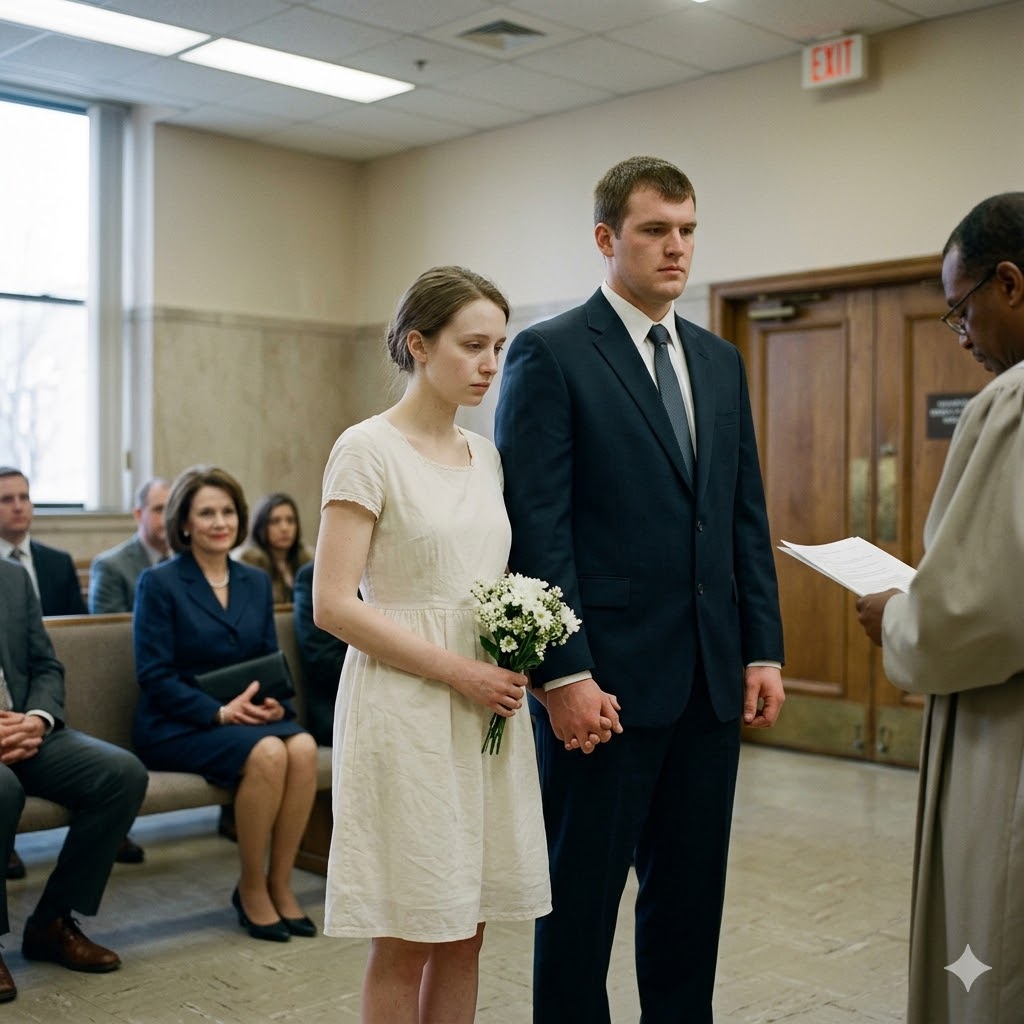
Her mother didn’t cry at the wedding. She just smiled, the kind of smile that meant the problem had been handled. Clara wasn’t the daughter they introduced at dinner parties. She was the one they explained away. Too quiet. Too sick. Too much. So, when the arrangement was made, no one asked what she wanted.
Vanessa got the Harrisons. Clara got Marcus, a man nobody knew from a town nobody cared about. They thought they were discarding her. They had no idea they were handing her everything. The Whitfield house was always clean, not comfortable clean. Every surface reflected light the way a showroom does, arranged for impression rather than living.
Diane Whitfield believed that a home said everything about a family before anyone opened their mouth, and she was not wrong. People who visited left with a particular image in their minds, successful, tasteful, put-together. What they didn’t see was what happened behind closed doors, where the same woman who smiled over dinner could reduce her eldest daughter to silence with a single look.
Clara had grown up learning to make herself small in that house. Not by choice, not at first, but because smallness was the only shape the house seemed to have room for her. She had been sick for stretches of her adolescence, nothing catastrophic, but enough to leave marks, a pallor that never fully lifted.
A frame that stayed thin in a way that read as fragile rather than graceful. A habit of stillness that her mother called withdrawn, and her doctors called cautious. Diane did not deal well with things she couldn’t control, and Clara’s body, with its quiet failures, was something Diane had never forgiven. Vanessa was different. Vanessa had always been different.
She was the daughter Diane could hold up bright, polished, the kind of beautiful that photographed well, and attracted the right kind of attention. She laughed easily, and moved through rooms like she expected them to part for her. Clara didn’t resent her for it. Vanessa hadn’t chosen to be born into a different light, but Clara understood from an early age that the two of them occupied different categories in their mother’s mind, and no amount of effort on her part was going to change the architecture of that. The conversation that changed
everything happened on a Tuesday afternoon in the front sitting room, the one with the pale blue chairs that no one ever actually sat in comfortably. Diane had asked Clara to come downstairs in a tone that left no real room for refusal. She was already seated when Clara arrived back, straight hands folded, wearing the expression she reserved for announcements she had already decided on.
She did not offer Clara a seat. She simply began. Diane told her that she had made arrangements. The Harrison family, old money, the kind that didn’t need to announce itself, had expressed interest in a formal connection between their son, Derek, and one of her daughters. It was a significant opportunity, she said, the kind of thing that didn’t come twice.
Then she told Clara that Vanessa would be the one to marry Derek Harrison. She said it without hesitation, without softening the way you state a fact about weather. Clara asked what that meant for her. She already knew somewhere in the part of her that had always known, but she asked anyway. Diane told her there was another arrangement, a man named Marcus Cole, who lived several hours away in a small town called Ardmore.
He was quiet, she said. Stable. He wouldn’t ask for much. She made it sound like a compliment, but the shape of what she was saying was perfectly clear. Marcus Cole was a manageable option for a daughter who was not quite manageable herself. The word she never said out loud was consolation, but it sat in the room between them the entire time. Clara didn’t argue.
She had learned over years of living in that house that arguing with her mother was not a conversation, it was a performance Diane had already rehearsed the ending to. There was something almost clarifying about it. This wasn’t a new message. It was just the first time her mother had put it in writing, so to speak.
She met Marcus once before the wedding, a brief meeting coffee at a neutral location, neither of their territories, neither of their choosing. He arrived exactly on time, which Clara noticed. He was tall, broader than she expected, with a face that gave very little away. He dressed simply, not carelessly, and he spoke in measured sentences that didn’t fill space just to fill it.
He asked her two questions, whether she had any condition she needed in a living arrangement, and whether she had dietary restrictions. No performance, no charm offensive. She didn’t know whether to find that reassuring or alarming. What Clara understood, standing in her childhood bedroom the night before she was meant to sign the civil paperwork, was that she had two options.
She could resist formally, loudly, in a way that might delay things, but would not stop them. Or she could go. Not because she surrendered to her mother’s logic, but because staying in that house, in that version of herself, was its own kind of slow loss. She had been disappearing there for years already. At least leaving was a direction.
She packed methodically without ceremony. She kept what was hers, and left everything that had ever been given to her as a condition. The dresses Diane had bought for events where Clara was meant to be a presentable background figure, those stayed. The small jewelry box that had belonged to her grandmother that came with her.
The morning of the courthouse appointment, Vanessa knocked on her door and came in without waiting for an answer, which she had always done. She stood in the doorway, looking at the two bags on the floor with an expression Clara couldn’t fully read, somewhere between guilt and something more complicated. Vanessa told Clara she didn’t have to do this.
Clara looked at her sister, really looked at her the way you look at someone you love despite everything, and told her she knew that. Then she picked up her bags. The drive to Ardmore took 4 hours. Clara sat in the passenger seat watching the landscape flatten, and then open up into something less manicured and more honest.
She didn’t make conversation. Neither did Marcus. The radio played something low and instrumental, and at some point the city gave way to smaller roads, and the smaller roads gave way to trees, and Clara found herself breathing differently without realizing it had changed. Ardmore was not impressive. It was a town that had never been designed to impress anyone.
The main street had a hardware store, a diner, a pharmacy, and a church with a sign out front that changed its message weekly. The houses were lived in, marked by weather and use, and the particular kind of quiet that comes from people who aren’t performing anything. Clara looked at it through the windshield, and thought for the first time in longer than she could remember that she had no idea what came next.
Marcus parked in front of a house at the edge of town, plain solid with a porch that faced west. He carried her bags inside without asking if she needed help. She followed him through the front door, and stood in the entryway while he set everything down in what would be her room, separate from his, she noted, which she hadn’t expected, but immediately felt grateful for.
He told her the kitchen was fully stocked, that he was usually out early in the mornings, and that she was welcome to use whatever she needed. Then he went into the other room and let her be. Clara stood in her new room and looked at the window. Outside, the light was late afternoon gold, the kind that didn’t care about what had just happened or what was coming.
What she felt was something closer to the absence of performance, like a sound she had been straining to hear had finally gone quiet. And in the silence, she wasn’t sure yet what to make of it. The first 2 weeks in Ardmore were the strangest Clara had ever lived through, not because anything terrible happened, but because nothing did.
She had braced for difficulty the way you brace for weather you’ve been warned about, and instead, she got ordinary mornings, ordinary light through ordinary windows, and a man who moved through his own house like he had nothing to prove to anyone in it. Marcus was gone before she woke most days. She would come into the kitchen to find coffee already made, the kind of small consideration that asked nothing in return, and therefore unnerved her slightly, because she had grown up in a house where every small consideration
came attached to an expectation. She would sit at the kitchen table with her laptop and her work, and find to her mild surprise that she could concentrate here in a way she hadn’t been able to in years. The house was still without being oppressive. There were no expectations embedded in the walls.
She had always done freelance editing, quiet, precise work that suited her temperament, and could be done from anywhere. She used the same platform she had always used, took contracts as they came in, invoiced under the same business name she had operated under for years. What she noticed gradually was that the volume had picked up since arriving in Ardmore.
Clients were more consistent. The rates were better than average. She told herself she was simply having a good run and didn’t examine it further. She and Marcus settled into a rhythm without discussing it. He came home in the early evenings, made dinner without asking if she wanted any, and left a portion for her on the counter when he ate first.
They ate together some nights, not often, and the conversations they had were brief and factual. What she needed from the store, whether the heating in her room was adequate, whether she had found the pharmacy on Main Street. It was not warmth, exactly, but it was consistent. And consistency, Clara was beginning to understand, was its own form of respect.
What unsettled her was not his distance. It was the moments when the distance lifted slightly and she caught something underneath it that didn’t match the version of him her mother had sold her. Diane had described Marcus Cole as someone unremarkable, a man who had settled for a small life because a small life was all he could manage.
But the man Clara was living alongside didn’t read as someone who had settled for anything. He was deliberate. Every decision he made, from the way he organized his kitchen to the way he ended a phone call, carried the weight of someone who had thought carefully about what he wanted and arranged his life accordingly.
That wasn’t the signature of a man without options. That was the signature of a man who had chosen. She started noticing other things. A car she didn’t recognize parked outside the house one morning, expensive and understated, driven by a man in a suit who spoke with Marcus in the driveway for less than 10 minutes before leaving without ceremony.
A phone call she overheard fragments of through the wall one evening, Marcus’s voice measured and authoritative in a way that didn’t sound like a man discussing ordinary business. The name of a company that appeared on a piece of mail she accidentally picked up from the front step, Cole Capital Partners, with an address in a city three states away.
She didn’t ask. She stored the pieces the way she had always stored information that didn’t yet have a category, carefully, without forcing an interpretation. The shift happened on a Thursday afternoon, 5 weeks into her time in Ardmore. She had driven to a town 40 minutes away to return a package, and on her way back, she stopped at a roadside diner.
She ordered and sat and was halfway through reading something on her phone when the two men in the booth behind her began talking about someone. She wasn’t trying to listen, but the name reached her before she could stop it. One of the men said that Marcus Cole had turned down a seat on the board of a financial group based in New York.
Turned it down, not failed to be considered, because he didn’t want to relocate. The other mentioned a merger Cole Capital had handled the previous year, a deal worth several hundred million dollars that had restructured an entire sector. They spoke about him the way people speak about forces rather than individuals, not with admiration, exactly, but with a particular carefulness reserved for things that are large enough to cause damage if handled wrong.
Clara set her phone down and looked at the window. Outside the road ran straight toward the horizon, no curves, no hedging, just direction. She thought about her mother sitting in that pale blue chair explaining that Marcus Cole was a manageable option. She thought about the word stable, which Diane had offered like a consolation prize.
She thought about the way you could be completely wrong about something and never know it because no one around you had bothered to look. She drove back to Ardmore in a quiet that was different from her usual quiet. This one had weight. She made dinner herself for the first time that evening, something simple, pasta with whatever was in the refrigerator, and set two plates on the table.
When Marcus came in and saw it, he looked at the table for a moment and then sat down without comment. They ate. She told him what she had overheard, not as an accusation, but as a statement of fact, the way you put something on a table between two people and let it sit there. Marcus listened without interrupting.
When she finished, he said that most of what those men said was probably accurate. He said it without inflation, without the performance of modesty that would have felt worse. He said that he had built something over the course of several years that had grown into something significant and that he had no interest in making that the largest fact about himself in every room he entered.
Then he asked if she wanted more bread. Clara looked at him across the table and understood with a clarity that was almost uncomfortable that she had been operating with the wrong map entirely. The story she had been told, the story she had on some level accepted, was that she was the lesser daughter delivered to a lesser man.
But sitting here in this kitchen, in this house that existed outside of every performance she had ever been asked to give, that story didn’t hold. It had never held. It had just been the only story on offer and she had been too tired to look for another one. She said thank you for telling her and yes, she’d have more bread.
But something in the structure of how she understood her own life had shifted quietly and permanently. Three weeks after that evening, her mother called. Diane’s voice on the phone was the same as it had always been, controlled, surface smooth, projecting warmth that was really just the absence of coldness when coldness wasn’t useful.
She asked how Clara was settling in, which was not a question she actually wanted answered. Then she moved directly to the point beneath the point. She told Clara that Vanessa’s situation with Derek Harrison had become complicated. The Harrisons had not been what they appeared. There were financial difficulties that didn’t resolve quickly and Vanessa was in a difficult position.
She said this the way she said everything difficult as a problem that existed in the abstract, not as a consequence of decisions. Then she said, there was a matter of the family trust. Her father’s estate, he had died 4 years earlier, quietly and without drama, which was the only way he had known how to do anything, had left Clara a portion.
Not a large one, but enough to matter. And Diane needed her to sign a document redirecting that portion back into the family estate where it could be, she said, put to better use. Clara sat on the edge of her bed while her mother talked. She looked at the plain wall of her room in Ardmore, at the single painting Marcus had clearly chosen because he liked it and not because it matched anything.
And she listened to her mother explain in careful and reasonable language that Clara’s inheritance, the one thing her father had arranged specifically for her, should be handed back to correct the mistakes made by the family that had discarded her. She asked her mother to send the document. Diane seemed surprised and then pleased, which was worse.
She told herself she was being practical. She told herself the money was not the point. She had work. She had a roof. She had more than she had expected. She told herself the inheritance was a thread she hadn’t needed, a last remaining filament connecting her to a family system that had never actually claimed her. And underneath all of it, she knew that what she was really doing was cutting the last thing loose because holding on to it required hoping for something from people who had already shown her exactly what she was worth to them. The document
arrived 5 days later. Clean, formal, precise. What it said, stripped of the legal phrasing, was that Clara would receive nothing from her father’s estate and that all remaining assets would be redistributed at the family’s discretion. She read it twice. She signed it. She sent it back the same day.
Marcus saw the envelope on the counter before she mailed it. He didn’t ask what it was. He looked at it for a moment, just long enough for her to notice, and then went to make coffee. She appreciated that more than she could have explained. She wasn’t ready to talk about it and he seemed to understand that without being told, which was becoming a pattern she was beginning to depend on.
What she didn’t know was that Marcus had already known about the document before it arrived. He had people who kept him informed of things that moved in certain circles and a legal action involving his wife’s name had moved through one of those circles. He had known and he had said nothing because he understood that this was not his decision to make.
Some things cannot be carried for another person. They can only be witnessed. The morning after she sent the envelope, Clara woke early and sat on the front porch while the sun came up over the tree line. The air was cold and completely still. She had nothing from her family. Now, no money, no standing, no thread she could pull to bring herself back into their orbit even if she wanted to.
She was by every measure her mother had ever applied without resources. She sat with that for a long time. And then slowly, she became aware of something she hadn’t expected. Not relief, not grief, but something closer to ground. Solid ground, the kind that didn’t shift based on what someone else decided she was worth.
She had been so busy being evaluated by her mother, by Vanessa’s reflected success, by the invisible standards of a house she had never truly lived in, that she had forgotten what it felt like to simply exist without that constant measurement running in the background. Marcus came out after a while and set a cup of coffee beside her without asking if she wanted it.
He sat in the other chair and looked at the tree line the same way she was looking at it. They stayed like that for a while, not talking. Just two people watching the same light come up over the same horizon. It was the most honest morning Clara could remember in years. She thought about her father who had loved her in the way of people who don’t know how to fight the systems they live inside.
Quietly, indirectly, through small provisions that were the closest he could get to saying something he never said out loud. She thought that he would have understood. She hoped he would have understood. She did not cry. She drank her coffee and understood that she was for the first time in her adult life entirely her own.
Not rescued. Not repositioned. Just her own with whatever that was going to mean. She went inside. She had work to do. The invitation arrived on a Wednesday printed on heavy stock with an embossed letterhead. It was addressed to both of them, Mr. and Mrs. Cole. Which was still a thing she hadn’t fully gotten used to seeing written down.
Marcus set it on the kitchen counter without comment. Which by now she understood meant it was her decision whether they went. She turned it over and read it twice. An industry dinner hosted by a financial consortium in the city honoring several firms for their contributions to regional economic development.
Cole Capital Partners was listed among the recipients. She set the card back on the counter and told him she would go. She said it the way she had started saying most things in Ardmore, without performing certainty she didn’t feel, without hedging so much that the statement collapsed under its own weight. The version of herself who shrank from rooms was not a law she was bound by.
It was a habit. And habits were not the same as character. They drove to the city on a Friday evening. Clara wore a dress she had bought herself, no performance in it, no calculation about what it communicated to the right people. Just a dress she liked. Marcus wore a dark suit and said nothing about the drive except that there was construction near the tunnel and they should take the bridge.
She looked out the window while the skyline came into view and thought about the last time she had been in a city, which was the day she left her family’s house with two bags and didn’t look back. The event was held in a building downtown with ceilings high enough to make every conversation feel like it was happening at a slight distance from itself.
There were perhaps 200 people in the room, the kind of crowd that moved with practiced ease through spaces like this, that spoke in the shorthand of people who had been in the same rooms for years. Clara took a glass from a passing tray and stood beside Marcus and watched the room calibrate.
She noticed how people moved when they became aware of him. Not dramatically. Just a subtle reorientation the way a room shifts when something important has entered it. Several people approached him over the course of the first hour. She watched him handle each one the way she had watched him handle everything directly, without warmth he didn’t mean.
Without coldness he didn’t earn. He introduced her each time as his wife, simply and without qualification. There were a hundred ways to introduce a person that contained small diminishments and he used none of them. A man named Stewart who ran a development firm out of the northeast shook her hand and asked what she did.
She told him she was an editor. Stewart said that was interesting in the tone of someone who meant the opposite. Marcus, without looking up from his drink, said that she was one of the best in her field. And that two of the reports his firm had submitted to the consortium that year had gone through her before they went out.
Routed through his firm’s external review process, which she would have known only by its vendor name, not by Cole Capital’s. Stewart adjusted his expression. Clara looked at Marcus. He was already looking elsewhere. She hadn’t made the connection. The external review contracts had come through a vendor account, professionally managed the client name listed as a holding entity she hadn’t thought to trace.
Standing in that room, she began to work it back. The contracts that had arrived with unusual regularity. The clients that were always professional and prompt. The rate that was notably better than average. She had told herself she was simply having a good run. She had not looked at why. She stepped away from a conversation in the second hour and found a quieter section of the room near the windows.
Below the city moved without caring what was happening on this floor. She stood there and thought about the document she had signed, her inheritance, her father’s last provision for her. The thing she had handed back because she had decided she didn’t need it. She thought about what Marcus had done instead. Not with her knowledge, not in a way that would have required her to accept it as charity.
But quietly, through channels he controlled in a way that preserved her sense of having earned what she had. She didn’t know whether to be grateful or unsettled. And she stayed there with both feelings until they settled into something she could hold. He found her by the window about 10 minutes later and stood beside her looking out at the city the same way he had looked at the tree line that morning on the porch, like someone who had made his peace with the scale of things and didn’t need to announce it.
She told him she had traced the contracts back. He didn’t pretend not to know what she meant. He said he had wanted to make sure she had something that was fully hers with no strings attached to anyone else’s version of her life. And that routing it through a neutral vendor was the only way to do that without making it a transaction between them.
Clara looked at the window rather than at him. She said that she had signed away her inheritance without telling him. He said he knew. She asked why he hadn’t said anything. He told her it wasn’t his decision to make that what she did with her own life was not something he intended to manage regardless of what he knew. She turned and looked at him then.
And what she saw was not the profile of a powerful man in an expensive room. It was the person who had made coffee before she woke up every morning without being asked, who had let her eat dinner in silence on the nights she needed it. Who had seen an envelope on the counter and simply gone to make coffee and said nothing.
She told him she didn’t know what to do with someone who just let her be. He said that was a strange thing to not know, which was probably the most useful thing anyone had said to her in years. The award portion of the evening came later, formal brief, the kind of recognition that was really just an excuse for the room to acknowledge what it already knew.
When Marcus’s name was called and the room responded the way rooms respond to someone they have watched build something real over a long period of time. Clara stood beside him and felt something she hadn’t expected. Not pride in the borrowed sense. Not the reflected glow of proximity to status, but something quieter and more specific.
She felt seen. Not because of what he was, but because she was standing in a room full of people who measured everything. And she had gotten here without being measured at all. She had gotten here because she had been let in. Her phone lit up during the reception. It was Vanessa. She almost didn’t answer. But something in the way the name sat on her screen made her step into a quieter hallway and pick up.
Vanessa’s voice was different. Not the easy moving through rooms voice that had always made Clara feel slightly behind. But something stripped of its usual assurance. She said she had seen a photo from the event on someone’s social media. And had sat with her phone for 40 minutes before calling. She said she didn’t need anything.
She said that specifically. Which meant she had anticipated being asked. Which meant she had called people before and always needed something. She just wanted Clara to know that she understood now, that she had not known anything about Marcus Cole or about what their mother had arranged or about what she had agreed to by not objecting harder.
She said she had spoken to Diane after the inheritance document was processed. And that for the first time in her life she had told their mother directly. That what she had done was wrong. She didn’t say what Diane had answered. Clara stood in the hallway and listened and felt the complexity of it. Years of love and resentment and parallel loneliness braided into something that didn’t resolve cleanly.
She didn’t tell Vanessa it was fine. She didn’t perform forgiveness that hadn’t finished forming. She said she heard her. And that she was glad Vanessa called. That was true. It was not the whole truth, but it was the part that could be said honestly in a hallway with everything else still in motion. She went back inside.
Marcus was speaking with someone near the center of the room and looked up when she came through the door just for a moment, just long enough to locate her. She crossed the room and stood beside him again. The conversation continued around them. She was there, not as a background figure, not as someone’s less impressive option, not as the daughter who had been explained away just there.
Present. Real. Taking up exactly the amount of space she was supposed to take up. They drove home to Ardmore later that night. The city fell away behind them the way it always did when you drove far enough, gradually and then completely. The roads narrowed and the sky opened up and the quiet settled back over everything like it had been waiting.
Clara looked at the dark fields on either side of the highway and thought about the version of herself that had sat in this same passenger seat months ago watching the landscape flatten out and wondering what she was driving toward. She had not been driving toward status reclaimed or a position restored. She had been driving away from a story that had never been true.
And what she had found in a plain house at the edge of an unimpressive town was not the grand correction her mother’s world would have recognized. It was simpler than that, a life in which the way she was treated on an ordinary Tuesday was the same as the way she was treated in a room full of people who mattered.
Marcus pulled into the driveway and cut the engine. She sat with the quiet for a moment before reaching for the door. She had signed away her inheritance. She had lost her family’s version of her. She had walked into a town she didn’t choose beside a man she had been handed like a consolation. And somewhere in all of that, without ceremony, without anyone arranging it or approving it, she had become someone she could actually recognize.
She got out of the car. The air was cold and still. She walked up the porch steps and went inside.






