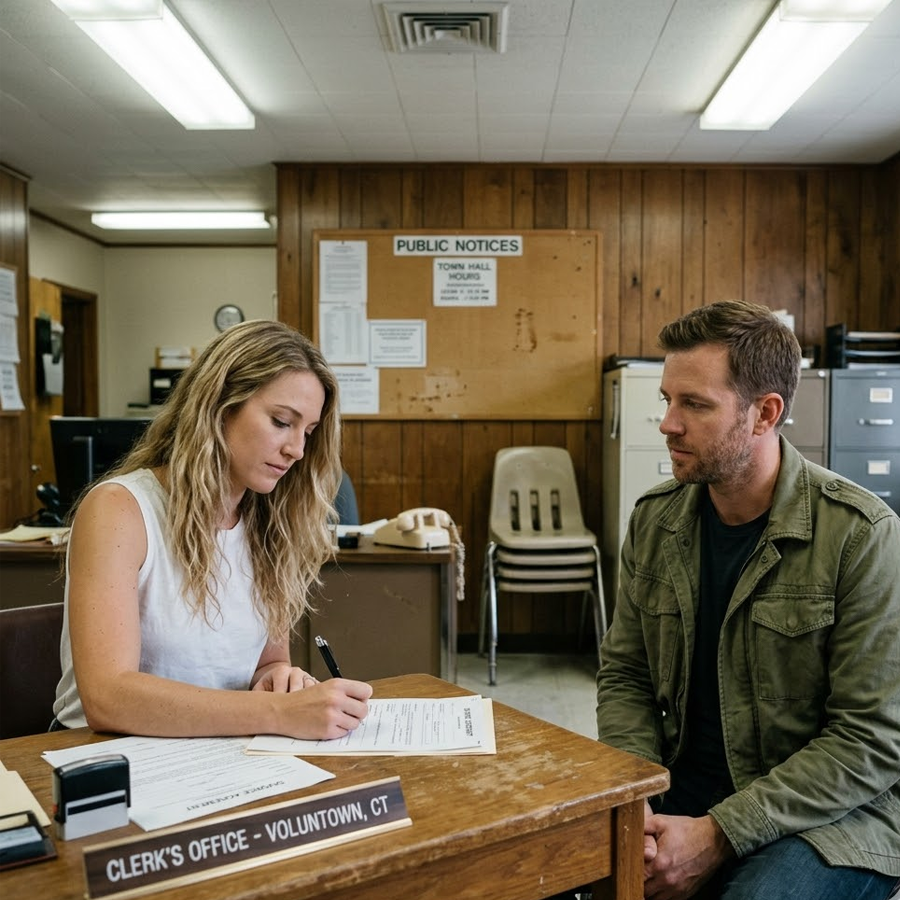
Mara Hensley signed the marriage certificate the same way she signed everything her father put in front of her — quickly, cleanly, without reading the fine print. She had learned a long time ago that reading the fine print only made it hurt more.
The county clerk’s office in Hartford smelled like old paper and floor cleaner. The fluorescent lights had the particular flatness of a place where people came to make things official that they hadn’t chosen. Mara sat in a plastic chair with her long blonde hair falling forward, pen moving across the signature line with practiced composure, and she did not look at the man sitting across from her.
She could feel him watching her, though.
She had noticed that about him in the three weeks since her father had introduced them in the dining room of the Hensley estate. The way he watched things. Not intrusively — not the way men sometimes watched her with that particular entitled assessment she had grown weary of by the time she was twenty-two. He watched the way people did when they were actually paying attention. Like information mattered to him. Like people mattered to him.
His name was Cole Merritt. He was thirty-four, dark hair, dark eyes, quietly handsome in the way of a person who had never thought much about it. He wore a dark olive jacket over a blue t-shirt and jeans that had seen better days. He carried himself with a relaxed steadiness that Mara, in three weeks of reluctant observation, had been completely unable to categorize.
Her father had told her Cole was a single father. His daughter was five years old. His wife had passed away two years ago. He worked in — and here George Hensley, a man who was never vague about money, had been uncharacteristically vague — some kind of consulting work. He had modest means. He was a decent man.
Her father had said decent man the way he said everything, as though it were a transaction and Mara were the commodity being exchanged.
What George Hensley had not said — and what Mara had been too exhausted by the entire arrangement to investigate — was why. Why this man. Why now. Why her father, who had spent thirty years measuring every human being by the size of their portfolio, had arranged for his only daughter to marry someone described as having modest means.
She had asked once. George Hensley had looked at her with his flat financial eyes and said: “Because I owe him something I cannot pay any other way.”
Mara had stopped asking after that.
—
The drive from the clerk’s office to Cole’s house took twenty-two minutes. He drove a dark green SUV that was clean but not new, and he drove the way he did everything — steadily, without urgency, without performance. They had barely spoken during the ceremony. The clerk had asked the questions. They had answered them. Cole had said “I do” in a quiet, even voice that gave nothing away. Mara had said it in the same tone she used for all obligatory statements.
Then it was done. By the laws of Connecticut, they were married.
“You don’t have to pretend this is something it isn’t,” Mara said, looking out the passenger window at the October trees. “I know what this is.”
A pause. “What is it?” Cole said.
She glanced at him. He was watching the road, but there was something attentive in his profile. Something that suggested the question wasn’t rhetorical.
“An arrangement,” she said. “My father owes you something. This is how he’s paying it.”
Cole was quiet for a moment. “Does that make you angry?”
“It makes me tired,” Mara said. “There’s a difference.”
He nodded slowly, like that made sense to him. “For what it’s worth,” he said, “I didn’t ask for this. I want you to know that.”
“Then why did you agree to it?”
He kept his eyes on the road. “Because of Lily,” he said. “My daughter. She deserves a stable home. Two parents, if possible.” A pause. “I know that’s not a romantic reason.”
“No,” Mara said. “But it’s an honest one.”
They drove the rest of the way in a silence that was, unexpectedly, not uncomfortable.
—
Lily Merritt was five years old with her father’s dark hair and enormous brown eyes and the fearless openness of a child who had been deeply loved by at least one person her entire life. She was waiting at the front door when they arrived — a modest two-story colonial on a quiet street, well-kept and warm-looking — and when Cole came through the door she launched herself at him with the total physical commitment small children reserve for the people they trust most completely.
Cole caught her without breaking stride. Lifted her with one arm. Held her while she wrapped herself around his neck.
“This is Mara,” he said, his voice easy and natural. “She’s going to be living with us.”
Lily studied Mara from the safety of her father’s arms with the frank, unfiltered assessment available only to five-year-olds. “Your hair is really long,” she said.
“Yours is really curly,” Mara said.
Lily considered this. “Do you know how to make pancakes?”
“I do.”
“Good,” Lily said, apparently satisfied.
That was the entirety of Lily Merritt’s deliberation on the matter of her new stepmother. Mara looked at Cole over Lily’s head. Something shifted in his expression — not quite a smile, but the shadow of one. The kind that happened before a person decided whether to let it show.
He let it show. Mara looked away first.
—
The weeks that followed were the strangest of Mara’s twenty-eight years, and she had lived through some genuinely strange ones.
The house was modest by every measure she had grown up using. The kitchen was small. The furniture was comfortable rather than impressive. Cole drove her to the grocery store on Saturday mornings and pushed the cart with Lily riding on the front, narrating the produce section with expert authority. He cooked dinner four nights a week — actually cooked, standing at the stove in an old t-shirt with Lily on a step stool beside him, describing every step. He asked Mara questions about her life with a genuine curiosity that she kept waiting to reveal itself as performance and never did.
He worked from home most days in a small office off the hallway, door left open. She could see him sometimes from the kitchen — on calls, working through documents, on his laptop with a quiet, focused intensity. He never discussed his work in specific terms. She didn’t ask. The arrangement had rules, even if they were unspoken.
What he did consistently and without announcement was notice things.
He noticed when she hadn’t slept, and left a cup of coffee outside her bedroom door without comment. He noticed when she was working on her design portfolio — she’d been a graphic designer before her father had quietly defunded her independence — and left space at the kitchen table without being asked. He noticed when Lily was too much, which five-year-olds always were, and redirected her with the practiced patience of a parent who had been doing it alone for two years.
Three weeks in, Mara sat at the kitchen table after Lily was asleep and said, without looking up from her laptop: “You’re not what I expected.”
Cole was washing dishes. He didn’t turn around. “What did you expect?”
Mara thought about it. “Someone who needed something from me.”
“Everyone needs something from the people they live with,” Cole said. He turned off the tap and dried his hands and leaned against the counter, looking at her with those attentive eyes. “The question is whether what they need is reasonable.”
Mara looked at him. “What do you need?”
Cole was quiet for several seconds. “For Lily to have someone in her life who’s steady,” he said. “And kind. That’s all I actually asked for.” A pause. “You’re both of those things, for what it’s worth. She talks about you every morning.”
Mara looked back at her laptop. Her chest felt strange — like something that had been braced for a long time was deciding whether it was safe to stop.
—
The discovery happened on a Thursday in November, and it came through the most ordinary door imaginable.
Mara was at the kitchen table working on a logo project when a news notification crossed her screen. She almost scrolled past it. She would spend a long time afterward thinking about the particular randomness of that moment — the way enormous things arrived through the smallest openings.
She stopped.
The headline read: “Merit Capital Completes $4.2 Billion Acquisition of Novatech Medical Systems.”
The photo beneath it showed a man at a podium in a tailored suit. Dark hair. Dark eyes. A familiar jaw. Older in the photo, more formal, more assembled — but unmistakably, completely, the same face that had been standing at her kitchen sink twenty minutes ago washing dinner dishes in an old t-shirt.
Cole Merritt. Founder and sole owner of Merit Capital. Net worth, according to the article sidebar: approximately nineteen billion dollars.
Mara sat very still for a long time. She read the article once. Then again. Then she closed her laptop, stood up, walked down the hallway, and knocked on the open office door.
Cole looked up from his desk.
“Merit Capital,” Mara said. Her voice was level. She was proud of how level it was. “Four-point-two billion.”
A pause. Something moved through Cole’s expression — not guilt exactly, more like a man who had been waiting for a particular door to open and had now watched it happen.
“Yes,” he said.
“You’re worth nineteen billion dollars.” She looked at him. “Approximately.”
“Approximately.”
“And you drive a five-year-old SUV.”
“It’s reliable.”
Mara stared at him. “Why? Why all of this? The house, the grocery store, the — ”
“Because Lily grows up here,” Cole said quietly. “In this neighborhood, with kids who don’t know what her father is worth. Who play with her because they like her.” He leaned back in his chair and something tired and genuine moved across his face, the kind of tired that came from years of carrying a decision. “I grew up in real money. I watched what it did to the people around me. What it did to my marriage.” A pause. “When Sarah died, I made a decision about what kind of life Lily was going to have. This is it.”
Mara leaned against the doorframe. Her mind was moving through three weeks of memories and reassembling them against this new information. The ordinary evenings. The grocery cart. The dishes. The door left open.
“Did my father know?” she asked.
“Your father has known me for eleven years,” Cole said. “He’s the one who taught me everything I know about building a fund.” The tiredness in his face deepened slightly. “He also made some decisions toward the end of his career that I covered for. That’s the debt.” He met her eyes. “He told me you were someone worth knowing. He was right about that, at least.”
Mara was quiet for a long time.
“You could have told me,” she said finally.
“You would have treated me differently,” Cole said. Not accusing — just honest.
She thought about it. She thought about how she’d been with him: direct, unimpressed, occasionally sharp-tongued. And then she thought about how she’d been treated her entire life by people who knew exactly what her family was worth — the performance energy, the calculation behind every conversation, the way nothing had ever felt simply given.
“Yes,” she admitted. “I would have.”
Cole nodded once. No judgment in it.
“I need to think,” Mara said.
“Take all the time you need,” Cole said. He turned back to his work with the same steadiness he brought to everything else.
—
She thought for three days.
She walked in the neighborhood in the mornings while Lily was at preschool. She sat with the information the way you sat with something heavy — waiting to understand the shape of it before you decided how to carry it.
She turned over the deception and found underneath it something more complicated than anger. The recognition that the three weeks she had spent in this house, with this man and this child, had been the most honest three weeks she could remember in years. That Cole Merritt, across nineteen billion dollars of carefully constructed ordinariness, had never once been anything other than exactly what he appeared to be.
The money was the secret. The man was not.
On the fourth morning, she came downstairs at 6:30 and found Cole already in the kitchen making coffee. Lily was still asleep. The house was quiet and gray with early light.
Mara sat down at the kitchen table.
“I’m not angry,” she said. “I want you to know that. I was. I’m not anymore.”
Cole set a cup of coffee in front of her without being asked, the same way he always did. “Okay,” he said.
“I want to stay,” Mara said. “Not because of the money. I want to be clear about that.”
Cole looked at her.
“I want to stay because of Lily,” she continued. “And because you’re — ” she paused, searching for the right word, the honest one. “Decent,” she said. “My father called you decent, and I thought he was being dismissive. He wasn’t. It’s the most important thing about you.”
Cole was quiet for a moment. Something in his face shifted — careful, real, the shadow of that almost-smile becoming something more than a shadow.
“I want to stay too,” he said. “For the same reasons.” A pause. His eyes met hers. “And maybe some additional ones.”
Mara wrapped her hands around the coffee cup. The kitchen was warm and smelled like morning and somewhere above them Lily’s small feet were audible on the ceiling, getting ready to come downstairs and start another ordinary day.
“Additional ones,” Mara repeated.
“If that’s all right,” Cole said.
Mara looked at him — this man with nineteen billion dollars and dish soap on his hands and absolute steady attention in his eyes and a five-year-old upstairs who asked about pancakes as a test of character — and felt the particular loosening of a person who has decided to stop bracing.
“It’s all right,” she said.
Lily’s feet hit the stairs. Both of them turned toward the sound.
—
Six months later, on a Saturday morning in April, Mara Hensley Merritt sat at the kitchen table with her design laptop open and a contract beside it. Her first major client — a branding project she had landed entirely on her own. Nothing to do with the name she now carried or the fortune attached to it. Everything to do with the portfolio she had been building at a kitchen table in West Hartford while a five-year-old narrated pancake construction in the background.
She read the contract once. Then she picked up the pen.
Lily was at the counter on her step stool, describing batter consistency to her father with the authority of someone who had strong opinions on the subject. Cole looked over his shoulder at Mara. The almost-smile had been all the way there for months now — had made the full transition from shadow to real sometime in November, in a kitchen doorway, across a cup of coffee that he’d set in front of her without being asked.
“You’re going to take it?” he said.
“I already signed,” Mara said.
Lily turned on her step stool. “Mara signs everything really fast,” she informed her father seriously. “I watched her once.”
Cole looked at Mara.
Mara looked at Cole.
“She’s not wrong,” Mara said.
Cole laughed — a real one, the kind that reached his eyes. He turned back to the pancakes. Lily resumed her narration. The kitchen filled with the particular warmth of a Saturday morning in a house where everyone, finally and completely, had chosen to be exactly where they were.
THE END






