The garage on Meridian Street did not have a sign. That was the first thing people noticed, or rather, the first thing they failed to notice, which was the point. A hand-painted plywood board leaned against the chain-link fence at the driveway entrance. Repairs, cash only, ring bell. The letters were even, unhurried, the kind of lettering a man produces when he has learned not to waste effort on things that don’t hold.
The garage itself was a converted double bay, the concrete floor permanently stained in constellations of motor oil, every shelf organized with a precision that struck first-time customers as oddly out of place for a neighborhood operation. Wrenches hung in descending size order. Fluid containers were labeled and grouped.
A small corkboard above the workbench held a photograph, a crayon drawing, and a folded piece of paper. Daniel Hartley wiped his hands on a shop rag and studied the photograph for a moment. He did this sometimes without realizing it before turning back to the fuel injector he was cleaning. He was 37 years old, lean in the way that comes not from discipline but from never quite eating enough, with the kind of hands that told a story most people didn’t bother to read.
There were calluses in the right places and a thin scar along his right index finger from a grinder accident six years ago, and oil worked so deep into the creases of his knuckles that it no longer entirely washed out. He was not unhappy. That was the important thing to understand about Daniel. He had made a choice, a specific, deliberate, irreversible choice, and he had long since stopped measuring its cost.
The voice came from the corner of the garage, where a camp chair sat beside a folding table that held a half-eaten lunch, a library book on marine biology, and a 9-year-old girl currently lying across the chair with her legs dangling over one arm and her head propped on the other, reading with the focused intensity of someone who has discovered something magnificent.
What’s up, Rosie? Did you know a mantis shrimp can punch hard enough to break aquarium glass? Daniel set down the injector. I did not know that. And they can see 16 types of color. She looked up. We can only see three. That means everything we look at, we’re only seeing, like, a tiny piece of it. That’s actually a pretty good way to think about the world. I know.
She returned to the book with a satisfied air of someone confirming what they already suspected. Can we have pasta tonight? Sure. The exchange was ordinary and complete. This was how their days went. Work, reading, pasta on Thursday evenings, library visits on Saturday mornings, homework spread across the kitchen table while Daniel reviewed invoices or read whatever engineering journal he’d found at the used bookstore.
They lived in a two-bedroom apartment above a dry cleaner on Fenwick Avenue, the kind of place where the radiator knocked through the winter and the light in the hallway had been burned out for 8 months because the landlord was responsive to exactly nothing. But Rosie had her own room with a bookshelf that reached the ceiling, built by her father over a single weekend from lumber and leftover hardware, and she had never once said she wanted anything different.
She was, in the way that children sometimes are without knowing it, the complete center of someone else’s gravity. Daniel had been a mechanical engineer for 8 years, Haverford Systems, Structural Dynamics Division, the kind of work that involved precise calculations and peer review, and a salary that came with a benefits package and quarterly goals.
He had been, by every measurable standard, good at it. Then, the accident that took Caroline happened when Rosie was 14 months old, and the year that followed was not something Daniel organized into narrative. What emerged on the other side was a man who had sold the house, left the position, moved into the apartment on Fenwick Avenue, and opened the garage on Meridian Street because Rosie needed someone present, and presence was the one thing a corporate engineering position did not accommodate. His former colleagues had
assumed it was grief speaking. Maybe it was. He had never corrected them. Rosie’s teacher, Ms. Meredith Calloway, was one of the people who existed in Daniel’s life as a face and a name, but not yet as a person. He saw her twice a year at parent-teacher conferences, where she reported, with clear, professional warmth, that Rosie was exceptional, curious, empathetic, one of those students who asked questions the curriculum wasn’t designed to answer.
Daniel thanked her and meant it and returned to the garage. He had no particular impression of her beyond competent and organized. She had no particular impression of him beyond attentive father, works in trades. Neither of them knew that was about to change. The storm came in from the northwest and arrived ahead of schedule, the way bad weather has a habit of doing when you have somewhere to be.
Meredith Calloway became aware of it first as a change in the pressure of the air while she was still inside the school building, the specific atmospheric shift that precedes serious rain. She had parents night in 40 minutes, which meant she needed to drive home, change out of the blazer she’d spilled coffee on that morning, and drive back. She was an organized person.
She had a system for most things. She had not, however, anticipated the way the rain would arrive, not as a steady fall, but as an event, a curtain of water dropping without warning as she crossed the faculty parking lot, soaking through her jacket before she reached her car. She sat in the driver’s seat and pulled her hair out of her face and turned the key.
Nothing. She tried again. A faint, dispirited click, the sound of a car that has already given up and is merely being polite about it. No. She said aloud, quietly and with precision, as if addressing the vehicle directly. No. Not tonight. The car did not respond. She had purchased it 4 years ago, a second-hand silver sedan with reasonable mileage and a clean service history, and it had been reliable until approximately this moment.
She called her roadside assistance service and was informed by a recorded voice that estimated wait time was 90 minutes. She called her sister, who lived 40 minutes away and would not arrive in time. She sat and watched the rain make rivers across her windshield and thought about the parents currently driving toward the school for a meeting she was now going to miss unless something changed. The parking lot was emptying.
A few teachers passed. One paused, saw her expression, and gestured helplessly at the rain before hurrying to her own car. Another colleague offered to call someone, which was kind and not useful. Within 10 minutes, the lot was nearly empty. She was on her phone composing an apologetic email to the principal when she heard a knock on the passenger side window. She looked up.
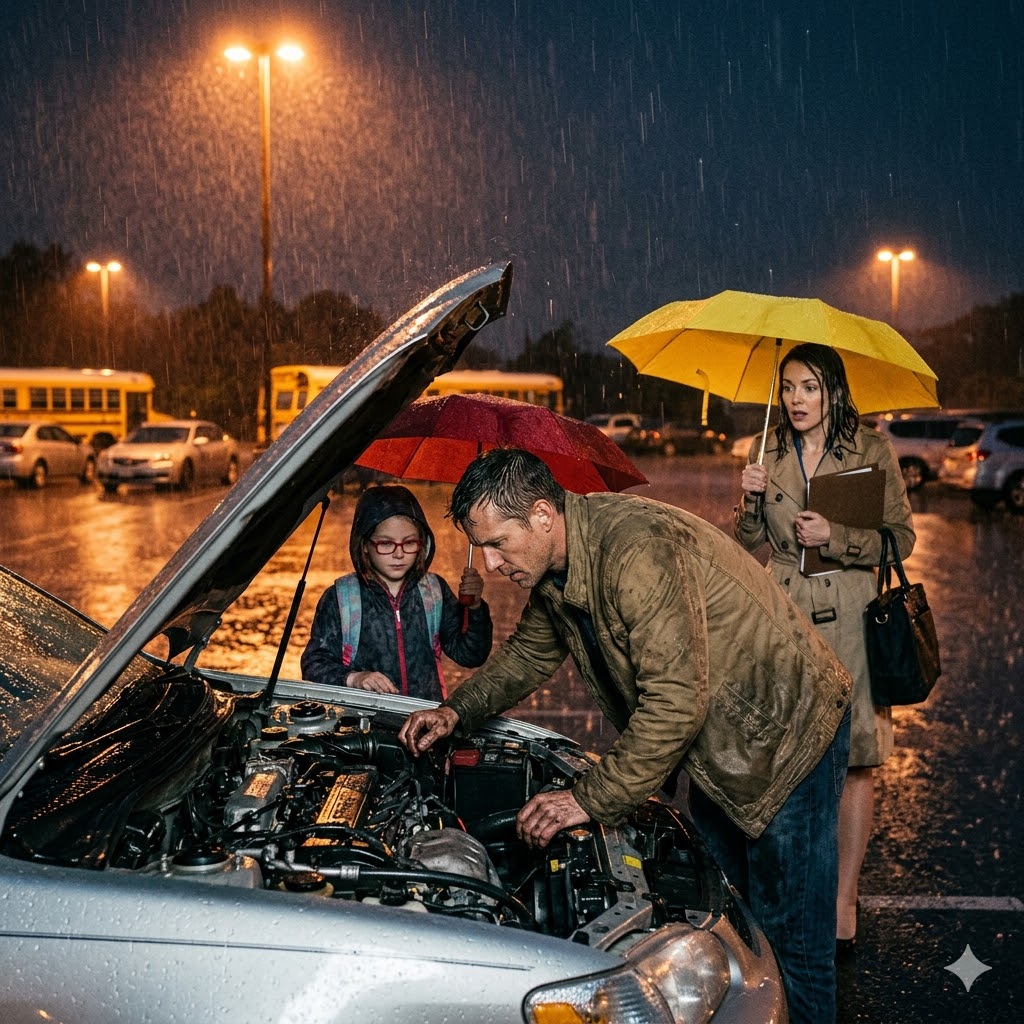
A man stood in the rain. He was tall, perhaps 35 or 40, with dark hair plastered to his forehead and a jacket that was losing its argument with the weather. He held a small umbrella over a child beside him, a girl with red-framed glasses and a backpack covered in marine biology stickers, who was looking at Meredith through the window with immediate and transparent recognition.
It took Meredith a half second. Then, she placed the face, Rosie Hartley. Third row, second from the window. Favorite subject, anything involving animals or mechanisms. Currently reading ahead in the science unit. The man made a small gesture window, and she hesitated for exactly 1 second before rolling it down. Ms. Calloway.
The girl’s voice was bright despite the rain. Your car broke? It seems that way, yes. My dad can fix cars. She said this the way one might announce that things are now resolved. He’s really good. Meredith looked at the man. He was not looking at her the way people look when they’re being helpful. He was looking at the car, or rather, looking at a specific point somewhere near the hood with the focused, undemonstrative attention of someone who has already begun diagnosing a problem.
You don’t have to, she started. What did it sound like when you turned the key? he said. His voice was even, unremarkable, directed at the steering column more than at her. A click. Just one click. He nodded slightly. She could not have explained why, but the nod had the quality of a professional confirmation.
He straightened up, looked at the rain as if taking brief inventory of it, then looked at his daughter. Rosie. You’ve got the hood latch, right? Pull the lever inside, then the secondary release at the front, Rosie said, with the tone of someone reciting multiplication facts. Good. He shrugged his jacket up and walked to the front of the car.
Can you pop it? Meredith, slightly disoriented by the pace of events, reached under the dashboard and pulled the hood release. She heard the hood go up. In the rain, in the faculty parking lot of Greenfield Elementary, a man she knew only as the father of one of her students was calmly assessing the engine of her car, as though this were a perfectly natural progression of his Tuesday evening.
Rosie moved around to stand beside her father, sharing the small umbrella, watching with the same focused attention. Rain ran down Daniel’s back. He didn’t appear to notice. “Starter relay.” He said after about 90 seconds. He hadn’t moved from his position at the front of the car. He’d traced a few cables with his fingers and looked at something near the firewall, and that appeared to have been sufficient.
Meredith had gotten out of the car by this point, standing slightly to the side under a compact travel umbrella she’d found in the back seat. The rain was a steady roar. The parking lot lights cast everything in orange, and in that orange light the scene had a quality of unreality. The empty lot, the water rushing along the gutters, this man methodically examining her engine as though the weather were irrelevant.
“The relays failed.” He said. He glanced at her briefly, the first time he’d made real eye contact. His eyes were dark gray, the kind that look lighter or darker depending on what’s around them. “It’s telling the starter motor to do nothing. That’s the click. There’s power, but no transfer. Is that fixable?” “Yeah.
” “I’ve got a relay in the truck that should bridge it temporarily.” He paused. “Not ideal, but it’ll get you where you’re going.” “You carry spare relays in your truck?” The corner of his mouth moved. It wasn’t quite a smile. “I carry a lot of things.” Rosie, who had been watching this exchange with obvious interest, contributed.
“He has a whole organized system.” “I made labels for some of the bins.” “You made very good labels.” Daniel said, and walked back toward a gray pickup parked at the edge of the lot. Meredith watched him go. She was a person who organized her impressions efficiently, and what she found herself doing was revising.
The image she’d had built from two brief parent-teacher conferences and the general category of tradesman, amiable, not complicated, was shifting, and she wasn’t quite sure what it was shifting into. She looked at Rosie. “How long has your dad been fixing cars?” Rosie considered this. “A really long time, I think.
” “But he used to do something else before.” “He doesn’t talk about it a lot.” She pushed her glasses up. “He knows about lots of things. Sometimes, when we’re driving and we pass a construction site, he explains everything they’re building and why it works that way.” “It’s interesting.” “I imagine it is.” “He taught me how internal combustion works.
” “I made a diagram.” She paused. “I have a question, though.” “What’s that?” “Is it hard to be a teacher?” “Like, is it hard to be patient with kids who don’t get things the first time?” The question was so earnest and so specific that Meredith felt something loosen slightly in her chest. “Sometimes.” She said honestly.
“But I like it. I like the moment when someone understands something they didn’t understand before. It feels like watching a light come on.” Rosie nodded with an expression that suggested she was filing this away carefully. Daniel returned with a small component and a canvas tool roll. And for the next 20 minutes, Meredith stood in the rain and watched something she could not have anticipated watching, a man disassemble and reconfigure a section of her engine with the economy of motion that belongs to people who
have done something so many times that the actions have become instinctive. He worked quietly, occasionally asking Rosie to hold something or hand him a tool, which she did without ceremony. The two of them moved around the engine bay with the practiced ease of people who have worked together before. He wasn’t just fixing the car.
He was reading it, pausing at intervals to trace connections, check for secondary issues, test a seal with his thumb. It was the behavior not of a mechanic working from a manual, but of an engineer working from comprehension. “Your coolant hose has a soft spot.” He said without looking up. “Not urgent, but watch it through the winter. If it fails, it’ll fail fast.
” “I’ll have it looked at.” “I can look at it now if you want. Easier while everything’s open.” She hesitated. “I’m already making you stand in the rain.” “I’m already standing in the rain.” He said it without inflection, a simple statement of fact. She didn’t answer immediately. He glanced up, and again there was that brief eye contact assessing, not intrusive, and then he was back at the engine.
“Let me check it.” He said. “Takes 2 minutes.” The rain did not ease. If anything, it redoubled around the time Daniel finished the temporary repair, and the three of them retreated to the covered walkway along the side of the school, building a narrow strip of roof that accommodated two adults and one child, standing close enough for conversation.
Meredith had texted the office. Parents’ night was postponed. The guilt of it was offset by the reality of the situation, which was that she was stranded in a parking lot in a storm, and the man standing 3 ft to her right had just given her car a functional evening. “Thank you.” She said. She meant it to come out professionally, but it came out like the thing it was.
“I was I was very stuck.” “We saw the car.” Rosie said. “And I recognized your umbrella first.” “The yellow one you always carry.” She looked at her father. “Didn’t I say it was Miss Callaway’s yellow umbrella?” “You did. I notice things.” Rosie informed Meredith. “Dad says it’s a useful habit.” “It is.” Meredith agreed.
She was studying Daniel without intending to. He had pushed his wet hair back and was leaning against the wall with the economy of someone comfortable with silence. He had not offered a name. She realized she knew it only because she knew Rosie’s, because of the conference files. He hadn’t introduced himself at all. He had simply started working. “Mr.
Hartley.” She said. He looked at her. “How much do I owe you?” Something moved across his face, not offense, exactly. More like the mild recognition of a category error. “Nothing. That’s not You don’t owe me anything.” He said it plainly. Rosie wanted to help. “I had the part. That doesn’t mean I know it doesn’t.
” He looked at Rosie, who was crouched down watching a rivulet of rainwater navigate the edge of the curb with the focused interest she brought to most things. “She talks about your class a lot, about the questions you let her ask even when they’re not on the syllabus.” Meredith looked at Rosie, then back at him.
“She asks good questions.” “She does.” He paused. The rain filled the silence comfortably. “She came home last month talking about convergent evolution. Spent most of dinner explaining it to me. She’d found a book that mentioned dolphins and ichthyosaurs having similar body shapes despite completely different lineages.
She wanted to know how that was possible.” Meredith paused. “I pulled out three other books. We ended up 15 minutes over.” The corner of his mouth moved again, and this time it became something more definitively a smile, quiet, private, the kind that doesn’t announce itself. “She came home and drew a diagram, put it on the fridge.
” That’s Meredith stopped herself from saying adorable, which felt like the wrong word for what she actually felt, which was something more like moved. She regrouped. “She’s one of those students you remember.” He looked at her then with a steadiness that was neither searching nor aggressive, simply present, and said, “I know.
” “She talks about you the same way.” Rosie looked up from the rivulet. “What are you talking about?” “You.” Daniel said. “Good things.” Meredith added. Rosie appeared satisfied by this and returned to the rivulet. They stayed under the walkway roof for another 15 minutes while the rain continued its argument with the evening, and Meredith became gradually aware of something she could not precisely name.
It wasn’t attraction, not yet. She was too careful a person to arrive there so quickly. It was something prior to attraction. It was attention. She found herself attending to him in the way she attended to things she did not yet understand, with patience, with a kind of gathered focus. He was not what she would have put together as a type.
She dated, occasionally, men who were articulate in the way that professional environments reward quick with observations, comfortable with abstraction, fond of their own fluency. Daniel Hartley was articulate in an entirely different register. His sentences were short, and they meant what they said. And when he didn’t have anything to say, he didn’t fill the space, and the space he left was not uncomfortable.
It was the quiet of someone for whom silence was not a problem to solve. She had met many people who used language to manage distance, to present themselves, to control impressions, to fill the gaps before anything real could come through. He was not doing any of that. He was simply there, leaning against the wall in wet clothes, not performing anything.
It took her a moment to recognize why that was disorienting. She had grown so accustomed to people performing that the absence of it felt like a new texture. Did you grow up here? She asked at one point. No, moved here about 6 years ago. From where? Philadelphia. He paused a beat. Before that, a few different places.
Followed the work. What kind of work? The slight hesitation was so brief, she almost missed it. Engineering, he said, different kinds. She could have let it rest there. She chose not to, gently. But you run the garage now. Yeah. By choice? He looked at Rosie again with the specific focus a person directs at the thing they’re protecting and said, completely.
It was the simplest possible answer and also somehow the most complete one. She found she had nothing to add to it. The rain moved in the gutters and the orange lot lights hummed and for a few seconds nobody said anything and it was fine. Dad rebuilt the kitchen shelves, Rosie offered without looking up. And my bookshelf. And he rewired the outlet in my room because it kept flickering.
You can do electrical work, too? Enough to be careful. He glanced at her. You probably shouldn’t do electrical work just because you understand the theory. She laughed before she meant to, genuinely, a short, unguarded sound. He looked slightly surprised by it and then something in his expression settled into something quieter, more open, as if the laugh had confirmed something he’d been uncertain of and the confirmation was welcome. The rain began to ease.
I should drive home before it starts again, she said. Yeah. He straightened off the wall. Don’t take the highway for the first couple miles. The relay fix is temporary, give it smooth roads until you can get it properly replaced. When should I get it replaced? Soon as you can. Monday at the latest. He reached into his jacket pocket and produced a business card, plain white, simple print, just the address on Meridian Street and a phone number.
He held it out. She took it. Their fingers didn’t touch. She looked at the card and then at him. This is your garage? Yeah. I’ll bring it in tomorrow afternoon, if you have time. He nodded. Come around 3:00. Rosie stood up and tugged once on Daniel’s jacket. He looked down at her and something passed between them, the wordless shorthand of two people who have had many quiet evenings together, who have learned each other’s language in the way that happens slowly and without announcement.
Okay, Rosie said with great satisfaction. Okay, what? Meredith asked. Nothing, Rosie said in the tone that means everything. She almost didn’t go. Not because she didn’t want to, she had thought about the parking lot conversation more than she’d intended, turning it over in the back of her mind, the way you turn over a stone that has an interesting texture.
She almost didn’t go because going felt like a decision and she wasn’t sure she was ready to make decisions about what the parking lot meant. She went anyway. The garage on Meridian Street was more organized than she’d expected from a one-man operation. She’d anticipated chaos. Most repair shops she’d been to had a particular kind of productive disorder, towers of parts and greasy manuals and the ambient feeling that order was aspirational rather than achieved. This place was different.
The tools were organized. The shelves were labeled in a handwriting she recognized, rounded and earnest, the same handwriting that appeared on Rosie’s homework headers. The floor was stained but clean. Daniel appeared from beneath a lifted sedan as she pulled in, sliding out on a creeper with the unhurried efficiency of someone who always knows exactly where he is in a task. You came, he said. I said I would.
He stood, wiped his hands and crossed to her car. How’d she run this morning? Fine. Smooth. Good. He opened the hood without asking permission, not rudely, simply because the hood was what needed to be opened and began the proper repair with the same quiet competence she’d watched the night before.
She sat in a folding chair near the work bench. She had brought a bag of student work to grade. She graded approximately half a page before she stopped pretending and simply watched. He worked differently in the garage than he had in the parking lot, less compressed, more fluid. Here he had everything he needed. The right tools, proper lighting, the organized infrastructure of a space that was specifically his.
She could see, in the way he moved through it, that this was not a place where he merely worked. It was a place he had made into what he needed it to be. After a while she said, Can I ask you something? Sure. The relay you put in last night. You said you had one in the truck. Yeah. That’s not a common item to carry.
He was quiet for a moment, then, I carry a kit when I’m driving Rosie. If something goes wrong, I want to be able to fix it. If someone else’s something goes wrong, it’s useful, too. You plan for that? For someone else needing help? I plan for the general category of problems on the road. She considered that. That’s a very engineering way to think about carrying emergency supplies.
He stopped what he was doing and looked at her over the top of the engine. It was a measuring look, not unfriendly, but assessing. Rosie told you I used to do engineering work? She mentioned you explained construction sites to her. And the way you diagnosed the relay last night was she paused, picking the word carefully, not how a general mechanic works.
He held her gaze for a moment, then he went back to the engine. Structural dynamics, he said finally. 8 years, Haverford Systems. She knew the name, not well, but enough. A mid-size firm with a good reputation, the kind of place that did interesting work, the kind of place that appeared in the trade publications she’d occasionally read in her research years. That’s serious work.
It was. Why’d you leave? The answer came slowly, not because he was reluctant, she sensed he had made peace with it, but because he was choosing the form of it. My wife died, he said. Rosie was 14 months old. The job needed it, needed someone present in a way I couldn’t be and also be what Rosie needed. So you chose. So I chose.
The simplicity of it sat in the air between them. She realized she had stopped breathing for a second and made herself breathe again. She had expected the answer to come wrapped in something defensiveness or the practiced self-deprecation people use when they’ve had to explain explain a life-changing decision too much times.
There was none of that. He stated it the way he stated everything, with the flat honesty of a man who had looked at the facts a long time ago and accepted them. Do you miss it? Yeah, he said without a pause. Every day. Like you’d miss a language you used to be fluent in. He adjusted something, tightened a fitting.
But I’m fluent in other things now. She looked at the shelves. The photograph pinned to the corkboard. She couldn’t make out the details from here. The crayon drawing beside it. The neatly folded paper. The organization of the space around her felt newly significant. This was not someone who had simply given up on precision and rigor.
He had relocated it. Every labeled shelf, every tool in its exact place, every system built for reliability. The mind that had designed load-bearing structures for a living had turned itself toward the problem of running a good small business and of raising a daughter alone and had brought the same methodical intelligence to bear on both.
She thought about what that cost every day and about what it preserved. What’s on the corkboard? She asked. He followed her eyes. Picture of Rosie’s first day of school. Drawing she made last year, she said it was me fixing something, but it looks more like a robot. And a letter from her that she put in my lunch when she was in first grade before she really knew how to write.
What did it say? Dad, you’re good at your job. I love you. Signed, Rosie Claire Hartley. He said it from memory and the recitation was so precise and unselfconscious that something in Meredith’s chest pulled tight. You’re good with no apostrophe. Did you keep it because of the grammar? He gave her a real smile then, not the quiet corner of mouth thing, but an actual smile.
And it changed his face substantially, opened it up, made him look younger and more unguarded, made him look like the person he might have been in a different circumstance, in a life with fewer sharp edges. I kept it because she signed her full name. Like it was official. Meredith looked at the corkboard and the three items on it, photograph, drawing, letter, and thought about what a man chose to look at every day while he worked and what it said about what mattered to him, and found she had nothing useful to say and didn’t
try to say anything. The repair took 40 minutes. She stayed for an hour and a half. She couldn’t have explained afterward exactly how it happened. The conversation simply continued, opening out in the way that conversations do when two people discover they are unexpectedly interested in the same things.
She taught language arts and science and had a particular interest in how children develop abstract reasoning. He had read widely in developmental psychology for reasons that were not academic, but practical. She had a background in biology before she’d switched to education. He had designed load-bearing systems that needed to account for material behavior at temperatures most engineers didn’t model.
They were talking about something completely unrelated to either cars or teaching. She was explaining the mantis shrimp fact that Rosie had shared, which had apparently originated from a library book she’d checked out the previous week when the subject of the conversation arrived. Rosie came in at half past four, dropped off by a neighbor’s car, backpack bouncing, glasses slightly askew.
She stopped in the doorway and registered the scene, her father standing near the workbench, Miss Callaway in the folding chair. Both of them mid-sentence with an expression of complete and utter satisfaction. “Hi, Miss Callaway,” she said. “Hi, Rosie. Is the car better?” “It is. Your dad fixed it properly.” Rosie looked at Daniel. He looked back at her with the slight weariness of a man who recognizes a particular expression in his daughter’s face. “What?” he said. “Nothing.
” She dropped her backpack, pulled out her library book, and climbed onto the stool at the end of the workbench with the air of someone settling in for a while. They talked for another 15 minutes. Meredith gathered her grading bag. The afternoon light had shifted to early evening gold coming through the high windows and catching the dust motes and the hanging tools and the organized shelving in a way that made the whole space look less like a garage and more like something a person had considered and built with care. She was standing
beside her car, keys in hand, when Rosie looked up from her book. “Dad,” she said with the particular tone that 9-year-olds employ when they have decided that something should be said and have been thinking about how to say it. “What do you think of Miss Callaway?” The garage went quiet in a specific way. Meredith felt heat come into her face, which surprised her because she was not generally a person who blushed.
She kept her expression neutral through an act of will, but she could feel the warmth in her cheeks and was entirely certain it was visible. Daniel had gone very still at the workbench. He was looking at his daughter with the expression of a man who recognizes an ambush and knows there’s no clean exit. “Rosie,” he said quietly.
“It’s a real question,” Rosie said with transparent earnestness. She looked between them. “I’m asking a real question.” The silence stretched 1 second, 2 seconds. Meredith looked at the floor. She was aware that whatever Daniel said next was going to land somewhere significant, regardless of what it was, and she was aware that she was waiting for it in a way that was already revealing.
“Rosie,” he said again. “I won’t ask again,” Rosie said, which they both knew was not a promise about the future so much as a negotiating position about the present. Daniel set down the rag he’d been holding. He looked at Meredith briefly with that steady gray look and then away. “She’s very patient,” he said finally, “with the things that actually require patience.
” It was not what Meredith had expected. She had braced for deflection or mild embarrassment or the performative lightness that people deploy to diffuse awkward moments. What he said instead was specific and considered and said with the complete absence of theatrics that characterized everything he did. Rosie tilted her head.
“What do you mean?” “She lets you ask questions that take time to answer. She doesn’t rush to the simple version.” He paused. “That’s harder than most people think. What else?” Rosie asked, and there was nothing manipulative about it. She was simply genuinely curious with the directness that had not yet been trained out of her. “Rosie.
” His voice was soft, but certain. “That’s enough.” Rosie accepted this with surprising dignity and returned to her book, but Meredith saw, as the girl settled back onto the stool, the small satisfied expression that crossed her face, the expression of someone who has accomplished exactly what they set out to accomplish.
She drove home with her hands loose on the wheel and her mind doing the thing it did when she was working something out quiet, methodical, like sorting papers into the right files. She’s very patient. “With the things that actually require patience.” It was not a compliment about her appearance.
It was not a compliment about her professionalism. It was something more specific and more deliberate, an observation about character made with the matter-of-fact certainty of someone who has watched carefully enough to have formed an actual opinion. She was used to being seen in a certain way. She had been told at various points in her life that she was smart, that she was dedicated.
These were true things and she had no quarrel with them, but they were also the kinds of things that people said about the category of person she represented, the organized, competent, professionally warm teacher, rather than about her specifically. They were descriptions of a type, not a person.
“She’s very patient with the things that actually require patience.” She realized, somewhere on the drive home, that he must have heard a great deal about her over the course of the school year, not from direct contact, they’d barely spoken, but through Rosie, who was apparently a precise and detailed reporter of things she found interesting.
All of Meredith’s classroom decisions that Rosie had found significant, all the moments that Meredith had thought were gone the instant the school day ended, the 15 minutes spent on convergent evolution, the way she let a question run long when it was a real question, the books she pulled off the shelf when a student needed something the curriculum didn’t have, had apparently been carried home and examined and integrated into Rosie’s ongoing account of the world.
Daniel had been listening to that account for months. She thought about what that meant, not in a way that made her uncomfortable, but in a way that made her slow down. He had formed his impression of her through the careful observations of his daughter. He trusted those observations enough to have actual views, specific enough to say the things that actually require patience, rather than simply patient, which would have been the shorthand version.
He had chosen the longer, more accurate version. She thought about the corkboard, the photograph and the drawing and the letter with the missing apostrophe. She thought about a man who carried spare relays in his truck because he planned for the general category of problems and who kept a first grader’s official letter in his lunchbox and then pinned it where he could see it every day for 8 years.
She sat in her apartment that evening with a cup of tea that cooled while she thought, and she thought about what it meant to be truly seen by someone who had not met you directly through the careful eyes of a 9-year-old who signed her letters with her full name, and she thought about the fact that she had stayed for 90 minutes in a garage to grade a half page of student work, and that this had not occurred to her as odd until now, sitting in her own kitchen with the cold tea in front of her.
“The mantis shrimp,” Rosie had said, “can see 16 kinds of color. We can only see three. Everything we look at, we’re only seeing a tiny piece of it.” She thought about that for a long time. Then she picked up the business card from Meridian Street, which she had placed on the kitchen counter and not moved, and looked at it in the lamplight and put it back down.
She wasn’t sure what she was building yet, but she was fairly certain she was building something. She brought Rosie to the library on Saturday, as she sometimes did. The public library did reading hours for the third and fourth grades, and Meredith volunteered when her schedule allowed. She had not thought through entirely what it would mean to arrive and find Daniel sitting in one of the reading nooks near the back, a dog-eared engineering journal open in his lap.
He looked up when they came in, and there was a beat in which neither of them said anything. And then Rosie pulled off her jacket and said, “I’ll see you in the reading hour” to Meredith, and then turned to her father and said, also with complete composure, “You can go get coffee if you want. I’ll be fine.
” And walked to the reading corner with the self-possession of a much older person. Daniel and Meredith stood in the foyer of the library and looked at each other. “She planned this,” Meredith said. “Absolutely.” He said it without particular surprise. “She knew you came here on Saturdays. She also knows you volunteer here on the second Saturday of the month.
” He paused. “She mentioned it once. I should have thought harder about the timing. She looked at him. He was looking at the shelves with the expression of a man being gently outmaneuvered by a 9-year-old and finding he doesn’t entirely mind. Coffee? He said. There’s a cart near the periodical section. I know where it is.
She thought about saying no. She thought about saying something neutral that would redirect to professional terrain. She thought about any number of things and then she thought about the mantis shrimp and its 16 kinds of color and the idea that most of what she was looking at she couldn’t see yet. Okay, she said.
They stood at the coffee cart near the periodicals and talked for 45 minutes and did not run out of things to say. Which was, Meredith reflected later, its own form of information. He told her about a project he’d worked on at Haverford, a bridge reinforcement system that had used an unconventional material combination and the 2-year process of getting conservative engineers to look at data instead of assumptions.
She told him about a research project she’d been involved in after her teaching certification, studying how abstract reasoning developed in early childhood and how she had eventually decided that classroom practice interested her more than research documentation. You went toward the application, he said. So did you, in a way. He considered that.
I suppose I did. She looked at her coffee cup. Do you think you’ll go back to it? Engineering, I mean. Maybe. The word was more open than she’d expected. Rosie will be older. Things change. He paused. There are companies that do consulting work part-time. I’ve looked. You’ve looked. I’ve looked. He met her eyes. I don’t just survive things.
That’s not the same as being fine with where things stop. It was the most revealing thing he’d said to her and she understood he knew that and had chosen it. She held his gaze for a moment and then looked away not because she was uncomfortable but because she needed a second to absorb it. Why did you answer Rosie’s question? She asked.
Which one? In the garage. What do you think of Miss Callaway? He was quiet. Then because she asked it in front of you. That’s why you answered honestly. That’s why I answered at all. He looked down at the coffee cup. If she’d asked me privately, I probably would have given her some version of she seems like a good teacher and changed the subject. A pause.
But she asked in front of you. Which meant, I think, she wanted you to hear the answer. Meredith thought about that. She’s nine. She’s nine and she’s been watching both of us very carefully for a while. He said it without embarrassment or apology. I don’t think she misread anything. The library was quiet around them. The specific quality of Saturday library quiet. Which has its own texture.
Somewhere in the reading corner Meredith could hear the reader beginning a story. And she could hear, among the children’s voices, Rosie’s low, attentive response to a question. She’s very good at noticing things, Meredith said. She gets it from her mother. He said it simply with the composed certainty of someone who has learned to speak of this without it breaking.
Caroline was the same way, always reading the room before she walked into it. She looked at him. He was not performing grief. He was stating a fact about a person he had loved the way you might state a fact about weather or geography. It was clear and honest and cost him something she could see only at the edges.
She sounds like she was wonderful, Meredith said. She was. He looked toward the reading corner. Rosie has her eyes. Same way of watching. She didn’t call it anything that fall. She was a careful person and careful people give things time to become what they are. What she knew was this. She began to look differently at the photograph above the workbench when she came into the garage and she came into the garage.
Now, not always with a broken car but sometimes with coffee and a bag of student work because it had become a place where she sat and thought. Where the organized quiet of the space and the company of a man who didn’t require her to perform anything made the end of a teaching week easier. She had not made a decision about this.
It had simply become true. The way certain truths become true. Incrementally and then all at once. She knew that Rosie had stopped being simply a student and had become something adjacent to, she didn’t quite name it, a person she cared about with a specificity that was different from the care she had for her other students.
When she pulled books from the library cart, she sometimes set one aside because she thought Rosie would find it interesting. When she planned a unit on structural engineering for the spring, she found herself thinking about what questions Rosie would ask and planning for them. She knew that when Daniel looked at her he was looking at her, not at the category teacher, not at the category woman, but at whatever particular configuration of qualities she was and that this was both more comfortable and more startling than most forms of being
looked at. In November he took on a weekend consulting project for a small structural firm that had been referred to him by a former colleague, someone who’d heard through the specific networks of engineering that Daniel Hartley was still thinking about materials under load, was still running calculations in the evenings after Rosie went to sleep, had not let that part of himself go quiet.
He mentioned it to Meredith on a Saturday in the library and she watched his face change when he talked about the project, not dramatically, not in a way most people would notice, but in a way she had learned to read, the way the stillness in him became something slightly more alive. It’s one weekend, he said with the carefulness of someone who has learned not to want things too visibly.
It’s a start, she said. He looked at her. You said you didn’t just survive things, she reminded him. A pause. I did say that. It sounded like you meant it. I meant it. Another pause, quieter. It’s It takes time to trust that wanting something again is allowed. She thought about that for a long moment. I know what that’s like, she said.
He looked at her with the directness that she’d come to understand was not boldness but honesty, a refusal to look at something obliquely when looking at it clearly was possible. Yeah, he said. Yeah. The afternoon light came through the library windows and fell across the periodicals cart and the cooling coffee cups and two people sitting in the specific gravity of a thing that was taking its time to become itself because both of them were the kind of people who knew that the things built slowly were the ones that held. In December Rosie
made a card for her father’s birthday. She spent a long time on it, longer than usual, with watercolor pencils and careful lettering. And she signed it at the bottom in her full, official signature. Rosie Claire Hartley. Below that she had written, in smaller letters, a single edition. P.S. I think you should invite Miss Callaway to your birthday dinner. Just saying.
Daniel read it at the kitchen table and sat with it for a while. Then he set it on the refrigerator beside the crayon drawing that looked more like a robot and the first grade letter with the missing apostrophe. He picked up his phone. He put it down. He picked it up again. The call lasted 4 minutes and the conversation was short and specific and ended with her saying yes, of course, she’d love to come.
There was a warmth in her voice that he’d been learning to recognize, not performed, not careful, just present. And he stood in the kitchen holding the phone after she’d hung up and felt the particular quality of a good Tuesday evening in November. The radiator ticking. The lamp on in Rosie’s room. The sound of his daughter turning pages.
He stood in the kitchen after and looked at the refrigerator. At the collection of things pinned there, evidence of years, of choices, of the slow accumulation of a life he had built by hand. Not the life he’d planned. A different one, smaller in some ways and in other ways larger than he’d expected. With different textures and different rewards.
A life organized around what mattered with everything else sorted and labeled and put away. The thing about structures built carefully, he knew, was that they were meant to last. He went to tell Rosie. She was in her room reading about mantis shrimp. And she looked up when he appeared in the doorway and the look on his face told her everything she needed to know.
I told you, she said with great dignity and turned back to her book. He leaned in the doorway for a moment watching his daughter read in the lamplight. Outside the winter was settling in and the street was quiet and somewhere across town a woman was looking at a business card on a kitchen counter and thinking about how you only see three kinds of color when there are 16 to see and how the rest of what’s there is not absent, only waiting for the right kind of attention.
Yeah, he said softly. You did.