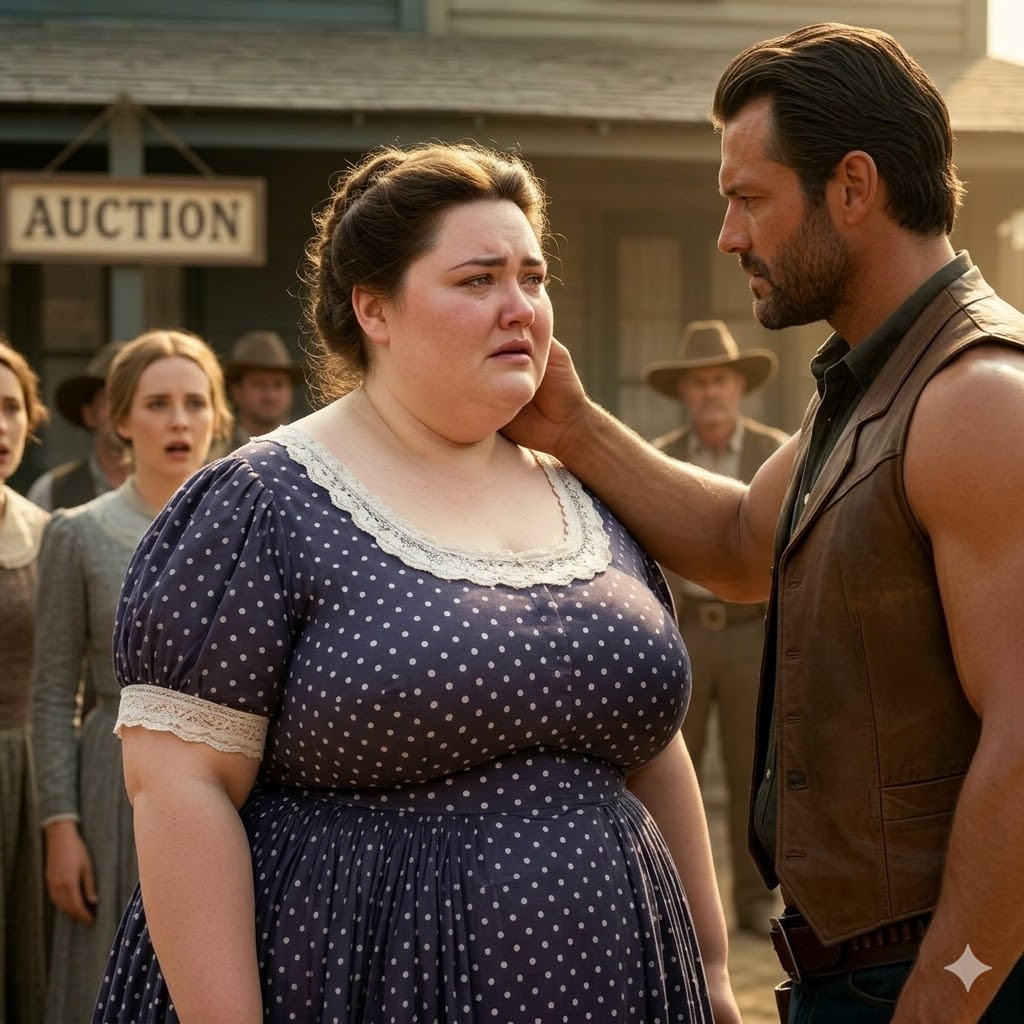
Nobody placed a bid.
The auctioneer tried $20. Then $15. Then $10. The crowd shifted its weight and murmured and said what it thought of her loudly enough for her to hear every word. Too heavy to work a field. Who’s going to feed her. Probably eats more than she’s worth. Clara stood on the block with her head down and her hands folded over her belly and listened to strangers calculate what she cost against what she would produce and arrive at a number below zero.
Her husband had been dead six months. The debts he left behind were real and the bank had claimed the house and the sheriff had run out of patience, so they brought her to the square on a Tuesday morning and told her to stand still while men decided her future. She wore the same calico dress she had worn to the funeral. It was stained at the hem and tight across her shoulders. Her hands shook.
The auctioneer dropped the price again. Still nothing.
The sheriff stepped forward. If no one took her, he said, she’d be sent to a workhouse two counties over.
Clara had heard about those places. Women did not come back.
Then a voice came from the back of the crowd. Low and rough, not raised, not performing.
“I’ll take her.”
—
He was tall, standing near the edge of the square in a worn leather coat and a wide-brimmed hat pulled low. His boots were dusty. His jaw carried a few days of stubble. He did not smile. He did not explain himself.
The auctioneer blinked. “You’ll pay the full settlement?”
The man nodded. He stepped forward and drew a leather pouch from his coat. He counted out coins in silence. It was more than the debt required. He handed it over without comment.
The auctioneer took the money. The man walked up to the platform.
He did not grab Clara. He offered his hand.
She stared at it for a moment — the rough, calloused palm extended toward her, attached to a man she had never seen before in her life, a man who had just paid money for her in front of an entire town. She did not understand it. She did not trust it. But the alternative was the workhouse two counties over.
She took his hand.
His grip was firm. Not rough. He helped her down the steps and led her toward a wagon parked near the general store. Clara looked back once. The crowd was already dispersing. The sheriff tipped his hat to the man and walked away. It was as if she had never existed there at all.
The man gestured to the back of the wagon. She climbed in. He took the bench, clicked his tongue at the horses, and they moved.
Clara sat on a wooden crate and watched the town disappear behind her. The buildings shrank. The voices faded. The hills rose on either side of the road. She did not know where she was going. She did not know why this man had chosen her. But for the first time in months, she was not standing in front of a crowd that was deciding what she was worth.
It was enough. For now, it was enough.
—
The ride lasted hours. The man did not turn around. He did not ask her name. He did not tell her his. Clara studied what she could see of him from the back — the hat, old and curled at the brim. The coat, patched at the shoulders. The hands on the reins, steady and unhurried.
He did not seem angry. He did not seem cruel. Clara had learned not to trust silence, but she watched him and could find no malice in the set of his shoulders or the way he held the reins or the particular patience with which he navigated the trail as it narrowed into the trees.
After the first hour, he reached behind him without looking and held up a canteen.
Clara hesitated. Then took it. The water was cool and clean. She drank slowly, careful not to take too much. When she handed it back, he nodded.
Later, bread wrapped in cloth. Thick and soft. Clara forced herself to eat slowly, though her stomach tightened with hunger. She did not want him to think she was greedy. She did not want to give him reason to regret what he’d done.
The landscape changed as they traveled. Plains gave way to rolling hills, then steep country covered in pine and aspen. The road disappeared and became a trail winding between trees. The air cooled. Clara pulled her shawl tighter.
She thought about what kind of work he would want from her. Cooking. Cleaning. Animals, probably. She had done those things before, not well — her husband had often said she was slow and clumsy — but she would try. She would try harder than she ever had because there was nowhere else to go.
Then a darker thought arrived. He lived alone in the mountains. Far from any law or witness. Clara’s hands began to shake.
The wagon rounded a corner.
The trees opened into a small valley. A cabin sat at its center, built from rough-cut logs with a stone chimney and smoke rising steady from the top. A shed nearby. A small corral with two horses. And on the porch — waiting, standing side by side, utterly still — two children. A boy and a girl, about six years old.
The girl had light brown hair tied back with a ribbon. The boy wore suspenders and no shoes. They stared at the approaching wagon without waving.
The man pulled the horses to a stop and climbed down. He walked around to the back and offered Clara his hand again. She took it and stepped down carefully, her legs stiff and her back aching. The children came closer, cautious.
The man looked at them. Then at Clara.
“You’ll sleep inside,” he said. His voice was calm. “They need someone here.”
Clara blinked. She looked at the children. They looked back at her with wide, uncertain eyes.
“You want me to watch them?”
“Cook, clean. Keep them safe while I work.” He gestured toward the cabin. “That’s all.”
Relief struck her so hard she felt dizzy. She nodded quickly. “I can do that.”
The man studied her for a moment, then nodded. He turned and walked toward the shed.
The children stayed where they were, still watching.
Clara took a slow breath. She looked at the cabin, at the valley, at the cool and enormous quiet surrounding all of it. She did not know if she could do what this man asked. But she would try. She would try with everything she had.
That night she lay on a cot near the hearth. The fire crackled softly. The children slept across the room, their breathing slow and even. The man slept on a pallet near the door, his rifle propped beside him.
Clara listened to them breathe. She closed her eyes.
For the first time in months, she did not cry herself to sleep.
—
Morning came with the smell of coffee and wood smoke.
The man — his name was Emmett Carr, she learned, and the children were Lucy and Thomas — was crouched by the hearth stirring a pot when she woke. He told her the basics without ceremony: trapline ran north, timber work after that, she would cook and clean and watch the children, creek out back for water, chickens in the coop, don’t let the kids wander past the corral.
He looked at her once to see if she understood. Then he picked up his rifle and walked out.
Clara stood in the silence.
Then she began.
She burned the first batch of biscuits. The eggs stuck to the pan. She spilled water carrying the bucket from the creek and had to make the trip twice. Her hands were clumsy. Her back ached. But the children ate without complaint. They watched her with the careful assessment of children deciding what kind of person someone was.
By midday, her arms were trembling. She had scrubbed the floor, washed the dishes, swept the porch, fed the chickens, checked the fire. The children played quietly near the cabin, always within sight. Lucy came inside while Clara was kneading dough and stood by the table watching.
“Are you staying?” she asked.
Clara looked down at her. “I think so. For now.”
“Good,” Lucy said. Then she went back outside.
Thomas showed her a small wooden horse that afternoon — carved smooth, made with care. “Papa made it,” he said. Clara told him it was really nice. He clutched it and ran back to his sister.
Emmett came back just before dark. He set his rifle by the door, washed his hands, looked around the cabin. He did not say anything, but Clara saw him notice the swept floor, the folded blankets, the pot of stew she had managed not to burn.
He sat down. She served him a bowl. He ate in silence. When he finished, he said one word.
“Good.”
It was not much. It was enough.
That night, Clara tucked the children into bed. Lucy let her pull the blanket up. Thomas asked if she would be there in the morning. Clara said yes. Emmett watched from across the room. When she stood, he caught her eye and gave a small nod.
Clara lay on the cot and closed her eyes. Her body ached. Her hands were raw. But something inside her had shifted. She had been useful today. She had done something that mattered. For the first time in years, she did not feel like a burden.
—
Weeks passed and Clara found her rhythm.
She woke before dawn. She started the fire, made coffee and breakfast, cleaned and mended and cooked. She learned to bake bread that rose properly. She learned to stretch the flour and salt. She discovered which herbs grew near the creek — rosemary, wild thyme — and began tying bunches of them to dry by the window. The smell of them became familiar, then comforting.
Her hands grew tougher. The blisters healed into calluses.
The children opened to her slowly, the way children open to new things — cautiously, and then all at once. Lucy began sitting beside her while she sewed. Thomas brought her things he found in the woods: smooth stones, pine cones, a hawk feather. Clara kept them on the windowsill in a careful row, like small treasures.
One afternoon, Lucy asked her to braid her hair. Clara’s hands were clumsy at first but she managed. When she finished, Lucy ran to show her brother. “Look, Thomas. Clara did it.” Thomas said it looked good. Clara felt something warm spread through her chest that she had not felt in a long time.
Emmett remained quiet, but not cold. He worked long hours and spoke little, but Clara began to notice the things he did without announcement. He brought extra flour from town without being asked. He fixed the chicken coop latch when it broke. He carved a new spoon when she dropped the old one in the fire. One morning she found a pair of leather gloves on the table — used but sturdy, and they fit her hands perfectly. He said nothing about them.
She thought about him more than she let herself acknowledge.
She began to plant a garden. The soil near the cabin was rocky, but there was a patch that looked promising. She found a rusted spade in the shed and began to dig, the earth cold and hard, sweat forming on her brow despite the cool air. The children came to help — Lucy pulling weeds, Thomas carrying stones to the edge of the clearing.
Emmett watched from the porch. He said nothing. The next morning, a small cloth sack sat on the table. Inside: seeds. Carrots. Beans. Squash.
He was already gone by the time she found it.
That evening, Clara planted them. The children knelt beside her, patting the dirt down with care. Lucy hummed something. Thomas asked if the plants would grow as tall as trees. Clara smiled and told him they’d see.
She felt something she recognized, with some difficulty, as hope.
—
The letter came on a Thursday morning.
A rider in a dark coat approached while Clara was hanging laundry. Emmett was chopping wood. He set down the axe, walked over, exchanged words, accepted a folded piece of paper. When the rider left, he brought the letter inside.
Clara’s hands shook as she read it.
It was from the sheriff. It claimed that Clara’s indenture had been improperly processed. That there were additional debts tied to her late husband’s estate that had not been settled. It demanded that she return to town within the week.
“It’s a lie,” Clara whispered. “You paid everything.”
“I know,” Emmett said.
“Then why—”
“Because they want you back.” His voice was calm. “And they’ll keep pushing until they get what they want.”
Clara’s chest tightened. She knew what going back meant. The sheriff would humiliate her again. He would auction her again. The next buyer might not be Emmett Carr.
“I’ll go,” she said quietly. “I don’t want to bring trouble to you or the children.”
“No,” Emmett said.
Clara looked at him.
“You’re not going back.” He folded the letter and set it on the table. “The debt was paid. They’ve got no legal right to you.”
That night, Emmett saddled his horse. He did not say where he was going. He checked his rifle and rode out into the dark. Clara stood in the doorway and watched until the sound of hoofbeats faded. She sat by the fire all night and held Lucy’s hand when the girl woke twice asking if Clara was still there.
He returned two days later in the late afternoon, his face bruised, his knuckles scraped, his coat torn at the shoulder. He washed his hands, sat down, and did not explain.
Clara made him food and brought him water and let him have his silence. She brought clean cloth and warm water without a word. He let her clean the cut on his knuckles. His hands were rough and steady under hers.
That night, after the children were asleep, she said quietly: “Thank you.”
He looked at her. “You don’t owe me thanks.”
“I do,” Clara said. “You didn’t have to fight for me.”
Emmett was quiet for a long moment. “You’re part of this house now,” he said. “That means you’re worth fighting for.”
Clara looked down at her hands. They were no longer shaking.
—
Five days later, she heard horses.
Three of them. The sheriff himself, flanked by two men with rifles across their laps. She saw them from the window and her heart dropped into her stomach.
Emmett was already reaching for his gun.
He stepped out onto the porch. Clara moved to the doorway where she could see.
The sheriff dismounted. He was a broad man with a thick mustache and a badge on his vest and the particular confidence of someone who had never had to worry about being wrong. “Emmett Carr. I’m here for the woman.”
“She’s not going anywhere.”
“That’s not your decision.” The sheriff stepped closer. “The county has a legal claim. She comes back with me or you’ll be charged with obstruction.”
“The debt was paid in full. I’ve got the receipt.”
“Receipts don’t matter if the debt was miscalculated.”
They stood their ground on both sides. The sheriff’s men shifted in their saddles. Then the sheriff looked past Emmett at Clara in the doorway, and his voice dropped into something uglier. “You really going to risk your land and those kids for her? She’s a burden. She always has been. Why are you throwing your life away for that?”
Clara heard every word.
She stepped out onto the porch. “I’ll go,” she said.
Emmett turned sharply.
“I’ll go with him,” she said again. Her voice shook, but she kept it even. “I won’t let them hurt you or the children.”
The sheriff smiled.
Then the door behind her burst open.
Lucy and Thomas ran out. Lucy planted herself in front of Clara, small fists clenched. Thomas grabbed the hem of Clara’s dress and held on with both hands and buried his face in the fabric.
“No!” Lucy’s voice was fierce beyond her years. “She’s ours. You can’t take her.”
Thomas did not speak. He just held on.
The sheriff stared at the children. His smile faded.
Emmett walked off the porch and crossed the yard and stopped a few feet from the sheriff. His voice was calm and low, but it carried.
“You’ve got no legal claim on her. The debt was paid in full and you know it. If you try to take her by force, I will ride to the territorial judge in Prescott and bring every crooked deal you’ve made in the last five years into the light. Every bribe, every fixed auction, every man you’ve cheated. I’ve got names. I’ve got witnesses. And I’ve got nothing to lose.”
The sheriff’s jaw worked. He looked at Emmett, then at Clara, then at the children clinging to her.
One of his men cleared his throat. “Sheriff, maybe we ought to—”
“Shut up.” But the other man was already turning his horse. The sheriff stared at Emmett for a long moment. Then he spat into the dirt. “This isn’t over.”
“Yes, it is,” Emmett said.
The sheriff climbed his horse and rode away. His men followed.
Clara’s knees went out from under her.
Emmett moved fast. He caught her before she reached the ground. The children wrapped their arms around her, crying and holding on, and Clara pressed her face into Lucy’s hair and let herself shake. Emmett held her steady.
“You’re safe,” he said quietly. “You’re all right.”
She looked up at him. His face was bruised and exhausted, but his eyes were steady and completely present.
She nodded. And this time she believed it.
—
Spring came slowly.
The snow melted. The creek ran fast and clear. Clara’s garden broke through the soil — tiny green shoots, then taller, then the feathery tops of carrots and the climbing tendrils of beans reaching for the stakes Emmett had set for her. The children ran through the clearing and brought her wildflowers from the ridge. She pressed some of them between the pages of an old Bible she found on the shelf.
Emmett smiled more. Small smiles, quiet ones. Clara had learned to see them.
One morning he asked her to walk with him. They climbed to the ridge where the valley spread below them, the sky impossibly wide and blue, a hawk circling overhead in the warm current of air.
He stood beside her for a long time without speaking. Then: “My wife died three years ago. I thought I’d raise them alone. I thought I didn’t need anyone else.”
Clara looked at him.
“I was wrong,” he said. His voice was rough but steady. “You brought life back into that house. Not just for them.”
Clara did not know what to say. She looked down at her hands — rough, scarred, stronger than they had ever been.
“I don’t have anywhere else I’d rather be,” she said softly.
Emmett turned to face her. For the first time, he held her gaze without looking away. There was something in his eyes she hadn’t seen before — not just gratitude, not just respect. The beginning of something that neither of them was in a hurry to name.
“You’re family now,” he said. “That’s all there is to it.”
It was not a proposal. It was not a declaration of romance. It was something more solid than both of those things. It was belonging. It was being chosen, not by necessity, not by debt — but by a man who had watched her burn the biscuits and scrub the floor and braid a little girl’s hair and stand on his porch and offer to sacrifice herself to protect his children, and had decided she was worth fighting for.
Clara felt the weight she had carried since the auction block — since long before that, since the first time someone had looked at her and made their calculations and found her wanting — finally, quietly, lift.
—
That evening, Clara knelt in the garden. The soil was warm now, soft under her fingers. Lucy and Thomas knelt beside her. Clara pressed her finger into the dirt and wrote her name. Clara. Lucy copied her, tracing the letters carefully. Thomas did the same, his small hand shaking with effort.
They laughed when they finished, hands covered in soil.
Emmett watched from the porch. Then he walked down and knelt beside them. He pressed his own finger into the dirt.
We are a family.
The sun began to set. The sky went orange and gold. The four of them walked back to the cabin together, side by side. The door stood open. The fire was warm inside. Supper was waiting.
Clara stepped through the doorway and looked back once.
The valley stretched out behind them — wide and wild and free. She had come here afraid and unwanted and ashamed. She had stood on an auction block while a crowd decided she was worth nothing. She had ridden in the back of a wagon to a place she didn’t know, with a man she didn’t understand, and she had made herself useful one day at a time until the word useful stopped being enough and was replaced by something that felt, at last, like its true name.
She was home.
THE END