I haven’t seen any of you since you traveled. You don’t take my calls. You don’t care about me. Mom. The day her son called from London, Regina was on her knees, not praying, scrubbing. She was on the floor of a stranger’s kitchen in the Wuse district of Abuja. Her hands raw from bleach, her back bent at an angle that a 60-year-old spine was never designed to hold.
She had been cleaning this woman’s house since 6:00 in the morning. It was now past 2:00 in the afternoon. She had not eaten. She had not rested. And the woman of the house, a government contractor’s wife who wore Brazilian hair and spoke to domestic staff the way you speak to furniture, had just added the bathrooms to Regina’s list without asking.
Regina did not complain. She needed the money. Her phone vibrated in her wrapper. She peeled off one rubber glove and looked at the screen. Steven calling. Her whole face changed. The tiredness lifted. The pain in her back became something she would deal with later. She pressed the phone to her ear and her voice, when she answered, carried none of the floor she was kneeling on.
Steven, my son, how are you? Mommy. His voice was warm, distracted, the voice of a man multitasking. How are you doing? I’m fine. I’m fine. Very fine. Are you well? How is the weather there? Cold. Listen, Mommy, I wanted to ask you about the land again. Regina went still. The land, she repeated. Yes.
Ruth and I were talking. We’ve done the calculations. If you sell all four plots now, all of them, that’s enough for my tuition, Ruth’s program, and Fina’s first year. We could all go at the same time instead of waiting. She looked down at her reflection in the wet kitchen tiles. A tired woman, a woman who had been tired for so long she had forgotten what the other thing felt like.
All four, she said quietly. Mommy, it’s an investment. Once we’re all settled abroad, we will take care of everything. You won’t have to clean anybody’s house again. I promise you. And there was that word, promise. She closed her eyes. In the darkness behind her eyelids, she could see Arthur, her husband, gone 11 years now, the way he had looked the day he registered the first plot, proud in a way that had nothing to do with arrogance, the quiet pride of a man who was building something that would outlast him.
This land is for our old age, he had told her. When we cannot walk anymore, this land will work for us. Arthur had not imagined that he would be gone before old age arrived. He had not imagined a lot of things. Regina opened her eyes. The kitchen floor was still wet. The contractor’s wife was upstairs watching a series on her laptop, unbothered.
Outside, Abuja moved in its loud and indifferent way. Okay, Regina said. Just that, one word. Okay. Steven’s voice brightened immediately. Mommy, you won’t regret this. I swear to you. Don’t swear, she said softly. Just make me proud. She hung up, put the glove back on, and went back to scrubbing the floor. Three weeks later, she stood at the land registry office in her best Ankara blouse, the one she wore only to church and to places where she needed people to take her seriously, and she signed away everything Arthur had built.
Her neighbor, Mama Chichi, had tried to stop her at the gate that morning. Regina, think about what you are doing. What will happen to you when you are old? Land is security. Land does not travel abroad and forget your face. Regina smiled, the real kind, not the performance kind. My children are my land, she said simply.
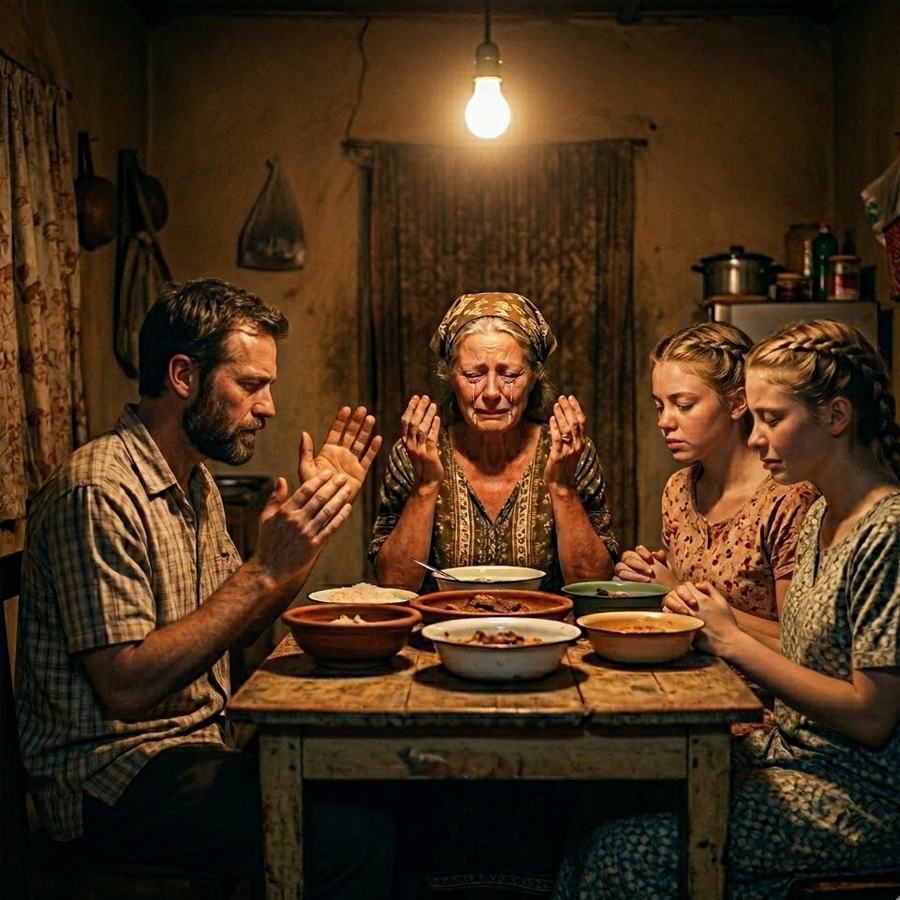
I am investing in something that cannot be seized by government, something that cannot be sold or repossessed. My children will take care of me. Mama Chichi had said nothing after that. What do you say to a woman who is already gone? That night, Regina cooked a pot of ofe onugbu that filled the whole street with its aroma, and all three of her children sat around a small wooden table that had seen better days.
Steven was 23, Ruth was 21, and Fina was 18 and already carrying herself like someone who had already arrived somewhere, even though her visa had not come. They prayed together. Steven led it. He always led because he was the oldest and because his voice made you feel like God was actually paying attention. God, let everything Mommy has sacrificed come back to her a hundredfold, he prayed.
Everyone said amen, including Regina. She said it with tears on her face, hands raised, eyes closed, a woman who believed with everything inside her that the seed she was planting would come back as a harvest she would live to eat. She did not know at that wooden table in Enugu that the children eating her pepper soup would one day see her name on their screens and choose not to pick up.
She did not know that the boy who just prayed over her life would one day tell his wife, that woman is just too demanding. She did not know it yet. And so, she smiled. Five years passed the way years do when you are waiting, slowly at first, then suddenly all at once. Steven got his engineering degree, married a British-Nigerian woman named Caroline, who wore her hair in a way that said, I do not have time for African drama, and secured a job at a firm in Manchester.
He sent money home at first, not much, but enough. Enough to fix the roof, enough to buy a small generator, enough to make Regina stand in her compound and thank God out loud. Ruth qualified as a nurse in Toronto, moved into a flat with two other Nigerian girls, and started dating a Jamaican man named Marcus, who her mother had never met and probably never would.
Ruth also sent money, but her money came with instructions. Mommy, use this for food only. Don’t give it to anybody. Don’t tell people I sent it, as if generosity was something to be hidden. Fina, the lastborn, the baby, became the most successful of all of them, at least on paper. She started a logistics business in Houston, got a green card, and began posting photos on Facebook that made people in the village say, “Chai, see how that woman’s daughter is living.
” She rarely sent money, but she sent pictures. And in some families, pictures are considered a form of provision. Regina still lived in the same house in Enugu. She had patched the roof, painted the walls herself with help from her neighbor’s son, and planted tomatoes and ugu leaves in the backyard because her knees were starting to complain, but her hands still needed something to do.
She was 61 now, old enough to feel it, not old enough to admit it. The calls in the beginning had been warm. Steven would call every Sunday, Ruth every Wednesday. Fina was inconsistent but dramatic. She would disappear for 3 weeks and then call for 45 minutes talking about herself. Regina would listen with a smile on her face, holding the phone like it was a grandchild she had not seen in years.
But slowly, the way termites work, quietly and from the inside, things began to change. Steven’s Sunday calls became every 2 weeks, then once a month, then, Mommy, things are really busy at work. I’ll call when I can. His wife, Caroline, began to answer the phone sometimes before passing it over, and there was something in her voice.
Not rudeness, exactly, just a door that was only slightly open. You could hear that you are not entirely welcome on the other side. Ruth started cutting calls short. Mommy, I’m on shift. I’ll call you back. She rarely called back. When Regina called her, it would ring and ring and then go to voicemail, a voicemail she had set up with her Canadian accent that she had definitely not had growing up in Enugu.
Fina was worse. Fina had developed a new language. Everything she said came wrapped in a kind of cheerful dismissal. Mommy, you are always worrying. I’m fine. Everything is fine. Stop calling so much. You’ll give yourself high blood pressure. And then she would hang up before her mother could say what she had actually called to say.
What Regina called to say, what she never said out loud because she was a proud woman, was this. I am lonely. My knees hurt. I cough at night and there’s nobody to bring me water. I look at your pictures on that phone that Fina sent me, and I try to understand who you have become.
I miss you, not the money, not the roof you fixed, you, your faces at my table, the sound of someone else breathing in this house. She never said it. Instead, she said, “I’m fine. Just calling to hear your voice. Greet the children for me.” Then she would put down the phone, sit in the plastic chair on her veranda, and watch the sun go down over the compound where her children had once played, where Steven had once fallen off the guava tree and split his chin open, where Ruth had learned to plait hair on the heads of other children who sat
still long enough, where Fina had once cried for 2 hours because she could not find her school shoes. She would watch the shadows grow long. Then she would go inside and heat up whatever she had cooked, usually too much because when you have spent 20 years cooking for three children, you forget how to cook for one, and eat alone at the same wooden table where they had once prayed together.
She ate slowly. She was not yet broken, but she was beginning to understand that the harvest she had been waiting for might not come the way she had imagined. She told herself it was fine. They were busy. They had their own lives. This was what she had worked for, their success, their freedom, their futures.
She told herself that every night until she started to believe it less. The first time they suggested the home, it was Steven’s idea. He called it a care facility. Regina was 67. She had survived a mild stroke the year before, not a big one, the doctor said, almost like he was apologizing for the inconvenience. But the kind that leaves a small shadow behind it.
Her left hand sometimes shook. Her speech was still clear. Her mind still sharp. But she tired easily and the stairs had become a negotiation rather than a habit. She had called Steven after the stroke. She had waited 3 days to call because she did not want to disturb him and also because she was not sure how to say it.
When she finally told him, there was a pause on the line. “How bad is it?” he asked. “The doctor says I need to rest more and take medication. I just need someone.” “I’ll call Ruth and Fina,” he said. “We’ll sort it out.” They had a family meeting on video call, the three of them on a screen, their mother sitting in Enugu with her phone propped against a cup so they could all see her.
She had combed her hair and put on a good blouse. She wanted to look well. She did not want them to think she was trying to make them feel guilty. She should not have worried. None of them looked guilty. Ruth spoke first in the careful measured tone of a nurse who had learned to deliver bad news professionally.
“Mommy, we’ve been talking and honestly we think the best thing now is for you to be somewhere with proper medical care, people who can watch you, not just a neighbor checking in.” “I can come,” Regina said quietly. “Let me come and stay with one of you. I don’t need much space. I won’t trouble anybody.” Silence.
The kind of silence that has already made a decision before you finish speaking. Steven cleared his throat. “Mommy, it’s not that simple. The visa process, Caroline and I we’re also quite busy with the kids and our place isn’t really “I can sleep in any room,” she said. Her voice was still steady but something in her eyes had shifted. “Any corner.
I will not be in the way.” More silence. Ruth said, “What about Fina? Fina, you have more space.” “Me?” Fina’s face on the screen went through several expressions quickly. “I’m literally in the middle of expanding the business. Marcos, I mean my partner, he’s also staying with me right now and it’s just “I thought his name was Marcos,” Regina said.
“That’s not the point, Mommy.” They found the home 2 weeks later. Steven had searched online and sent the link in the family WhatsApp group with the message, “This place looks decent, not too expensive, close to a hospital.” Ruth replied with a thumbs up. Fina sent a money transfer with a note that said, “For the first 6 months.
” Nobody asked Regina what she thought. The home was in a town 3 hours from Enugu in a building that had once been a guest house and had been converted with minimum effort and maximum optimism. There were 12 other residents, mostly women, mostly old, mostly carrying the same quiet bewilderment on their faces, the look of people who had not expected to end up here in a plastic chair in a common room watching a television nobody controlled.
The staff were not unkind. They were simply overwhelmed and underpaid and kindness, when it is not sustained by enough resources, eventually becomes efficiency. She was fed. She was given her medication. Someone came to change her sheets twice a week. On her birthday, they brought a small cupcake with a candle.
She blew out the candle alone. She had one photograph on her small dresser, the one from the night they had prayed together before the children left. Steven’s voice, Ruth’s laugh, Fina’s face already tilted towards somewhere else, Regina in the middle of them holding them all, her arms wide like she was trying to contain the future.
She looked at that photograph every morning. She had stopped calling them. Not because she was angry. She had moved past anger somewhere around month four. What she had arrived at on the other side of anger was something quieter and heavier, an understanding, a kind of tired knowing. She understood now that she had made a decision years ago in a land registry office in Enugu in her best Ankara blouse and the decision was not about land at all.
She had traded her security for a dream. The dream had come true. Just not for her. If you are watching this and the story is touching your heart, subscribe because we are just getting to the part that will change how you see everything. Regina passed away on a Wednesday morning in March. The nurse found her at 6:45 a.m.
still in her bed, her face turned toward the window, one hand resting open on the blanket as though she had been waiting for someone to hold it. The photograph of her children was on the dresser where she had placed it every single day for 3 years. The candle from her last birthday, half burnt, stood beside it. She had died in the night, quietly, without disturbing anybody.
The home called Steven first because his number was listed as the emergency contact. He missed the call. He was in a meeting. He called back 40 minutes later. The news traveled through the family WhatsApp group within the hour. Steven’s message, “Mommy has passed. We need to arrange to come home.” Ruth replied with three crying emojis and then, “I’ll look at flights tonight.
” Fina went offline for 2 hours, then came back with, “I’m devastated. Booking flights now. We have to do this properly.” Properly. That word will define everything that followed. The funeral was organized with the energy and precision that these three children had never once applied to visiting their mother while she was alive.
Fina flew in first in a black lace outfit that had clearly been purchased specifically for the occasion, the kind of outfit that says, “I am grieving and I am put together.” She hired a makeup artist for the day of burial. She ordered a casket that the funeral home owner quietly described as the premium option.
Ruth arrived with Marcos who turned out to be real, tall, and uncomfortable in the August heat of Enugu. She wore sunglasses throughout most of the proceedings, which some people took as a sign of deep grief and others took as a sign of something else entirely. She organized the catering. She made sure there was a photographer.
Steven came with Caroline and their two children, a boy of 12 named Daniel and a girl of nine named Sophia who kept asking why everyone was crying. Steven had aged in the way that some men age when they have been comfortable for too long, softly at the edges with a smoothness that comes from a life without real suffering.
He wore a well-cut agbada and walked through the funeral with the quiet authority of the firstborn son receiving condolences. He received many condolences. “Your mother was a great woman. She sacrificed so much for you children. God will reward you for giving her a proper burial.” Steven nodded at each one.
He shook hands. He looked appropriately sad. At one point, when the women from her mother’s old church began to sing her favorite hymn, “It is well,” he covered his eyes with his hand and his shoulders moved. Mammy Chichi, now 73 and leaning on a cane, watched him from across the compound. She watched all three of them.
She had known these children when they were small. She had been there the day their mother sold her land. She had been there the first time Steven sent money and she had been there quietly and without announcement the many times he had not. She did not say anything at the funeral. She waited until the burial was done, until the photographs had been taken at the graveside, until the food had been served and the guests had begun to drift away in the warm afternoon.
Then she walked slowly to where Fina was standing, still in her black lace, scrolling through photos on her phone. “You took beautiful pictures,” Mammy Chichi said. Fina looked up and smiled. “Thank you, Mama. We wanted to honor her properly.” “Mm.” The older woman looked at the phone, at the photos of the expensive casket, the flowers, the full compound of guests.
“She would have exchanged all of this,” she said quietly, “for one Sunday visit.” Fina’s smile stayed on her face but something behind it shifted. Mammy Chichi turned and walked away without waiting for a response. The children left Enugu 4 days after the burial. The house was locked. The photograph was packed into a box along with Regina’s other things, her Bible, her favorite wrapper, the small notebook where she had written down Bible verses in her careful handwriting.
The box was placed in a corner of a room and covered with a piece of cloth. Then they went back to their lives, Steven to Manchester, Ruth to Toronto, Fina to Houston. Back to the busy noise of their ordinary days that had long ago been redesigned to have no space in them for an old woman in a plastic chair in a town 3 hours from Enugu.
They went back, each of them carrying something they could not name yet. Not guilt exactly. Not grief because real grief requires presence and you cannot fully grieve what you had already treated as gone. What they carried was smaller and sharper than grief. It was a sound. The sound of a phone ringing and ringing and no one picking up.
They had heard it on Regina’s phone when they cleaned out her room at the home. The nurse said she had tried calling all three numbers in her final week. The calls had not connected. They carried that sound back across the ocean with them and they tried in the busy noise of their ordinary days to put it somewhere and leave it there.
But sounds like that do not stay where you put them. It did not happen all at once. That is the thing about karma that people misunderstand. They expect lightning. They expect a sudden dramatic reversal. The wicked person struck down at the height of their wickedness. The universe arriving like a court bailiff with paperwork and consequences. They wait for the moment.
But real karma is not a moment. It is a season. And for Stephen, Ruth, and Fina, the season began quietly in the ordinary passage of years as their own children grew up and began without knowing it, without ever having met their grandmother, without anyone ever sitting them down and explaining the pattern, began to behave in ways that felt strangely, terribly familiar.
It started with Stephen. Daniel, his son, was the first to leave. A scholarship to a university in Australia at age 18. He was brilliant, charming, full of promise. Stephen had celebrated at the airport with champagne. In the first year, Daniel called every week. In the second year, every 2 weeks.
By his third year, Stephen was leaving voicemails that were not returned for days. Caroline told him he was being dramatic. Daniel was busy. Young people were busy. This was normal. Stephen sat in his living room in Manchester one evening, his phone in his hand, Daniel’s number on the screen. Three missed calls from the past week unreturned.
And something moved through him like cold water. He thought of a Tuesday in Enugu. He thought of a plastic chair facing a window. He pushed the thought away and poured himself a drink. Sophia, his daughter, finished university in London and moved into a flat with her boyfriend, a young man Stephen had met twice. She was polite when they spoke, cheerful actually, in the way that young people are cheerful when they are managing you, when they have decided the conversation has a time limit. “Dad, I’m fine. Stop worrying.
You’ll give yourself high blood pressure.” Stephen heard those words and stood very still in his kitchen. He had heard those words before. He had said those words before. In Toronto, Ruth’s story came differently. Her eldest daughter, Amara, became a doctor. Ruth’s greatest pride, the thing she spoke about at every gathering with a brightness in her eyes that she had not turned on anything else in years.
Amara moved to Vancouver for a residency, met a man from Alberta, and slowly, with the impeccable politeness of someone who loves you but does not want to be managed by you, began to create distance. Ruth called every Sunday. Amara answered most of the time, but the calls had a quality to them, the same quality Ruth’s calls to her own mother had eventually developed.
Efficient, caring at the surface, hollow underneath. The holiday that Ruth had planned for 3 months, a trip to Vancouver to see Amara, to meet the man from Alberta, to sleep in her daughter’s home and feel for a few days like her family was whole, that holiday was postponed twice before Amara finally said, gently and with great care, “Mom, it’s just a really hectic time.
Maybe next year.” Ruth sat in her apartment in Toronto, Marcos asleep in the next room, and she did not know what to do with the thing that was happening in her chest. She thought about calling Stephen, but what would she say? That she was lonely? That her daughter’s voice had started sounding like a door closing? That she had begun to understand something she had not wanted to understand? She did not call Stephen.
Instead, she opened her phone and went to the family WhatsApp group, the one that had been quiet for months, and she scrolled up. All the way up, past the news about the funeral, past the plans, past the photos of the casket and the flowers and the full compound. All the way up to the last message Regina had ever sent to the group.
It was 2 years before she died, a voice note 40 seconds long. Regina pressed play. Regina’s voice filled the quiet Toronto apartment, slightly hoarse, slightly careful, with that particular cadence of a woman who was trying not to ask for too much. “My children, good morning. Just calling to say I am well.
I pray God continues to bless you and your families. If any of you has time this weekend, just a call will be enough. I am not asking for much, just to hear your voices. God bless you all.” The voice note ended. Ruth put the phone face down on the table. She pressed both hands flat on the table in front of her, the way you press down on something to stop it from shaking, and she breathed.
“Just to hear your voices.” She sat there for a long time. Fina’s reckoning came last, and it came the way all the most painful things come, through the child you are most certain would not do it to you. Kobe, her youngest, had always been her mirror, the one who looked like her, thought like her, moved through the world with the same restless energy and the same hunger for more, always more.
She had poured herself into Kobe in a way she had not even poured herself into her business. She had told herself, “This one will not forget me. This one is different.” Kobe moved to Dubai at 25 with a tech startup that within 2 years was worth enough money to make Fina cry with pride.
He sent her things, expensive things, the kind that came in boxes wrapped in tissue. He posted photos of himself at rooftop dinners and tagged her with captions like, “Everything I am, I owe to this woman.” But he did not visit. There was always a reason, the business, the investors, the expansion into the European market.
Fina listened to each reason with a smile on her face because she understood business, because she had built something herself, because she knew what it meant to be in that season of growth where everything else has to wait. And then, she turned 65 and planned a birthday dinner in Houston. Nothing big, just family.
And Kobe sent a gift instead of himself, a beautiful gift, a very expensive gift with a card that said, “Mommy, sorry I can’t make it. You know how things are. Love you always.” Fina sat at the birthday dinner she had planned. Her two other children there, Marcos there, a few friends. And she looked at the empty chair where Kobe should have been.
She looked at it the way Regina must have looked at three empty chairs at a wooden table in Enugu. She excused herself and went to the bathroom. She stood in front of the mirror. She looked at her own face, the face of a woman who had made it, who had built something, who had lived a life that people in the village called a success.
And she saw for the first time, clearly and without the protection of business or self-justification, exactly what she had done. She saw the land registry office, her mother in the Ankara blouse. She saw the video call and the silence after her mother said, “I can sleep in any corner.
” She heard her own voice saying, “I’m literally in the middle of expanding the business.” She heard her mother’s voice note, “Just to hear your voices.” She saw the photograph on the dresser in the care home, three children praying around a wooden table, a mother with her arms wide open. And she understood, finally, completely, in the way that truth arrives when there is no longer any place to hide from it, that her mother had not just loved them.
Her mother had been everything, had poured herself out like water into the ground, completely and without reservation, and had trusted that something would grow back. Something had grown, but it had not grown back for her. They met at the grave on a Sunday in December, all three of them, for the first time since the burial.
Nobody had planned it. Stephen had called Ruth, Ruth had called Fina, and somehow, drawn by something they could not name, pulled by the same quiet force, they had all arrived. The grave was simple. They had paid for a headstone at least. It said, “Regina Daniels, beloved mother. She gave everything.” They stood around it in the December heat, three aging, successful, lonely people in a cemetery in Enugu.
And nobody spoke for a long time. Stephen crouched down and touched the headstone with one hand. His fingers traced the letters, “Beloved mother.” He thought about Daniel’s unreturned calls. He thought about the meeting he had been in when the care home called. He thought about the word properly and what it had meant to him at the funeral and what it meant to him now. “She gave everything.
” He stayed crouched for a while, then he sat down in the dust right there beside the grave in his good clothes, and nobody told him to get up. Ruth stood with her hands clasped in front of her, head bowed, and she was crying. Not the managed tears of the funeral, not the performance, but the real thing, ugly and uncontrolled, the kind of crying that has been held in storage for years and has finally found a way out. She did not wipe her face.
She let it come. Fina sat cross-legged on the ground opposite Steven. Both of them flanking the grave like two people on either side of a truth too heavy to stand next to. She had brought the photograph, the one from the dresser in the care home, and she held it in both hands looking at it. The young faces, the wooden table, the prayer, the mother with her arms wide open.
And she understood, finally, completely, in the way that truth arrives when there is no longer any place to hide from it, that her mother had not just loved them. Her mother had been everything, had poured herself out like water into the ground, completely and without reservation, and had trusted that something would grow back.
Something had grown, but it had not grown back for her. I keep thinking, I keep thinking, Ruth said between ragged breaths, about that voice note. She said she said all she wanted was to hear our voices. That’s all she asked for, and we couldn’t even She stopped. Steven put his hand on the headstone again. I have Daniel’s number.
I’ve called it five times this week. Amara says maybe next year, Fina said. Kobe sent a gift to my birthday instead of himself. The three of them sat with that. Three successful people in a cemetery in December, surrounded by the silence of a woman who loved them beyond reason, beyond wisdom, beyond self-preservation. A woman who stood at a land registry office in her best blouse and traded her future for theirs and had trusted completely and fatally that they would not waste the weight of that sacrifice.
They had wasted it. And now, the universe, not cruelly, not dramatically, but with the steady patience of something that never forgets, was showing them exactly what that felt like. I want to ask her to forgive me, Fina said. I want to say I’m sorry. I need to say I’m sorry. She looked at the headstone. The headstone said nothing.
Because forgiveness, when it is not asked for while the person is alive to give it, does not arrive after. It simply becomes a debt you carry, a weight with no surface to set it down on. Steven finally stood up. He brushed the dust from his clothes slowly, without urgency. He looked at his siblings, at Ruth’s wet face, at Fina still holding the photograph, and he said the truest thing any of them had said in years.
We don’t just remember what we did to her. We’re living it. The sun was moving west over the Enugu cemetery, throwing long shadows across the graves, across the red earth, across three children who had made it everywhere except the one place that had ever truly mattered. Somewhere in Australia, a phone was ringing.
In Vancouver, a message was going unanswered. In Dubai, a birthday chair sat empty. The seeds they had planted were bearing fruit now. Every single one. The land was sold. The children were sent. The mother was left. And in the end, the harvest came back, not to the field where she had planted, but to theirs.
Some debts are not paid to the one we owe them to. They are paid to time, and time always collects.






