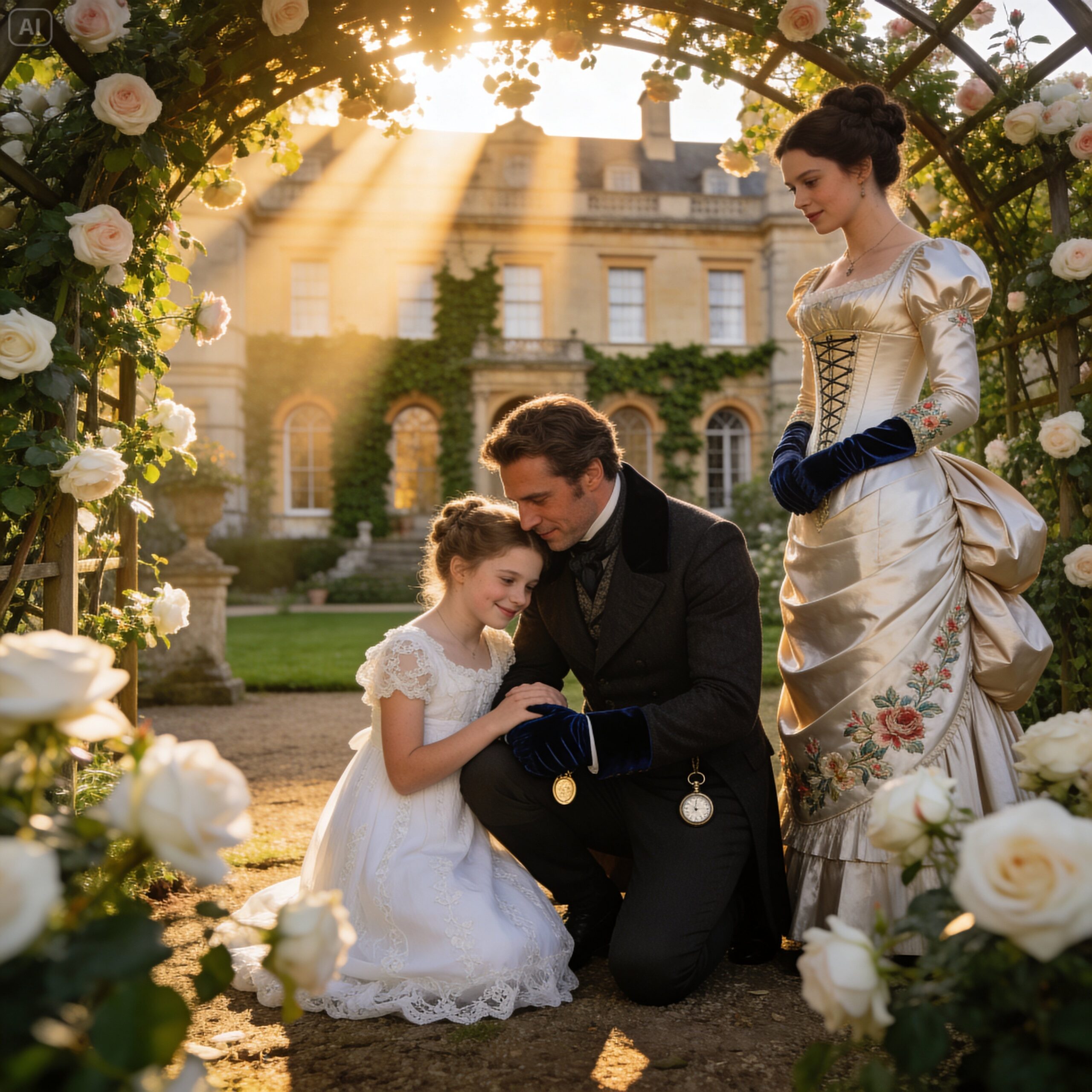
Until Miss Perpetua Voss arrived. She came with muddy boots, three trunks of books, and a complete refusal to make herself smaller for anyone. She was not meant to stay, a replacement, a second choice. The governess hired in haste after the last one fled the Duke’s silence before a fortnight had passed.
But Lady Rosalind Cavendish, 7 years old, solemn and watchful with her mother’s gray eyes, did not wait to be cautious. She chose Perpetua within the first afternoon. And on the third evening, while the Duke sat alone in the library, the lamplight dim and the glass at his elbow untouched, Rosalind found her. She took Perpetua’s hand, rose onto her toes, and whispered with the quiet certainty of a child who has already decided, “Can you fix him? Everyone leaves because they’re afraid of him, but I don’t think he’s frightening.”
A pause. “I think he’s broken.” Perpetua’s gaze moved to the closed library door, then back to the child. And in that moment, she chose. She knocked. England, 1852. The season turns and turns, indifferent to the houses that have gone dark. Hartwell Park is one such house. 300 years of Cavendish history pressed into stone and glass, its formal gardens maintained by gardeners who no longer expect to be praised for it.
Its great rooms opened once a year out of obligation and shut again with something close to relief. The Duke of Merrow keeps it running because duty requires it. He does not keep it warm because warmth requires something he has not had since the night his wife died and took most of him with her. His Grace, Julian Cavendish, Duke of Merrow, is 36 years old.
He is broad-shouldered and dark-haired, with a kind of face that would be handsome if it moved more, if the jaw unclenched occasionally, if the eyes remembered how to look at something without measuring its distance. He manages his estates with meticulous efficiency. He fulfills his parliamentary obligations.
He is, by every external measure, a man performing the function of a Duke with complete competence. He has not laughed since March of 1847. He knows the exact date. He has never told anyone. Miss Perpetua Voss is 26, the daughter of a radical printer from Bristol whose library was more ambitious than his income. She has dark eyes that register everything, copper-streaked brown hair that defies most pins, and a moral compass so fixed that it has occasionally got her dismissed from positions.
She was educated at the Edinburgh Ladies Academy for practical instruction, which means she can teach Latin, argue political philosophy, and ride astride, none of which are considered desirable qualities in a governess. She takes the position at Hartwell because Rosalind’s letter, written in a 7-year-old’s careful hand and slipped inside the agency envelope by means Perpetua never fully established, contained this single line: “I’m very good at lessons, but I have nobody to talk to properly.
My father tries, but he is very far away, even when he is in the same room.” Perpetua packed her trunks within the hour. She had no idea she was walking into a house that was holding its breath, waiting for someone brave enough to make it exhale. Perpetua arrived at Hartwell Park in rain. This seemed appropriate.
The house itself appeared to be made of gray. Gray stone, gray sky, gray gravel drive darkened to near black by the downpour. Even the roses along the east wall, which were presumably pink in better weather, had retreated into something the color of old tea. The housekeeper, a Mrs. Dunmore of formidable posture and cautious eyes, received her at the servants’ entrance with an expression that said she had received four governesses this way in the past 2 years and was not yet convinced a fifth would fare differently.
“The Duke does not keep late hours,” Mrs. Dunmore said, guiding Perpetua through stone corridors that smelled of beeswax and something older, something like grief preserved in formaldehyde. “He takes breakfast at 7:00, alone. Dinner at 8:00, sometimes with Lady Rosalind if her lessons are satisfactory. He does not require conversation.
” “What does he require?” Perpetua asked. Mrs. Dunmore paused at a staircase. The pause was eloquent. “Quiet, Miss Voss. He requires very thorough quiet.” Lady Rosalind was waiting in the schoolroom on the second floor, sitting at a table with her hands folded, wearing the expression of someone who has been told not to be too eager and is doing their absolute best.
She was small for 7, with the particular stillness of children who have spent considerable time in adult rooms. Her gray eyes moved from Mrs. Dunmore to Perpetua with swift, assessing intelligence. “You have ink on your left hand,” Rosalind said. “Miss Hartley never had ink on her hands. She smelled of lavender, and she cried on her fourth day.
” “I do not cry easily,” Perpetua said, sitting down across from the child without being invited. “And the ink is from an argument I was having with a letter. The letter was wrong. I was correcting it.” Rosalind looked at her for a very long time. “What was the letter wrong about?” “The proper education of women,” Perpetua said.
“Do you have opinions on the subject?” The child’s expression did something extraordinary. It opened. “I have several,” said Rosalind. “Nobody has asked before.” From somewhere below, a door closed, heavy, deliberate. The sound of a man moving through his own house like a guest who has not yet decided whether to stay.
Rosalind heard it, too. Her eyes went to the ceiling, then back to Perpetua, carrying a question she was not yet ready to ask aloud. She was not supposed to be in the library. Mrs. Dunmore had been very clear on this point. The library was His Grace’s domain from 9:00 in the evening onwards, and His Grace valued his solitude with the intensity of a man who had converted it from necessity into religion.
Governesses used the schoolroom library. Full stop. But the schoolroom library did not contain Locke’s Second Treatise, and Perpetua needed Locke’s Second Treatise to properly construct tomorrow’s lesson on natural rights, which Rosalind had requested after Perpetua mentioned that women had been arguing for them since before either of them was born.
So at half past 9:00, with a candle and complete absence of guilt, Perpetua walked into the library. The Duke was already there. He stood at the far window with his back to the room in shirt sleeves, without his coat, his hands braced against the window frame as though he were holding the glass in place by force of will.
The fire had burned low. The port at his elbow was untouched. He was staring into the darkness of the garden with the focused attention of a man watching something that nobody else could see. Perpetua should have retreated. She took three more steps toward the bookshelves instead, because Locke was in the third row from the left, and she could see the spine from here.
He heard her. Julian Cavendish turned with the speed of a man accustomed to a house where nothing moved after dark without permission. His eyes, which were dark and deep-set and currently carrying the particular emptiness of someone interrupted in the middle of their own absence, fixed on her with an expression that cycled through surprise, displeasure, and something she could not quite read before settling into cool authority.
“You are the new governess,” he said. Not a question. “I am,” Perpetua said. “I apologize for the intrusion. I need Locke. I’ll be out of your way within 2 minutes.” She crossed to the shelf and extracted the volume with efficient calm. She was turning to leave when he spoke again. “Locke,” the Duke said.
“For a 7-year-old?” “For a 7-year-old who asked me this morning why some people get to make rules for other people who had no say in the making. I thought Locke might be a more satisfying answer than because they always have.” The library was very quiet. Julian Cavendish looked at her across the room with an expression she had no framework for.
It was not displeasure. It was not approval. It was something that had not been activated in a very long time, blinking awake like a lamp in a room that had forgotten it had windows. He said nothing, but he did not tell her to leave. It happened on the third evening, exactly as the hook promised. Rosalind had been unusually quiet through her supper, the careful quiet of a child working something out.
Perpetua had learned in three days to distinguish between Rosalind’s thinking silence and her sad silence. This was thinking. She did not interrupt it. After supper, after the lamp was lit in the schoolroom and the Latin declensions were laid aside, Rosalind put down her pen and said, “Do you think my father is frightening?” “No.” Perpetua said immediately.
“Miss Hartley did.” “She told Mrs. Dunmore he made the house feel like a funeral that nobody was allowed to end.” Perpetua was quiet for a moment, choosing her words the way one chooses a path across uncertain ground. “I think,” she said carefully, “that people who are very sad sometimes look frightening to people who are not accustomed to grief.
But sadness is not the same as danger.” Rosalind absorbed this. Then she picked up her pen, put it down again, and looked at Perpetua with those gray eyes that carried the particular weight of a child who has been managing something too large for a long time. “Can you fix him?” she asked. The corridor outside the library, the low light under the door, the untouched port which Perpetua had noticed three nights running.
“I don’t think people can be fixed like clocks.” Perpetua said quietly. “I know.” said Rosalind. “But can you try?” “Everyone else leaves because they’re afraid of him. I don’t think you’re afraid, are you?” Perpetua stood. She picked up her candle. She looked at the child’s face, that brave, careful, seven-year-old face holding so much more than it should have had to hold.
“No.” she said. “I’m not afraid.” She walked to the library door. She knocked. A silence. The specific silence of a man recalibrating. Then, low and measured and entirely unprepared for her, “Come in.” Rosalind in the schoolroom down the corridor pressed her hands together and waited. The Duke was at his desk, a letter open before him, and he did not look like a man receiving a visitor.
He looked like a man who had been sitting in the dark so long he had forgotten other people existed. He looked up when she entered. His expression arranged itself into something formal. “Miss Voss, is something wrong with Rosalind?” “Nothing is wrong with Rosalind.” Perpetua said. She did not sit. She stood in the middle of the room with her candle and looked at him with the direct, undeflected attention that had, she was aware, made several people deeply uncomfortable in the past.
“Rosalind is the most impressive seven-year-old I have ever taught. She is curious and precise, and she has been managing far more than a child her age should be required to manage. That is what I wanted to speak to you about.” Julian Cavendish put down his pen. The movement was careful, deliberate, the action of a man giving his full attention to something because he has decided it deserves it and is not yet sure he is glad about that decision.
“Say what you came to say, Miss Voss.” “Your daughter is worried about you.” Perpetua said. “Not in the way children worry about scraped knees or broken toys. In the way that a child worries when she senses that something important in the world is wrong and nobody will tell her so. She watches the door every evening.
She counts how many minutes you spend at dinner. She measures her own behavior carefully because she believes, and I think she has believed this for some time, that if she is very good and very quiet and very perfect, something in you might come back.” The silence was absolute. The fire had burned to coals. In the dim light, the Duke’s face was unreadable, but Perpetua had learned in three days that his stillness was not emptiness.
It was containment. Something inside him moved. She could see the effort of holding it still. “You have been here four days.” he said at last. “Yes.” “And you feel qualified to make these observations?” “I feel obligated to make them.” Perpetua said. “Qualified is beside the point when a child needs something said.
” Another silence. This one different. Not cold, but charged. “Good night, Miss Voss.” he said finally. She went. But at the door, she paused. “She does not need you to be happy, Your Grace. She just needs to know you are still here.” She left him in the dark with that. And the letter on his desk remained unfinished all night because he could not remember what he had been writing before she knocked.
She found him in the garden the following morning. This was notable because Mrs. Dunmore had informed her, with the confidence of standing household intelligence, that the Duke did not walk in the garden before noon. He had not walked in the garden before noon since his wife had died, which was when the roses had been planted in a specific arrangement that the head gardener maintained to the letter because no one had told him to change it.
And yet there he was. In the formal rose garden at half past eight, in his great coat, standing in front of a particular bed of white roses with an expression that was not grief exactly, but lived in grief’s immediate neighborhood. Rosalind was with Perpetua because Rosalind had requested a lesson on botanical illustration and the garden had seemed the obvious location.
The child saw her father before Perpetua could redirect. She stopped walking. Then she did something Perpetua had not yet seen her do. She ran. “Papa!” Julian Cavendish turned. The expression on his face when he saw his daughter running toward him across the wet grass was the most unguarded thing Perpetua had witnessed in Hartwell Park.
He caught Rosalind when she reached him, lifting her with a practiced ease of a father who had done this a thousand times. And the gesture was so natural, so physical, so entirely at odds with the armored distance he projected in every other context that Perpetua felt she had accidentally witnessed something private.
She began to look away. “Miss Voss.” His voice across the garden even, careful. She stopped. “Rosalind tells me you are teaching botanical illustration. Our library has Redouté’s roses, the 1817 edition. It might be useful to your lesson.” He put Rosalind down. He looked at Perpetua with the specific expression of a man offering something small because he does not yet know how to offer something large.
“Thank you.” Perpetua said. “That would be very useful indeed.” Rosalind looked between them with the expression of a child watching something she had quietly arranged begin to work. Later, in the schoolroom, she drew a white rose with careful precision and wrote beneath it in her best hand, “Papa came to the garden today.
” Miss Voss did not seem surprised. The trouble arrived in the form of Lady Granville, who came for tea on a Tuesday with the declared purpose of checking on dear Julian and the unstated purpose of investigating the new governess, about whom her housekeeper’s cousin had sent a rather interesting letter. Lady Granville was 62, politically connected, and possessed of a social intelligence so refined it had become almost supernatural.
She registered everything, the ink on Perpetua’s fingers, the ease with which Rosalind addressed her, the particular quality of the Duke’s attention when Perpetua spoke at the tea table. He had joined them. That itself was news. Julian Cavendish had not taken tea with visitors in two years. “Miss Voss.
” Lady Granville said, with the sweetness of a woman beginning an excavation. “I understand you studied in Edinburgh. Most unusual for a governess.” “Most useful.” Perpetua said pleasantly. “They taught us to think as well as instruct. The two are not always the same.” “And what do you think,” Lady Granville continued, “about a governess who makes herself rather too comfortable in the family’s social spaces?” The tea table went very still.
“I think,” Perpetua said, setting down her cup with complete calm, “that comfort is what makes a house a home rather than a well-maintained building. If my presence at a tea table makes this house feel less like a mausoleum, I am not certain that is the problem you are suggesting it is.” Lady Granville blinked.
In 40 years of social combat, she had not been called a mausoleum by a governess. She looked at Julian. Julian Cavendish was looking at Perpetua Voss. And on his face, for the first time in Lady Granville’s long acquaintance with him, was the particular expression of a man who has just been surprised into a feeling he had forgotten he was capable of.
It was not a smile. Not quite. But it was the architecture of one. The scaffolding, the suggestion that somewhere beneath all that armored silence, a smile still existed and was considering its options. Lady Granville drove home and wrote three letters before supper. Hartwell Park, she told everyone, was no longer dark.
The Something in it had caught light. There was a portrait in the east corridor that Perpetua had been avoiding. Not consciously, but she had noticed over 2 weeks at Hartwell that she found reasons to take the west staircase, to use the south passage, to simply not walk down the east corridor if she could help it.
She told herself it was efficiency. It was not. The late Duchess of Merrow had been painted at 24 in a gown of deep rose silk with Rosalind’s gray eyes and a warmth in her expression that made the portrait feel less like oil on canvas and more like an interruption. Perpetua found herself there on a Wednesday afternoon, alone, because Rosalind was with her music teacher and the house was quiet.
She looked at the portrait for a long time. She did not hear the Duke until he was standing beside her. Her name was Charlotte, he said. His voice was entirely level. Perpetua had learned that his levelness was not coldness. It was the way he kept himself from fracturing in public. “She was,” Perpetua said carefully, “the kind of person who left a shape in things. You can tell.
” He turned to look at her. The question was in his expression before it reached his mouth. “The garden,” Perpetua said, “the way the roses are arranged, the books in Rosalind’s room, someone chose them with great attention, the way your daughter smiles, which is exactly like the woman in this painting. The shape Charlotte left in things is still here. That is not a small thing.
” Julian looked back at the portrait. The line of his jaw was rigid. She could see him working to hold something in place. “People tell me,” he said very quietly, “that time heals it. It has been 5 years. I find that time does not heal. It only teaches you to carry the weight without letting it show.” “That is not the same as healing,” Perpetua said. “That is endurance.
You are very good at endurance, but your daughter needs you to learn something easier. Not healed. Just present.” He said nothing, but he did not move away. They stood together in the east corridor for several minutes, not speaking, looking at Charlotte’s portrait while the afternoon light moved across the floor between them.
That evening, Rosalind came to supper and found her father already at the table, waiting. He had never been at the table before her. She sat down without comment, but her hands were clasped in her lap beneath the table, pressed tight together in the way of someone trying to contain something too large for their chest.
It began as significant arguments often do, over something small. Perpetua had arranged for Rosalind to attend a small educational gathering in the village. The vicar’s wife hosted monthly discussions for the local children, mixing classes without apology. A radical act in the Derbyshire countryside. Perpetua had attended one herself and found it exactly the sort of thing Rosalind needed.
Other children, argument, the discovery that her mind was not unusual, but simply untested. The Duke refused to permit it. He declined in a note delivered through Mrs. Dunmore, which Perpetua considered sufficiently cowardly to warrant a direct response. She found him in the estate office. “I would like to understand your objection,” she said, closing the door behind her with a particular care of someone who intends to say something that requires privacy.
“Rosalind does not mix with village children,” the Duke said without looking up from his ledger. “Because?” “Because it is not done.” “By whom?” He looked up. “By people of her position, Miss Voss. She’s the daughter of a Duke. She has responsibilities to her standing that a governess from a reformist school in Edinburgh may not fully appreciate.
” Perpetua took a breath that was not entirely steady. “Rosalind is 7 years old and she has not had a friend in this house since her mother died,” she said. “She speaks beautifully. She thinks precisely. She is, as far as I can tell, deeply lonely and you are proposing to preserve her standing at the cost of her happiness because you are afraid.
” “I beg your pardon?” “Not of the village children,” Perpetua continued, her voice quieter but no less direct. “You are afraid that if she goes out into the world, she might find things to love in it and if she loves things in it, she might lose them and you cannot bear, your grace, to watch your daughter learn what loss feels like because you know exactly how long the lesson lasts.
” The silence that followed was the longest Perpetua had experienced in Hartwell Park. Julian Cavendish’s expression was not anger. It was the face of a man who has been handed a mirror he was not ready for. “That will be all, Miss Voss.” “The gathering is on Thursday,” Perpetua said and let herself out. On Thursday morning, the Duke’s carriage was ordered.
He drove Rosalind to the village himself. He did not explain. Perpetua did not ask him to. It was not a grand occasion. That was the important thing. It happened in the schoolroom on an unremarkable Friday morning in October during a lesson on natural philosophy that had somehow devolved into a debate about whether horses or dogs demonstrated greater capacity for loyalty.
A debate that Rosalind was conducting with the forensic commitment of a barrister and absolutely no intention of conceding. Julian had come to observe the lesson. He had been doing this twice a week since the argument in the estate office. He sat in the chair by the window, slightly removed in the particular position of a man who is not yet certain of his welcome but has decided to risk it.
He watched his daughter deploy three separate arguments, a counterexample, and what appeared to be a prepared rebuttal against Perpetua’s horse hypothesis. He watched Perpetua argue back with equal conviction, then deliberately introduce a flaw in her own reasoning to give Rosalind room to find it. He watched Rosalind find it.
Her face lit with the specific joy of a mind encountering itself. “You did that on purpose,” Rosalind said, pointing at Perpetua. “You left the gap. I saw you leave the gap.” “I have absolutely no idea what you are referring to,” Perpetua said with an expression of complete innocence so badly performed that Rosalind burst into laughter.
Rosalind’s laughter was a particular sound, high and clear and absolutely unguarded, the laugh of a child who has forgotten, just for a moment, to be careful. Julian heard it and the armor cracked. Not dramatically. There was no great moment of visible collapse, but the line of his mouth changed.
The set of his jaw released fractionally, like stone remembering it had once been water. And in the corners of his eyes, in the lines around his mouth, in the way his chest rose with a breath that was not measured or controlled but simply taken, he smiled. Perpetua saw it. She looked away immediately because some things are too private to witness directly and because her own chest did something she was not yet prepared to examine.
Rosalind did not look away. She saw her father’s face and went very still, the way a person goes still when something they have been waiting a long time for finally, quietly, arrives. “Papa,” she said softly. “Yes?” “You look like you again.” Julian Cavendish looked at his daughter and said nothing, but he reached across and covered her small hand with his and held it there while the morning light moved across the schoolroom floor and the tears he would not shed pressed against the backs of his eyes and were somehow not entirely
made of grief. She was packing. Not because she had been dismissed, because she had decided, with the careful, painful logic of someone who has spent 3 months watching a man remember how to feel and is now aware of precisely what her own feelings mean, that staying was no longer something she could do without honesty and honesty might cost her the position.
Mrs. Dunmore found her at it on a Monday morning and went, without a word, directly to the Duke’s study. Julian found Perpetua in the schoolroom, one trunk partially filled, Rosalind’s most recent drawing of the white rose garden in her hands because she could not quite make herself put it in. “Miss Voss,” she set the drawing down carefully.
“I think it is time,” she said before he could speak. “Rosalind is flourishing. She does not need me the way she did and I have She paused, choosing precision over protection. “I have become someone who has feelings that are not appropriate to my position in this house. I would rather leave with my honesty intact than stay and pretend otherwise.
” Julian was very still. “What feelings?” he asked. His voice was careful, completely controlled and underneath it, like a current under ice, something urgent. You know what feelings. I want to hear you say them. Perpetua looked at him. This man who had been a ghost in his own house when she arrived, who had learned slowly, painstakingly to be present again, who drove his daughter to the village because a governess challenged him to, who stood beside a portrait and told the truth about his grief because she had created a space safe enough to
say it in, who smiled 3 weeks ago for the first time in 5 years, and whose face had rearranged itself around that smile into something that made her chest ache every time she thought of it. “I love you.” Perpetua said. “Not as my employer, not as Rosalind’s father, as yourself, which is why I cannot stay and say nothing and why I cannot stay and say something because the distance between your life and mine is considerable.” Julian said. “Yes.
I’m aware of the distance.” He crossed the room in four measured steps and stopped within arm’s reach. “I’m also aware that I have spent 5 years at the correct distance from everything and everyone, and I am acutely, specifically, unreasonably tired of it.” “Your Grace.” “Julian.” He said. “If you’re going to tell me you love me, you might use my name.
” The schoolroom was very quiet. Through the window, the white rose garden was turning copper with autumn. “Julian.” Perpetua said. He took her hand. He held it the way he had held Rosalind’s, not possessively, but with a particular certainty of someone who has decided that letting go is no longer the correct response to caring about something.
“I’m not asking you to bridge the distance alone.” He said. “I’m asking if you are willing to let me bridge it with you, publicly, permanently, with full understanding that my mother will disapprove. Society will be astonished, and Rosalind will consider herself entirely responsible for the outcome and insufferably smug about it.
” Despite everything, Perpetua laughed. It was the first time she had laughed in Hartwell Park. The sound moved through the schoolroom like light through a window that had been closed too long. “Yes.” She said. “Yes to which part?” “All of it.” Perpetua said. “Even the insufferably smug 7-year-old.” Down the corridor, Rosalind sat outside the schoolroom door with her hands pressed together, her ear tilted very slightly toward the gap, and the expression of someone who had asked a question 3 months ago and had just
finally received her answer. The white roses bloomed in May as they always had. This year, however, there were more of them. Julian had asked the head gardener in the quiet way he asked for things now, directly, without extensive preamble, to expand the bed along the eastern wall. He had stood with Perpetua while the plan was discussed, their shoulders touching in the unconcerned way of people who have stopped measuring the space between themselves.
And Rosalind had contributed three opinions on where specifically the new plants should go, all of which the gardener had incorporated without being asked to. Hartwell Park smelled different in spring. This was an objective fact confirmed by Mrs. Dunmore, who had been housekeeper here for 19 years and had not previously thought of a house as having a smell beyond stone and beeswax and the occasional boot polish.
It smelled now of something she could not precisely name, but which she had come to associate with the sound of a child running in the east corridor and the Duke’s voice responding without the measured quality he had used for 5 years. It smelled, she finally decided, like a house being lived in. The Duchess of Merrow had been received with less resistance than expected.
Society had been astonished as Julian predicted, but astonishment was not uniformly hostile. Lady Granville had declared at the first dinner Perpetua attended as Julian’s intended, that any woman who called a social call a mausoleum to the hostess’s face and made the Duke of Merrow look at something with warmth for the first time in 5 years was either the most foolish woman in England or the most necessary one.
She had declared for necessary, and society, which followed Lady Granville with the devotion of people who have learned she is usually right, had adjusted its position accordingly. Julian’s mother had not adjusted. She had sent seven letters. Julian had answered three of them kindly and without apology, and Perpetua had answered two of the others, which had ended the correspondence, though not, apparently, the disapproval.
“She will come round.” Julian said. With the equanimity of a man who has decided his mother’s approval is desirable but not required. “Or she will not.” Perpetua said. “And we will manage perfectly well either way.” Rosalind attended the village gatherings every month now and had accumulated, in the manner of small children who discover social appetite late, an almost aggressive number of friendships.
She had also developed opinions on estate management, parliamentary procedure, and the proper cultivation of roses that she delivered to her father with the confidence of someone who has been told her thoughts matter and has decided to take that at face value. Julian listened to all of them. Sometimes he disagreed.
He said so directly, and Rosalind argued back, and Perpetua watched this exchange across the dinner table with a particular satisfaction of someone who has witnessed two people learn to be fully present with each other. On an evening in late May, with the long light of spring turning the garden gold, Julian found Perpetua at the window of the library, her library now, in the sense that she had reorganized three shelves and he had not objected, watching Rosalind in the garden below with the village vicar’s daughter engaged in some project
involving a great deal of mud and what appeared to be architectural ambition. He stood beside her. They watched together. “She is going to be extraordinary.” Perpetua said. “She already is.” Julian said. “She has been since she was born. I was not always present enough to notice.” “You are now.” “I am now.” He turned to look at her, and his face in the evening light was the face of a man who has come back from somewhere very far away and found the journey was worth the distance.
“That is your doing.” “It is Rosalind’s doing.” Perpetua said. “She asked the right question.” Julian smiled. He smiled the way he had been smiling for 11 months now, not cautiously, not briefly, not with the self-conscious quality of a man who has forgotten how to use a muscle and is still relearning the motion.
He smiled the way people smile when they are standing in the right place with the right person and the garden is full of light and a child is laughing somewhere below, and the world, for this particular moment, contains exactly what it should. Below, Rosalind looked up at the library window, saw them both there, and waved with the unbothered confidence of someone who asked a question, waited patiently for the answer, and was not the slightest bit surprised by it.
Perpetua waved back. Julian raised his hand. And Hartwell Park, which had been dark for 5 years and was dark no longer, held all three of them in its old stone walls and did not creak or settle or press the cold of grief into its corridors, but simply stood in the warm May evening doing what houses are built to do, keeping the people inside them safe.
If this story reached you, if you have ever been the one who knocked on a closed door, or the one sitting in the dark hoping someone would, leave your thoughts below. We read everyone. And if you know someone who needs reminding that grief and presence can exist together, that broken is not the same as gone, share this story with them.