PART 2
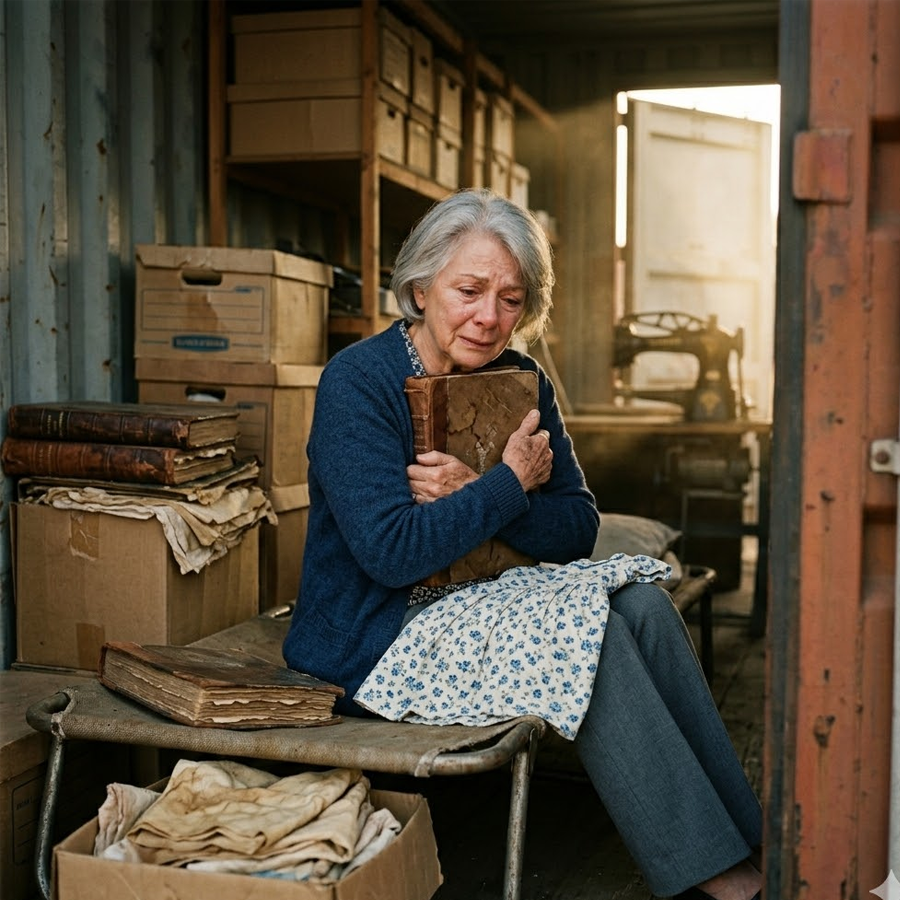
Dust coated every surface, but the mechanism moved when she turned the wheel by hand, smooth, oiled, maintained by someone who understood that machines lasted when you cared for them.
She looked at the shelving, pulled down a box. Inside, fabric. Folded precisely, wrapped in tissue paper that crumbled at her touch. Cotton prints from another era. Florals, plaids, ginghams, the kind of patterns Agnes hadn’t seen since she was a child. Since her hands stopped. She recognized the floral. Blue flowers on white.
A tiny pattern, almost invisible unless you held it close. Her mother had worn a dress made from that fabric. Agnes remembered it, not clearly, but the way children remember things. As texture, as smell, as the feeling of pressing your face against someone’s hip and inhaling the scent of laundry soap and warm cotton. Agnes’s mother, Iris, who had left in 1953, who had walked out of the house on a Tuesday morning when Agnes was 7 and never come back.
No note, no call, no explanation. Agnes’s father had said, “She’s gone.” And the subject was closed with the finality of a coffin lid. Agnes had spent 72 years believing her mother had abandoned her. Now, she was standing in a shipping container holding fabric with a pattern she hadn’t seen since 1953. Her legs gave out.
She sat on the cot, the folded cot that someone had slept on, and held the fabric against her face and inhaled. Nothing. Just dust and age and the ghost of something that might have been laundry soap if she imagined hard enough. She didn’t cry. Not yet. Crying required understanding and understanding hadn’t arrived.
She opened the next box. More fabric, different patterns. Some cut into shapes, pattern pieces pinned together, ready to be sewn. Children’s clothes, small, sized for bodies that hadn’t finished growing. The next box, finished garments. Dresses, shirts, trousers, dozens of them, folded and stacked with the precision of someone who took pride in invisible work.
Each one had a tag sewn into the collar. Not a brand name, a handwritten tag stitched in red thread. Made for blank. The blank was filled in with different names, different handwriting. No, the same handwriting, just different names. Made for Alice Hearn. Made for the Briggs children. Made for Tommy Watts. Agnes knew those names.
Hearn, Briggs, Watts. Families from town. Old families. The kind whose names showed up on cemetery headstones and church donation plaques and the faded awning of the hardware store that had been a hardware store since before Agnes was born. She opened the next box. A ledger. Hardcover, water stained, thick with entries. She opened it.
The handwriting was precise, small, slanted left, the kind of penmanship taught in schools that no longer existed. Each entry had the same format. Date, name, garment, payment. October 3rd, 1953. Alice Hearn, winter coat, wool, children’s size six, two dozen eggs. October 11th, 1953. Briggs family, three school shirts, cotton, one bushel apples, jar of honey.
November 2nd, 1953. Tommy Watts, trousers, patched, resized, no payment, family in hardship. No payment. Agnes turned pages, hundreds of entries from 1953 through 1971. 18 years of sewing, coats, dresses, shirts, trousers, quilts, curtains, made for families who paid in eggs and apples and firewood and sometimes nothing at all because the seamstress recorded no payment beside the names of families she knew couldn’t afford it and sewed for them anyway.
The seamstress. Agnes turned to the inside cover of the ledger. A name was written there in the same precise hand. Iris Wren, seamstress. This is my work. Agnes closed the ledger, pressed it against her chest, and the crying came, not gentle, not quiet, the raw, ugly, full-body crying of a woman who just found her mother in a metal box and understood in one terrible instant that Iris hadn’t left.
She’d been here, working, sewing, making clothes for people who couldn’t afford them for 18 years after she’d supposedly disappeared. Agnes’s father had said, “She’s gone.” He hadn’t said where. Tap like if you just felt the floor shift under you because the next thing Agnes found in that container wasn’t fabric or ledgers.
It was the reason Iris had hidden and the reason she never came home. At the back of the container, behind the cot, Agnes found a second ledger, smaller, personal, not business records, a journal. She read it standing up because she didn’t trust her legs to hold if she sat down. The first entry was dated September 1953, 1 month after Iris had left.
I’m writing this because no one will believe me if I only speak. Frank has told everyone I abandoned the family. He has told Agnes I chose to leave. The truth is I was removed. He changed the locks. He told me if I tried to see Agnes, he would call the police and tell them I was unstable. He has friends at the station.
They will believe him. They always believe him. Frank, Agnes’s father, the man who’d raised her after Iris left, the man who’d said, “She’s gone.” and built a life on that sentence. Agnes read faster now, her hands shaking. I found this container at the railyard, abandoned. I cleaned it. I brought my machine.
I sew because it is what I know and because the families in this town need clothes they cannot buy. I trade for food. I sleep here when I must. Mrs. Garvey at the church lets me wash in the basement on Tuesdays. I watch Agnes from the road sometimes. She walks to school at 7:45. She carries a blue lunchbox. She doesn’t look for me.
Frank has made sure of that. I made a dress for Agnes today, blue flowers on white, the fabric she used to touch when she sat in my lap, size seven. I cannot deliver it. I put it in the box with the others. Agnes stopped reading. The box with the others. She turned, looked at the shelving, the boxes she hadn’t opened yet, the ones at the very back, behind the fabric and the finished garments.
She pulled the first one down, opened it. Dresses, small, children’s sizes. Each one tagged, made for Agnes. Seven of them, sizes seven through 13. One for every year from 1953 to 1959. Each one in a different fabric, each one sewn with the same impossible care. Each one with the same tag in red thread, made for Agnes, never delivered, never worn, folded and wrapped and stored in a box in a container that Iris had turned into a workshop because she’d been thrown out of her own home and erased from her own daughter’s life. Agnes held the smallest
dress, the blue flowers on white, size seven, and pressed it to her face. The fabric smelled like nothing. 72 years had taken the scent, but the stitching was still tight, the seams still straight, the hem still even. Made by hands that loved the person they were sewing for, even if those hands would never dress her.
She sat on the floor of the container with seven dresses in her lap and understood that her entire life had been built on a lie her father told when she was 7 years old. Her mother hadn’t left. Her mother had been 18 ft away from this town for 18 years, sewing clothes for other people’s children because she wasn’t allowed to sew for her own.
If you’ve ever discovered that the story you were told about your own life was written by someone who didn’t want you to know the truth, stay with me because what Agnes did with Iris’s container didn’t just change her life. It changed the lives of every family whose name was in that ledger. Agnes didn’t move into the container.
She did something else. She drove to the church, found Pastor Elaine. Did the church know about my mother? Elaine’s hands stopped on the hymnals she was sorting. Mrs. Garvey let my mother wash in the basement. The church knew Iris was alive. Elaine sat down. My grandmother was Mrs. Garvey.
She told me before she died, “Your mother came the week your father locked her out. She begged for help. My grandmother called the police. The police called your father. He told them Iris was mentally unwell. She wasn’t. No, but in 1953, a husband’s word was enough.” Elaine paused. “Your father threatened to pull the family donation if anyone contacted you.
” Agnes stood very still. 72 years of silence bought with a donation. 200 families in that ledger knew my mother was alive and not one told a 7-year-old girl that her mother was sewing dresses for her 3 miles away. What do you want to do? I want to show them. The exhibition happened 2 weeks later in the church hall because the church owed a debt it couldn’t calculate and this was the beginning of payment.
Agnes set up the container’s contents herself, the sewing machine in the center, cleaned, oiled, the needle still threaded, the fabric on one wall, the finished garments on another, the ledger open on a reading stand, and the seven dresses hung on a line, smallest to largest, blue flowers on white, made for Agnes, sizes seven through 13.
She opened the doors at 10:00 a.m. on a Saturday. The first person through the door was Alice Earn, 83. She saw her name in the ledger, October 3rd, 1953, winter coat, wool, and put her hand over her mouth. “She made my coat.” Alice whispered. “I wore that coat for three winters. My mother told me a friend made it.
She never said who.” The Briggs family came. Tommy Watts’ daughter came. Tom himself had died in 2019. She found her father’s name in the ledger, trousers, patched, resized, no payment, and cried standing up. 87 people came that first day. Most were descendants of names in the ledger. Some remembered Iris faintly, the way you remember a shape in a doorway or a woman at the edge of a parking lot that your parents didn’t explain.
Some had garments Iris had made, still in closets, still intact, the stitching tight after seven decades, and every single one of them stood in front of the seven dresses and went quiet. Seven dresses for a daughter who never wore them, hung on a line like a timeline of a childhood measured in fabric and hope. Keith came without Brenda.
He stood in the church hall and looked at the container’s contents and looked at his mother and his face did the thing faces do when shame and love collide. It broke slowly along fault lines it didn’t know it had. “Mom.” he said, “I didn’t know. Nobody knew. That was the point. I mean, about Brenda, about the house, about letting you You let your wife push me out the same way my father pushed my mother out.
Different words, same door.” Keith flinched. Agnes watched him flinch and felt no satisfaction, just the tired recognition of a pattern, men who loved women but lacked the spine to protect them from other people’s cruelty. “Your grandmother sewed dresses for me for 6 years.” Agnes said. “She couldn’t deliver them because my father wouldn’t allow it. She did it anyway.
She kept sewing for a child she couldn’t reach because love doesn’t stop working just because someone locks the door.” She looked at her son. “You can come back when you’re ready to be the kind of man who opens doors instead of closing them.” Keith left, came back Saturday, and the Saturday after that. Each time without Brenda.
Each time with tools. He built shelves for the church hall, display cases for Iris’s garments. He sanded the sewing machine’s cabinet until the wood glowed. He framed the seven dresses behind glass and hung them on the wall with a plaque that read, “Made for Agnes by her mother Iris Wren, 1953 to 1959. Never delivered. Never forgotten.”
The town paper ran a story. Then the regional paper. Then a textile museum in Nashville called. They wanted the sewing machine and three garments for a permanent exhibit on women’s labor in post-war Appalachia. Agnes let them borrow the garments. She kept the machine. “That machine is my mother’s hands,” she told the curator.
“You can borrow the clothes. The hands stay with me.” She moved the machine to a small apartment the church helped her find. $650 a month, subsidized. One bedroom, a kitchen, and a living room where Iris’s Singer sat by the window in the morning light. Agnes didn’t sew. She’d never learned. Iris had been gone before she could teach her, but she sat beside the machine every morning with her coffee and ran her fingers over the wheel, the needle plate, the tension dial, and felt a specific vibration of a connection that had been broken by a lie and
rebuilt by a metal box and seven dresses that smelled like dust and stitching and the kind of love that sews in the dark because it can’t stop. On a Tuesday evening, Agnes opened Iris’s journal to the last entry. Dated March 1971, the year the container was seized and impounded, though Iris couldn’t have known that.
“I am 61 now. My hands shake. The needle is harder to thread.” Agnes is 25. I saw her last week walking into the hospital in a nurse’s uniform. She looked like me. The jaw, the way she holds her shoulders. I wanted to call out. I didn’t. Some doors, once closed, cannot be opened by the person who was locked out.
They can only be opened from the inside. If Agnes ever finds this place, if she ever reads these words, I want her to know I didn’t leave. I was here. I was always here. Every stitch was a letter I couldn’t send. Every dress was a year I couldn’t hold her. And the blue flowers on white, that was the first fabric she ever touched, sitting in my lap, pressing her face against my hip.
I remember. I never stopped remembering. Iris. Agnes closed the journal. She looked at the sewing machine, at the morning light on the wheel, at the apartment that was small and hers, and at the lock she controlled. “I found you, Mama,” she said. “72 years late, but I found you.” The machine didn’t answer.
Machines don’t. But the light moved across the needle plate the way light moves across everything it touches, without judgment, without schedule, just arriving the way it always arrives, whether anyone is there to see it or not. Agnes was there. That was enough.






