The morning Daniel Harlow woke up, the sky was the color of old pewter. He had learned over the years to read weather the way other men read financial reports, with a calm attention to detail that carried real consequence. The pewter meant pressure. The stillness in the bare oak outside his kitchen window meant the pressure was building.
And the particular way the temperature had dropped overnight, pulling frost into the corners of the window panes in jagged little fingers, meant one thing with near certainty. The storm the radio had been promising all week was no longer a promise. It was an appointment. He stood at the kitchen counter in his worn thermal shirt and jeans, pouring coffee into a chipped mug that read “World’s Okayest Dad”, a gift from his daughter, Emma, who had seen it in a dollar bin two Christmases ago and thought it was the funniest thing she
had ever encountered in her eight years of life. The mug had been used every single morning since. “Daddy.” Emma appeared at the kitchen doorway in her pajamas, dark circles under eyes that were still soft with sleep. Her hair, which she refused to let him braid properly, jutted sideways in approximately three different directions.
“The radio says no school. I heard it says the storm is going to be really bad, like really really bad.” “I heard that, too.” She padded across the linoleum floor in her socks, the ones with the cartoon foxes on them, and pulled out a chair at the small kitchen table. “Are you still going to work?” Daniel set her glass of orange juice in front of her, then sat across from her with his coffee.
The table between them was slightly uneven. One leg had been shimmed with a folded piece of cardboard, a repair he kept meaning to make permanent and never quite got around to. “I have the Mercer route, five stops. Should be done before it hits hard.” Emma wrapped both hands around her juice glass. “I don’t want you to go.” “I know.” “What if you get stuck?” “Then I come home.
” “What if you can’t come home?” He looked at her over the rim of his mug. She had her mother’s eyes, a pale, serious gray that could hold more feeling than most people expressed in a full conversation. Claire’s eyes. Sometimes it made his chest tighten in a way that had nothing to do with grief anymore and everything to do with love, the kind that outlasts the person who first taught you to feel it.
“Then I get unstuck,” he said, “and then I come home.” She didn’t look entirely convinced, but she picked up her juice and drank it, which he understood to be acceptance. Daniel had been doing the Mercer route for Pearson Freight for 2 years. Before that, he’d done auto repair at Tillman’s Garage on the edge of town, a job he’d held since he was 19 and which he genuinely loved right up until the moment the owner’s son came back from college, decided the garage was a better investment than his father had made it, and methodically pushed out anyone who’d been hired under
the old terms. Daniel had been one of the last to go. He’d walked out on a Tuesday, driven home through a light autumn rain, and sat in the truck for 10 minutes before going inside. He hadn’t been dramatic about it. There hadn’t been much point. The freight job paid a little less and the hours were more erratic.
But the route was familiar and the manager, a woman named Sandra Kipp, respected that he didn’t call in sick and didn’t complain. That counted for something. In Grover Falls, Iowa, a town of 11,000 pressed between farmland and a river that flooded every few years without apology, most things of real value counted for something quietly.
His house was a two-bedroom rental on Aldine Street. The furnace was reliable in a grudging way. The porch had a soft board he’d been meaning to replace. And the backyard was just large enough for Emma’s swing set, which she was starting to get too tall for but still used when she thought no one was watching.
It was not much by most measures, but he kept it clean and warm and full of the particular small routines that made a place feel like a home rather than just an address. He had been alone with Emma for 3 years. Claire had died of a brain aneurysm at 31, fast, without warning, without any of the narrative architecture that tragedy is supposed to provide.
She was there one morning and not there by evening. And Daniel had taken that fact and built a life around the edges of it, the way you build a house around a load-bearing wall. You don’t remove it. You work with it. You make something functional and decent around the shape of what can’t be changed. He was 34 years old.
He was not a man who talked about himself much. He was a man who showed up. There was a specific quality to the life he had built that he could not have explained to someone from outside it. It was not a large life by most definitions. The budget was tight in the way that a bolt is tight, functional, necessary, occasionally uncomfortable.
There were months when the math worked only if nothing went wrong, and something always went wrong. A truck repair, a doctor’s visit, a heating bill that came in higher than projected. He kept a small fund in a jar in the kitchen cabinet, a habit he’d started after Claire died, a tangible hedge against the specific anxiety of being the only adult in the house.
The jar was never full, but it was never empty, either. What he had instead of ease was competence. He could fix most things. He could cook well enough. He knew when a furnace was running wrong before it stopped running entirely. And he knew which neighbors would help without needing to be asked. And he knew which problems could wait and which couldn’t.
This knowledge, practical, accumulated, specific, was the real architecture of the life he maintained. Not money. Not connections. Just the reliable ability to look at a situation and know what it needed. He did not spend much time wishing things were different. He had found, in the 3 years since Claire, that wishing was the least efficient way to use the energy available to him.
Emma needed him present, not wistful. The truck needed oil changes, not prayers. The house needed maintenance, not dreams about a different house. He had oriented himself, by will and by practice, toward the actual. Emma, for her part, had developed an unusually mature instinct for knowing when not to push him and when to push hard.
She was small for her age, with a sharp mind and a sense of humor that could occasionally make him laugh when he had not expected to. Her teacher, Mrs. Albright, had sent home a note once saying Emma had a remarkable sensitivity to the people around her. He’d kept the note in the kitchen drawer.
By 9:00 that morning, he had Emma set up at the table with her drawing supplies, a box of crackers, and strict instructions not to open the front door for any reason. His neighbor, Patricia Ingalls, had agreed to check in by phone every hour. He kissed the top of Emma’s head. She grabbed his sleeve. “Be careful, Daddy.” “Always.
” “You say that every time.” “Because it’s true every time.” He went out to the truck. By 11:30, Daniel had finished three of his five stops and was beginning to feel the first real teeth of the storm. The forecast had called for 8 to 12 inches, starting by midday. The forecasters had been conservative.
The sky came down like a curtain at a little before noon, not gradually, not with any of the usual warning softness of a building snowstorm, but all at once. A white wall that moved across the highway east of town and swallowed everything it touched. The temperature dropped 7° in 20 minutes. Daniel watched his truck thermometer tick downward and pressed the defroster up to full.
The roads on the west side of Grover Falls were better maintained, the county plow routes were reliable there, near the business district and the main residential streets. But the Mercer route ran south, then curved back along the county road that followed the river bluff, and those roads were among the last to be cleared.
The bluff road was already glazing over when he made the turn at mile marker four, the truck’s rear wheels sliding slightly on the first corner and then catching. He drove carefully. He had been driving in winter conditions for 15 years, and he knew the particular quality of overconfidence that killed people the way a man could tell himself he had seen worse and be right about that and wrong about everything that mattered anyway.
He kept his speed at 20 mph and gave himself triple the normal stopping distance and watched the white shoulder of the road the way a chess player watches the board, with attention to what wasn’t there yet. The world had contracted. That was the correct way to describe what a blizzard does to the scale of things.
It reduces your entire operational universe to the cone of your headlights and the immediate edges of the road and the 6 inches of glass between you and wind that would work its way into your bones in minutes if you were caught outside it. He had grown up in this landscape. He understood it the way you understand anything.
You have no choice but to understand thoroughly, practically, without romance. The radio shifted to emergency broadcast as he cleared the junction at Miller Road. The automated voice read the list of road closures in its flat, unhurried cadence, as if the information it was delivering were no more urgent than a grocery list.
County Road 14, closed. Highway 30 east of Grover Falls, reduced to single lane, conditions critical. The bluff road, not mentioned, which meant either it was still open or it hadn’t been assessed yet. He was already on it, so the distinction was academic. The Elroy delivery took 11 minutes despite the worsening conditions.
The man at the dock, a heavy-set older fellow named Gus, who smelled of tobacco and chain oil, shook his hand and said, “You’re crazy for being out here.” “Last stop after this one,” Daniel told him. “Where’s the last stop?” “Fletcher place, other side of the bluff.” Gus had looked at him with the particular expression of a man who knew better than to argue with another man’s job obligations.
“Drive slow.” He drove slow. The bluff road by that point was almost entirely white. The lane markers invisible. The ditch edges softened into the same texture as the road surface. His headlights pushed maybe 30 ft into the white before the snowfall absorbed them. The radio, which had been cycling between weather warnings and a country music station, gave up on the country music and went to continuous emergency broadcast.
“All residents are advised to remain indoors. Road conditions are critically hazardous.” “Emergency services are operating at reduced capacity.” He thought briefly of Emma. He thought about her fox socks and the card game she’d been inventing all week and the way she would have the television on to the nature channel and would fall asleep in the armchair by 7:00 if left to her own devices.
Patricia Ingalls would call at the top of each hour. Emma would answer cheerfully and say she was fine and go back to her program. He had run through this sequence in his head before he left the house and it still held. She was fine. He just needed to be fine, too, which meant finishing the route and coming home.
He completed the Fletcher delivery and turned back north. It was on the return run, coming off the bluff curve and back onto the county road, that he saw her. She was not standing. That was what registered first, not a person standing by a disabled vehicle, the ordinary roadside emergency that winter produced reliably every year.
She was on the ground, on her hands and knees, then one knee, then falling sideways in the white center of the road. And the snow falling around her made her look like a figure in a snow globe, tilted at the wrong angle. Daniel saw her from 40 yd out. He had time to stop safely, more than enough time, and he did.
The truck sliding to a smooth halt with the headlights casting across her shape in the snow. There was a car in the ditch behind her, 15 or 20 yd back. A dark-colored sedan, high-end, nose down at a sharp angle that said it had gone off fast and hit the ditch hard. The driver’s door was open. She must have gotten out and started walking toward town.
He realized. Which was north. And had made it perhaps 300 m before she could no longer stand up. He sat in the truck for exactly 4 seconds. In those 4 seconds, he registered no other vehicles, no other lights. The temperature outside reading 14° F. The woman’s coat, which was wrong for the conditions, a wool blend city coat, the kind worn for aesthetics and light urban weather.
Not for 14° bluff road conditions. And the way her body had gone still in the snow, in the particular stillness that is not rest. He got out. The wind hit him immediately. Not harsh, the way wind is sometimes described, but insistent, a steady, business-like cold that moved through his jacket and made the skin of his face contract and tighten within seconds. He walked to her quickly.
She was on her side. Mid-30s, he estimated. It was hard to tell with the cold and the pallor and the snow caught in her hair, which was dark and had come loose from some kind of arrangement at the back of her head. Her lips had begun to take on the wrong color. Her eyes were open, barely. And they looked at him without full comprehension.
“I’m going to pick you up,” he said, not a question. She said something that was not words. He assessed quickly. Pulse visible at the neck. Which was good. Pupils responsive. Which was good. Extremities, her hands, when he took them briefly to check, were cold in the specific, alarming way that suggested she’d been down long enough for real problems to develop.
Her breathing was shallow, but present. He had taken a first aid course twice, once for work certification and once voluntarily the summer after Emma was born, because he had decided that being a single father meant being the only person standing between his daughter and any given crisis. And he intended to be prepared for that.
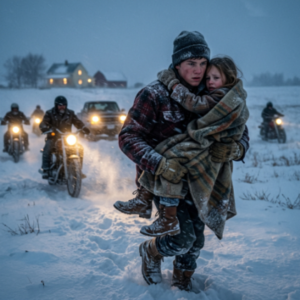
None of it was academic now. He worked his arms under her. She was slight, lighter than he expected, and got her to her feet, which she could not use properly. And then simply lifted her, the way you lift someone who cannot help you lift them, and walked back to the truck. The wind pushed sideways against him as he carried her.
He turned his shoulder into it and kept moving. The truck was 30 yd. He did not think about the cold or the wind or the weight or any of it. He thought about the next step and then the one after that, which was how he got through most things that required getting through. He got her into the passenger seat. Her coat was saturated.
Her shoes, the kind with a modest heel. City shoes, profoundly wrong for any of this, were soaked through. He reached behind the seat for the emergency blanket that lived in a zip bag back there. The same blanket he’d kept in every vehicle he’d driven since Emma was born, and he wrapped it around her from the shoulders down. “You’re okay,” he said.
He pulled the door shut and turned the heat vents toward her. “You’re in a truck. The heat’s on. You’re okay.” She looked at him. Her eyes were still not entirely focused. “Your car’s in the ditch,” he said. “I can’t get it out tonight. We need to get you warm.” She said something then, slowly, with visible effort.
“My phone.” She touched her coat pocket. “It’s Don’t worry about the phone right now. I need to. You can worry about it when you’re warm.” He put the truck in gear. “Okay?” A pause. Then, very quietly, “Okay.” He drove north. Emma heard the truck and was at the window before he got to the front walk.
He saw her face through the glass, that particular expression she made when she was trying to determine whether something was wrong and whether she should be afraid. He held up one hand, the universal signal between them for “I’m okay. Stay put.” And she stepped back from the window. Getting the woman from the truck to the front door was a two-stage project.
She could walk with support, but she couldn’t walk reliably. Her feet went where they were pointed, but without full coordination, the cold having done something to her motor control that wasn’t permanent, but was significant. He kept a hand under her arm and she leaned against him and they got up the porch steps and through the front door without incident.
Emma was standing in the middle of the living room in her fox socks, eyes wide, taking in the woman her father had brought home from the storm. “Her car went off the road,” Daniel said. “She needs to get warm.” Emma looked at the woman. Then she looked at her father. Then she went, without being asked, to the closet in the hallway and pulled out the heavy quilt that lived on the top shelf, the one with the pattern of interlocking rings that had been a wedding gift to Daniel and Claire, the warmest thing in the house, and carried it back with both
arms. “For the couch?” Emma asked. “Couch,” he confirmed. He got the woman to the couch. She sat heavily, the emergency blanket still around her. Emma arranged the quilt over her lap with the serious attention of someone for whom the task was important. The woman looked at her. “Thank you,” she said. Her voice was steadier than it had been in the truck, but still careful.
Emma said, “You were really cold. I could tell from the door. I was. I was cold last winter when I fell in the creek. Daddy had to carry me, too.” She looked at the woman with 8-year-old directness. “Are you okay?” “I think so. Getting better.” “I can make soup,” Emma said. “We have chicken soup. Canned, but Daddy makes it good. He adds real parsley.
” The woman blinked at this. Something crossed her face, not quite a smile, not quite surprise. Something between the two that settled quietly. “That sounds wonderful.” Emma went to the kitchen. Daniel crouched in front of the wood stove in the corner, not the primary heat source, which was the furnace, but the supplemental one he used in deep cold because it made the room feel genuinely warm rather than just technically warm, and started a fire with the efficient motions of someone who had done it so many times that it required no thought. Kindling,
two small logs, the match applied to the corner of the newspaper beneath it. The fire took in under a minute. He moved to the armchair across from the couch and sat. Her wet coat was on the hook by the door where he’d hung it. She was wearing a dark wool sweater underneath. Also damp along the shoulders.
“Do you need to call someone?” he asked. “My assistant.” A pause. “The number is in my phone. Which is I’ll check on the car when it’s clear. If the phone survived the ditch, it’ll be in there.” He considered. “Is there someone who needs to know where you are tonight? Family?” “My assistant will know what to do when I reach him.
” She said it evenly, without elaboration. He noted the when, not if. “Okay.” He did not press it. “There’s a landline in the kitchen if you need it tonight.” She looked at him, a long, direct look, not unfriendly, that had a quality of assessment in it, not the suspicious kind, but the kind a careful person applies to any situation that is outside their normal range of experience.
“You don’t ask questions,” she said. “You don’t have to answer any.” A brief silence. “Most people ask. You’re not going anywhere in this storm,” he said. Whatever the answers are, they’ll keep until morning. The soup was, as advertised, better than it had any right to be. Emma sat at the kitchen table while Daniel heated it, narrating the process with the authority of an 8-year-old who has watched her father cook many times and has developed strong opinions about the correct way to do it.
“The parsley goes in at the end,” she said, “not before.” “Daddy says heat makes it lose flavor.” “He’s right,” the woman said. Emma looked pleased. “He’s right about most things.” “Except when he says spinach is not that bad.” “That’s wrong,” the woman who had said her name was Victoria, offered simply and without surname, sat at the kitchen table with the quilt around her shoulders and drank the soup and ate half a sleeve of crackers that Emma set in front of her with the air of a practiced host. Her hands had stopped
trembling by then. Her color was, by most indications, fully restored. Daniel ate at the counter, watching the storm press itself against the kitchen window. The weather radio cycled through its updates. All roads in the county closed. Expected accumulation now revised upward to 16 in, possibly more.
Temperatures overnight -4. All of this was delivered in the calm, almost musical cadence of the emergency broadcast system. As if weather were just information and not the particular, insistent fact of the world. Reminding you of its scale. He thought about the three cars that had passed her. He didn’t think about it with judgement.
Exactly. Judgement was easy from the inside of a warm kitchen and he was not a man who spent a lot of time being easy about things. But he thought about it. 14 degrees. A woman on her side in the road. Three cars going north toward town, toward warmth, toward whatever waited for each of them at the end of that drive.
He understood, abstractly, how each of those drivers might have arrived at the decision not to stop. The storm, the danger, the calculation that someone else would handle it. That stopping a stranger in a blizzard carried its own risks. That there would be liability or complication or simply the raw, honest fear of getting out of a warm vehicle into a wind that wanted to hurt you.
He understood all of it. He did not particularly care about any of it. He had seen the woman and he had stopped. The same way he would have stopped if it had been anyone else’s problem on any other road. There was no heroism in it from the inside. It was just what you did when you saw someone in the road. Emma told Victoria about her class project on the solar system.
Victoria listened with what Daniel could see was genuine attention, not the performed attentiveness of an adult tolerating a child’s monologue, but real engagement. She asked about Jupiter’s moons. She knew the correct number before Emma had to count them on her fingers. “How do you know that?” Emma asked. “I like science,” Victoria said.
“I studied engineering in school.” “What kind?” “Software. Computers as in ‘games’.” Emma considered this. “Computers are okay,” she said judiciously. “But I like drawing better.” “Those aren’t mutually exclusive,” Victoria said. Emma looked at her father for translation. “You can like both,” he said.
Emma accepted this and went back to her crackers. After Emma was asleep, she had insisted on staying up as long as possible and then fallen asleep at 9:45 with the decisiveness of someone whose body simply overruled their intentions, Daniel built the fire up, the wood stove, and sat in the armchair with his coffee and the night arranged itself into the particular quiet that deep winter storms produce.
A silence that isn’t empty, but full. The whole world insulated and stilled and turned inward. Victoria sat on the couch. She had borrowed a dry sweater from the small pile of Claire’s things he kept in the top of the bedroom closet, which he’d offered without ceremony, and she’d accepted the same way.
He’d stood at the closet for a moment before opening it. The way he always stood there for a moment acknowledging the fact of it. That this was still here. That he kept it for reasons that were not fully articulate, but were real. Then he’d taken out the gray cable knit and brought it to her and that was all. She had her feet tucked under her, the quilt still around her, and she watched the fire the way people watch fires when they are thinking about something that has nothing to do with fire.
She was quiet in the way that suggested comfort with silence rather than discomfort with conversation, which he recognized because he was the same way. Most people filled silence reflexively, the way you’d fill a crack in a wall, not because you’d decided to, but because the crack was there and the instinct was automatic.
She let the silence be what it was. “You could have kept driving,” she said. He looked up from his coffee. “Sorry?” “When you saw me on the road.” “Most people would have.” “Most people didn’t.” “That’s a kind way to frame it.” She said it without self-pity, as a neutral observation. He turned the mug in his hands.
“I wasn’t going to leave someone in the road.” “No, I could see that.” A pause. “Your daughter said the same thing, actually.” “In the truck, while you were getting me in. She just kept saying we had to stop. We had to stop.” Something softened around her eyes. “She’s remarkable.” “She is.” “Her name is Emma.
” “Emma Grace.” Victoria looked at the fire. “She reminds me of my sister’s daughter. Same age.” “Same way of just saying the exact thing that needs to be said without worrying whether it’s appropriate.” She paused. “I don’t see them often enough.” He didn’t respond to that. “Some things are better received with silence.
Do you mind if I ask about her mother?” Victoria said and then immediately “You don’t have to answer.” He looked at the fire. “She passed 3 years ago.” “Brain aneurysm.” “I’m sorry.” “Yeah.” He was quiet a moment. “She would have found Emma’s card game funny.” The part where the rules change based on the situation that would have been exactly her sense of humor.
Victoria smiled. And it was real. And it changed the whole geometry of her face. “What was her name?” “Claire.” The fire settled and shifted in the stove. A small domestic sound in the quiet of the house. Somewhere upstairs, Emma shifted in her sleep. The storm outside had reduced itself to a soft, steady pressure against the windows. The violence spent.
What remained merely the long, cold aftermath. At 11:00, she excused herself to the spare room. Emma had offered it with great ceremony, having moved her drawing supplies off the bed and set a glass of water on the nightstand with the air of a hotel concierge, and Daniel stayed up another hour, listening to the storm, checking the furnace, making sure the pipes were running warm on the exterior walls.
The domestic work of keeping a small house sound in difficult weather. He was good at it. He had always been good at the useful things. He was up at 6:00. Emma slept late on snow days, which was one of their few household blessings. He had coffee made and was sitting at the kitchen table with the road report still all closures.
Plows working from the north down. The bluff road likely not cleared until early afternoon. When he heard movement from the spare room. A few minutes later, Victoria came into the kitchen in yesterday’s clothes, her hair brushed back and her face composed. And for the first time, he saw her clearly in full light.
She was a woman who carried herself with the particular ease of someone long accustomed to rooms, paying attention when she entered them, not through effort or display, but simply as a fact. Her face had strong, clear lines and eyes that were dark and direct and did not miss things. She was dressed in a damp wool sweater and last night’s slacks, which was not how she was meant to be dressed.
And she moved through his small kitchen with the deliberate, slightly careful manner of someone learning the geography of an unfamiliar space. “Coffee?” he asked. “Please.” He poured it. She sat at the table. They were quiet for a moment in the way people are quiet when they have moved past the awkwardness of a situation and arrived at something simpler.
“The bluff road won’t be cleared until this afternoon,” he said. She nodded slowly. She was looking at her hands around the coffee mug. “I need to reach my assistant.” He slid the landline across the table toward her. She looked at it for a moment. Then she picked it up and dialed from memory and waited.
When the call connected, the conversation that followed was not what he had expected, which was a brief reassurance call, a logistics discussion, the ordinary structure of someone notifying their emergency contact that they were safe. What it actually was a 17-minute call conducted in a low, calm, completely authoritative voice during which she made four separate decisions about what appeared to be international business operations, issued instructions that required a person on the other end to take notes with a speed Daniel could hear implied
even at a distance, and concluded with a set of directions about rescheduling something that involved the phrase the Singapore board won’t like it, and that’s acceptable. She said this the way you say it might rain later as a fact about the world to be noted and moved past. Daniel stood at the counter and drank his coffee and looked out the window at the backyard, which was buried under 16 in of snow.
Emma’s swing set reduced to two steel arcs and a crossbar. He was not eavesdropping. There was nothing covert about any of it. She had simply done what she needed to do without apology or performance. When she hung up, she set the phone on the table and looked at him with an expression that was direct and slightly amused and entirely self-aware.
You have questions, she said. Not my business. It’s somewhat your business given that I spent the night in your spare room. He turned from the window. It doesn’t change anything about last night. She looked at him steadily. No, she said after a moment. I didn’t think it would. Emma appeared in the doorway in her pajamas, assessed the scene, and went directly to the cabinet for her cereal bowl.
Is the road open? She asked. Not yet, Daniel said. So Victoria’s staying for breakfast? Apparently. Emma nodded with satisfaction and got out the cereal. The vehicle arrived at 2:15 in the afternoon. Daniel was on the porch replacing the soft board he’d gotten the lumber from the garage, a task he’d been putting off for 3 months and which somehow the enforced stillness of the storm day had made possible when the large black SUV turned onto Aldine Street and moved with careful deliberation through shoveled snow toward his house. It was not a vehicle
that belonged on Aldine Street. Aldine Street was a street of aging sedans, one minivan, a pickup truck or two. The black SUV had the quiet, emphatic certainty of something that exists in a different category of object, entirely not flashy, not trying to be noticed, but impossible not to notice.
It stopped in front of his house. The man who got out was in his late 30s in a coat that looked expensive without advertising it, with an earpiece in his left ear and an expression of controlled professional relief that made Daniel think of the particular look soldiers had in old photographs taken immediately after an emergency has been resolved. Mr.
Harlow, the man said. That’s me. I’m Marcus. Miss Harlow’s He stopped. I’m sorry. Miss Langford’s assistant. Daniel set his hammer down on the porch rail. Langford? Yes, sir. Victoria Langford. I wanted to thank you personally on behalf of She’s inside, Daniel said. Come in. The man Marcus had the professional discipline not to react to the directness of this.
He came up the porch steps and followed Daniel inside. Victoria was at the kitchen table with Emma, who had been teaching her a card game of her own invention that had rules which changed. Emma had explained to Daniel earlier based on the situation. When Marcus came through the door, Victoria’s expression didn’t change significantly, a slight readjustment.
The composure of a woman who had expected this and was simply seeing it arrive. Marcus, she said. Miss Langford. I’m very glad to see you. He said it with the measured warmth of someone for whom emotional expression is a professional tool deployed with precision. The board has been I’m aware of what the board has been.
She glanced at Emma. Sweetheart, can you give us just a minute? Emma looked between the adults, made the rapid social calculation of an 8-year-old with a well-developed instinct for subtext, and said, I’m going to count the snow and went out the back door. Daniel stayed where he was in the kitchen doorway.
Victoria looked at him. I owe you an explanation. You don’t. I think I do. She paused. My name is Victoria Langford. I’m the chief executive of Langford Systems, which is She stopped and seemed to briefly consider the act of summarizing something she had spent 15 years building. A technology infrastructure company based in Chicago.
We have operations in 11 countries. A beat. I was driving myself back from a board site visit in Des Moines. My driver was sick. My security protocol had me taking the alternate route, which I was told was clear. It was not clear. The room was quiet, Daniel said. I know who Langford Systems is. A small stillness in her expression.
You do? My wife used to work for a company that ran your logistics software. She talked about it. He paused. It’s good software. Something moved across Victoria’s face that was harder to classify, something that had to do, he thought, with the particular human experience of being known before you introduce yourself, and not in the way you expected. Thank you, she said.
Marcus had the practiced invisibility of a man who has learned to be present without being intrusive in moments that do not require him. You saved my life, Victoria said. Her voice was level, but it carried the weight of something that had been thought about overnight. I stopped a truck in a blizzard on the Bluff Road when everyone else drove past.
I don’t know that everyone else drove past. Three vehicles, she said. I counted them going by. I couldn’t stand up anymore. She said this without drama, which made it hit harder than drama would have. You stopped. He looked at her. He did not say anything because there wasn’t anything to say that would improve on what had already been said.
Emma came back in from the back door trailing snow on the floor and announced that there was approximately a thousand inches of snow in the yard and that the birds were confused. The moment rearranged itself around her presence, which was the way moments often did. The plow came through Aldine Street at 4:00. The Bluff Road was cleared by 5:00.
Marcus had the ditch car on a flatbed within the hour, a call made, a truck dispatched. The problem solved with the seamless efficiency of someone who solved problems for a living. He brought Daniel’s emergency blanket back from the car, folded precisely, and returned it without comment. Daniel appreciated this.
Victoria was ready to leave by 5:30. She had her coat dried, brushed, returned to something approaching its proper condition, and her shoes, which would never be the same and which she regarded with the mild resignation of someone who understood that objects were replaceable and some experiences were not.
Emma stood in the front hallway and said, Will you come back? Victoria looked at her for a moment. I hope to, she said, which was the honest answer rather than the comfortable one and which Emma seemed to appreciate. She shook Daniel’s hand at the door. He walked with her to the porch. I want to help, she said. I understand you’ll probably say no, and I’ll accept that.
But I want to. He leaned against the porch rail. The evening was still and clear. The storm entirely spent. The sky the particular deep blue of winter after a big snow. Stars beginning to appear in the east. The street was white and quiet and the houses along it were lit from inside with the ordinary warmth of families at dinner time. I’m fine, he said.
I know you are. She paused. Emma’s school. Is it good? He looked at her. I’m not asking to do anything you wouldn’t approve of, she said. I’m just asking. He was quiet for a moment. It’s okay. Budget’s been cut 3 years running. They lost their science program last spring. She nodded slowly. She didn’t say anything else about it.
She’s gifted, Victoria said. I mean that in the specific sense, the way she thinks, the questions she asks. She should have access to things that give that room to grow. I’m working on it. I know you are. She said it without condescension, which was the only way it could have been received. What you do, taking in a stranger in a storm, not asking what you might get from it, that’s not nothing, Daniel.
Most people have forgotten how to do that. She paused. I had. The car was waiting at the curb. Marcus stood by it with the patience of stone. The software your wife used, Victoria said. The logistics platform. We have an operations team that coordinates with smaller regional freight systems. If you were ever interested in something different, a coordinator position, something stable with benefits, Marcus has my contact.
No pressure, no obligation. It’s just there. He didn’t say yes or no. He nodded once, which she seemed to understand was its own kind of answer. She went down the porch steps. At the bottom she turned once, briefly. Thank you, she said. For stopping. He watched the car until it turned off Aldine Street and disappeared.
He stood on the porch for a while after that. In the cold that was already softening toward evening, the sky still that deep winter blue that precedes true dark. The street was quiet in the particular way that follows a big storm, not the absence of activity, but a kind of collective exhale, the neighborhood recovering itself, people moving through the aftermath of something large and returning to the business of ordinary days.
He thought about what she had said, like yourself. Not the job, not the circumstances, not the improvements in the external architecture of his daily existence, just the way he looked, which was apparently, to her eyes, like himself. He wasn’t sure when he had stopped looking that way, or when he had started again. He suspected Emma could have told him if he asked, but he probably wouldn’t ask.
He went back inside and put the hammer away and started dinner. He made pasta that night, the simple kind with olive oil and garlic that Emma liked because she could identify all the components, which she found reassuring in food. She sat at the kitchen table and told him about a bird she’d seen in the backyard that she didn’t recognize, a small pale brown thing that had been investigating the snow around the base of the swing set with focused, methodical curiosity.
“It wasn’t scared,” Emma said, “like at all. It just walked around like it owned the yard. Maybe it did before we got here.” Emma considered this seriously. “Do you think animals remember who lived somewhere before? I think they remember what matters to them.” Food. Warmth. Safe places. Emma was quiet for a moment, twirling pasta around her fork with imprecise eight-year-old technique.
“That’s kind of what people remember, too, isn’t it?” He looked at her. “Yeah,” he said. “I guess it is.” She finished her dinner and went to get her drawing supplies, and he washed the dishes, and outside the last of the winter light left the sky, and the house held its warmth against the cold, the way it always did, the way he had always made sure it would.
Three weeks later, a letter arrived for Emma from the Langford Foundation’s STEM Education Initiative. It was addressed to her directly, Emma Grace Harlow, in the precise, formal way that important correspondence is addressed when it means to be taken seriously. It enclosed a scholarship to a summer science program at the University of Iowa for students ages 7 through 12.
The letter described the program with the dry language of institutional documents, but at the bottom, in different handwriting, were five words. “Your moon’s answer was correct.” Emma read it twice, then she folded it very carefully, like it was a document that needed to be filed, and put it in the drawer where she kept her most important things, her mother’s photograph, a smooth river stone from the creek, a birthday card from her second grade teacher, and now this.
She didn’t make a big moment of it. She just went back to her drawing. Daniel called the number on Marcus’s card in January, not because of the scholarship, that was Emma’s thing, separate, not a transaction. He called because Sandra Kipp had announced the Pearson route was being restructured, and his position was being consolidated with two others, which was the careful language they used when they meant there would be fewer jobs, and his might be one of them, and because he was 34 years old and he understood clearly, and without bitterness, that
there is a difference between being fine and being okay, and that caring about the difference is not weakness. The coordinator position turned out to be genuinely what it had been described as, a logistics coordination role, working with the regional freight network that ran Langford software, based in the Des Moines satellite office 40 minutes away, with hours that were mostly standard and benefits that included health coverage and a 401k.
And the particular dignity of a job that reflected what he actually knew how to do. He interviewed in February. The interview was conducted by a regional manager named Brian Kowalski, who had no idea about any of what had happened in December, and who hired him because of his two years on the Mercer route and his previous work at Tillmans, and the reference letter from Sandra Kipp, which said he was the most reliable driver she had worked with in 12 years.
He started in March. He saw Victoria once more, in April, when she came through the Des Moines office for a quarterly review. She came by his desk, a real desk, a proper one, his name on a placard, and said, “You look different.” “Different how?” She considered him for a moment. “Like yourself,” she said.
He thought about that for a long time afterward. He thought it might be the most accurate thing anyone had said about him in years. Emma went to the science program that summer. She came home talking about orbital mechanics and plant biology, and a girl named Sophia, who was her new best friend and lived in Cedar Rapids, and who was, according to Emma, the second best drawer Emma had ever met.
First place she assigned to herself, which Daniel thought was exactly right. He still had the world’s okayest dad mug. It had chipped further along the handle, a small additional notch that happened when Emma knocked it off the counter while trying to reach the high cabinet. He kept using it anyway.
Some things you keep because they work. Some things you keep because they mean something. The best things do both. She was at the kitchen table working on a drawing, a detailed, careful rendering of Jupiter and its moons, each one labeled in her precise handwriting, the planet itself shaded in careful concentric oranges and browns.
“Daddy,” she said without looking up. “Yeah.” “Do you think Victoria is our friend?” He poured himself coffee, considered it. “I think she might be. Yeah.” “Even though she’s important?” “Important people can be friends.” Emma thought about this, her pencil moving in small, deliberate strokes. “Sophia’s mom is a doctor,” she said.
“That’s important.” “And she’s nice.” “Right.” “And Mrs. Albright is important because she knows everything about fourth grade. That’s important, too.” Emma nodded, satisfied with her taxonomy of importance. Then she said, “I think Victoria was scared out there before you stopped, even if she didn’t say it.
” He sat down across from her. The table was still uneven. He’d fixed the shim, but not properly, not yet. “Probably. She just didn’t act like it because she’s the kind of person who doesn’t act like things.” Emma glanced up at him briefly. “Like you.” He didn’t say anything to that. Emma went back to her drawing. Jupiter grew rounder and more detailed under her hand.
Outside, the February light was thin and pale, and the yard was still half covered in old gray snow, the kind that’s been there long enough to stop being beautiful and become simply geological. “I’m glad we stopped,” Emma said. “Me, too,” he said. That was all. The kitchen was warm, the coffee was hot, the drawing spread across the table between them, planet and moons, everything in its orbit.
Some storms break things. Some storms, if you are where you’re supposed to be and doing what you’re supposed to do, lead you somewhere you didn’t know you needed to go, not through money, not through rescue in the grand cinematic sense, just through a truck stopping on a bluff road in the snow, just through a little girl saying, “Daddy, she’ll die out there,” just through the particular, unremarkable, irreplaceable fact of one person deciding that another person’s survival is worth 20 minutes of their time.
That’s all it was. That’s everything it was.