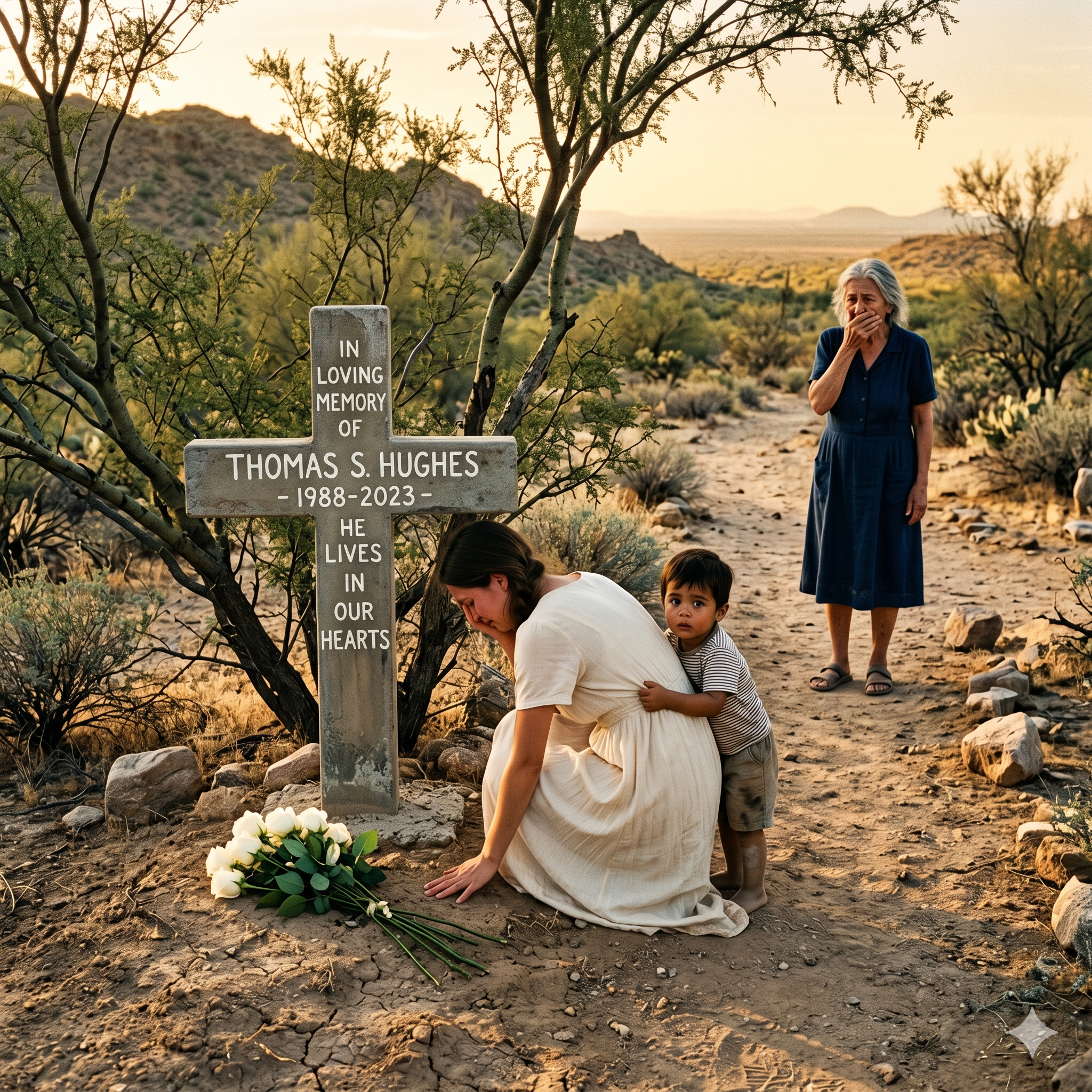
Catherine saw the white roses before she saw the woman. They were long-stemmed and heavy with dew still clinging to the petals, the kind of roses that cost real money and traveled a long distance to reach a place like this. She had been coming to this grave for three years. She knew every weed, every crack in the dry earth, every shadow the mesquite tree threw across the concrete cross on a March morning. She had never once found another set of footprints in the dust.
She stopped walking.
There was a woman kneeling at Matthew’s grave. Her back was turned, her shoulders moving with the rhythm of silent weeping, one hand pressed flat against the dirt as if trying to reach something through the layers of earth. And clinging to her leg, staring at the headstone with wide, dark eyes, was a small boy. Perhaps three years old. Perhaps younger.
Catherine stood at the edge of the cemetery path for a long moment with her plastic bucket in one hand and her wildflowers in the other and her heart doing something she could not name. Then she looked at the boy’s eyes.
She had looked at those eyes every day for twenty-eight years.
Three years. That was the distance between now and the last morning she had seen Matthew alive. He had stood at the door of the ranch with a red bandana around his neck and a backpack over one shoulder, telling her he was going north for real work, that he would come back with enough money to fix the roof. He had kissed her cheek and walked into the horizon and never came back. The roof still leaked. She had learned to put a pot under the drip when the rare rains came.
Every fifteenth of the month, Catherine put on her dark blue dress, brushed her silver hair into a braid, and opened the bottom drawer of her mother’s old dresser. Inside was a faded red bandana, weathered by years of use, softened by the hands that had worn it. She took it out with the same care every time, ran her fingers over the fabric, and put it in her apron pocket. She never wore it. She only needed to know it was there.
The walk to the cemetery was two kilometers across country that had not seen significant rain in months. Cracked terracotta earth, dust devils spinning in the gaps between cactus, the sky a white-blue of heat that had nowhere to go. The cemetery itself was a rectangle of desert fenced with rusted barbed wire, wooden and concrete crosses rising among mesquite and creosote, the oldest graves scrubbed nameless by decades of wind and sun.
Matthew’s cross was at the back, near the largest tree. His name painted by their neighbor Lawrence, who had done it carefully and for free. Matthew Miller. Son of Catherine. May God keep him in his glory.
The white roses were enormous against the pale cross. Long-stemmed and city-born, they had no business in a place like this. Roses like that came from refrigerated florist shops and air-conditioned cars. They came from another world entirely.
Catherine cleared her throat.
The woman spun around. Thirty or so, undeniably beautiful, wearing a cream-colored dress that had never touched desert dust before today. Her eyes were swollen from crying that had been going on long before Catherine arrived. She had the look of someone caught in the middle of a private act, suddenly exposed.
“Who are you?” Catherine asked. The words came out harder than she meant. When the heart beats fast enough, the voice sharpens itself.
“I’m sorry,” the woman said. “I didn’t think anyone would be here.”
“I come every month. Three years. I have never seen anyone else.” Catherine looked at her steadily. “Did you know my son?”
The woman opened her mouth. What came out was not a word. It was a sob pulled up from somewhere very deep, the kind that has been compressed for years and does not come out gently when it finally does.
Before she could say anything further, the boy let go of her leg and took two small steps forward. He crouched down, pressed his tiny hand against the painted letters of the name on the cross, and looked up at his mother with the complete, uncomplicated certainty of a very young child.
“This is my daddy’s place, right, Mommy?”
Catherine’s bucket slipped from her fingers. The water hit the dry earth and vanished instantly into the sand, but she did not look at it. She could not look away from the boy. From his eyes. Dark and deep and carrying in their brightness exactly the same particular light she had spent twenty-eight years looking into, the same light she had been looking for in strangers’ faces for three years, without consciously knowing she was doing it.
“What did that child just say?” Catherine whispered.
The woman grabbed the boy up into her arms with the panicked speed of someone protecting something irreplaceable. “We have to go. I’m sorry. We shouldn’t have come.” She began walking quickly toward the cemetery exit.
Catherine tried to follow. But sixty-two-year-old legs do not keep pace with thirty-year-old fear, and the woman was already through the gate when Catherine called out. “Wait! Don’t take him away from me!”
The boy looked back over his mother’s shoulder at Catherine’s voice. He was frightened by the shouting, his brow furrowed, his small face uncertain. And then, without thinking about it at all, he did something.
He raised his right hand to his neck, closed his fingers around an invisible knot, and tugged downward.
The same gesture. The exact same gesture — right hand, close on the fabric, pull down, the automatic movement of loosening something that had become too tight. Matthew had done it since he was six years old. The first day Catherine gave him a bandana of his own, he had grabbed it out of nervousness and pulled it, and the habit had stayed his entire life. When he was thinking hard, when he was anxious, when he was excited. Right hand, close, pull down.
She had never seen another person do it. Not once. In twenty-eight years of watching her son, it had remained entirely his.
No one could have taught a three-year-old to replicate a dead man’s nervous habit. There was no photograph of Matthew doing it. There was no one alive who would even know to teach it. It had come from inside the boy the way it had come from inside Matthew — not learned, but inherited, passed through blood without words.
Catherine grabbed the fence post to keep from falling.
The car engine started on the other side of the road. A cloud of fine dust rose and then settled. The road was empty. She stood in the desert cemetery with the red bandana in her pocket and the wildflowers scattered on the ground and understood — in her bones, in her blood, in the part of a mother that cannot be argued with — that her son was not completely gone.
Lawrence found her sitting on the concrete step of the ranch when he came by with goat milk that afternoon. He sat down beside her without asking permission and listened to everything without interrupting. When she finished, he was quiet for a long time.
“And if you’re wrong?” he finally said. “Eyes look like other eyes sometimes. Grief makes us see things we want to see.”
“That gesture,” Catherine said, shaking her head firmly. “It is not something you see and copy. It appeared in Matthew when he was six. He didn’t choose it. It came out of him like a hiccup. And that boy did it exactly — the same hand, the same pull, the same loosening motion.” She looked at Lawrence directly. “No one could have taught him that.”
Lawrence nodded slowly. “I saw a black SUV parked at the bend of the old road this morning,” he said. “Plates from Maricopa County. Phoenix or Scottsdale direction.”
That night, Catherine sat at her kitchen table with weak coffee and her savings tin open in front of her. She counted the bills one by one, smoothed and worn from years of handling. Just enough for a bus ticket and a few meals. Whether there was enough to return was a question she left to God.
Before sleeping, she placed the red bandana on the pillow on Matthew’s side of the bed. The side he had slept on as a child when the desert thunderstorms frightened him.
“I’m going to find him,” she said into the darkness. “My son’s boy. I’m going to find him.”
The desert outside held its breath.
Lawrence drove her to the bus terminal before dawn, two hours across a dirt road in his old truck. At the terminal he handed her a folded paper. His friend Frank at the junction gas station had spoken with the driver of the black SUV the day before. They had asked for directions toward Scottsdale. The driver had mentioned the name Harrington.
Catherine repeated the name to herself like a prayer on the six-hour bus ride north. She watched the desert transform through the window — the flat scorched earth of home giving way to suburbs and then to the dense, incomprehensible sprawl of a city she had only ever heard described. Buildings taller than anything she had imagined. Roads wider than the whole of her town. People walking in every direction without looking at anyone. She had never seen so many people in one place and felt so utterly alone.
She found Paradise Valley by asking a kind janitor at the Phoenix terminal, then a city bus driver, then a man walking a dog who pointed her uphill toward a gated community where the Harringtons with that kind of money had their house. She walked twenty minutes uphill in heat that tasted of trapped exhaust and found a wall of carved sandstone with the family name in gold letters on an iron gate and a guard who looked at her worn dress and dusty sandals and slid his window shut.
Catherine crossed the street and sat down on the curb. She waited four hours.
At five o’clock a maid came out to walk a small pampered dog. Catherine stood and showed her the photo of Matthew — eighteen years old, smiling his crooked smile, red bandana around his neck. She asked her to take it inside and tell the young woman with the little boy that Catherine Miller was at the gate.
Ten minutes later, Beatrice Harrington came out herself.
She was in her early sixties, silk blouse the color of pearls, a gold watch that caught the last sun. She had the walk of a woman who had spent a lifetime in rooms where she was the center of gravity. She stopped three meters from Catherine and looked at her with the specific coldness of someone who has decided in advance not to be moved.
“I don’t know anyone by that name,” she said when Catherine spoke Matthew’s name.
“I saw your daughter three days ago at my son’s grave,” Catherine replied. Her voice was level. “She was weeping over the man your family buried in a desert cemetery while she was carrying his child.”
Beatrice’s jaw tightened by a fraction. “That child is my daughter’s son by her husband. A respected businessman. You are wasting your time.”
“I came six hours by bus with what I had in my savings tin,” Catherine said. “I am not wasting my time. I came for my son’s blood.”
Beatrice called the guard. As the gate began to close, Catherine caught a glimpse of the garden behind the wall — and there, near a stone fountain, was Nathan. Playing with a toy car, entirely unaware of what was happening around him. And standing nearby, her eyes red and her face carrying the look of a woman who had been afraid for three years and was exhausted by it, was Cassandra. She met Catherine’s eyes through the narrowing gap.
The gate closed.
Catherine went back to the curb. She sat through the dusk and into the dark. She slept on a park bench under a shawl and watched the cold city stars and thought about Father Richard’s voice. Are you really going to tell me you’re afraid of a door?
The next morning she was back at seven.
At ten, the maid came out to sweep and saw her still there. She looked over her shoulder toward the guard shack and spoke very quietly. Miss Cassandra goes to the park three blocks down every Tuesday at ten with the boy. Today is Tuesday.
Cassandra came into the park wearing large sunglasses and a simple sundress that made her look like someone trying to disappear. She froze when she saw Catherine. The boy looked up with bright, curious eyes.
“Five minutes,” Catherine said. “If you want me gone after that, I’ll go. I won’t come back.”
They sat on a bench. Nathan played nearby. Catherine reached into her bag and folded a paper napkin into the shape of a small hen — a trick she had taught Matthew at exactly Nathan’s age. She held it out. Nathan took it, laughed, made it cluck against the sand. Cassandra watched this and said nothing and pressed her lips together.
Then she took off her sunglasses.
“I know who you are,” she said. “Matthew talked about you. He said you were the strongest woman in the world.”
The story came out slowly, in the halting rhythm of something that had been locked up for three years and was finally being allowed to move. She had met Matthew at a construction site her family was developing. She was studying architecture. He was building a wall in July heat with a red bandana around his neck and his hands covered in wet cement. They didn’t speak for four days. On the fifth day she tripped on a cable and he caught her before she fell. “Careful, engineer,” he had said, and she had known then.
Eight months of secret meetings in parks and coffee shops far from her mother’s world. Matthew saving money, planning to fix Catherine’s roof before bringing Cassandra to meet her. Ashamed of the roof. Never once mentioning any of it to Catherine.
Her brother Samuel had found out. Had come to Matthew’s apartment and threatened him — deportation, blacklisting, ruin. Matthew had refused to leave. A week later Samuel signed a transfer order moving him to a high-risk site in the northern mountains, a project he wasn’t trained for, riddled with safety violations that Samuel had personally reviewed and ignored. The scaffolding collapsed on a Tuesday morning.
“I was two months pregnant,” Cassandra said. “Samuel took me to a private hospital. Told me if I ever mentioned Matthew he would take the baby. He forced me to marry Edward — a business partner, to cover everything. My mother thinks Samuel saved me from a mistake. She doesn’t know Matthew is dead. She doesn’t know what Samuel did.”
Catherine sat very still. The fury moved through her in a cold wave that found no exit, because there was nowhere to put it. Matthew had not died from bad luck. He had died because a wealthy man had decided his life was worth less than a family’s reputation.
Two days later, Cassandra called the number on the cheap phone she had given Catherine. Come now. Mother is here. Samuel is away. It’s now or never.
Catherine washed her face in the park fountain, smoothed her dress, and walked to the gate. The guard had been given orders. She walked through onto the lush green grass of the Harrington estate and felt the moisture of the sprinklers through her sandals. A luxury that felt like something imagined.
Cassandra was waiting at the front door, holding Nathan’s hand. The boy saw Catherine and lit up entirely. “The hen lady!” he shouted.
In the living room — marble floors, leather furniture, a space larger than Catherine’s entire ranch — Beatrice sat with a cup of untouched tea. When Cassandra finished speaking, Beatrice’s face moved through disbelief and into something harder to watch. She was a woman of many faults, but she loved her daughter. And she had just understood that in protecting her family’s image, she had been an instrument of her own child’s misery.
Catherine reached into her bag. She placed the photo of Matthew on the marble table beside Beatrice’s tea. Eighteen years old, smiling, his right hand raised to the red bandana at his neck, tugging it downward.
The same gesture Nathan was performing at that moment on the floor, nervous from the raised voices, his small right hand closing around an invisible knot and pulling.
Beatrice looked at the photograph. Looked at the child. Looked at the photograph.
The resemblance was undeniable. But it was the gesture that broke her — not the eyes, not the jaw line, not the shape of the nose. The gesture, that small, unconscious tick passed from father to son through blood without anyone deciding to pass it. She looked at it and understood in her body what she had not been willing to understand in her mind.
She put down the cup. She exhaled very slowly. “Samuel told me he had handled the situation,” she said. “He told me the man had moved on.” Her voice was almost inaudible. “I didn’t know he was dead. I didn’t know.”
“Your son knew,” Catherine said. “And he sent him to that mountain anyway.”
The aftermath was quiet and thorough. Beatrice spent the rest of the day going through Samuel’s private files. She found the transfer orders. She found the safety reports he had reviewed and dismissed. By the following morning Samuel had been removed from the family business. No police sirens, no public scandal. A quiet, cold removal by the woman who had built the company and could dismantle a man’s place in it without a word spoken publicly. Edward signed the divorce papers without hesitation. He had never wanted the marriage.
Two weeks later, a car pulled up to the ranch in the Arizona desert.
Cassandra and Nathan stepped out. Then Beatrice, entirely out of place in her expensive shoes on the cracked ground, looking at the small brick house and the scraggly chickens and the corrugated metal roof with an expression that moved through her features like a slow tide — discomfort first, then something humbler.
They walked to the cemetery together. Three women brought together by a man who was no longer there. Nathan ran circles around the mesquite tree chasing a lizard, his laughter carrying across the desert quiet.
Cassandra knelt at the cross and placed fresh white roses. Then she reached into her bag and placed something else beside them — a small, worn red bandana. The one Matthew had been wearing the day he died. She had kept it in a drawer for three years.
Catherine reached out and took Beatrice’s hand. The two grandmothers stood side by side in the desert wind. They did not need to speak. The desert had already said everything that needed saying — in the rust on the fence wire and the painted letters on the cross and the small boy laughing under the mesquite tree with his father’s eyes and his father’s habit and his father’s life running through him.
Nathan stopped running and came to stand between them. He looked up at the cross. He looked up at Catherine. He took her hand in his small one, unhesitating, the way children take the hands of people they have already decided belong to them.
The sun was going down. The sky turned the colors that Matthew had grown up watching — orange at the horizon, then rose, then the deep violet of a desert evening that seemed to go on forever. The wind moved through the mesquite and the dry grass and the space between them all.
Catherine stood in the place where she had stood alone for three years, and she was not alone.
Matthew had not come back. But he had sent something forward. Something that ran on small legs and laughed at lizards and inherited a nervous gesture that no one could have taught. Something that would grow up knowing the name of the woman who raised the man who had loved his mother enough to want to fix her roof before he let anyone else see how he lived.
That was not nothing.
That was everything.
THE END