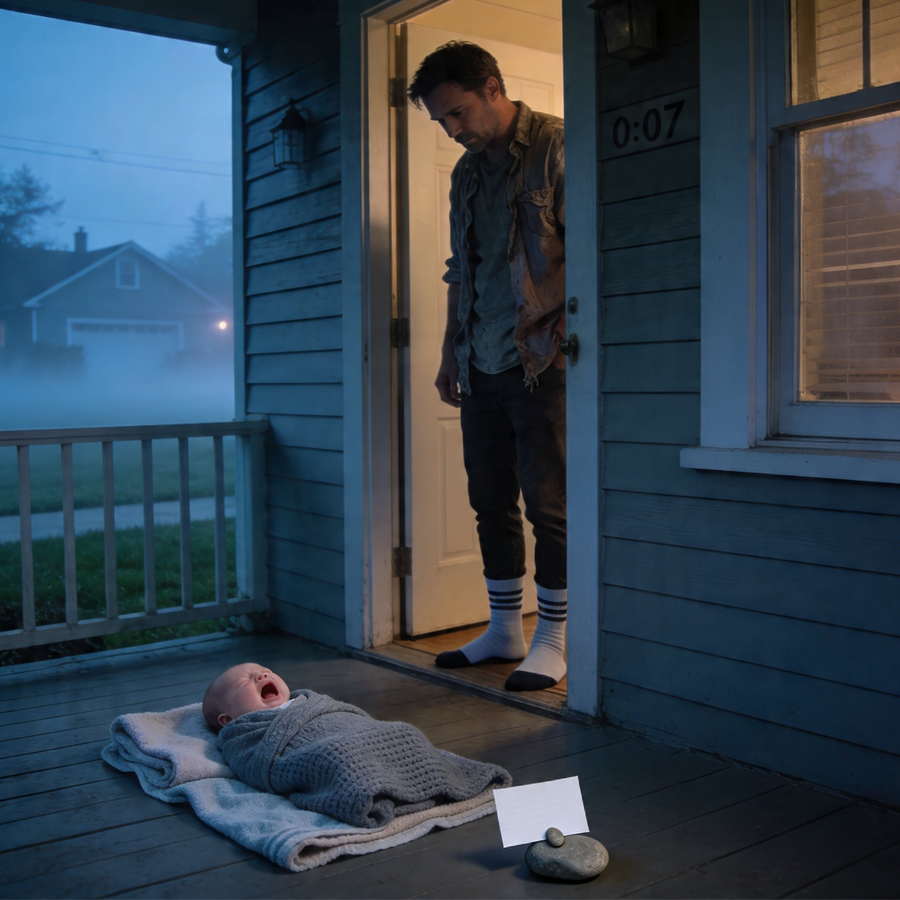
The crying wasn’t loud enough to be inside the house. That’s the first thing I registered. Half-awake, 5:47 in the morning, lying in a bed I had been in for maybe five hours, and the sound that pulled me up was real but it was outside. Too close to be a neighbor. Too small to be an animal. Too persistent to be something the wind was doing.
I sat up. Listened. Cried again.
I got to the front door in eight seconds.
There was a baby on my porch, wrapped in a gray knit blanket, lying on top of a folded towel, screaming with the full commitment of someone who had been at it for a while and had no intention of stopping. The morning air was cold and still. Fog sitting low on the grass. Nobody on the street in either direction. Beside the blanket, held down by a small stone so it wouldn’t blow away in the wind, was a note card.
Two words. One period.
One night, please.
I stood in my doorway in my socks at 5:47 in the morning and looked at a crying baby on my porch and I had exactly one clear thought.
Somebody trusted me with this.
My name is Owen Garrett. I’m thirty years old. I build custom furniture out of a workshop behind my house in a small town called Clover Creek, Virginia. Population around eight thousand. The kind of town where people know your truck and wave at it even when you’re not in it. The kind of town where the same people have been running the same businesses for twenty years and strangers stand out not because anyone is unfriendly but because familiarity is the default and departures from it are noticed.
I was not a father. I had no children and had not spent significant time around children since I was one myself. I had a shop dog named Hatch, a reliable coffee maker, and a four-month waiting list for my work. My life was quiet and ordered and the kind of complete that doesn’t feel complete until something happens to it.
I picked up the baby. Not carefully, not with technique, not with any of the specific knowledge that people who have held babies before carry in their hands. I picked her up the way you pick up something fragile that needs to not be on a porch floor in the cold anymore. She fit in both of my hands. She kept crying.
I looked down the street. Both directions. Nothing. Morning fog on the grass and one dog somewhere in the middle distance and nobody moving, no car pulling away, no shape disappearing around a corner. I looked at the note again. I brought her inside.
I want to be honest about the next twenty minutes because they were not graceful or competent or anything like what I would have wanted them to be. I did not know how to hold a baby correctly. I figured it out through trial and error using the baby’s feedback system, which was immediate and unambiguous. I did not have formula. I did not have diapers or a changing mat or anything designed for the care of an infant. I had half a bag of dog food, three kinds of hot sauce, a collection of hand tools, and a drill press.
I called the only person I could think to call at six in the morning who would answer without panicking before I could explain the situation.
My neighbor Patrice. Sixty-one years old. Retired nurse. Raised four children. Up before the sun every day of her life as far as I had ever been able to tell.
She picked up on the second ring.
“I have a baby,” I said.
Silence.
“Owen?”
“On my porch. Note said one night. I don’t have anything. No formula, no—”
“I’ll be there in four minutes,” she said.
She was there in three. She came through my front door and took the baby from my arms with the calm of someone who had performed this motion ten thousand times, and the baby, who had been screaming at consistent volume for the previous fifteen minutes, went almost immediately quiet.
“How,” I said.
“You were holding her like a two-by-four,” Patrice said.
She looked the baby over with the practiced efficiency of a person who has done clinical assessments of infants and whose hands remember how to do this the way hands remember anything done enough times. Temperature by hand on forehead. Eyes. Ears. She unwrapped the blanket.
“She’s okay,” Patrice said. “Hungry. Dry diaper. Someone took care of her before they left her.”
“Who does that?” I said.
Patrice looked at me. “Someone who didn’t have another option and knew you’d answer the door.”
Patrice went home and came back twenty minutes later with formula, two diapers, and the look of a person who had opinions she was keeping to herself until I was ready to hear them.
I sat at my kitchen table watching her feed the baby in my armchair. The baby ate with single-minded focus, the way very young things eat when they’ve been hungry long enough to stop crying about it and commit entirely to the solution.
“You need to call the county,” Patrice said.
“I know.”
“Today, Owen.”
“I know. I will.” I looked at the baby. Eyes half-closed now, one fist opening and closing against the air. “I just want to understand first.”
“Understand what?”
“Who left her. Why me specifically. This is a town of eight thousand people and my porch is not the only porch.”
I picked up the note card and set it back down.
“One night, please,” I said. “That’s someone who planned to come back.”
Patrice looked at me over the baby’s head. “Maybe.”
“You don’t think so.”
“I think,” she said carefully, “that someone wrote the kindest lie they could think of before they walked away.” She paused. “Or I’m wrong. And you should prepare yourself for both possibilities at the same time.”
She left at 7:30 with a look over her shoulder that meant: call me when you need me, and you will need me.
I sat alone with the baby in my kitchen. She was asleep now. I had put her in the armchair surrounded by couch pillows because I had nowhere else to put her. She looked impossibly small in it. Gray blanket. White onesie. Hair that hadn’t decided what color it was going to be yet.
I turned the note card over.
There was more on the back. Smaller writing, different pressure, like it had been added after. Like whoever wrote it had walked to the door and walked back.
Her name is Maya. She is 8 weeks old. She is healthy. She has not been vaccinated yet. She likes to be patted on the back, not rubbed. She is afraid of loud noises. She is not afraid of dogs. She is the best thing I have ever done and I cannot keep her safe right now. Please.
I read it three times.
Then I put it face-down on the table and went to check on Maya.
I called county child services at 8:15. They said someone would come between noon and four. Four to eight hours with a baby and minimal supplies. I called Patrice back. She arrived twelve minutes later with a laundry basket lined with folded blankets, a borrowed bouncer seat, enough formula for three days, and an expression that had moved from concern to the specific focused calm of someone who has decided to be useful.
“She wrote more on the back,” I said.
Patrice read it. Didn’t say anything for a moment.
“She loves her,” she said finally.
“I know.”
“This isn’t someone who didn’t want her baby.”
“I know that.”
She set the note down. “That makes it harder.”
“Yes,” I said.
Maya was in the bouncer seat now, doing the thing babies do where they stare at a fixed point on the ceiling with absolute concentration, as if the ceiling tile is the most important object they have encountered so far and they intend to fully understand it before moving on.
I was sitting on the floor next to the bouncer at her level, because Patrice had told me babies needed to see a face nearby and the floor was the only way to get to her level without picking her up.
“You’re going to be fine,” I told her.
She stared at the ceiling.
“I know that’s not very specific,” I said. “But it’s what I have right now.”
From the couch, Patrice said nothing. But something had shifted in her face.
“What,” I said.
“Nothing,” she said. “Just—you’re already talking to her.”
“Is that strange?”
“No,” she said. “It’s not strange at all.”
The caseworker arrived at 2:30. Her name was Renee. She was efficient and thorough in the manner of someone who has been doing difficult work long enough to build a professional layer over it that is necessary and hard-won and does not mean that what’s underneath has gone anywhere. She read the note. Both sides.
“This is detailed,” she said.
“Yes.”
“She says she can’t keep her safe right now.” She looked at me. “Not that she doesn’t want her. Not that she can’t raise her.”
“Right now,” I said.
“Right now. That language matters.”
She asked me everything. How long I had lived in Clover Creek. Whether I had any connection to the person who might have left the baby. Whether anything unusual had happened in the days before. Cars I didn’t recognize. Strangers asking questions.
I said no to all of it, which was true and also felt incomplete, because someone had specifically chosen my porch. My house was not on a main road. My porch was not visible from the highway. Someone had known where I lived and had chosen this address over every other address in a town of eight thousand people, and that was not random and I did not understand it yet.
Renee left with Maya at 4:15.
I am not going to dress up what watching that was like. I had known this baby for ten hours and thirty minutes. I watched Renee carry her to the county vehicle in her gray blanket and I walked back inside and stood in my kitchen for a while without doing anything useful.
The bouncer seat was still on the floor. I left it there.
That evening Patrice came over and brought soup and we ate it and didn’t talk about it directly, which was the right call.
At nine o’clock she said: “Are you going to try to find her? The mother.”
I had been thinking about nothing else since eight in the morning.
“Small town,” I said.
“Owen.”
“I’m not going to do anything that makes things worse,” I said. “I just want to understand. I want to make sure she’s okay. Both of them.”
Patrice looked at her soup.
“What would you do if you found her?” she asked.
“Tell her Maya is safe,” I said. “Tell her she didn’t disappear into a system anonymously. Tell her someone knows her name.” I thought for a moment. “Tell her right now doesn’t have to be permanent.”
Patrice was quiet.
“She wrote please,” I said. “On a note card at five in the morning. She didn’t leave a baby. She left a please. Those are different things.”
Three days later, Renee called.
The mother had come in voluntarily. Twenty-two years old. Her name was Cara. She had been living in her car for six weeks after losing her apartment. The baby’s father was not in the picture. She had driven past my house three times the morning before she left Maya, circling and circling, because she had bought a rocking chair from me eight months before and I had helped her carry it to her car and asked if she needed help getting it up the stairs and she had said no and I had said: okay, let me know if you change your mind.
She had remembered that.
Let me know if you change your mind.
At five in the morning, eight months later, living in her car with an eight-week-old and nowhere to go and out of options and terrified, she had changed her mind. And she had remembered a man who had made an ordinary offer of help and had not made it conditional on anything. She had remembered that he had a porch and that his lights came on in the morning.
She had put a stone on the note card so it wouldn’t blow away.
I sat with that for a long time.
Renee told me Cara was connected with housing assistance and a family advocate. Maya was in temporary foster care with a family in the next county. Reunification was the goal. The timeline was uncertain.
“Can she know someone’s paying attention?” I said. “Not me specifically. Just—can she know it’s not anonymous?”
Renee was quiet for a moment. “I’ll tell her the man who found Maya wanted her to know they’re both going to be okay.”
“Tell her right now doesn’t have to be permanent,” I said.
“I will.”
That was seven months ago.
Cara has housing now. A studio apartment. She’s employed. The case is still open but moving in the right direction, which is the phrase Renee uses and which I have learned to understand means: it’s going the way it should go, and these things take time, and the time is being used correctly.
Maya is eleven months old. I know this because I asked.
I have not met Cara. I don’t have a plan to unless she wants that, and that is her call to make and no one else’s. What I have is a rocking chair order in my records from eight months before that morning. Queen Anne style, white oak, three weeks of work. She had paid in three installments because that was what she could manage at the time.
She had left a review after the third payment.
It said: This is the most beautiful thing I own. I’m going to keep it forever.
I read that and I thought about a woman sitting in an apartment with a baby she loved, in a chair I built, and then I thought about a morning when she had to choose between two impossible things. And I thought about how she chose the one that kept Maya safe, and then she chose a porch, a specific porch, a man who had once made a small offer of help and had not attached conditions to it.
People remember small kindnesses longer than you think.
I keep coming back to that. She had an entire town full of porches. She drove past mine three times. She chose it because of a conversation about stairs that lasted maybe thirty seconds and cost me nothing.
I don’t know what lessons a person is supposed to draw from a story like this. I’m not sure I’m the right person to tell you what it means. But I know what it means to me, which is this: there’s a difference between giving up on something and putting something somewhere safe while you find your footing.
Cara knew the difference.
She wrote please. She went back and wrote her daughter’s name on the other side, and that she was afraid of loud noises but not dogs, and that she was the best thing she had ever done. She put a stone on the note card so it wouldn’t blow away. She drove past the house three times before she stopped. She came in voluntarily three days later.
That is not abandonment. That is someone fighting for their child the only way they had left.
The bouncer seat is still in my workshop. I haven’t returned it to Patrice. It sits in the corner next to the lumber rack and Hatch sleeps next to it in the afternoons for reasons I have decided not to examine too carefully.
I am thirty years old. I build furniture in a small town in Virginia. I was not a father and I am not now, technically, and the story is not mine to finish.
But I answered the door. And I’m glad my porch was there.
I’m going to keep being the kind of person who says: let me know if you change your mind.
THE END






