PART TWO: THE COLLECTION AND THE BREAD
The Couch That Had Sitting Powers
Forty minutes later, Daniel got up from his desk to refill his coffee. He told himself that was the only reason he was walking toward the kitchen. Coffee. That was it. He passed through the living room. Sophia was sitting in the middle of his enormous cream-colored couch—the one that had cost fourteen thousand dollars and had been selected by his interior designer because it was architecturally pure and created a sense of restrained luxury.
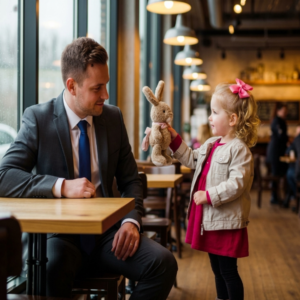
She looked very small on it. She had taken off her purple jacket because the penthouse was warm and folded it neatly beside her. Or tried to fold it anyway, which for a three-year-old meant it was sort of bunched into a little pile that she had patted flat with both hands and seemed very proud of. Her rabbit was propped up against the arm of the couch. She had apparently decided it needed a rest.
On the glass coffee table in front of her—the one that was always empty and polished to a mirror shine because Daniel had no decorative objects in his living room because he had never had a reason to acquire any—Sophia had arranged a small collection of things from her jacket pocket. A pink hair tie, a button, a small folded piece of paper, a single AA battery, a plastic ring with a purple gem that was slightly melted on one side.
She was looking at these things with the focused gravity of a museum curator arranging an exhibit. She looked up when she noticed Daniel in the doorway.
“I made a collection,” she told him very seriously.
“I see that,” he said.
“This is a power ring,” she said, holding up the melted plastic ring. “It doesn’t have much power left because it got too hot, but it still has some.”
“That’s good to know,” Daniel said.
“You can sit down,” Sophia told him in the exact tone that a person uses when they are being gracious and generous about sharing a space that they have claimed as their own. He sat down on the opposite end of the couch because it felt right to leave space.
“What’s that?” he asked, nodding at the folded piece of paper. Sophia picked it up, unfolded it with great care. It was a drawing—crayon on lined notebook paper, the kind torn from a school composition book—of two figures. One was tall with what appeared to be a large circular head and lines radiating from it like a sun. The other was very small, holding the tall figure’s hand.
“That’s me and Mommy,” Sophia said.
“I can see that,” Daniel said. And he could, actually. Sophia looked at the drawing for a moment. Then she folded it back up very carefully and placed it in the center of her collection like it was the most valuable thing in it. Because it was.
The Snack That Changed Everything
It happened just before noon. Maria had moved through the penthouse with quiet efficiency—the bathrooms, the bedroom, the hallway, the study. She worked the way Daniel had noticed she always worked, on the rare occasions he had been in the same room during the cleaning. Methodically, thoroughly, without wasted movement. She was good at her job, really good. The kind of good that comes not from training alone, but from a deep personal investment in doing things properly, even when, maybe especially when, nobody is watching.
Sophia had stayed on the couch for most of the morning, which Daniel found remarkable for a child that age. She had talked to her rabbit. She had rearranged her collection three times. She had fallen into a brief drooping nap around ten, curling herself into the corner of the couch cushions with her jacket pulled over her like a blanket, and she had slept for forty-five minutes with her mouth slightly open and her little chest rising and falling, looking so entirely peaceful and so entirely small that Daniel, who had walked through the living room to get water, had stopped and looked at her for a long moment before continuing to the kitchen.
Just before noon, Sophia woke up. She woke up the way small children do—suddenly and completely, sitting up straight and blinking with the expression of someone who requires a moment to reconstruct the facts of the world. Then she seemed to remember where she was, and her eyes moved around the room and found her rabbit and relaxed. Then her stomach growled.
It was a small sound, but the penthouse was quiet and Daniel was sitting in the armchair across the room. He had, without quite deciding to, gradually migrated from his office to the living room over the course of the morning, and he heard it clearly. Sophia looked down at her stomach with an expression of mild betrayal. Then she looked at Daniel.
“I’m a little hungry,” she said, in the tone of someone making a formal disclosure.
“Okay,” Daniel said. “What do you like to eat?”
She considered this with genuine gravity. “Cheese and crackers and sometimes yogurt and bread. I really like bread.”
“I think I have all of those things,” Daniel said. He went to the kitchen. His chef had stocked everything before leaving. There were several kinds of cheese in the refrigerator, a full loaf of fresh sourdough bread on the counter, crackers in the pantry, and an assortment of yogurts. Daniel stared at all of it for a second, having the strange experience of making a snack for a child in his kitchen for the first time in his life.
He put together a small plate—cheese slices, crackers, a piece of sourdough bread torn from the loaf. He found a small bunch of grapes and added those, too. He poured a glass of apple juice because there was apple juice in the refrigerator for reasons he’d never questioned. His chef always stocked it and he’d never asked why. He carried it to the living room and set it on the coffee table in front of Sophia, gently moving her collection to the side to make room.
The Question That Broke Him
Sophia stared at the plate with wide eyes. “Thank you,” she breathed. She ate with the focused appreciation of a person who understands, even at the age of three, that food is not nothing. She didn’t grab. She didn’t rush. She ate one thing at a time, neatly and carefully, and she said “Mhm” for the bread, which made Daniel look up from the report he was pretending to read.
For a few minutes, they sat in a comfortable and entirely strange silence—the thirty-eight-year-old billionaire and the three-year-old girl—while Sophia worked through her snack and Daniel pretended to work. Then Sophia picked up the remaining piece of bread. She looked at it. She looked at it for a long time in a way that went beyond just regular looking. Daniel noticed.
“You can eat it,” he said. “It’s yours.”
Sophia shook her head slowly.
“What’s wrong?” he asked.
Sophia turned the piece of bread over in her small hands. She looked up at him and there was something in her face that didn’t belong there. Something too heavy, too old, too worn for a three-year-old’s features. Something that had come from watching the world more carefully than three-year-olds should ever have to.
“Can I take this home?” she asked.
Daniel felt something shift in his chest. “Sure. But why? You can have more here if you want.”
Sophia looked at the bread again. Then she looked at Daniel. And her enormous eyes were completely steady and completely serious and completely honest in the way that only very young children’s eyes ever are. “Because,” she said quietly, “Mommy didn’t eat since yesterday.”
The room went absolutely silent. Daniel Hargrove, who had negotiated with kings, who had built a billion-dollar empire, who had stood at windows watching cities like they belonged to him, felt those seven words hit him somewhere in his chest like a physical thing. Like a door he didn’t know was closed had just been blown open.
“What?” he asked. His voice came out different than usual.
“Mommy says she’s not hungry,” Sophia said, with the knowing look of a child who has heard this particular sentence too many times and has started to understand that it doesn’t always mean what it says. “But I think she is. I think she’s just saving it.”
“Saving what?” Daniel asked, though he already knew.
“The food,” Sophia said simply. She shrugged one small shoulder, the way children shrug when they are reporting a fact they have simply accepted about the world. “She saves it for me. She always saves it for me.”
She held out the piece of bread, offering it to him to look at like it was evidence. “So, can I take this home for her?” Sophia asked. “So she can eat tonight? Please.”
The Truth He Finally Saw
Daniel sat with Sophia’s words for a long moment. The piece of bread was still in her small hands. She was still holding it out toward him slightly, still waiting for his answer with a patient, serious expression of a child making a very important request. He could not speak, which was not a thing that happened to Daniel Hargrove. He always had words. He had built his entire career, his entire public identity, on the ability to speak clearly, compellingly, confidently, in any situation.
But right now, with a three-year-old holding a piece of bread and looking at him with those enormous, honest eyes, he had nothing.
“Yes,” he finally said. “Of course you can.”
Sophia nodded, satisfied, and tucked the bread very carefully into the pocket of her purple jacket. Daniel stood up. He walked to the kitchen doorway and looked in. Maria was cleaning the sink, her back to him, moving with that same quiet efficiency. But now, with Sophia’s words ringing in his ears, he saw it differently. He saw the thin line of her shoulders. He saw the careful economy of her movements—nothing wasted, nothing extra. He saw the way her shirt was just slightly worn at the collar, in a way that a woman who was doing well financially would have replaced months ago.
He saw all of it, and he understood, with a clarity that felt like cold water on the face, that he had been sharing a space with this woman every Tuesday and Friday for—he tried to remember—almost two years. Two years. And he had never, not once, asked her a single question about her life. Not one.
He was not a cruel man. He had never thought of himself as cruel. He donated to charities, significant amounts, actually, and he didn’t publicize it, which he considered a point of personal integrity. He paid his full staff generously. He had a reputation in his industry for being demanding, but fair. But kindness and fairness, he was understanding in this moment, are not the same as seeing. He had never seen Maria. She had been there in his home every week for two years. And he had never once actually looked at her.
He knocked gently on the kitchen door frame. Maria turned. When she saw his face, which must have been showing something unfamiliar, because she looked immediately worried. She put down her cloth and straightened up.
“Is something wrong? Did Sophia—”
“Nothing’s wrong,” Daniel said. He paused. He was not entirely sure how to do this. He was not a man who had many conversations about anything personal. His world was transactions and strategy and forward motion. He wasn’t sure he had the language for this kind of conversation, but he tried. “I just—Sophia said something. And I wanted to ask you.”
Maria’s eyes went quickly to the living room, where Sophia was visible through the doorway, rearranging her collection again. Her expression shifted. The particular, helpless, private look of a parent realizing that their child has said something true that they weren’t ready to have said. “She said you haven’t eaten since yesterday,” Daniel said, keeping his voice as gentle as he could. “She wanted to take bread home for you.”
A long silence. Maria looked down at the kitchen counter. “She worries,” Maria said finally. Her voice was controlled, but it had an edge to it—the kind that comes from holding something in for a very long time. “She is three and she already worries. I hate that she worries.”
“I know,” Daniel said, though he didn’t, not really, not in the way Maria did. “But I’m asking because—will you please let me help?”
👉 [Tap here for the Next Part ] 👈
Disclaimer : This content may be created by AI for entertainment purposes. Any resemblance to real persons, events, or places is coincidental.