Raymond Dalton was not a poor man by any definition that mattered in the part of Iowa where he had spent his entire life. He owned 600 acres of fertile farmland, three grain elevators that had become landmarks along the county roads, and a financial portfolio large enough to secure comfort for generations. People in town didn’t talk about his wealth in numbers; they talked about it in reputation. Raymond was the kind of man whose handshake meant something, whose word carried weight, whose name opened doors without needing to knock.
But when his wife Eileen died, none of that seemed to matter anymore. The farmhouse they had built together over nearly five decades felt different in a way he couldn’t quite explain. It wasn’t emptier in a physical sense; the furniture was still there, the kitchen still held the scent of coffee if he brewed a pot early enough, and her recipes still sat in the drawer beside the stove. But the warmth had gone out of the place, as if something essential had been pulled from its foundation.
At first, Raymond told himself grief simply had a way of changing things. People withdrew. Time passed differently. The silence in the evenings stretched longer than it used to, and the mornings arrived without the familiar rhythm of Eileen moving through the house. He adjusted the best he could, keeping himself busy with the farm, the books, the endless small decisions that came with running something that size.
But then he noticed something else. The phone calls from his children didn’t stop entirely, but they changed. Marcus called, but the conversations always turned toward investments or market timing. Diane texted more than she spoke, her messages brief and efficient. Kevin came by occasionally, but there was always a reason, always something he needed. Only Nora remained consistent, calling every Sunday evening without fail, asking questions that had nothing to do with money or land or assets.
It took Raymond longer than he would later admit to see the pattern clearly. At first, he excused it. They had their own lives, their own responsibilities. But over time, the realization settled into him with a quiet certainty he could not shake. His children reached out when there was something to gain. When there wasn’t, the silence returned.
The moment that changed everything came on an ordinary evening. Raymond was sorting through Eileen’s clothes, packing them into boxes for donation, when a journal slipped from the top shelf of the closet. He caught it before it hit the floor, sat down on the edge of the bed, and opened it without thinking. The entry he landed on wasn’t recent. It was written years before her illness, in the steady, familiar handwriting he had seen on grocery lists and recipe cards for decades.
“A man’s children should come to see him because they want to, not because there’s something to sign.”
Raymond read the line twice, then closed the journal. He sat there for a long time, the quiet of the house pressing in around him, and understood something he had spent most of his life avoiding. Eileen had seen this long before he had. She had tried to tell him, in ways both subtle and direct, that providing for a family was not the same as connecting with one. He had built security, stability, wealth. But somewhere along the way, he had left something else undone.
That night, Raymond made a decision that would alter everything.
He called his lawyer the next morning and arranged for all of his assets to be quietly moved into a trust under temporary control. He coordinated with a trusted friend to maintain the farm’s operations without his name appearing anywhere on the paperwork. Then, with everything secured and hidden, he did something even more drastic.
He told his children he had lost everything.
The farm had failed, he said. Bad investments, poor years, debts he could no longer manage. The land was gone, the money gone, the life they had known erased almost overnight. He didn’t dramatize it. He didn’t elaborate. He simply stated it as fact and waited for their responses.
Then he moved into an old trailer on the edge of his property.
It was the kind of place they had once used for seasonal workers decades earlier, narrow and worn, with a furnace that rattled more than it heated and floors that creaked under even the lightest step. Raymond brought only what he needed: a few clothes, a photograph of Eileen, and the notebook he had picked up from a hardware store in town.
And then, he waited.
The first call came from Marcus. The shock in his voice lasted only a few seconds before it shifted into something sharper, more critical. He questioned the decisions, the lack of diversification, the missed opportunities that could have prevented such a loss. There was no anger at first, only frustration, the kind reserved for a bad business deal. By the time the call ended, he had not asked his father a single personal question.
Diane’s response was quieter, more measured. She expressed sympathy, asked what the next steps might be, whether there was a plan moving forward. Her concern sounded genuine, but it remained distant, framed within the language of logistics rather than emotion.
Kevin’s reaction was immediate and raw, but not in the way Raymond had expected. His concern centered on the money he had been expecting, the support he had assumed would always be there. When Raymond told him there was nothing left, the line went silent before the call abruptly ended.
And then there was Nora.
She didn’t interrupt. She didn’t question the details. When Raymond finished speaking, there was a brief pause on the line, and then she asked the only question that seemed to matter.
“Are you safe?”
Raymond wrote each of their responses down in his notebook that night, the words precise, unfiltered. It was the first entry in what would become a record of everything that followed.
The weeks turned into months, and the pattern deepened rather than changed. Marcus visited once, walking through the property with the detached focus of someone evaluating a situation rather than experiencing it. Diane never came at all, her calls infrequent and brief. Kevin returned once, his visit marked by tension and unspoken frustration.
But Nora came every Saturday.
She drove three hours round trip without fail, bringing groceries, fixing what needed fixing, filling the small trailer with a sense of life it otherwise lacked. She never asked about the will, never mentioned money, never hinted at anything beyond the immediate reality of her father’s situation. She cooked meals, mended small things, and sat with him in a way that required no explanation.
As winter arrived, the conditions in the trailer worsened. The cold settled into the walls, into the floors, into Raymond’s bones. It was during this time that he fell ill, a persistent cough that turned into something more serious. He dismissed it at first, but Nora didn’t. She arrived the next morning, took one look at him, and drove him to the doctor.
Pneumonia.
She stayed with him for four days, sleeping on the couch, waking at night to check his breathing, managing his medication with a quiet efficiency that reminded him so much of Eileen it was almost unbearable. She missed work without complaint, arranged her life around his needs without hesitation.
And Raymond wrote it all down.
Every visit, every absence, every moment that revealed something he had spent years not seeing clearly. By the time spring arrived, the notebook was nearly full, its pages worn from handling, its contents impossible to ignore.
The answer he had been looking for was there.
But it came with a weight he hadn’t anticipated.
Because the test didn’t just reveal his children. It revealed him.
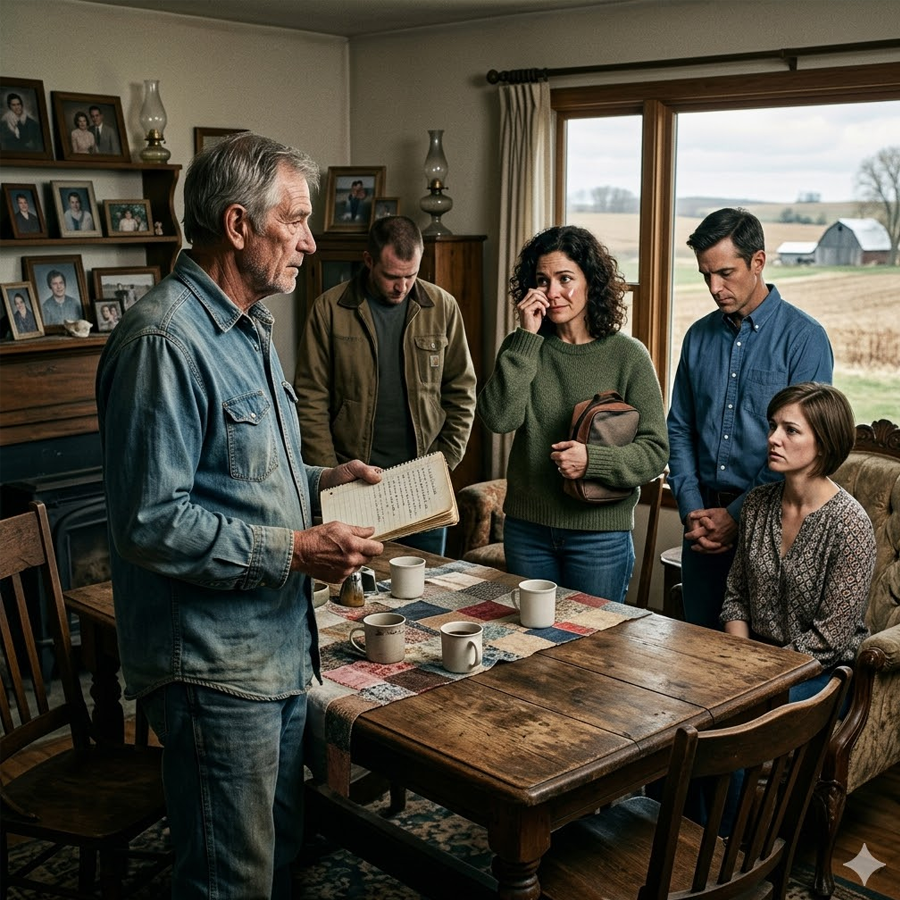
Nine months after he began, Raymond ended it. He called them all home, asked them to meet at the farmhouse on a Saturday morning. They arrived one by one, stepping into a space filled with memory and expectation, unaware of what was about to unfold.
When he told them the truth, the reaction was immediate and sharp. Shock, anger, disbelief. Marcus accused him of manipulation. Diane struggled to process the betrayal. Kevin said nothing at first, his silence heavier than any words.
And Nora simply watched.
Raymond read from the notebook, each entry a mirror held up to their actions. He didn’t raise his voice. He didn’t exaggerate. He simply presented what had happened.
When he finished, the room fell into a silence that felt different from anything that had come before. It wasn’t empty. It was full of recognition, of things understood too late or too clearly to ignore.
“I wasn’t a good father,” Raymond said finally.
The admission changed something. Not instantly, not completely, but enough to shift the conversation away from accusation and toward something more honest. Kevin spoke about his shame, Diane about her choices, Marcus about the distance he had built without realizing it.
And Nora said what none of them had yet put into words.
“We all failed.”
That day did not fix everything. It did not erase the years that had led them there. But it created something new, something fragile but real. A starting point.
A month later, they came back.
Not for money, not for obligation, but for dinner.
It wasn’t perfect. Nothing about it was. But as they sat together at the table, sharing a meal in the house that had once held them together, there was a sense of something returning, something that had been lost but not entirely gone.
Raymond understood then what he had misunderstood for most of his life. The farm was not his legacy. The land, the buildings, the wealth—they were all secondary.
What mattered was this.
The table. The people around it. The choice to show up.
That night, standing on the porch, he looked out over the fields one last time before turning back toward the house. Inside, he could hear voices, laughter, the quiet sounds of a family trying again.
For the first time in a long time, he wasn’t standing there alone.
And this time, he didn’t hesitate.
He went inside.
THE END






