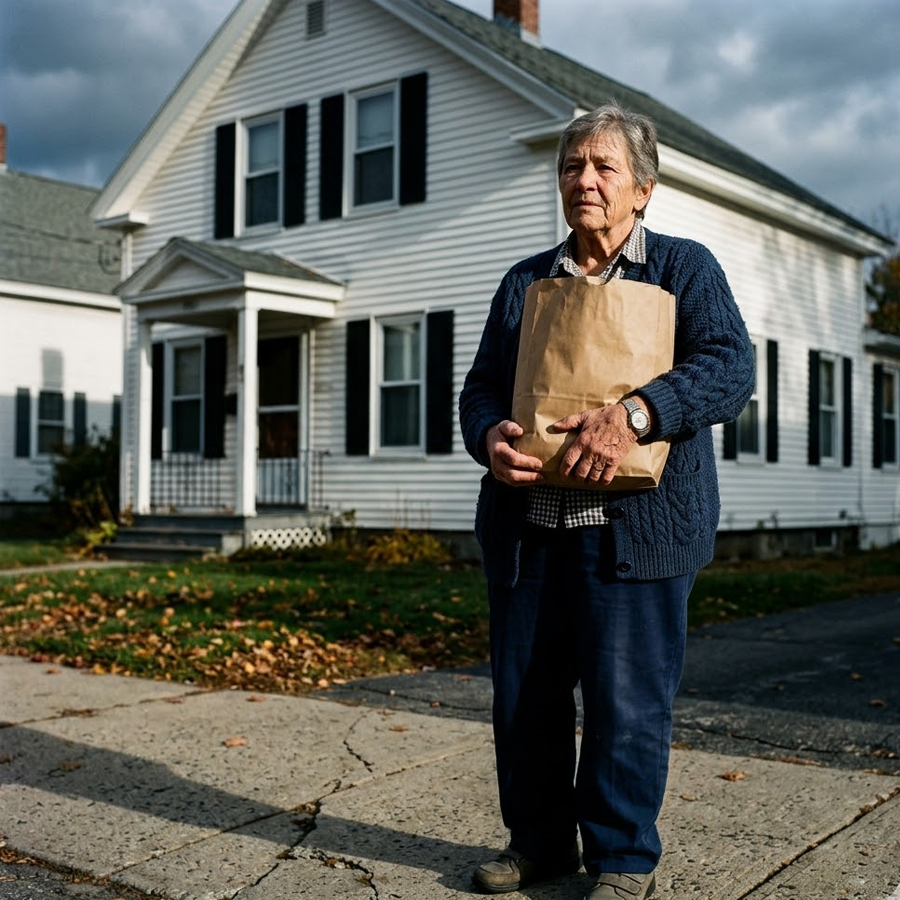
Mavis Bellamy had always believed that betrayal was something you could hear coming. She thought it would arrive loudly, with raised voices and slammed doors, with anger sharp enough to prepare you for the damage it was about to do. But the truth, as she would learn at seventy-two years old, was quieter than that. It came in soft reassurances, in familiar voices, in signatures placed neatly on documents she never thought to question. It came from her son, and it came without warning.
The morning everything changed began like any other Thursday. Mavis woke before sunrise, the house still wrapped in that gentle silence she had grown used to since Frank passed three years earlier. She moved through the kitchen slowly, making coffee the way she always had, measuring each spoonful carefully as if precision could somehow preserve the life she once knew. She watered the small plants by the window, straightened the dish towel, and stood for a moment looking out at the dogwood tree in the yard, its branches just beginning to show the first hints of bloom. It was a quiet life, predictable and small, but it was hers.
She went to the grocery store around mid-morning, following the same route she had taken for decades. She bought bread, milk, eggs, and a small bouquet of white flowers she didn’t need but liked to keep near the window because Frank used to say the house felt more alive when there were flowers in it. She didn’t rush. There was no reason to. Time had slowed for her in the years since he died, stretching out into long, quiet afternoons and evenings that passed without much notice.
When she returned home, she noticed something was wrong before she even reached the door. It was subtle, almost imperceptible at first, but enough to make her pause. The front door handle looked different. Shinier. Newer. She frowned slightly, shifting the grocery bag in her arms, and stepped forward. She inserted her key into the lock and turned it.
It didn’t move.
She pulled it out, looked at it, then tried again, slower this time. The key scraped uselessly against the mechanism, refusing to catch. A small, uneasy feeling began to form in her chest. She tried a third time, pressing harder, as if force might correct whatever mistake had been made.
Then the door opened.
Derek stood there.
He didn’t look surprised to see her. He didn’t look guilty either. He just stood in the doorway like he had been waiting, his hand still resting on the inside knob, his expression calm in a way that felt rehearsed.
“You can’t stay here anymore, Mom,” he said.
For a moment, Mavis didn’t understand the words. They didn’t fit into any reality she recognized. “What do you mean?” she asked, her voice softer than she intended.
“We talked about this,” Derek replied, his tone steady, almost patient. “You signed the paperwork.”
“I signed tax forms,” she said, confusion rising slowly, like water creeping up the sides of a glass.
Derek shook his head. “No. It was a transfer. The house is in my name now.”
Something inside her went very still. Not broken. Not yet. Just… still.
Behind him, she could see the living room, and something about it felt wrong. The curtains were different. The couch had been moved. Objects she didn’t recognize sat on surfaces that had once held her life. It looked like her house, but it didn’t feel like it anymore.
“You have thirty minutes,” Derek said.
And just like that, forty-four years of marriage, of shared meals and quiet conversations and memories built layer by layer into every corner of that house, were reduced to a deadline spoken on a porch that suddenly didn’t belong to her.
She didn’t argue. She didn’t raise her voice. She didn’t even cry.
She simply nodded, stepped back, and walked away.
What Derek didn’t know—what he couldn’t have known—was that his decision would not end her story.
It would reveal it.
Three days later, Mavis found the key to a life she had never seen.
It was hidden in a small wooden box in the back of Frank’s closet, tucked beneath old receipts and folded papers she had never bothered to sort through. The key was attached to a faded tag with a number written in black marker: 314. There was also a slip of paper with an address just off Route 12.
She didn’t know why she went.
Maybe it was curiosity. Maybe it was grief. Maybe it was the quiet, persistent feeling that there were still parts of Frank she had never fully understood.
The storage facility sat behind a rusted chain-link fence, rows of identical metal doors stretching out under a pale sky. It was the kind of place people forgot about. Temporary. Unimportant.
Unit 314 didn’t look like anything special.
Until she opened it.
The door rolled up with a long, metallic groan, and what waited inside was not storage.
It was a life.
Furniture filled the space. Not random pieces, not old junk stored away and forgotten, but carefully crafted objects arranged with intention. Chairs, tables, shelves, chests—each one built with a precision that made her breath catch. The wood was smooth, the joints seamless, the proportions balanced in a way that felt almost instinctive.
And on the underside of each piece, burned into the wood, were two letters.
FB.
Frank Bellamy.
Mavis stood there for a long time, her hand resting on the edge of a workbench she had never seen before, trying to understand how the man she had lived beside for over four decades could have built something like this without her knowing.
She had thought she knew him.
She had thought their life was simple.
But this… this was not simple.
This was mastery.
And suddenly, everything shifted.
Frank had not been invisible.
He had been building something quietly, patiently, without ever asking for recognition.
And now that hidden world was all she had left.
When she brought one of the pieces to a local antique shop, the reaction confirmed what she was only beginning to suspect.
The owner, Ruth, recognized the mark immediately.
“FB?” she said, her voice tightening with something close to excitement. “Where did you get this?”
“My husband made it,” Mavis replied.
Ruth stared at her in disbelief. “I’ve been selling his work for years.”
That was the moment everything changed.
Frank had a reputation.
People knew his work.
They valued it.
They sought it out.
And he had never told her.
The realization was overwhelming, not because of what he had kept from her, but because of what it revealed. He had built an entire legacy in silence, piece by piece, not for recognition, not for money, but because he loved the work.
And Derek had thrown it away.
Sold it.
Erased it.
For less than five hundred dollars.
That truth hardened into something unmovable inside her.
The legal battle that followed was almost inevitable. When the lawyer confirmed what she already suspected—that the deed had been forged, that the transfer was fraudulent, that the house had never legally left her ownership—Mavis didn’t feel anger.
She felt clarity.
Derek had not just taken her home.
He had erased her husband.
And that was something she would not allow.
The house was returned.
The title restored.
Derek lost everything.
But even after it was over, standing once again inside the house she had lived in for decades, Mavis realized something unexpected.
It didn’t feel like home anymore.
The walls were the same. The floors were the same. But the life that had once filled those spaces was gone, stripped away and replaced by something unfamiliar.
So she started again.
Not in the house.
In the garage.
Where the floor still held the dark stain of Frank’s workbench, a mark that couldn’t be cleaned away no matter how hard someone tried.
That stain became the foundation.
She rebuilt the space, not as it had been, but as it could be.
A workshop.
A place where people could come to build something real.
She called it Bellamy Workshop.
And slowly, quietly, it filled with life.
A teenager who didn’t trust anyone.
A widower who needed purpose.
A single mother trying to build something for her children.
Each of them carrying something broken.
Each of them finding something steady in the rhythm of work.
Because that was what Frank had understood all along.
You don’t fix life all at once.
You build it.
Piece by piece.
Month by month, the workshop became something more than just a place to work. It became a place where people stayed longer than they needed to, where conversations started slowly and stretched into something meaningful without anyone noticing exactly when it happened. Mavis didn’t try to teach everything at once. She let the work do that. Sanding first. Measuring next. Then cutting, fitting, adjusting, trying again. There were mistakes, plenty of them, but she never treated mistakes as failures. They were part of the process, something to be understood rather than avoided.
James was the first to change. When he walked into the workshop for the first time, he barely spoke, his shoulders tight, his eyes constantly scanning for a reason to leave. But over weeks, something softened. His movements became more deliberate, his frustration less immediate. The day he completed his first clean joint, he didn’t smile, but he didn’t need to. Mavis saw it in the way he held the piece, turning it under the light, understanding that he had made something real with his own hands.
Sonia came in tired from night shifts but stayed longer each time. She built shelves first, then a small cabinet, then something more ambitious. She talked about her sons without being asked, about how they needed a place for their books, about how she wanted to give them something that wouldn’t break or disappear. Curtis rarely spoke at all, but his presence filled the room. He fixed things without being asked, adjusted tools, corrected angles with a quiet precision that made everything else easier.
And through it all, Mavis worked.
Not to forget.
Not to move on.
But to continue.
Because that was what Frank had done.
And now, it was what she would do.
Months later, Derek came back.
He stood in the doorway of the workshop, thinner, quieter, stripped of everything he once used to control the situation. He didn’t argue. He didn’t justify anything. He just stood there and asked a simple question.
“Can I come in?”
Mavis looked at him for a long time.
Then she handed him a piece of wood.
And sandpaper.
“Start here,” she said.
Because that was where Frank would have started.
Not with forgiveness.
Not with explanations.
But with work.
Derek sat down and began to sand.
Slowly.
Carefully.
No shortcuts.
No excuses.
Just effort.
It didn’t fix everything.
But it was a beginning.
And sometimes, that’s all there is.
That evening, Mavis sat on the porch in Frank’s rocking chair, watching the light fade across the yard. The dogwood tree was in full bloom now, its white flowers catching the last light of the day. She rested her hand on the arm of the chair, feeling the smoothness of the wood, the patience it had taken to shape it, the care that had gone into every detail.
For the first time in a long time, she understood something clearly.
Home was not the house.
It was not the walls or the locks or the documents that said who owned what.
Home was what you built.
What you kept building.
What you refused to let disappear.
And as the evening settled into quiet, Mavis closed her eyes and let the gentle motion of the chair carry her, steady and certain, into a future she was no longer afraid to face.
She hadn’t lost everything.
Not even close.
She was still building.
And this time…
She knew exactly why.
THE END






