‘Can I Sit Here?’ A Navy SEAL Asked a Disabled Nurse Then His K9 Stopped the Entire Diner
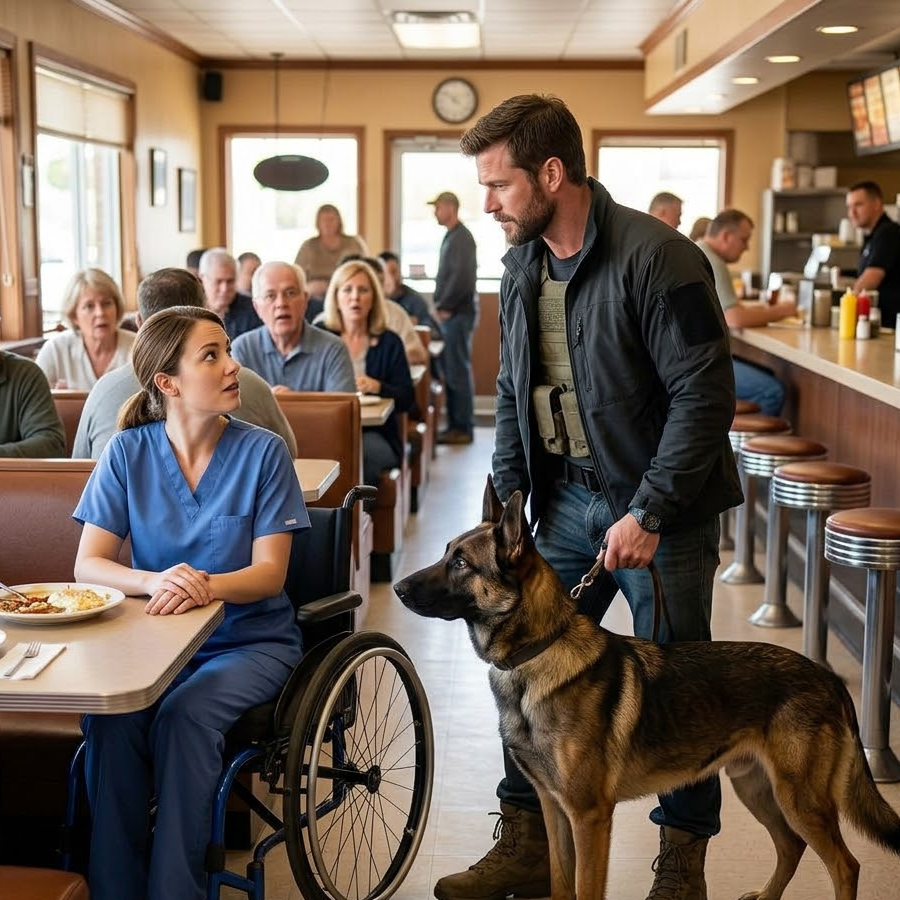
The German Shepherd didn’t wait for permission. The moment his paws crossed the threshold of that diner, something shifted in him. His nose dropped low, then lifted sharply, reading the air the way only a military working dog can. Sorting through coffee and bacon grease and morning sweat until he found what he was looking for.
His ears pressed forward, his entire body changed, and then before his handler could react, before a single person in that crowded diner could understand what they were witnessing, the dog pulled. Not aggressively, not frantically, deliberately, like he had been searching for something for a very long time and had finally, in the most ordinary place imaginable, found it.
Jason Carter, Navy Seal, tightened his grip on the harness instinctively. He was used to Valor being disciplined, precise, controlled. In 8 years of service together, through three deployments, through dark rooms and darker nights, Valor had never once broken formation without a command. Not once until this moment.
Jason followed the dog’s path with his eyes and saw her. A woman sitting alone at a small table near the window, coffee cup held in both hands, a brace on her left leg, a quiet face that had learned a long time ago how to look completely calm while carrying something impossibly heavy. She had no idea what was coming. Neither did anyone else in that diner.
Valor moved through the crowded room like he owned it. Around the trucker’s chair, past Doy and her coffee pot, between two construction workers who went completely silent as the big German Shepherd passed between them with quiet authority. People stopped talking. Forks stopped moving. The jukebox in the corner kept playing, but nobody was listening to it anymore.
Every single eye in the Sunrise Diner followed that dog to the small table by the window. And when Valor reached her, he didn’t bark. He didn’t jump. He simply stopped, lowered his great head, and rested it gently in her lap. The woman’s hands froze around her coffee cup. The diner held its breath, and Hannah Brooks, who had not been truly seen by another living soul in longer than she could remember, looked down at that dog’s face, and something behind her eyes broke wide open.
Her name had once meant something in a very different world. Hannah Brooks had grown up in a small town outside of Nashville, the daughter of a postal worker and a school librarian, two people who believed deeply in service and quietly in God and loudly in the Tennessee volunteers every single Saturday in the fall. She had been the kind of girl who stayed after class to help stack chairs, who drove her grandmother to doctor’s appointments without being asked, who at 19 years old walked into a Navy recruitment office not because she had nowhere else to go,
but because something in her chest had always pointed towards something larger than herself. She became a Navy corman, and she was extraordinary at it. By the time she was deployed to Afghanistan at 26, attached to a SEAL team operating out of Kandahar, she had already earned a reputation that traveled ahead of her.
The operator she worked with called her Angel 6, their designated call sign for her, but also something more than that, something they meant. Because Hannah Brooks had a quality that couldn’t be trained into a person, she stayed calm when the world was coming apart. She moved toward the sound of the explosion instead of away from it.
And she had hands that somehow steadied themselves most when everything around them was shaking. She was exactly the kind of person you wanted beside you when things went wrong. And in Kandahar, things went wrong. It was a night mission in the fall. The kind of night that sits heavy and moonless over the Afghan desert, where the darkness feels deliberate, like it’s been placed there specifically to hide the things that want to hurt you.
Her team was moving through a narrow corridor between two compounds when the first explosion tore through the left side of the formation, then the second. Then the radio became a wall of voices, everyone talking at once, and Hannah was already moving before she had consciously decided to move. Her medical bag swinging from her shoulder, her boots finding the ground in the dark by instinct alone.
The medical tent became a war of its own. Men were brought to her, bleeding and broken, and she worked on every single one of them with the kind of focused ferocity that looks from the outside almost like anger. Her hands moved. She called out for supplies. She made decisions in seconds that other people would need minutes to make.
She did not stop. She did not flinch. She did not look at the faces of the men she was working on because she had learned early that looking at their faces made you feel things that slowed your hands down. And her hands could not slow down. Not tonight. Then they brought in the dog. A soldier stumbled through the tent entrance carrying a large German Shepherd, a military working dog, his vest torn, his left shoulder dark with blood.
A piece of shrapnel lodged near the muscle. The dog’s handler came in right behind himself wounded, barely standing, refusing to let go of his partner even as his own legs were giving out beneath him. “Please,” the handler said. It was the simplest word, just that, please. Hannah looked at the dog, then at the handler.
She knelt on the ground beside them both. She worked on the dog the way she worked on everyone, methodically, carefully, whispering low and steady, while her hands found the shrapnel and removed it cleanly. The dog’s dark eyes watched her face the entire time, not with fear, with something much closer to trust. She wrapped the wound.
She kept her voice low and even, telling him he was all right, telling him he was going to be fine. The same words she used with every wounded soldier because she believed that living things needed to hear that they were going to be fine even when nobody could be completely certain, especially then. The helicopters came before dawn.
The handler didn’t make it to morning. Hannah stayed until the last man was evacuated. She stood in that empty tent after they were all gone. Her hands finally still, her uniform soaked through. And she made a mistake that would cost her years of peace. She counted. She counted who had come in and who had gone out.
And she found a number she couldn’t reconcile. And she decided, standing alone in that tent in the dark, that the number was her fault. It wasn’t. But grief doesn’t ask for facts before it moves in. She carry that number home with her like a stone in her chest. Home was supposed to fix things. And for a while, it almost did. She married a good man named Thomas, a high school history teacher who made her laugh in the particular way that reaches all the way down.
The kind of laughing that makes you forget briefly that you ever had anything to carry. They had a daughter, Lily, who had Thomas’s eyes and Hannah’s stubbornness and a laugh so big it seemed too large for her small body. For 4 years, Hannah Brooks was, if not healed, then at least whole. Then a driver ran a red light on wet November evening, and the world ended.
Thomas and Lily were gone before the ambulance arrived. Hannah survived with a shattered leg, a fractured wrist, and an absence inside her that no surgeon could locate or repair. She went through the motions of recovery the way soldiers go through the motions of paperwork mechanically without investment, waiting for it to be over.
She became a nurse at a small veterans clinic. She took extra shifts at the Sunrise Diner because silence at home had become something she couldn’t live inside of. She poured coffee and made small talk and smiled at Dotty’s jokes and went home to a house that was quiet in a way that had nothing to do with sound. She stopped talking about Afghanistan.
She stopped talking about Thomas. She stopped talking about Lily. She carried all three of them in the same place she’d carried the number from Kandahar. Deep and quiet and completely alone. She had been alone at that window table every Tuesday morning for 2 years until the bell above the door rang one more time.
Mind if I sit here? Hannah looked up from her coffee. The man standing across from her was tall, broadshouldered, with the particular kind of stillness that military people carry in their bodies, even in civilian clothes. A German Shepherd stood beside him in a military canine rest, looking at her with an intensity that made the hair on her arms rise beneath her sleeves. “Go ahead,” she said quietly.
Jason Carter lowered himself into the chair across from her. He looked tired in the way that had nothing to do with last night and everything to do with the last several years. His eyes were kind. His hands, she noticed, were the hands of someone who had used them in ways that regular life doesn’t prepare you for. Valor was still watching her.
And then the dog moved. He crossed the small distance between them and placed his head in her lap with a gentleness so deliberate, so specific that it stopped being a dog behavior and became something else entirely. Hannah’s breath caught in her throat. Her hands came up slowly and rested on either side of his face, and she felt beneath her palms the old raised line of a scar near his left shoulder.
“Her hands knew that scar. Her hands had made it, or rather had closed it.” “He doesn’t do that,” Jason said softly, watching with an expression she couldn’t fully read. “He’s never done that with a stranger.” Hannah couldn’t speak. Her throat had closed around something she hadn’t felt in years. The specific devastating sensation of being recognized.
Jason’s eyes moved to her wrist to the scar there. And something shifted in his face. “You were a corman,” he said. It wasn’t quite a question. She nodded. “Candahar?” Her eyes came up to his. Angel 6,” he said, almost a whisper. The diner had gone completely quiet. Doie had stopped pouring.
The construction workers had forgotten their coffee. The truckers near the door had turned without realizing it, drawn by something in the quality of the silence at that small table by the window. Hannah’s lips parted. She hadn’t said the words aloud in over a decade. They came out smaller than she expected, like something she’d kept in a dark place for so long it had forgotten its own size.
“Angel 6,” she whispered. Jason exhaled slowly, his jaw tightened the way men’s jaws tighten when they are fighting to keep their faces still. “I was a lieutenant attached to the team that came in after your ambush,” he said. “I read every debrief. I heard about the medic who stayed until every last operator was out. He paused.
We looked for you to say thank you. You’d already separated from service. Hannah shook her head slowly. I didn’t save everyone. You saved eight men that night. His voice was steady and firm. Eight. There were nine came in. Jason said, “I know. I know the number you’ve been carrying. He leaned forward slightly. That ninth man was gone before he reached Johanna, before he ever reached that tent.
The debrief confirmed it years ago. You’ve been carrying something that was never yours to carry. The sound Hannah made was not quite a word. It was the sound of something releasing that had been held too tightly for too long. Her hand pressed flat against Valor’s back, and the dog pressed upward into her palm, steady and warm and present.
“There’s something else,” Jason said. He reached across the table, not to touch her hand, but to gently turn it so the scar on her wrist faced upward. Then he pointed to the scar beneath his hand on Valor’s shoulder. “You saved him that night. The handler didn’t survive, and when we recovered Valor, the field report noted that his wound had been professionally dressed.
Someone had removed the shrapnel, closed the wound, kept him alive long enough to be evacuated. Hannah stared at the scar beneath her hand. “That was you,” Jason said simply. “Valor is 12 years old. He should have died in Kandahar at age two.” He paused, watching her face. He’s been alive for 10 extra years because of what you did that night.
And I don’t know how to explain what just happened when he walked through that door and came straight to you, except to tell you that dogs don’t forget the hands that save them. They carry that in a place that doesn’t fade. Valor lifted his head from her lap and looked directly into her face. His dark eyes steady and ancient and full of something that had no name in any human language, but that every human heart immediately understands.
The first tear ran down Hannah’s cheek without her permission, then another. She didn’t wipe them away. In the corner booth, one of the construction workers took off his baseball cap and held it against his chest and didn’t seem to notice he’d done it. Doie sat down her coffee pot on the counter and pressed her hand over her mouth.
The young mother near the door held her toddler a little tighter. Nobody spoke. Nobody needed to. 3 weeks later, Hannah Brooks walked through the doors of the Valor’s Watch Veterans Therapy Center on the east side of Clarksville, not as a patient, but as a nurse. A purpose-driven, cleareyed, finally forwardmoving nurse who had rediscovered in the head of a 12-year-old German Shepherd the things she had lost somewhere between Kandahar and a rainy November intersection.
She worked with veterans and their service dogs. She worked with men and women who came in carrying numbers the way she had carried hers, convinced they were responsible for weights that didn’t belong to them. She sat across from them in quiet rooms, and she told them with the particular authority of someone who has lived it that some things we carry are not ours.
And sometimes on Tuesday mornings she still sat at the small table by the window at the Sunrise Diner, but the coffee cup didn’t need to be held with both hands for warmth anymore. Valor came every time, and every time he laid his head in her lap like he was keeping a promise he’d made a long time ago in the dark in Kandahar, when a young woman’s steady hands had told him wordlessly that he was going to be all right.
She had been right then. She was all right now. Some heroes come home to parades and medals and hands reaching out to shake theirs. And they deserve every bit of it. But some heroes come home quietly, to empty houses and invisible wounds and mornings spent holding a coffee cup just to have something warm to hold.
They don’t ask to be remembered. They don’t believe they deserve to be. They have counted their numbers and found themselves lacking and decided in the silence of their own hearts that what they did was never quite enough. This story is for them because sometimes the universe finds a way to send the recognition that was always owed.
Sometimes it arrives not in a ceremony or a letter or a headline. Sometimes it arrives on four legs through a diner door on an ordinary Tuesday morning and it finds you at a small table by the window and it lays its head in your lap and it tells you without a single word everything you needed to hear. You were not forgotten. You were never forgotten.
You were always enough. If this story reached something inside you, if Hannah’s courage and valor’s loyalty and the quiet heroism of the ones who serve without seeking recognition moved your heart today, then you are exactly who this channel was made for. Hit that subscribe button and join the State of Valor family because every week we come back here to make sure the ones who gave everything are never ever forgotten.
And if you know someone who needs to hear this story today, a veteran, a nurse, a quiet hero sitting alone at their own window table, share this with them. They need to know the same thing Hannah finally learned. The ones who truly matter never forgot you. Not for a single day.