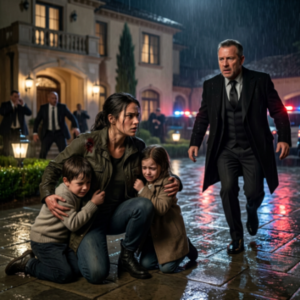
When the billionaire patriarch of the Stone family died, his greedy relatives inherited everything. His devoted niece was left with nothing but a rusty key and a mocking smile from her uncle. They thought she had lost. They didn’t know she was about to uncover an empire no one claimed. The mahogany paneled conference room at Reed, Harrison and Associates smelled of lemon polish, old paper, and barely concealed greed.
Outside the towering glass windows, the Boston skyline was a dreary wash of gray rain. A fitting backdrop for the mourning of Andrew Stone. Or at least, what was supposed to be mourning. Rachel Brighton sat at the far end of the long conference table, twisting a cheap tissue between her trembling fingers. At 28, Rachel was a pediatric nurse who lived in a modest walk-up in Somerville.
She was also Andrew Stone’s great niece, and for the last five years of the billionaire’s life, she had been his only real family. While the rest of the Stone clan was busy schmoozing at charity galas in New York or skiing in Gstaad, Rachel was the one sitting by Andrew’s bedside. She was the one who managed his medications, read him classic maritime history books when his eyesight failed, and listened to his endless stories about building a logistics empire out of a single rusted cargo van in the 1970s.
Across the table sat her uncle, Henry Stone. Henry was a 55-year-old corporate shark whose custom-tailored Italian suit couldn’t hide the desperate nervous energy radiating from him. Rumors had been swirling in the financial district that Henry’s hedge fund was on the verge of total collapse, drowning in over-leveraged debt.
Next to him was Sylvia Sterling, Rachel’s older cousin, scrolling mindlessly through her phone, her designer sunglasses pushed up into her bleached blonde hair. Neither of them had visited Andrew in the hospital. Neither had attended the private burial two days prior. They were only here for the payout. Thomas Reed, the senior partner and Andrew’s long-time confidant, cleared his throat.
He adjusted his half-moon spectacles and looked down at the thick stack of legal documents. “We are gathered here today to execute the last will and testament of Andrew James Stone.” Reed began, his voice gravelly and devoid of emotion. Rachel closed her eyes, fighting back a fresh wave of tears. She didn’t care about the money. She just missed the old man’s booming laugh and his sharp, cynical wit.
“To my nephew, Henry Stone.” Reed read aloud, the paper rustling in the quiet room. Henry sat up straighter, leaning forward like a predator catching a scent. “I leave the primary estate located in Beacon Hill, alongside my controlling shares in Stone Logistics, the commercial real estate portfolio in lower Manhattan, and liquid assets totaling 42 million dollars.
” Henry let out a breath he seemed to have been holding for years. A smug, victorious smile spread across his face. He shot a brief, triumphant glance at Rachel, as if he had just won a war she didn’t even know they were fighting. “To my niece, Sylvia Sterling.” The lawyer continued. Sylvia finally put her phone down.
“I leave the summer property in Nantucket, the vintage automobile collection, and my portfolio of international blue chip stocks valued currently at approximately 28 million dollars.” Sylvia nodded, not looking surprised, merely satisfied. “Good.” “That’s settled, then.” She whispered, already reaching for her designer handbag.
Rachel felt her heart pound against her ribs. It wasn’t jealousy that made her stomach twist, but a deep, sinking dread. Andrew had promised her she would be taken care of. He had held her hand just days before he passed, his breathing shallow, and told her, “You are the only one with a good heart, Rachel. You will carry the real legacy.
” Thomas Reed paused. He looked over the rim of his glasses directly at Rachel. There was a flicker of something in the old lawyer’s eyes. Pity? Confusion? “And finally,” Reed said, his voice dropping a fraction of a decibel, “to my great niece, Rachel Brighton, for her unwavering dedication in my twilight years, Rachel held her breath.
Henry scoffed quietly, a sound of pure disdain. “I leave the sum of one dollar to satisfy all legal claims, and” Reed reached under the table and placed a small, scuffed wooden lock box on the polished mahogany table. He opened the lid. Inside rested a single, heavy, rusted iron key and a sealed envelope.
“My oldest possession, which holds the true weight of my legacy.” The room fell dead silent. The ticking of the grandfather clock in the corner suddenly sounded like a sledgehammer. Rachel stared at the rusted key. It looked like it belonged to a 19th century barn, not a billionaire’s estate. “I I don’t understand.
” She stammered, her voice barely a whisper. “Is that it?” Henry burst into laughter. It was a harsh, booming sound that echoed off the wood panels. “A rusty key? Oh, that’s rich. The old man really had a sense of humor at the end. All those years changing his bedpans and spoon-feeding him soup, and he leaves you a piece of scrap metal.
” “Henry, please.” Mr. Reed admonished mildly, though he didn’t look entirely convinced himself. “Don’t Henry me, Tom.” Henry sneered, standing up and buttoning his jacket. “The will is ironclad, isn’t it? She gets the junk, we get the estate. I told you, Rachel, playing the martyr doesn’t pay off in the real world.
” Sylvia stood up, slipping her phone into her bag. “Honestly, Rachel, it’s for the best. You wouldn’t know what to do with real wealth, anyway. Keep the key. Maybe it opens a nice diary or something.” Rachel sat frozen as her aunt and uncle strutted out of the conference room, leaving a trail of expensive cologne and shattered illusions in their wake.
She felt a hot tear slide down her cheek. It wasn’t the loss of millions that broke her heart. It was the feeling of being discarded. Had Andrew manipulated her? Had she been nothing but free hospice care to a man who secretly despised her? Mr. Reed gently pushed the wooden box toward her. “I am sorry, Rachel.
Andrew was an eccentric man. I drafted the documents exactly as he instructed. He was adamant.” Rachel reached out with shaking fingers and picked up the heavy iron key. The metal was cold and pitted with age. Engraved on the bow of the key were four numbers, 1978. She picked up the sealed envelope. Her name was written on the front in Andrew’s shaky, spiderweb handwriting.
“Did he say anything else, Mr. Reed?” Rachel asked, her voice cracking. “Only this.” The lawyer replied softly. “He told me, ‘When the wolves take the meat, they always leave the bones. But the marrow is where the life is.'” Rachel didn’t understand the riddle. She took the box, stood up on shaky legs, and walked out of the law office into the pouring Boston rain, feeling utterly alone.
She thought she had lost everything. But the game had only just begun. The rain lashed against the single window of Rachel’s cramped kitchen. She sat at her wobbly Formica table, a cup of tea growing cold beside her. In front of her lay the rusted key and the unopened envelope. It had been 24 hours since the disastrous will reading.
Her phone had been buzzing all morning with notifications, news alerts about Henry Stone officially taking over Stone Logistics, photos of Sylvia celebrating her inheritance at an exclusive rooftop bar. The world had moved on, rewarding the cruel and forgetting the loyal. Rachel wiped her eyes and finally picked up the envelope.
She slid her thumb under the flap and pulled out a single sheet of heavy, cream-colored stationery. “My dearest Rachel, if you are reading this, it means the vultures have descended. I know Henry and Sylvia took the bait. They always were blinded by the shine of new money. They see value in bank accounts, stock portfolios, and glass towers.
But you and I know that anything built on a weak foundation will eventually crumble. Henry’s greed is a disease, and he will bankrupt the companies I gave him within 5 years. I gave them enough rope to hang themselves. I am sorry for the pain I caused you at the lawyer’s office. It was necessary. To protect the true fortune, I had to make them believe you were left with nothing.
The law demands a public accounting of assets, but the law only knows about the assets the government can track. You hold the key to where the first stone was laid. The year is on the key. You know where I go to breathe when the city suffocates me. Go there quickly, Rachel. Henry is ruthless. He will not hesitate to burn the past to fuel his future.
Love always, Uncle Artie. Rachel stared at the letter, her pulse quickening. Where the first stone was laid. The key was engraved with 1978. Her mind raced back through the hundreds of hours she had spent listening to Andrew’s stories. 1978 was the year he started his first real business. Before the skyscrapers and the logistics empire, Andrew was a broke 20-something hauling scrap metal and timber.
But where did he go to breathe? Suddenly, her breath hitched. The Blackwood cabin. It was a dilapidated off-the-grid hunting cabin hidden deep in the Berkshire Mountains in Western Massachusetts. Andrew had bought the land for a few thousand dollars in 1978. It was his very first real estate purchase.
He never modernized it. No electricity. No running water. The rest of the family despised the place, mocking it as Andrew’s mud hut. But Andrew had loved it. It was his sanctuary. Rachel grabbed her phone and opened her email. Mr. Reed had forwarded her a digital copy of the entire estate inventory for her records.
She scrolled frantically through the PDFs, scanning the endless lists of properties. There it was. Asset 402. Blackwood parcel, Berkshire County. 12 acres. Structure condemned. And right next to it, a terrifying note under Henry’s directives. Scheduled for demolition and land liquidation. Demolition date Friday the 14th. Rachel looked at the calendar on her wall.
Today was Thursday the 13th. Panic seized her. Henry was fast-tracking the sale of the useless assets to inject cash into his failing hedge fund. If she didn’t get to the cabin immediately, whatever Andrew had hidden there would be crushed under the treads of a bulldozer. Within 20 minutes, Rachel had packed a duffel bag with a flashlight, batteries, a crowbar, and a first aid kit.
She threw herself into a 10-year-old Honda Civic and tore out of the city, merging onto the Massachusetts Turnpike. The drive took 3 hours, transitioning from the concrete maze of Boston into the dense, brooding forests of the Berkshires. The rain had turned the dirt access roads into treacherous ribbons of mud.
Rachel’s small car fishtailed violently as she forced her way up the mountain, the engine screaming in protest. Finally, she hit a dead end. A rusted, padlocked chain hung across a path blocked by overgrown pines. A fresh, neon orange sign was stapled to a tree. Stone Holdings. No trespassing. Demolition zone.
Rachel parked the car, grabbed her bag, and ducked under the chain. The hike took another 40 minutes through dense, wet brush. By the time the cabin came into view, she was soaked to the bone and shivering. The Blackwood cabin was a tragic sight. It leaned heavily to one side, its timber rotting, the roof sagging under the weight of decades of wet leaves.
The windows were boarded up and the porch looked ready to collapse. Rachel stepped onto the porch, wincing as the wood groaned beneath her boots. She approached the heavy oak front door. It was secured by a modern, heavy-duty padlock, undoubtedly Henry’s doing. She didn’t hesitate. She pulled the crowbar from her bag, wedged it behind the padlock hasp, and threw her entire body weight against it.
With a loud crack that echoed through the quiet forest, the rusted wood splintered and the door swung open. Inside, it was pitch black and smelled of damp earth, mildew, and decaying wood. Rachel clicked on her flashlight, the beam cutting through a thick cloud of dust. The cabin was essentially one large room.
There was an old cast iron wood stove, a rotting cot, and a massive heavy oak desk in the center of the room. Where was the lock? The key in her pocket was huge. It belonged to something substantial. She searched frantically. She checked the desk drawers. Empty. She pulled up the moth-eaten rug, looking for a trapdoor. Nothing. She shone the light up into the rafters, inside the belly of the cold wood stove, behind the peeling wallpaper.
45 minutes passed. Panic began to claw at her throat. Had she misunderstood the clue? Had Henry already found it? Desperate, Rachel stood in the center of the room, shining her flashlight around. Where the first stone was laid. She looked at the fireplace. It wasn’t brick. It was built from massive, uneven river stones that Andrew had hauled from the creek himself.
Rachel walked over to it. She knelt in the soot and ash, examining the masonry. The first stone, she whispered. She looked at the very bottom right corner of the fireplace hearth. There was a massive, rectangular river stone that looked perfectly flush with the others. But the mortar around it wasn’t gray like the rest.
It was slightly darker, crumbling at the edges. Rachel wedged the tip of her crowbar into the crack beside the stone. She pushed with all her might. The stone didn’t budge. She tried again, gritting her teeth, her muscles burning. Suddenly, there was a grinding sound. The massive stone shifted forward.
With a final, desperate heave, she pulled the stone completely out, letting it crash heavily onto the wooden floorboards. Behind the stone was a dark, square cavity in the masonry. Inside sat a heavy, black iron strongbox. Rachel reached in and hauled the box out. It was shockingly heavy, covered in decades of dust and spiderwebs.
On the front of the box was a large, ancient keyhole. With trembling hands, Rachel reached into her pocket and pulled out the rusted iron key. She slid it into the keyhole. It fit perfectly. She took a deep breath, praying to whoever was listening, and turned the key. Click. The heavy latch disengaged. Just as Rachel placed her hands on the lid to open it, a sound pierced the quiet of the mountain.
It wasn’t the wind. It was the deep, guttural roar of heavy diesel engines. Headlights swept through the cracks in the boarded-up windows, casting long, terrifying shadows across the cabin floor. Rachel froze. The demolition crew wasn’t coming tomorrow. They had arrived a day early. And over the roar of the engines, she heard the distinct, aggressive shouting of her Uncle Henry barking orders.
She had nowhere to hide. The iron box was too heavy to run with, and the bulldozers were mere yards away. The cabin floorboards vibrated violently under Rachel’s boots. The roar of the bulldozer’s diesel engine was deafening, drowning out the pounding of her own heart. Dust rained down from the rotting rafters, coating her hair and shoulders.
Through the gaps in the boarded-up windows, the harsh glare of halogen work lights sliced through the darkness like frantic laser beams. She had seconds. Rachel threw open the heavy lid of the iron strongbox. She expected stacks of dusty hundred-dollar bills, or perhaps gold bullion. Instead, the box contained only three items.
A thick, leather-bound ledger embossed with the crest of Banque Pictet and Cie, a sealed Manila envelope thick with paperwork, and a small velvet jewelry box. Outside, a megaphone crackled. Tear down the porch first. If the structural beams give, the roof will cave in on itself. Let’s get this done tonight, boys. It was Henry.
His voice was laced with a manic, frantic urgency. He was liquidating the asset tonight, desperate for the cash to cover his failing hedge fund’s margin calls. Rachel didn’t have time to examine the contents. She grabbed the Swiss ledger, the thick envelope, and the velvet box, shoving them ruthlessly into her waterproof duffel bag.
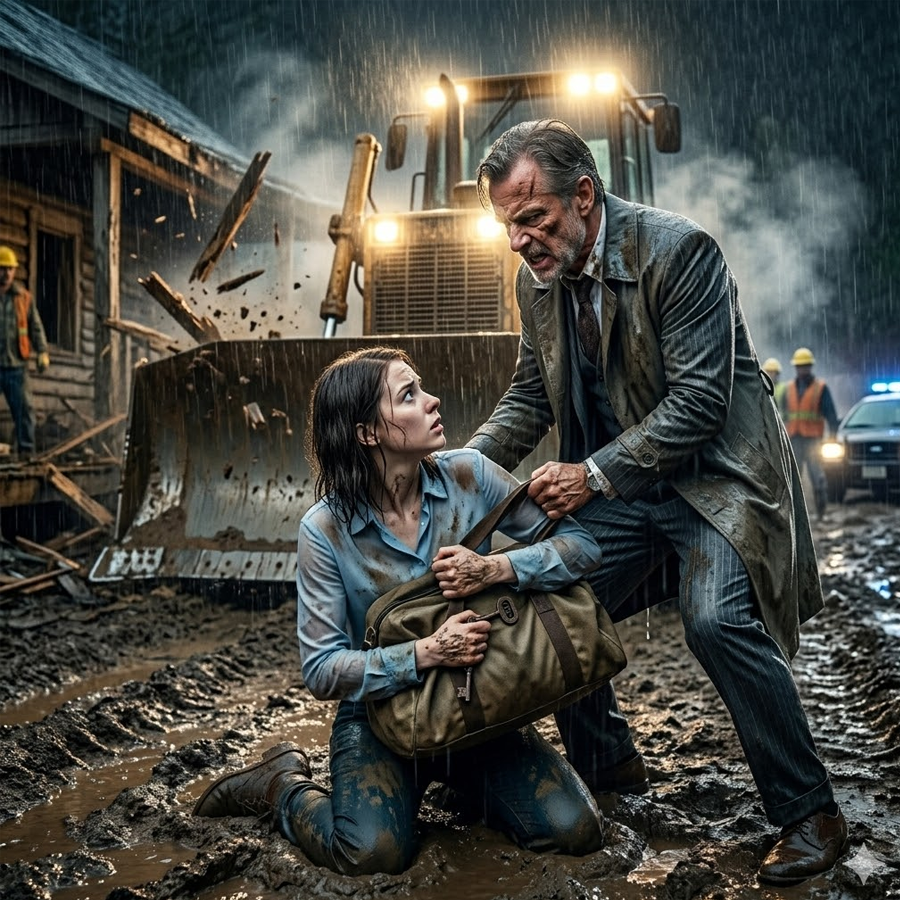
She zipped it shut just as the front of the cabin took a massive hit. Crack. The entire structure groaned as the bulldozer’s blade smashed into the front porch. The door frame buckled and the rusted lock Rachel had broken earlier gave way completely. The heavy oak door crashed inward falling flat onto the floorboards. Standing in the doorway, silhouetted against the blinding halogen work lights, was Henry Stone.
He wore an expensive trench coat over his Italian suit, his face contorted in a mix of rage and shock. “Rachel!” he shouted over the idling engines. He stepped into the dusty ruined room, a heavy Maglite flashlight in his hand. He swept the beam over the torn-up floorboards, the displaced river stone from the fireplace, and the empty rusted iron strongbox sitting at Rachel’s feet.
His eyes locked onto the strongbox, then snapped up to Rachel’s duffel bag, which she was clutching tightly to her chest. “What the hell are you doing in my property?” Henry snarled, stepping closer. The smug corporate shark from the lawyer’s office was gone. In his place was a desperate, dangerous man. “And what did you take out of that box?” “Uncle Artie left me the key.
” Rachel said, forcing her voice to stay steady despite her trembling knees. “I just came to get what was mine.” Henry let out a harsh, barking laugh, though his eyes remained dead and cold. “You broke into a condemned demolition site to scavenge? Pathetic.” “Open the bag, Rachel.” “No.” She said, taking a step back.
“This is mine.” “You got your millions, Henry. Let me have my dollar’s worth.” “I am the executor of this estate.” Henry roared, stepping forward and grabbing the strap of her duffel bag. “Anything on this land belongs to Stone Holdings. Give it to me.” A fierce struggle ensued in the dim, dusty light of the collapsing cabin.
Henry was stronger, but Rachel was fueled by years of repressed anger and a desperate need to protect Andrew’s final wish. As Henry yanked the bag, the zipper caught on the fabric and popped open. The velvet jewelry box tumbled out, hitting the floorboards and springing open. Inside sat a cheap, tarnished silver locket on a broken chain.
It was an old trinket, worth perhaps $20 at a flea market. Henry froze, staring at the locket. He let go of the bag. Rachel immediately scooped up the jewelry box, shielding the deeper contents of the duffel, the thick envelope, and the Swiss ledger from his view. Henry looked from the cheap locket to Rachel, his expression twisting into a sneer of absolute disgust.
“A rusted key for a broken necklace. Good god.” “The old man really did hate you, didn’t he?” “He sent you on a wild goose chase in the mud for a piece of garbage.” Rachel swallowed hard, playing the part. She let a tear slip down her cheek, hugging the bag to her chest as if she were a wounded child. “It was his mother’s.
” She whispered, a lie she invented on the spot. Henry rolled his eyes, adjusting his expensive coat. “You make me sick, Rachel.” “You’re a weak, sentimental fool, just like Andrew was at the end.” “Take your trash and get off my land before I have you arrested for trespassing.” He turned toward the door, yelling to the foreman outside, “Knock it down! Flatten the whole damn thing!” Rachel didn’t wait.
She bolted past him, out into the freezing rain, clutching her bag as if her life depended on it. She scrambled through the mud, ducking under the rusted chain, and throwing herself into her Honda Civic. As she put the car in reverse, she looked back through the rain-streaked windshield.
The bulldozer surged forward, its massive steel blade biting into the Blackwood cabin. With a sickening crunch of timber, Andrew’s sanctuary collapsed in on itself, burying the empty iron strongbox under tons of debris. Henry stood in the mud, watching the destruction with a satisfied smirk. He thought he had buried the past.
He had no idea that Rachel was driving away with his entire future. The following Tuesday, Rachel sat in the pristine, ultra-modern offices of Kensington and Croft, an elite private wealth management firm in downtown Manhattan. Across from her sat David Kensington, a senior partner whose hourly rate was more than Rachel made in a month.
Rachel had spent the weekend pouring over the documents from the strongbox. Now, they were spread across Kensington’s glass table, the bank picked it ledger, and the contents of the Manila envelope. Kensington, a man who usually projected an aura of unshakeable calm, was visibly sweating as he read through the antique paper certificates.
“Ms. Brighton.” Kensington finally said, removing his designer glasses and rubbing the bridge of his nose. “Do you comprehend exactly what your uncle has done here?” “I think so.” Rachel replied quietly. “But I need you to confirm it.” “Andrew Stone was a terrifying genius.” Kensington muttered, tapping the thick stack of papers.
“Henry inherited Stone Logistics, the commercial real estate portfolio, and the liquid cash. A massive fortune on paper.” “But it’s an illusion.” Kensington stood up, pacing to the window. “Decades ago, Andrew created a private holding company in the Cayman Islands called Aegis Vanguard Group. These documents you brought me, these are bearer shares.
” “They are unregistered physical certificates.” “Whoever holds these pieces of paper physically in their hands is the sole, absolute owner of Aegis Vanguard.” “And you are holding all of them.” “And what does Aegis Vanguard own?” Rachel asked. Kensington offered a grim, razor-sharp smile. “Everything. Stone Logistics doesn’t own its transport trucks, Ms. Brighton.
They lease them from Aegis Vanguard. Stone Logistics doesn’t own the patents for their routing software.” “They license them from Aegis Vanguard.” “And that commercial real estate portfolio Henry inherited?” “The land beneath those skyscrapers is owned by Aegis Vanguard.” “Henry inherited the public-facing company.” “But Andrew saddled it with astronomical hidden debt owed entirely to this shadow corporation.
” Rachel felt the breath leave her lungs. “So?” “So?” Kensington finished. “Henry inherited the shell.” “You inherited the yolk.” “And according to these ledgers, Stone Logistics owes Aegis Vanguard over $400 million in backdated licensing fees and land leases.” “Fees that Andrew purposely suspended collecting for the last 10 years, until now.
” Over the next 3 months, the trap Andrew had carefully laid for his greedy nephew snapped shut with bone-crushing force. Henry’s hedge fund officially collapsed, drowning in toxic assets. Desperate for liquidity, he attempted to sell off Stone Logistics’ massive fleet of cargo planes and trucks. It was then that the legal injunctions hit.
The corporate world was stunned when Aegis Vanguard Group, a ghost corporation no one had ever heard of, stepped out of the shadows and blocked the sale, proving they held the titles to every single vehicle. Panic set in. Henry tried to liquidate the Manhattan real estate, only to discover the ground leases had suddenly been terminated due to nonpayment.
Sylvia Sterling, Rachel’s cousin, faced her own ruin. Her inherited blue-chip stocks had been heavily leveraged by Henry to keep his fund afloat. When Henry fell, Sylvia’s fortune was wiped out in margin calls overnight. The final blow came on a crisp November morning. Henry Stone sat at the head of the mahogany conference table at Reed, Harrison and Associates, the exact same room where the will had been read months prior.
He looked 10 years older. His suit hung loosely on his frame, his hair was unkempt, and the arrogant fire in his eyes had been extinguished, replaced by a hollow, frantic terror. He was facing bankruptcy, federal fraud investigations, and total ruin. Thomas Reed, the elderly lawyer, sat at the end of the table.
“Henry.” “The representatives from Aegis Vanguard are here to discuss the settlement of your outstanding corporate debt.” The heavy oak doors opened. Henry didn’t look up, his head buried in his hands. “Just give them the keys, Tom. Give them the company. I’m done. I have nothing left.” “We don’t want the company, Henry.
It’s bankrupt.” Henry’s head snapped up at the sound of the voice. Rachel walked into the room. She was no longer wearing cheap scrubs or twisting a tissue in her hands. She wore a tailored charcoal blazer, projecting an aura of quiet, unshakable authority. David Kensington walked beside her carrying a sleek leather briefcase.
Henry stared at her, his mouth opening and closing like a suffocating fish. Rachel? What? What are you doing here? Did you come to gloat? To ask for a handout? I’m the majority shareholder of Aegis Vanguard Group. Rachel said calmly, taking the seat directly across from him. The exact seat she had occupied months ago.
Henry’s face drained of all color. His eyes darted to Kensington, then back to Rachel. The memory of the muddy cabin, the bulldozer, and the duffel bag suddenly flashed in his mind. The velvet box was a distraction. No. Henry whispered, his voice trembling. No, that’s impossible. He left you a rusted key, a dollar.
He left me the first stone. Rachel corrected him, her voice echoing with Andrew’s wisdom. You took the meat, Henry. But you forgot that the marrow is where the life is. You were blinded by the shine of new money, just like he said you would be. Kensington opened his briefcase and slid a thick stack of legal documents across the table.
My client is willing to forgive the $400 in corporate debt, Mr. Stone. In exchange, you will sign over all remaining voting rights, your Beacon Hill estate, and any residual assets to the Vanguard Trust. You will walk away with exactly what you deserve. Henry looked at the pen resting on the contract. He was shaking violently.
He had spent his entire life scheming, stepping on others, and worshiping at the altar of greed. And in the end, he had been utterly dismantled by a dying old man and a 28-year-old nurse. With tears of humiliation pooling in his eyes, Henry picked up the pen and signed his empire away. Rachel stood up, buttoning her blazer.
She looked down at her uncle, feeling no triumph, only a profound sense of closure. Goodbye, Henry. She said softly. Rachel walked out of the glass-paneled building and into the bright, crisp Boston sunlight. She had already drawn up the paperwork with Kensington. The liquidated assets of Henry’s failed shell companies would be channeled into the newly formed Andrew James Stone Foundation, dedicated to building state-of-the-art pediatric wings in underfunded hospitals across the East Coast.
She reached into her pocket, her fingers brushing against the cold, heavy iron of the rusted key. They thought she had lost everything. They didn’t realize she was the only one who truly understood what it meant to win. Rachel’s incredible journey proves that true wealth isn’t just about what’s on paper. It’s about loyalty, patience, and having a good heart.
Karma always collects its debts, and the greediest wolves eventually starve. If this story of ultimate revenge and hidden fortunes kept you on the edge of your seat, hit that like button, share it with your friends, and subscribe to our channel for more dramatic, real-life stories.