Six-year-old Lily Voss had not spoken a single word in two years. The silence in the house was not loud, not dramatic, but heavy in a way that settled into everything—into the walls, into the long hallways, into the way people lowered their voices without being told. Her father, Sawyer Voss, had spent those two years trying to break it. Doctors, specialists, private clinics in different countries, entire rooms redesigned for comfort, therapy, stimulation, recovery. None of it worked. Lily understood everything. She simply refused to speak into the world anymore.
The doctors called it trauma.
Sawyer called it failure, though never out loud.
Then one night, just after midnight, a wounded pitbull was carried into the house without permission.
Marcus knew it was a mistake the moment he stepped through the back entrance. Sawyer was already there, standing at the bottom of the stairs, still dressed, arms crossed, watching. “Explain,” he said. One word. It was always enough.
Marcus set the dog down carefully. “Found him near the warehouse. Shot in the shoulder. Tied to our fence like a warning.” Sawyer didn’t look at the dog. He looked at Marcus. “So you brought it into my house.” A pause. “Put it in the garage. Call a vet in the morning.”
It should have ended there.
But it didn’t.
Because at the top of the stairs, Lily was standing barefoot in her yellow pajamas, hands wrapped around the railing, looking down at the dog. Her face had been distant for two years, quiet in a way that made people uncomfortable. But now there was something else—something alive, sharp, present.
Sawyer noticed immediately.
“Go back to bed,” he said, softer than usual.
She didn’t move right away. She looked at him, then back at the dog, as if deciding something. Then she turned and walked away without a sound.
Sawyer stood there longer than he needed to.
What unsettled him wasn’t the dog.
It was the way Lily had looked at it—like she wanted it to stay.
The next morning, the dog was still alive.
And with it came Elena Reyes.
She arrived earlier than expected, standing outside the gate with a canvas bag over her shoulder, looking directly into the camera like she knew exactly where to stand. When Sawyer let her in, she didn’t comment on the house, the security, or the men watching her.
“Where is he?” she asked.
In the garage, she crouched beside the dog without touching him. She waited. A full minute passed before the dog even acknowledged her. Then slowly, he shifted, just slightly.
“He’s not aggressive,” she said quietly. “He’s terrified. Most people don’t know the difference.”
She placed food near him, not forcing, not reaching.
Sawyer watched carefully. He understood control. Pressure. Outcomes. But this—this was different. She wasn’t trying to dominate the situation. She was removing the need for resistance.
It was unfamiliar.
“He needs a name,” she said.
“He may not stay,” Sawyer replied.
“He still needs one,” she said calmly. “It tells him he exists.”
That stayed with Sawyer longer than he expected.
On the third morning, Lily went to the garage.
Sawyer saw it on the security feed and reached her quickly, but not quickly enough to stop her. She was crouched by the door, watching through a small gap. Inside, Elena sat on the floor, speaking softly.
The dog hesitated… then took food from her hand.
And Lily made a sound.
Barely anything. A soft, uncertain syllable.
Sawyer froze.
He didn’t react. He had learned not to. But something inside him shifted in a way he couldn’t control.
That night, he spoke to Elena.
“She made a sound,” he said.
Elena nodded. “Then let her come in tomorrow. Let her choose it.”
He almost refused.
Hope had failed him too many times.
But he said yes.
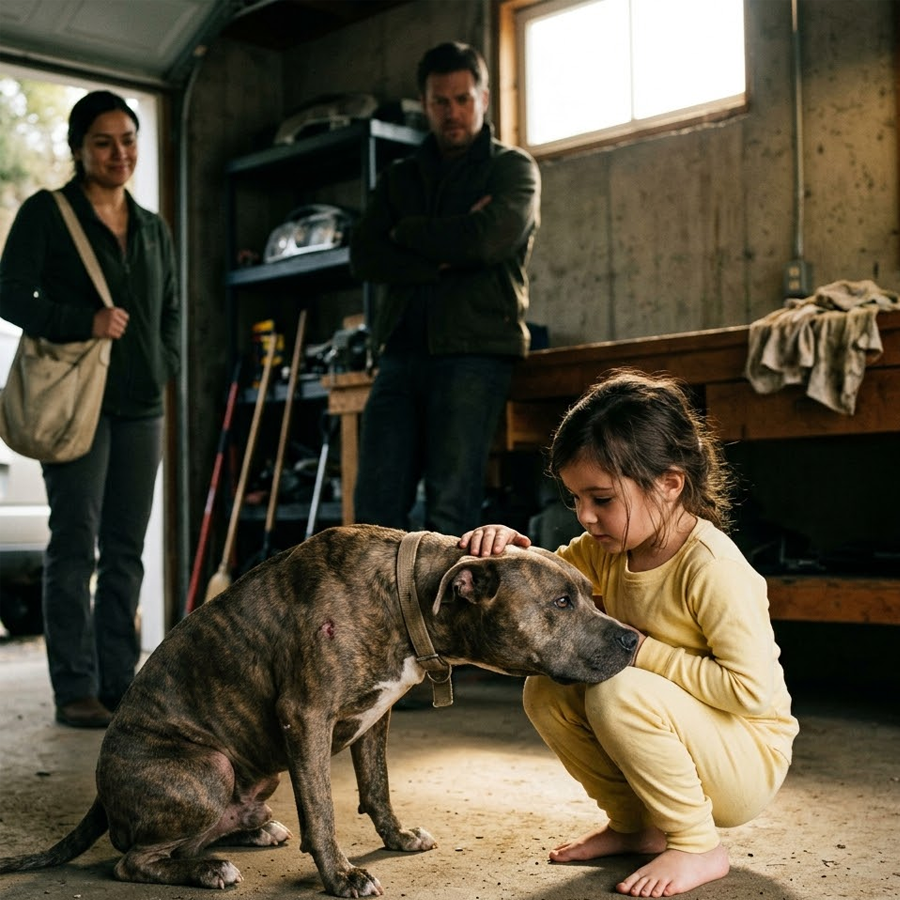
The next morning, Lily walked into the garage slowly. The dog watched her. She stopped a few feet away and crouched, just like Elena did. Not direct. Not threatening.
Still.
The dog moved first.
He stepped closer and lowered his head onto her knee.
Sawyer felt the breath leave his body.
Lily raised her hand and placed it gently on his head. They stayed like that, quiet, unmoving, as if the moment might break if either of them rushed it.
Then she spoke.
“Rex.”
One word.
But it changed everything.
From that day, things began to shift.
Lily started speaking again—not all at once, not in full sentences, but slowly, carefully. First to Rex, then to Elena, then to the world around her. The house felt different. Lighter, though no one said it out loud.
Rex healed too. His wound closed, his strength returned, but more than that—he stayed close to Lily. Always a few steps behind. Always watching.
Elena called it trust.
Sawyer called it something he didn’t have a word for.
Then the past caught up.
Someone noticed Elena. Someone connected her to Sawyer’s world. And in that world, connections meant risk.
Sawyer went to her himself.
“You need to stop coming,” he said. “For your safety.”
Elena listened, then said, “Give me three days. Let me prepare her. If you take this away suddenly, she’ll disappear again.”
He knew she was right.
So he gave her three days.
On the second day, he told Lily the truth. Not all of it, but enough.
“This is because of me,” he said. “The same reason you saw what you saw before.”
Lily was quiet for a long time.
Then she looked at him.
“I know you didn’t mean it,” she said. “I was just scared. Everything was loud. Rex is quiet. He stays.”
Sawyer didn’t know what to say.
But for the first time in two years, his daughter understood him.
Weeks later, Elena returned.
The danger had been handled.
Lily ran to her without hesitation, wrapping her arms around her tightly. No words. None were needed.
Rex ran across the yard, faster than before, stronger, stopping beside them like he belonged there.
Later, at the gate, Sawyer said, “Thank you.”
Elena shook her head. “Thank Rex.”
Then she looked at him. “Your daughter didn’t give you forgiveness. She gave you a door.”
Sawyer stood there long after she left, looking at the house, at the light in Lily’s window, at the small shadow beside hers.
Then he turned and walked back inside.
This time, not as the man he had been.
But as someone willing to change.
And sometimes, that is where everything truly begins.
THE END






