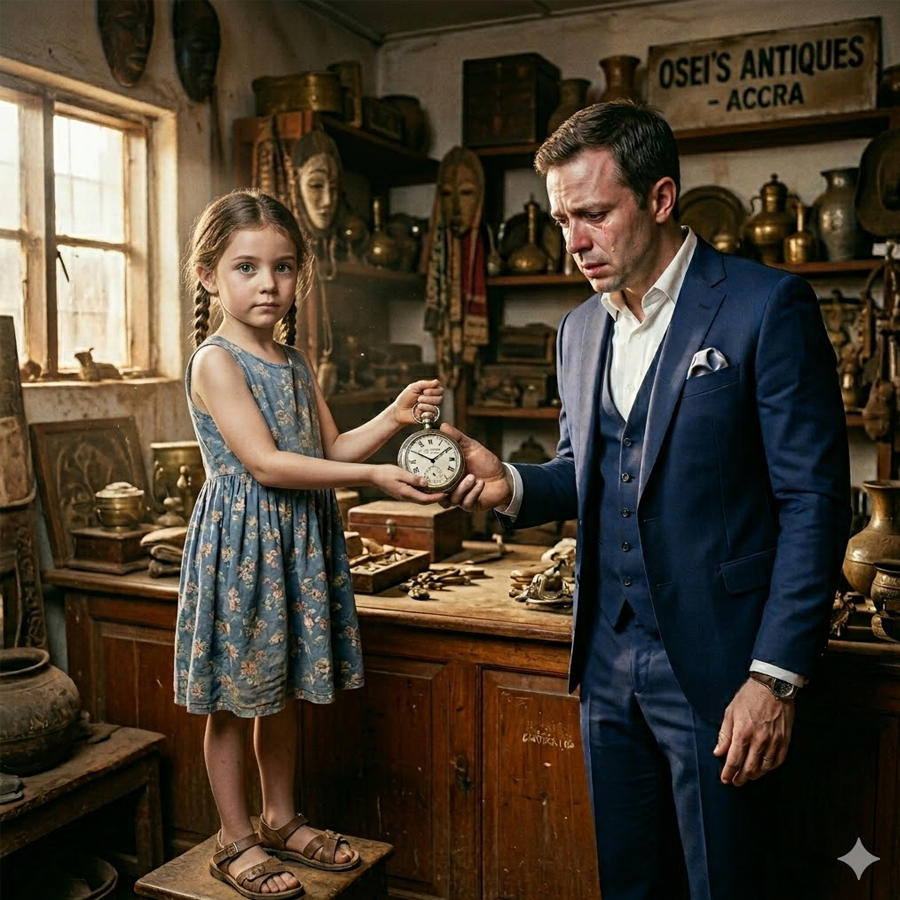
Sir, I want to sell something. What is it? It belongs to my mother. She’s sick. We need money. Let me see that. Seven years before the little girl walked into his antique shop with his own pocket watch in her hand, Evan Mensah still believed that love, if chosen clearly enough, could survive any room built to deny it.
He was 30 then, the only son of Kojo Mensah Senior, chairman of Mensah Holdings, heir to transport contracts, warehouses, construction interests, and the kind of old money that did not have to mention itself aloud because entire rooms rearranged in its presence. He had gone to the best schools. He wore the right suits without thinking.
He knew how to sit at donor dinners and say exactly enough without ever sounding hungry. The future prepared for him was so polished it had become a prison before anyone admitted it. Then, he met Ama Serwaa. She was not dramatic the first time he saw her. That was part of why he never forgot her. It happened at the private clinic where his aunt’s foundation had sponsored a maternal health fundraiser.
Evan had come because his father insisted visibility matters even when sincerity is optional. Ama was there because she worked in the clinic’s records office and had stayed late helping the nurses sort patient files before the event. She wore a simple navy dress, her hair braided back neatly, no jewelry except small silver studs.
She moved with the quiet self-containment of someone who had learned long ago that too much visible need invites contempt, but too much pride can cost opportunities she could not afford to lose. He noticed her because while everyone else in the room reacted to his surname, she did not.
She looked at him once when he asked for directions to the side office, answered plainly, and returned to what she was doing. No smile stretched too far. No false warmth. No stiff fear. He stood there 1 second longer than needed, unexpectedly irritated and intrigued. “You work here?” he asked. “Yes.” “You’re not joining the event?” “I’m still working.
” He almost smiled. “At this hour?” She glanced up at the overflowing tray of files and then back at him. “Babies don’t time themselves around fundraising.” That was the first thing she ever said to him that landed deep enough to stay. He came back 3 days later with paperwork his aunt did not need him to deliver.
Then again the following week with a donated equipment list. Then once more with no excuse at all, finally honest enough to say, “I wanted to see you.” Ama should have refused him then. She knew the type of story he represented. Rich man, curious for a while, then gone. Powerful family, poor woman, unequal ending.
She knew it before he did. But Evan was not careless with her. That was his danger. He listened when she spoke. He remembered details. He arrived when he said he would. He learned which street vendor she bought roasted plantain from after long shifts. He knew her younger sister’s nursing exams mattered. He noticed when she was tired and never turned concern into ownership.
When he asked her out properly, he did not do it with a car waiting and a driver watching. He waited outside the clinic at closing in a simple shirt holding two cups of Sobolo from the stand nearby. “I know why you should say no,” he told her. “I also know I’m asking anyway.” She looked at him for a long time, then took the cup.
“Just because I take this doesn’t mean I trust you,” she said. “That’s fair.” “Or your family.” “That’s even more fair.” “Or where this goes.” He nodded. “I don’t know where it goes either. I only know I want to go there with you.” It was not smooth. It was better than smooth. It was true enough to trouble her. Their love grew in ordinary places, under church awnings after rain, in traffic with windows open, in small restaurants where no one important dined and no one cared if a rich man’s son sat too long over pepper soup because the woman across from him
made the whole room worth staying in. He brought her books she did not have time to read. She corrected his certainty without admiring it first. He told her things he never said at home, that the company felt like a machine waiting to swallow his name, that his father’s approval came dressed as strategy, that he was tired of every future already being spoken for before he entered it.
With Ama, he became less polished and more alive. With Evan, Ama became less guarded and more dangerous to herself. She let him meet her mother in Osu, not as a secret, but not yet as a declaration. She let him sit on their small veranda and eat kenkey with his sleeves rolled up while her mother watched him too carefully and later said, “A man raised in comfort can still love truly.
The question is whether he can remain true when comfort starts screaming.” Ama laughed then and called her mother dramatic. Her mother did not laugh. By the second year, Evan had chosen in his heart he would marry her. He had not yet survived telling his father. Kojo Mensah Senior was 63, broad-faced, dignified, and dangerous in the most culturally devastating way.
He believes sincerely in the righteousness of hierarchy. He never thought of himself as cruel. Cruel men who know they are cruel can at least sometimes be embarrassed. Kojo Senior thought of himself as preserving order, family name, social continuity, appropriate alignment. Those phrases covered more damage than open malice ever could.
He first heard of Ama through gossip, not confession. Men like him always do. Drivers here, assistants notice, cousins pretend concern while delivering information sharpened for use. By the time he called Evan into the study, he already knew enough to be offended. “A clinic records clerk?” he asked standing by the shelves as if literacy itself were on his side.
“You intend to destroy your future over a girl with no standing?” Evan was 32, but under his father’s gaze the habits of younger obedience still pulled at his body. He fought them. “Her name is Ama.” “That is not the issue.” “It is the issue to me.” Kojo Senior smiled in the way men smile when their children mistake emotion for leverage.
“You are free to enjoy whatever passing attachment you like in private. You are not free to confuse attachment with inheritance. It isn’t passing. Everything is passing at your age if it threatens the family business.” Evan stood. “I’m not discussing the company. I’m telling you I love her.” “That,” his father said quietly, “is why you are not ready to lead anything.
” The argument that followed did not end the way cinematic arguments do. No shattered glass. No dramatic exit. Worse, coldness, withdrawal, strategic silence. Kojo Senior understood something his son learned too late. Love can withstand opposition more easily than it can withstand systems deployed quietly against it.
The first warnings came dressed as logistics. Evan’s travel schedule changed unexpectedly. Ama’s supervisor mentioned concerns about professional boundaries after someone influential called the clinic board. A landlord who had agreed to renew her mother’s lease suddenly decided a relative needed the space. None of these things could be pinned directly on one hand.
That was the point. When Ama told Evan she was pregnant, she was trembling. Not because she feared him, but because truth often arrives carrying all possible futures at once. They were in the small apartment he rented under another name for evenings when he needed to be nowhere attached to Mensah Holdings.
Rain tapped the balcony rail. The city beyond the glass glowed as if money itself had learned electricity. She stood near the sofa with both hands clasped below her stomach and said, “I’m pregnant.” And then braced for whatever might come next. Evan crossed the room in three steps and held her so tightly she had to laugh through her tears.
“Are you hearing me?” she whispered into his chest. “I said pregnant, not that I found five Cedis.” “I heard you.” “You’re not shocked?” “I am shocked. I’m also” he pulled back just enough to look at her properly. His whole face had changed. “Ama, I’m so happy I feel afraid.” That made her cry for real.
He knelt then, forehead against her stomach though there was barely any visible change yet, and said, “I won’t let them erase you. I won’t let them erase this child. I promise.” It was a beautiful promise. It was also one he did not yet know how to keep. He gave her the pocket watch that same night.
It had belonged to no ancestor that mattered. It was his, chosen years earlier in London because it felt older than the life prepared for him, silver, heavy, scratched near the hinge. Inside the cover he had once engraved words no one else had ever seen. For our time. E. “It’s ridiculous,” Ama said softly when he placed it in her palm.
“Who gives a woman a pocket watch now?” “A man who wants to mark the exact second his life became his own.” She smiled through tears. “That is too much.” “It isn’t enough.” He closed her fingers around it. “No matter what happens, this time is ours.” She repeated the words later to herself in the dark after he slept.
As if practicing them would make them stronger than the world waiting outside. For a few weeks they lived inside a dangerous tenderness. Names for the baby. Secret doctor visits. Lists. A small pair of knitted socks Ama bought from a market stall and hid in her bag because looking at them too long made the future feel so real it hurt.
Then Kojo senior moved. He did not confront Ama directly. Men like him do not soil themselves with the center of their own violence if they can help it. Ama received a call that her mother’s cousin in Kumasi had taken ill and wanted to see her urgently. The timing was odd, the message vague, but family obligation sits deep in women raised as she was.
Evan was out of town on company travel he had not chosen and could not easily refuse without triggering suspicion he was not yet ready to make open. He told her to wait a day until he returned. She said it was probably nothing. She said she would go and come back by evening. She said people survive rich fathers by not making every move look like a rebellion.
It was the last conversation they had before the lie. The car never reached Kumasi. At least that was the version Evan was given. What actually happened belonged to a quieter cruelty. On the road beyond Nisum the hired vehicle carrying Ama was intercepted not by masked men not by obvious criminals by people who spoke politely and told the driver there had been an issue ahead that they were sent to escort the passenger safely to another route.
She argued. She asked who had sent them. One of the men told her almost apologetically that some families do not negotiate with inconvenience when it threatens legacy. She tried to get out while the car was still moving slowly. That was the accident. The vehicle swerved, clipped the shoulder, and rolled into a ditch thick with brush and flood water from earlier rains. The driver died. Ama did not.
But by the time villagers and later emergency responders pulled her out she had suffered a head injury severe enough to scramble memory into scattered light. Kojo senior’s people moved faster than truth. A funeral was arranged around a different female body from the same district accident report burned badly enough to make identification depend on suggestion and grief.
Evan was told there had been no reason for him to view the remains that mercy sometimes looks like closing the coffin. Papers were shown, priests were found, questions were managed. And because grief stunned even intelligent men into obedience when delivered through family structure and urgency Evan believed what he was handed.
He buried Ama without ever seeing her face. He also buried the child he thought had died with her. The weeks after broke him in a way his father mistook for eventual usefulness. Evan worked. He traveled. He said little. He moved through meetings like a man using his own body as borrowed property.
People said tragedy matures some men. What they meant was that sorrow had made him easier to steer. He never married. He came close twice because other people arranged proximity to suitable women long enough that refusal became rude. But each time something in him pulled back before ceremony could begin. His father called it unresolved sentiment.
Evan called it an unfinished grave. Ama woke in a district hospital with her memory shattered. She knew pain first, bright white pain, then voices, then a nurse saying the baby is strong, then blankness. She could speak, but what she could not do was connect. Name, family, where she came from, whom to call.
Why the silver watch wrapped in cloth beside the bed made her cry without understanding. The hospital file listed her as unidentified female until an older market woman named Mama Efua, who had helped bring accident victims in that day, recognized that the young pregnant woman had nowhere to go and no one coming. Mama Efua was not sentimental.
She simply had the kind of moral instinct that refuses to let the abandoned remain accidentally disposable. She took Ama in after discharge to the outskirts of Koforidua where she sold tomatoes and dried fish and let life remain practical even when it hurt. Ama gave birth to a daughter 7 weeks later after a difficult labor under heavy rain.
The baby screamed with such force that one nurse laughed and said, “This one has returned from somewhere angry.” Ama named her Lily because the name arrived in her mind from nowhere and made her chest ache as if memory were trying to knock but did not yet know how hard. The watch stayed with her always. She did not know who had given it to her.
She did not know why the engraving inside made her fingers shake. She only knew that every time anyone suggested selling it a panic rose through her body so violently that even Mama Efua stopped asking. So she kept it wrapped in cloth at the bottom of a wooden trunk alongside baby clothes, clinic cards, and the scraps of a life slowly built around not knowing.
Years passed in the shape hardship usually takes when no dramatic miracle interrupts it. Ama worked where she could sorting vegetables at dawn markets, washing uniforms for a school mistress, sewing hems badly at first then better. She was kind with customers, careful with Lily, and subject to episodes of distance when a smell or phrase or city name made something flicker behind her eyes and vanish again before she could hold it.
Sometimes she dreamed a man’s voice saying, “No matter what happens this time is ours.” She would wake crying into her pillow and have no idea whether she was mourning memory or inventing it. Lily grew into the kind of child poverty makes observant. At 7 she already understood how money changes adult breathing. She knew which days her mother’s smile was borrowed.
She knew when medicine was being skipped because food had to come first. She knew that the silver pocket watch in the trunk mattered more than any other object they owned though she did not know why. By then Mama Efua had died leaving them with a room, some goodwill in the neighborhood, and nothing like safety.
Ama’s headaches worsened over time. So did the fainting spells. The clinic doctor in Koforidua said more tests were needed. Perhaps scarring from the old injury. Perhaps something vascular. The kind of maybe that becomes expensive before it becomes clear. Lily listened from the bench outside and counted the medicines they could not yet buy.
The day she found the watch her mother was asleep and breathing unevenly after another dizzy spell. Lily opened the trunk looking for the cloth purse where small emergency notes were sometimes hidden. Instead she found the silver watch again. It felt heavy and valuable and grown-up in her hand. She turned it over, saw the scratch near the hinge, pressed the little latch and watched it open.
For our time. E. She could not read it fully then but she recognized value even where literacy was incomplete. Value often has a shine. Children in hardship learn faster than school teaches. That was how she came to Accra. Not through fate arranged poetically but through one practical desperate child decision after another.
She rode with a trader heading down before dawn, told no one but the woman at the next stall who thought she was meeting an aunt, and arrived in a city bigger than fear with the watch wrapped in a handkerchief under her dress. She ended up in the antique shop by accident. Or what looks like accident before stories explain themselves.
Evan partly owned the shop through a heritage retail venture one of his companies had absorbed years earlier. He did not usually sit there. But on that afternoon a delayed meeting, a restless mind, and the inability to stay in his office one more hour with his father’s voice still alive in the walls sent him there instead.
He was 39 now. Grief had refined him into a man others found composed and women often called kind in that cautious tone used for men carrying old damage. He wore success well because he had been trained to but there were still shadows under the eyes and a loneliness in the pauses between his sentences that people either found romantic or worrying depending on whether they loved him enough to care.
When Lily stepped inside he was bent over a cabinet invoice with the manager. Neither of them paid much attention at first. Children drifted in sometimes with old coins, brass trinkets, family radios, fake war medals, objects stolen from grandparents and renamed as necessities. The manager began his usual dismissal before seeing the seriousness on the girl’s face.
“I want to sell something.” Lily said. Evan looked up only because there was no childishness in her tone. She stood small in the doorway, dress faded at the shoulder seams, sandals dusty, hair pulled into uneven ponytails, trying very hard to look older than 7. Her eyes were the kind that made adults uncomfortable if they were not careful, too direct, too exhausted for that age.
“What is it?” the manager asked. Lily unfolded the handkerchief. The watch touched the counter. Evan went still. Not slowly. Entirely. The room changed around him without sound. He knew it before he touched it. The scratch, the weight, the absurdity of seeing an object he had once given as a vow lying on a shop counter under fluorescent light in front of a little girl who looked hungry.
His hand reached before his mind did. When he opened the cover and saw the engraving something old and buried in him tore open so fast he almost dropped the watch. For our time. E. He sat down without meaning to. The manager said something perhaps, “Sir?” but it came from very far away. He looked at the girl.
“Where Where you get this?” She stepped back instinctively, sensing danger and adult intensity, even when the intensity is grief. It is my mother’s. What is her name? She hesitated. That was good. Cautious children live longer. Lily. What is your mother’s name? Ama. The shop disappeared. Not literally, emotionally. All the years between one sentence and the next folded inward until Evan felt as if he were standing at the edge of his own life, watching it split in two.
He asked no more questions immediately because the girl was frightened now and because shock, when genuine, teaches restraint faster than etiquette does. He breathed once, then again. You don’t have to sell this today. I do, Lily replied. The firmness in that one sentence sounded painfully familiar. Evan swallowed.
What if I help your mother first and we decide about the watch later? Children raised in shortage do not trust offers quickly. Lily looked at him, then at the manager, then at the door, calculating escape and risk with a seriousness that would have broken him even if he had not already suspected the truth. Why? Because your mother is alive.
Because you are mine. Because seven years were stolen from me and all I have found so far is a watch in your hand. He said none of that. Because someone once trusted me with it, he said, touching the watch, and I would like to earn that trust back. Lily did not fully understand. That was fine. She understood something else.
The man in front of her was shaking. Not with anger, with something larger. She gave him the clinic card from her pocket because sick mothers teach triage before trust. Evan took one look at the location and diagnosis notes and was already moving. He did not tell his father first. He did not ask permission.
He did not call an assistant to handle it. He drove himself. Koforidua lay under a pale unforgiving afternoon The room Ama rented sat behind a provision shop and a tailor shed. A narrow compound of block walls, wash basins, children’s voices, and fatigue made communal by necessity. When Lily let him inside, he had to stop in the doorway and hold the frame for 1 second because grief, when resurrected unexpectedly, can mimic physical injury.
Ama lay on a low bed by the window. She was thinner than memory and older in the face than seven years should have made her. Her hair was braided back now, loose from sleep. She wore a faded wrapper and a small cream blouse that had once been white. One hand rested over her forehead, the other lay open beside her, empty.
Alive. The word did not feel large enough. He stepped closer. At the sound, she opened her eyes and looked at him. Nothing. No recognition. No dramatic widening. No name breaking from her mouth. Only the ordinary caution of a sick woman seeing a strange man in her room with her child behind him. Lily, she said, voice rough.
I brought someone, Lily answered carefully. He says he can help. Ama pushed herself upright too quickly and winced. Who are you? Evan had imagined, without knowing he had imagined it, every possible version of this moment over the years since her death. None of them included surviving it. My name is Evan, he said.
The name moved across her face strangely. Not recognition exactly, more like a shadow passing over water. Something disturbed, then gone. I don’t know you. His throat tightened. No, he said softly. You don’t. That was the beginning of the second life. He moved them to Accra within 48 hours. Not to the Mensa mansion. Never there.
Not while his father still believed architecture could erase history. He placed them instead in a quiet guest house owned through a company trust with a live-in nurse, a neurologist’s appointment, and enough money available that no one could ever again place medicine on one side of a scale and supper on the other.
He told the staff they were under his personal protection. The phrase carried enough force in his world to prevent questions for at least a while. Ama accepted help suspiciously. Memory loss had not made her foolish. If anything, it had sharpened the instinct that whatever enters your life suddenly and expensively often carries a price hidden in the folds.
She let the doctors test her. She let the nurse monitor her. She allowed Lily to sleep easier for the first time in months, but when Evan visited, she watched him like a woman listening for something behind his words. You look at me like I owe you something, she told him on the third day. He leaned back in the chair by the window, too tired for pretense.
Not owe, he said, remember. That made her face change again. Not into recognition, into pain. Please don’t do that, she whispered. Do what? Say things that make my head feel full. He closed his eyes briefly. I’m sorry. That apology mattered. She was used to men with resources apologizing only when it cost them nothing. The doctors confirmed what the district clinic had feared.
Old traumatic brain injury, scar tissue, episodes of dissociation, headaches worsened by untreated stress and poor follow-up care. Her memory loss had never been total blankness, more like a wall built from broken doors. Language remained. Habit remained. Emotional responses remained. Some names and places flickered at the edge, but autobiographical continuity had been shattered by the accident and then left to scar over in hardship instead of being treated early enough to recover cleanly. Can it come back? Evan asked.
The neurologist, a woman too experienced to sell false hope, answered carefully. Pieces already are coming back, whether she recognizes them or not. Full integration is possible, not guaranteed. Memory often returns through emotionally charged triggers. Smell, phrase, object, location.
Stress can either block or unlock it. Object. He looked at the watch on the desk and felt the story reassembling itself around metal, but he did not rush. He let Lily set the pace of trust. He paid bills quietly. He sat through doctor explanations. He brought food he remembered Ama loving years ago and said nothing when she ate it without any sign of recognition.
He answered Lily’s questions honestly when he could and gently when he could not. Children reveal truth differently than adults. On the fifth day, Lily asked him, why do you look sad when my mother sleeps? He was tying her shoelace at the time. Because I’m trying to remember something important, he said.
Lily considered that. Then maybe you should sleep more. He laughed unexpectedly. She looked pleased. That laugh broke something else open in him. He had not heard his own joy arrive without permission in years. He started asking questions behind the scenes. The accident report. The district police log. The funeral papers. The medical transfer chain.
The timeline of calls made from his father’s office the week Ama died. He used resources the way rich men do when finally motivated by something other than expansion. Quiet investigators. Old contacts. One retired driver who remembered too much. One former assistant paid to remain discreet for years who now had grandchildren’s school fees and weaker loyalties.
The outline emerged hideously clean. His father had lied. Not only lied, engineered. The intercepted vehicle. The substituted body. The rushed funeral. The suppression of survivor records under a different district name. The quiet payments. The assumption that grief would complete what force had begun.
When Evan confronted him, Kojo senior did not deny it first. That was the most terrible part. The confrontation happened in the study where the first war had begun. Shelves unchanged. Decanter untouched. Afternoon light across the polished floor like history mocking repetition. You told me she died, Evan said, placing the copied accident report and witness statements on the desk between them.
Kojo senior read the top page and exhaled through his nose. Not guilt, irritation. She would have destroyed your future. You destroyed it. No, I protected what was larger than your temporary feelings. She was carrying my child. His father’s eyes sharpened but did not soften. Then I protected more than one life from a mistake.
That sentence almost made murder feel simpler than restraint. Evan gripped the edge of the desk so hard his knuckles whitened. Do you hear yourself? Perfectly. Do you? Kojo senior leaned back. You were not a village boy following lust into disaster. You were heir to responsibility, to continuity, to hundreds of livelihoods tied to your name.
I removed an unsuitable complication before it became irreversible. She was not a complication. She was a woman you loved at the wrong station in life. My daughter is seven. Yes, his father replied coldly, and still alive. You should be grateful for the moderation of what I arranged. There are moments when a person’s moral structure reveals itself so fully that argument ends not because the conflict is resolved, but because language itself grows too weak for the ugliness present.
Evan looked at the man who had raised him and realized two things at once. First, his father did love him in his own way. Second, that way was monstrous. He left without another word because staying would have forced action one could never take back. The next weeks became a secret war under polished surfaces.
Kojo senior still had power, but age and public visibility had thinned his capacity for quiet mess. Evan now had evidence, investigators, and the one thing his father had underestimated completely, nothing left he feared losing more than the lie itself. He did not expose him immediately, not yet. Ama still did not remember, Lily still needed stability.
The story’s second detonation had not arrived. Ama’s partial responses to him deepened unpredictably. Sometimes his presence calmed her. Sometimes it unnerved her. Sometimes when he said Lily’s name the way he naturally did, something in her face tightened as if she had heard that tone before in another life.
She began having stronger dreams. Rain, a silver watch, a hand on her stomach, a man saying something she could not fully hear upon waking, only feel. One evening she found him standing by the balcony watching Lily do homework with the nurse. “You love her,” Ama said. He turned. “Yes.” The answer came too fast for her to mistrust. She watched him a long moment.
“Sometimes when I look at you, my chest hurts before my head does.” He could not speak for a second. “I’m sorry.” “Stop apologizing as if I’m a guest in my own confusion.” That made him smile, brief and broken. “You used to say things like that.” Her hand went to her temple. “See? Don’t that.
It makes me feel as if there is a room in my head with people standing inside whispering, but no one opens the door.” “Then I’ll wait outside it,” he said quietly, “as long as it takes.” Something softened in her then, not memory, but regard. The first time she let him touch her hand without flinching was while signing a hospital consent form after a dizziness episode.
His fingers steadied the paper. She left them there 1 second longer than necessary. The first time she laughed properly with him after memory returned, came when Lily announced that rich people still look confused eating banku, and Ama nearly choked because Evan, in all his board chair polish, still could not keep soup from his cuffs if distracted.
The first time she kissed him again happened after an argument. He had arranged a larger apartment for them without asking. Safe, beautiful, private. Ama saw it, and her face closed instantly. “You still think protection means deciding.” He froze. “I thought “Yes, you thought. Alone.” “I wanted you somewhere safer than a guest house.
” “I need safety that asks me first.” The fight was sharp because both had suffered control from different angles. When he finally apologized, not for loving too much, but for acting too quickly, she stood in the doorway a long time, then said, “You are not your father. But if you ever stop watching that carefully, you could become him in kinder clothes.
” He looked like he had been struck. Then later that night she touched his face and kissed him once because truth that cuts and love that remains are not opposites in grown stories. They are often the same scene. Meanwhile, Lily built her own bridge. Children are practical mystics. She did not need DNA yet to know what adult sorrow looked like when it belonged to her. She began bringing Evan things.
A drawing with three figures and no explanation. A question about whether he liked mango. A request to fix the loose strap on her sandal because you look like someone who can make things stop breaking. Once, half asleep in the car, she leaned against his arm and stayed there. He held still the whole drive because joy had become a creature he was afraid to startle.
The first time she called him Uncle Evan, he smiled. The first time she almost said Daddy by mistake to get his attention and then flushed in embarrassment, he had to turn away before either of them saw his face fully. He got the paternity test anyway, not because he doubted it, because truth, once stolen once, deserves paperwork the second time.
The result came back absolute. He folded it into the same file now growing on his desk beside the watch and his father’s lies. “My daughter,” he thought, and sat there for 10 minutes unable to do anything else. Ama’s mother had died while she was still missing, another cruelty of the intervening years. But her younger sister, Adwoa, found them through radio talk and old church contacts after the first rumors around the Mensah family began circulating.
She arrived furious, thin, and disbelieving, then wept at the sight of Ama alive. Her testimony filled missing pieces. “Yes, Ama had been on the way to see an ill relative. Yes, there had been calls afterward from people discouraging questions. Yes, the family had been told the body was damaged and hurried through burial by men who behaved like paperwork was enough to replace a daughter.
” Adwoa hated Evan immediately, then less so once she understood the lie had been total. Still, she did not spare him. “You buried her.” She said in the courtyard one evening, voice low so Lily would not hear. “Maybe because your father lied. Maybe because you were broken, but she still vanished into poverty while your house remained lit.
” He accepted that without defense. “What do I do with that?” he asked. “You do not do anything with it,” she replied. “You carry it.” That was fair, too. Then came the storm. Not metaphor first, real weather. A hard late season rain that started in the afternoon and deepened toward evening until the city looked washed out and sharpened at once.
Lily had spent the day restless from being kept inside too long, drawing families and watches and rain on scrap paper while the adults around her moved like people listening for old ghosts. Ama had been better that morning, then worse by dusk. Memories were flickering closer now. The doctors called it agitation around integration.
Evan called it cruelty on installment. He was there that evening because he rarely spent nights away anymore unless work physically removed him. Lily had been carrying the watch around the room, clicking it open and shut, though they kept telling her it was not a toy. Ama grew tense at the sound. Evan suggested putting it away.
Lily, already overstimulated by thunder and adult seriousness, snatched it back and bolted out into the corridor before anyone could stop her. At first they thought she had gone to the courtyard. Then the nurse checked. Then the guard checked. Then rain intensified and she was nowhere in the guest house. Panic arrived total.
Ama’s face went white in a way that had nothing to do with memory and everything to do with motherhood. “Lily!” Evan was already in the rain. The search lasted perhaps 11 minutes. It felt like the lifetime between one family and the next. They found her under the awning of the old roadside chapel two streets down, sheltering with a roasted corn seller who had seen the child crying in the rain and pulled her out of traffic.
Lily was soaked, shaking, but safe. The watch was clutched in both hands under her dress. When Ama reached her first, she dropped to her knees and pulled the girl so hard against her body that Lily squeaked in protest before bursting into tears herself. “Don’t leave me,” Ama kept saying. “Don’t leave me.
Don’t leave me.” Evan reached them seconds later, drenched, lungs burning, heart still wild from the possibility he had almost lost his daughter the same way he had lost everything else, through one gap in time too small to defend against. The corn seller, sensing a family moment larger than commerce, stepped back. Lily was safe.
That mattered. That had to land first. Evan knelt beside them under the awning while rain hammered the zinc roof above like history trying to force its way in. Ama’s hands moved over Lily’s face, hair, shoulders, proving safety by touch. The watch slipped from Lily’s fingers to the wet ground and sprang open. Evan picked it up.
The chapel bell rope knocked softly in the wind. Rain blurred the road. Ama looked at the silver interior, at the engraving, “For our time, E.” Then Evan, not planning it, not strategizing, said the words he had spoken the night he gave it to her. “No matter what happens, this time is ours.” The world detonated.
Not outside, inside her. Ama went still in a way that terrified him more than crying would have. Then everything hit at once. The apartment balcony in Accra. His hands kneeling before her. The confession of pregnancy. The watch in her palm. The road. The men. The voice saying some families do not negotiate with inconvenience.
The car spinning. The hospital ceiling. The child at her breast. Years of not knowing why grief arrived without source. Years of dreams with no names. The shape of his mouth saying promise like prayer. Her body folded before sound came. Evan caught her with one arm while Lily clung to the other side, frightened, but no longer lost. “Ama.
” Then she said his name, not vaguely, not like a stranger trying it out. “Evan.” She stared at him as if the whole lost continent of seven years had risen up behind his face. “Evan,” she said again, and then the second sentence broke her fully. “You buried me.” He started crying before he could answer. So did she.
Lily, safe now, but confused, pressed herself between them because children instinctively closed the distance adults create when grief finally becomes honest. Recovery after memory returns is not the same thing as happiness. Ama did not wake the next day fully healed into romance. She woke with a migraine so severe she vomited twice, then cried for an hour while trying to braid Lily’s hair because memory had returned, not as neat sequence, but as flood. She knew him now.
She knew the pregnancy. She knew the father’s violence. She also knew every year she had lost and every version of herself forced to live without the context of her own love. The first real conversation came three nights after the storm. Lily was asleep. The nurse had withdrawn. Rain had finally stopped and left the city washed and quiet.
Ama sat by the window holding the watch. “I remember your father’s face,” she said. Evan leaned against the opposite wall because sitting felt too soft for what this was. “So do I. I remember trying to get out of the car.” His jaw tightened. “I remember one of them saying I should have accepted money and disappeared gracefully.” He closed his eyes.
“I’m sorry.” She looked up sharply. “Stop apologizing for weather you did not make.” “My father made it.” “Yes, but if I let your apology stand in for his cruelty, then I start giving one man payment for another.” That was Ama. Even after 7 years erased, she still cut to the bone of things. He nodded once.
“Then what do you need from me?” She looked at the watch in her hand. “Not speed,” she said. “Do not come near me now as if memory means I am waiting exactly where you left me. I am not that woman. I am all the women that happened after.” He respected it. So the reunion became something more mature than the usual story would allow.
He did not reclaim her. He re-met her. He learned the woman who survived without memory. The mother built under pressure. The one who measured rice differently, slept lighter, distrusted comfort, and no longer believed men’s promises merely because they sounded beautiful at night. Ama learned, too, that the man before her was not exactly the one she had loved 7 years ago.
Grief had hollowed him. Guilt had disciplined him. Power had become something he wore with less innocence and more caution. When Lily asked directly, 2 weeks after the storm, “Are you my father?” neither of them escaped the question through adulthood’s usual cowardice. Evan knelt. “Yes.” Lily looked at him a long time, then asked, “Then where were you?” He did not say, “I was lied to.
” He did not say, “I was grieving.” He did not say, “I didn’t know.” He said the hardest honest thing. “I was not where I should have been.” She studied him further. Then she asked, “Are you here now?” He nearly broke again. “Yes.” “Okay,” she said. “Then don’t go away.” He didn’t. The public downfall of Kojo Mensa senior came not in handcuffs at first, but in reputation.
Shareholders dislike scandal. Board members dislike family tyranny when it threatens profit. Church elders dislike fake burials more than adultery because one embarrasses morality, while the other embarrasses prestige. When the story finally broke through the business press, it did not read like gossip. It read like a man had used influence to fake the death of a poor pregnant woman and hide his granddaughter for 7 years to preserve family image.
That is not the sort of sentence that allows legacy dinners to continue comfortably. Direct criminal consequences proved complex. Paper trails had been thinned. Some intermediaries were dead. Others had enough money to remember poorly. But civil exposure, board displacement, and public disgrace cut deeper than prison would have in some ways.
Kojo senior was forced to step down from the chairmanship for health reasons. He was not invited to the family foundation gala. The church he helped fund asked him to sit out public leadership pending private reconciliation. Old associates stopped answering promptly. Evan visited him once more before the final collapse. Not to reconcile.
To state terms. He found him in the study again, smaller now, though the room had not changed. “There will be no private settlement,” Evan said. “No version where this becomes a family misunderstanding. Lily will know what you did. Not every detail now, but the shape. Ama decides for herself whether she ever sees you again.
You do not come near them without invitation.” Kojo senior stared at him with something close to bewilderment. “I made you.” “No,” Evan replied. “You managed me. She made me.” He did not need to say Ama’s name. The room knew. Then he left. The real climax was quieter. It came months later at Lily’s school foundation day.
Plastic chairs, a badly tuned microphone, children in pressed uniforms, parents under a canopy fanning themselves with programs. Ama wore a new blue dress Evan had bought only after asking three times and being told yes twice. Lily was reciting a poem. Evan sat beside them, not in front, not apart, exactly where family should have looked all along.
Halfway through the program, Lily grew nervous on stage and began searching faces. She found theirs. Both. Her mother. Her father. And because children are not interested in subtle symbolism when joy is available, she smiled so brightly the teacher later said, “The whole school compound seemed to warm.” Ama took Evan’s hand under the program leaflet.
Not hidden from shame. Simply because it belonged there now. He looked at her. She looked back and said, very softly, “This time is ours.” Later, on the terrace of the apartment they had chosen together, after Lily had finally gone to sleep, Evan placed the pocket watch in Ama’s palm.
“This was never mine after the night I gave it to you,” he said. “I just held it in pieces for a while.” She opened it. Saw the engraving. Smiled through tears. “For our time,” she whispered. “And all the time after,” he replied. She looked at him then with the full knowledge of everything in between. Love, theft, accident, memory loss, poverty, illness, child, recovery, patience, fury, return.
Then she said the line that completed the whole story. “They stole 7 years. They don’t get the rest.” That was the ending spine. Not simple reunion. Not revenge alone. Claim. They don’t get the rest. Years later, when business magazines wrote careful profiles of Evan’s unexpected humanitarian turn, Ama would read them with one eyebrow raised, and then fold the pages under the fruit bowl.
She had little patience for narratives that made basic decency sound like a bold strategic pivot. Evan understood that and did not argue. He had learned by then that correction offered by the woman you love is not humiliation. It is maintenance. He changed the company anyway. He restructured the family foundation away from gala philanthropy and into clinics, legal aid partnerships, and transportation grants for women needing emergency care from rural districts to city hospitals.
He funded a memory recovery unit in one of the public hospitals under another name at first until Ama told him that anonymous guilt still enjoys too much comfort. “If it matters enough to build,” she said, “it matters enough to attach your name and let people ask why.” So he did. The first time they visited the unit together, Ama stood longer than expected at the doorway of a consultation room where a young mother sat trying to remember the details of a road accident while her husband answered too many questions for
her. The doctor speaking to them was gentle, but the room itself, the laminated charts, the metal trolley, the smell of spirit and rain-damp cloth from patients’ umbrellas brought back the old terror like a taste she had hoped never to feel again. Evan noticed it once. “Do you want to leave?” She breathed once before answering, “No.
I want this room to know I came back.” Lily, meanwhile, grew into the kind of child who made adults alternate between laughter and alarm. At 10, she was reading above her age and asking complicated questions about inheritance, truth, and why rich people seem so offended when poor people do not act grateful for fairness. At 11, she wanted violin lessons for 3 weeks, then switched to debate club because arguing properly is cheaper than instruments.
At 12, she found an old company photograph of Kojo Mensa senior in Evan’s study and asked, with disarming directness, “Is that the man who thought I should not exist?” Evan nearly dropped his pen. Ama looked at the picture, then at Lily, and decided not to lie softly just because the child was young. “Yes.” Lily studied the photograph 1 second longer, then handed it back.
“He looks like someone who always thought rooms belonged to him.” That line made Ama laugh so hard she cried. When people asked whether Kojo senior ever sought reconciliation, the truth was complicated enough to feel real. He tried twice. The first attempt came through lawyers with language like restoration of private family dignity and structured generational healing.
Evan returned the letter unopened. The second came through church elders after a health scare left the old man hospitalized and for the first time perhaps in his adult life physically dependent on the care of people he could not command. Ama agreed to one meeting only after Lily said unexpectedly, “I think I want to see what that kind of person looks like when he’s old.” So they went.
Not to forgive. To witness. Kojo senior lay thinner, diminished by illness in ways power cannot easily bribe back into invisibility. He looked first at Ama, then at Lily, and only last at his son. “I did what I thought was necessary.” He said after the nurse had gone. Lily glanced at her mother, then answered before either adult could.
“That must be a very lonely sentence.” No one in the room had prepared for that. Kojo senior looked at the girl who should have been his granddaughter all along and perhaps for the first time saw not inconvenience, not proof, not scandal, but person. “I was wrong.” He said. That should have been enough for some stories.
For this one it was only accurate. “Very.” Lily replied. The old man gave a weak breath that might once have become anger, then became only age. “Will you come again?” Ama spoke then. “Not because you ask.” He nodded. That was all. He died the following year. The funeral was large, tasteful, full of the right sort of dark cloth and restrained public language.
Men praised vision, discipline, and national contribution. Women praised service. Pastors praised God and then legacy. Evan attended because burial is for the living as much as the dead. Ama attended because leaving would have made the day too easy for memory. Lily attended because she wanted to see whether people could tell the truth in polished rooms.
They mostly could not. After the service, while important mourners moved toward cars and cameras, Lily asked, “Why do grown people tell soft lies over hard coffins?” Ama answered, “Because some people believe respect means smoothing the edges of truth.” “And what do we believe?” Evan looked at both of them and said, “That truth does not dishonor the dead.
It only embarrasses the living who needed lies from them.” By the time Lily turned 14, the pocket watch was no longer something hidden in cloth or placed on shelves with reverence. It had become woven into family ritual. On birthdays, one of them would open it and read the engraving aloud. On the anniversary of the storm, Ama sometimes wore it in the pocket of her dress all day. Not as relic, but as reminder.
When Lily once suggested getting it polished properly, Ama stopped her at once. “No.” “Why?” “Because scratches are also memory.” That answer made it into Lily’s journal and later into one of her university essays, though by then she had enough discipline to change identifying details. Yes, university. She went, of course, but the subject she chose surprised them both less than it surprised the world around them.
Not business. Not medicine. Not law. Archival studies and public memory. Evan blinked when she told him. “You want to study old records?” She looked offended at the reduction. “I want to study how people disappear and how paper can either help or help destroy them.” Ama put down her spoon and smiled with unmistakable pride.
“There she is.” She said softly. Lily wrote her thesis on informal archives in family survival. How women in lower income households preserve truth outside institutions through letters, receipts, wrappers sewn with names, oral chains, and objects that outsiders misread as sentimental clutter. The opening paragraph referenced, without naming directly, a silver watch once mistaken for a saleable object when in fact it was a compressed family history.
Her professor called it the strongest thing in the department that year. Evan cried when he read it in secret before the formal defense. Ama did not cry. She closed the copy, looked out the window for a long time, and said, “Good. Let the world be studied back.” The story people told about them shifted depending on who was speaking.
Some told it as a billionaire romance because wealth always makes listeners lazy. Some called it a cautionary tale about powerful fathers. Some made Ama too saintly and Evan too tragic and forgot Lily entirely. Some emphasized the watch as though objects are magic rather than containers for choices. But the truest version was always more human and therefore more powerful.
A woman was nearly erased and still mothered well. A man was lied to and still learned responsibility instead of entitlement. A child walked into a room carrying an object she could not fully read and brought the dead years back to life. A family with money tried to use death as paperwork and discovered some truths wait patiently for witnesses.
And when memory finally returned, it did so only after the child was safe because love in mature stories does not demand that terror compete with revelation. That is why the story can become one of your best. Not because it is the most shocking. Because it earns its tears. It begins as romance, becomes tragedy, reveals conspiracy, breaks into reunion, then matures into something larger than all of that.
A family learning not only to survive what power did to them, but to turn the wound into method, language, and future. That is not soap opera. That is legacy reclaimed. When Ama and Evan were old enough to laugh about their younger selves without cruelty, they sometimes sat together on the veranda in the long blue evenings after rain.
Lily away at university or later work. The city humming beyond the trees, and they would ask each other impossible questions because age makes impossible questions less threatening. “What would you have named her if everything had happened properly?” Evan asked once. Ama smiled into her tea. “Probably not Lily.” “What then?” She thought for a long time. “Niera.
Blessing.” He considered that. “Too obvious.” “For a man who engraved a pocket watch, you should not fear obvious tenderness.” He laughed. “Fair.” Then he said, “Do you ever miss the woman who didn’t know me?” Ama looked at him sidelong. “I miss nobody who had to survive without context.” She said. “I only grieve for her.
” That answer sat between them with the dignity of a hard-earned truth. Because memory, once restored, does not make the years of absence unreal. It only returns ownership over them. And maybe that is what the best version of this story is actually about. Ownership. Of love. Of time. Of parenthood. Of memory. Of narrative itself.
Kojo senior tried to own all of it by force. He lost. Ama and Evan do not win because they are rich or romantic or specially chosen by fate. They win because through object and child and patience and truth, they reclaim authorship. They tell the story correctly at last. And the pocket watch remains the perfect object for that.
Not flashy. Not magical. Not grand. Simply precise. A device made to measure what can be lost if one is not careful and what can still be reclaimed if one is brave enough to open it again. So if someone asks years later why the story affected people so deeply, the answer is not only that it had twists. It is that every twist revealed something older audiences know by heart.
Power will bury love if love threatens order. Women will keep living even when memory is broken. Children often carry truth into rooms adults have fortified against it. And when the right object meets the right words at the right time, seven dead years can rise and testify. That is exceptional. And that is why, in the end, the most important sentence is the one she said on the terrace with the watch in her hand and the future finally standing in front of her whole.
“They stole seven years. They don’t get the rest.” Some stories are not just stories. They are mirrors. We hope this one reminded you that love does not always die when it disappears. Sometimes it waits in the hands of a child who does not yet know what she is carrying. If it moved you, please like this video and share it with someone who needs to hear it tonight.
Tell us in the comments what this story made you feel and where in the world you are watching from. Jamaica? Toronto? South Africa? London? Canada? Ghana? We will see you in the next one.






