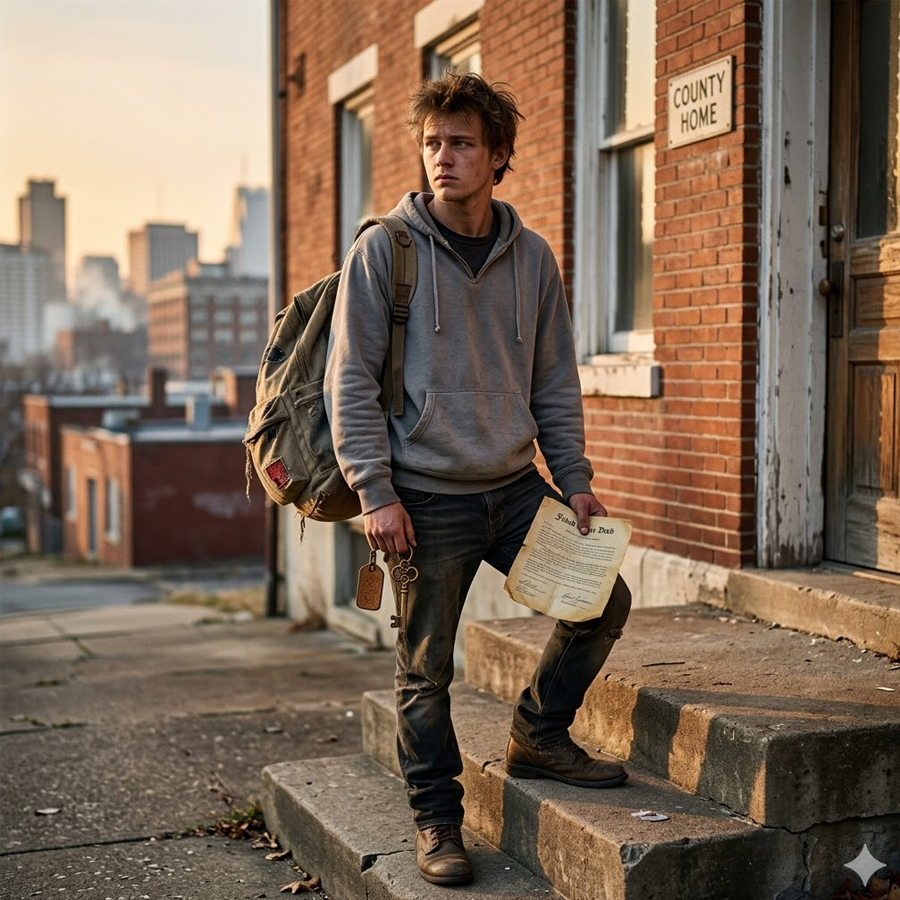
On the day he aged out of foster care, they handed Jack Miller a backpack, a printed list of shelters, and a smile too tired to mean anything. That was freedom, according to the county.
At eighteen, Jack stood on the concrete steps of the county home, squinting into the morning sun with everything he owned slung over one shoulder. There was no cake, no celebration, no one waiting in the parking lot. No family. No one saying goodbye. Just a caseworker offering quiet encouragement in the careful tone adults use when they want to sound kind without making promises. “I know you’ll figure something out, Jack.”
He nodded, because that’s what you learn to do.
He had barely taken a few steps when a black sedan pulled up in front of the building. It didn’t belong there. Too clean. Too expensive. Too out of place. A man in a charcoal suit stepped out, holding a leather briefcase, and called his full name with quiet authority.
Jack stopped.
Half an hour later, he found himself sitting in a glass-walled conference room high above the city, trying not to notice that the chair beneath him probably cost more than everything he owned combined. Across from him sat two people who looked like they wished he hadn’t shown up at all.
Trent Miller leaned back in his seat, confidence dripping from every movement, his expensive watch catching the light. Beside him, Khloe Miller sat perfectly composed in designer clothing, her expression calm but unmistakably cold. They carried the kind of wealth that didn’t need to prove itself—the kind passed down, protected, and never questioned.
The attorney began reading the will.
Properties in Aspen. A beachfront home in Malibu. Investment portfolios. Luxury vehicles. Shares in companies Jack had only heard about on the news. Trent received more wealth than most people could spend in a lifetime. Khloe received just as much, packaged differently but equally impressive.
Then came the final page.
“To my grandson, Jack Miller—”
Trent let out a quiet laugh.
The attorney slid a small envelope across the table. Inside was a rusted key and a deed to a remote parcel of land in Blackwood County. One cabin. No listed value.
Trent smirked. “Looks like the stray got himself a camping spot.”
Jack didn’t respond. He just stared at the key resting in his palm. To them, it was meaningless. A joke. A leftover piece nobody wanted. But to Jack, who had spent years being moved from one temporary place to another, never able to call anything his own, this was something else entirely.
It was permanent.
That night, he slept on a bus station bench. The attorney had offered a hotel, but Jack refused without thinking. He’d already had enough of polite gestures for one day. By morning, the truth settled in—he had nowhere else to go.
So he bought a one-way ticket north.
By the time he reached the small town nearest the property, the world felt quieter, slower. At a gas station, a woman studied his deed, then handed it back with a faint smile. “If the road gets rough enough to make you think nothing worth having is up there,” she said, “you’re close.”
He walked for hours. Pavement turned to dirt, dirt to rock. The deeper he went, the more the noise of the world faded behind him. By nightfall, hope wasn’t what drove him forward anymore—just the need for a door he could close.
Then the trees opened.
A cabin stood in a clearing, solid and deliberate, with solar panels lining the roof and a narrow wooden bridge crossing a quiet stream. It didn’t look abandoned. It looked… waiting.
The key turned easily in the lock.
The door opened with a low creak, releasing the scent of cedar and time.
Jack stepped inside—and froze.
The wall above the fireplace was covered in photographs.
Dozens of them.
A small boy on a swing. A teenager with a bruised lip. A young man in a borrowed football uniform. A graduate in a wrinkled gown.
Every single one was him.
His breath caught. His chest tightened as he stepped closer, his fingers trembling as they brushed the edge of a frame. He remembered each moment—but he had always believed no one else did. No one had been there. No one had cared enough to watch.
But someone had.
Beneath the photographs sat a carved wooden box. On top of it was a single envelope.
The Grandson Who Endured.
Jack opened it slowly, his hands shaking.
The letter inside changed everything.
His grandfather had been there all along—hidden, watching, protecting him from a distance. The “anonymous” help, the sudden changes in foster placements, the unseen hand guiding him away from harm—it had never been luck.
It had been love.
The cabin wasn’t worthless. Beneath the hearthstone lay the truth—land, resources, and a fortune built quietly over decades, hidden away from those who would have destroyed it. A legacy meant not for power, but for protection.
And more than that, it was a home.
For the first time in his life, Jack understood something he had never felt before.
He hadn’t been abandoned.
He had been protected.
He knelt on the wooden floor, the weight of years finally catching up to him. All the loneliness, the silence, the feeling of being invisible—it cracked open, replaced by something unfamiliar but steady.
Belonging.
When he lifted the stone beneath the fireplace, he found more than documents. Journals. Years of them. Letters written week after week, filled with quiet pride, with stories, with words meant for him—always meant for him.
As the first light of morning crept over the mountains, Jack stepped out onto the porch. The air was cold and clean, carrying the scent of pine and something new.
He looked at the key in his hand.
It was never just a key.
It was proof.
Proof that someone had seen him. That someone had cared. That his story hadn’t been one of loss—but of survival, of strength, of something waiting for him at the end of it all.
Jack Miller was no longer the foster kid with nowhere to go.
He was the heir to a hidden legacy. The keeper of a mountain. A man who had finally found where he belonged.
And for the first time, the silence around him didn’t feel empty.
It felt like home.
THE END






