PART 2
But as Lillian Mercer stepped off the last bus with only two worn suitcases and an old brass key clutched tightly in her hand, she realized there was one place untouched by lawyers, signatures, and betrayal. A place her husband had never even remembered existed.
The road ended miles back, replaced by a narrow dirt path half swallowed by weeds and time. And each step Lillian took felt heavier than the last, not just because of her age, but because of the weight of everything she had left behind pressing against her thoughts like an echo that wouldn’t fade. Yet there was something else guiding her forward, too.
Something quieter, steadier. The memory of summers long ago, of laughter carried through trees, of a woman’s voice calling her name from a porch that had once felt like the safest place in the world. The air smelled different here, cleaner, tinged with pine and earth. And as the sounds of distant traffic disappeared completely, replaced by the soft rustle of leaves overhead, Lillian felt a strange sense of stillness settle around her, as if she had stepped out of time itself and into something preserved, waiting. It had been over 40 years since she had last walked this path, back when her hair was still dark and her life still hers, back before marriage had slowly rewritten everything she thought she knew about belonging. And for a moment, she wondered if she had remembered it wrong, if the cabin had long since collapsed into nothing, swallowed by the forest like so many forgotten things. But then she saw it.
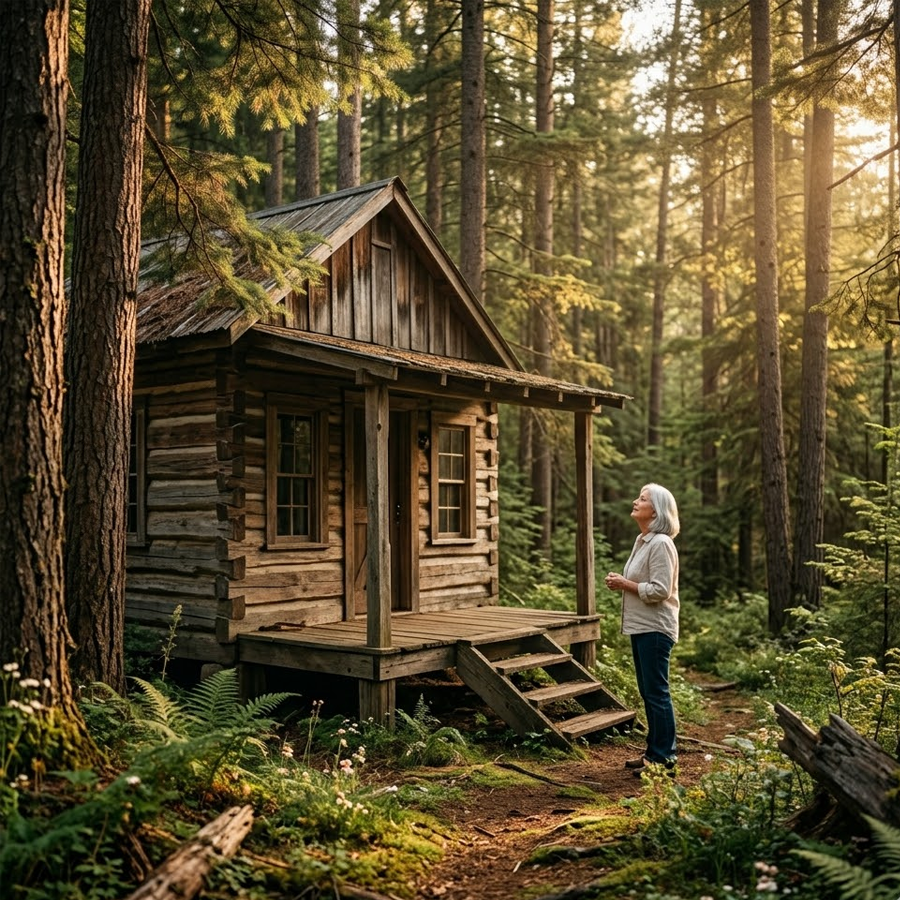
Barely visible through the trees at first, just the faint outline of a structure where no structure should have been. And then clearer with each step until there was no mistaking it. The cabin still stood. Smaller than she remembered, yes, its wooden boards weathered and darkened by decades of wind and rain.
The porch slightly tilted, one of the railings leaning just enough to suggest time had not been entirely kind. But it was there, solid and real, and most importantly, untouched. Lillian stopped a few feet away, her breath catching not from exhaustion this time, but from something deeper, something almost like disbelief. As if she had expected the past to vanish the moment she reached for it.
And yet here it was, waiting exactly where she had left it all those years ago. “You kept it safe?” she whispered, though she wasn’t sure if she was speaking to the house, the land, or the memory of her mother, whose presence seemed to linger in the quiet spaces between the trees. Her fingers trembled slightly as she reached into her coat pocket and pulled out the brass key, holding it up to the light as if seeing it for the first time.
And for a brief moment, doubt flickered through her mind. What if it didn’t work anymore? What if time had taken this, too? What if she had come all this way only to find one more door closed to her? But she pushed the thought aside and stepped forward, climbing the creaking steps of the porch with slow, careful movements until she stood in front of the door, the same door she had run through as a child, the same door she had leaned against as a teenager listening to her mother hum softly in the kitchen.
The lock was stiff, resisting her at first as if testing whether she truly belonged there. But then, with a soft click that seemed louder than it should have been in the stillness around her, it turned. Lillian paused, her hand resting on the handle, her heart beating just a little faster.
And then she pushed the door open. The air inside was cool and faintly stale, carrying the scent of wood and dust and something else, something familiar that hadn’t entirely faded with time. And as sunlight filtered in through the small windows, illuminating particles that drifted lazily through the air, she stepped inside slowly, almost reverently, as if afraid that moving too quickly might break whatever fragile connection had allowed this place to remain intact.
The furniture was still there, covered in white sheets that had yellowed with age but remained carefully straight. The old wooden table standing exactly where she remembered it, the small stone fireplace untouched, a stack of neatly arranged logs beside it as though someone had been preparing for a fire that was never lit.
And along the walls, shelves filled with books, jars, and small objects that seemed less like forgotten clutter and more like pieces of a life deliberately left behind rather than abandoned. Lillian set her suitcases down by the door, the sound echoing softly through the quiet, and walked further in. Her fingers brushing lightly against surfaces as if reacquainting herself with something she had once known intimately but had been forced to forget.
“Mama,” she said under her breath, the word slipping out before she could stop it. And for a moment, the silence that followed felt almost like an answer. She moved toward the window and pulled back the curtain, letting more light spill into the room. And with it came a sense of clarity that settled deep within her chest, replacing the confusion and loss that had consumed her just days before.
Because here, in this small, forgotten cabin, nothing had been taken from her. Nothing had been signed away or divided or reduced to numbers on a page. This place existed outside of all of that, untouched by the man who had erased her life as if it had never mattered. As the realization sank in, Lillian felt something shift inside her, something she hadn’t felt in years, not even before the divorce.
Because this wasn’t about reclaiming what she had lost. It was about discovering what had never been taken in the first place. She walked into the small bedroom at the back, pushing the door open gently. And there it was, the old quilt folded neatly at the foot of the bed, the same one her mother had made by hand, each stitch a quiet act of care.
And beside it, a wooden trunk sat at the corner of the room, its surface worn but intact, as if it had been waiting for her return. Lillian knelt slowly in front of it, her knees protesting the movement, and lifted the lid, half expecting it to be empty or filled with things that no longer mattered.
But instead, she found something else entirely. Not valuables, not money, not anything that would have mattered to the world Richard had chosen, but notebooks, dozens of them, stacked carefully one on top of the other, each filled with her mother’s handwriting, neat and deliberate, covering page after page with thoughts, recipes, observations, and ideas that stretched far beyond the simple life she had appeared to live.
Lillian picked one up, her fingers tracing the familiar curves of the writing, and opened it slowly, her eyes scanning the first page as a small, unexpected warmth spread through her chest. Because in that moment, she understood something that hadn’t been clear before. This cabin wasn’t just a place to hide or survive. It was a beginning, a quiet, overlooked foundation for something more, something her mother had left behind not as an afterthought, but as a gift waiting to be discovered at exactly the right time.
And as Lillian sat there on the floor, surrounded by the pieces of a life that had been preserved just for her, she realized that while Richard had taken everything he could see, he had missed the one thing that truly mattered, the one place where she could start again, not as the woman he had left behind, but as someone entirely new.
He thought he had walked away with everything that mattered, but months later, as word quietly spread about a small cabin hidden deep in the woods and the woman who had rebuilt her life there from nothing, Richard Mercer would come to understand the one mistake that cost him more than everything he had taken. Winter passed slowly at first, each day blending into the next as Lillian Mercer learned how to live again, not the life she had been forced into for decades, but something simpler, quieter, and strangely more honest. And though her hands ached from work they hadn’t done in years, and her body protested the cold mornings and long afternoons, she found a rhythm in it, a kind of steady purpose that grew stronger with every sunrise. Because for the first time in a long time, every small thing she did belonged entirely to her.
She cleaned the cabin room by room, pulling away dust-covered sheets, opening windows that hadn’t been touched in decades, letting fresh air and sunlight reclaim what time had tried to bury. And with each small act, the space began to change, not just physically, but emotionally, as if the walls themselves were waking up, remembering what it meant to be lived in.
The notebook she had found in her mother’s trunk became her guide. Their pages filled with more than simple recipes or passing thoughts. They held knowledge, practical, thoughtful, and deeply rooted in the land around her.
From preserving fruits and herbs to crafting remedies and simple goods that required little but patience and care. And Lillian read them late into the night, her fingers tracing each line as if reconnecting with a voice she had lost but never truly forgotten. By early spring, the land around the cabin began to soften, green pushing through the cold earth.
And with it came the first signs that what she was building might become something more than survival. It started small, almost accidental, a jar of homemade jam placed on a wooden crate near the edge of the dirt road with a simple handwritten sign, more out of curiosity than expectation. But someone stopped, then another, and then a few more.
And before long, what had begun as a quiet experiment turned into something steady, something real. Travelers passing through began to recognize the spot. Locals from nearby towns made the trip intentionally. And Lillian found herself speaking to strangers again, not as someone being managed or dismissed, but as someone offering something of value, something she had created with her own hands.
Weeks turned into months, and the cabin changed along with her. The garden expanded, rows of vegetables and herbs growing in careful patterns guided by her mother’s notes. The porch repaired and straightened. A small table added near the front where she displayed her goods, jams, breads, dried herbs, simple remedies.
Each one carrying a piece of her effort, her time, her quiet determination to prove, if only to herself, that she was not finished yet. And somewhere along the way, without her noticing exactly when it happened, the weight she had carried the day Richard drove away began to disappear, replaced by something steadier, something stronger, something that didn’t depend on what had been taken from her, but on what she had chosen to build instead.
It was late immediately out of place. And Lillian looked up from the table where she had been arranging jars, her eyes narrowing slightly as the vehicle came into view, slowing as it approached the edge of the property before coming to a stop. For a moment, she didn’t move, didn’t react, just watched as the driver’s door opened and a man stepped out.
His posture less certain than she remembered, his movements slower, as if time had caught up with him in ways it had not with her. Richard closed the door behind him and looked around, taking in the cabin, the garden, the small but undeniable signs of life that had taken root there. And for a brief moment, something flickered across his face, something like surprise or perhaps disbelief, as if he had expected to find her broken, diminished, waiting for something that never came.
“Lillian,” he said, his voice carrying an unfamiliar hesitation as he stepped closer, though not too close, as if unsure of where he stood. She didn’t invite him forward, didn’t offer a greeting, just met his gaze with a calm that would have been impossible months earlier. “Richard,” she replied simply. He shifted his weight, glancing again at the jars, the table, the carefully tended garden.
“I heard about this place,” he said, gesturing vaguely. “Didn’t think it was this.” “No,” she said quietly. “You didn’t think about it at all.” The words weren’t sharp, weren’t spoken with anger, but they landed with a weight that made him pause, his expression tightening slightly before he looked away. “Things changed,” he said after a moment.
“The house, it didn’t work out the way I expected. Costs, maintenance, it’s complicated.” Lillian said nothing, simply waiting, her silence more unsettling than any accusation. He cleared his throat, his gaze returning to her. I thought maybe we could talk, he added, figure something out. For a long moment, neither of them moved, the quiet stretching between them as the wind moved softly through the trees.
And then Lillian stepped forward, not toward him, but slightly to the side, placing herself between him and the cabin door in a gesture so subtle it might have gone unnoticed by anyone else. You already figured everything out, she said gently. Remember? He frowned slightly. That was different.
She shook her head, a small, almost sad smile touching her lips. No, she said, that was exactly the same. He opened his mouth as if to respond, but no words came. And for the first time since she had known him, he seemed uncertain, not because he didn’t understand the situation, but because he no longer understood her.
You took the house, she continued, her voice steady. You took the car. You took the bank account. He nodded slowly, his expression guarded. I know. Lillian rested her hand lightly against the wooden frame of the cabin door, her fingers tracing the grain as if grounding herself in the reality of what she had built.
And you thought that was everything, she said. Another pause. Then, quietly, almost to himself, he asked, wasn’t it? Lillian met his eyes fully then, not with anger or resentment, but with a clarity that left no room for misunderstanding. No, she said, it wasn’t. The words hung in the air between them, simple but undeniable. And something in Richard’s posture shifted, the certainty he had carried for so long finally beginning to crack under the weight of a truth he had never considered.
Lillian took a slow breath, her gaze softening just slightly, not out of forgiveness, but out of understanding. Understanding of who he was, of what he had chosen, and of why she no longer needed any part of it. You took what you could see, she said. But you forgot the one thing that was never yours to take. He followed her gaze as it moved briefly toward the cabin, the land, the life that existed there without him.
And for the first time, he seemed to truly understand, not just what he had missed, but what he had lost. The silence that followed was heavier than any argument they had ever had, filled with everything that no longer needed to be said. And after a moment, Richard nodded slowly, as if accepting something he could no longer change. I see that now, he admitted.
Lillian didn’t respond right away, just watched him for a moment longer before stepping back, her hand closing around the edge of the door. Take care of yourself, Richard, she said, her voice calm, final, and entirely her own. Then she stepped inside and closed the door, not with anger, not with regret, but with a quiet certainty that settled deep within her.
Because for the first time in her life, she wasn’t holding on to something that was slipping away. She was protecting something she had chosen, something she had built, something that belonged only to her. And outside, as Richard stood alone on the edge of the property he had never known existed, the truth became impossible to ignore.
He had taken everything he thought mattered and lost the one thing that actually did.