No Doctor Could Reach the Dying SEAL Admiral But the New Nurse Knew His Call Sign
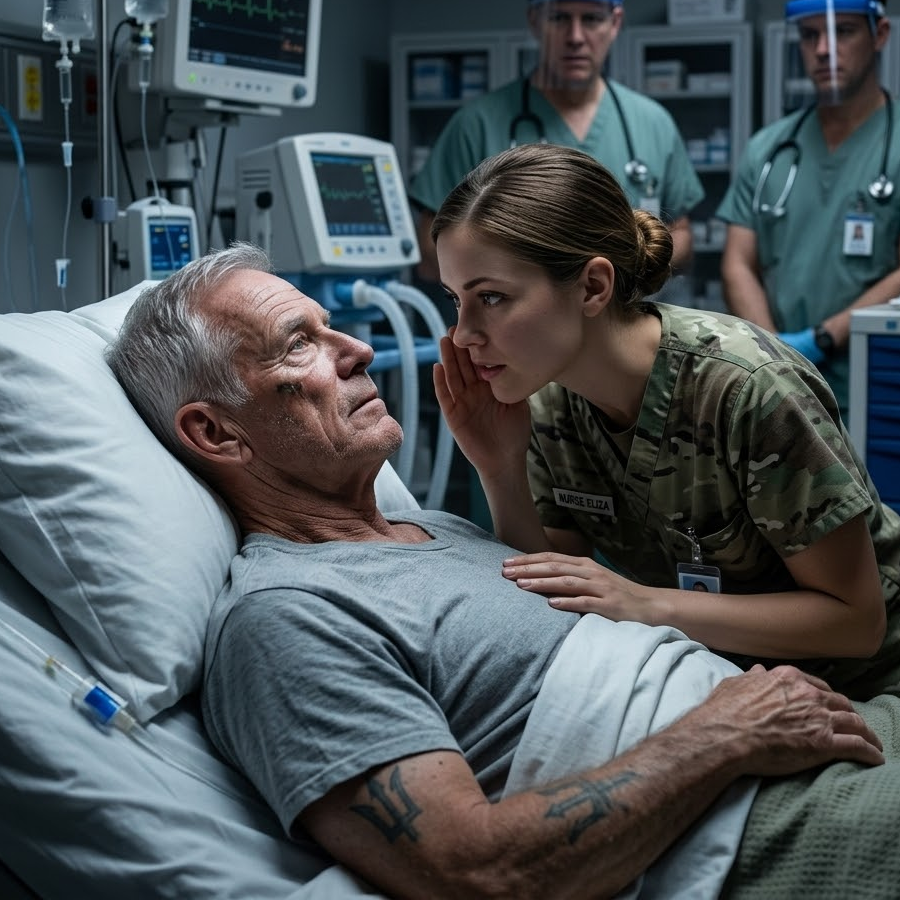
The monitors in the intensive care unit at Walter Reed National Military Medical Center blared a continuous, frantic alarm. Five of the nation’s top cardiologists stood paralyzed outside room 412, effectively locked out by the sheer, terrifying force of a dying man’s will. Inside lay Rear Admiral Thomas Sterling, a legendary Navy SEAL whose failing heart was giving out, yet who violently refused the very IV lines that could save him.
They called him uncooperative. They called him delirious. But the quiet, newly hired night shift nurse, standing at the edge of the chaotic huddle, knew better. She didn’t see a combative patient. She saw a trapped operator, and she knew exactly what to say. Because 12 years ago in the dust of Kandahar, he wasn’t Admiral Sterling. He was Grizzly Actual.
The sterile, fluorescent-lit corridors of Walter Reed National Military Medical Center were usually a place of hushed reverence and disciplined quiet. It was a hospital that catered to presidents, four-star generals, and the most decorated combat veterans in the United States Armed Forces. But on this unusually bitter Tuesday in November, the cardiac intensive care unit, CICU, felt less like a place of healing and more like a hostile front line.
At the epicenter of the tension was room 412. Inside the glass-walled room lay Rear Admiral Thomas Sterling. At 58, Sterling’s body was a road map of modern warfare. His chart documented shrapnel scars from Mogadishu, a reconstructed femur from the Shah-i-Kot Valley during Operation Anaconda, and burns from a classified HALO jump over the Syrian border.
But it wasn’t a bullet or an IED that was killing him now. It was his own heart. Ischemic cardiomyopathy, exacerbated by decades of extreme physical stress, sleep deprivation, and the silent, heavy toll of sending young men into the dark. His ejection fraction had plummeted to a lethal 14%. He needed an emergency left ventricular assist device, LVAD, implanted immediately as a bridge to a transplant.
The problem was Admiral Sterling wouldn’t let anyone near him. He ripped the central line out again. Dr. Richard Hayes, the chief of cardiology, muttered, rubbing his temples as he stepped out of the room. Blood spotted his white coat. He looked exhausted, his face pale under the harsh hospital lights.
That’s the third time this morning. He’s in a state of hyperarousal. ICU delirium mixed with severe combat-related PTSD. Whenever we try to sedate him, he fights like he’s being interrogated. Dr. Emily Chen, the chief resident, hugged her tablet to her chest. His blood pressure is tanking, Dr. Hayes. If we don’t get the milrinone drip back into him, he’s going to code before the surgical team even scrubs in.
We have Pentagon liaisons sitting in the VIP waiting room asking for hourly updates. The Chief of Naval Operations called an hour ago. I know who is waiting, Emily, Hayes snapped, though his anger was clearly born of helplessness. But I cannot legally or ethically strap down a two-star admiral and force him into a medically induced coma when he is still technically conscious and violently refusing.
We brought in the base chaplains. We brought in the Navy psychiatrists. He just stares right through them or threatens to break their arms. He thinks he’s back in the sandbox. He thinks we’re the enemy. Inside the room, the scene was harrowing. Admiral Sterling was propped up against the pillows, his breathing labored and shallow.
His skin held the grayish, ashen pallor of a man whose organs were slowly starving for oxygen. Yet, his pale blue eyes were wide, darting around the room with a predator’s lethal focus. His hands, though trembling from heart failure, were clenched into fists. A monitor beeped a rhythmic, desperate warning. Heart rate 130. Oxygen saturation 84%.
He was drowning in his own chest, but his mind was thousands of miles away, locked in a firefight no one else could see. Two burly orderlies stood nervously by the door, having already been shoved back when they tried to restrain his arms for Dr. Hayes. Sterling hadn’t shouted. That was the most terrifying part. He hadn’t screamed in panic.
He had simply looked at the orderlies with a cold, terrifying deadness and whispered, “Take one more step and I’ll crush your trachea.” They believed him. “We need a miracle, or we need to start drafting the morbidity and mortality report,” Dr. Hayes said grimly to the gathered medical team. “He’s barricaded himself inside his own mind, and his body is giving out.
” Seline Jenkins was technically the new nurse on the CICU floor, having transferred to Walter Reed only 3 weeks prior. But at 34, she was far from a novice. Before she had earned her Bachelor of Science in Nursing, before she had learned to navigate politics of civilian and military hospitals, she had been a Fleet Marine Force, FMF, corpsman.
She had spent her early 20s attached to Marine Recon and JSOC elements in some of the most unforgiving corners of Al Anbar province and the Helmand Valley. Seline knew the smell of copper and dust. She knew the sound a man makes when he realizes he’s missing a limb. And more importantly, she knew the specific, profound silence of the special operations community.
She had just clocked in for the second half of a brutal double shift. The break room was buzzing with anxious whispers about the monster in 412. “I heard he broke a psych tech’s wrist yesterday,” a younger nurse, Jessica, whispered over a cup of stale coffee. “He’s a Navy SEAL, or was. They say he’s completely lost his mind.
” Seline quietly placed her lunch bag in the refrigerator. She poured herself a cup of black coffee, listening without reacting. “Dr. Hayes is talking about calling in military police to physically hold him down so they can push the propofol,” another nurse added. “It’s going to be a bloodbath.” Seline frowned, her professional instincts warring with her deeper, buried memories.
“You don’t hold down an operator,” she thought. “You corner a wounded apex predator, and someone is going to die.” Leaving the break room, Seline walked over to the central nurses’ station and pulled up the electronic medical record for room 412. The screen populated with a dizzying array of critical alerts, lab values, and red-flagged warnings.
But Seline scrolled past the lipid panels and the echocardiogram results. She opened the administrative and historical tabs. Most of Rear Admiral Thomas Sterling’s military service record was redacted. Black bars covered locations, unit designations, and specific operational dates. But the unclassified fragments painted a picture Seline recognized instantly. 1993.
Gunshot wound, right shoulder. Location classified. 2005. Blast trauma. Bilateral tympanic membrane rupture. Location classified. 2009. Multiple shrapnel lacerations. Blunt force trauma to the chest. Medical evacuation via Bagram Airfield. Seline’s finger hovered over the screen. 2009. Bagram.
A ghost of a memory flickered in her mind. The blinding heat of an August night, the deafening roar of an MH-47 Chinook touching down in a swirl of choking brown dust. She had been a young corpsman then, waiting on the tarmac as a severely battered SEAL team unloaded their casualties from a botched raid in the Korengal Valley. They had lost two men.
The team leader, a towering man covered in his own blood and the blood of his brothers, had refused the stretcher. He had walked off the bird on a shattered leg, his eyes hollow, carrying the encrypted comms gear himself. Seline pulled up Sterling’s admission photo. The man in the picture was older, his hair silver, his face lined with the deep grooves of command and exhaustion.
But the eyes, the pale, unyielding blue eyes, were exactly the same. It was him. “Jenkins.” Dr. Hayes’ voice broke her concentration. He marched up to the desk, looking desperate. “I need an experienced nurse. The others are terrified of him. We are going to make one last attempt to establish a central line. I have a syringe of midazolam.
If he so much as flinches, I need you to push it through his peripheral IV, assuming we can even find a vein he hasn’t torn open. Are you comfortable with this?” Seline looked at the chief cardiologist. She saw the clinical desperation in his posture. He was treating the man like a medical puzzle that needed to be forced into submission.
“Doctor,” Seline said, her voice calm and measured, “with all due respect, if you walk in there with a a and a team of orderlies, he’s going to view it as a hostile boarding. His sympathetic nervous system is trapped in fight or flight. You can’t out muscle a man who has been trained for 30 years to fight to the death when cornered. Dr.
Hayes bristled. I don’t have time for a psychiatric evaluation, Nurse Jenkins. His heart is failing now. If we don’t get the meds in, he dies, period. Give me 5 minutes, Selene said, stepping out from behind the desk. Excuse me? 5 minutes, alone. No orderlies. No syringes, Selene requested, holding Hayes’ gaze.
Let me go in there and talk to him. He doesn’t talk, Dr. Hayes countered, exasperated. He threatens. He threw a plastic water pitcher at Dr. Chen. 5 minutes, Dr. Hayes. If I can’t calm him down, you can send in the cavalry. Hayes looked at the monitor above the desk. Sterling’s heart rate was a jagged, dangerous 135 beats per minute.
The window was closing rapidly. 3 minutes, Jenkins, and leave the door open. Selene didn’t nod. She just turned and walked down the corridor toward room 412. As she approached, the two orderlies stepped aside, eyeing her with a mix of pity and relief. She paused at the threshold. The room smelled of iodine, sweat, and impending death.
Admiral Sterling was propped up, his chest heaving. Blood trickled down his forearm from where he had forcefully removed the last IV catheter. As Selene stepped into the room, his head snapped toward her. His eyes locked onto hers with a frightening intensity. He didn’t see a nurse in scrubs.
In his hypoxic, trauma clouded mind, he was scanning for a threat, assessing her posture, her hands, her proximity to his bed. Get out. Sterling rasped. His voice was weak, gravelly, but it carried the undeniable heavyweight of absolute command. You touch me and I’ll break you. Selene didn’t stop, but she didn’t rush. She moved with deliberate, slow, and calculated steps.
She kept her hands visible, open, and relaxed by her sides. She didn’t look at the heart monitor. She looked him dead in the eyes. You’re bleeding, Admiral, Selene said softly, her voice steady. I said, get out. Sterling growled, shifting his weight, his muscles tensing beneath the thin hospital gown.
He looked ready to launch himself out of the bed, despite the fact that the effort would likely trigger a fatal cardiac arrest. Selene stopped at the foot of his bed. She didn’t reach for a bandage. She didn’t reach for a chart. She simply stood at parade, rest hands behind her back, feet shoulder width apart.
It was a subtle, distinctly military posture. Sterling’s eyes narrowed slightly. The hostile glare faltered for a fraction of a second, replaced by a flicker of confusion. Sir, Selene said, her tone dropping the gentle, coddling cadence usually reserved for sick patients, adopting instead the crisp, factual delivery of a tactical briefing.
My name is Selene. I am your nurse. I am also a former FMF corpsman, and you are actively bleeding on my deck. Sterling’s jaw tightened. I don’t need a corpsman. I need my team. Your team isn’t here, Admiral, Selene replied, keeping her voice incredibly calm, an anchor in the storm of his delirium. You are at Walter Reed.
It is 2026. You are safe, but your heart is failing. You are fighting the wrong enemy right now. You don’t know a damn thing about the enemy, Sterling hissed, clutching his chest as a spasm of pain crossed his face. The monitor behind him shrieked as his oxygen levels dipped further. They’re in the wire. We have to move.
We have to. He trailed off, coughing weakly. His mind slipping back into the past. Selene took a slow step closer. She knew the standard medical protocol was failing. She needed a bypass, a key to unlock the barricade he had built around his failing mind. She remembered the classified file.
She remembered the dusty tarmac at Bagram. She remembered the radio chatter that night in 2009, the frantic calls for medical evacuation, the call sign of the operator who had refused to die on the mountain. She leaned in slightly, just enough so only he could hear her over the frantic beeping of the machines. I know the enemy isn’t here, sir, Selene said quietly, her voice cutting through the noise with surgical precision, because the Korengal is a long way away, and I know you’re not going to quit now.
Grizzly Actual. The words hung in the sterile air of room 412, heavier than the suffocating scent of iodine. Grizzly Actual. For 3 seconds, the rhythmic, frantic blaring of the cardiac monitor was the only sound in the universe. Outside the glass walls, Dr. Hayes and the medical team pressed closer, their faces etched with a mixture of dread and morbid fascination, expecting the Admiral to violently erupt. Instead, Thomas Sterling froze.
The terrifying, predatory focus that had locked his jaw and tensed his muscles suddenly fractured. It was as if Selene had reached into the tangled, sparking circuitry of his hypoxic brain and pulled the main breaker. The name, his operational call sign from a disastrous deployment over a decade ago, was a tether thrown into the dark water of his delirium. Sterling blinked.
The pale blue eyes, previously dilated with raw combat adrenaline, slowly contracted. The gray pallor of his skin seemed to deepen as the fight or flight response collapsed, leaving behind only the crushing reality of a man dying in a hospital bed. His breathing hitched, turning into a wet, agonizing wheeze.
Who? Sterling rasped, the word tearing at his dry throat. He looked at Selene, truly seeing her for the first time. He didn’t see an enemy combatant. He saw a woman in blue scrubs standing with the rigid, disciplined stillness of a soldier. Hospital man second class, Selene Jenkins. Sir, she said softly, maintaining eye contact.
She didn’t move an inch toward him, allowing him the space to process. I was on the tarmac at Bagram. August Dominoa. I watched you carry the comms gear off the bird with a shattered tibia. I helped cut your rig off. Sterling’s trembling hand fell away from his chest, coming to rest weakly on the starched white sheets.
The monitors behind him registered a marginal, almost imperceptible drop in his heart rate from 135 down to 128. It was still lethally high, but the upward spike had broken. Bagram, he whispered, staring through Selene into a past she couldn’t see, but entirely understood. A profound, devastating sorrow washed over his hardened features.
The walls of his psychological fortress were crumbling, revealing the agonizing guilt that had been keeping him barricaded inside. We didn’t all come off that bird. No, sir. You didn’t, Selene replied, her voice steady, validating his pain without feeding the delusion. You lost Petty Officer Danny Miller and Lieutenant Seth Garner.
You brought them home, Admiral. You did your job. I left them on the ridge too long, Sterling choked out, a sudden tear tracking through the sweat and grime on his ashen face. He wasn’t looking at Selene anymore. He was looking at the ghosts that had followed him from the mountains of Afghanistan to the intensive care unit in Maryland. Danny had a daughter.
He he bled out on the shale. And now I’m here. My heart it’s fitting, isn’t it? It’s finally giving out. The twist of his logic hit Selene like a physical blow. Sterling wasn’t just experiencing ICU delirium or PTSD flashbacks. He was actively punishing himself. In his mind, his failing heart wasn’t a medical condition.
It was a long overdue sentence. He was refusing treatment because he didn’t believe he deserved the miracle of a mechanical pump or a transplant. He was trying to die with his men. Admiral, Selene said, taking one deliberate step forward. She kept her hands visible. Danny Miller didn’t die on that ridge so his commanding officer could surrender to a failing ventricle 15 years later in a hospital bed.
Sterling’s eyes snapped back to hers. The shock of her candor, the sheer audacity of a nurse challenging a SEAL Admiral on the value of a sacrifice left him momentarily speechless. Your heart is ischemic, sir, Selene continued, stepping up to the side of the bed. She didn’t reach for the torn IV line yet. Your ejection fraction is 14%.
Your body is starved for oxygen, and it’s playing tricks on your mind. You are not on the ridge. You are at Walter Reed. And right now, the enemy isn’t the Taliban. The enemy is the clock, and you are letting it win. Outside the glass, Dr. Hayes tapped his watch anxiously, holding up two fingers. 2 minutes left before they had to forcibly intervene.
Sterling let out a long, shuddering breath. The fight drained out of him, leaving a profound, terrifying weakness. The mighty admiral looked small against the pillows, a mortal man whose engine was finally seizing. “I’m tired, Jenkins.” He whispered, his voice cracking. “I’m so damn tired.” “I know you are, sir.
” Selene said, her voice dropping to a gentle, steady murmur. She finally reached out, slowly laying her warm hand over his cold, trembling fingers. He didn’t pull away. He didn’t flinch. “But you don’t get to tap out today. I need to get this milrinone drip back into your vein. And then, Dr. Hayes is going to place a central line in your neck. It’s going to buy you enough time to get to the OR for the LVAD.
Can I have your arm, Grizzly Actual?” Sterling looked down at her hand resting over his. He swallowed hard, fighting the exhaustion that was threatening to pull him under into unconsciousness. Slowly, painfully, he rotated his bruised, bloodied right arm outward, exposing the chaotic mess of blown veins and torn tape. “Do it.
” He murmured, his eyes slipping shut. “Fix the line.” Selene turned toward the glass wall and gave Dr. Hayes a sharp, single nod. The doors to room 412 slid open and the atmosphere in the room shifted instantly. Dr. Hayes, Dr. Chen, and the two orderlies stepped inside, their postures rigid with anticipated violence. Dr. Hayes held the syringe of midazolam like a weapon, ready to sedate a combative patient. “Stand down, Dr. Hayes.
” Selene ordered, her tone brooking absolutely no argument. She didn’t even look up from Sterling’s arm as she expertly swabbed a fresh patch of skin with an alcohol prep pad. “The admiral is cooperative. Put the sedative away. He needs to maintain his respiratory drive.” Hayes stopped dead in his tracks, staring in disbelief at the sight of the previously terrifying seal lying back quietly while Selene prepped his arm.
“He’s He consented?” “He consented.” Selene affirmed, her hands moving with blinding speed and precision. She found a viable vein in the cephalic pathway, slid the 18 gauge needle in perfectly on the first try, and flushed the line. “Milrinone is going in now. Dr. Chen, get the central line kit open. We don’t have time to waste.
” The residents scrambled into action, the tension in the room pivoting from fear of the patient to the sheer adrenaline of a critical medical intervention. Dr. Hayes moved to the head of the bed, donning sterile gloves and a mask. “Admiral Sterling.” Hayes said, his voice softer now, profoundly relieved. “I’m going to numb the right side of your neck.
You’re going to feel a sting and a burn, and then some intense pressure. We are putting a large catheter into your jugular vein to feed medications directly to your heart.” Sterling didn’t open his eyes, but his left hand reached out blindly across the bedsheets. Selene saw the movement and instantly took his hand, gripping it firmly.
“I’ve got you, sir.” Selene said. “Hold the line, Jenkins.” Sterling mumbled, his grip surprisingly strong despite his failing hemodynamics. The next 10 minutes were a blur of sterile drapes, the sharp smell of chlorhexidine, and the tense, quiet commands of Dr. Hayes as he navigated the guidewire into the large vein just above Sterling’s heart.
Through it all, Selene stood by the bed, monitoring the vitals, adjusting the IV drips, and maintaining a constant, grounding physical contact with the admiral. Suddenly, the heavy doors of the ICU swung open and Dr. William Caldwell, the chief of cardiothoracic surgery, strode in. Caldwell was a towering figure in the medical community, known for his icy demeanor and unparalleled skill with mechanical heart pumps.
“Hayes, what’s the status?” Caldwell demanded, snapping on a pair of purple nitrile gloves. “The Pentagon is breathing down my neck. Is the bridge open?” “Central line is in and secured. Pressors are maxed out. Milrinone is flowing.” Dr. Hayes reported, stepping back and pulling off his bloody gloves. “But his MAP is still hovering around 55.
His left ventricle is effectively dead weight. He needs the LVAD now. Prep him for transport.” Caldwell ordered, looking down at Sterling. “Admiral, you’re going to sleep for a while. When you wake up, you’ll have a machine pumping your blood. It’s going to be loud, but it’s going to keep you alive until we find you a new heart.
” Sterling finally opened his eyes. They were hazy, fighting the edges of the darkness creeping in from the lack of oxygen. He looked past Caldwell, past Hayes, and locked onto Selene. “Jenkins.” He breathed heavily. “I’m right here.” She answered, leaning in as the nurses and orderlies began unlocking the heavy hospital bed to roll it down the hall.
“If I don’t If I don’t wake up.” Sterling strained, his grip on her hand tightening until it hurt. He wasn’t giving a medical directive. He was issuing a final command from a dying officer. “Tell my daughter. Tell Julia I didn’t quit. Tell her I didn’t leave anyone behind this time.” A lump formed in Selene’s throat, but she swallowed it down.
She leaned closer, her voice fiercely reassuring. “I will tell her no such thing, Admiral, because you are going to tell her yourself. Do you hear me? You are going to wake up. That is an order from your corpsman.” A faint, ghostly smirk touched the corner of Sterling’s mouth. “And subordination. Write me up when you recover, sir.
Let’s move.” Dr. Caldwell shouted. The transport team surged forward, pushing the heavy bed out of room 412 and into the brightly lit corridor. Selene ran alongside them, her hand firmly holding the IV bags attached to the pole mounted on the bed, her eyes glued to the portable monitor resting on Sterling’s legs.
They hit the elevator banks, the wheels of the bed rattling over the metal threshold. The doors closed, sealing them in a descending metal box. “Going down to surgical level two.” Dr. Chen announced, her finger pressing the glowing button. Suddenly, the portable monitor emitted a shrill, terrifyingly fast sequence of tones.
It wasn’t the rhythmic beeping of a struggling heart. It was the chaotic, screeching alarm of a heart that had completely lost its electrical coordination. Selene’s eyes darted to the screen. The jagged peaks of the EKG had dissolved into wide, bizarre, rolling waves. “V-tach!” Selene shouted, the clinical term for ventricular tachycardia slicing through the confined space of the elevator.
Admiral Sterling’s eyes rolled back in his head and his grip on Selene’s hand went entirely slack. His body arched off the mattress as his heart began quivering violently, unable to pump a single drop of blood. He was entering sudden cardiac arrest. “He’s pulseless.” Dr. Hayes yelled, throwing his fingers against Sterling’s carotid artery.
“Caldwell, he’s crashing! Start compressions.” Caldwell hitting the emergency stop button on the elevator panel to prevent the doors from opening on the wrong floor and delaying them further. “We need to shock him. Where is the transport defib?” “Under the bed.” Selene was already moving. She dropped the IV bags, climbed directly onto the moving mattress, straddling the unconscious admiral’s thighs, and laced her hands together over the center of his chest.
She locked her elbows and drove her weight down, crushing the sternum. “One, two, three, four.” The sickening crack of frail ribs giving way echoed in the small elevator, but Selene didn’t stop. She couldn’t stop. She was the only thing keeping oxygen flowing to his brain. “Pads are on.” Dr. Chen cried out, slapping the adhesive defibrillator pads onto Sterling’s bare, pale chest.
“Charging to 200 joules.” Dr. Hayes yelled over the noise of the alarms and Selene’s rhythmic grunts of exertion. “Jenkins, clear.” Selene threw her hands off his chest and leaned back. “Clear.” Hayes hit the shock button. Admiral Sterling’s massive frame jolted upward violently, a macabre puppet pulled by invisible strings, before slamming back down onto the mattress.
Selene’s eyes locked onto the monitor. The rolling waves flatlined for one agonizing second. Then, a slow, weak, jagged spike appeared, then another. “We have a rhythm.” Hayes gasped. “Sinus bradycardia. He’s back, but he’s fading. Resume compressions to support the pressure.” Caldwell ordered. “Get this damn elevator moving.” Selene threw her hands back onto Sterling’s chest, pushing down with everything she had as the elevator lurched downward toward the operating rooms.
She looked down at the pale, lifeless face of the the beneath her hands. “Don’t you dare quit on me, Grizzly actual, she prayed silently with every thrust of her palms. Don’t you dare. The elevator doors hammered open on surgical level two, revealing the sterile, blindingly white corridor of Walter Reed’s cardiothoracic wing.
The transport team burst out like a breaching stack, clearing a fatal funnel. Selene remained on the bed, her knees bruised against the metal rails. Continuing the grueling rhythm of chest compressions as Dr. Hayes pushed the head of the bed. OR four, he’s prepped and waiting. A scrub nurse yelled, holding the heavy double doors wide open.
They rushed Admiral Thomas Sterling into the freezing expansive theater of operating room four. The room was a labyrinth of state-of-the-art medical technology. Banks of high-definition monitors, rows of intravenous pumps, and the massive intimidating bulk of the Maquet cardiopulmonary bypass machine. Transfer on three, Dr.
William Caldwell barked, already gowned and snapping his sterile gloves into place. One, two, three. The team heaved the massive unconscious seal onto the operating table. The instant Sterling’s back hit the surgical surface, the room exploded into hyper-coordinated action. Doctor James Reynolds, the lead anesthesiologist, immediately took control of the airway, intubating Sterling with practiced, ruthless efficiency. I have the airway.
Propofol and fentanyl are pushing. Paralytics are in, Reynolds announced, his eyes glued to his monitors. He’s under. Thank you, Jenkins. You can step down now, Caldwell said, his tone entirely stripped of its previous panic, replaced by the icy, calculating calm of a master surgeon in his element. Selene, her chest heaving and her scrubs soaked with sweat, slid off the table.
Her arms ached with a deep lactic burn from the CPR. She took a step back, pressing her shoulders against the cool, tiled wall of the OR, out of the sterile field. Technically, her job was done. Protocol dictated she return to the CICU, but she didn’t move. She couldn’t leave him alone in the trench.
I’m staying, Selene stated, her voice quiet but unyielding. Caldwell shot her a brief, assessing glance over his surgical mask. He looked at the bruised, broken man on the table, then back at the nurse who had somehow talked a combative, dying SEAL out of a violent standoff. Stay against the wall. Don’t touch anything blue.
Scalpel, Caldwell demanded, holding out his hand. A scrub tech slapped a Hajonz neuro blade into his palm. Caldwell positioned himself over Sterling’s chest. With one smooth, unbroken motion, he drew the blade down the center of the Admiral’s sternum. The sharp scent of cauterized tissue instantly filled the air as the Bovie electrocautery pen was used to seal the bleeding vessels.
Sternal saw, Caldwell ordered. The high-pitched mechanical whine of the oscillating saw echoed through the OR, followed by the brutal, unmistakable sound of bone giving way as Caldwell split Sterling’s ribcage open. Retractors were placed, cracking the chest wide to expose the failing engine within.
But as Caldwell peered into the chest cavity, the rhythmic beeping of the monitors seemed to mock the sudden silence that fell over the surgical team. Damn it, Caldwell hissed, his posture stiffening. What is it? Dr. Avery, the assisting surgeon, asked, leaning in. Adhesions. Massive, dense adhesions, Caldwell grumbled, his voice tight with frustration.
His heart is completely fused to the posterior sternal table and the pericardium. It’s like pouring concrete into the chest cavity. Selene closed her eyes for a brief second. 2009. Blunt force trauma to the chest. The explosion that had ruptured Sterling’s eardrums and shattered his leg had also slammed him into the rocky earth of the Korengal with enough force to cause severe internal bleeding.
Over the last 15 years, his body had healed the only way it knew how, by building thick, fibrous scar tissue around his heart, inadvertently entombing it. We have to dissect him out before we can even cannulate for bypass, Caldwell said, signaling for specialized microscopic scissors. If I nick the right ventricle during this dissection, he bleeds out on the table in under 30 seconds.
Reynolds, have massive transfusion protocols on standby. We are walking through a minefield. For the next tortuous hour, the OR was dead silent, save for the rhythmic hiss of the ventilator. Caldwell worked with terrifying precision, painstakingly peeling millimeter after millimeter of rock-hard scar tissue away from the fragile, failing muscle of the heart.
The tension was suffocating. Every snip of the scissors was a gamble with a national hero’s life. Finally, Caldwell let out a long, controlled breath. He’s free. Dave, get ready to take over. Ready on pump, Dave, the perfusionist replied from behind the bypass machine. Thick plastic tubes were sutured into Sterling’s aorta and right atrium.
The dark, deoxygenated blood was routed out of his body through the machine to be oxygenated and pumped back in. On bypass, flow is full. Arresting the heart, Caldwell announced. He infused a cold, potassium-rich cardioplegia solution directly into the coronary arteries. On the monitors, the erratic, struggling electrical rhythm of Admiral Sterling’s heart slowed, stretched, and then fell into a flat, lifeless line.
Asystole. It was a controlled death. For the next hour, Thomas Sterling was technically deceased, his life sustained entirely by the whirring plastic pumps of the Maquet machine. Caldwell worked swiftly to install the HeartMate 3 left ventricular assist device. He used a specialized circular blade to core a perfect hole into the apex of the left ventricle, removing a plug of dead, scarred muscle.
He sewed the titanium inlet ring into the heart muscle, a brutal marriage of flesh and metal. Pump is seated. Routing the drive line, Caldwell narrated, feeding the power cable out through a small incision in Sterling’s abdomen, connecting the outflow graft to the ascending aorta. Let’s start waking the heart up. Dave, warm him up.
As warm blood washed back into the coronary arteries, the heart muscle began to fibrillate a chaotic, worm-like writhing. Caldwell applied internal defibrillator paddles directly to the wet muscle. Clear. A jolt of electricity snapped the tissue. The heart jumped, then fell into a slow, steady rhythm. We have a rhythm. Weaning off bypass, Caldwell said, his eyes intensely focused on the mechanical pump now humming inside Sterling’s chest.
LVAD speed to 5,000 RPMs. Flow is good, Dave reported. Coming down on pump support, 70%, 50%. Suddenly, an alarm blared from the anesthesia station. Pressures are tanking, Dr. Reynolds shouted, his hands flying across his dials. Central venous pressure is spiking to 25. The right heart is ballooning. Selene pushed herself off the wall, stepping closer to the sterile field, her heart in her throat.
Damn it, it’s right ventricular failure, Caldwell growled. It was the most feared complication of an LVAD surgery. The mechanical pump was now sucking blood out of the left side of the heart at an incredible speed, pushing it out to the body. But the weakened right side of the heart, damaged by years of back pressure and the trauma of the surgery, couldn’t pump blood through the lungs fast enough to feed the machine.
The right ventricle was distending, stretching dangerously thin, threatening to rupture. We need to offload the right heart now, Caldwell ordered. Reynolds, max out the inhaled nitric oxide. Give me a bolus of epinephrine and start an epinephrine drip. If the right ventricle gives out, the LVAD runs dry and he codes again.
Nitric oxide is at 40 parts per million, Reynolds confirmed. Epi is in. Caldwell stared into the open chest cavity, watching the bloated right ventricle struggle to contract. Come on, Tom, Caldwell whispered, dropping the formalities. You didn’t survive a helicopter crash in the Hindu Kush to die on my table.
Squeeze, damn it, squeeze. Seconds stretched into agonizing minutes. The surgical team stood frozen, watching the physical manifestation of a man’s will to live, battling against the limits of his biology. Slowly, agonizingly, the distended right ventricle began to shrink. The muscle, stimulated by the massive dose of adrenaline and the pulmonary relaxing effects of the nitric oxide, found a latent reserve of strength.
It began to beat with renewed desperate vigor, pushing blood through the lungs and into the waiting mechanical pump. CVP is dropping down to 15, Reynolds announced, letting out a breath he seemed to have been holding for 5 minutes. Blood pressure is stabilizing. MAP is 75. Caldwell closed his eyes for a fraction of a second, his shoulders dropping a microscopic inch.
He’s holding. The LVAD is doing the heavy lifting. Let’s get him closed up before he changes his mind. Selene slowly backed away to the wall, sliding down until she was sitting on the cold tile floor. She buried her face in her hands, the adrenaline finally leaving her body, replaced by a bone-deep exhaustion. Grizzly Actual had survived the breach.
The VIP family waiting area in building 10 was a stark contrast to the sterile violence of the operating room. It featured plush leather armchairs, subdued mahogany paneling, and a large window overlooking the manicured grounds of the Walter Reed campus. It was designed to offer comfort to the families of senators, generals, and foreign dignitaries while they awaited news that could alter the course of their lives or nations.
When Selene pushed through the heavy oak doors, still wearing her blood-speckled scrubs and surgical cap, the room fell silent. There were two Navy officers in dress uniforms standing by the window, likely liaisons from the Pentagon. But Selene’s eyes bypassed the brass and landed immediately on a young woman sitting rigidly on the edge of a leather sofa.
She looked to be in her late 20s. She wore a simple gray trench coat over dark jeans. Her dark hair was pulled back into a messy knot, and her eyes, the exact same piercing pale blue as the admiral’s, were red and swollen with unshed tears. This was Julia Sterling. The two officers took a step forward, assuming Selene was a surgeon bringing the final word.
Nurse? One of the captains asked softly. I’m looking for Julia, Selene said, her voice raspy from the dry air of the OR. Julia stood up, her hands trembling violently. I’m Julia. Is my father She couldn’t finish the sentence. The terrifying reality of the missing word hung in the air. He is alive, Selene said immediately, knowing better than to bury the lead when dealing with families in trauma.
The collective exhale in the room was audible. He is still in surgery, and Dr. Caldwell will be out shortly to give you the clinical details, but he survived the bypass and the device is implanted. Julia collapsed back onto the sofa, burying her face in her hands as a sob violently tore through her chest.
The two Navy officers exchanged relieved glances and quietly stepped out into the hallway to make their calls to the Department of Defense, leaving Selene alone with the daughter. Selene walked over to the adjacent armchair and sat down heavily. She didn’t offer empty platitudes. She waited.
After a minute, Julia wiped her face, looking at Selene with a mixture of immense gratitude and deep confusion. The chief of cardiology, Dr. Hayes, he called me 2 hours ago. He told me my dad was combative. He said he was refusing the IVs, that he was delusional, and trying to fight the orderlies. He told me I needed to prepare myself because his heart was going to stop.
Julia swallowed hard, looking down at her hands. Dr. Hayes said a nurse managed to talk him down. Was that you? Yes, ma’am, Selene replied quietly. How? Julia’s voice cracked. She looked up, her blue eyes pleading for an answer to a puzzle she had been trying to solve her entire life. My dad is He’s a vault.
He’s been a vault since I was a little girl, since my mom died, and definitely since he came back from Afghanistan the last time. He pushes everyone away. He wouldn’t even let me come to the hospital this morning. He told me to stay at my apartment because he didn’t want me to see him weak. How did you get through to him? Selene leaned forward, resting her elbows on her knees.
She thought about patient confidentiality, but she also knew that the wounds Admiral Sterling carried were not just physical. They were systemic, and they infected everyone who loved him. Julia, your father wasn’t fighting the doctors because he wanted to die, Selene explained gently, choosing her words with immense care.
He was fighting them because his brain was deprived of oxygen, and it trapped him in a memory. He thought he was back in the Korengal Valley. Julia closed her eyes, a fresh tear slipping down her cheek. 2009, the ambush. Yes, Selene nodded. I was a young Navy Corpsman deployed to Bagram Airfield when his team was brought in.
I was on the tarmac when he walked off that helicopter. Julia looked at Selene, stunned. You were there? I was. And I remembered his call sign. When I walked into his room today, I didn’t treat him like a patient. I addressed him as his Corpsman. I called him Grizzly Actual. It broke the loop he was stuck in.
He never talks about it, Julia whispered, staring out the window at the gray November sky. He brought two of his men home in flag-draped transfer cases, Danny Miller and Seth Garner. He went to their funerals. He stood at attention, and then he just shut down. He threw himself into command, into the Pentagon, but he left a part of his soul on that mountain.
Survivor’s guilt is a terminal illness if it goes untreated, Julia, Selene said softly. In his mind today, his failing heart wasn’t a tragedy. It was a punishment. He felt he deserved it for surviving when they didn’t. He thought he was finally paying his debt. Julia let out a bitter, heartbroken laugh. That stubborn, arrogant fool.
He thinks his life belongs to the ghosts instead of the people still here trying to love him. Before they put him under, Selene said, her tone shifting, drawing Julia’s absolute focus. Before he crashed in the elevator and we had to shock his heart. Julia gasped, her hand flying to her mouth. He crashed? He did, but he came back, Selene reassured her quickly.
Just before that happened, he gave me an order. He told me that if he didn’t wake up, I was to tell you that he didn’t quit. He wanted you to know that he didn’t leave anyone behind this time. Julia broke down completely, the heavy, defensive armor she wore as a military daughter finally shattering.
She wept for the father she had lost to a war a decade ago, and for the father who was currently fighting for his life hooked up to machines a few floors below. Selene moved from the armchair to the sofa, sitting beside Julia and wrapping an arm around the younger woman’s shoulders, offering the silent, steadfast support of someone who understood the unique, isolating weight of the military family.
20 minutes later, the heavy oak doors opened again. Dr. William Caldwell stepped into the room. He looked utterly exhausted. His surgical cap was pulled off, revealing matted silver hair, and his face was lined with the deep fatigue of a grueling combat surgery. Julia stood up instantly, wiping her face, her posture stiffening into a mimicry of her father’s stoicism. Dr.
Caldwell? Caldwell offered a small, weary, but genuine smile. Your father is the most stubborn son of a gun I have ever had the displeasure of operating on, Ms. Sterling. Julia let out a wet, shaky laugh. That sounds like him. The LVAD is implanted and functioning perfectly, Caldwell stated, his tone shifting back to professional clinical precision.
His right ventricle gave us a severe scare when we came off the bypass machine, but it responded to medication. He is currently being transferred back to the cardiac ICU. He is heavily sedated, on a ventilator, and will remain in a medically induced coma for the next 24 to 48 hours to allow his body to stabilize.
Is he out of the woods? Julia asked, her hands clasped tightly together. No, Caldwell answered honestly. The next 2 days are critical. We have to watch for bleeding, infection, and right heart failure. But the mechanical pump is doing what his biological heart could not. He has a fighting chance. Caldwell turned his gaze to Selene, who was standing quietly behind Julia.
And he wouldn’t have even made it to the table if it weren’t for Nurse Jenkins here. I’ve read the preliminary code report from the elevator. 32 compressions per minute on a moving bed while maintaining a patent airway. Remarkable work, Jenkins. Just doing my job, Doctor, Selene said, deflecting the praise with a slight nod.
Well, your shift ended 4 hours ago, Caldwell noted gruffly. Go home, wash the blood off, try to forget about this place for 12 hours. Selene looked at Julia, who reached out and gripped Selene’s hand with immense strength. Thank you, Julia whispered, her voice thick with emotion. “Thank you for bringing him back from the mountain.
” “He brought himself back, Julia,” Selene replied, giving her hand a firm squeeze. “I just reminded him of his call sign.” The rhythmic, frantic beeping of the cardiac monitor was gone, replaced by a steady, low-frequency hum that vibrated deep within the mattress. Rear Admiral Thomas Sterling slowly surfaced from the murky depths of a 48-hour chemically induced dark.
His eyelids felt like they were lined with grit. His chest felt as though it had been struck by a kinetic penetrator and bound with iron cables, which, clinically, wasn’t far from the truth. He tried to take a deep breath. It rattled in his throat. A sharp pain radiating outward from his split sternum.
He instinctively moved to reach for his chest, anticipating the restrictive tangle of tubes, but a warm, small hand firmly intercepted his thick, calloused fingers. “Easy, Dad. You’re wired to the mainframe.” Sterling blinked against the harsh, fluorescent glare of the intensive care unit. The blurry silhouette sitting beside his bed slowly resolved into sharp focus.
Julia. She looked exhausted, her dark hair pulled back loosely, dark circles bruising the skin under her pale blue eyes. But she was smiling, a fragile, watery smile that hit him harder than the pain in his chest. “Jules,” he rasped. His voice was a ruined, gravelly whisper, stripped raw by the endotracheal tube that Dr.
Reynolds had removed just 3 hours prior. “I’m here,” Julia said softly, adjusting her grip on his hand. “I’ve been here the whole time. You’re at Walter Reed. You’ve been asleep for 2 days.” Sterling let his head roll back against the pillows. The last coherent memory he possessed was the terrifying sensation of falling backward into a dark abyss while trapped inside a descending elevator, his heart seizing in his chest.
And before that, the ridge. The blinding dust of the Korengal, the overwhelming, suffocating certainty that he was finally going to die alongside his men. He brought his free hand up, moving sluggishly through the haze of residual fentanyl, and pressed his fingertips to his own carotid artery. He waited for the familiar, reassuring thud of his own pulse. There was nothing.
Just a smooth, continuous, unnatural vibration. A spike of raw panic flared in his eyes. “My pulse.” “You don’t have one anymore, Admiral,” a calm, familiar voice stated from the doorway. Selene Jenkins stepped into room 412. She was back in her standard blue scrubs, holding a digital tablet, looking vastly different from the blood-soaked, adrenaline-fueled warrior who had straddled his chest in the elevator.
She walked to the side of the bed, her professional gaze sweeping over his monitors before meeting his eyes. “The HeartMate 3 is a continuous flow centrifugal pump, sir,” Selene explained, her tone grounded, factual, and immensely reassuring. “It doesn’t beat. It pushes the blood through your body in a constant, unbroken stream. If you check your wrist or your neck, you won’t feel a pulse, but you are very much alive.
” Sterling stared at her, absorbing the reality of the machinery now keeping him tethered to the earth. The silence of his own heart was deafening. Yet, he was breathing. He was looking at his daughter. The physiological impossible had been achieved. “Dr. Caldwell said your right ventricle was a stubborn piece of work,” Julia added, a tear finally escaping and tracking down her cheek. “But it held.
You held.” Sterling looked from Julia to Selene. The fragmented, violent memories of his delirium pieced themselves together. He remembered the barricaded room. He remembered the terrified doctors. And he remembered the quiet, unyielding Corpsman who had walked into the line of fire, looked him dead in the eye, and called him “Grizzly Actual.
” He had wanted to die. He had truly, deeply believed that giving up his life was the final act of leadership he owed to Petty Officer Danny Miller and Lieutenant Seth Garner. “You,” Sterling started, looking at Selene. He swallowed hard against the dryness in his throat. The formidable, impenetrable vault of the SEAL Commander finally cracked open right there in the harsh light of the CICU.
“You broke protocol, Jenkins.” “I did what was required to secure the patient, sir,” Selene replied, standing at parade rest at the foot of his bed, offering him a faint, respectful smile. “Standard medical doctrine wasn’t working. You needed a tactical intervention.” “I was ready to stay on that mountain,” Sterling whispered, his voice cracking with a vulnerability Julia had never witnessed in her entire life.
He looked at his daughter, his eyes shining with unshed tears. “Jules, I’ve been dragging that mountain around with me for 15 years. I thought if I just worked harder, if I just pushed the deployments, I could make their sacrifice worth it. And when my heart started failing, I thought I thought it was just the bill finally coming due.
” Julia leaned forward, pressing her forehead against his shoulder, careful of the central line still taped to his neck. “Dad, Danny and Seth didn’t die so you could punish yourself to death in a hospital room. They died so you could come home to me. You left me out here alone.” The words struck Sterling with the precision of a sniper’s bullet.
He closed his eyes, a single tear slipping free and burying itself in the silver stubble on his cheek. For 15 years, he had been so focused on the men he couldn’t save that he had entirely neglected the one person he had come back for. He weakly wrapped his arm around his daughter’s shoulders, pulling her close.
“I’m sorry, Julabug,” he whispered, using a childhood nickname he hadn’t spoken since she was 10 years old. “I’m so sorry. I’m here now. I’m not going anywhere.” Selene watched the exchange quietly, recognizing the profound shift in the room. The psychological barricade wasn’t just breached.
It was completely dismantled. The Admiral wasn’t fighting the ghosts anymore. He had finally signed a truce with the past. She tapped a few notes into her tablet, checking the flow rate of the LVAD displayed on the bedside console. “Flow is at 4.8 liters per minute, Admiral. Your numbers are solid. Dr. Caldwell will be in later to discuss the physical therapy schedule and the transplant list.
” Sterling looked up over Julia’s shoulder. The fierce, commanding intensity was back in his pale blue eyes, but this time, it was stripped of the hostility and the trauma. It was replaced by a profound, life-altering gratitude. “Jenkins,” Sterling called out as she turned toward the door. Selene paused, looking back. “Sir?” “I don’t just owe you for the compressions in the elevator,” Sterling said, his voice steadying, carrying the weight of a man who fully understood the debt he had incurred.
“You saved my life before the doctors even opened my chest. You brought me home.” Selene gave a slow, deep nod, recognizing the magnitude of the admission. “We never leave our people behind, Admiral. Welcome back.” With that, Selene stepped out of the room, leaving the door partially open. As she walked down the sterile corridor toward the nurse’s station, she could hear the soft, muffled sound of Julia crying and the deep, steady voice of a father finally comforting his daughter.
Above it all was the quiet, mechanical hum of the HeartMate 3, the unbroken, continuous sound of a man who had chosen to live. The story of Rear Admiral Thomas Sterling and Nurse Selene Jenkins highlights a profound truth about trauma and healing. Sometimes, the most critical intervention isn’t a scalpel, but shared understanding.
In the high-stakes environment of intensive care, physical survival often depends on breaking psychological barricades. Sterling was dying not just from ischemic cardiomyopathy, but from the crushing weight of survivor’s guilt, a silent killer no mechanical pump could fix alone. It took a former Corpsman, fluent in the unspoken language of the battlefield, to reach him.
By acknowledging his past and validating his pain, Selene provided the emotional bridge necessary for the surgical team to build the physical one. Ultimately, this narrative serves as a testament to the enduring bonds of military service, proving that true healing only begins when we finally stop fighting the ghosts of yesterday and consciously choose to live for the present.






