The Morning He Thought He Had Already Won
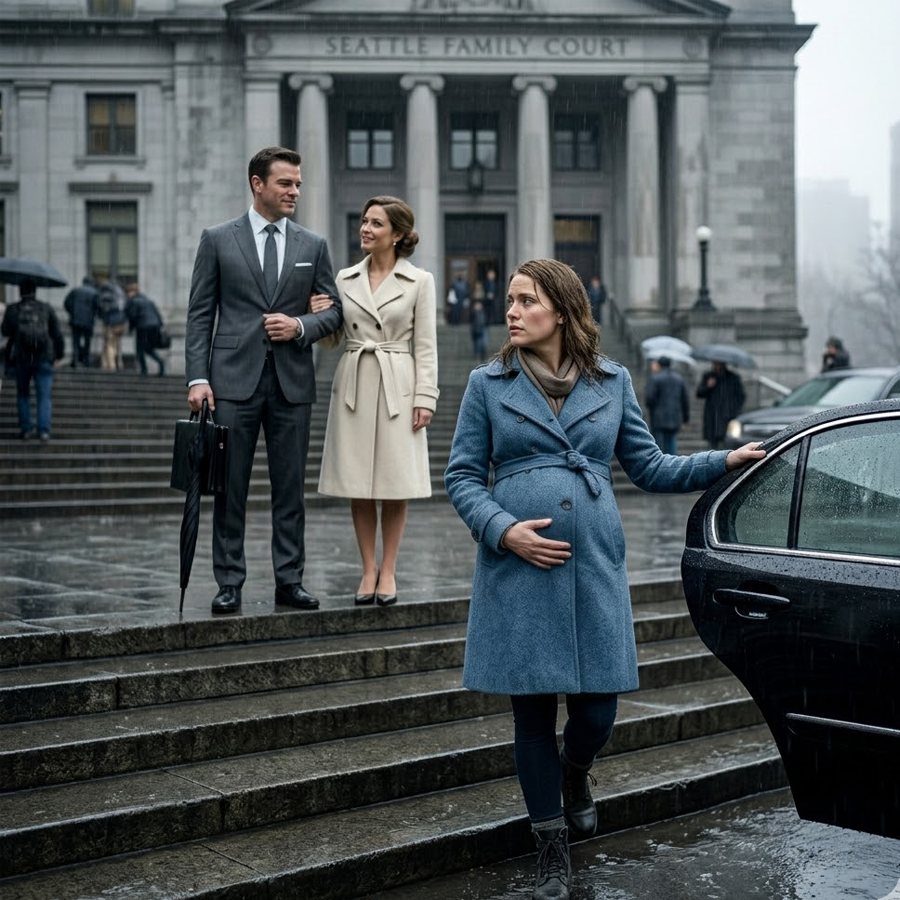
The rain came down in thin, needling strands that turned the courthouse steps slick and silver, and as you stepped carefully out of your mother’s car with one hand supporting the underside of your stomach and the other braced against the doorframe, you were aware of the fact that anyone watching might mistake your caution for fragility, when in truth it had nothing to do with weakness and everything to do with the relentless physical reality of being eight months pregnant, carrying not only the weight of a child but also the final, unbearable weeks of a marriage that had already collapsed long before any judge was asked to make it official.
October in Seattle always had a way of making the world feel colder than it really was, as if the damp air could find every vulnerable place in a person and settle there, and across the wide stone steps of the family court building stood the man who had once promised to build a life with you, now flanked by the woman who had been living in the fractures of that life for months, perhaps longer than you even knew. They looked polished in the way people often do when they mistake expensive clothes for dignity, and the smugness in their posture made it clear that they believed the day would go exactly as they had imagined it.
Ethan liked you uncertain. He liked you apologetic. He liked you tired enough to doubt your own instincts, soft enough to be shaped around his convenience, and for a long time he had relied on the belief that you would continue being the woman who explained away every inconsistency, every cold remark, every late-night absence, and every small humiliation that he wrapped in charm before setting at your feet like something you were expected to accept with gratitude. That version of you, however, had ended the night you found the invoices for the downtown apartment, the hidden lease, and the quiet financial trail that proved his betrayal had not been spontaneous or emotional, but methodical and sustained.
Your mother lowered the passenger-side window just before you closed the door, her fingers tightening around your wrist with the urgency of someone who understood that there were moments in life when love could not shield you, but could still stand close enough to remind you that you were not facing ruin alone.
“Call me the minute this is over,” she said, her voice steady, though her eyes gave away the fear she had been containing for weeks.
You squeezed her hand and nodded. “I will.”
What you did not say, because it no longer needed to be said aloud, was that by noon the life Ethan was so certain belonged to him would be stripped of every false certainty he had built around it.
Inside the Room Where He Performed Innocence
The courthouse lobby smelled faintly of wet wool, old paper, and burnt coffee, while the fluorescent lights made everyone look slightly more exhausted than they probably were, yet Ethan somehow still managed to arrange his face into the expression he wore whenever he wanted strangers to believe he was reasonable, wounded, and quietly noble. Beside him stood Vanessa, elegant and composed in a cream coat cinched perfectly at the waist, her hand resting lightly on his sleeve with the proprietary ease of a woman who believed she had already inherited the future.
Your attorney, Gabriel Mercer, met you near the courtroom doors with the kind of calm that only comes from preparation so thorough it borders on inevitability. He lowered his voice, glancing once toward Ethan and then back at you.
“Everything is ready,” he said. “But once I set the next part in motion, there won’t be any room left for reversals or private resolutions.”
You followed his gaze to where Ethan was leaning toward Vanessa, saying something that made her smile, and the sight of them no longer pierced you the way it once would have, because grief had already done its work and left behind something far clearer than sorrow.
“Good,” you replied. “I didn’t come here to retreat.”
The hearing itself unfolded with almost insulting efficiency, because the law is often least dramatic at the exact moments when people’s lives are being restructured in permanent ways. Ethan answered the judge’s questions in a measured tone, carefully respectful, carefully regretful, carefully crafted for effect, and if someone had entered the room without context, they might have mistaken him for a decent man caught in a difficult season rather than a man who had lied, stolen, and arranged a second life while mocking the woman carrying his child.
Vanessa sat several rows back with the serene expression of someone who believed she was watching the final scene of another woman’s defeat. She had always mistaken proximity to ambition for victory, and perhaps that was the first of many things she was about to learn.
When the judge finalized the divorce, Ethan released a breath you could actually hear from where you were standing, and that single exhale revealed more than any confession ever could. He had not been grieving the marriage. He had been waiting to be freed from consequences.
Outside the courtroom doors, he stepped in front of you before you could reach the exit, his smile already returning in that familiar way that made your skin crawl because it suggested he believed civility could erase history.
“Well,” he said, straightening his cuff as though the day had merely been inconvenient, “maybe now you can stop fighting reality and focus on the baby.”
Vanessa moved beside him, the sharp floral scent of her perfume arriving before her words did.
“We truly wish you the best,” she said, wearing compassion the way some people wear costume jewelry, visibly and without substance. “This is probably healthier for everyone in the long run. A child deserves stability.”
You smiled then, not because anything they said amused you, but because the irony was so complete that it almost felt elegant.
“I agree,” you said. “A child deserves stability, and honesty, and eventually those things matter more than appearances.”
You walked past them before either could answer, and behind you Vanessa gave a soft laugh before murmuring something about acceptance, as though peace and surrender were interchangeable, as though the absence of visible anger meant defeat rather than restraint.
No, you thought as you descended the courthouse steps. I simply stopped trying to rescue people who are determined to drown inside the stories they tell themselves.
The Name He Never Bothered to Understand
Outside, the rain had softened into a mist, and a black town car pulled to the curb with the clean, quiet precision of something accustomed to attention. The driver stepped out first, then your father emerged from the back seat, silver-haired, impeccably dressed, and carrying the kind of authority that required no announcement because everyone in Seattle’s business circles already knew exactly who he was.
Adrian Calloway.
Founder and chairman of Calloway Biomedical, a company whose research, licensing deals, and acquisitions had made it one of the most influential names in American biotech over the last fifteen years.
Even before Ethan fully recognized him, you saw the shift begin, the faint draining of color from his face, the quick recalculation in his eyes, the awful dawning recognition that there had been an entire dimension of your life he had never cared enough to learn.
“Mr. Calloway,” Ethan stammered, stepping forward with a hand he would never get to shake. “I didn’t realize—”
“I’m aware of that,” your father said, not bothering to look at the hand still hovering uselessly between them.
Vanessa stared openly now, her confidence cracking fast enough to be almost visible.
“Claire,” she said, your name sounding unfamiliar in her mouth for the first time, “you never said—”
You turned toward her with a calm that felt cleaner than anger.
“You never asked anything about me,” you said, “unless you believed the answer could somehow serve you.”
Your father glanced at Gabriel. “Is it finished?”
Gabriel gave a short nod. “The divorce is finalized. The other filings are cleared and ready to be activated.”
Ethan’s voice sharpened at once. “What filings?”
Your father ignored the question and opened the rear door of the car for you, because there are moments when true power does not argue, explain, or perform. It simply proceeds.
“Come on,” he said. “Your mother is right behind us.”
Before getting into the car, you looked back at Ethan one last time, really looked at him, at the panic beginning to rise under his polished exterior, at the humiliation of a man realizing too late that he had mistaken silence for ignorance and kindness for helplessness.
“You’ll know soon enough,” you said.
What He Called Ordinary
During the drive, the city moved past in blurred gray reflections, while your father sat beside you in the kind of composed silence he used whenever he was restraining himself from saying everything he truly thought.
Finally, he exhaled and looked out the window. “I told you I could have ended his career the moment I understood what he was doing.”
“I know,” you answered.
“And you still wanted it handled this way.”
“Yes.”
He shook his head once, though not in disagreement.
“He called you ordinary,” he said after a moment. “That may turn out to be the most expensive miscalculation of his life.”
Two years earlier, you had married Ethan Cross, an ambitious architect with sharp features, polished instincts, and the restless dissatisfaction of a man who mistook upward motion for identity. At first he had admired your refusal to lean on your family’s name, telling friends that your independence was refreshing, your work admirable, your refusal to perform wealth one of the things he loved most about you. What he had actually loved, as it turned out, was the assumption that your family’s influence would eventually become available to him if he positioned himself correctly.
When your father declined to intervene on his behalf after Ethan was passed over for a major development partnership, something inside him shifted permanently. Resentment began to bloom in him like mold in a sealed room, silent at first, then everywhere. He mocked your rehabilitation work as sentimental. He called your pregnancy badly timed. He once referred to your changing body as a barrier to momentum, as though the child you carried were not his own son but an obstacle placed in the path of some grander future he imagined he deserved.
Vanessa arrived not as a temptation but as an accomplice to that delusion, and the affair was only one part of what Ethan had been hiding. The true betrayal lay elsewhere, buried in forwarded files, copied credentials, unauthorized downloads, and financial transfers routed through accounts he assumed no one would ever connect to him. He had stolen confidential development data from Calloway Biomedical and passed it to a competitor through an intermediary, believing that because he was only adjacent to the company by marriage, suspicion would never land on him.
What he did not know was that you had found everything.
Not at once, and not through luck alone, but piece by piece, by refusing to ignore irregularities, by taking screenshots before he could erase them, by preserving email headers, transaction histories, access logs, apartment receipts, and private messages that revealed not just infidelity, but intent. You waited until the divorce was final because you knew exactly how men like Ethan operated when cornered. If the criminal filings had been launched too soon, he would have hidden behind the language of marital conflict, vindictive allegations, and emotional instability. Once the marriage was legally over, however, the evidence would stand where it belonged, outside the reach of his preferred explanations.
Noon
At exactly twelve o’clock, Gabriel’s office released the formal criminal complaints, along with supporting documentation already reviewed by outside counsel, cybersecurity analysts, and the federal authorities who had quietly been waiting for procedural clearance before taking the next step. Within the hour, Ethan had been placed on administrative suspension by his firm pending internal investigation, several project partners froze their dealings with him, and the first wave of industry inquiries began moving through channels he had once considered secure.
Your phone rang while you were seated at your mother’s kitchen table, one hand wrapped around a mug of ginger tea that had long since cooled.
Ethan.
You let it ring once before answering.
“Claire, what have you done?” he snapped, panic fraying every word. “Calloway Biomedical is accusing me of theft.”
You leaned back in your chair, exhaustion and clarity settling into place together.
“Are they accusing you,” you asked quietly, “or are they describing what you actually chose to do?”
There was a brief silence, then the full force of his anger surged through the line.
“You set me up.”
You closed your eyes for a moment, not out of weakness, but from the weary recognition that even now he was reaching for the same pattern, the same belief that consequences were something inflicted by others rather than produced by himself.
Then you ended the call.
The Woman Who Thought She Had Won
Vanessa arrived at your mother’s house that evening in a storm of indignation, still dressed beautifully, still speaking as though tone alone could restore a collapsing narrative.
“Ethan says your father is trying to ruin him over personal resentment,” she said, barely waiting for the door to close behind her. “This has gone far beyond a divorce.”
You looked at her for a long moment, and for the first time you saw not a rival, but a woman who had built her confidence on borrowed illusions and now had no idea what to do without them.
“I let him go when he lied to me,” you said. “I let him go when he cheated, when he ridiculed my body, and when he treated my pregnancy like an inconvenience. What I did not do was erase the things he chose afterward.”
Her expression faltered.
“You think this was a love story,” you continued, your voice even and almost gentle. “It never was. He selected you because you were useful to his appetite, not because you were irreplaceable.”
That landed harder than anger would have, because some truths do not need volume to wound.
Vanessa’s face changed then, not dramatically, but enough for you to see the first terrible outline of understanding. She had not been chosen over you in any meaningful sense. She had merely been incorporated into the same machinery of ambition that had consumed everything else.
The Life That Began After the Ending
A week later, your son was born under soft hospital lights on a quiet morning that carried none of the grand drama of the months before, only the immense and humbling stillness that comes when an entirely new life enters the room and reorders every priority without asking permission.
You named him Owen.
Ethan was not there. By then, too much had already broken, and you had no intention of letting the first hours of your son’s life become another stage for his father’s instability, regret, or performance. In the months that followed, Ethan lost not only Vanessa, who left once the investigations widened and the future no longer looked glamorous, but also the professional reputation he had spent years constructing with such vanity. His name circulated in legal articles, trade publications, and business columns, usually attached to words like misconduct, breach, and investigation, and though the headlines were sensational in the way headlines always are, they still captured the cruel symmetry of what had happened: a man who abandoned his pregnant wife in pursuit of status had forfeited both his career and the illusion of control because of secrets he assumed would never surface.
Six months later, you opened your own rehabilitation clinic in Bellevue and named it Horizon House, because recovery, you had learned, is not the same thing as returning to what was, but rather learning how to move toward what remains possible after illusion is removed. The clinic was modest by the standards of the world your father moved through, yet it was elegant, thoughtful, and fully yours, built with intention rather than vanity.
You allowed Ethan supervised visits with Owen because your son deserved clarity, not inherited bitterness, and because there is a meaningful difference between boundaries and cruelty, though Ethan seemed older each time you saw him, diminished less by financial loss than by the dawning awareness that regret cannot negotiate with time.
At the clinic’s opening reception, a reporter asked whether the event felt like a triumphant new beginning after such a public scandal, and you glanced down at Owen laughing in your arms, his small hands reaching for the silver chain at your neck with total trust.
“No,” you said, smiling softly. “This is the life I was always supposed to build once I stopped carrying what had already gone rotten.”
That, in the end, was the part Ethan and Vanessa never understood. They believed your story had ended when the marriage was dissolved, when the judge signed the papers, when they stood on those courthouse steps imagining they had survived the worst of it.
In truth, that morning had not been your ending at all.
It had only been the first clean page.