The Duke Woke To Find A Woman In His Shirt—Until He Learned Who She Was
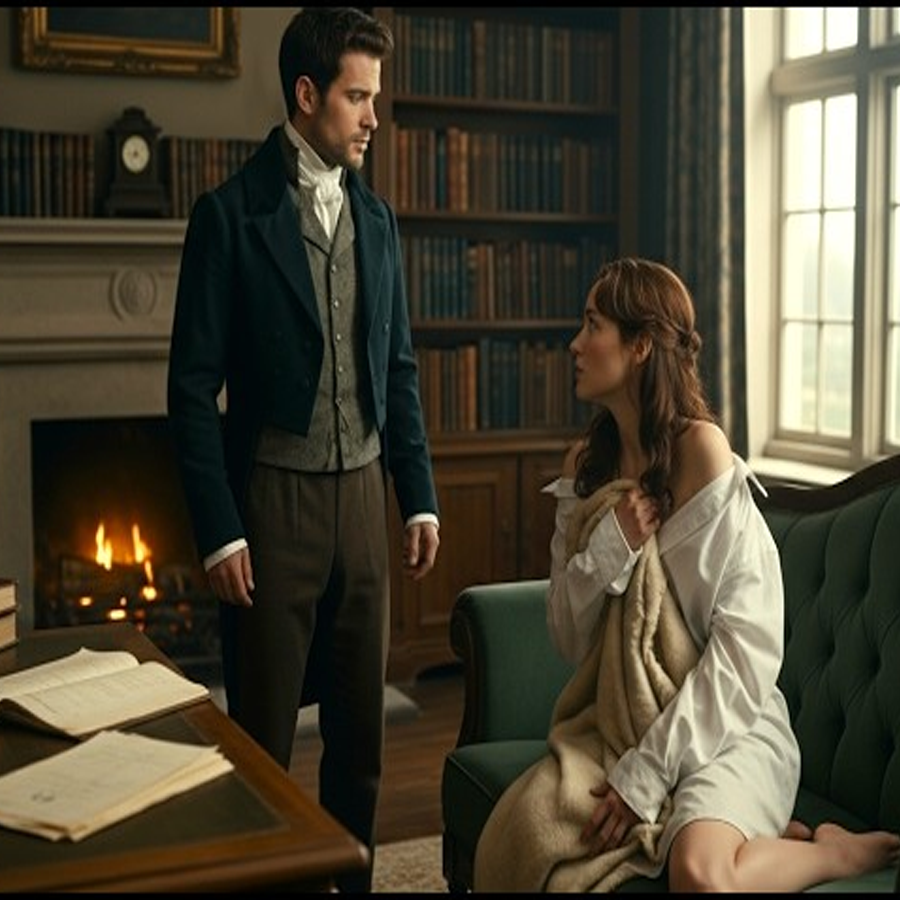
The fire had burned low, casting amber shadows across the study walls. Alexander Langford, Duke of Northmir, blinked against the early morning light filtering through rain streaked windows, his neck stiff from falling asleep in his chair. Again the estate ledgers lay open across his lap, ink dried on calculations he’d been reviewing until exhaustion claimed him sometime past midnight.
He straightened, rolling his shoulders, and froze. There was a woman asleep on his sofa. She was curled beneath a thick woolen blanket, dark orbin hair spilling across the cushions in tangled waves. But it wasn’t her presence that stopped his breath. It was what she wore, his shirt. The white linen hung loose on her smaller frame, the collar gaping at her throat, sleeves rolled back to reveal slender wrists.
Her feet were bare, pale against the deep green upholstery. She looked impossibly young, vulnerable in a way that made something protective and entirely inappropriate stir in his chest. Alexander stood slowly, his mind racing through possibilities. A servant wouldn’t be here. A guest wouldn’t be dressed, undressed like this.
The storm last night had been vicious, the worst he’d seen in years. But surely his housekeeper would have informed him if someone had arrived seeking shelter. He moved closer, silent on the thick carpet, studying her face. Even in sleep, there was tension in the set of her jaw. A small furrow between her brows. Dirt smudged her cheekbone.
Her hands resting near her face bore scratches and what looked like rope burns across the palms. “Who are you?” he murmured, not expecting an answer. Her eyes snapped open. They were an extraordinary shade of green, wide with panic as they locked on his face. for a heartbeat. Neither moved. Then she bolted upright, the blanket falling away, and pressed herself against the back of the sofa as if she could disappear into it.
I Forgive me, I didn’t. Her voice was horsearo, rough as gravel. I didn’t mean to fall asleep here. Mrs. Winters said I could wait by the fire, and I just She looked down at herself at his shirt hanging off one shoulder, and color flooded her face. Mrs. Winters brought you here. Alexander kept his voice level, carefully neutral, even as his mind cataloged details, educated accent, wellspoken despite her distress.
The way she’d said his housekeeper’s name suggested she’d been conscious enough to learn it. When last night, late I was there was an accident on the bridge. She clutched the blanket to her chest, knuckles white. I’m sorry. I know how this looks. I know what you must think, but I swear to you I didn’t come here to this wasn’t the bridge.
Alexander’s stomach dropped. He stroed to the window, yanking the curtain fully aside. Morning light revealed the devastation the darkness had hidden. The stone bridge that spanned the river to his estate, the only access point for miles, was simply gone. Chunks of masonry jutted from the churning water like broken teeth.
Christ, I barely made it across. Her voice was small behind him. My horse. She panicked when the water started rising. I thought we’d both drown. I managed to get to the other side before it gave way completely, but she threw me. I don’t remember much after that. Your groom found me in the stables. I think Mrs. Winters said I was freezing, soaked through.
She took my clothes to dry them, hence his shirt. It was logical, practical, even. The fastest way to warm someone suffering from cold was to remove wet clothing and replace it with dry. But logic didn’t change the fact that an unknown woman was in his study, wearing his clothes, and now trapped here by an impossible river.
Alexander turned back to face her. She’d pulled the blanket around herself more securely, but she was watching him with those remarkable eyes, fear and defiance waring in her expression. She expected him to rage at her. He realized to accuse her of impropriy or worse. “Are you hurt?” he asked instead. The question seemed to startle her.
“I no bruised. My hands are roar from the rains, but nothing serious. You were extraordinarily fortunate.” He moved to the bellpool and tugged it twice. “I’ll have Mrs. Winters bring you something more suitable to wear and some breakfast. You look half starved. I don’t want to impose. You’re already here,” he said, not unkindly, “and you’ll be here for several more days at least, until I can arrange some way to get you across the river safely.
The bridge won’t be passable for a week, possibly more.” Her face went pale. A week? You’re welcome to try swimming if you’d prefer.” It was a poor attempt at levity, but something flickered in her expression, a flash of spirit beneath the fear. “I’ve had enough of that river, thank you.” The door opened, and Mrs.
Winters swept in, her usually composed face creasing with relief when she saw the girl awake. Miss. Oh, thank heavens. I checked on you an hour ago, and you were sleeping so soundly. I didn’t want to disturb you. She shot Alexander a look that was pure maternal sensure. Your grace, you weren’t meant to be in here.
I was going to wake the young lady myself and get her properly settled before you knew anything about it. Too late for that. Alexander gestured toward his unexpected guest. though you might have mentioned we had a visitor who nearly died on my doorstep. It was 3:00 in the morning, your grace, and you’d given strict orders not to be disturbed while you worked on the estate accounts. I made a judgment call. Mrs.
Winters moved to the sofa, her voice softening as she addressed the girl. How are you feeling, dear? You gave us quite a fright. I’m so sorry for the trouble. The girl’s voice wavered. I never meant I should never have come. This was a mistake. Coming to a house in a storm is survival, not a mistake. Mrs.
Winters patted her shoulder. Now, let’s get you upstairs to a proper room and into a dress. Your clothes should be dry by now, though I’m afraid your riding habit took quite a beating.” The girl nodded, rising on unsteady legs. The blanket trailed behind her like a cloak, and Alexander found himself looking away from the bare curve of her calves, the vulnerable arch of her foot.
She paused at the door, glancing back at him with an expression he couldn’t quite read. “Thank you,” she said quietly. “For not, for being kind.” “Then she was gone, Mrs. Winters ushering her out with the efficiency of a general marshalling troops.” Alexander stood alone in his study, the faint scent of rain and something floral, lavender perhaps, lingering in the air.
He realized with a start that he hadn’t asked her name, and he very much wanted to know it. An hour later, bathed and dressed in his own clothes, Alexander found Mrs. Winters in the kitchen, supervising the preparation of what looked like enough breakfast to feed a small army. “Is our guest settled?” he asked.
“In the rose room, your grace, I sent up a tray, but she insisted on coming down to speak with you.” Mrs. Winters pursed her lips. She’s quite insistent, actually. Unusually so. Then I suppose I should receive her properly. Alexander straightened his cuffs. In the drawing room, I think, more appropriate than the study, given the circumstances.
Your grace. Mrs. Winters set down the teapot she’d been inspecting, her voice dropping. The young lady hasn’t told me her name. Won’t say where she’s from or who her people are. Just keeps asking to speak with you privately. I don’t like it. Neither did he, if he was honest, but his curiosity outweighed his caution.
I’ll find out what this is about. Have someone bring tea to the drawing room in 15 minutes. When he entered the drawing room, she was standing by the window, staring out at the ruined bridge. She’d been dressed in what he assumed were her own clothes, a traveling dress of deep blue that had been cleaned, but still bore water stains along the hem.
Her hair had been braided and pinned, revealing the elegant line of her neck. She looked older now, composed, though her shoulders were rigid with tension. She turned when she heard him enter, and he saw her take a breath, steadying herself. “Your grace,” she said, and dropped into a curtsy that was flawlessly executed.
“Thank you for seeing me. You have me at a disadvantage,” Alexander said, moving to stand near the fireplace, keeping a respectful distance between them. “You know who I am, but I still don’t know who you are.” No. She lifted her chin. You don’t. The silence stretched between them, charged with something he couldn’t name.
She was studying him as intently as he studied her. Those green eyes cataloging every detail of his face, his posture, his expression. Looking for something or dreading something. My name, she said finally, her voice steady despite the tremor in her hands, is Lydia Carrington. The name struck him like a physical blow. Carrington, his intended bride, bore that name, the woman his family had arranged for him to marry, the alliance his father had negotiated before his death 3 years ago, and his mother had finalized before hers last winter. The woman he’d never met,
never even seen, but whose dowry and family connections would secure the political influence Northmere needed. The marriage was supposed to be announced formally in London in two weeks time. He stared at her, understanding crashing over him in waves. You’re you’re betrothed, Lydia finished, and there was something bitter in her smile.
Yes, though I suppose that’s not quite how you imagined our first meeting. Alexander couldn’t speak. His mind was reeling, trying to reconcile the terrified woman in his shirt from this morning with the composed, defiant creature before him now, trying to understand why his future wife would ride through a storm to his estate in secret, risking her life in the process.
Why? The word came out rougher than he intended. “Why are you here?” Lydia met his gaze squarely. “I came to ask you to break our engagement.” The tea arrived, carried by a maid, who clearly sensed the tension in the room, and fled as quickly as propriety allowed. Neither Alexander nor Lydia moved to pour it. They stood facing each other like duelists, and he had the absurd thought that she looked ready to bolt again, not from fear this time, but from sheer force of will.
Explain, he said, when the silence became unbearable. Our families arranged this marriage for political advantage. You need the Carrington connections in Parliament. My father needs your influence in the north. Lydia’s voice was clinical, detached, as if she were discussing a business contract rather than her own future.
Neither of us had any say in it. We’ve never met. We don’t know each other, and I Her composure cracked just slightly. I can’t marry you. Can’t or won’t? Both. Alexander moved to the tea service, pouring two cups with deliberate care, using the mundane action to steady himself. He’d known this marriage was arranged. He’d accepted it with the same resignation he accepted all his duties as inevitable, necessary, nothing to be resented.
His parents’ marriage had been arranged, his grandparents before that. It was simply how things were done. Love, if it came, came later. Respect and partnership were what mattered, but he’d never considered that his bride might not share that acceptance. He handed Lydia a cup. She took it, her fingers brushing his for a fraction of a second, and he felt that touch like static. Why not? He asked.
What about this arrangement is intolerable to you? She laughed, a sharp sound without humor. What isn’t? I’m being traded like property for my family’s gain. and I have no choice in where I’ll live, how I’ll spend my days, who I’ll stopped, turning away. I had plans, dreams of my own. They don’t matter to my father.
They won’t matter to you. What plans? Why do you care? She set the teacup down untouched, her hands shaking. You’re going to refuse. You’ll send word to my father that I’m here, that I behaved shamefully by coming alone, and he’ll drag me back to London and march me down the aisle whether I want it or not.
So why pretend my answer matters?” Alexander studied her, the defiant tilt of her chin, the way she held herself as if braced for a blow. She expected him to be a villain in this story, expected cruelty, or at minimum indifference. “I asked,” he said quietly, “because I want to know.” Lydia turned, searching his face. Whatever she saw there made something in her expression shift, the brittle armor cracking just enough to let him glimpse the woman beneath.
I want to study botanical illustration, she said, in Florence. There’s a woman there, Senora Benedeti, who teaches the classical techniques. My mother, her voice caught. My mother was an artist, a talented one. She gave it all up when she married my father. By the time I was old enough to understand, she’d convinced herself that her painting had been a frivolous waste of time, a childish dream.
She died believing she’d made the right choice, sacrificing everything for duty. And you’re afraid you’ll do the same. I know I will. The words were barely a whisper. Because once I marry you, your grace, I’ll belong to you. My time, my interests, my future, all of it will be yours to dictate. and one day I’ll wake up and realize I’ve disappeared entirely.
The accusation stung precisely because he couldn’t entirely refute it. He hadn’t thought about what his future duchess might want beyond fulfilling her role. Hadn’t considered that she might have dreams that existed outside the boundaries of his expectations. So you rode through a storm to ask me to release you from our engagement, he said slowly.
You risked your life for a chance at freedom. Yes, and if I refuse, Lydia’s shoulders sagged, the fight draining out of her, then I’ll have tried. At least I’ll know I didn’t just accept my cage without fighting for something more. Alexander set down his own cup and moved to the window, looking out at the destroyed bridge. The river churned below, swollen with rain, carrying broken pieces of stone toward the sea.
A week ago that bridge had been solid, permanent. Now it was gone. The landscape irrevocably changed. “I won’t break the engagement,” he said. He heard her sharp intake of breath, felt her disappointment like a physical weight in the room. “But he continued, turning to face her, you’re trapped here for the next several days.
The bridge is impossible, and the river too dangerous to cross any other way. Since we’re both stuck, perhaps we should use the time to actually meet each other properly.” Lydia stared at him. What? You said we don’t know each other. You’re right. I know your name and your father’s political positions and the size of your dowy, but I don’t know you.
What you care about? What frightens you? What makes you willing to risk everything? He held her gaze. Maybe we should remedy that before we make any permanent decisions. You just said you won’t break the engagement. I won’t break it today, Alexander corrected. But I’m willing to listen, to understand why you’re so desperate to escape this marriage.
Perhaps you’ll convince me. Or perhaps, he paused, choosing his words carefully. Perhaps you’ll discover I’m not the prison you think I am. The expression on her face was complicated, layered. Suspicion, and hope, and bone deep weariness, all tangled together. Why would you do this? Why not just send for my father and be done with it? Because, Alexander said, surprised by his own honesty, the woman I found this morning in my study was the most interesting thing that’s happened to me in months.
And I’m curious to know who you actually are, Lydia Carrington. Her name felt strange on his tongue, intimate, real in a way it hadn’t been when she was just an abstract idea, a name on a marriage contract. She studied him for a long moment, then nodded slowly. All right, we have a week. 5 days most likely.
5 days. Then she moved toward the door, pausing with her hand on the frame. But your grace, I should warn you. I’m very good at arguing my position. By the time that bridge is repaired, you’re going to want to be rid of me. Alexander watched her leave, her spine straight despite her exhaustion.
Every inch of her radiating stubborn determination. He found himself smiling. We’ll see about that. By midday the household had adjusted to their unexpected guest with the smooth efficiency Alexander had come to expect from his staff. Mrs. Winters had Lydia settled in the rose room with everything she needed and the housekeeper’s initial suspicion had transformed into something resembling protective concern once she learned through Alexander’s carefully vague explanation that Miss Carrington was a distant family connection stranded by
the storm. It wasn’t quite a lie. They were about to be family after all. Alexander sent messages to both estates, hers and his, explaining that Miss Carrington was safe but delayed due to the bridge collapse, and that she’d be returned home as soon as passage could be arranged. He worded his letter to her father with particular care, making it clear that she’d arrived seeking shelter from the storm and nothing more.
It was the truth, if not the whole truth. What he didn’t mention was her request to break their engagement. That conversation, he decided, was theirs alone. Lunch was served in the smaller dining room, a more intimate space than the formal hall. Lydia appeared promptly, her damp traveling dress replaced by something Mrs.
Winters must have found in storage, a daydress in soft gray that fit reasonably well, though it was slightly too long and clearly a decade out of fashion. She’d left her hair in its simple braid, and Alexander noticed she moved stiffly, favoring her left side. “Qu said, “You weren’t hurt,” he observed as he held her chair.
“Bues aren’t injuries, but she winced as she sat.” “I may have understated how hard I hit the ground. I’ll have the physician come from the village tomorrow if the water recedes enough.” “That’s not necessary. It wasn’t a question, Miss Carrington.” Her eyes flashed. I’m not accustomed to being ordered about your grace, and I’m not accustomed to guests lying about their welfare. He took his own seat.
Shall we call it even? For a moment he thought she might argue, then unexpectedly she laughed, a real laugh surprised out of her. Fair enough. The meal began in careful silence, both of them navigating the strange territory of forced intimacy. They were betrothed yet strangers, trapped together, yet adversaries of a sort.
Alexander found himself acutely aware of her presence across the table, the way she ate with delicate precision, the small crease that formed between her brows when she was thinking. “Tell me about Florence,” he said finally. “This teacher you want to study with.” Lydia’s head came up sharply, as if she’d expected him to dismiss the subject entirely.
“Senor Benedeti is one of the finest botanical illustrators in Europe. She trained under the old masters, learned the techniques they used in the Renaissance. Most of her students are men, but she takes a few women each year if their work shows promise. And yours does? I think so. I hope so. She set down her fork.
My mother taught me to draw when I was young. Plants, flowers, anything that grew in our garden. After she died, I kept practicing. It was the only part of her I had left. Her voice softened. Last year, I sent a portfolio to Senora Benedeti. She wrote back saying I had talent worth developing, that if I could come to Florence, she’d take me on.
But you’d need your father’s permission to travel, which he refused the moment I suggested it. Bitterness crept into Lydia’s tone. He said it was an absurd waste of time, that I’d be married soon anyway, and my husband certainly wouldn’t allow such nonsense. Art is a hobby for bored wives, not a serious pursuit.
Alexander heard the echo of her father’s words in her voice, the way she’d internalized that dismissal. Do you have your sketches with you? She blinked. What? Your botanical illustrations. Did you bring any with you? I Yes, a few in my saddle bag, though they’re probably ruined by now. Lydia’s expression turned rofal. I didn’t exactly pack carefully when I decided to flee in the middle of the night. Perhaps we should check. Mrs.
Winters is frighteningly good at salvaging things. 20 minutes later, they stood in the housekeeper’s domain while Mrs. Winters carefully extracted a leather portfolio from Lydia’s battered saddle bag. The edges were water stained, but the older woman’s face brightened as she opened it. The insides mostly dry. Miss, you wrapped it well.
Lydia took the portfolio with trembling hands, opening it on the kitchen table. She pulled out several sheets of heavy paper, and Alexander leaned closer to look. His breath caught. The drawings were exquisite. Precise, detailed studies of wild flowers and medicinal herbs, each petal and leaf rendered with scientific accuracy, but also something more, a quality that made them seem alive on the page.
She’d captured not just the structure of each plant, but its essential character, the way it moved in the wind, the pattern of light through its leaves. These are extraordinary, he said, and meant it. Lydia glanced at him, suspicious. You don’t have to patronize me. I’m not. Alexander picked up a study of fox glove, admiring the delicate gradation of color in the bell-shaped flowers.
My mother kept a conservatory. She’d have loved these. Kept? She died 18 months ago. He set the drawing down carefully. The conservatory’s been locked since. I haven’t had the heart to go through her things. Something shifted in Lydia’s expression, the defensive walls lowering slightly. I’m sorry.
Losing a parent is She stopped. I know. They stood there in the warm kitchen. The only sound the crackle of the fire and the distant rumble of rain starting again outside. Alexander became aware that Mrs. Winters had quietly excused herself, leaving them alone with Lydia’s art spread between them like a bridge. “Would you like to see it?” he asked.
The conservatory. Lydia’s eyes widened. I Yes, if you don’t mind. I think, Alexander said slowly, it might do me good to open it again. The conservatory was on the east side of the manor, accessible through a set of French doors in what had been his mother’s private sitting room. Alexander hadn’t entered this wing of the house since the funeral.
He told himself he was simply busy, that there was always some urgent estate matter requiring his attention. But standing here now, key in hand, he recognized the excuse for what it was. Cowardice. He unlocked the doors. The conservatory was a disaster. Glass panels had cracked in places, letting in rain and wind. Plants had overgrown their beds, vines tangling together in wild profusion.
Others had died from neglect, leaving sad brown stalks among the chaos. The air smelled of earth and decay and something sweet he couldn’t identify. Lydia stepped past him, moving into the space with the careful reverence of someone entering a cathedral. “Oh,” she breathed. “It’s a mess,” Alexander said. “I should have had the groundskeeper maintain it, but I couldn’t. I didn’t. It’s beautiful.
” She moved deeper into the conservatory, trailing her fingers over leaves, pausing to examine plants that had somehow survived despite the neglect. He watched her crouch beside a cluster of pale orchids, their blooms beginning to wither, and felt something tight in his chest begin to ease. Your mother had excellent taste, Lydia said.
These are all medicinal herbs, feverfw, chamomile, lavender. And here she moved to another bed. Bella Dononna, dangerous if used incorrectly, but valuable for medicine. She knew her plants. She studied them. Used to prepare remedies for the tenants when they were ill. Alexander stepped carefully through the overgrowth.
The physicians hated it, but the people trusted her. I can see why. Lydia stood, brushing dirt from her borrowed dress. This place is a treasure. It could be again with work. She said it simply without judgment. But Alexander felt the implication. Another thing he’d let languish, another responsibility he’d hidden from.
“I’ll have the groundskeeper begin repairs,” he said. “Get it back to what it was, or you could make it something new.” Lydia met his gaze. Not a memorial, a living thing. The suggestion unsettled him in ways he couldn’t articulate. But before he could respond, Lydia suddenly bent down, exclaiming in delight, “Is that it can’t be?” She was crouched beside a raised bed in the corner, partially hidden by overgrown rosemary.
She brushed the woody stems aside, revealing a plant with delicate white flowers just beginning to open. “Madagascar jasmine,” she said, wonder in her voice. I’ve only ever seen drawings. They’re nearly impossible to grow in England. The climate’s all wrong. Mother had the bed specially prepared, some kind of soil mixture she imported.
Alexander knelt beside Lydia, looking at the plant with new eyes. She said it reminded her of her wedding bouquet. Lydia reached out, stopping just short of touching the flowers. May I sketch it now? if you don’t mind. While the light still good, she looked at him, and there was something raw in her expression. I might never get another chance to see one.
The unspoken implication hung between them, because once she left here, once she returned to London, her fate would be sealed one way or another. Either she’d marry him and abandon her dreams, or or what. He still hadn’t decided what he’d do if he broke the engagement. The political consequences alone would be significant.
I’ll have your portfolio brought here, he said, and proper drawing supplies if we have them. Lydia’s smile was like sunlight breaking through clouds. Thank you. He left her there among the plants, sketching the jasmine with fierce concentration, and made his way back through the house in a days. Mrs. Winters intercepted him in the hall, her knowing look suggesting she’d been watching from somewhere.
“The young lady is settling in then,” she asked mildly. She’s in the conservatory drawing, drawing. Mrs. Winter’s expression softened. Your mother would have liked that. She always said that room should be full of life. Alexander nodded, not trusting himself to speak. He continued to his study, closing the door behind him, and stood for a long moment, staring at the sofa where he’d first seen Lydia curled in sleep.
He told her he wouldn’t break the engagement. told himself this marriage was necessary, advantageous, exactly what his family needed. But watching her light up at the sight of a flower, listening to her talk about her mother’s dreams and her own, he was beginning to suspect this arrangement was far more complicated than he’d ever imagined.
Dinner that evening was a quieter affair. Lydia appeared with ink stains on her fingers and a far away look in her eyes that suggested her mind was still in the conservatory. Alexander didn’t mind. He found himself content to simply observe her, noting the way she tucked a loose strand of hair behind her ear when she was thinking.
The small smile that played at her lips when she was pleased with something. I finished the jasmine study, she said finally, as the soup course was cleared, and started cataloging the other plants. There are at least 40 species in there, maybe more. Some I don’t even recognize. My mother kept journals, notes on each plant and how to care for it.
Alexander hesitated. They’re in her sitting room. I could find them for you if you’d like. Lydia set down her wine glass. You’d let me read them. I’d be grateful if you did. Someone should put that knowledge to use. They looked at each other across the table, and Alexander felt the shift again, that subtle reccalibration of how they stood with one another.
Not quite allies, not quite friends, but not adversaries either. Your grace, Lydia said carefully. Why are you being so kind to me? I came here to sabotage our engagement. I should be your enemy. Should you? Alexander leaned back in his chair. You were honest about what you wanted, even knowing I could use it against you.
That takes courage or desperation. Both, she admitted. I respect honesty, he paused. And I’m beginning to think that if we’re going to be married, we should at least try to understand each other. Even if you’re determined to hate me, I don’t hate you. You don’t trust me. I don’t trust this. Lydia gestured between them.
The arrangement, the expectation that I should be grateful to be chosen for political convenience, the assumption that what I want doesn’t matter as long as the alliance benefits our families. Does it matter what I want? The question surprised him as much as it seemed to surprise her. I didn’t choose this marriage either, Lydia.
My parents arranged it. They’re both dead now, but I’m bound by their decision just as much as you are. That’s different, is it? Because you’re a woman and I’m a man. My cage is more comfortable. Alexander shook his head. I have duties, expectations, an entire estate depending on my decisions. I can’t just abandon my responsibilities to pursue my own dreams, whatever those might be.
What would you do? Lydia leaned forward. If you could choose anything, if duty didn’t matter, what would you want? No one had ever asked him that, not in his entire life. He thought about it, really thought about it, trying to imagine a world where Alexander Langford wasn’t the Duke of Northmre, wasn’t bound by centuries of family obligation and social expectation.
I don’t know, he said finally. I’ve never let myself consider it. Lydia’s expression softened into something that looked almost like pity. That’s the saddest thing I’ve ever heard. The words stung because they were true. He’d been raised to believe that duty was everything, that personal desires were selfish and small compared to the weight of responsibility he carried.
It had never occurred to him that this might be its own form of imprisonment. Perhaps he said, “We’re both trapped, just in different ways.” Lydia didn’t answer, but when dessert was served, a lemon tart that made her eyes close in appreciation, she told him about her childhood, about learning to ride badly, and preferring to spend hours in the garden sketching insects.
He told her about his father, stern and distant, and his mother, who’d created the conservatory as her own small rebellion, against a life that left little room for joy. They talked until the candles burned low, and the servants began clearing the table with pointed efficiency. When Lydia finally excused herself for the evening, she paused at the door. “Thank you,” she said.
“For dinner, for listening, for not being what I expected.” “What did you expect?” “Someone who didn’t see me at all,” she smiled, but it was tinged with sadness. “Good night, your grace, Alexander,” he said impulsively. If we’re going to be honest with each other, you should call me Alexander.
She studied him for a long moment. Good night, Alexander. He stayed in the dining room long after she’d gone, finishing his wine and thinking about cages and choices, and the woman who’d ridden through a storm to ask for her freedom. Outside, the rain continued to fall. The next three days fell into an unexpected rhythm.
Mornings Lydia worked in the conservatory sketching plants and consulting his mother’s journals which Alexander had delivered to her along with additional drawing supplies ordered from the village. Afternoons they walked the estate grounds when the weather permitted or played chess in the library when it didn’t.
Lydia was a terrible chess player but a gracious loser and her laughter when he won particularly clever games made him want to keep playing. evenings they dined together and talked about everything, books, politics, the absurd social rituals of the ton, their respective childhoods. She told him about her father’s increasing pressure to secure an advantageous match, the way he’d paraded her before every eligible bachelor in London like a prize mayor.
He told her about the crushing weight of the dupdom, the impossible task of maintaining an estate this size while navigating political alliances he’d never asked for. They didn’t talk about the engagement, about the decision still looming between them. It hung in the air like fog, but neither seemed willing to break the fragile piece they’d built.
On the fourth morning, Alexander woke to silence. The rain had finally stopped. He found Lydia already in the conservatory, working on a comprehensive catalog of every plant. She’d transformed the space in just a few days, clearing the dead growth, organizing the beds, even directing the groundskeeper on repairs to the glass panels.
Her hair was pinned up haphazardly. Dirt smudged on her cheek, and she’d never looked more beautiful. “The bridge,” he said, and watched her go still. “They’re starting repairs today. The waters receded enough.” Lydia didn’t turn around. “How long? 3 days? Maybe four. I see. The silence stretched between them, heavy with everything they hadn’t said.
There’s something I want to show you, Alexander said. If you’re willing, she finally looked at him. What? A surprise. Come with me. He led her through the manor to the west wing to a set of rooms that had been closed off for years, his mother’s private chambers. He’d avoided them even more thoroughly than the conservatory, but last night he’d made a decision.
Alexander opened the door. The room beyond was bright with morning light streaming through tall windows. But it wasn’t the sitting room that made Lydia gasp. It was what filled it. Easels, dozens of them in various sizes. Canvases stacked against the walls, paints, brushes, drawing pencils in every grade, a workt covered with supplies.
In the corner, a printing press for making multiple copies of illustrations. My mother’s art studio. Alexander said quietly. She had it built the year before she died, but she was too ill to use it much. I thought if you’re going to be trapped here, you might as well have proper equipment. Lydia moved through the room like a sleepwalker, touching everything with reverent fingers.
She picked up a set of brushes, their bristles still perfect, unused, ran her hand over a blank canvas. When she turned back to him, there were tears in her eyes. Why? she whispered. Because you should have the chance to create something that matters to you. Alexander stayed in the doorway, giving her space.
Even if it’s just for a few more days. I don’t understand you. Lydia shook her head. You could have just kept me comfortable and sent me home when the bridge was ready. Instead, your why are you giving me this? Maybe, he said, I want you to see that marrying me doesn’t have to mean giving up everything you care about. The words hung between them, naked and far too revealing.
Lydia stared at him, and he watched her expression shift through a dozen emotions. Surprise, confusion, something that might have been hope. Alexander. A knock at the door interrupted whatever she’d been about to say. One of the footmen stood there looking apologetic. Your grace, there’s a rider from the village.
The Earl of Carrington arrived late last night. He’s staying at the inn in the village, waiting for the bridge repairs to be completed enough for safe passage. The foreman says it will be ready by noon today. The earl sent word he’ll be here to retrieve Miss Carrington as soon as the crossing is possible. Alexander’s blood went cold. Today? Yes, your grace.
Within the next few hours. Lydia had gone pale. My father. Yes, Miss. The footman shifted uncomfortably. He sent word ahead that he’s coming to retrieve his daughter. Alexander dismissed the footman and turned back to Lydia. She looked terrified, all the confidence she’d built over the past days crumbling. I should have known, she said dullly the moment he got your letter.
Of course he’d come. He can’t have me making decisions on my own. Lydia, it’s over. She set down the brushes, her hands shaking. Whatever this was, whatever I thought might be possible, it’s done. He’ll take me back to London, and the engagement will proceed exactly as planned, and none of this will have mattered.
It matters to me,” she looked at him, and the devastation in her eyes cut him deeper than he’d thought possible. “Does it enough to actually do something about it?” She laughed, a broken sound. “You said you wouldn’t break the engagement. You said the marriage was necessary, advantageous. Was all of this just what? A pleasant diversion, a way to make me more amunable to my fate. No.
Alexander moved toward her, then stopped helpless. I don’t know what this is, but it’s not a game, Lydia. These past days, getting to know you. Have changed nothing. She wiped at her eyes angrily. I’m still going to marry you. Still going to give up Florence and become your duchess and disappear into duty just like my mother did.
and you’re going to let it happen because it’s what’s expected. What do you want me to do?” The question came out harsher than he intended. Break the engagement and face my family’s censure, destroy the alliance both our fathers worked for, let you leave for Florence and pretend none of this happened. I want you to want that.
” The words burst out of her, raw and desperate. I want you to care enough to fight for something other than duty for once in your life, but you won’t because I’m not enough to make you choose differently.” The accusation landed like a blow, but before Alexander could respond, could find the words to explain the impossible position they were both in.
Voices echoed in the hallway. “Where is my daughter?” Earl Carrington’s voice carried the particular authority of a man accustomed to being obeyed. Alexander heard Mrs. Winter’s calmer tones trying to weigh lay him, but the earl was clearly not to be deterred. Lydia straightened, wiping her face clean of tears, transforming before his eyes into someone composed and blank.
It was like watching her put on armor. I should go down, she said tonelessly. Face this. You don’t have to face him alone. Don’t I? She looked at him, and there was no warmth left in her expression. Just resignation. He is my father and you’re my future husband. Both of you have already decided my fate.
What difference does it make which of you I face first? She swept past him and out of the room, leaving Alexander standing alone among his mother’s unused art supplies, the scent of oil paint and tarpentine sharp in his nose. He thought he had more time, thought he could sort through the tangle of feelings that had been growing in him since he’d first seen her sleeping in his study.
But time, it seemed, had run out, and he still didn’t know what he was going to do about it. Alexander found them in the drawing room, Lydia standing by the window, her father pacing before the fireplace like a caged predator. The Earl of Carrington was a tall man, imposing despite his age, with steel gray hair and eyes that missed nothing.
Those eyes fixed on Alexander the moment he entered. Northre. The ear’s tone was clipped. I trust my daughter has been appropriately accommodated during her unexpected visit. Miss Carrington has been a perfect guest, Alexander said, moving to stand near Lydia. Not quite beside her, but close enough to make his position clear.
The storm left her no choice but to seek shelter here. The storm. The Earl’s gaze flickered to Lydia, who stood silent and pale. Yes, most unfortunate, though I wonder what possessed my daughter to be riding alone in such weather in the first place, so far from home, so close to your estate. Father, be silent, Lydia.
The command was casual, automatic, and Alexander watched Lydia’s jaw clench. I’m speaking with your betrothed. Then perhaps, Alexander said mildly, you should allow her to participate in the conversation, given that it concerns her directly. The Earl’s eyebrows rose. I wasn’t aware you had such progressive views on a woman’s place in these matters.
I believe Miss Carrington is intelligent enough to speak for herself. Intelligence isn’t the issue. The earl turned fully to face Alexander, dismissing Lydia as if she weren’t there. The issue is propriety. My daughter has been staying unshapered in your home for 4 days. That kind of scandal could damage both our families if word got out.
No one outside this household knows she’s here, Alexander said, and my staff are discreet. Nevertheless, the situation is irregular, the Earl’s eyes narrowed. Which is why I’m here to ensure the engagement proceeds immediately. I’ve made arrangements for the bands to be read starting this Sunday. We can be married within the month.
Lydia made a sound, quickly, stifled, but Alexander heard it, heard the desperation in it. That seems unnecessarily hasty, he said carefully. Hasty? The Earl’s voice rose. My daughter compromised herself by coming here alone. Or was that your plan, Lydia, forced the Duke’s hand by creating a scandal that would require immediate marriage? That’s not Lydia finally found her voice.
I never meant what you meant is irrelevant. What matters is salvaging this situation before rumors start. The earl turned back to Alexander. Unless you’ve changed your mind about the match. Found my daughter unsuitable during her stay? It was a test. Alexander recognized it immediately. The earl was giving him an opening to back out to end the engagement with the excuse of Lydia’s improper behavior.
It would destroy her reputation, but it would free them both. He could do it. Could take the easy path. Let Lydia go and find another alliance, another bride who wouldn’t challenge him or make him question everything he thought he knew about duty and desire. The room was silent. Waiting. Alexander looked at Lydia. She was staring at him with an expression that broke his heart.
Not quite hope, but not quite hopelessness either, just a terrible, fragile uncertainty. He thought about the past four days, her laughter over chess, the way she’d transformed his mother’s conservatory from a tomb into something living, the light in her eyes when she talked about Florence and botanical illustration and dreams she’d been taught to consider impossible.
He thought about what she’d asked him. “What would you do if you could choose anything?” And he finally knew his answer. “I haven’t changed my mind about the engagement,” Alexander said slowly, watching Lydia’s face fall. But I disagree about the timeline, Lord Carrington. Rushing into marriage serves no one. The scandal? There is no scandal.
Your daughter sought shelter during a storm. She’s been appropriately chaperoned by my housekeeper. Nothing improper has occurred. He held the Earl’s gaze. And I have a proposal to make about the terms of the marriage. Lydia’s head snapped up. What? The engagement will stand, Alexander continued. But the wedding will be delayed. Not indefinitely. 6 months.
That’s absurd, the Earl sputtered. What possible reason. Because, Alexander said, and this time he did move to stand beside Lydia, close enough that their shoulders nearly touched. I want to give your daughter the opportunity to pursue her studies in Florence with Senora Benedeti. The silence in the room was absolute.
Lydia stared at him. You can’t mean that. I do. Alexander kept his attention on the Earl, whose face had gone an alarming shade of purple. 6 months for Miss Carrington to study botanical illustration at my expense with appropriate chaperonage, of course. When she returns, we’ll marry as planned. This is outrageous, the Earl said.
Send my daughter gallivanting across Europe to indulge in some frivolous hobby. It’s not frivolous. Alexander’s voice hardened. Your daughter is extraordinarily talented. I’ve seen her work. It deserves to be developed properly. You’ve seen The Earl turned on Lydia. How you’ve been showing him your sketches, wasting the Duke’s time with your childish drawings? They’re not childish.
Alexander stepped forward, putting himself physically between Lydia and her father. They’re remarkable, and I’m offering her the chance to become even better. Unless you’d prefer she spend the next 6 months sitting in London, waiting for a wedding date, growing more resentful of this marriage every day. It was a gamble, playing on the ear’s self-interest.
But Alexander saw the calculation in the older man’s eyes, the weighing of options. “And you’d be willing to wait?” the Earl asked suspiciously. To have your betrothed abroad for half a year? I would. Why? Because I want her to choose me, Alexander thought. not the title or the alliance or the inevitability of our arrangement. Me.
But he couldn’t say that. Not in front of her father. Maybe not ever. Because he said instead, “I want my wife to come to our marriage without regrets.” Without feeling that she sacrificed everything she cared about for duty. 6 months is a small price to pay for that peace. The earl studied him for a long moment, then shook his head.
You’re a fool, Northmere. Give a woman an inch and she’ll take a mile. Let Lydia go to Florence and she’ll find some reason never to come back. Then perhaps, Alexander said quietly. I’ll have to give her a reason to return. He finally looked at Lydia. She was staring at him with an expression he couldn’t read, her eyes bright with unshed tears.
I Her voice broke. I don’t understand. You asked me what I would choose if duty didn’t matter. Alexander said, I’m choosing this. you, your happiness, even if it costs me 6 months and the certainty I thought I wanted. This is madness, the earl muttered, but he was wavering. Alexander could see it. The expense alone is mine to bear.
I’ll arrange everything. The travel, the accommodations, the chaperone, all of it. Alexander held out his hand to Lydia. If you want to go, she looked at his outstretched hand like it might burn her. And if I do, if I go to Florence and study with Senora Benedeti and come back in 6 months, what then? We just marry as if none of this happened.
We marry, Alexander confirmed, but you’ll have had your chance, your dream, and maybe, he hesitated. Maybe you’ll come back knowing that this marriage doesn’t have to be a cage, that I’m not your enemy. You’re offering me everything I wanted, Lydia whispered. Why? because watching you fight for your dreams reminded me that I’d stopped fighting for anything at all.
Alexander let his hand drop, not wanting to pressure her. I can’t give you freedom from this engagement, but I can give you 6 months. What you do with them is your choice. The earl made an exasperated sound. This is highly irregular. The scandal, if anyone finds out, no one will find out if we control the narrative, Alexander said.
We announce that the engagement stands, but the wedding is delayed to allow Miss Carrington to complete a course of study abroad, something perfectly acceptable for a woman of her station. We frame it as my gift to my future bride. Romantic, even romantic, the repeated flatly. You’re letting her run off to Italy and calling it romantic.
I’m giving her what she asked for, what she was willing to risk her life to pursue. Alexander looked at Lydia again. The question is whether she still wants it. Lydia’s hands were shaking. She clasped them together, staring at him with an intensity that made his chest ache. You’d really do this. Let me go. Yes. And you’d wait for me to come back? Yes.
Why should I believe you? The words came out raw, desperate. You said yourself, “This marriage is necessary, advantageous. What if you change your mind while I’m gone? What if you decide I’m too much trouble and break the engagement anyway? Then you’d be free, Alexander said simply. Isn’t that what you wanted? I Lydia stopped, and he watched her realize the trap she’d laid for herself.
If she said yes, she’d admit she wanted to escape him. If she said no, she’d admit something had changed in the past 4 days, something neither of them knew how to name. The Earl broke the silence with a heavy sigh. Fine. 6 months. But there will be conditions, Northmir. A proper chaperone, regular correspondence, and at the end of that time, the marriage proceeds immediately.
No more delays. Agreed. Alexander extended his hand. And after a moment’s hesitation, the Earl shook it. Lydia, go pack your things, the earl ordered. We’re leaving as soon as the bridge is fully passable. The foreman assures me it will be within 2 hours. Now, Lydia’s voice rose. But I thought, you thought you’d have more time to continue this charade.
I’ve been waiting in that miserable village inn for 2 days, watching workers repair the damage your recklessness caused. We leave today. The earl moved toward the door, then paused. And Lydia, when you write to thank the Duke for his generosity, remember that this arrangement is contingent on your good behavior.
Any hint of scandal and the offer is void. He left and suddenly the room felt enormous and empty. Lydia and Alexander stood facing each other, neither quite able to bridge the distance between them. “I should go,” Lydia said finally. “Pack! Wait!” Alexander caught her hand, the first time he deliberately touched her since that morning when their fingers brushed over the teacup.
“You haven’t said whether you want this, whether you’ll go to Florence.” “Of course I want it,” but her voice wavered. It’s everything I asked for, everything I came here to fight for. Then why do you look so uncertain? Lydia pulled her hand free, wrapping her arms around herself. Because 4 days ago, escaping this engagement was all I cared about, and now you’re giving me exactly what I wanted, and I She stopped, shaking her head. I don’t know what I feel anymore.
Tell me. I can’t. She backed toward the door. I need to think. I need to I have to go. She fled, leaving Alexander alone in the drawing room with the ghost of her confusion hanging in the air. He’d done it, given her the choice she’d demanded, the freedom she’d been willing to risk everything for.
So why did it feel like he’d just made the biggest mistake of his life? The next hour passed in a blur of activity. Lydia’s belongings were gathered, her ruined riding habit replaced with a traveling dress Mrs. winters produced from somewhere. Alexander watched from his study window as the Earl’s coach was prepared, horses stamping nervously at the temporary repairs on the bridgeg’s north approach.
He should let her go, should let her pack and leave, and take her 6 months in Florence without another word from him. It was what she wanted, what he’d promised. But the thought of her leaving like this, confused and uncertain, with everything unresolved between them, was unbearable. Alexander found her in the conservatory.
She was standing beside the Madagascar Jasmine, her fingertips resting lightly on the white blooms. She’d changed into the traveling dress, her hair pinned up properly, every inch of her appearance correct and composed, but her shoulders were shaking. Lydia. She didn’t turn around. I was saying goodbye to the plants. Foolish, I know.
They won’t remember me. I’ll take care of them. Alexander moved closer, drawn by her sadness like a magnet. The conservatory will be here when you return. If you return, when? Lydia corrected softly. The agreement is that I come back in 6 months. That the marriage proceeds. Do you want that? Want what? The marriage. Florence. I wanted Florence 4 days ago.
I was certain of it. But now her voice broke. Now I don’t know what I want anymore. And I hate that. I hate that you’ve made everything complicated. I’m sorry. No, you’re not. She finally turned to face him, and her eyes were red- rimmed. You did this on purpose, showed me the studio, gave me access to your mother’s journals, listened when I talked about my dreams.
You made me see you as a person instead of just an obstacle. Would you prefer I’d been cruel? Alexander asked. Dismissive. Yes. The word came out fierce. because then I could leave without looking back. Could go to Florence and spend 6 months becoming the artist I want to be without feeling like I’m running away from something important.
What are you running from? Lydia laughed a broken sound. You this the possibility that I was wrong about what marrying you would mean? She pressed her hands to her face. I came here so certain that you’d be like my father, that you’d see me as property, something to be managed and controlled. But you’re not like him at all, and that terrifies me.
Why does it terrify you? Because if you’re not the villain I expected, then maybe I’m making a mistake by leaving. She lowered her hands, meeting his gaze directly. And if I stay, if I give up Florence, I’ll never know if I could have been more than just someone’s wife. Just another woman who sacrificed her dreams for a man. The words cut deep.
But Alexander understood them, understood the impossible choice she was facing, between the life she’d always imagined and the life that had unexpectedly begun to take shape between them over four rain soaked days. “Then go,” he said, “go, study with Senora Benedeti. become the artist you’re meant to be and in 6 months when you come back he stepped closer close enough to catch the scent of lavender in her hair.
You’ll know whether this marriage is something you can build a life around or whether it’s a sacrifice you can’t bear to make but at least the choice will be yours. And if I come back and decide I can’t do this. Lydia’s voice was barely audible. If 6 months isn’t enough to make peace with losing my freedom, then I’ll break the engagement myself.
The promise surprised him even as he made it. I won’t trap you in a marriage you despise, Lydia, even if it costs me everything. She stared at him, searching his face for the lie, the manipulation. He let her look, hiding nothing. I believe you, she whispered finally. And that makes this so much harder. A knock at the door interrupted them.
One of the footmen stood there apologetic. Miss Carrington, your father is ready to depart. Lydia nodded, straightening her shoulders. When she looked at Alexander again, she’d composed herself, though her eyes still shimmerred with tears. “Thank you,” she said formally, “for your hospitality, for the opportunities you’ve offered me.
I’ll write to you from Florence. I’ll look forward to your letters.” They walked together through the manor to the front entrance where the earl waited, impatient and irritated by the delay. Lydia climbed into the coach without looking back, and Alexander stood on the steps as it rolled away, watching until it disappeared around the bend in the drive. Mrs.
Winters appeared at his elbow, her expression knowing, “You let her go. I had to. Did you?” The housekeeper’s tone was gentle. Or did you just make the same mistake your father made with your mother? Assuming duty matters more than what the heart wants, Alexander didn’t answer. He couldn’t because the truth was he didn’t know what his heart wanted.
Not until Lydia Carrington rode away, taking something vital with her that he hadn’t known he needed until it was gone. The weeks that followed were strange and hollow. Alexander threw himself into estate business with single-minded focus, approving the bridge repairs, meeting with tenants, reviewing accounts until his eyes burned.
But everywhere he looked, he saw reminders of Lydia, the conservatory, where her sketches still lay on the workt, the library, where they’d played chess, the dining room, where her laughter had made the cavernous space feel warm. Her first letter arrived 3 weeks after she’d left. Your grace, I have arrived safely in Florence and met with Senora Benedeti.
She is everything I hoped, brilliant, exacting, and generous with her knowledge. The work is challenging in ways I never imagined. She has me drawing the same rose from 12 different angles, studying how light changes its appearance throughout the day. I thought I understood botanical illustration, but I was only scratching the surface.
The city is beautiful. overwhelming. I find myself thinking of your conservatory, the quiet focus I felt there. Perhaps that makes me provincial, but I miss the simplicity of those days. Thank you for making this possible. I will not waste the gift you’ve given me. Yours in gratitude, Lydia Carrington. The formality of the letter stung, but Alexander read it a dozen times, searching for meaning in every word.
She missed the conservatory. Did she miss him or just the peaceful space she’d found there? He wrote back, keeping his own tone carefully neutral, telling her about the bridge repairs and the conservatory’s progress. He didn’t mention how empty the manor felt. Didn’t tell her that he’d started taking his morning tea in the library just to feel closer to the memory of their chess games.
More letters came once a week at first, then more frequently. Lydia wrote about her studies, the other students, the markets where she bought fresh flowers to sketch. Alexander wrote about estate matters, local news, the small dramas of manner life. Neither of them mentioned the engagement or what would happen when 6 months ended. It was remarkably easy to pretend they were just friends corresponding across distance until the letter that arrived in the third month.
Alexander, I hope you don’t mind the informality. Your grace feels absurd when you’ve seen me covered in mud and wearing your shirt. Something happened today that I need to tell you about, though I’m not sure why. Perhaps because you’re the only person who would understand. Senora Benadeti introduced me to a gallery owner, Senor Duca. He was impressed by my work.
Said I had promise, real promise. He wants to feature some of my botanical studies in an exhibition next spring. I should be thrilled. This is the kind of recognition I dreamed about. But all I could think was that next spring I’ll be in England married. And even if you meant what you said about supporting my work, what man wants his duchess displaying art in Florentine galleries? I think I’m afraid, Alexander.
Afraid that no matter what I choose, I’ll lose something irreplaceable. I miss the conservatory. I miss our talks. I miss feeling like I could be both things. An artist and a person who belongs somewhere. Do you ever feel like that? Torn between who you’re supposed to be and who you actually are? Right back, please.
Even if you think I’m being foolish. Yours? Lydia Alexander sat in his study for an hour, staring at her words. Then he pulled out fresh paper and wrote the most honest letter of his life. Lydia, you’re not foolish. You’re asking the question I’ve been avoiding since you left. What happens when duty and desire pull in opposite directions? My father would have said duty always wins.
That personal wants are secondary to responsibility. I believed that once, built my entire life around it. But I’ve spent the past 3 months wandering around this manner like a ghost, tending a conservatory I’d locked away, reading books you recommended, playing chess games against myself because no one else makes me work for the victory.
And I’ve realized something. Duty without joy is just a beautiful prison for both of us. So here’s what I propose. Accept Senor Duca’s offer. Show your work in his gallery. Stay in Florence as long as you need to establish yourself as the artist you’re meant to be. And when you’re ready, not when 6 months is up or when your father demands it or when society expects it, come back.
We’ll figure out together what a marriage could look like that honors both your dreams and my responsibilities. If you still want to marry me at all, which I realize is a significant if. I miss our talks, too. More than I thought possible to miss someone I only knew for 4 days. Don’t be afraid, Lydia. Choose what makes you feel alive, even if that means choosing not to come back. Yours, Alexander.
He sealed the letter before he could reconsider, before the practical part of his brain could remind him that he was essentially giving his betrothed permission to abandon their engagement indefinitely. But it was the truth, and after everything, he owed her truth. Her response came faster than any of her previous letters.
Alexander, you can’t mean that. You can’t offer me everything with no guarantee I’ll come back. What about the alliance? your family’s expectations, the political advantages this marriage was supposed to secure. Unless this is your way of ending things, letting me down gently by pretending to be selfless, when really you’ve decided I’m more trouble than I’m worth.
Is that what this is? Are you trying to be rid of me? Because if you are, just say so. Don’t make me guess. Don’t leave me hoping for something that doesn’t exist. Lydia Alexander read the letter three times, hearing the fear and confusion in every line. She thought he was abandoning her, thought this was rejection dressed up as generosity.
He didn’t write back. Instead, he went to his study, pulled out the estate ledgers, and began making arrangements, transfer of funds, letters of credit, communications with his man of business in London. It took him 2 days of concentrated work, but when he was finished, he’d restructured his entire spring calendar.
Then he packed a bag and rode for the coast. Florence was exactly as overwhelming as Lydia had described. Alexander arrived after a week of travel, exhausted and feeling deeply out of place among the colorful chaos of the Italian city, but he found Senora Benedeti studio easily enough. Lydia’s directions had been characteristically precise.
The Senora herself answered his knock. A formidable woman in her 60s with paintstained fingers and shrewd eyes. I’m looking for Miss Lydia Carrington, Alexander said in careful Italian. The English Duke, Senora Benedeti’s mouth curved in amusement. She mentioned you might come, though she didn’t believe it. You are early.
She is not meant to return for two more months. I’m not here to take her home. I’m here to Alexander paused. I’m here to see her if she’ll see me. The senora studied him for a long moment, then nodded. She is in the garden sketching the roses before the light changes through there. She gestured to a door at the back of the studio, and Alexander followed it into a sundrenched courtyard full of flowers.
And there, sitting on a bench with a sketchbook in her lap, was Lydia. She’d changed, not dramatically, but in subtle ways that made his breath catch. Her hair was longer, pinned up loosely with tendrils escaping around her face. She wore a simple dress in pale yellow that she never would have chosen in England, and she looked peaceful, absorbed in her work in a way that radiated contentment.
He must have made a sound because she looked up. For a moment she just stared at him, her expressions cycling through shock, confusion, and something that might have been hope. Alexander, Lydia. She set down her sketchbook with trembling hands. What are you doing here? You thought I was trying to end our engagement.
He moved closer, stopping a few feet away, giving her space. You thought my letter was a rejection. I came to prove you wrong by traveling to Italy. She stood and he could see the tension in every line of her body. That’s you can’t just I can actually. I’m a duke. I can do whatever I want. He smiled slightly. Turns out that includes abandoning my responsibilities for a few weeks to chase after a woman who thinks I don’t want her. Lydia’s eyes widened.
You came all this way just to tell me you meant what you said in your letter. I came because you were afraid and because I realized something sitting in that empty manner reading your letters, missing you. Alexander took a breath. I don’t want to marry you because it’s convenient or advantageous or what our families arranged.
I want to marry you because these past four months without you have been the longest of my life. Because your letters are the best part of my day. Because when I imagine my future now, you’re in it not as an obligation, but as a choice, Alexander. Let me finish. He held up a hand. I know this is complicated. I know you have your work here, your exhibition with Senor Duca.
I’m not asking you to give that up. I’m asking. He stopped suddenly uncertain. Actually, I don’t know what I’m asking. I just knew I couldn’t leave things the way they were with you doubting whether I wanted you at all. Lydia was crying, tears streaming down her face even as she smiled. You’re an idiot. I’m aware.
You don’t just show up in Florence and make grand declarations and expect. She shook her head. Except I’ve been miserable. Absolutely miserable. because I have everything I thought I wanted. The teacher, the work, the recognition, and all I can think about is whether you’re taking care of the conservatory, whether you’re playing chess alone, whether you miss me even a fraction as much as I miss you.
Alexander’s heart stopped. You miss me? Of course I miss you. She laughed through her tears. I left half my heart in that manner and spent 4 months pretending I didn’t. Pretending that 6 months in Florence would be enough to forget what those four days felt like. But it won’t be enough. 20 years wouldn’t be enough. Then come home.
The words spilled out before he could stop them. Marry me. Not because you have to, but because you want to. Because what we started to build in those four days is worth more than either of us knew. What about my work? the exhibition. We’ll figure it out together. Alexander closed the distance between them, reaching for her hands.
Maybe you spend half the year here, half in England. Maybe I come with you sometimes. Maybe we fill the conservatory with your botanical studies and commission a studio in London, and scandalously allow the Duchess of Northmir to be a working artist. I don’t know the answers, Lydia, but I know I want to find them with you. She was staring at him like he’d grown a second head.
You’d really do that, upend your entire life for me. You rode through a storm and nearly died trying to escape our engagement. The least I can do is ride to Italy to ask you to reconsider. He smiled. Besides, I’m reliably informed that duty without joy is just a beautiful prison, and I’m tired of being imprisoned by expectations that leave no room for what I actually want.
“What do you want?” Lydia whispered. “You. Your laughter, your stubbornness, your terrible chess strategies, your art filling our home, your dreams woven into mine until I can’t tell them apart. Alexander brought her hands to his lips. I want everything, Lydia. With you, if you’ll have me. She searched his face, and he let her see everything, the fear and hope and desperate longing he’d been carrying for months.
all the feelings he’d been taught to suppress in favor of duty and propriety and maintaining perfect control. “This is insane,” she said finally. “Probably society will talk. Your peers will think you’re weak, controlled by your wife. Let them think what they want. My father will be furious if I don’t return immediately. If we change the terms again, your father,” Alexander said quietly, doesn’t get a vote in this. Neither does mine.
This is between us. Lydia’s breath hitched. Then, without warning, she pulled her hands free and punched him in the shoulder. Ow! Alexander rubbed the spot, more surprised than hurt. “What was that for? For making me fall in love with you when I was trying so hard not to.” She punched him again, but this time it was half-hearted.
For being exactly what I needed instead of what I expected. for ruining Florence by making me spend every day wishing you were here to see it with me. Alexander caught her hands before she could hit him again, his heart stuttering on one specific word. Love? Of course, love, you ridiculous man. Lydia’s voice cracked.
“Did you think I cry over just anyone’s letters? That I tell just anyone about my fears and dreams? I’ve been in love with you since you offered me the conservatory, and didn’t expect anything in return. Maybe before that. Maybe since you looked at my drawings and saw them instead of just humoring me, Lydia.
But I was terrified, she continued, the words pouring out now. Because loving you meant giving you power to destroy me, to become like my mother, so consumed by her husband’s life that she forgot her own, and I couldn’t. I wouldn’t. Alexander pulled her into his arms, cutting off her spiral. She resisted for half a second, then melted against him, her face buried in his chest.
“You are nothing like your mother,” he said into her hair. “And I am nothing like your father. We’re two people who were forced together by circumstances, but who found something real anyway, something worth fighting for. I don’t want to lose myself in this marriage. Then we’ll build a marriage where that’s impossible. where you’re not the Duchess who happens to paint, but Lydia, who is an artist, and also happens to be married to a duke, in that order.
” She pulled back enough to look at him, her eyes still wet. “You promise?” “I promise, though I reserve the right to be occasionally pompous and dal about certain things,” like what? “Like this.” He cupped her face in his hands. “May I kiss you, Lydia Carrington?” Her smile was brilliant, transforming her face. “It’s about time” you asked.
When their lips met, it was nothing like the dramatic, passionate kisses Alexander had read about in novels. It was tentative, almost shy, two people learning each other’s rhythms, testing the shape of this new thing between them. But it was also perfect, right in a way that made his chest ache with the certainty of it. When they finally broke apart, both breathing unsteadily, Lydia laughed.
“What?” Alexander asked. “I just realized I never actually said yes to kissing me.” “Because that rather seemed like to marrying you, idiot.” She poked him in the chest. “You showed up and made declarations and promised me the world, but you never actually asked.” Alexander stared at her, then started laughing, too.
He’d traveled a week to get here, rehearsed speeches in his head, and completely forgotten the most important part. He dropped to one knee right there in the garden, holding both her hands. Lydia Carrington, will you marry me? Not because our families arranged it, or because it’s advantageous, or because society expects it.
Will you marry me because you love me and I love you, and because neither of us wants to spend another day wondering what might have been? Yes. No hesitation, no doubt. Just that single perfect word. Yes, I’ll marry you. He stood lifting her off her feet and spinning her around while she laughed and clung to his shoulders. When he set her down, they were both grinning like fools. When? She asked breathlessly.
Whenever you want. Tomorrow, next month after your exhibition. Well wait as long as you need. I want to finish my studies here. Complete the full year with Senora Benedeti. Lydia bit her lip. Is that all right? Can you wait? I waited four months already. I can wait eight more. Alexander tucked a strand of hair behind her ear.
As long as I know you’re coming back to me. I’m coming back. She rose on her toes, kissing him softly. Always. I’m coming back. They spent two weeks in Florence together. Alexander met Senor Duca and saw the gallery space where Lydia’s work would be displayed. He watched her study with Senora Benedeti, marveling at the way she lost herself in the work, the fierce concentration that made her even more beautiful.
They walked through the Ufitzy Gallery, ate meals in tiny trateras, and talked endlessly about the future they were going to build together. Plans took shape slowly. Lydia would finish her year in Florence, then return to England for the wedding. Afterward, they’d split their time. Six months in Northmre managing the estate, six months traveling with regular visits to Florence so Lydia could maintain her connection to Senora Benadeti and the artistic community there.
The conservatory would be converted into a proper studio and teaching space. Lydia wanted to offer instruction to young women interested in botanical art, creating opportunities that had been denied to her mother’s generation. You realize this is going to be scandalous, Lydia said one evening as they sat in a cafe watching the sun set over the Arno River.
A duchess who works, who travels independently, who’s more interested in plants than gossip. Good. Alexander laced his fingers through hers. I’m tired of pretending conventional is the same as correct. Let them talk. Your mother would have liked this plan, Lydia said softly. She would have liked me, I think. She would have loved you. Alexander’s throat tightened.
She would have loved that her conservatory is bringing someone joy again. I’ll take care of it. When I come back, I’ll make it beautiful. It’s already beautiful. You made it beautiful. Lydia leaned her head on his shoulder, and they sat in comfortable silence as the sky turned golden amber. Tomorrow Alexander would leave.
His responsibilities couldn’t be ignored indefinitely. But tonight they had this. I’m going to miss you, Lydia murmured. Even though I know it’s temporary. Even though I know you’re coming back for me. I’ll write every week. You better. Your letters are the only thing that kept me sane these past months. Mine, too. 8 months suddenly felt like an eternity.
But Alexander had learned patience. Had learned that some things, the important things, were worth waiting for. When he left Florence 3 days later, Lydia stood in the courtyard of Senora Benedeti’s studio and watched him go. She didn’t cry this time, just smiled and waved, secure in the knowledge that this wasn’t goodbye.
It was just a pause, a breath between chapters. And when the story continued, they’d write it together. 8 months later, the church was packed with everyone who mattered in London society, peers and politicians, family and fortune hunters, all crammed into pews to witness the marriage of the Duke of Northmare to Miss Lydia Carrington.
But Alexander barely noticed them. His entire world had narrowed to the woman walking down the aisle toward him. Lydia was stunning in cream silk, her hair crowned with jasmine flowers, cutings from his mother’s conservatory, preserved and coaxed into bloom for this day. But it was her expression that undid him.
Pure joy, no hesitation, no doubt, just happiness radiating from her like light. When she reached him, she whispered, “Your grace, my love.” The ceremony passed in a blur of familiar words and sacred promises. Alexander barely heard them. He was too busy memorizing the way Lydia’s hand felt in his, the way she smiled when the priest pronounced them husband and wife, the way she kissed him as if they were the only two people in the world.
The wedding breakfast afterward was an exercise in maintaining propriety while desperately wanting to be alone with his new wife. Alexander endured congratulations from people he barely knew, subtle jibes from peers who thought he’d been foolish to wait, and his new father-in-law’s heavy-handed comments about finally securing the alliance.
But then Lord Westmore, one of the more conservative members of Alexander’s social circle, approached with thinly veiled concern. Northmere, congratulations. Though I must say there are rumors about the new duchess’s unusual activities abroad. He smiled condescendingly at Lydia. I’m sure now that you’re married, you’ll help her understand the proper role of a woman in your position.
The table around them went quiet. Alexander felt Lydia tense beside him, saw her start to shrink back to prepare herself for his capitulation. Instead, he stood, drawing every eye in the room. “Lord Westmore,” he said, his voice carrying. “My wife is a brilliant botanical illustrator whose work is currently displayed in one of Florence’s finest galleries.
She studied with one of the greatest artists in Europe. She plans to continue that work to teach and create and contribute something meaningful to the world beyond hosting dinner parties and managing a household.” He paused, letting that sink in. If that’s unusual, then I hope she remains unusual for the rest of her life because I didn’t marry her to make her ordinary. Silence.
Absolute stunned silence. Then Lydia stood beside him, her hand finding his. And I didn’t marry him to be managed or controlled or reformed into some acceptable version of myself. I married him because he’s the first person who ever looked at me and saw possibility instead of propriety. Well said.
The voice came from across the room. Alexander’s great aunt Caroline, a formidable woman in her 80s who terrified most of the town. She raised her glass. To the Duke and Duchess. May they continue scandalizing us all. Laughter rippled through the room, breaking the tension. Other guests raised their glasses, echoing the toast. Lord Westmore retreated, his face mottled with embarrassment.
Alexander looked down at Lydia, who was grinning up at him with fierce pride. That, she said softly, was extremely dal of you. I told you I reserved the right. I love you. I love you, too. Can we leave our own wedding breakfast yet? Not for another hour, at least. But after that, she rose on her toes, whispering in his ear.
After that, your grace, I’m all yours. The shiver that ran through him had nothing to do with the cold. epilogue. One year later, Lydia stood in the conservatory, her conservatory now, in every way that mattered, supervising the first session of her botanical illustration course. Eight young women sat at easels arranged around the room, sketching the hibiscus blooms she’d coaxed from the tropical bed.
“Remember,” she called out, moving between the easels, “you’re not just drawing what you see. You’re teaching the viewer to see it the way you do. Every line matters. Every shadow tells a story. One of the girls, Emma, the blacksmith’s daughter from the village, looked up with bright eyes. “Like this your grace?” Lydia examined Emma’s work, her heart swelling with pride.
The girl had raw talent, the kind that deserved development regardless of her station. “Exactly like that, the way you’ve captured the light through the petals is exquisite.” The lesson continued for another hour, and when the girls finally packed up their supplies, chattering excitedly about next week’s session, Lydia felt a deep sense of satisfaction.
“This teaching, creating space for others to grow was everything she’d hoped for. “You’re glowing,” Alexander said from the doorway. She turned, smiling at her husband. “He’d shed his jacket somewhere, his sleeves rolled up, looking far too appealing for someone who’d supposedly been working on estate ledgers all afternoon.
They’re so talented, Lydia said. Emma especially. She could really become something given the chance. Then we’ll make sure she has that chance. Alexander pulled her into his arms, kissing her temple. How does it feel teaching your first proper course? Perfect. Right, she leaned into him. Thank you for this.
For making space for something I love. Always, he said. Though there’s something I’ve been meaning to tell you,” Lydia said softly. “Something that might complicate our travel plans for next spring.” Alexander pulled back slightly, studying her face. “What is it?” She took his hand and placed it gently on her still flat abdomen, her smile radiant.
“I’m with child. We’re going to have a baby.” For a moment, he couldn’t breathe. His eyes widened, dropping to where his hand rested, then back to her face. You’re we’re Yes. She laughed at his stunned expression. I’ve suspected for a few weeks, but I wanted to be certain before I told you. A baby, he whispered, his voice thick with emotion.
A baby who’s going to grow up watching their mother create beautiful things and knowing they can be anything they want to be. Alexander cupped her face. Who will learn that duty and joy aren’t opposites? That you can build a life that honors both? Tears spilled down Lydia’s cheeks. Happy tears this time. Our baby. Our baby. He agreed.
Though this does mean we might need to postpone the Florence trip until autumn. I don’t care. And she didn’t because standing here in this conservatory surrounded by blooming plants and the evidence of dreams realized with Alexander’s arms around her and their child growing inside her, this was everything she’d never known to want.
everything those four storm-drenched days had promised. “I love you,” she said, “So much it terrifies me sometimes. I know the feeling.” Alexander kissed her softly. “But we’ll be terrified together, just like we’ll be everything else together.” Through the conservatory windows, the late afternoon sun painted everything gold.
The hibiscus blooms nodded in a breeze that carried the scent of jasmine and earth and possibility. And in that moment, wrapped in her husband’s arms, with their future taking shape between them, Lydia Langford, Duchess of Northmir, artist, teacher, wife, and soon-to-be mother, finally understood what freedom actually meant. Not the absence of commitment or duty, but the presence of choice and love.
And someone who saw all of who you were and said yes anyway. She’d ridden through a storm once, desperate to escape a cage, and found instead that home wasn’t a prison at all. It was this himm always. End. Thank you for staying until the end. This story exists because of you, your time, your attention, your willingness to believe in love that honors both people completely.
If this story touched you, I’d be grateful if you’d like, comment, and subscribe. Let me know what resonated with you, what made you feel seen. Your support means everything and it’s the reason I’ll keep telling stories about people who find their way to each other against all odds. Thank you for being here.
You’re the reason these stories come to life.