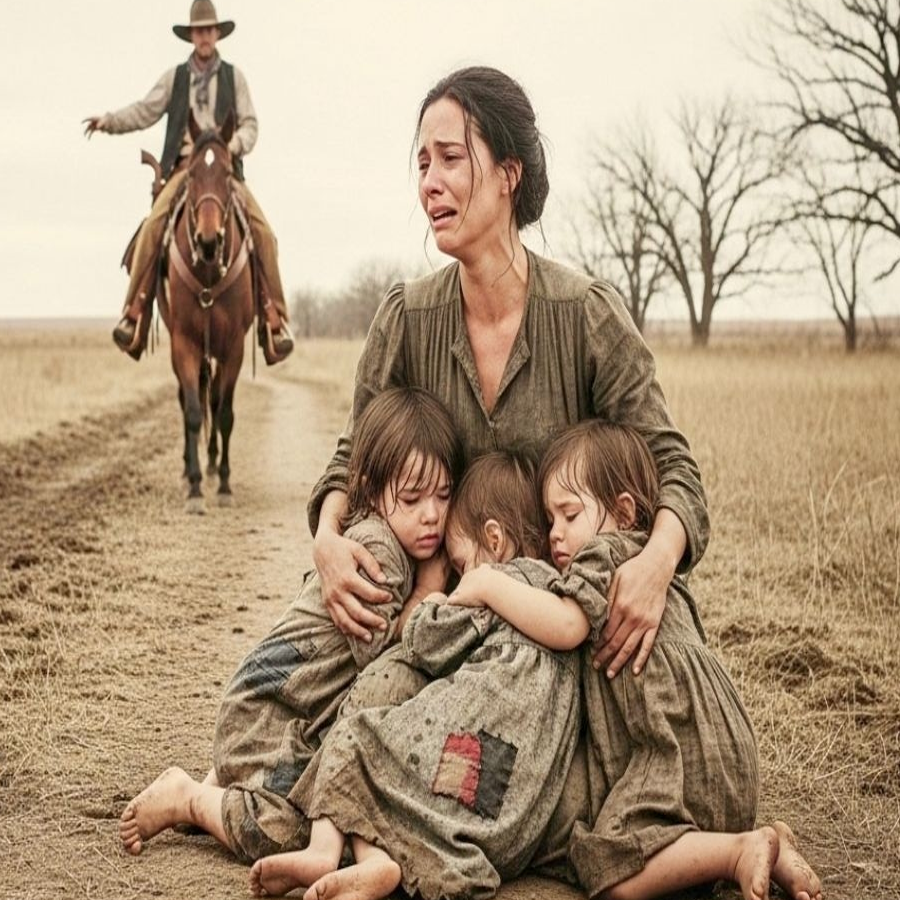
Eleanor Hayes dropped to her knees in the middle of the Kansas Trail, her baby still pressed against her chest. She hadn’t eaten in two days. The mule was dead, the wagon wheel was split, and the last town had looked her straight in the eye and said, “We don’t feed widows for free.” Her daughter was shaking her arm.
Her son had stopped crying hours ago. Then she heard it. Hoof beatats one rider and the words he spoke next would change every life on that trail forever. If this story touches your heart, subscribe to our channel and stay until the very end. Drop a comment with the name of the city you’re watching from. I’d love to see just how far this story travels.
The first thing Caleb Turner saw was the buzzard. It circled low and lazy against the white sky. Patient the way only death could be patient. He pulled his horse to a stop. His hand tightened on the res. He wasn’t looking for trouble. Hadn’t looked for anything in over a year.
He rode because riding meant not standing still, and standing still meant thinking, and thinking meant remembering the two graves he dug with his own hands back in Abalene. But the buzzard circled again, and Caleb Turner, for all his wanting to be left alone, couldn’t ride past a circling buzzard without knowing what lay beneath it.
He nudged the horse forward. The trail bent around a shallow ridge, and that’s when he saw them. A woman on her knees in the dust. A baby clutched to her chest. A girl, maybe 10, pulling at the woman’s sleeve. A boy, maybe six, sitting perfectly still beside a broken wagon wheel, staring at nothing. Caleb didn’t move right away.
He studied the scene the way a man studies a river before crossing, looking for what might pull him under. The woman’s dress was torn at the shoulder. Her bonnet had fallen back. Her lips were cracked white and her arms trembled, but she did not let go of that baby. The girl looked up at him. Her eyes were wide and dry. No tears left.
Please, she said. One word. Caleb dismounted. His boots hit the dirt and he walked toward them slow. the way you’d walk toward a wounded animal that might bolt or bite. He crouched down in front of the girl. How long since she drank? The girl swallowed hard. Yesterday morning, she gave us the last of it. Caleb looked at the woman.
Her eyes were half open, but she wasn’t seeing him. She was somewhere past seen. He reached for his canteen, unscrewed the cap, held it toward the girl. Give your brother a drink first. Small sips, then you. The girl took it with both hands shaking. Caleb turned back to the woman. He pulled a second canteen from his saddle bag, the one he kept for the horse, and knelt beside her.
Ma’am, no answer. Ma’am, I need you to drink. Her lips moved, but nothing came out. He tipped the canteen gently. Water ran down her chin. She coughed. Then her throat worked, and she swallowed once. Twice, her eyes focused. She saw him. And the first thing she did was pull the baby tighter against her body. Caleb raised both hands, palms open.
I ain’t going to hurt you. I ain’t going to hurt them. She stared at him like she was trying to decide if he was real. My name is Caleb Turner. I got a cabin about 9 mi north. There’s a well, there’s shade. I can get you there before dark. She shook her head. I don’t I don’t take charity from it. Ain’t charity, ma’am.
It’s water and your children need it. That word children, it broke something open in her face. Her chin trembled. She looked at Lucy, who was helping Thomas drink. She looked at the baby in her arms, Noah, whose little fist was curled around the collar of her dress. “I can’t walk 9 miles,” she whispered. Caleb looked at the broken wagon, looked at the dead mule 50 yards back, already beginning to bloat in the heat.
Looked at the three children. I can carry them all, he said. She blinked. What? The children on the horse. I’ll walk beside. You ride or walk. Your choice. But we move now or that buzzard up there gets what it came for. Eleanor Hayes looked at this stranger, this scarred, sunburned man with dust in his beard and nothing soft in his face except his voice, and she made the hardest decision a mother can make. She trusted him.
[clears throat] “Lucy,” she said, “come here.” They moved slow. Caleb put Thomas and Noah on the horse first. The boy held the baby the way his mother must have taught him. Both arms wrapped tight, chin tucked down. Lucy walked beside the horse with one hand on its flank, studying. Eleanor walked. Caleb offered twice.
She refused twice. He didn’t offer again. He understood something about this woman without asking. She would crawl before she’d let a stranger carry her. The children were different. The children were survival. But her own body, her own legs, her own pain, those belonged to her, and she would not surrender them.
They didn’t speak for the first two miles. The sun beat down white and cruel, and the dust rose with every step. Caleb kept his eyes on the horizon and his hand on the horse’s bridal. Elellaner walked three steps behind, her breathing ragged, her shadow thin and bent on the ground beside her. Finally, Lucy spoke. “Mister.
” “Yeah.” “Are you a good man?” Caleb didn’t answer right away. “I’m trying to be,” he said. Lucy seemed to think about this. “My paw was a good man. He drowned.” Caleb’s jaw tightened. He kept walking. I’m sorry to hear that. Ma says God needed him. But I think the river just took him. Your ma is probably right.
Then why’ God let the river do it? Caleb pulled his hat lower. I don’t have an answer for that one. Lucy nodded like she’d expected as much. Nobody does, she said. They walked on. At mile four, Elellanar stumbled. She caught herself. One hand on her knee, the other pressed to her side. She stayed there, bent, breathing hard.
Caleb stopped the horse and turned around. He didn’t rush to her. Didn’t reach for her arm. He just waited. Eleanor straightened up. I’m fine. Yes, ma’am. Don’t look at me like that. Like what? Like I’m about to fall. Wasn’t thinking that. What were you thinking? Caleb pushed his hat back and wiped the sweat from his forehead with his sleeve.
I was thinking you’ve been walking on nothing but grit for about 30 miles, and grit don’t fill a stomach. He pulled a strip of dried beef from his saddle bag, held it out. She stared at it. “Take it,” he said. “It ain’t pride, it’s jerky.” Something flickered across her face, almost a smile. Not quite. She took it.
They kept moving. By mile 6, Thomas had fallen asleep against the horse’s neck. Noah cradled in his small arms. Lucy had stopped talking. The heat had stolen the last of her energy, and she walked now with her head down, feet shuffling. Caleb lifted her under the horse without asking.
“For people who needed help and hated needing it.” “Your girl’s strong,” Caleb said. She shouldn’t have to be. No, ma’am. But she is. Eleanor wiped her face with the back of her hand. Dust and sweat and something else. My name is Eleanor. Eleanor Hayes. My husband was William. He died 8 months ago trying to cross the Solomon River with a loaded wagon. Horse spooked. Current took him.
Caleb nodded. I tried to reach my brother and Lawrence. He wrote me back and said he didn’t have room. Her voice thinned. His house has six bedrooms. I know because I helped his wife pick the curtains. Caleb said nothing. Every town since then, same story. We ain’t got room for a widow with three kids.
Like we’re furniture somebody left on the road. Some people got small hearts. Some people got no hearts at all. She stumbled again. This time, Caleb did step forward. Not to catch her, just to stand close enough that if she fell, she wouldn’t hit the ground. She didn’t fall. She kept walking. 9 miles took them 4 hours.
The sun was sliding toward the horizon when Caleb’s cabin came into view. It wasn’t much. rough cut timber, a tar paper roof, a well with a rope and bucket, a small corral where a second horse stood watching them approach, but it had walls and shade and water. Eleanor stopped at the edge of the property. This yours, such as it is.
You live alone? I do. She looked at the cabin, looked at her children on the horse, looked at him. Why’d you stop? She asked. Ma’am. On the trail. A lot of men would have ridden past. Caleb took a long breath. I nearly did. What stopped you? Your girl. She was pulling your arm, trying to wake you up. And I thought, he paused.
I thought I’ve seen that before. A child trying to wake someone who might not get up. Eleanor’s breath caught. Your wife, my daughter. His voice went flat and quiet. Kalera. She was three. My wife went two days later. I buried them both in the same week. The air between them changed. Not warmth, not pity, something harder than both.
Recognition. The understanding of someone who knows what it means to keep breathing. when breathing is the crulest thing the body does. I’m sorry, Elellanar said. So am I. He turned toward the cabin. Wells out back, buckets clean. I’ll get the children down and you can wash up inside. There’s beans and cornbread from this morning.
It ain’t much. It’s more than we’ve had in 3 days. Inside the cabin, Eleanor fed the children first. She always fed them first. That was the law she’d written in her own bones. They eat, then she eats. If there’s not enough, she doesn’t eat. It wasn’t sacrifice. It was mathematics. Her body could take more punishment.
Theirs couldn’t. Noah ate with both fists. Thomas ate slow and careful, watching Caleb the whole time with eyes that were too old for six years. Lucy ate nothing. Lucy. Elellanor said. Eat. I ain’t hungry. You haven’t eaten since yesterday. Neither of you. Eleanor looked at her daughter, 10 years old and already arguing like a grown woman.
William’s stubbornness in that jaw, her own fury in those eyes. Eat, Elellanor said again. Softer this time. Lucy picked up the cornbread, took a bite, chewed slowly. Caleb stood by the door, arms crossed. He hadn’t sat down, hadn’t eaten. He watched them like a man watching something he’d forgotten existed. A family sitting at a table sharing food.
Mr. Turner, he looked at Eleanor. Sit down. Eat your own food. I’m all right. You carried three children 9 miles in this heat, and you haven’t drunk water since you gave me yours. Sit down. He almost smiled. He sat. They ate in silence for a while. The kind of silence that comes after survival, thick and heavy and full of things nobody’s ready to say yet.
Thomas finally spoke. Mister. Yeah, son. You got a dog? No. How come? Caleb looked at the boy. Never thought about it. We had a dog. His name was Jack. He ran off after P died. Dogs do that sometimes. Ma said he was looking for P. Caleb glanced at Eleanor. She was staring at her plate. Maybe he was, Caleb said. Thomas nodded.
Went back to eating. And something in that small exchange, a boy, a stranger, and a dog that wasn’t there, cracked open a silence that had been locked shut in that cabin for over a year. After the children slept, Caleb stepped outside. Eleanor followed. The sky had turned deep purple, and the first stars were pushing through.
The heat was finally breaking, just barely, and a thin wind moved across the grass. “I’ll sleep in the barn,” Caleb said. “You and the children take the cabin. I can’t put you out of your own home. It ain’t putting me out. I’ve slept in worse. That don’t make it right.” He looked at her in the fading light. She looked 10 years older than she probably was, sunburned and hollow cheicked and wire thin.
But she stood straight, shoulders back, chin level. Mrs. Hayes. Eleanor. Eleanor, I ain’t looking for anything from you. I don’t expect work or company or gratitude. You and your children can stay until you’re strong enough to decide what comes next. That’s all this is. She studied him for a long time. Why? Because I had a family once and when they died, not a single soul offered me a meal or a roof or a kind word.
Whole town just stepped around me like grief was catching. His voice didn’t crack. It didn’t rise. It stayed level and low. And that was worse because it meant the pain had been carried so long. It had gone smooth like a riverstone. I won’t do that to someone else, he said. That’s all. Elellanar crossed her arms against the cooling air.
How long you been alone? Year and a half. Does it get easier? No, ma’am. You just get used to it. She nodded slow. That’s what I was afraid of. They stood there a while longer. Two people on the edge of a Kansas evening. Neither one touching the other. neither one walking away. “Thank you,” Ellaner said finally, “for stopping.
“Thank you for letting me.” She went inside. He went to the barn, and for the first time in 18 months, Caleb Turner fell asleep, knowing there were people breathing under his roof. Morning came fast and hot. Elellaner woke before the children. She always did. It was habit now, rising in the dark, checking their breathing, counting their heartbeats through the thin blankets. Three alive, three still here.
She stepped outside and found Caleb already at the well pulling water. He looked up. Morning. Morning. Coffeey’s on the stove. Hope you don’t mind. I came in quiet to start the fire. I didn’t hear you. That was the idea. She looked at him, this [clears throat] man who moved through his own house like a guest so he wouldn’t wake her children.
Mr. Turner, Caleb, Caleb, I need to say something and I need you to hear it straight. He set the bucket down, gave her his full attention. I’m not looking for a husband. I’m not looking for a father for my children. I’m not looking for rescue. I’ve been rescued before and it always comes with a price. He nodded. I hear you. I need work.
I need wages. If you’ve got work on this property, I’ll earn my keep. But I won’t owe a man anything ever again. William left debts I didn’t know about. That’s half the reason I’m on this trail. What kind of work you know? I can cook, mend, wash, garden, tan hides, dress a deer, set a snare, birth a calf, and keep books.
I ran our homestead for 2 years while William rode contract work. Caleb raised an eyebrow. You can birth a calf breach alone in a snowstorm. All right, then. He picked the bucket back up. I’ve got 60 acres, 12 head of cattle, a hen house that’s falling apart, and a garden I planted wrong because I don’t know a thing about growing food.
I’ve been eating beans and jerky for 6 months. That ain’t living. No, ma’am, it ain’t. So, so if you want work, I’ve got more than I can handle. I’ll pay fair. You and the children stay as long as you want. You leave when you’re ready. No questions. Eleanor looked at the land flat and wide and brutal under the rising sun. The kind of land that broke people.
The kind of land that made people. One condition, she said. Name it. You eat meals with us. No more standing by the door like a stranger in your own house. Caleb looked at her. Really looked at her and something moved behind his eyes. something old and buried and startled to find itself still alive. “Yes, ma’am,” he said.
Word traveled fast in small places. By noon, the whole territory seemed to know. Caleb Turner, the man who hadn’t spoken to anyone in town for a year, had brought home a widow with three children. Old Hattie Dawson heard it from the feed store clerk. He carried them off the trail. Three little ones and her half dead from walking. Hadtie shook her head.
That man’s got more hurt in him than sense. Maybe that’s why he done it. Or maybe he’s just fool enough to think he can fix what broke him. At the general store, a different conversation. Silus Granger leaned on the counter, rolling a coin between his fingers. Turner still ain’t got a real deed on that land, does he? The clerk shrugged. Filed a claim.
Hasn’t been surveyed proper. Interesting. Granger pocketed the coin. 60 acres of prime grazing land held by a man who can barely hold a conversation. He ain’t bothering nobody, Silas. He’s bothering me. That land connects my east range to the creek. I need it. Then make him an offer.
Granger smiled thin and cold. I intend to. Back at the cabin, Elellanar had already started. She cleared out the hen house by midm morning, repaired two of the nesting boxes with scrap wood she found behind the barn, set Lucy to collecting eggs. Only four, but four more than yesterday. Thomas, she put to weeding the garden. But Ma, I don’t know what’s a weed.
If it ain’t corn, pull it. What if it’s a flower? Flowers don’t feed babies. Pull it. Thomas sighed and got to work. Noah she kept on her hip while she inspected the garden. Caleb hadn’t lied. He’d planted wrong. Rose too close. Corn next tomatoes which would shade them out. Beans with no poles to climb.
She shook her head. You really don’t know the first thing about growing food. Caleb was mending a fence 20 ft away. He didn’t look up. I know how to grow cattle. Cattle don’t need straight rows. That’s why I like them. Elellaner almost laughed. She caught it in her throat and pushed it down, surprised by it. The reflex of joy.
It had been so long she almost didn’t recognize it. She replanted the beans before lunch. Lunch was salt pork, biscuits, and the four eggs scrambled together. Eleanor made Caleb sit at the table. He did, but he sat at the far end like he was still getting used to the idea that someone else was in the room. Lucy watched him across the table.
Mr. Turner. Miss Lucy, how’d you get that scar? Eleanor put down her fork. Lucy, that ain’t polite. It’s all right, Caleb said. He touched the line that ran from his left ear to his jaw. Horse threw me into a fence post 3 years ago. Did it hurt like the devil. Did you cry? I don’t recall. P said men don’t cry, but I saw him cry when Noah was born. He said it was dust.
Caleb looked at the girl, steady and unblinking. “Your paw sounds like he was honest when it counted.” Lucy smiled, small and quick, and gone. “He was,” Thomas looked up from his plate. “Are we going to live here now?” The table went silent. Eleanor looked at Caleb. Caleb looked at Eleanor. “We’re staying for a while,” Eleanor said carefully.
How long’s a while? As long as we need. I like it here, Thomas said. It’s quiet. Nobody yells. Something passed across Caleb’s face. He stood up and took his plate to the basin. I’ll be in the barn, he said, and walked out. Elellanor watched him go. She understood. The boy had said something ordinary and it had hit Caleb like a fist because ordinary was exactly what he’d lost.
Quiet meals, a child’s voice at a table. The small devastating normaly of being needed. She cleared the dishes and did not follow him. Some things a man had to walk through alone. That evening, Eleanor put the children to bed early. Thomas fell asleep in minutes. Noah was already gone, curled on the mattress like a small, warm stone.
Lucy lay awake, staring at the ceiling. Ma? Yeah, baby. Is he sad? Who? Mr. Turner. Eleanor stroked her daughter’s hair. I think so. Because of his family? Yeah. Are we going to make him sadder being here? Eleanor’s hands stilled. Why would you think that? Because we remind him of what he lost. 10 years old, asking questions that would break a philosopher.
Maybe at first, Eleanor said, but sometimes being reminded is what brings you back. Back from where? From the place you go. when you stop letting people in. Lucy turned on her side. I think he’s nice. I think so, too. P would have liked him. Eleanor closed her eyes. Yeah, he would have.
She waited until Lucy’s breathing slowed, then stepped outside. Caleb was on the porch. He hadn’t gone to the barn after all. He was sitting on the step whittling something small. He didn’t look up when she sat beside him. “Kids asleep?” he asked. “All three.” “Good.” The night was wide and dark and full of stars.
Somewhere a coyote called out once and then fell silent like even the animals knew better than to disturb this particular quiet. “My daughter asked if we’re making you sadder,” Eleanor said. Caleb’s knife stilled. Being here, he was quiet for a long time. This morning, he said, I woke up and heard a child laughing. Thomas was chasing a hen around the yard and I stood in that barn and I couldn’t move because for just a second, one second, I thought it was my Emma.
Eleanor didn’t touch him. Didn’t reach for his arm. She just sat there close enough that he could feel the warmth of another person, which is sometimes the only medicine that matters. Then the second passed, Caleb said, and it was just a boy chasing a chicken. And I was glad, not because it wasn’t Emma, but because a child was laughing on this land again. He went back to whittling.
You ain’t making me sadder, Eleanor. You’re making this place remember what it was supposed to be. She sat with him until the stars moved. Neither spoke, neither needed to. Then she went inside and he went to the barn, and the cabin held four sleeping souls instead of one. And somewhere out in the dark Kansas night, a man named Silas Granger was drawing up papers to take it all away.
3 days passed before Silus Granger made his move. Elellanar was hauling water from the well when she saw the rider coming up the south trail. She set the bucket down and wiped her hands on her apron. The horse was too fine for a ranch hand, the saddle too polished. The man sitting on it too clean for anyone who worked honest ground.
She called out without turning her head. Caleb. He came around the side of the barn, hammer still in his hand. He saw the rider and stopped. You know him? Eleanor asked. Silus Granger, cattle broker, owns most of the range east of here. What’s he want? Nothing good. Granger pulled up 20 ft from the well and smiled down at them like a man inspecting livestock he intended to buy cheap.
Turner. He tipped his hat. Ma’am. Caleb didn’t move. Granger. Heard you got company. thought I’d pay a neighborly visit. You ain’t my neighbor. Granger laughed, short and dry. Well, not yet. He swung down from his horse, slow and deliberate. Took his time pulling off his gloves. Nice little place you got here.
60 acres, right? You know what it is. I do. I also know your claim ain’t been surveyed proper. filed it with the territory office, sure, but no survey, no witness marks, no formal deed. Caleb’s hand tightened on the hammer. I filed legal. You filed paper. Paper ain’t land, Turner. Paper’s just paper until a judge says otherwise.
Granger looked around the property. His eyes moved from the cabin to the garden to the hen house. Then they landed on Lucy, who was standing in the doorway holding Noah. Cute kids, he said. Yours? They’re under my roof. That ain’t what I asked. Eleanor stepped forward. They’re mine. Granger looked at her for the first time. Really looked at her.
He took her in the way a man takes in a hand of cards, calculating what she was worth and what she might cost. Mrs. Hayes. Mrs. Hayes, you the widow from the trail? News travels fast. In Kansas, ma’am, news is about all that does. He smiled again. Well, I won’t take up your time. Just wanted to introduce myself and let Mr.
Turner here know that I’ll be filing a counter claim on this parcel with a territory office in Hayes City. My surveyor will be out next week. Caleb took a step toward him. You got no right to this land. I got money, Turner. Out here, that’s better than right. Get off my property. See, that’s the question, isn’t it? Granger put his gloves back on, one finger at a time.
Whose property is it? He mounted his horse, tipped his hat at Eleanor. Ma’am, pleasure. He rode out the way he came, slow, like a man who had all the time in the world because he’d already decided how this ended. Eleanor watched him go. “He can’t do that, can he?” Caleb didn’t answer. He turned and walked into the barn.
She followed. “Caleb, can he take this land?” He set the hammer down on the workbench. His hands were shaking, not from fear, from the kind of anger that comes when a man who’s lost everything sees the last thing he has being measured for a coffin. The claim’s legal, but Grers’s right about one thing. I never got it surveyed.
Cost money I didn’t have, and without a survey, a counter claim can tie it up in the territory court for months, maybe longer. And while it’s tied up, he moves cattle onto the land, builds fence, makes improvements, then argues possession. That’s theft. That’s Kansas. Elellanor crossed her arms.
So, what do we do? Caleb looked at her. That word we landed on him heavier than he expected. You don’t have to do anything. This ain’t your fight. I’m standing on this land. My children are sleeping under this roof. That makes it my fight. Eleanor, don’t. Don’t tell me to stand aside while some man in a clean hat takes the only safe place my children have had in eight months. Caleb stared at her.
The anger in her voice wasn’t loud. It was low and steady and ancient. The anger of a woman who had been pushed past every limit and had nothing left to lose except the people she’d die for. “All right,” he said. Then we need a survey and we need it fast. How much? $20, maybe 25. I’ve got six. I’ve got 11. That ain’t enough. No, it ain’t.
They stood in the barn, the silence between them full of math that didn’t add up and a deadline that wouldn’t wait. Lucy appeared in the doorway. Ma Thomas found something in the garden. Eleanor looked at Caleb one more time. We ain’t done talking about this. No, ma’am. We ain’t. She went out. Caleb stayed.
He put both hands on the workbench and leaned there, head down, breathing slow. He’d come to this land to disappear. Now the land was disappearing instead. And for the first time in a year and a half, he cared about something enough to fight for it. That scared him more than Granger ever could. That night after supper, Thomas brought a dead snake to the table.
Found it in the garden. I killed it with a stick. Eleanor grabbed him by the collar. Thomas William Hayes, you put that outside right now. But Ma, it was by the beans. Outside now. Thomas trudged to the door, holding the snake by its tail like a trophy he’d been robbed of. Lucy shook her head. He’s going to be trouble.
He’s already trouble. Caleb pushed his plate back. It was a bullsnake. Harmless. They keep the rats out. Eleanor looked at him. You telling me I should let my son keep a dead snake? I’m telling you the snake was doing you a favor. The snake is dead and your rat problem just got worse. Eleanor stared at him for a long beat.
Then she laughed. Not the almost laugh from before, a real one. It came up from somewhere deep and surprised them both. Caleb looked at his plate like he didn’t know what to do with the sound of a woman laughing in his kitchen. “I forgot what that sounds like,” he said quietly. “The laughter died, but not the warmth that caused it.
” “I forgot, too,” Eleanor said. Thomas came back inside, snakeless, and sat down hard. Can I have more biscuits? You just carried a dead reptile through my kitchen. But I put it outside like you said. Did you wash your hands? Thomas looked at his hands, looked at Eleanor, looked at the biscuits. I’ll wash them now.
You’ll wash them twice. He went to the basin, muttering something about snakes being cleaner than people. Caleb caught Elellanar’s eye across the table, and something passed between them. Not romance, not desire, but the simple, staggering recognition that this was what a family sounded like, and both of them had been starving for it.
The next morning, Caleb rode to town. He didn’t tell Elellanar where he was going. He said he needed supplies and he’d be back by afternoon. She didn’t ask more. She was learning the shape of his silences. Which ones meant thinking, which ones meant hurting, and which ones meant he was about to do something he hadn’t decided about yet.
Hey city was 9 mi east, a dust choke collection of buildings clinging to the railroad like ticks on a dog. Caleb hadn’t been there in 4 months. Last time was for salt and nails. time before that flower. [snorts] He bought what he needed and left without speaking to anyone, which was exactly how he liked it. Today, he went to the land office.
The clerk was a thin man named Puit, who wore spectacles too small for his face and spoke like every word cost him money. Turner, haven’t seen you in a while. I need my claim surveyed. That cost $25. I know what it costs. You got $25? Caleb put $17 on the counter. Every cent he and Eleanor had between them minus the grocery money.
Puit looked at the money, looked at Caleb. That’s 17. I can see that. Surveys 25. I’ll have the rest within the week. I can’t schedule a surveyor on credit. Turner policy. Granger filed a counter claim on my land. Puit’s expression changed just barely. A flicker of something. Maybe sympathy. Maybe just the recognition of a story he’d seen play out too many times.
Wendy file. Don’t know. He came to my property yesterday. Told me his surveyor would be out next week. Puit took off his spectacles and cleaned them on his shirt. Grangers filed three counter claims this year. One, two of them. Both times, the original claimant didn’t have a formal survey.
I’m not leaving my land. Nobody’s saying you have to, but without a survey, a judge will look at two claims and side with whoever’s got more documentation. Granger’s got a lawyer in Topeka. You got $17. Caleb’s jaw worked. How long do I have? If he files formal, the territory court will schedule a hearing. Could be 30 days, could be 60, depends on the judge.
And if I get the survey done before the hearing, then you’ve got standing. Legal standing. A surveyed claim with witness marks beats a counter claim nine times out of 10. So, I need eight more dollars. You need eight more dollars. and you need them before Granger Surveyor stakes his version of your property line.
Caleb picked up the $17, put it back in his pocket. I’ll be back, he said. Turner. He stopped at the door. For what it’s worth, I think your claim’s good. I processed it myself. But good and legal ain’t always the same thing out here. Caleb put his hat on and walked out into the white Kansas sun. $8. $8 between keeping his land and losing everything.
He mounted his horse and sat there for a moment, looking down the main street of Hayes City. the general store, the saloon, the feed shop, the church with its crooked steeple, a town full of people who’d stepped around him for a year and a half while he grieved alone. He thought about riding to the saloon. There were men in there who owed him favors, small ones.
A fence mended here, a calf pulled there. But asking for money was different than asking for help. Money changed things. between men. Then he thought about Eleanor standing in his barn with her arms crossed and her voice low and steady, saying, “That makes it my fight.” He turned the horse toward home. Elellaner saw it in his face the moment he rode in.
She was on the porch mending Thomas’s shirt. The boy tore everything he wore within 48 hours. And she set the needle down and watched Caleb dismount and lead the horse to the corral without looking at her. She waited. He came to the porch. Survey cost 25. We’ve got 17. Eight short. Puit won’t schedule on credit. Can we earn it in a week out here? He sat down heavy on the step.
I could sell the second horse, but then I can’t work cattle. Lose the horse, lose the herd. Lose the herd, lose the land anyway. What about the cattle? Sell one head. Markets in Dodge, 60 m, 3 days round trip. And if Granger Surveyor shows up while I’m gone, I’ll be here. Caleb looked at her. you’ll be here. A woman standing on claimed land with three children ain’t nothing.
A woman standing on claimed land with a loaded rifle is a legal presence. I know the law. Caleb William taught me. He stared at her for a long time. You’d hold this place alone. I held a homestead alone for 2 years. I birthed the calf in a blizzard. I buried my husband in frozen ground with a shovel I could barely lift.
Her voice didn’t waver. I can hold a cabin for 3 days. Something shifted in Caleb’s face. Not admiration, something deeper. The recognition that this woman wasn’t brave because she had no fear. She was brave because she was terrified and she stood up anyway. All right, he said. I’ll leave it dawn. Take the best steer.
Should bring 12, maybe $15 at the Dodge Stockyard. That more than covers the survey and buys us time. Eleanor picked up her mending. Caleb. Yeah. Come back. He looked at her. I will. I mean it. Don’t decide somewhere between here and Dodge that we’d be better off without you. Don’t talk yourself into riding the other direction.
I’ve watched you think about leaving. I’ve seen it in your eyes at least twice since we got here. He was quiet. I ain’t wrong, am I? No, he said, you ain’t wrong. So, promise me. I don’t make promises. Then make this one. The evening air moved between them. Somewhere Thomas was laughing.
a high wild sound of a boy chasing something only he could see. I’ll come back, Caleb said. All right, Eleanor. Yeah, keep the rifle loaded. It’s been loaded since the day I got here. He almost smiled again. It was getting closer to his face every time, like a man remembering how the muscles worked. He left before dawn.
Eleanor heard him go. The creek of the barn door, the low murmur of his voice talking to the horse. The soft thud of hooves moving south. She lay in the dark and listened until the sound disappeared. Then she got up, lit the stove, started coffee. The rifle she placed by the front door. Lucy woke next. Where’s Mr.
Turner? He had business in Dodge. He’ll be back in 3 days. Lucy’s eyes went to the rifle. Ma, yeah. Is that man coming back? The one with the clean hat? He might. What do we do if he does? Elellanar poured two cups of coffee, handed one to her 10-year-old daughter, who took it like it was the most natural thing in the world. We do what Hayes women do.
What’s that? We don’t move. Day one alone passed quiet. Eleanor worked the garden, fed the chickens, checked the remaining cattle in the near pasture. Thomas helped carry water. Lucy kept Noah in the shade and read to him from the only book they had, a water-damaged Bible with half of Genesis missing. Nobody came. Day two was different.
Eleanor was at the well just past noon when she saw dust on the south trail. Her hand went to her hip before she remembered the rifle was by the door. She walked to the cabin, not running. Running told a visitor you were scared. Walking told them you had time because you had a plan. She picked up the rifle and stepped onto the porch.
It wasn’t Granger. It was a woman, old, hunched, driving a mule cart loaded with burlap sacks. She pulled up in front of the cabin and squinted up at Eleanor through eyes half-closed against the sun. You the widow Turner brought home. Eleanor didn’t lower the rifle. Who’s asking? Hattie Dawson. I live 4 miles west. I bring eggs and gossip, and today I got both.
Eleanor studied her. 65 if she was a day. hands like leather, a face that had been arguing with the Kansas wind for decades and losing gracefully. She lowered the rifle. “Come in.” Had he climbed down from the cart with a groan, “Lord, my knees. I told the Almighty when he made me, he should have used better hinges.
” She came inside and sat at the table like she’d been there a hundred times. “Coffee?” Eleanor asked. If it ain’t too much trouble, it ain’t. Eleanor poured. Hatty drank, looked around the cabin. He’s cleaned up. Place was a tomb last time I was here. After Ruth and little Emma passed, he boarded up the windows for a month.
I brought him soup, and he left it on the porch until it rotted. You knew his wife. Knew her well. Good woman, strong. Loved that man beyond reason. Hattie set down her cup. Kalera took half the settlements that summer. Ruth went first, then the girl two days later. Caleb dug both graves himself. Wouldn’t let nobody help. Stood out there in the rain for 3 hours after just staring at the dirt.
Eleanor sat down across from her. Why are you telling me this? Because you need to know what you’re standing next to. That man ain’t broken, but he’s cracked deep. And cracked things can go one of two ways. They either heal stronger or they shatter complete. He’s been kind to us. Oh, I know he has. That’s what worries me.
Why would kindness worry you? Happy leaned forward. Because Caleb Turner spent a year and a half building a wall around himself so thick a cannonball couldn’t crack it. Then you showed up with three children and walked right through it. And now he’s out there feeling things again. Things he swore he’d never feel. And if this goes wrong, if you leave, if Granger takes this land, if something happens to one of those babies.
She didn’t finish. She didn’t have to. I ain’t going anywhere. Eleanor said. That’s what Ruth said, too. The words hung in the air. Heavy and cruel and true. Eleanor set her jaw. I ain’t Ruth and I ain’t dying. Jav looked at her for a long time. Then she nodded slow. No, no, I don’t think you are. She stood up.
I brought you flour, salt, and a side of bacon. It’s in the cart. Consider it a welcome gift. I can’t take. You can and you will. I’ve been feeding strays for 40 years. Adding four more ain’t going to break me. She walked to the door, stopped. One more thing. Yeah. Silus Granger came by my place yesterday, asked about you, how many children you got, whether Turner married you, whether you had any legal claim to this property.
Ellaner’s blood went cold. What’d you tell him? I told him to mind his own business, but that man don’t have business. He has appetites, and right now he’s hungry for this land. Caleb’s gone to Dodge to sell a steer for the survey money. Hadtie nodded. Then he better ride fast because Granger surveyor was seen heading this direction yesterday.
She climbed back into her cart. Keep that rifle where you can reach it, Mrs. Hayes. Ellaner. Elellaner. Hadtie picked up the res. You’re tougher than you look. Don’t let nobody tell you different. She drove off. Elellaner stood on the porch, the rifle in her hands, watching the dust settle. 2 days until Caleb got back. Granger’s surveyor was already coming.
She looked at Lucy in the doorway. “Get your brother,” Elellanar said. “We got work to do.” They spent the afternoon marking the property. Eleanor didn’t have survey tools, but she had William’s old compass and the description from Caleb’s original filing. She’d found it in a tin box under the bed.
60 acres bounded north by the creek, south by the old wagon road, east by the lightning split oak, west by the stone outcrop. She walked every inch of it. Lucy carried stakes, sharpened sticks she’d cut from a fallen cottonwood. Thomas carried the hammer. At each corner, Eleanor drove a stake into the ground. “Ma, what are we doing?” Marking what’s ours.
It ain’t ours. It is tonight. They finished by sunset. Four stakes, four corners. 60 acres of Kansas dirt held together by a woman with a compass and a fury that hadn’t even started to burn. That night she couldn’t sleep. She sat at the table with a rifle across her lap and the land filing spread in front of her, reading it over and over like scripture.
Lucy came out in her night gown. Ma, come to bed in a minute. You always say that. Lucy sat down across from her. You’re scared. I ain’t scared. Your hands are shaking. Eleanor looked down. They were. Being scared and being ready ain’t the same thing, she said. What are you ready for? Whatever comes through that door.
Lucy reached across the table and put her small hand on her mother’s. Whatever comes through that door has to get through both of us. Eleanor looked at her daughter, 10 years old. 10 years old and already made of iron and heartbreak and something that hadn’t been named yet because the world didn’t have a word for what women built when everything was taken from them.
Go to bed, Lucy. Come with me in a minute. Promise? I promise. Lucy went back to bed. Eleanor sat alone in the dark cabin, listening to her children breathe, counting the hours until dawn. At first light, the surveyor came. He rode in with a chain and a compass and a leather case full of documents. And behind him, half a mile back, came Silas Granger on his fine horse, smiling like a man who’d already won.
Eleanor stepped off the porch with the rifle in her hands. That’s far enough, she said. The surveyor pulled his horse up short. He was a young man, maybe 25, with a sunburn across his nose and the nervous look of someone who hadn’t expected to find a rifle pointed at his chest before breakfast. “Ma’am, I’m just here to I know what you’re here to do.
” Granger wrote up beside the surveyor, easy and unhurried. He looked at Eleanor the way a man looks at a fence post he intends to pull out of the ground. Mrs. Hayes, put that rifle down before you hurt yourself. I know how to use it, Mr. Granger. My husband taught me to shoot a coyote at 80 yard. You’re standing at 20. Granger’s smile thinned.
This is a legal survey, ma’am. Authorized by the territory office. This land has a filed claim under Caleb Turner’s name. You want to survey it, you do it when the claimant is present. The law don’t require the claimant’s presence for a survey. Maybe not, but decency does. And I reckon the territory judge in Hayes City would be real interested to hear that you surveyed a man’s land while he was away without notice, without witness.
Granger’s jaw tightened. The surveyor shifted in his saddle. Mr. Granger, maybe we should come back when, Shut up, Perkins. Granger dismounted. He walked toward the porch, slow, hands at his sides. He stopped 10 ft from Elellaner and looked up at her. You think you’re clever? I think I’m standing on my ground. It ain’t your ground.
It ain’t even Turner’s ground. Not legally. Not until a survey says so. Then I guess we both got a problem because I ain’t moving and you ain’t surveying. Granger looked past her through the open cabin door. Lucy was standing inside holding Noah, watching through the gap with wide eyes. Thomas was behind her, gripping the doorframe.
Your children are watching, Mrs. Hayes. Good. They need to see what it looks like when a woman don’t back down. Something flickered across Granger’s face. Not fear, calculation. He was reccalibrating. He’d expected an empty cabin, a simple walkthrough, stakes in the ground, and paperwork filed before Turner got back from Dodge.
Instead, he’d found a woman with a rifle, and a mouth that wouldn’t quit. He stepped back. “All right,” he put his gloves on. “We’ll come back with the sheriff. You do that. And while you’re at it, tell the sheriff I’ve got Caleb Turner’s original filing right here on this table. Every boundary marker described.
Every corner staked as of yesterday. Granger stopped. You staked the property? All 60 acres. Compass bearings match the filing description. That ain’t a legal survey. It ain’t. But it’s evidence of continuous habitation and improvement by the original claimant, and any judge west of Topeka will recognize that.
” Granger stared at her long and hard and cold. “Who are you?” “I’m a widow with three children and a rifle, and you’re on my porch without an invitation.” He turned away, mounted his horse, looked down at her one final time. This ain’t over, Mrs. Hayes. No, sir, it ain’t. He rode out. The surveyor followed, looking back once over his shoulder like a man who wanted to apologize, but didn’t dare.
Eleanor stood on that porch until they were nothing but dust on the horizon. Then her knees buckled. She grabbed the porch rail. The rifle slipped from her hands and clattered against the boards. Her whole body shook, a violent trembling that started in her hands and moved through her like a wave. Lucy was beside her in seconds. Ma. Ma, sit down.
I’m all right. You’re not. Sit. Eleanor sat on the step, put her head between her knees, breathed. Did I just point a rifle at the richest man in the territory? Yes, ma’am, you did. Eleanor looked at her daughter. Your father would have had a heart attack. P would have been proud. Eleanor pulled Lucy against her and held on.
Held on like the girl was an anchor and the ground was trying to spin away beneath her. Thomas appeared in the doorway. Ma, are the bad men gone? They’re gone, baby. Are they coming back? Eleanor looked out toward the trail. Yeah, she said. They’re coming back. She stood up, picked up the rifle, but so is Caleb. She prayed she was right about that.
60 mi south, Caleb Turner was arguing with a cattle buyer named Dee Morrison, who had a face like a fist and a wallet he guarded like a firstborn child. $8 for a prime steer. That’s robbery. That’s the market, Turner. Prices are down. Railroads got beef coming in from Texas at half the cost. This is a Kansas raised steer.
Grainfed, healthy. I can see that. And I’m offering eight. 12 9 11. Deak spat in the dirt. 10. Final. Caleb looked at the steer. A good animal. Strong. the kind of animal a man raises, right? Because it’s the only honest work he knows. 10, he said. Dee counted out the bills. Caleb folded them into his shirt pocket and buttoned it shut.
Pleasure doing business, Dee said. It wasn’t, but Caleb didn’t say so. He mounted his horse and turned north. $10 plus the 17 he already had 27. enough for the survey with $2 to spare. He should have felt relief. Instead, he felt a pull in his chest that had nothing to do with money. He’d been gone 2 days, the longest he’d been away from the cabin since Elellanar and the children arrived.
And somewhere in the back of his mind, the part he kept locked and quiet, a voice was saying things he didn’t want to hear. You could keep riding south, west, anywhere. Leave the money with Puit. Send word to Elellanar. She’s strong enough. She’ll manage. You don’t have to go back. You don’t have to feel this. He rode for an hour with that voice in his head.
Then he thought about Thomas at the table, asking if they were going to live there now. He thought about Lucy handing him coffee like he was already part of her world. He thought about Noah reaching for his finger one morning and gripping it with a strength that made no sense for something that small. And he thought about Ellaner standing in his barn, saying, “Come back.
” Not asking, telling. He kicked the horse into a gallop. He rode through the night, pushed the horse harder than he should have, stopped once at a creek to let the animal drink, then mounted again, and kept going. The stars wheeled overhead, and the prairie stretched out black and endless in every direction, and he rode through it like a man chasing something he was terrified to lose.
He reached the cabin at dawn. Elellanar was on the porch, rifle in her lap, coffee in her hand. She hadn’t slept. He could see it in her face, in the bruised half moons beneath her eyes. She saw him come over the rise and stood up. He dismounted at the corral, led the horse in, pulled the saddle off. His hands were moving automatic, but his eyes kept going to her, standing there on the porch waiting.
He walked to her. “You’re early,” she said. I rode through the night. Why? He reached into his shirt pocket, pulled out the $10, held it up. Got 10 for the steer. That gives us 27. Enough for the survey. Eleanor took the money, looked at it, then looked at him. Granger came yesterday. Caleb’s face hardened with a surveyor.
What happened? I stopped them. How? I stood on the porch with a rifle and told them to leave. Caleb stared at her. You pointed a rifle at Silus Granger. I pointed a rifle in the general direction of Silus Granger. There’s a difference. Eleanor. He left. The surveyor left. They’ll be back with the sheriff, but I bought us time.
Caleb put both hands on the porch rail, leaned there, let out a breath that sounded like it came from the bottom of a well. You could have been hurt. I could have been a lot of things. What I was was standing on this land with your filing papers on the table and your property staked at all four corners. He looked at her.
You staked the property. Compass bearings from your original filing. Every corner marked with what? Cottonwood stakes and stubbornness. He stood there looking at this woman who’d been half dead on a Kansas trail a week ago and was now defending his land with a rifle and a compass and a will that would have made Iron jealous.
I’m going to Hay City today, he said. I’m paying for that survey. Not alone. You’re not, Eleanor. If you walk into that land office alone, it’s one man filing one claim. If I walk in with you, it’s a household, a family that carries weight with a judge, and you know it. We ain’t a family. The words hung between them, sharp and honest and stinging.
Eleanor’s face didn’t change. We ain’t, she agreed. But Granger don’t know that. And neither does the judge. Caleb searched her eyes. What are you saying? I’m saying we go together. We file together. We stand in that office together. And we make it clear that this land has people on it who ain’t leaving. And the children.
Hadtie Dawson. She came by yesterday. Brought flour and bacon and enough gossip to fill a library. She’ll watch them. Caleb was quiet for a long time. You’ve thought about this. I’ve done nothing but think for two days. Caleb, thinking is what you do when you can’t sleep and you’re sitting in the dock with a rifle wondering if you made the biggest mistake of your life trusting a man you met on a trail.
Did you make a mistake? She looked at him. You came back. I said I would. A lot of men say a lot of things. I ain’t a lot of men. No, she said, “You ain’t.” She went inside to wake the children. Caleb stood on the porch and watched the sun come up over his land, the land he’d almost ridden away from and felt something crack open in his chest that he’d spent a year and a half trying to brick shut. It hurt.
It was supposed to. They rode to Hadtie’s place first. The old woman took one look at the two of them, dusty, sleepdeprived, and grim-faced, and didn’t ask a single question. “Leave the children. I’ve got pie cooling in a barn full of kittens. They won’t even notice you’re gone.” Thomas was already running toward the barn.
“Thomas, mind your manners?” Eleanor called. “Yes, ma’am,” he yelled without slowing down. Noah went to Hadtie’s arms like he’d known her his whole life. Lucy stood by the horse watching Eleanor. You’re going to fight for the land. I’m going to file papers. Same thing. Eleanor kissed her daughter’s forehead. Stay with Mrs. Dawson.
Help with your brothers. Ma. Yeah. Don’t let them take it. Elellanar cuped her daughter’s face in both hands. I won’t. They rode to Hayes City. The land office was hot and small and smelled of ink and old paper. Puit looked up when they walked in. His eyes went from Caleb to Elellaner and back. Turner, back again.
Caleb put $25 on the counter. I want the survey scheduled today. Puit counted the money, nodded slowly. I can have a surveyor out by Thursday. That’s 4 days. That’s the earliest I’ve got. Grers’s already sent his own surveyor to the property. He’ll have documentation filed before Thursday. Puit leaned back in his chair.
A private survey don’t carry the same weight as a territory survey. Turner, you should know that. I do, but a judge might not look that carefully when Granger’s lawyer is standing in front of him with a stack of papers. Elellanar stepped forward. Mr. Puit, he looked at her. Ma’am, I’m Eleanor Hayes. I’m living on Mr.
Turner’s property with my three children. We’ve been there 10 days. In that time, we’ve repaired the hen house, replanted the garden, staked the property boundaries, and improved the cabin. All documented. Puit raised an eyebrow. Documented how. Eleanor reached into her pocket and pulled out a folded piece of paper. She’d written it the night before, a list of every improvement, dated and described in careful handwriting.
This is a record of improvements made to the property under the original claim. I’ve also got a copy of Mr. Turner’s original filing with boundary descriptions that match the stakes I placed at all four corners. Puit took the paper, read it, looked at Eleanor over his spectacles. You staked the property yourself with compass bearings from the filing.
Ma’am, that ain’t it ain’t a legal survey, I know, but it’s evidence of active habitation and improvement by parties associated with the original claimment, which is more than Silas Granger can show for land he’s never set foot on. Puit was quiet for a moment. Then he took off his spectacles and pinched the bridge of his nose.
You a lawyer, Mrs. Hayes? I’m a widow who lost everything and learned real fast how the law works when you ain’t got a man to speak for you. Puit looked at Caleb. Where’d you find this woman? On the trail. Well, she’s worth more than the $25 you just put on my counter. He picked up a pen. I’ll schedule the survey for Wednesday, one day early.
Best I can do. Wednesday works, Caleb said. One more thing. Puit pointed his pen at both of them. If Granger files before then, the territory court will set a hearing. You’ll need to appear, both of you, and you’ll need to make the case that this claim has been continuously occupied and improved. We’ll be there,” Eleanor said.
They walked out of the land office into the bright, hard Kansas sun. Caleb didn’t speak for a moment. He stood on the boardwalk and looked at Elellanor like he was seeing something new. Where’d you learn all that? William was bad with money, good with law. He read every territorial statute he could get his hands on.
Said a poor man’s only weapon was knowing the rules better than the rich man trying to break them. Smart man. He was right up until he tried to cross a flooded river. She said it flat. No bitterness, just fact. We need to get back, she said. I don’t want the children at Hadties too long. Eleanor. She stopped. What you did yesterday with Granger with the rifle? He paused.
Nobody stood up for me since Ruth died. I wasn’t standing up for you. I was standing up for the land. Same thing, she looked at him long and steady. Yeah, she said quietly. I guess it is. They mounted up and rode north. Wednesday morning, the territory surveyor arrived. His name was Fletcher, older man, methodical, with a transit scope and a chain and an assistant who barely looked old enough to shave.
Caleb walked the property with them. Eleanor stayed at the cabin with the children, watching from the porch. It took 4 hours. Fletcher measured every boundary, marked every corner with iron stakes, drove witness posts at the quarter sections, wrote everything down in a leatherbound book with a pencil so sharp it could have drawn blood.
When he was done, he stood in front of the cabin and handed Caleb a certificate. 60 acres as described in your original filing. Boundaries confirmed. Witness marks set. This is a legal survey, Mr. Turner. It’ll hold in any territory court. Caleb took the paper. His hands were steady, but something behind his eyes wasn’t.
Thank you. Fletcher tipped his hat and wrote out. Caleb stood there holding the certificate, just holding it. like a man holding proof that something real existed, that the ground under his feet was his legally, officially in writing. Eleanor came down from the porch. Is it done? It’s done. 60 acres. 60 acres confirmed.
She looked at the paper, then at him. You own this land, Caleb Turner. I own this land. And for the first time since she’d known him, she saw his eyes go bright. He turned away fast, walked to the well, put both hands on the stone rim, and stood there with his back to her. She didn’t follow. She knew what was happening.
A man who’d lost everything, his wife, his daughter, his reason for standing still, had just been told that one thing at least was his, that the ground wouldn’t be pulled from beneath him, that something would stay. She went inside and gave him his silence. Granger filed his counter claim the next day.
The hearing was set for the following Monday at the Territory Courthouse in Hayes City. Judge Samuel Keane presiding. The news reached them through Hattie, who rode out Friday afternoon with her mule cart and a face full of thunder. Grers’s got a lawyer coming from Topeka. Man named Harwell wears a silk tie and charges $5 a word. Eleanor was shelling peas on the porch.
She didn’t look up. We don’t need a lawyer. Honey, everybody needs a lawyer when Silus Granger’s involved. We’ve got a legal survey, an original filing, a record of improvements, and four stakes in the ground. We don’t need a man in a silk tie. We need a judge who can read. Hadtie looked at Caleb, who was leaning against the porch post.
She always like this every single day. Lord help you. I think he already did. Hadtie shook her head, but there was something warm in her eyes. Monday morning, courthouse. Be there at 9:00. Dress decent. And for heaven’s sake, Turner, comb your hair. Yes, ma’am. She drove off. Eleanor finished the peas. Caleb. Yeah. We need to talk about Monday.
I know. Granger is going to argue that you abandoned the claim that you’ve been living here alone without making improvements that you filed and forgot. I didn’t forget. I know that. But a judge don’t know that. What a judge sees is an empty cabin, no improvements for a year, and a rich man with a lawyer saying he can make better use of the land.
So, what do we show him? Eleanor set the bowl of peas aside. We show him a family. Caleb went still. We show him a man who filed a legal claim, built a cabin, dug a well, raised cattle. We show him a woman and three children who’ve been living on that land, improving it, working it. We show him that this isn’t abandoned property.
This is a home. Eleanor, that means standing up in front of a judge and saying it means standing up in front of a judge and telling the truth. I live here. My children live here. You live here. This is a working homestead and we can prove it. He’s going to ask about us, about us, about what we are to each other.
The air between them went tight. Eleanor met his eyes. What are we, Caleb? He didn’t answer, not because he didn’t know, but because the answer was bigger than anything he’d said out loud in a year and a half. And saying it wrong would break something that was only just beginning to mend. We’re partners, he said.
Partners in the land, in the work. Is that all? His throat worked. I don’t know how to answer that without saying too much or too little. Eleanor stood up, walked to the edge of the porch, looked out at the 60 acres of Kansas dirt that had somehow become the center of her world. Then don’t answer it. Not now.
Answer it Monday in front of that judge when it counts. She went inside. Caleb stayed on the porch. The sun was going down and the sky had turned that shade of gold that made the whole prairie look like it was on fire. He thought about Ruth, about Emma, about the two graves on the hill behind the cabin that he visited every morning and every night.
He thought about Elellanar, about the way she’d stood on this porch with a rifle and faced down the most powerful man in the territory, about the way she’d walked 30 miles on nothing. about the way she’d looked at him and said, “Come back.” Like it was the simplest, hardest thing in the world. He thought about Monday.
And he made a decision. Not the safe one, not the easy one, the one that would change everything for good or for ruin. and he made it standing on his own porch with the smell of peas and coffee in the air and the sound of children laughing inside the cabin behind him. Monday came. [clears throat] Caleb Turner put on his cleanest shirt, combed his hair for the first time in memory, and drove Elellaner and the children to Hayes City in a borrowed wagon from Hattie Dawson.
The courthouse was a single room building with a plank floor and a judge’s bench made from a salvaged church pulpit. Judge Keen sat behind it, a lean man with white hair and steady eyes that looked like they’d heard every lie Kansas had to offer and were tired of all of them. Granger was already there, silk tied Harwell beside him, papers stacked on the table like a fortress.
Caleb and Eleanor walked in together. Lucy held Thomas’s hand. Thomas held Noah. The room went quiet. Granger looked at them and his jaw tightened. He hadn’t expected the children. Judge Keen looked over his spectacles. “This the matter of Granger versus Turner regarding the 60 acre parcel on the North Fork?” Yes, your honor, Harwell said, standing.
My client has filed a counter claim based on I know what it’s based on. I’ve read the filing. Keen looked at Caleb. Mr. Turner, you filed the original claim? Yes, sir. 14 months ago. And you have a survey? Caleb handed the certificate to the clerk. Completed last Wednesday. Territory surveyor Mr. Fletcher. Keen examined it, nodded.
Harwell stood again. Your honor, my client contests the validity of the claim on grounds that the property has not been continuously improved or inhabited since. Mr. Harwell, I’ll get to you in a moment. Keen looked at Eleanor. And you are? Eleanor stood. Eleanor Hayes, your honor, I live on the property with my three children.
In what capacity? I work the land. I’ve repaired structures, replanted the garden, and maintained the homestead. Harwell cut in. Your honor, Mrs. Hayes has no legal claim to I said I’ll get to you. Keen’s voice could have frozen a river. He looked at Elellanor. How long have you been on the property? 12 days? That’s hardly Keen held up his hand at Harwell without looking at him.
In 12 days, Mrs. Hayes, what improvements have you made? Elellanar pulled out her list. The clerk took it to the judge. Keen read it. His eyebrows rose slightly. You repaired the hen house, replanted the garden, staked the property boundaries, and he looked up. Birth to calf. The heer was struggling, your honor. Breach presentation.
I turned it myself. A murmur went through the small room. Keen looked at Caleb. Mr. Turner, do you corroborate this? Every word, your honor, Mrs. Hayes has done more with that property in 12 days than I managed in a year. Granger shifted in his chair. Harwell stood again, more carefully this time. Your honor, regardless of recent improvements, the fact remains that for over 12 months prior, the property showed no evidence of habitation or I was grieving.
The room went silent. Caleb stood. His voice was low, but it carried to every corner. My wife and my daughter died of chalera 14 months ago. I buried them on that land. I stayed on that land. I didn’t improve it because I could barely get out of bed in the morning. But I never left. I never abandoned my claim.
That land has my family’s graves on it, and I will not hand it to a man who wants it for cattle grazing. Keen looked at Gringanger. Mr. Granger, have you ever set foot on the property in question? Granger’s lawyer answered, “My client has I asked Mr. Granger.” Granger stood. No, your honor, I have not.
Have you made any improvements to the property? No. Have you ever lived on, worked on, or used the property in any capacity? No. Keen took off his spectacles, cleaned them, put them back on. Then I’m struggling to understand on what basis you’re filing a counter claim against a man who has a legal filing, a completed territory survey, continuous residence, and documented improvements.
Harwell opened his mouth. Keen stopped him with a look. The counter claim is denied. The original claim stands, Mr. Turner, your survey is entered into the record and your deed will be formalized within 30 days. He brought down the gavvel, one sharp crack that echoed through the room like a gunshot. Granger stood. His face was white.
He looked at Caleb, then at Elellanor, then at the three children sitting in the front row. Lucy with her jaw set. Thomas with his hands folded in his lap, and Noah asleep against his sister’s shoulder. This ain’t finished, Turner. Caleb stepped forward. Not threateningly, just forward.
Close enough that Granger could see his eyes. Yeah, Granger, it is. Granger turned and walked out. Harwell gathered his papers and followed, silk tie slightly a skew. The courtroom emptied. Caleb stood there, holding the survey certificate in one hand. Eleanor touched his arm. It’s yours,” she said. “For real this time.” He looked at her. Then he looked at Lucy, who was already standing, holding Noah Thomas beside her. “It ain’t just mine,” he said.
Lucy smiled. Thomas tugged his sleeve. “Mr. Turner, can we go home now?” “Home?” The word landed on Caleb Turner like the first rain after a long drought. sudden and soft and almost too much to bear. “Yeah, son,” he said. “Let’s go home.” The wagon ride back from Haye City was the quietest hour Elanor could remember.
Not the silence of fear, not the silence of grief, the silence of people who’d been holding their breath for days and had finally, finally let it go. Thomas fell asleep against Eleanor’s shoulder before they cleared the edge of town. Noah was already out, bundled in a blanket on Lucy’s lap.
Lucy sat straight back, watching the prairie roll past, her face older than any 10-year-old’s face had a right to be. Caleb drove. He hadn’t said more than a dozen words since they left the courthouse. His hands were steady on the rains, but Eleanor could see the tension draining out of his shoulders with every mile. Like sand emptying from a glass, she waited. 3 mi from home, he spoke.
I almost didn’t stand up. in the courtroom. When the judge asked about the 12 months, about why I didn’t improve the land, I almost just said I was busy or I was working cattle. Something that didn’t cost anything to say. But you didn’t. No, you told the truth. First time I’ve said it out loud about Ruth and Emma, about how bad it got. His jaw worked. Puit knew.
Hadtie knew. The whole town knew. But I never said it. Not to anyone. Eleanor looked at him. Why’d you say it today? Because Granger was sitting there in his pressed shirt trying to take the land where my daughters buried, and the only weapon I had left was the truth. He was quiet again for a long stretch. “It worked,” Eleanor said. It hurt.
Those ain’t different things. Caleb glanced at her. Something passed between them that neither one named. He turned back to the road. They got home at dusk. The first thing Caleb did was walk to the hill behind the cabin. Eleanor watched him go. She didn’t follow. She knew where he was going, and she knew it wasn’t a place she’d been invited yet.
Two graves side by side. Simple wooden crosses that Caleb had carved himself. The letters rough but readable. Ruth Turner. Emma Turner. He stood there for a long time. Eleanor put the children to bed, fed the animals, banked the fire, did all the things that needed doing while a man said whatever he needed to say to the people he’d lost.
When he came back, his eyes were red, but his voice was steady. “I told them,” he said. Eleanor was at the table mending Thomas’s shirt again. The boy was a plague on clothing. “Told them what?” About the hearing, about the land being safe. He sat down across from her. About you? Eleanor’s hands stillilled on the needle.
What about me? That you’re here? That you stood on the porch with a rifle and ran off Granger? That your girl asked if she was making me sadder. What’d you tell him? I told Ruth she’d like you. Eleanor’s throat tightened. She looked down at the shirt in her hands. Would she? She’d have arm wrestled you for the garden. I’d have won. Probably.
He paused. She was terrible with plants. worse than you? Nobody’s worse than me. Eleanor almost smiled, pushed the needle through the fabric, pulled the thread tight. I told her something else. Caleb said, “What? That I ain’t replacing her? That what she was? Nobody replaces that. But that I’ve been walking around dead for a year and a half, and I don’t want to be dead anymore.
” The cabin was quiet, just the fire popping and two people breathing on opposite sides of a table with a whole world of unspoken things between them. That’s a brave thing to say to a grave, Eleanor said. It’s the truth. I know it is. She set down the mending. Caleb, I need to tell you something, and I need you to hear it the way I mean it.
All right. I’m grateful to you for the water on the trail, for the roof, for fighting for this land, but gratitude ain’t what’s happening here, and we both know it. He didn’t move. I didn’t come here looking for a husband. I didn’t come here looking for anything except a place for my children to stop running.
But something happened in the last two weeks that I didn’t plan on, and I ain’t going to pretend it didn’t. What happened? You. You happened. You and your sad barn and your terrible garden and the way you look at my children like they’re the most terrifying, beautiful thing you’ve ever seen. Caleb’s hands clenched on the table.
Not anger, the opposite. The effort of holding something in that wanted desperately to come out. Eleanor, I’m not done. She took a breath. I loved William. I loved him hard and true. And I will love him till the day they put me in the ground. But William’s gone and I’m here and you’re here.
And I will not spend the rest of my life pretending I don’t feel what I feel because I’m supposed to be grieving. Who says you’re supposed to? Everybody. Every town we pass through. Every woman who looked at me like I was damaged goods. every man who looked at me like I was available. Grief is supposed to make you invisible. It’s supposed to make you sit in a dark room and wait for permission to live again.
You don’t strike me as someone who waits for permission. I ain’t and neither are you. They looked at each other across that table. So, what do we do? Caleb asked. We do what we’ve been doing. We work. We eat. We raise these children. We build this place and we stop pretending that’s all this is. It scares me. It scares me, too.
I mean, it really scares me, Eleanor. Last time I let myself have something, God took it. Took it in a week. Ruth was fine on a Monday and gone by Saturday. Emma was playing in the yard and then she wasn’t. I woke up one morning with everything and went to bed with nothing. And I swore I would never. His voice broke. Not loud, not dramatic.
It just stopped like a rope pulled too tight that finally snaps. Eleanor reached across the table and took his hand. He flinched. She didn’t let go. I can’t promise you I won’t die, she said. I can’t promise the children won’t get sick. I can’t promise a single thing about tomorrow. But I can promise you right now, this table, this hand, this minute, and the next one, and the one after that, and that’s all anybody ever really has.
Caleb looked at their hands, hers small and roughened, his scarred and calloused, both of them shaking. All right, he said. All right, all right. It wasn’t a declaration. It wasn’t a proposal. It was something quieter and harder. Two people who’d been gutted by loss, agreeing to stand in the same place and see what grew.
Morning brought new work and a new rhythm. Something had shifted between them. Nothing visible, nothing the children could point to or name. But the air in the cabin was different, lighter, like a window had been opened in a room that had been sealed too long. Caleb ate breakfast at the table without sitting at the far end.
He sat next to Thomas across from Eleanor, like a man who’ decided he lived here. “Mr. Turner Thomas said through a mouthful of biscuit. Yes, son. Can I help with the cattle today? You know anything about cattle? No, sir. Then you’re perfectly qualified. Most of what cattle work is is not knowing what you’re doing and hoping the cows don’t notice.
Thomas grinned. I can do that. I know you can. Lucy watched this exchange with narrow eyes. Ma h he’s being funny. I noticed he wasn’t funny before. People change, Lucy. Not that fast. Eleanor looked at her daughter. Sometimes they do when they’ve got a reason. Lucy considered this. Then she looked at Caleb. Mr. Turner.
Miss Lucy, are you going to marry my mother? The table went dead silent. Thomas stopped chewing. Noah banged his spoon on the table, oblivious. Caleb’s coffee cup froze halfway to his mouth. Eleanor closed her eyes. Lucy, it’s a reasonable question. It’s a private question. Private means you won’t answer it in front of people.
So answer it when we’re alone. Lucy N Hayes. Ma, I’m just asking because if he is, I need to know because that changes things. Caleb set his cup down. He looked at Lucy with an expression that was part admiration and part terror. What things does it change? Whether I call you Mr. Turner or something else. Whether Thomas gets to work cattle or has to do school.
Whether Noah is going to grow up thinking you’re his paw. The weight of that list landed on every person at the table. Caleb looked at Elellanor. She looked at him. It’s too soon for that conversation, Lucy. Elellanar said carefully. No, it ain’t. We’ve been here 2 weeks, and you already look at him different than you looked at anybody since P.
and he looks at you like he can’t figure out if you’re going to save his life or ruin it.” Caleb blinked. “She’s 10,” he said to Elellanar. “She’s been 10 going on 40 since the day she was born.” Lucy crossed her arms. “I’m waiting.” Caleb put both hands flat on the table. He looked at the girl, this fierce, sharp, unblinking creature who guarded her mother like a wolf guards a den.
I don’t know the answer to your question, Miss Lucy. What I do know is this. Your mother is the strongest person I’ve ever met. Your brothers are good boys. And you are smarter than every adult I know, including me. If something changes between your mother and me, you’ll be the first to know. Not because you asked, but because you deserve that.
Lucy studied him for a long beat. “All right,” she said. “Can I have more eggs?” “You can have all the eggs you want.” She took two. The tension broke. Thomas started chewing again. Noah threw his spoon on the floor. Eleanor picked it up without looking at Caleb. But under the table, her hand found his knee, squeezed once, let go.
He said nothing. He didn’t need to. That week, the land started to breathe. Caleb and Thomas worked the cattle every morning. The boy was hopeless at first, tripping over his own feet, spooked by every sudden movement, talking too loud and too much. But Caleb didn’t scold him. He showed him once, then showed him again, then the third time, with the patience of a man who remembered what it was like to learn something new from someone who mattered.
By Friday, Thomas could rope a fence post from 10 ft. “It moved,” he said when he missed on the 11th try. “Fence posts don’t move.” “This one did. Try again.” He tried again. Made it. I did it. You did. Thomas looked up at him with the kind of face that breaks grown men. Pure pride shining out of a six-year-old boy who hadn’t had anyone to show him things since his father drowned in a river 8 months ago.
Caleb turned away and busied himself with a bridal strap. But Elellanar saw his face. She was hanging laundry 30 ft away. And she saw it. the crack, the flood, the fierce and desperate love of a man watching a boy fill a space he’d sworn would stay empty forever. She didn’t say anything. Some things didn’t need words. They just needed witnesses.
Saturday night, Hattie came for supper. She brought a pie apple. The crust golden and perfect. Don’t ask me the recipe, she said. I’ve killed for less. They ate at the table, all six of them, Hattie at one end, telling stories about the early settlements that made Thomas’s eyes go wide and Lucy roll hers.
“And then the buffalo just stood there right in the middle of Main Street, like he was waiting for the general store to open.” “That didn’t happen,” Lucy said. “It absolutely did. Ask anyone over 60 in this territory. You’re the only one over 60 in this territory. Hadtie pointed her fork at Lucy. That girl’s going to be a lawyer.
God help us, Eleanor said. After supper, Hadtie pulled Eleanor aside while Caleb washed dishes. The fact that he washed dishes without being asked had not gone unnoticed by anyone. “I need to tell you something,” Hattie said, her voice low. “About Gringanger? about Caleb. Eleanor’s face changed after Ruth and Emma died.
He came to my place one night, three months after I found him sitting on my porch in the dark. He’d walked four miles. He was holding his rifle. Eleanor’s blood went cold. He didn’t say why he came. He just sat there. I made him coffee. We sat until dawn. He left the rifle leaning against my porch rail. I kept it for 2 months before he came back for it.
Hadtie, I’m telling you this because you need to know where he was. Not where he is, where he was. That man walked through a valley most people don’t walk out of. And he walked out. And the reason he walked out is standing in that kitchen right now washing dishes and listening to a six-year-old talk about snakes. Eleanor pressed her hand to her mouth.
“Don’t pity him,” Hattie said. “He don’t need pity. He needs exactly what you’re giving him. A reason to wake up.” “I didn’t know. He wouldn’t have told you. He wouldn’t have told anyone. He told me by accident by showing up on my porch with a weapon he didn’t use.” “Why are you telling me?” Hadtie took her hand.
Because if you’re thinking about leaving, if Granger or money or fear or anything else makes you think about packing those children up and walking away, I need you to know what you’d be leaving behind. Not a man who wants company, a man who chose to live because you showed up. Eleanor stood there, tears running down her face, and she could not speak.
From inside the cabin, Thomas’s voice. Mr. Turner, can I show you the snake hole? I found Caleb’s voice. After dishes, son, but it might be gone by then. Snakes don’t move that fast. This one does. Eleanor wiped her eyes, breathed. I ain’t leaving, Hattie. I know you ain’t, but I needed to say it. You said it. Good.
Now, let’s go eat that pie before your boy finds another reptile. Sunday morning, Caleb didn’t go to the barn. He sat on the porchstep whiddling. Eleanor came out with coffee and sat beside him. “What are you making?” He turned the piece of wood in his hands. It was small, barely 3 in long. The shape was starting to emerge. A horse. Rough but recognizable.
For Thomas, for Noah. He grabs at everything. Figured he should have something to grab that won’t break. Eleanor watched his hands work. Careful and sure. A man who knew how to make small things with big hands. Caleb. Yeah. Hadtie told me. His knife stopped about after Ruth and Emma. About your porch. About the rifle. He was quiet for a very long time.
The kind of quiet that comes before a man either opens a door or walls it shut forever. She shouldn’t have told you that. She needed to. Why? Because I needed to know. It doesn’t change anything. It changes everything. It tells me what you walked through to get here to this porch to this morning.
It tells me what it costs you every single day to open that door and sit at that table and let my children climb into your life. He set down the knife, set down the wood. I’m not that man anymore. I know. That night, I walked to Hadtie’s because I couldn’t stay in this cabin alone one more minute. Every wall had Ruth in it.
Every corner had Emma. I couldn’t breathe without breathing them in. And I thought if I walk, if I keep walking, maybe I’ll walk far enough that it stops. Did it? No. But I got to Hadtie’s porch and she made coffee and she didn’t ask a single question. And somewhere between midnight and dawn, I decided that dying was the one thing I wouldn’t do.
Because Ruth would have been furious. She would have come back from the grave just to kill me herself for wasting what she fought to give me. Eleanor took his hand. He let her. You remind me of her, he said. Not in how you look, not in how you talk, in how you fight. She fought for everything, for this land, for our family, for every single day.
Like it was worth having. It is worth having. I know that now. He picked up the wooden horse and went back to whittling. Eleanor. Yeah. Lucy asked me if I was going to marry you. She asks everybody everything. Last week, she asked the hen why it wasn’t laying more. What’ the hen say? Nothing. But production went up.
He turned the wood in his hands. I ain’t going to ask you today or tomorrow, but one day when the time is right and the land is settled and the children are strong, I’m going to ask.” Eleanor looked at him. This scarred, quiet, stubborn man who’d carried her children off a trail and fought for his land and told a courtroom the truth about his grief and carved a tiny wooden horse for a baby that wasn’t his.
“And I’m going to say yes,” she said. He nodded, went back to whittling. All right, then. All right. They sat on the porch side by side while the Kansas morning spread out warm and wide around them. Inside, Thomas was telling Lucy about the snake hole. Noah was babbling at nothing. The coffee was getting cold, and for the first time in longer than either of them could remember, nothing was wrong.
Not one single thing. Then Lucy’s voice from inside. Ma Thomas put a frog in the water bucket. It was already there, Thomas yelled. It was not already there. Eleanor stood up. Caleb didn’t move. You going to help me? She said. I’m going to let you handle this one. Coward. Strategic retreat, ma’am. She went inside.
He kept whittling and the cabin held them all imperfect, scarred, stubborn, alive in the only way that mattered together, choosing it every single day. Caleb held up the little wooden horse, studied it, blew the dust off. It wasn’t perfect. The legs were uneven. The mane was rough. But it would hold. It would last.
and a small hand would grip it and carry it everywhere. And years from now, a grown man named Noah would hold a tiny wooden horse and remember the summer his mother collapsed on a Kansas trail. And the stranger said, “I can carry them all.” And he did, not because he was strong, because he decided to stay. 3 weeks after the hearing, a letter came.
Caleb found it in the mailbox at the crossroads. A wooden post nailed to a fence where a territory rider dropped whatever needed dropping. He didn’t open it on the road. He tucked it inside his shirt and rode home with it burning against his chest like a coal. Elellaner was in the garden when he got back. She’d coaxed more out of that dirt in a month than he’d managed in 14.
Tomatoes were coming in. Beans were climbing the poles she’d built from stripped branches. Even the corn was standing taller like it knew better than to disappoint her. She looked up when he dismounted. What’s wrong? Nothing’s wrong. Your face says otherwise. He pulled the letter from his shirt, held it up from the territory office.
Elellaner wiped her hands on her apron and walked to him. She looked at the envelope. Official seal stamped. Open it. You open it. It’s your land. Open it, Elellaner. She took it, tore the seal, unfolded the paper, read it once, read it again. Her hand went to her mouth. What? Caleb said. She handed it to him. He read it.
His lips moved with the words, but no sound came out. Then he read it again, slower, like he needed the letters to carve themselves into his brain before he’d believe them. Deed, he said. Formal deed. 60 acres. Caleb Turner. Recorded and filed with the Kansas Territory Land Office. It’s yours legally, permanently. Nobody can take it.
Caleb folded the paper carefully, put it back in the envelope, put the envelope in his shirt pocket. Then he sat down in the dirt, just sat down right there in the yard, like his legs had decided they were done holding him up. Ellaner sat down beside him. They sat in the dirt together, two grown people who should have been working, and neither one of them spoke for a full minute.
Thomas came running around the corner of the cabin. Ma, there’s a He stopped. Why are you sitting in the dirt? Because sometimes that’s where you need to be, Ellaner said. Can I sit in the dirt, too? Come here. He plopped down between them. Noah was crawling behind him. The baby had figured out locomotion two days ago, and now nothing was safe below knee height. Lucy appeared on the porch.
Are we having a meeting in the yard? Come sit, Caleb said. Lucy came down and sat cross-legged in front of them. Noah crawled into her lap. Caleb pulled out the letter. This says the land is ours, official, permanent. Does that mean nobody can take it? Thomas asked. Nobody can take it. Even the man with the clean hat? Even him? Thomas pumped his fist. Good.
I don’t like him. Nobody likes him, Thomas. Lucy took the letter, read it with the seriousness of a judge reviewing a verdict. It says Caleb Turner. Just your name. That’s right. Should it say Ma’s name, too? The question landed like a stone in still water. Caleb looked at Eleanor. Eleanor looked at the dirt.
That’s a conversation for another day. Eleanor said. You keep saying that because it keeps being true. Lucy handed the letter back. I think it should say both your names. That’s all. She stood up, collected Noah, and went inside. Thomas scrambled after her. Lucy, wait. I want to show you the frog. If you bring that frog inside, I will end you, Thomas.
Their voices faded into the cabin. Caleb and Eleanor sat alone in the yard. “She ain’t wrong,” Caleb said. “About what?” “About the name on the deed.” Eleanor pulled her knees up, wrapped her arms around them. “Caleb, don’t do this because a 10-year-old told you to. I ain’t doing it because she told me to. I’m doing it because I’ve been thinking about it every day since the courthouse and I’m tired of thinking.
What are you saying? I’m saying I want your name on that deed and I know only one way that happens. Eleanor’s breath caught. Are you asking me? Not yet. Not here in the dirt with chicken feathers in my hair. But soon, proper. She looked at him. this man who couldn’t grow a tomato and slept in a barn so her children could have his bed and had ridden 60 miles through the night because she’d told him to come back when you ask she said don’t make a speech I don’t make speeches good don’t start he nodded stood up offered her his hand she
took it he pulled her to her feet and they stood there close enough to touch and he didn’t let go of her hand. “Soon,” he said. Soon he let go, walked to the barn. She watched him go and pressed her hand against her chest where her heart was doing something it hadn’t done in a very long time.
Racing like it remembered how. He asked her on a Tuesday. No particular reason for a Tuesday. No planning, no rehearsal. He just woke up that morning and knew the way a man knows when rain is coming. Not because he could see it, but because the air changed and his bones told him it was time. Eleanor was at the stove making breakfast.
Noah was on her hip. Thomas was under the table looking for a marble he’d lost 3 days ago. Lucy was reading the water damaged Bible currently somewhere in Exodus. Caleb came in from the barn, stood in the doorway. Elellanor, coffee’s ready. Eleanor. Something in his voice made her turn around.
He was standing there in his workclo, hat in his hand, dirt on his boots, nothing cleaned up, nothing prepared, just a man in a doorway. Marry me. The cabin went silent. Thomas’s head appeared from under the table. Lucy’s Bible lowered an inch. Eleanor stared at him. You said you wouldn’t make a speech. That ain’t a speech. That’s two words.
It’s two words in front of my children at 7:00 in the morning while I’m holding a baby and burning eggs. I didn’t want to wait for a better moment. Every moment I’ve waited felt like a moment wasted. Noah grabbed a fistful of Eleanor’s hair and yanked. She barely noticed. You’re serious. I’m standing in a doorway with my hat in my hand asking you to marry me.
I reckon that’s about as serious as I get. Lucy sat down the Bible. Thomas climbed out from under the table. Elellanar shifted Noah to her other hip. The eggs were definitely burning now. She didn’t care. You’re asking me to marry a man with a terrible garden, 12 head of cattle, and a cabin with one window. Two windows.
I put in the second one last week. When? While you were sleeping? Wanted it to be a surprise. You put in a window while I was sleeping. I’m quiet. You’re insane. Probably. She looked at her children. Thomas was grinning so wide his face might split. Lucy’s expression was unreadable. Careful, watchful, protective. Noah was eating Elellaner’s hair.
Lucy, Ellaner said, “You started this. What do you think?” Lucy looked at Caleb long and hard. the same look she’d given him the first day, sitting at his table, measuring him with eyes too old for her face. “Do you love her?” Lucy asked. “Lucy?” Elellanar started. “I’m asking him.” Caleb looked at the girl.
He didn’t flinch, didn’t dodge. “I love all of you,” he said. Your mother, yes. But you, too, and Thomas. And that baby who just ate a button off my shirt yesterday. I love this family, and I didn’t think I’d ever say those words again as long as I lived. Lucy’s chin trembled. Just once. She locked it down fast. Then yes, she said. Ma, say yes.
Thomas grabbed Ellaner’s arm. Say yes, ma. Say yes. We can stay forever. Noah shrieked and pulled more hair. Ellaner looked at Caleb through eyes that were blurring fast. “Yes,” she said. “One word.” Caleb crossed the kitchen in three steps. He took Noah from her arms, smooth and natural, the way he’d been lifting that baby for weeks now, like his body had memorized the weight without being told.
And he set the boy in Lucy’s arms. Then he put his hands on Ellaner’s face. He kissed her, not desperate, not hungry. Gentle and sure and steady. The way a man does something he’s been afraid to do for a long time and has finally stopped being afraid. Thomas covered his eyes. Gross. Lucy covered Thomas’s eyes. Shut up, Thomas.
I can’t see. That’s the point. Eleanor pulled back. Her hands were on Caleb’s chest. She could feel his heart hammering against her palms. “The eggs are burning,” she whispered. “Let them burn. We only have six. I’ll get more chickens.” She laughed. He held her. And the cabin, that rough timberwalled one- room shelter that had been a tomb for a year and a half, filled with a sound it had almost forgotten how to hold.
They married the following Sunday. No church, no preacher was close enough, and neither of them wanted to wait. Hadtie Dawson performed the ceremony. She had no legal authority to do so and didn’t care. I’ve married more things in this territory than any preacher. Married a man to his land. Married a woman to her goats.
I can sure as hell marry two stubborn people who should have done this a week ago. They stood behind the cabin on the hill between the two graves. Caleb had asked for that. Elellaner hadn’t argued. Lucy stood beside her mother holding Noah. Thomas stood beside Caleb holding the ring. a simple band Caleb had made from a silver dollar hammered and shaped on his anvil.
It wasn’t pretty. It wasn’t smooth, but it would hold. Hadtie looked at them both. I ain’t going to read scripture because the only Bible within 5 miles is missing half of Genesis, and I don’t trust the rest. So, I’ll say what I know. She cleared her throat. Marriage ain’t about love. Love’s easy. Love shows up without being asked and stays without being earned.
Marriage is about choosing every morning, every fight, every drought, and every flood. It’s looking at another person and saying, “I could walk away, but I won’t. That’s it. That’s the whole thing.” She looked at Caleb. Your vows. Caleb took Elellanar’s hands. His were trembling. Hers were steady. I won’t save you.
He said, “You don’t need saving. I’ll stand beside you in the dirt, in the heat, in whatever storm comes next. I’ll stand there until you tell me to move.” Ellaner’s eyes spilled over. “Your turn, honey,” Hattie said softly. Ellaner squeezed his hands. “I don’t need saving. I need staying. I’ve walked across Kansas with three children and nothing to my name.
I’ve buried a husband and been turned away by my own blood. The only thing I need from you is what you’ve already given me. A man who stopped when he could have ridden past. She paused. I’m not Ruth. I’m not trying to be. But I will love this land and these children and you with everything I’ve got. And I’ve got more than people think.
Caleb’s jaw tightened. He nodded. Couldn’t speak. Hadtie wiped her own eyes. Give her the ring for heaven’s sake before we all drown. Thomas held it up. Caleb took it, slid it onto Elnor’s finger. It fit. Not perfectly, but close enough. By the power vested in me by absolutely nobody, Hattie said. I pronounce you married.
Kiss her before I change my mind. He kissed her, soft and real and true. Thomas made gagging noises. Lucy elbowed him silent. Noah clapped his hands at nothing in particular, and on the hill behind them, two wooden crosses stood in the summer grass, witnesses to a promise made, where promises mattered most.
on the ground where love had already been buried and where it was growing back stubborn and wild. The way everything grew in Kansas. That evening, the sky changed. The heat that had been pressing down for weeks shifted. A wind came from the west, cool and sharp, carrying the smell of rain. Caleb stood on the porch and watched the clouds build. Elellanor came beside him.
Her ring caught what little light was left. Storm coming, he said. Big one. You scared of a storm? I walked through worse. I know you did. He put his arm around her. First time natural, like his body had been waiting for permission, and his heart had finally given it. Caleb. Yeah.
If somebody had told me two months ago that I’d be standing on a porch in Kansas, married to a cowboy I met on a trail watching a storm come in, I would have said they were out of their mind. And now, now I’d say they didn’t tell me the half of it. Thunder rolled across the prairie, long and low and deep, like the land itself was speaking.
Inside the cabin, Thomas pressed his face to the window. Ma, the sky is all green. Get away from the window, Thomas. But it’s green. Thomas William Hayes, get away from that window right now. He pulled back, then pressed his face against it again two seconds later. Lucy was already organizing. She’d pulled the mattresses away from the walls, gathered the blankets, filled the water pail.
10 years old and running disaster preparation like a general. Noah’s asleep, she reported. Thomas is being Thomas. We need to secure the hen house. I’ll get it, Caleb said. He stepped off the porch into the wind. Elanor caught his arm. Be careful. It’s a hen house, not a war. With your chickens, I’m not sure there’s a difference. He went. She watched him go.
This man, her husband, moving through the gathering storm to save a handful of chickens because chickens meant eggs and eggs meant breakfast and breakfast meant his family would eat tomorrow. That’s what love looked like. Not grand gestures, not poetry. A man securing a hen house in the wind because someone else’s children needed eggs in the morning.
The storm hit at full dark. Rain came down like God had turned a river upside down. Wind shook the cabin walls. Thunder cracked so close that Thomas screamed and grabbed Eleanor’s leg. “I ain’t scared,” he said into her skirt. “I know you ain’t. I’m just holding on.” “I know.” Caleb came in soaked, closed the door against the wind, barred it.
“Hen house is secure. Chickens are furious. They’ll forgive you. They won’t. Chickens hold grudges. He towled off his hair, sat down at the table. The whole cabin shook with the next blast of thunder, and Lucy instinctively curled around Noah, shielding him. Caleb watched her do it, the same gesture Elellanar had made on the trail, wrapping herself around her youngest, making her body a wall between the baby and the world.
Lucy. She looked up. He’s safe. You’re safe. We’re all safe. She didn’t uncurl right away. She held on for a few more seconds like her body needed time to believe what her ears had heard. Then slowly she relaxed. I know, she said. Good. The storm raged for 2 hours. The children fell asleep in a pile on the mattress. Thomas wrapped around Lucy.
Lucy wrapped around Noah. A tangle of limbs and breath and absolute trust. Elellanor and Caleb sat at the table. She had her head on his shoulder. He had his arm around her. The candle between them guttered in the draft. Caleb H. That first day on the trail, if I hadn’t fallen, would you have kept riding? He was quiet for a long time.
“Yes.” She nodded against his shoulder. “But I’m glad you fell,” he said. “That’s a terrible thing to say. It’s the truth.” “I know. That’s why it’s terrible.” She laced her fingers through his. “I need to tell you something,” she said. “All right.” I wasn’t just walking to Lawrence. I mean, I was That’s what I told myself.
That’s what I told Lucy. But somewhere around mile 20, after the mule died and the wagon broke and the last town turned us away, I stopped walking toward something. I was just walking because stopping meant deciding, and deciding meant admitting that there was nowhere left to go. her voice dropped and then my legs gave out and I went down in the dust and Lucy was pulling my arm and Thomas had stopped crying which is worse than crying because it means a child has given up and I lay there and I thought this is it. This is where it ends. Not
with a fight, not with a bang, just dust and heat and three children I couldn’t save. Caleb’s arm tightened around her. Then I heard hoof beatats and I didn’t even hope. I was past hoping. I just thought, if he’s a good man, let him take the children. If he’s not, let it be fast, Eleanor.
And then your boots hit the ground. And you asked, “How long since they drank?” “Not who I was, not what I wanted, not where I was going. How long since they drank? Like that was the only thing in the world that mattered. It was I know. That’s when I knew. Knew what? That whoever you were, whatever you’d been through, whatever scars you carried, you were the kind of man who asked about the children first.
Thunder rolled again, softer now. The storm was passing, moving east, dragging its fury with it, leaving the land washed clean. “I didn’t save you,” Caleb said. “No, you saved me.” Eleanor lifted her head from his shoulder, looked at him. “We saved each other. That’s how it works. That’s the only way it ever works.
” He kissed her forehead. She closed her eyes. Storm’s passing, he said. Let it pass. Eleanor. Yeah. This cabin, this land, these children, you, this is what I was supposed to build. I didn’t know it. I spent a year and a half thinking I was done. That the best part of my life was in the ground on that hill. But it wasn’t.
It was on a trail 30 mi south, walking toward me on legs that shouldn’t have been standing. She held his hand against her face. “We’re going to be all right,” she said. “I know. We’re going to argue about the garden.” “I know. Thomas is going to bring home every reptile in Kansas.” I expect he will. Lucy’s going to run this household before she turns 12.
She already does, Eleanor smiled. A real full unguarded smile, the kind she hadn’t worn since William was alive. The kind that starts deep in the chest and rises like dawn and changes the shape of a face. I love you, Caleb Turner. I love you, Eleanor Turner. She blinked. Turner, her new name.
She hadn’t said it yet, hadn’t heard it, and now it was hanging in the air between them. Real as the ring on her finger, real as the deed in the drawer, real as the four sleeping souls in this cabin. Say it again, she whispered. Eleanor Turner. She pressed her face against his neck and cried. Not from sadness, not from grief, from the unbearable relief of a woman who’d been carrying the weight of the world on her back and had finally, finally found someone who said, “Set it down. I’ll carry it with you.
” The storm passed. The morning came. Caleb stepped onto the porch, and the land was shining, wet and clean, and stretching out in every direction. green and gold under a sky so blue it hurt to look at. Ellaner came beside him, coffee in one hand, Noah on her hip. Thomas burst out the door. Can I check the snake hole? After breakfast, Ellaner said, “But Ma, after breakfast,” he groaned and went back inside.
Lucy appeared in the doorway. She looked at Caleb, looked at her mother, looked at the land. It’s still here, she said. What is? Ellaner asked. Everything. She went back in. Caleb took the coffee from Ellaner’s hand, sipped it, handed it back. She’s right, he said. She’s always right. That’s the problem. They stood there shoulderto-shoulder, and the sun came up over 60 acres of Kansas dirt that belonged to them legally and permanently.
a piece of earth that had been fought for and bled for and stood on and refused to be given up. And on the hill behind the cabin, two wooden crosses caught the morning light. Not forgotten, not replaced. Just joined now by the sound of children’s voices and a woman’s laughter and a man’s quiet, steady breathing.
the sound of someone who’d finally stopped running from his own life and turned around to face it. Strength isn’t loud. It’s a man who carries what isn’t his. It’s a woman who keeps walking when she shouldn’t. It’s not rescue. It’s not romance. It’s not a story with a perfect ending. It’s a Tuesday morning proposal with burning eggs.
It’s a silver ring hammered from a dollar coin. It’s a wooden horse carved for a baby who won’t remember but will carry it forever. It’s 60 acres of stubborn ground held by stubborn people who refused to let go. It’s staying. That’s all it ever was. Staying.a






