“Your dead daughter lives with me,” the poor cleaner told the billionaire couple…What Happened…
A woman walked into a billionaire’s party. She didn’t belong there. She knew it. Everyone knew it. But she walked in anyway. And she said four words that broke her father in half. See, 2 years earlier, their daughter died in a river. They buried an empty coffin. They buried their hope with it.
But this woman, this poor, trembling, nobody of a woman, had been living with their daughter the whole time. And that’s not even the worst part. The worst part, someone put that girl in that river on purpose and he was still in the room.
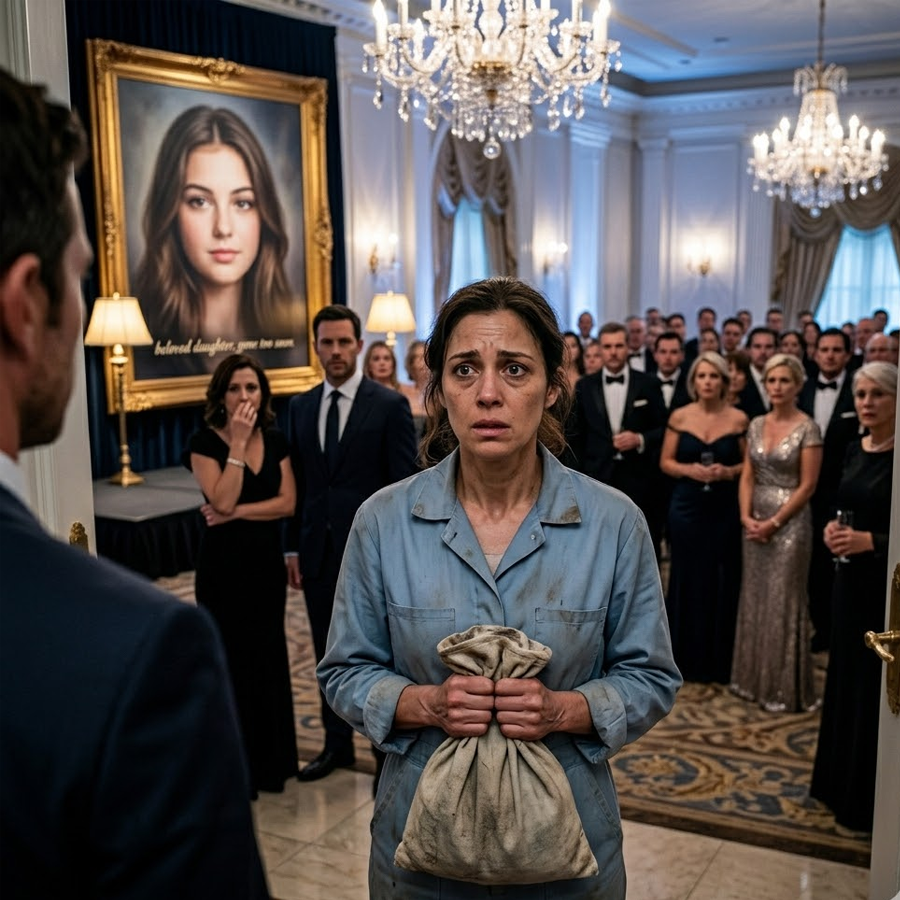
The room is so quiet you can hear people breathe. 200 of the most powerful people in the country stand shouldertosh shoulder in a ballroom that cost more to rent for one night than most people earn in a year.
Crystal chandeliers hang from the ceiling like frozen waterfalls. The kind of light that makes everything look expensive. The kind of light that makes pain look elegant. But tonight there is nothing elegant about the pain in this room. At the front of the ballroom raised on a small platform so that everyone can see it is a portrait.
A massive beautiful portrait in a gold frame. A young woman, 18 years old, soft brown eyes. A smile that looks like it belongs to someone who laughs easily. Someone who takes up space in a room just by walking into it. Someone who makes you feel like the world is a little warmer just because she’s in it. Beneath the portrait, in clean black letters, are the words, “Evelyn Lauron, beloved daughter, gone too soon.
Tonight is the second anniversary of her death. 2 years since the crash. Two years since they pulled an empty car from a swollen, angry river and told a mother and father that their only child was gone. Two years of grief so deep it changed the shape of their faces. Standing beside that portrait are two people who were once considered the most powerful couple in the country.
Mark Lauron, tall dark suit, the kind of man who walks into a room and every head turns without him saying a word. He built his fortune from nothing. cement, steel, construction projects that changed skylines. A man who never lost at anything until he lost her. And beside him, Valentina Lauron, beautiful in the way that a cracked vase is still beautiful.
You can see where the breaks happened. She is dressed in black, naturally. She is always dressed in black now. People say she hasn’t worn color since the funeral. People say she stopped sleeping in the couple’s bedroom because she kept dreaming of Evelyn calling out to her from a river. People say a lot of things about Valentina Lauron, but no one says them to her face.
Because there is something in her eyes now that makes people uncomfortable. Something hollow. Something that stares right through you to a place behind your head where maybe, just maybe, the version of her life that was supposed to happen is still playing out. The version where Evelyn is alive. Where she came home from that party 2 years ago laughing, smelling like perfume in the night air.
where she argued with her father at the breakfast table about something small and stupid and beautiful. Where everything was still whole. Mark places his hand on Valentina’s lower back. A quiet thing, a husband thing. She doesn’t look at him, but she leans slightly in his direction like a flower leaning toward whatever little light it can find.
A man at the front of the room taps a microphone softly. His name is Theo Johnson. He is the family’s head of public relations and he has the practiced look of a man who has delivered bad news so many times it no longer reaches his heart. We are gathered here tonight. Theo begins his voice filling the silent room like warm water to honor the memory of a young woman who touched every life she entered.
Evelyn Lauron was not just the daughter of Mark and Valentina. She was to those of us fortunate enough to have known her a kind of light. The kind that doesn’t warn you it’s coming. The kind that just arrives. And when it leaves, he pauses. His jaw tightens just slightly. The darkness it leaves behind is the truest measure of how brightly it once burned. Valentina closes her eyes.
Mark’s hand presses harder against her back. In the crowd, people dab at their eyes. Friends, business partners, politicians, socialites, people who knew Evelyn well, and people who only knew of her. All of them in expensive clothes, holding champagne glasses they are too respectful to drink from just yet. Standing in a room that smells of white liies because Evelyn loved white liies.
The portrait watches over all of them. That smile, those eyes, and then from the very back of the ballroom near the tall double doors that lead to the corridor outside, a sound, not a crash, not a shout, just a small strangled terrified sound like someone trying to speak and barely managing it. Heads begin to turn.
First the people closest to the doors. Then like a slow wave rolling across still water. More and more people turning, craning their necks, shifting their weight, trying to see what is happening at the back of this silent, expensive, grief-filled room. Standing in the doorway is a woman. She is not dressed for this event. Not even close.
She is wearing a faded blue work uniform. The kind cleaners wear. The fabric is clean but old. washed so many times the color has gone soft and pale at the elbows and the collar. Her shoes are flat and practical and scuffed at the toes. Her hair is pressed back tightly from her face. She is maybe four to five, maybe 50.
Hard to tell. Life has written things on her face that have nothing to do with age. She is clutching a worn cloth bag to her chest like it is the only thing keeping her upright. And she is shaking. Not shaking the way people shake when they are cold. shaking the way people shake when they are standing at the edge of something enormous.
When they have carried a secret so long and so heavy that their body has started to forget what it felt like to stand straight. Her eyes move across the room, past the chandeliers, past the beautiful, uncomfortable, confused faces of 200 powerful people staring at her, past all of it until they find Mark Lauron and they stop.
Theo has gone silent at the microphone. Everyone is silent. The woman opens her mouth. Her voice comes out small. Barely a whisper, but in that silence, a whisper carries like a shout. Sir. Mark steps forward. Just one step. His face is unreadable. Madam. Valentina’s hand finds the edge of the table beside her. Her fingers close around it. The woman swallows.
You can see it. You can almost hear it. And then she says the words, not loudly, not dramatically, just plainly, like someone who has rehearsed them 10,000 times and is only now after all that rehearsing, discovering that no amount of practice could have prepared her for this moment. Your daughter isn’t dead.
The room does not gasp. The room stops. It is different from a gasp. A gasp is something you can recover from. What happens in that ballroom in the 3 seconds after those words are spoken is something else entirely. It is the sound of 200 people forgetting at exactly the same moment how to exist normally. Someone drops a glass.
It shatters on the marble floor. Nobody moves to clean it up. Valentina’s face. Oh, Valentina’s face. It does something impossible. It crumbles and opens at the same time. Like a damn breaking. Like a window shattering outward. Every carefully constructed piece of her composure. Every wall she has built over two years of therapy in silence and black dresses and empty bedrooms.
All of it fractures in a single breath. She makes a sound that is not quite a word. Mark does not make any sound at all. He walks slowly. The crowd parts for him without being asked because there is something in the way he is moving that makes every person in that room understand on a deep and animal level that they should not be between this man and whatever is about to happen.
He stops 2 feet in front of the woman in the cleaner’s uniform. He looks at her for a long, terrible moment. His voice, when it comes, is so controlled it is almost worse than if he had shouted. “What did you just say?” The woman does not look away. Whatever fear is living in her body right now, her eyes are committed. Her eyes have already made the decision that brought her here tonight, dressed wrong, shaking in a doorway full of crystal and candle light.
And her eyes are not going back on it. She lifts her chin just slightly. Your daughter lives with me. And in the five words that follow. Five words that should be impossible. Five words that belong in a dream or a nightmare or a movie. But certainly not in this ballroom. Not on this anniversary. Not in this life. Mark Lauron. The man who breaks other men in boardrooms.
The man who rebuilt himself from nothing. The man who stood dry at his daughter’s memorial service 2 years ago because he decided in the car on the way there that someone had to be strong. Mark Lauron feels his knees go soft just for one second. just long enough for him to understand that everything he has built his grief around, every certainty, every acceptance, every hard and painful piece of moving forward is standing on sand and the tide just came in.
Her name, she tells them, is Marta Jacob. They don’t take her to a private room immediately. That would be the sensible thing to do. That would be the controlled thing. But Valentina cannot move. She is standing in the middle of the ballroom floor, both hands pressed to her mouth. And every time she tries to form a sentence, what comes out instead is something between a sob and a question that has no shape yet. The guests stand frozen.
Theo is whispering urgently into his earpiece. Two of Mark’s security men have appeared from somewhere and positioned themselves nearby, not touching anyone, just present. A wall of dark suits. Mark holds one hand up, a small quiet gesture, and the room goes even still if that is possible. Talk, he says to Marta. Just that one word.
Marta sets her back down slowly. Her hands are still trembling, but her voice finds something steadier now, like a person stepping off a boat and remembering what solid ground feels like. Two years ago, she begins, the night of the storm. I remember the night, Mark says. and the way he says it makes it clear that he will remember that night until he stops breathing. Martr nods.
My husband Solomon, he was driving home from his night shift. The rain was terrible. He almost didn’t stop. A pause, but he saw something on the riverbank below the bridge. Valentina makes a small wounded sound. A girl, Marta continues, young lying in the mud at the edge of the water, soaking her face was cut. She wasn’t moving, but she was breathing.
Solomon, he didn’t think. He just stopped. He carried her to the car. He drove to the hospital. They treated her. And when she woke up, Martr’s voice catches here, just slightly. She didn’t know anything, not her name, not where she came from, not who to call, nothing. The doctors said it was the impact from the crash.
They said sometimes with trauma like that, the memory it just goes. The room is so quiet right now that Valentina’s breathing is audible. The hospital kept her for 3 weeks, Marta continues. We tried to find her family. The police had already said she was dead and the girl had no ID on her. Nothing. So the hospital eventually they called her a Jane, an unknown girl.
And Solomon and I, we we asked if we could take her home. Mark’s jaw tightens. You took a stranger home. We took a child home, Martr says. And there is a quiet firmness in her voice that hasn’t been there before. A frightened, lost, hurt child who had nobody. And Solomon and I, her voice breaks just slightly on her late husband’s name.
We had no children of our own. So, we brought her home. We gave her a name. We gave her a room. We gave her a life. Valentina steps forward. Her heels click on the marble floor and then stop. What name? She whispers. Marta looks at her. We called her Lena. The sound that comes from Valentina then is the kind of sound that once you hear it, you don’t forget.
It is not crying. It is something older and deeper than crying. It is the sound of a grief that has been living inside a person’s chest for 2 years. Suddenly realizing it has been living in the wrong story. But then Marta reaches into her worn cloth bag. She reaches in slowly and she pulls out something small.
Something that catches the chandelier light. Something gold. A bracelet. Delicate. Simple. a thin band of gold with a small engraved plate on the front. Mark sees it first. He goes perfectly, terrifyingly still, because he knows that bracelet. He bought that bracelet for Evelyn’s 16th birthday. He had it custommade.
He had two letters engraved on it side by side. Eel Evelyn Lauron. He watched her put it on that birthday morning in the kitchen, laughing, holding her wrist up to the light. He watched Valentina clasp it around her daughter’s wrist and kissed the top of her head. He watched that bracelet on that wrist at breakfast tables and school ceremonies and family dinners for 2 years before it disappeared with her into a river.
And now it is here in the hand of a woman in a cleaner’s uniform in a ballroom. On the night of his daughter’s second memorial, Valentina sees the bracelet. And the scream that comes out of her is not loud. It is not the kind of scream that fills a room. It is the small, helpless, cracked open scream of a woman who has just been handed back a piece of a life she thought she would never touch again.
She reaches for it with both hands. Shaking her fingers close around the gold and she presses it to her mouth and she folds in half over it, holding it like it is the most precious thing in the world. Because to her it is because to her it is. Mark stands there watching his wife hold his dead daughter’s bracelet and he feels something shift inside him. Something enormous.
Something that has been stuck and frozen and locked in place for 2 years begins very slowly to move. But then Marta says something else and the shift stops. The warmth stops because what Marta says next changes everything. She says it quietly, carefully with the voice of a woman who has thought about how to say this a thousand times and still hasn’t found a way to make it land softly.
She’s not the child you lost. Marta says she’s grown now. She has a job. She has friends. She has routines and opinions and a life that she built herself from nothing without any memory of who she was before. A pause. She’s a whole person, a different person in some ways. And she doesn’t know I came here tonight. The room absorbs this.
Mark stares at Marta. Something cold moves across his face now. Not anger. Not yet. Something more complicated than anger. something like a man who has been given something precious and told simultaneously that it might not belong to him anymore. She doesn’t know, he says slowly. Marta shakes her head. I only found out recently.
I saw a photo, a newspaper photo from last year, a charity event. And I saw, she stops, steadies herself. I saw that your wife’s face and Lena’s face were were what? Valentina’s voice is raw. Marta looks at her. Were the same face? The silence that follows is absolute and Mark asks the question that is already burning a hole in his chest.
How long have you known? Mart’s eyes drop to the floor. And in that one tiny movement, that small guilty downward flicker, Mark gets his answer before she even speaks. 3 months, she whispers. 3 months. 3 months she knew and said nothing. 3 months his daughter was alive and this woman stood between them.
The vein in Mark’s temple begins to pulse. His voice drops to something very low and very dangerous. You knew for 3 months, he says. And tonight at my daughter’s memorial, tonight is when you decided to come. Marta’s hands clasp in front of her. I was afraid of what the words are barely words at this point. They are something more like stones.
Marta looks up at him then and what she says next said quietly, plainly without apology or performance hits Mark Lauron harder than anything has hit him in 2 years. I was afraid you would take her and she would be gone from me and I love her. I love her like she is mine because for 2 years she was. The ballroom is absolutely silent. 200 people holding their breath.
Mark stares at this woman. this ordinary, faded, shaking, brave, infuriating woman in her cleaner’s uniform. And for one long moment, nobody in that room can tell what he is going to do. Then Valentina touches his arm. Mark, just his name. But the way she says it, he turns to look at his wife. Her eyes are red.
The bracelet is still in her hands. She is looking at him with an expression he hasn’t seen on her face in 2 years. Hope. Actual, terrifying, fragile hope. And it is the most frightening thing Mark Lauron has seen all night. Because hope after 2 years of grief doesn’t feel like relief. It feels like standing at the top of a very high place and not knowing yet whether you are about to fly or fall.
They leave the ballroom 20 minutes later. Theo manages the guests. Mark’s assistant makes calls. Two cars are arranged, the kind with tinted windows that nobody outside can see through. Mata sits in the back seat with Valentina. Mark sits in front next to his driver. He doesn’t speak. He watches the city move past his window, the lights, the streets, the ordinary late night movement of a world that has no idea that his life is currently doing something to him that he does not have a word for. They drive for 40 minutes. The
neighborhood changes. It changes in the way cities change when you move away from money. Gradually at first, then suddenly the roads get narrower. The buildings get closer together. The lights get dimmer and more yellow. Laundry lines stretch between windows. Children’s shoes left outside front doors.
The car stops in front of a small plain house on a short, quiet street. A single light is on inside. Through the thin curtain, there is the shadow of movement. Someone home. Someone awake. Mark gets out of the car. He stands on the pavement and looks at this small house and he thinks about his home. the compound, the 12 rooms, the swimming pool, the staff quarters, and something in his chest makes a sound he cannot identify. Valentina is beside him.
She is holding the bracelet so tightly the clasp has left a small mark in her palm. Marta goes to the door. She puts her key in the lock. She pushes it open, calls inside softly. Lena, are you awake? I need you to come to the door. A moment, then footsteps, light ones, quick, and the door opens fully.
And there she is, 20 years old, standing in the doorway in house clothes, simple trousers, and a t-shirt, hair loose around her shoulders, a little tired looking like someone who was reading before bed. A small frown on her face at the unexpected late night summons. She looks at Marta. Then her eyes travel to the two strangers standing in the shadows behind Martr on her front step.
Mark cannot breathe because it is her 2 years older. Yes. Different in the way that a person changes when they grow up hard and fast and without safety nets. There is something steadier in her now. Something that was still soft and becoming when she was 18 and is now solid and arrived. But the face, the face is Evelyn’s face, his daughter’s face.
Valentina’s hand finds Mark’s arm and grips it like she is drowning because Valentina sees it too. The mouth, the eyes, the way the eyebrow lifts slightly on the left side when she is uncertain. A thing so small only a mother would know it. A thing Valentina has looked at in photographs for 2 years, trying to hold on to it before it fades.
The way everything eventually fades. It has not faded. It is right here. It is alive. Valentina breathes one word. Barely a sound. Evelyn. And the girl, Lena, looks at the woman saying her name with tears streaming down her face. this elegant, grief wrecked, desperate stranger on her doorstep and frowns. I’m not Evelyn, she says.
Her voice is calm, steady, a little guarded, the way a person gets when something confusing is happening and they are deciding how much of it to engage with. My name is Lena. And in those four words, four short, simple, ordinary words from a girl who does not know she has just split her own mother’s heart in two.
Mark and Valentina Lauron understand for the first time the real shape of what has happened to them. They did not just lose a daughter. They lost her and the world kept going without them. She kept going without them. She grew up and laughed and struggled and became someone and none of it, not one minute of it had anything to do with them.
They are strangers standing on the doorstep of their own daughter’s life. And she is looking at them the way you look at strangers. carefully, politely, from a distance. Mark Lauron, who has not cried in 2 years, who stood dryeyed at a funeral for an empty coffin, who has kept himself together through sheer iron, relentless will, feel something move behind his eyes.
Something hot, something he does not have the strength in this moment to stop because this this is not the reunion he imagined on the 40-minute drive here. This is not the falling into arms and the recognition and the tears of joy and the I knew. I always knew. A mother always knows. This is a 20-year-old woman looking at him like he is no one. And she is not wrong.
To her, he is no one. Marta steps forward. Lena. But before she can say another word, before she can explain, before the first piece of an impossible story can be laid down, before this night can become anything other than what it already is, something else happens. A phone buzzes. Mark’s phone. He pulls it out of his jacket pocket automatically, the way a man like him always does, even on the worst nights of his life. He looks at the screen.
It is his chief of security. The message is four words. Four words that are somehow impossibly worse than everything that has already happened tonight. Sir, we need to talk. Mark stares at those words. Something cold moves down his spine because in 15 years his chief of security has never sent that message after midnight. Not once.
He looks up from his phone. He looks at Evelyn at Lena standing in the doorway looking back at him with her mother’s eyes and a stranger’s expression. And he thinks, “What else? What else has been hidden? What else is still coming? He doesn’t know yet. But somewhere in the part of himself that has survived as long as he has by trusting the feeling in his gut above all else.
He knows this night is far from over. And what he is about to find out will make everything that has happened so far look simple. Mark puts the phone back in his pocket. He makes a decision in the space of one breath. The way men like him have always made decisions. Fast. Final. No looking back. He will deal with the message later.
Right now, standing on this doorstep with his wife gripping his arm and his daughter looking at him like a polite stranger. Right now is not a moment he is willing to leave. He straightens, clears his throat, and in the steadiest voice he can manage, which is considerably steadier than most men could manage in this situation, he looks at the young woman in the doorway and says, “Lena, my name is Mark Lauron.
I know this is strange. I know we look like two people who have lost their minds showing up at your door at this hour.” A pause. I am asking you, please, can we come inside? Lena looks at him. Then at Valentina, who is doing a remarkable job of trying to hold herself together and a terrible job of succeeding.
Then at Marta, something passes across Lena’s face. Something complicated. The kind of expression that a smart, cautious person makes when they are reading a situation and the numbers are not adding up and they are not sure yet whether to be curious or afraid. She looks at Mart again. Mama, she says, and the word lands in the night air like something physical.
What is happening? Marta steps forward, takes Lena’s hands. I need to tell you something, Marta says softly. Something I should have told you sooner. I was I was not brave enough. Her voice cracks on the last word. But I am being brave now. Can we go inside? Lena searches Marta’s face for a moment longer.
Then she steps back from the doorway. Come in, she says. The inside of the house is small and clean and full of the kind of order that comes not from wealth but from care. Everything is in its place. There are crocheted covers on the chair arms, framed Bible verses on the wall, a small kitchen visible through a doorway with pots hanging above the stove.
On a bookshelf near the window, paperbacks and a few school certificates and a small pot of fake flowers in the corner. It is the home of someone who has very little and treats what they have like it matters. Mark notices all of this in the first 5 seconds. He notices the single light bulb without a shade. He notices the worn rug.
He notices the small photograph on the wall above the television. Martr and a man he doesn’t know smiling at the camera. And between them, younger by a few years, laughing with her head thrown back. Evelyn. His Evelyn laughing in someone else’s living room. Laughing in a life he was not in. He has to look away. They sit. Lena takes the armchair.
Her chair clearly worn soft and exactly her shape. Marta sits beside her on a small stool, still holding her hands. Mark and Valentina sit on the sofa. The sofa is too soft and too low for Mark’s long frame and under different circumstances that would be mildly uncomfortable and forgettable. Right now, he barely feels it.
Marta begins. She tells the story from the beginning. everything she told them in the ballroom but fuller now slower with Lena sitting 3 ft away watching Martr’s face with an expression of growing stillness the storm Solomon stopping the car the girl on the riverbank the hospital the weeks of waiting for a memory that never came the decision to bring her home Lena listens she doesn’t interrupt she is the kind of person who listens the way some people can’t fully completely letting everything land before she decides what to do with it.
She sits with her hands resting on her knees and she listens to the story of how she came to be in this house and the expression on her face is very very hard to read. When Marta gets to the part about the photograph, the newspaper charity event, the face that matched Lena’s stillness deepens.
And when Marta reaches into the cloth bag one more time and places the gold bracelet on the low coffee table between them, Lena looks at it. She doesn’t reach for it immediately. She just looks at it. I found that in the pocket of the clothes Solomon brought you home in,” Marta says quietly. “I kept it. I don’t know why exactly.
I just I could not throw it away. It felt important.” Lena reaches out, picks up the bracelet, turns it over in her fingers, traces the engraved letters with her thumb. Eel. She holds it for a long time without speaking. Valentina is gripping Mark’s hand so tightly his fingers have gone slightly numb, but he doesn’t move.
doesn’t make a sound because every cell in his body is focused on his daughter sitting 3 ft away holding a bracelet she does not remember. Then Lena looks up. She looks at Valentina. She looks at her for a long quiet searching moment. And Valentina does something extraordinary. She doesn’t cry. She doesn’t reach for her. She doesn’t say anything.
She just looks back and lets her daughter look. Lets her look as long as she needs to because Valentina has waited 2 years. She can wait a little longer. Finally, Lena speaks. So, you’re saying, she says slowly, carefully, like someone building a sentence the way you build something fragile, one piece at a time, that I was in a car crash 2 years ago, and I lost my memory.
And the people who were looking for me, she glances at Mark. Were told I was dead. Yes, Mark says. And these, she holds up the bracelet. These are my initials. Evelyn Lauren. Evelyn Laura. Evelyn. Valentina stops herself, takes a breath. Your name is Evelyn. Evelyn Lauron. You were 18 years old. You were. Her voice breaks, holds, breaks again. You were everything.
Lena sets the bracelet down on the arm of her chair. She leans back. She stares at the ceiling for a moment. Then she says something that is so honest and so calm and so unexpected that it silences the entire room more completely than any dramatic declaration could have. I believe you. She says just that. I believe you. Not I remember.
Not I feel it. Not I knew something was wrong. Just a plain direct openeyed acknowledgement from a young woman who has spent 2 years building a life on the foundation of not knowing and is now being shown that the foundation was never empty. It was just buried. Valentina breathes in sharply. Mark closes his eyes for one second, but Lena continues.
And that word, that small, single, necessary word, lands in the room like a stone dropped in still water. Ripples moving outward in all directions. But she says again, believing something is true and knowing what to do about it are two very different things. She looks at Mark. I don’t know you, she says. I look at you and I feel. She pauses, searching.
Nothing familiar. I’m sorry. I know that’s not what you want to hear, but I won’t pretend. I don’t know your face. I don’t know her face. She glances at Valentina. I don’t know your voices or your names or anything about who you are. What I know is this house, this street, this chair. She looks at Marta. Huh? Marta squeezes her hand.
Mark nods slowly. The nod of a man absorbing a blow and choosing to stay standing. I understand that, he says. Do you? Lena asks. Not aggressively, not cruy. just really asking really wanting to know if the man in the expensive suit who just arrived at her door with the news that she is someone else can possibly understand what he is asking of her because you’re sitting there she says and you look at me like I’m something you lost like I’m a missing piece and I understand why you look at me like that I do but I am not a missing piece I am a
whole person and for 2 years this she gestures at the small modest room around her this has been my whole world This woman is my mother. This house is my home. Mark opens his mouth. She had a life with us. The words come out sharper than he intends. The grief and the relief and the two years of loss are mixing into something he cannot fully control.
And for a man who controls everything, that is its own kind of agony. Marta stands up. She is not tall. She is not intimidating. She is a middle-aged woman in a faded uniform who has been cleaning other people’s offices and other people’s buildings for 20 years. She is not the kind of person who normally stands up to Mark Lauron, but she stands up now.
She had a life with us too, Marta says. Her voice is steady, her eyes are steady. And where were you? She says to Mark when she needed saving. The room goes completely still. A cold silence. The kind that comes before something breaks. Mark stares at Marta and Marta stares back at Mark. Two people from completely different worlds standing on opposite sides of the most painful kind of love.
The love of a parent who lost a child and the love of a stranger who chose to save one. And neither of them in this moment is entirely wrong. That is the unbearable part. Neither of them is wrong. Valentina stands. She walks to the middle of the room. She stops between Mark and Martr, between grief and love and two years and all the impossible complicated things that have led to this moment in this small house on this quiet street.
She looks at Lena and she says very quietly. I screamed at the hospital that night. When they told me they couldn’t find her body, her voice is barely above a whisper. I screamed and I told them a mother does not accept what she cannot see. I said I said I did not see my daughter die and I refused. She stops, swallows, starts again.
But they brought a judge. They had witnesses. They had the car and the river and the driver who didn’t survive. And they had she is crying now silently tears running down her face without any sound at all. They had so much evidence and eventually she touches her own chest over her heart.
Eventually even this stopped fighting. Lena watches her but I never Valentina’s voice breaks completely here. Rebuilt from a whisper. I never stopped looking. Whenever I drove past a certain kind of girl on the street, a girl with your walk, a girl who laughed a certain way, I always she cannot finish the sentence. She doesn’t need to because Lena is looking at her now.
Really looking the way she wasn’t before. And something in her face has shifted. Not memory, not recognition in the clean cinematic way it happens in stories, but something quieter and more real. The kind of thing that happens when a person who has spent two years sensing an absence they couldn’t name is suddenly standing in front of the shape of that absence.
Not knowing but feeling. Lena looks down at the bracelet on the arm of her chair. I used to have dreams, she says quietly, almost to herself. I still have them sometimes. A big room, a voice calling my name, but I can never hear the name clearly. White flowers somewhere. She shakes her head. I always thought they were just dreams, things my brain made up because it had nothing real to work with.
Valentina’s breath catches because Evelyn’s bedroom was full of white flowers because Valentina used to stand in that doorway every morning and call her daughter’s name to wake her up for school. She doesn’t say this. She holds it inside where it burns. They stay for an hour. No decisions are made, no declarations, no dramatic moments of recognition or reunion.
Just five people in a small sitting room slowly, carefully, painfully beginning to understand the size of what has happened. Before they leave, Mark stands at the door. He turns to Lena. He wants to say so many things. He wants to say, “I have kept your room exactly as it was. I have not moved a single thing because moving them felt like accepting something I refuse to accept.
” He wants to say your mother stopped wearing color the day you disappeared. He wants to say I would give everything I have ever built, every building, every company, every dollar in every account for 5 minutes of you knowing who I am. He says none of these things. Instead, he says I won’t ask anything of you tonight, but I am asking for the chance to come back.
Lena looks at him. A long steady look. You can come back, she says. It is not a warm answer, but it is an honest one. and Mark Lauron, who has negotiated contracts worth hundreds of millions of dollars, who has sat across tables from some of the sharpest and most powerful people alive, who has won rooms and won arguments and won everything he ever went after, takes that answer, takes it like it is more valuable than anything he has ever been given.
Because in this moment, it is. The car is quiet on the drive back. Valentina has the bracelet in her lap. She is looking out of the window. Her breathing is slow and careful now. The breathing of someone concentrating very hard on not falling apart. She’s alive, she says finally. Not to Mark, not to anyone, just out loud. Into the dark car.
She’s alive, she says again, like she has to hear it twice before it becomes real. Mark reaches over and takes a hand. He holds it without speaking. And they ride through the city like that in silence, holding on to each other. Two people trying to hold on to a miracle that is there but not quite in their hands yet. Like trying to hold water.
Like trying to hold light. His phone buzzes again. The same number. His chief of security. Mark answers it this time. Talk. He says the voice on the other end is low and professional and very controlled. The voice of a man delivering information, not emotion. Sir, we’ve been going through the old accident file. The police reports from 2 years ago.
on your instructions. Last year, we kept a private investigator on the case. He found something. Mark’s grip tightens on the phone. What did he find? The car Evelyn was in the night of the crash. A pause. We had the wreck examined again privately. And there’s evidence that the brake line was cut, sir.
Deliberately, before the storm before she got in the car. The world stops. Mark Lauron sits in the back of his moving car in the dark holding his wife’s hand and feels the ground under him, the ground under everything open up. It wasn’t an accident, he says. No, sir. Someone cut the line. Yes, sir. A long silence. Do you have any idea who? Another pause.
That’s what I need to meet with you about in person tonight. The voice drops even lower. Sir, what I found? It’s someone close to you. Someone you trusted. Mark stares straight ahead. The city moves past his window. Lights and dark and lights and dark. Someone close to me. He repeats. Yes, sir. He closes his eyes.
Behind his eyelids, he sees the portrait from the ballroom. Evelyn at 18. That smile. Those eyes. He sees Lena in the doorway an hour ago. The same eyes. Older, guarded, alive. Two years. Two years his daughter was alive in a small house on a quiet street. Two years she was building a life from nothing, from an empty memory. From whatever scraps of herself survived a river and a crash, a crash that was not an accident. A crash that was designed.
A crash that was meant to kill her. The hot thing behind his eyes from earlier returns. But it is different now. This is not grief. This is not relief. This is something much older and much colder and much more dangerous than either of those things. This is the feeling of a man discovering that someone he trusted held a knife and used his daughter’s life as the blade.
“I’ll be there in 20 minutes,” Mark says. He hangs up. He looks at Valentina. She is watching him. She has heard enough from his side of the conversation to see on his face what she needs to see. Mark, she says, “What is it?” He looks at her and he makes another decision. Fast, final. No looking back. I will tell you everything, he says.
But I need you to be strong the way you were strong tonight. He squeezes her hand. Can you be strong? Valentina holds his gaze. And in her eyes is not the hollow griefcarved woman from the ballroom portrait. In her eyes is something that was always there. underneath the grief, underneath the black dresses and the empty nights and the hope she buried in a coffin that didn’t even have a body in it.
Something sharp, something that never actually went away. I have been strong every day for 2 years, she says quietly. I can be strong for one more night. Mark nods. He keeps holding her hand. And as the car moves through the city toward a conversation that is going to change everything they thought they knew toward the truth of who cut that brake line toward the name of the person who made an 18-year-old girl fall into a river and lose her whole life.
3 mi away in a small house on a quiet street. Lena sits alone in her armchair. The house is still. Marta has gone to bed after checking on her twice, squeezing her shoulder both times without words, the way mothers do when words are not the right tool. Lena sits in the dark. The bracelet is in her hand.
She is turning it over and over between her fingers. Eel. She holds it up to the thin strip of street light coming through the curtain. Studies it. She has held this bracelet before. Not tonight. Before tonight, before the ballroom, before the strangers on her doorstep. She has held this bracelet in her dreams without knowing what it was.
A flash of gold, a weight on her wrist, a voice she could never quite hear. She presses the bracelet against the inside of her wrist where a bracelet would sit. The cool gold touches her skin and something happens that she cannot explain. Not a memory, not a voice, but a feeling. Warmth. The particular kind of warmth that a person feels when they come home after a very long time away and step through a door and smell something familiar.
Not the name of the smell, not the memory attached to it, just the warmth of it, the safety of it, the feeling of something that once was yours. Lena sits there for a long time, the bracelet on her wrist, her eyes open in the dark, a small, strange, frightened, wondering expression on her face. Like someone who has just heard a song they have never heard before and somehow already knows all the words.
Mark arrives at his office building at 11:45 at night. The building is mostly empty. Three night security guards. A few lights on the upper floors where the systems run overnight. His chief of security, a solid, quiet man named Dennis Aa is waiting for him in the ground floor conference room. On the table are two folders and a photograph.
Mark walks in, sits down, looks at Dennis. Show me, he says. Dennis opens the first folder. Inside is a technical report, detailed photographs of the car wreck, close-up images of the brake line, an engineer’s assessment with words and measurements, and professional language that all adds up to one very simple, very terrible conclusion.
The failure was not caused by storm damage or impact. The brake line was deliberately compromised before the vehicle entered the road. Mark reads it without speaking, reads every word, then he sets it down. the second folder, he says. Dennis hesitates just for one second. The hesitation of a professional man who has delivered difficult information many times before and knows that this particular delivery is different. Then he opens it.
Inside is a series of documents, financial records, dates, transfers, communications, and a name. One name, a name that Mark Lauron knows as well as he knows his own. A name that has been in his life for over a decade. A name that has sat at his dinner table. A name that has been in his office, his boardroom, his confidence. Mark stares at the name.
He doesn’t move. He doesn’t speak. The clock on the wall ticks. Dennis sits very still across the table. Mark picks up the photograph that was sitting separately from the folders. It shows a man in his 40s, well-dressed, in conversation with someone that the investigators notes identify as a known criminal figure, a man linked to organized crime and contract work.
The meeting was 3 years ago, one year before the crash. The man in the photograph is someone Mark sees regularly. Someone who has access to his home, his schedule, his family’s movements. Someone who would have known exactly when Evelyn would be in that car. Exactly when to make a break line fail.
Exactly when to send a girl into a river. Mark puts the photograph down. He presses both hands flat on the conference table. He stares at the name in the folder. And when he finally speaks, his voice is so quiet that Dennis has to lean slightly forward to hear it. Does he know? Mark asks. Does he know we’re looking? No, sir.
Dennis says, “Does he know she’s alive?” A pause. We don’t believe so, sir. Not yet. Mark lifts his eyes, and in his eyes is something Dennis Aa, who has worked for this man for 9 years, has never seen before. Not anger, something colder than anger. Something that has been grief for 2 years and has just discovered in the space of one night that it was never allowed to be grief at all because the death was never real and the hand behind it, is still close, is still trusted, is still dangerous.
He has no idea, Mark says slowly, that the girl he tried to kill is alive. Dennis shakes his head. Mark nods once and in a voice that is absolutely perfectly calm. the voice of a man who has decided something that cannot be undecided. He says, “Good.” Then he is exactly where I want him. His name is Gerald Barten.
And if you asked anyone who knew Mark Lauron to name the person he trusted most in the world outside of his wife, they would say Gerald without pausing to think. 15 years. That is how long Gerald Barten had been part of Mark’s life. They met when Mark was still climbing, still building, still the kind of man who ate cheap food and wore cheap suits and slept 4 hours a night because the dream in his head was too loud to allow more.
Gerald was a financial strategist then. Sharp, precise, the kind of man who could look at a failing company and see in 30 minutes exactly which threat to pull to make the whole thing come undone or come together depending on who was paying him. Mark hired him, then promoted him, then trusted him. Then, and this is the part that makes everything else unbearable, loved him.
Not like a brother exactly, but something close to it. The kind of love that grows between men who have built things together. Who have sat in rooms together when things were falling apart and held the ceiling up with their bare hands. Who have shaken hands on deals that changed both their lives. Who have eaten at each other’s tables and known each other’s families and borrowed each other’s silence when silence was needed.
Gerald was at Evelyn’s 16th birthday. He was there when she got her exam results and danced in the kitchen. He was at the funeral. He wept at the funeral. Mark remembers it. He remembers thinking in that hollow, grief blasted place he existed in that day that at least Gerald understood. At least Gerald felt it too.
He remembers being grateful. And now he is sitting in a conference room at midnight looking at evidence that Gerald bought planned it. That Gerald sat in a meeting with a man who arranges for things to go wrong, for breaks to fail, for cars to go off bridges, and paid for it, planned for it, calculated the cost of an 18-year-old girl’s life like it was a line in a spreadsheet.
The motive, Dennis explains, is money. Of course, it is. It is always money. Three years ago, Mark was preparing to restructure his company. A major reorganization, divisions being merged, leadership roles being dissolved, new structure built from the ground up. Gerald stood to lose his position.
Not just his title, his entire stake, a percentage of the company he had negotiated years earlier that was worth by that point something close to $40 million. Mark did not know Gerald knew. The restructuring was confidential. Only two people besides Mark were aware of the details at that early stage. But Gerald had ways of finding things out.
Gerald had always had ways. And Gerald made a calculation. If Mark lost Evelyn, his only child, his entire world outside of business, he would fracture. He would grieve. He would be in no state to push through a complicated restructuring. He would need stability around him. He would lean harder on the people already close to him. He would keep Gerald close.
He would not dismantle the thing they had built together. Not while he was bleeding. Gerald bet everything on Mark’s grief. He bet $40 million that a father’s pain would make him too weak to see clearly. And for 2 years, for two whole years of black dresses and empty coffins and a mother who stopped sleeping and a father who stopped feeling, he was right.
Mark sits with this. He sits with it the way you sit with something that is too heavy to stand up under. His daughter fell into a river because a man he called a friend did not want to lose money. His daughter lost two years of her life, her name, her memory, her family, her everything because a man he trusted decided her existence was a reasonable price to pay for his comfort.
Mark looks at the photograph of Gerald Barten in conversation with the criminal contact. He looks at it for a very long time. Then he closes the folder. No police, he says. Not yet. Dennis nods carefully. Sir, not yet. Mark repeats. I need to think. I need to be careful. If we move too fast and he runs, he stops. His jaw tightens. He cannot run.
He cannot get the chance to run. If he knows we’re coming, he disappears. And we spend years chasing him through courts and lawyers and appeals, and I will not. His voice drops to something that is barely held together. I will not let this man sit comfortable somewhere while my daughter is trying to remember her own name. Dennis is silent.
You will watch him. Mark says every movement, every call, every meeting. I want to know where he sleeps and where he eats and what he is doing every hour of every day. He stands, but he does not know. We know. Not yet. Can you do that? Yes, sir. And Dennis. Sir. Mark picks up the photograph one more time. Looks at it. When I am ready to move, when I give you the word, I want it done in a way that he cannot escape. I want it airtight.
I want everything documented and witnessed and undeniable. He sets the photograph down. I want him to sit across from me and I want him to know before the police come, before the lawyers come, before any of it that I know and that Evelyn is alive and that everything he did, every calculation, every payment, every cowardly terrible thing was for nothing.
Dennis holds his gaze. Understood, he says quietly. Mark nods. He picks up his jacket and then he stops in the doorway. Dennis, he says without turning around. Sir, my daughter is alive. A pause. She doesn’t remember us yet. She lives in a small house with a woman who found her in the mud and loved her enough to keep her.
He is quiet for a moment, but she’s alive. She sat 3 ft away from me tonight and she’s alive. Dennis doesn’t say anything because there is nothing to say to that. Some truths don’t need a response. They just need to be spoken. Mark walks out. The next morning, Valentina is up before sunrise. She sits at the kitchen table in the big quiet house, the 12-room house, the house with the swimming pool that nobody swims in anymore, the house with the bedroom on the third floor that hasn’t been opened in 2 years.
And she drinks a tea and she thinks she has barely slept. That is not unusual. What is unusual is that for the first time in 2 years, the reason she could not sleep was not grief. It was something else entirely. She takes out her phone, opens it to the photo she took last night quickly, quietly before they left the small house, not of Lena.
She would not do that without asking. Just of the street, the house, the number on the gate. Small proof that it was real, that she didn’t dream it. She looks at those photos now. Then she puts her phone face down on the table and she makes a decision. A quiet one, the kind Valentina specializes in.
She is going back. Not with Mark. Not with cars and security and the full weight of the Lauron name pressing down on a small house in an ordinary neighborhood alone. Just her, just a woman. No title, no grief performance, no desperation pouring off her like heat. She is going to go back and she is going to sit across from her daughter and she is not going to ask for anything.
She is simply going to be there because Valentina Lauron has understood something in the long dark hours of this sleepless night that Mark in his pain and his anger and his newly discovered fury about Gerald has not yet had space to understand. You cannot reclaim a person. You cannot walk up to someone who has built a life without you and say, “Come back.
You belong to us.” Not if you want them to actually come back. Not if you want something real and not just the shape of something real, you have to earn it. She learned that lesson once before with Evelyn back when Evelyn was 17 and furious and pushing against every wall mark built around her. Back when Valentina was the one who sat on the edge of Evelyn’s bed at night after the arguments and just stayed, just was there not demanding, not explaining, just present.
And Evelyn eventually always turned toward her always. Valentina is going to trust that. She is going to trust that whatever Evelyn was, whatever fearless, stubborn, love soaked thing lived in that girl is still living in Lena. And she is going to sit with it patiently for as long as it takes. She arrives at the house at 9:00 in the morning.
She has dressed carefully, not expensively. She has thought about this. She wore simple trousers and a plain blouse. No jewelry except her wedding ring, which she could not bring herself to remove. Her car is a modest one from the pool, not the large black one with the tinted windows. She carries nothing except a small paper bag.
She knocks on the gate. She waits a moment then footsteps inside the yard. The gate opens and it is not Marta. It is Lena. She is wearing work clothes. The kind of clothes a person puts on when they are about to go somewhere. She is holding a bag of her own. She looks at Valentina with an expression that is not warm and is not cold and is not particularly surprised, which itself says something about the kind of person she is.
They look at each other. I was just leaving. Lena says, “I know.” Valentina says, “I won’t keep you.” A pause. I just I wanted to bring something for you and for Ma. She holds out the paper bag, just food from a bakery near here. I looked it up this morning. I didn’t know what you liked, so I got a few different things. Lena looks at the bag.
She looks at Valentina. You don’t have to do that, she says. I know, Valentina says. A moment. Then Lena takes the bag, looks inside briefly. Mema likes the chinchin once, she says almost to herself. A small observation. Not directed at Valentina particularly, but also not closed off. I’ll remember that, Valentina says. Lena looks at her.
You’re not what I expected, she says. Last night you were, she searches for the word. Smaller than now. Last night I was falling apart, Valentina says simply. And now, now I am trying to be a person instead of a mother because you don’t know me as a mother. She pauses. You don’t know me at all.
So, I thought perhaps I should start by just being a person. Something shifts in Lena’s face. subtle like a lock considering a key. Not opening, just considering. I have to go to work, she says. Of course, Valentina says, I work at a pharmacy assistant Monday to Saturday. She shifts her bag on her shoulder. I finish at 5.
She says this last sentence without looking directly at Valentina. She says it to the middle distance, to the gate post, to somewhere slightly to the left of the situation. But she says it and Valentina, who has learned over a lifetime of careful love how to hear the things people are not quite saying, understands.
I’ll be here at 5, she says quietly. Lena walks out of the gate without responding, but she doesn’t say no. Across the city, Gerald Barten is having breakfast. He does this every morning at the same restaurant at the same table by the window with the same order, eggs, toast, black coffee, orange juice, and the same newspaper which he reads from front to back in exactly 40 minutes.
He is a man of routine, a man of precision, a man who has for 2 years slept very well. This is perhaps the most monstrous thing about him. He sits at his table this morning, cutting his eggs, reading his newspaper, completely unaware that the world he has been living in, the safe, comfortable, grief cushioned world he bought with another person’s pain, cracked in half last night in a ballroom when a woman in a cleaner uniform said four words.
He does not know. His phone buzzes. He glances at it. A message from Mark’s office postponing this week’s board meeting. We’ll reschedule. Gerald frowns slightly. He types back, “Everything okay?” Three dots appear. Then, yes, minoruling conflict. We’ll be in touch. Gerald sets his phone down, picks up his coffee, returns to his newspaper.
On page seven, there is a small piece about the Lauron memorial event last night. A brief social column item. Nothing unusual, just a note about the gathering of prominent figures to mark the second anniversary of the tragic death of Evelyn Lauron. Gerald reads it. His face does not change.
He sips his coffee, turns the page. 3 miles away, in a parked car down the street from the restaurant, one of Dennis Arasa’s men watches Gerald Barting through a camera lens and notes the time and records the image and sends it to a secure folder. And Gerald Barten eats his eggs and does not know Lena’s full name at work is Lena Jacob.
She took Martr’s surname, or rather Martr and Solomon gave it to her two years ago, in the quiet matterof fact way that people in that neighborhood handled things that didn’t have an official process. She was their girl. She carried their name. That was simply what was. She is good at her job. The pharmacist she works for, a tired, decent woman named Dr.
Abina Darko, has said more than once that Lena is the most reliable person she has ever employed. She comes on time. She does not complain. She remembers everything. Every medication, every customer, every interaction. She has a precision that feels almost technical, like a part of her brain that survived the crash intact and simply found a new purpose.
She is restocking shelves when her phone buzzes. She looks at it, an unknown number. She almost ignores it. She gets calls from unknown numbers. Sometimes she is careful about them, but something makes her answer. Hello. A pause. Then a voice she has only heard once before. Last night in the dark in her doorway, a man’s voice, controlled, formal, but underneath the formality, something that sounds like a person trying very hard to appear steady.
Lena, this is Mark Lauron. A pause. I am sorry to call unannounced. Marta gave me your number. I hope that was. It’s fine, she says. She steps away from the shelves into the small back corridor. Her heartbeat is doing something slightly unusual. I don’t want to pressure you, Mark says. I made that very clear to myself this morning.
I am not calling to pressure you. Then why are you calling? A pause. Because I have a daughter who is alive, he says. And I am a man who has spent 2 years not knowing what to do with his hands. The sentence lands differently than she expected. Not sentimental, not performing grief, just honest. the kind of honest that comes from a person who has stopped caring what they sound like.
She leans against the corridor wall. Okay, she says carefully. So, what do you want? I want to ask you something, Mark says. And I want you to answer honestly without worrying about what the answer will do to me. Can you do that? A pause. Yes, she says. Do you want to know who you were? He asks. Not to become her. Not to come back to us.
Just for yourself, for your own peace. Do you want to know the story of the first 18 years of your life? Lena is quiet. The pharmacy sounds carry faintly through the corridor wall. Dr. Darko’s voice at the counter, the beep of the register. Lena looks at the plain corridor wall in front of her.
She thinks about the bracelet which she put on this morning and then took off and then put on again. She thinks about the dream, the big room, the white flowers, the voice that calls a name she can never quite hear. She thinks about the feeling of gold against her wrist in the dark. Yes, she says. Just that, but it is the most important yes, she has said in 2 years.
Mark takes her to lunch 3 days later. Not to his house. Not to an expensive restaurant where people will stare and whisper and the weight of the Lauron name will sit on the table between them like a stone. He takes her to a quiet, ordinary restaurant near her neighborhood. He arrives before her. He is already seated when she walks in.
And the thing that strikes her, the thing she notices before she can decide not to notice it is how different he looks here. Without the ballroom, without the suit, without the portrait and the grief and the 200 people, just a tall man in a simple shirt at an ordinary table standing up when he sees her.
And for one flash of a second, something a flicker like a light trying to come on in a room that has been dark for too long. Gone before she can name it. She sits down. He sits. They order. And then he starts talking. He starts at the beginning. He tells her about herself. Not the big dramatic pieces, not the accidents or the secrets or the things that are coming that she doesn’t know yet. The small things, the daily things.
He tells her that she used to hate mornings, but would never admit it. So, she developed an elaborate system of setting three separate alarms, all named with little encouraging notes to herself. She laughs. It is a short laugh, a surprised one, the kind that escapes before you can decide to allow it. Mark sees it. He keeps going.
He tells her that she had a notebook she carried everywhere, not a phone, a physical notebook, because she said screens made it too easy to delete things. and she believed in keeping her mistakes visible because they were still part of the story. She stops eating. She is looking at him. He tells her that she could not watch sad films without completely denying afterward that she had cried even when the evidence was sitting plainly on her face.
That is she stops. Is what? Mark asks. She shakes her head slowly. I watched a film last week alone and I cried and then I told mama the air conditioning made my eyes water. Mark looks at her and smiles. She looks at him and something in the space between them, something that has been a wall, that has been a careful, polite, professional distance, shifts just slightly, just a fraction, like a door that has been shut for a long time and is now against its own better judgment, beginning to wonder about opening.
“You loved white flowers,” Mark says quietly. His voice has changed. Something in it has become very careful, very tender. The way a person handles something they are terrified of dropping. Lena’s throat moves. You put them in your bedroom every week. He says white liies. Your mother started buying them because you asked and then it just became it was just what we did.
The house always had them. A pause. When you were gone, Valentina couldn’t look at them for months. And then one day she bought a bunch and put them in your room and cried in there for an hour and came out and told me it made her feel close to you. He is quiet for a moment. She still does it every week. Your room still has fresh flowers. Lena is very still.
Her eyes are bright. She looks down at the table. Her hand, which is resting near her glass, is trembling very slightly. The dreams, she says quietly. The white flowers. Mark nods. I didn’t know they were real, she whispers. I thought I was just inventing things to fill in the gaps.
You were remembering, Mark says softly. Your mind was remembering what it could. A tear escapes one. She catches it quickly, wipes it with the back of her hand, and Mark, who has been to enough negotiations, enough hard rooms, enough human situations to know when a person needs space, looks down at his food, and gives her the silence to reassemble herself.
She is grateful for that. She doesn’t say so, but she is. She comes to the house 2 weeks later. She tells Marta first. Marta sits very still when Lena tells her, hands folded in her lap, face doing something complicated that Lena has learned to read over 2 years. The thing Marta’s face does when she is holding an emotion down firmly because she has decided that this moment is not about her.
Are you sure? Ma asks. No, Lena says honestly. Ma nods. Then go, she says. Unsure is still a direction. Lena looks at her. Mama, she says don’t. Marta says firmly. A pause. Don’t say anything that sounds like goodbye. This is not goodbye. You come home for dinner and you tell me what their house looks like.
Lena almost smiles. It’s probably very big. Emm Marta says, “Tell me every room.” The car mark sends us quiet and clean. Lena sits in the back and watches the city change around her the way it changed when they drove to her house that first night, but in reverse now. The streets widening, the buildings growing, the lights getting brighter and more deliberate. She is wearing the bracelet.
She decided that morning to wear it, not for them, for herself. The car turns through a gate. A long driveway. A house that is, as she predicted, enormous. But the thing that stops her, the thing she was not prepared for, is not the size of it. It is the flowers. At the front of the house, in large pots on either side of the main door, there are white liies, fresh, bright, arranged carefully, like someone who knew she was coming made sure they would be the first thing she saw. Lena stands at the bottom of the
steps and looks at them. Her chest does something she cannot fully describe. The door opens. Valentina, she is standing in the doorway in simple clothes and her face, when she sees Lena looking at the flowers, does something extraordinarily careful. It tries very hard not to react. It tries to give nothing away.
It tries to be calm and ordinary and unwelcoming of pressure. But her eyes, Valentina’s eyes, when they land on Lena standing at the bottom of her steps with the gold bracelet on her wrist and the liies catching the afternoon light are the eyes of someone who has been in the dark for 2 years and has just finally finally finally seen a light.
Come in, Valentina says. Simple, ordinary. Come in. Lena climbs the steps. She reaches the top. She is now standing close enough to Valentina that she can see the fine lines at the corners of her eyes and the slight catch in her breath. “Thank you for the flowers,” Lena says quietly. Valentina holds the door open wider. “They are yours,” she says.
“They’ve always been yours.” She walks through the house. Valentina gives her space. Walks slightly behind her. Lets her look at whatever she wants to look at. Doesn’t narrate, doesn’t point, doesn’t say, “This is where you used to do this or you loved that or remember when.
” Just walks quietly behind her and lets Lena move through the rooms at her own pace. The sitting room, the dining room with its long table and many chairs, the garden she can see through the glass doors. Lena touches things lightly as she passes them. The smooth wood of the banister, the frame of a painting on the wall, small unconscious contacts, the way a person reaches for things without deciding to.
Then the staircase. She goes up. At the top of the staircase, there is a corridor with four doors. She doesn’t know which one to try, but she walks toward the third one. She doesn’t know why the third one. She just does. She stops in front of it, puts her hand on the handle, looks at Valentina.
Valentina, standing two steps away, looking at her with an expression that is all held breath and careful hope, nods once. Lena opens the door. The room is exactly as it was. Evelyn’s room exactly as an 18-year-old girl left it 2 years ago on a rainy night before getting into a car that had a cut brake line and driving toward a bridge and a river and a life she would not remember.
The notebooks on the desk, the photographs on the wall, friends, candid shots, a few concert tickets pinned alongside pictures. the school certificate in a frame. The half-finished book on the nightstand with a bookmark still in it. The wardrobe door slightly opened the way it would have been left by someone planning to come back.
And on the window sill, white liies fresh in a plain white vase. Lena stands in the doorway of this room. She stands there for a very long time. She is looking at the photographs on the wall. She is looking at her own face at 15 and 16 and 17, laughing, living, full of a life she has no memory of. She is looking at herself she cannot access.
And it is perhaps the strangest and most painful and most remarkable feeling she has ever had to stand in the room of who you used to be and feel like a visitor in your own past. Like reading a book about yourself. Like watching a film where you know the face on the screen is yours but the story belongs to someone else.
She walks in slowly, sits on the edge of the bed, picks up the book on the nightstand, opens to where the bookmark sits. The page is marked mid chapter. A story someone was halfway through. A story interrupted. Her handwriting is in the margin. Small neat notes. Reactions. A question mark next to a paragraph she found confusing. A tiny star next to a sentence she must have loved.
Lena stares at her own handwriting. The handwriting she developed from nothing two years ago, taught herself from workbooks built letter by letter from an empty beginning. And in the margin of this old book, the exact same letters, the exact same slope of the E. The same way the L reaches up just slightly higher than it needs to.
Her handwriting from before, the same. Lena puts the book down. She presses both hands flat on the quilt covering the bed. She looks at the ceiling of a bedroom she does not remember. And the thing that comes then is not a memory. It is not a rush of images or a voice or a smell that unlocks a door. It is not the cinematic flood of a returning past.
It is something quieter, more devastating. It is grief, her own grief for herself. For the girl who left this room and never came back. For the 18 years she cannot retrieve. For the parents who sat in this house and achd. for the woman downstairs in the doorway who has been putting fresh flowers in this room every single week for 2 years because she could not give up.
And for Marta, for Solomon who stopped a car in the rain and carried a stranger and saved a life. For a small house in a worn armchair and a woman who loved her without knowing who she was. The tears when they come are not quiet. They are the kind that have been building for 2 years without her name.
the kind that needed the right room in the right moment and the right combination of truth and loss before they could finally find their way out. Lena sits on the edge of her old bed and cries. She cries for everything she lost. She cries for everything they lost. She cries for the gap, the enormous, irretrievable 2-year gap that sits in the middle of all their lives like a wound that cannot be fully healed, only maybe lived with.
And Valentina, who has been standing in the doorway this whole time, watching her daughter sit in her old room and grieve a life she cannot remember, does not go to her immediately. She gives her the room to cry. She gives her the space to feel it. But then after a long, quiet, terrible moment, she walks in.
She sits beside her. She doesn’t say anything. She does not reach for her. She just sits close, warm, present. And after another long moment, Lena, who is still crying, who is not looking at her, who is staring at the notebooks on the desk and the photographs on the wall and the life that is and is not hers, leans just slightly, just a few cm against Valentina’s arm.
And Valentina, who has not held this girl in 2 years, who has not felt the weight of her, the warmth of her, the simple physical reality of her child being close, closes her eyes and breathes. Mark does not dismantle Gerald immediately. He is patient. He is meticulous. He is, and this is the part that costs him the most.
Still kind to Gerald in public. Still takes his calls. Still sits across from him at meetings and speaks normally and holds his face perfectly still. He needs Gerald to feel safe. He needs him to have no reason to run. And so for 3 weeks, while Dennis and the investigators build the case quietly, methodically, document by document, witness by witness, while lawyers are briefed in sealed rooms and police contacts are quietly notified on a strictly confidential basis.
Mark Lauron smiles at the man who tried to kill his daughter. It costs him more than he can measure. Every time he sees Gerald’s face, that well-fed, comfortable, routine face, he thinks about a rainy night two years ago, a young girl in a car, a bridge, a river, an empty coffin. He thinks about Lena sitting on the edge of a bed she doesn’t remember.
He thinks about Valentina putting fresh flowers in an empty room every week. He smiles and waits. 4 weeks after the night of the ballroom, on a Tuesday morning, Mark receives a call from Dennis. It’s ready, Dennis says. Mark is at his desk. He puts down his pen. All of it, he asks. Everything. Financial trails, signed witness testimony from the contact Gerald met with, phone records, the engineering report on the break line, and confirmation from two independent sources that Gerald commissioned the job. A pause. The police are ready to
move the moment you give the word. Mark is quiet. And the other thing I asked for, he says. arranged. Dennis says the meeting is set for this afternoon. Gerald thinks it is a routine portfolio review. He has no idea. Mark nods. He sits very still for a moment. He thinks about 15 years.
He thinks about the man he thought Gerald was. He thinks about how you can know someone, really know them, share years and trust and history with them, and still be completely, catastrophically wrong about what lies inside them. Then he picks up his phone. He makes a different call. It rings twice. Hello. Her voice. Lena’s voice. Are you home this evening? Mark asks.
A pause. Yes, she says. I need to tell you something, he says. About the crash. About what I found. His voice is very steady. I need to tell you because you have a right to know. This was done to you. And the person who did it is going to answer for it. But I wanted you to hear it from me first.
Silence on the line. He can hear her breathing. “Okay,” she says finally. “I’ll come to you,” he says at 5, “if that’s all right.” Another pause. “Ma will make tea,” she says. “A small thing, an ordinary thing.” But Mark feels it land in his chest like something enormous. “Thank you,” he says quietly. He meets Gerald at 3.
Gerald walks into the conference room looking exactly the way he always does. Pressed shirt, easy confidence, the comfortable self assurance of a man who has never in 15 years had any reason to be afraid in this building. He sits down. He opens his notebook. Right, he says, clicking his pen. What are we reviewing today? Mark looks at him across the table for one long quiet terrible moment. He just looks at him.
Gerald’s pen slows. Something in Mark’s face, something he has been controlling and controlling and controlling for 4 weeks, has stopped being controlled. Mark, Gerald says. His voice is still easy, but his eyes have flickered just slightly. The animal instinct, the thing in the body that knows before the mind does that the ground has changed.
Mark reaches into the folder on the table in front of him. He slides a single photograph across to Gerald. The photograph of Gerald’s meeting with the criminal contact 3 years ago. Gerald looks at it. The pen stops completely. I know everything, Mark says. His voice is very quiet, very calm. The complete final undecorated calm of a man who has arrived at the end of something.
Gerald looks at the photograph. He looks at Mark and in the silence that follows, in the space between one breath and the next, Gerald Bing’s face does something that Mark will never forget for the rest of his life. It doesn’t show guilt. It doesn’t show panic. It shows calculation. Even now, even caught, his mind is already moving, already working, already finding angles and exits and ways through.
And that that more than anything, that instant reflexive, remorseless calculation in the face of what he did is when the last piece of whatever Mark felt for this man, whatever 15 years of friendship and trust and shared history managed to survive the discovery of his betrayal, turns to Ash. Mark, Gerald begins. She’s alive, Mark says. Gerald stops.
The calculation freezes. What? He says, “Evelyn, Mark says, my daughter.” He leans forward very slightly. She survived the river. She lost her memory. She has been living few hours from here for 2 years. His voice does not shake. Not one syllable. She is 20 years old and she is learning her own name again. She sat in her old bedroom last week and cried for the first time.
And I watched my wife sit beside her. His eyes do not leave Gerald’s face. She is alive and she will stand up in a court of law and the world will know who she is and what was done to her. Gerald has gone very still. The color has drained from his face. And you, Mark says, the door to the conference room opens.
Two police officers step in. And behind them, a detective in plain clothes who nods at Mark once. Gerald stands up. The chair scrapes back. Mark, his voice has changed. The smoothness is gone. Something raw underneath it. Something that might in another person be shame. Mark, listen to me. I have been listening to you for 15 years, Mark says. He stands.
He is taller than Gerald. He has always been taller than Gerald. I will not listen to you anymore. He walks to the door. He stops one last time. He looks at Gerald Bartang, at the man across the table from him, at the press shirt and the notebook in the pen. At 15 years, at everything he thought it was, at what it actually was, the flowers at her funeral, Mark says.
Gerald stares at him. You sent the largest arrangement, Mark says. White roses. I thanked you for them. A pause. I thanked you. He walks out of the room. He does not look back in the corridor. He keeps walking past the offices, past his assistant, who rises and then sits again when she sees his face to the elevator, into it, down, and out into the afternoon air where he stands for a moment on the pavement outside his building.
and breathes. Just breathes. He drives to Mr’s house. He doesn’t call ahead. He just drives through the city, through the changing streets, through the narrowing roads until the car stops at the small gate on the quiet street. He knocks. Marta opens. She looks at his face and reads it immediately. The way women who have carried hard things their whole lives can read a face without being told anything. She steps aside.
Come in, she says. Lena is in the sitting room. He walks in. Lena is on the sofa. Valentina is beside her. They are looking at something on Lena’s phone together. A photograph she found somewhere. The two of them leaning close. Valentina pointing at something and Lena asking a question. An ordinary moment. A quiet one.
The kind of moment that used to be normal. The kind that was stolen. The kind that is slowly being rebuilt. They both look up when Mark enters. He sits down across from Lena. He tells her everything about Gerald, about the break line, about the motive, about 15 years of a friendship that was quietly, monstrously hollow at its center.
He tells her plainly without softening it because she asked him once not to soften things for her and he has not forgotten that. Lena listens. When he finishes, she is quiet for a long time. Marta brings tea, sets it down, sits in her own chair. The four of them sit together in the small room. So, it wasn’t an accident, Lena says finally.
No, Mark says, she nods slowly. She looks at her hands. And this man, he will go to prison. Mark says, “The evidence is complete. He will not walk away from this.” Another silence. Lena looks up. I want you to know something, she says. I’m not angry. Mark blinks. I thought I would be, she continues. When I heard you say someone did this deliberately, I waited for the anger.
But what I feel is she pauses searching sad for the girl who went into that river, for everything that was taken from her, from all of you. She looks at Valentina, then at Mark. I can’t be angry on her behalf because I don’t remember being her, but I can be sad for her. Valentina reaches over and takes a hand. Lena lets her.
She was worth being sad for, Valentina says softly. Lena looks at her. Tell me one more thing about her, Lena says. Valentina smiles through her tears. She used to sing in the kitchen when she thought nobody could hear her, she says terribly offkey, but completely committed like she was performing to a full stadium. Lena stares at her.
I do that, she whispers. I know, Valentina says. and the laugh that comes from Lena then sudden surprised wet with tears fills the small room like something that has been waiting a very long time to exist. Months pass. Gerald Bing stands trial. He is convicted. Mark is in the courtroom when the verdict is read. Valentina beside him.
Lena who chose to come sits on his other side. She holds his hand during the reading not because she needs studying but because she can feel that he does. And she is the kind of person, it turns out, who notices those things. She always was. The memory does not come back all at once. It comes in pieces.
Small, quiet pieces that arrive without warning. The smell of a particular soap that makes her stop in the middle of a supermarket aisle and stand there, eyes closed, hand on the shelf, while something tries to surface. A piece of music that makes her cry before she knows why. The way Mark laughs at something, a short surprised laugh, the kind he doesn’t perform and something in her chest responds to it before her mind catches up.
She does not become Evelyn again. That is the truth of it. The hard, honest, beautiful truth. Evelyn Lauron is gone in the way that all 18-year-olds are eventually gone, grown past, left behind, transformed into whoever survives them. Lena is who survived. Lena with her careful eyes and her rebuilt handwriting and her worn armchair and her two years of a life built from nothing.
She is Evelyn’s future. She is not her past. And slowly slowly everyone learns to love that. She keeps her job at the pharmacy. Dr. Darko, when she finds out who Lena is, does not treat her differently. This is one of the things Lena is most grateful for in the months that follow. She keeps her room at Martr’s house.
She also gets a key to the Lauron house. She uses both. Some week she sleeps in her old room with fresh lilies on the windowsill. Some week she sits in the worn armchair and lets Marta make tea. Some week she does both. This is her life now. Not divided, doubled. One evening in the quiet end of the year. They are all together.
Not for any occasion. Not for a memorial or an anniversary or a moment that was planned. Just an ordinary evening that became something without trying. Mark and Valentina in the sitting room of the Lauron house. Martr in the armchair by the window that Valentina put there because she noticed Marta was always more comfortable in armchairs than sofas. The television on low.
Tea on the table. And Lena standing in the kitchen doorway holding a plate of something she made badly attempting a recipe from a book she found on the shelf. Her own handwriting in the margins. Notes from years ago. A girl guiding her from the past. It might be terrible. Lena announces. It looks terrible, Mark says. Mark, Valentina says.
She said it first, he says. Lena laughs. She sets the plate down. She sits between Marta and Valentina on the sofa. Not because anyone arranged it that way, just because that is where she fits. Marta puts an arm around her from one side. Valentina, after a moment, tucks close on the other. Lena looks at Mark across the table.
He is watching her with an expression she has come to recognize over these months. Not grief, not longing, just love. The plain, uncomplicated, quietly enormous love of a father who has been given back something he thought he would never hold again. Papa, she says it is the first time she has called him that. She doesn’t make a moment of it.
She just says it the way you say a word you’ve been practicing privately until it fits in your mouth and then one day you just say it and it does. Mark is very still. The thing on your plate, Lena continues. What would you call that color? He looks down at the food. Back up at her. A crime, he says. She grins.
And the laughter that fills that room. All four of them is the kind that doesn’t know what it is made of. Grief and relief and time and loss and two years and a river and a bracelet and a woman in a faded uniform standing in a doorway with her hands shaking and her eyes certain. It is made of all of that.
And it is the most beautiful sound Mark Lauron has ever heard in his life. Sometimes late at night, Lena takes the bracelet from her wrist and turns it in her fingers. Eel. She used to wonder what those letters meant. Now she knows. They mean Evelyn, who loved white flowers and sang badly in the kitchen and left a bookmark in a chapter she never finished.
They mean Lena, who rebuilt herself from nothing and learned to be brave before she learned to be anything else. They mean the same person living the same life just from a different beginning she puts the bracelet back on. She sleeps and in her dreams for the first time she hears the voice clearly.
It is calling her name. Both names and this time she does not wake up before it reaches her. This time she stays.