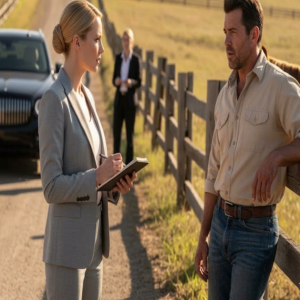
A dirt road in Vermont. Morning fog still clinging to the apple trees. A black SUV sat parked at the edge of the orchard like something that had wandered out of another world entirely. The woman who stepped out wore cashmere and heels, her dark hair pinned in a flawless twist.
She looked at the man standing by the fence, haydust on his shoulders, one hand resting on a horse’s neck. I need a husband by tomorrow, she said. He did not look up right away. His hand kept stroking the horse’s mane, steady, unhurried. Then he turned. His eyes met hers. And he said, “Then kiss me right now.
” Behind her, the secretary’s mouth fell open. The driver nearly dropped his phone. This is how it began 16 days earlier. The morning Nathan Cross found three strangers standing in his driveway. Started the same way every morning. started on his farm in Coloulton, Vermont. He woke before the sun. He pulled on the same boots he had worn for three years.
The leather cracked at the toe, but still holding. He made coffee in a pot that had belonged to his wife’s grandmother, poured it into a thermos, and walked out to check the fence line along the north pasture. Lily was already on the porch, her sketch pad balanced on her knees. A box of crayons spread across the top step.
She was 6 years old and she drew the same thing most mornings horses. The barn, the mountains in the distance. Their dog, a 12-year-old retriever named Copper, lay beside her with his chin on her foot. Nathan liked the quiet. He had built his days around it the way other men built days around meetings or deadlines.
After Sarah died, the quiet was the only thing that did not ask anything of him. It did not want explanations. It did not offer sympathy. It simply existed and he existed inside it and that was enough. He had been a structural engineer in Boston once, a man who wore pressed shirts and sat in glass conference rooms reviewing load calculations for high-rise buildings.
That life felt like it belonged to someone else now. He had left it behind the way you leave behind a coat you no longer need deliberately without regret and without looking back. He was tightening a loose rail on the fence when he heard the engine. “Not a truck engine, not a tractor, something smoother, heavier, expensive.
” He straightened and watched a black Cadillac Escalade roll up the dirt road, dust billowing behind it like a small storm. It stopped near the barn. The first person out was a young woman with short auburn hair and a tablet clutched to her chest. She looked around the property the way someone might look around a foreign country, curious but deeply uncertain.
Clare Wittmann, though Nathan did not know her name yet, was already regretting the shoes she had chosen. Then the rear door opened and Vivian Ashford stepped out. She was 32 years old. She was the CEO of Asheford Properties, one of the largest luxury real estate firms in Boston. She was worth on paper more than this entire town and every farm in it combined.
She was also at that particular moment standing in mud. Her heel sank 2 in into the soft ground beside the driveway. She looked down, frowned, and then looked up again with the expression of a woman who had decided that mud was simply not going to be a factor in her day. Nathan wiped his hands on his jeans and walked toward them.
He moved the way he always moved without hurry, without hesitation. He studied the car, the secretary, the driver still sitting behind the wheel with the engine running, and then the woman herself. She was beautiful in a way that felt deliberate, assembled, every detail managed and accounted for. He noticed that the way he noticed weather as a fact, not a feeling.
Ma’am, he said, if you’re here to buy my land, it’s not for sale. Viven told him she was not there for his land. Clare leaned close and whispered, “Are you sure about this?” Viven ignored her. She asked Nathan if they could speak privately. He looked at her for a long moment, then gestured toward the porch. Not a conference room, not an office, but two wooden chairs he had built by hand the winter after Sarah passed, sat beside a planter box filled with flowers his wife had put in the ground four years ago.
They still bloomed every spring, purple and white, stubborn and faithful. Nathan never had the heart to pull them out. As they walked toward the porch, Lily looked up from her drawing. She studied Viven with the frank, unguarded curiosity that only children possess. “You’re really pretty,” she said. “Are you a princess?” Clare smiled behind her tablet.
Vivien opened her mouth, closed it, and for the first time in a very long time did not know what to say. Viven sat in the wooden chair, and got straight to the point. That was her way. She did not soften things, did not ease into difficult conversations with small talk or pleasantries. Her father, Henry Ashford, had built Asheford properties from a single office in downtown Boston into a company that developed luxury residential towers across the Northeast.
He had died two years ago, a heart attack at his desk on a Tuesday afternoon, alone in his office because Viven was in London closing a deal. In his will, he had included a clause that no one had expected. If Viven did not marry before her 33rd birthday, controlling interest in the company would transfer to her uncle, Richard Ashford, the vice chairman of the board.
Her birthday was in 17 days. She needed a legal marriage. She had a contract prepared compensation terms, a divorce clause after 12 months. She needed someone outside her world, someone with no connections to her industry, no interest in her money, no agenda that could complicate things later. Her lawyers had conducted a search and produced a short list of candidates.
Nathan Cross had come up at the top. Former engineer, clean record, no debts, no criminal history, living off the grid on a farm in rural Vermont. He was from a legal standpoint ideal. Nathan listened without interrupting. When she finished, he was quiet for a long time. The wind moved through the apple trees, and somewhere in the barn, a horse stamped its foot.
Then he said, “Why me? You could find a hundred men in Boston willing to do this.” Viven explained that every man in her circle had his own angle shares, business relationships, media exposure. She needed someone who wanted nothing from her. Someone who had nothing to gain or lose from her world. Nathan’s expression shifted, his eyes cooled, the warmth draining out of them the way color drains from a sky before a storm.
You ran a background check on me before you drove 3 hours to my farm. Viven did not apologize. I run background checks on everyone I do business with. Nathan looked at her steadily. I’m not a business deal, ma’am. Vivien offered $200,000 for 12 months. Nathan was silent. Out on the porch, Lily ran to show Clare a drawing of a horse with wings.
Clare crouched down and admired it with genuine warmth. And for a moment, the scene was almost ordinary, just a child sharing her artwork on a summer morning. The wind moved through the apple orchard carrying the smell of grass and earth and something sweet that had no name. Nathan said, “No.” Clare looked at Viven. Vivien was not accustomed to hearing that word.
In her world, no was a negotiation tactic, a starting position, a problem to be engineered around. But she did not get angry. Something else crossed her face. instead something close to recognition, even respect. She had spent her career surrounded by men who said yes too quickly, who agreed because they wanted something. Nathan said no, the way a man says no when he means it calmly, without performance, without needing to explain himself to anyone. Vivian stood to leave.
She walked down the porch steps. And on the second one, the one Nathan kept meaning to fix every Saturday and then forgetting her heel caught and snapped. She stumbled forward. Nathan caught her by the arm, his hand closing around her wrist before she could fall. For a moment, they were very close, her skin against his calloused palm.
She could smell hay and coffee and soap. He could feel her pulse under his fingers. Fast, faster than a woman who controlled everything should have. He let go first. “Careful,” he said quietly. “That step’s been broken since last winter.” Then he turned and walked inside, letting the screen door close behind him.
The Escalade pulled back down the dirt road. Clare sat in the passenger seat, scrolling through her phone. “Well,” she said, “that went terribly, but Viven was not listening. She had opened Nathan’s file on her iPad and was reading it again, more slowly this time, the way you reread a letter that changes meaning the second time through.
Nathan Cross had graduated from MIT with a degree in structural engineering. He had worked at one of the top firms in Boston, the kind of firm that designed buildings, people photograph, and put on magazine covers. His salary had been in the high six figures. His career trajectory had pointed straight up.
Then Sarah was diagnosed with stage three ovarian cancer. Nathan resigned within a week. He sold their apartment in Back Bay, liquidated his retirement accounts, cancelled the promotion he had just been offered, and moved Sarah to her family’s farm in Vermont, the place where she had grown up, the place she loved more than anywhere else in the world.
He wanted her last days to be spent, where she felt most at home, where she could see the mountains from bed, where the air smelled like the air of her childhood. After she died, Nathan stayed, not because he could not go back, because he chose not to. Viven closed the iPad. She turned her face toward the window and watched the Vermont countryside slide past green hills, white fences, barns with peeling paint.
she whispered almost to herself. He gave up everything for her. Clare heard it. She said quietly. “And you’re asking him to pretend to love a stranger?” Vivian did not answer. She did not speak again until they reached the interstate. That evening on the farm, Nathan put Lily to bed. He read her the same book she asked for every night, a story about a wild horse who finds its way home across mountains and rivers.
He kissed her forehead, turned off the light, and went to sit on the porch. The sky over Vermont was enormous, crowded with stars that the city had always hidden from him. His phone rang. It was Maggie, his mother. She lived 12 mi away in the next town over, and she had already heard about the black SUV. Small towns worked that way. Everyone knew everything.
Usually before it happened, Nathan told her the basics. Maggie was quiet for a moment. Then she said, “What did she look like?” Nathan laughed a real laugh. The first one in that conversation, possibly the first real one in weeks. Maggie pressed further. Nathan, you’ve been talking to that horse more than you talked to any human being.
I’m not saying take the deal. I’m saying maybe don’t close every door just because the last one hurt. After they hung up, Nathan walked back inside. On the kitchen table, he found the drawing Lily had made that afternoon. A tall woman in a blue dress standing next to a horse. In Lily’s careful, crooked letters she had written across the bottom. The princess.
3 days later, Viven came back. She came alone this time. No driver, no Clare, no Escalade. She pulled up in a rented sedan, a plain gray Camry that looked almost as out of place on the dirt road as the Cadillac had, though for entirely different reasons. She was wearing jeans and a light jacket. The jeans were clearly new, still creased from the packaging, and the jacket still had a tag she had missed tucked inside the collar. But the effort meant something.
It was an effort she had never made for anyone. Nathan was in the stable brushing down his oldest horse, a begeling named Dutch. He heard the car, looked out, and saw her walking across the yard. He was surprised, but did not show it. He simply continued brushing, long, slow strokes along Dutch’s side.
Vivien stepped into the stable, her new flat shoes already stained with grass. The smell hit her. Hay, horse, old wood, leather. And she stood there for a moment, adjusting. Then she said, “I’m not here to offer you money. I’m here because I don’t know where else to go.” For the first time, Vivien did not negotiate.
She talked. She told him about her father, how Henry Ashford had started with nothing, how he had built the company one building at a time, how he had been brilliant and stubborn and terrible at saying he loved her, but showed it in a thousand small ways. She only recognized after he was gone. She told Nathan that the marriage clause in the will was not about control.
Her father had watched her work 100hour weeks, cancel every vacation, end every relationship before it started. He was afraid she would die alone in a penthouse the same way he had died alone in a hospital room because she had been overseas signing a deal and had not made it back in time.
I didn’t make it back, she said. Her voice was steady, but her hands were not. He died asking the nurse where I was. Nathan stopped brushing. He stood with his hand on Dutch’s side and looked at the ground. He knew that feeling the weight of a loss that was not just grief but guilt. The question that never fully goes away, what could I have done differently? He did not offer comfort.
He did not tell her it was not her fault, the way everyone always does, the way nobody ever believes. He just said, “Have you had breakfast?” She sat at his small kitchen table while Lily made her tea warm water with honey in a plastic cup shaped like a horse. Lily explained very seriously that this was the best cup in the house and that Viven should feel honored to drink from it.
Viven drank all of it. It was the most peaceful breakfast she had had in years. No emails buzzing against the table, no assistant hovering with a schedule, no agenda, just a little girl chattering about her drawing, and a man quietly making eggs at a stove that had a crooked burner he kept meaning to repair.
When Vivien stood to leave, Nathan said, “I won’t take your money, but I’ll think about it if you tell me one thing.” “Why does it have to be real enough that you drove three hours twice to ask a stranger?” Vivien looked at him, then looked through the screen door at Lily, who was sitting on the porch talking to Copper as if the dog understood every word.
“Because my uncle will destroy everything my father built,” she said. “And I can’t let that happen,” Nathan called Vivian that evening. She answered on the first ring, though she would never admit that she had been holding the phone for the better part of an hour, checking the screen every few minutes. He told her he would do it, but he had conditions.
He would not accept money, not a dollar, not a cent. Lily would know Viven as a friend of her fathers, nothing more. No one would pressure his daughter to call anyone anything she did not choose to call them on her own. If at any point Lily was affected, negatively confused, upset, hurt in any way, he would walk away immediately.
No discussion, no negotiation, and one final condition. Viven had to come to the farm at least twice a month. If this marriage needed to convince anyone, it had to start with her knowing what his real life actually looked like. Not the version in a background file, but the version with mud and broken porch steps and a six-year-old who asked a hundred questions before breakfast.
Viven agreed to everything and then for the first time in her career, she found herself at the end of a negotiation with nothing left to say. There was no lawyer to finalize the terms, no handshake across a conference table, no signatures on heavy paper, just Nathan’s voice through the phone in the dark saying, “I’ll see you Saturday, Vivien.
” It was the first time he had used her name. Saturday arrived and Vivien drove to the farm. This time she stayed the whole day. Nathan showed her his world, not as a performance, but as a fact. He fed the horses at dawn and she watched from the fence. Her hands wrapped around the thermos he had given her. He picked apples from the lower branches and handed them to her one by one.
He walked the fence line and pointed out where the deer came through in autumn, where the creek flooded in spring, where Sarah had planted a row of sunflowers that still came back every year without anyone tending them. Lily appointed herself Vivien’s official guide. She took Vivien to the stable and insisted on teaching her how to feed Dutch by hand.
Vivien was afraid, genuinely afraid of the horse’s size, its heavy, warm breath, its enormous teeth just inches from her fingers, but she hid it. Lily took Viven’s hand, small fingers wrapped around Viven’s wrist, and placed it flat against the horse’s nose. “See,” Lily said. “He’s gentle, just like Daddy.” That evening, after Lily fell asleep on the couch watching a movie about a talking dog, Nathan carried her to bed and came back to find Viven sitting on the porch alone.
The Vermont air was cold and sharp, full of the smell of wood smoke from a neighbor’s chimney half a mile away. Nathan pulled a flannel shirt from the hook by the door and handed it to her without a word. She put it on. It was enormous on her, the sleeves hanging past her fingers, and it smelled like him wood smoke and apples and clean soap.
They sat together and watched the darkness settle over the orchard. Vivien said she could not remember the last time she had sat still this long without checking her email. Nathan said, “That sounds exhausting.” Viven looked at him. It is. The silence between them was different now. It was not the silence of strangers measuring each other across a distance.
It was the silence of two people who had each carried something heavy for a very long time and had just set it down briefly in the same place and found that the ground could hold it. The wind moved through the apple trees. The stars emerged one by one, patient and unhurried. Neither of them spoke, but the distance between the two wooden chairs grew smaller without either of them moving.
Viven’s phone broke the quiet. It was Clare. Her voice was tense, clipped in a way Viven recognized as controlled alarm. Richard knew. He had learned that Vivien had been making repeated trips to Vermont, and he was already investigating. Whatever they were going to do, they needed to do it soon. Time was running out.
5 days before the deadline, a silver Mercedes appeared on the dirt road to Nathan’s farm. It was not Viven’s car. Richard Ashford stepped out alone. No lawyer, no assistant, no entourage. He wore a charcoal overcoat over a pressed shirt, and he looked at the farm the way a man looks at something he finds mildly distasteful, but is too polished to say so directly.
He checked his watch. He straightened his cuffs. Then he waited. Nathan returned 20 minutes later with Lily beside him in the truck, her backpack covered in horse stickers. He saw the Mercedes, saw the man standing beside it, and felt something tighten in his chest, a cold wire drawing taut beneath his ribs.
He parked, got out, and lifted Lily down. She ran toward the porch, unaware of anything wrong. Nathan stayed by the truck. Richard introduced himself with a handshake that was firm and practiced. His voice was warm, measured, the voice of a man accustomed to boardrooms and charity dinners and getting exactly what he wanted while making it sound like a favor.
He told Nathan he knew everything, the arrangement, the planned marriage, all of it. He said he did not blame Nathan. He said he understood how a man in Nathan’s position might find the offer appealing. Then his tone shifted almost imperceptibly like a blade turning beneath a silk cloth. A man raising a little girl alone on a farm, Richard said, looking toward the porch where Lily was pulling off her shoes.
That’s admirable, Mr. Cross. Truly, I’d hate to see that arrangement complicated by a fraud investigation. Family courts don’t look kindly on fathers involved in legal scandals. Custody evaluations can be very thorough, very public. The words landed exactly where Richard intended them.
Nathan felt the ground shift beneath him, not the ground of the farm, but something deeper, the bedrock of everything he had built his life around since Sarah died. Lily was his reason. She was the reason he woke up, the reason he stayed, the reason the quiet was bearable instead of suffocating. The thought of losing her, of some courtroom deciding he was unfit, of a judge questioning the stability of a single father on a remote farm, turned his blood cold.
Lily poked her head out the screen door. “Daddy, who’s that man?” Nathan squeezed the truck key in his hand until the metal bit into his palm. “Nobody, sweetheart. Go inside and wash up for dinner.” Richard left his business card on the fence post and drove away without another word. Nathan stood in the driveway until the sound of the engine disappeared behind the hill.
Then he went inside, made Lily dinner, helped her with her spelling worksheet, read her a story about a bear who learns to count, and tucked her in. He kissed her forehead, and turned off the light. He stood in her doorway for a long time, listening to her breathe. Then he sat on the edge of his own bed and called Viven.
His voice was flat, emptied of everything that had been building between them over the past two weeks. Vivien heard it, not anger, fear. The kind of fear that lives in the marrow, in the place where a parent keeps the worst possibilities locked away. She knew immediately what Richard had done. She knew because she had spent her entire adult life anticipating the moves of men like her uncle, reading the calculations behind their smiles.
But instead of arguing, instead of persuading, instead of deploying the CEO who could talk anyone into anything, she said quietly, “If walking away keeps Lily safe, then walk away. I will never ask you to risk your daughter for me.” Nathan hung up. Viven sat in her penthouse overlooking the Boston skyline, a view worth millions, a view she had never once enjoyed.
Because views are only beautiful when you have someone to share them with and cried. Not for the company, not for the deadline, for something she had not expected to find in a farmhouse in Vermont, and was now losing before she had even learned what to call it. Two days passed without a word from Nathan.
He returned to his routine with the grim efficiency of a man retreating to familiar ground. He fed the horses. He fixed the fence. He made Lily’s lunches and packed her backpack and drove her to school and picked her up and read her stories and told her he loved her. Everything was the same as before. But the quiet had changed. It was not peaceful anymore.
It pressed against him like something alive, like a presence in every room, reminding him of what was no longer there. Maggie came on the second day. She walked into the kitchen without knocking. She had never knocked in her life. Looked at her son standing at the sink washing dishes he had already washed twice and said, “You’re doing it again.
” Nathan did not look up. Doing what? Maggie sat down at the table and folded her hands. You’re calling it protecting Lily, but you’re protecting yourself. That little girl doesn’t need a father who’s too scared to live. Nathan turned around. I’m not scared. I’m being realistic. Maggie looked at him with the expression.
Only a mother can give the one that says, “I see through every wall you have ever built, and I love you too much to let you hide behind them.” Realistic, she repeated. You moved heaven and earth for Sarah. You sold everything you owned. You carried her through 18 months of chemotherapy. You held her hand the night she went.
That wasn’t safe, Nathan. That wasn’t realistic. That was love. And you survived it. You’ll survive this, too. In Boston, Vivien sat with her legal team in a glasswalled conference room 32 floors above the city. They were preparing for the worst full transfer of controlling interest to Richard. The lawyers spoke in measured tones about transition protocols and minority shareholder protections.
Clare asked if Vivien wanted to find another candidate. There was still time. Another man, another contract, another arrangement. Viven said, “No.” Clare stared at her. “Why not? There’s still time.” Viven did not answer, but the answer was written across her face as clearly as if she had spoken it aloud.
She did not want anyone else. That evening, Nathan picked Lily up from school. Her teacher handed him a drawing Lily had made during free period. It showed three people standing in front of a house. A tall man, a small girl with yellow hair, and a woman with long dark hair. The teacher had written a note at the bottom.
Lily says the woman is Daddy’s friend who smells nice and is scared of horses. Nathan sat in his truck in the school parking lot and looked at the drawing for a long time. The woman in the picture was smiling. So was the man. So was the little girl between them holding both their hands. He folded the drawing carefully and put it in his jacket pocket next to his heart. Then he took out his phone.
He did not call Viven. He called Clare. What time is her birthday? Viven arrived at the farm at dawn on her 33rd birthday. She had not told Nathan she was coming. Clare had driven her insisted on it. In fact, because Viven had not slept in 2 days, and Clare refused to let her drive 3 hours in that condition.
A hired driver followed in a separate car, Viven did not come to negotiate or persuade. She came to say goodbye. She wanted Nathan to know that regardless of what happened with the company, she did not regret any of it. Not the mud on her heels, not the honey tea in a plastic horse cup, not the cold nights on his porch, wearing a flannel shirt that smelled like wood smoke and apples. She stepped out of the car.
The fog had not yet burned off. The orchard was silver and gray, the trees standing like quiet sentinels in the mist. Nathan was by the fence, doing exactly what he had been doing the first time she arrived feeding Dutch, one hand on the horse’s neck. But this time, when she walked toward him, he turned and he did not look away.
Viven stopped a few feet from him, her voice was steady, but it was not the voice of a CEO. It was the voice of a woman standing in a field at sunrise with nothing left to hide behind. I’m not here to ask you anything, she said. I just wanted to see this place one more time. She paused. I need a husband by tomorrow. But I’d rather lose the company than lose whatever this was.
Nathan stepped forward. His hands were dirty. There was hay on his sleeve and mud on his boots. He looked at her the way he had not looked at anyone in 4 years without caution. without the careful distance he had maintained like a second skin since the day he buried his wife. “Then kiss me right now,” he said.
Vivien did not move. “Behind her, Clare made a sound that was halfway between a gasp and a laugh.” The driver fumbled with his phone. Nathan spoke again, his voice low and certain. “Not for the contract, not for the board, not for your uncle. If we’re doing this, I need to know it’s real. So, kiss me and mean it. She kissed him.
In the apple orchard, in the early Vermont light, with fog still curling through the trees and Dutch watching from the fence with mild equin disinterest, she stepped forward and kissed him. Her hands gripped the front of his flannel shirt. His hand came up to the side of her face, rough fingers against her cheek. It was not performance.
It was not strategy. It was the first honest thing either of them had allowed themselves in years. That afternoon, they drove to the Coloulton town hall. It was a small white building with a flag out front and a parking lot that held six cars. Nathan wore a clean shirt. Vivien wore the jeans she had bought for her second visit, the ones that finally had real dirt on them.
Maggie came in her best dress, a navy blue one she saved for Easter and funerals and apparently days when her son decided to come back to life. She was crying before they even got inside. Lily carried a wild flower Nathan had picked from the roadside ditch, a single purple aster, slightly bent at the stem, but still bright. The town clerk was a woman named Dorothy, who had known Nathan since he was a boy running barefoot through the general store.
She looked at Vivien, looked at Nathan, looked at Lily holding both their hands, and smiled. “Well,” she said. “It’s about time.” The paperwork took 11 minutes. There was no music, no photographer, no reception. When they walked back outside into the afternoon sun, Maggie took a photo on her old phone, the kind with the cracked screen protector she refused to replace.
Nathan was holding Viven’s hand. Lily was holding the other one. The aster was already wilting, but Lily clutched it like a scepter. On the drive home, Clare called. Her voice was tight. Richard knew he was scheduling a press conference at Ashford Property’s headquarters in Boston for the following morning. He had documentation.
He had a narrative. He was going to tear them apart in public. The next morning, the sidewalk in front of the Asheford Properties Tower in downtown Boston was crowded with reporters and camera crews. Richard Ashford stood behind a podium that had been set up with careful staging the company logo behind him, his expression grave and concerned, the performance of a man reluctantly doing the right thing.
He presented his evidence methodically. Vivian had traveled to rural Vermont multiple times in recent weeks. She had entered into an arrangement with a farmer, a man completely disconnected from her social and professional circles. He produced a timeline, travel records, and photographs taken by a private investigator. The marriage, he declared, was a sham designed to circumvent the legitimate terms of Henry Ashford’s will, the reporters wrote furiously.
The cameras clicked in word. Richard was in control, and he knew it. He had spent months preparing for this moment, positioning himself as the responsible steward of his brother’s legacy. Then the glass doors of the building opened, and Viven stepped out. She was dressed impeccably, sharp blazer, dark blouse, hair pulled back, every inch the CEO her father had raised her to be.
She walked toward the podium with the measured stride of a woman who had spent a decade commanding boardrooms full of men who underestimated her. But before she reached the microphone, Nathan stepped forward. No one had invited him to speak. No one had coached him or prepared remarks for him. He simply walked past Viven, past the podium, and stood in front of the cameras.
He was wearing the same boots he wore on the farm. His hands were clean, but the calluses were visible. He looked profoundly out of place among the glass and steel, and he did not care at all. Everything he just said is true,” Nathan began. His voice was calm, unhurried, the same voice he used to read bedtime stories to his daughter.
“She came to my farm with an offer, a business arrangement, a contract. She offered me $200,000 to marry her for 12 months.” He paused and let the murmur pass through the crowd. I said no. And I turned down the money, every dollar of it, because I don’t take payment to pretend to be something I’m not. He told them he had been an engineer once.
That he had lived in Boston, worked in a glass tower, not unlike this one, that he had given it all up when his wife got sick because being with her mattered more than being successful. That after she died, he had stayed on her family’s farm because he wanted to raise his daughter in the place her mother had loved most.
He told them he was not ashamed of any of it. Not the dirt under his nails, not the farm, not the life he had chosen. Then he reached into his jacket pocket and pulled out a folded piece of paper. He opened it carefully, holding it the way you hold something fragile and irreplaceable. “My daughter drew this at school last week,” he said.
“Three people in front of a house. Me, her, and a woman she calls daddy’s friend.” He held it up and the cameras captured it a child’s crayon drawing. Simple and bright. The kind of thing that hangs on refrigerators in kitchens across America. I’m standing here because I don’t want to tell my little girl that the woman in her picture isn’t real. The reporters went quiet.
Richard’s jaw tightened. Viven stepped to the microphone then, and the CEO was fully present, sharp, prepared, unwavering. She did not talk about love or feelings or the farm. She talked about fiduciary duty. She presented documentation that her legal team had assembled over the past 11 months.
Evidence that Richard had systematically pressured minority shareholders into proxy agreements, manipulated board votes, redirected company resources for personal investments, and made unauthorized commitments using the Ashford name. She had known about all of it for nearly a year. She had held the evidence back because she had not wanted to tear her family apart in public because despite everything, Richard was still her father’s brother.
Richard had made that decision for her. The board convened an emergency meeting that afternoon in the 32nd floor conference room. The vote of no confidence against Richard was unanimous. Viven retained full control of Asheford properties, not because of the marriage, but because of the evidence of fraud and her own strategic preparation.
The marriage was legally valid, but the company was saved by her competence, not by a contract. Richard left the building without speaking to anyone. He would resign from the board within the week. Three months later, the farm in Colton looked the same as it always had, except for small differences that only someone paying attention would notice.
There was a laptop on the kitchen table most mornings, open to spreadsheets and email chains, sitting next to a box of crayons, and a half-finish drawing of a horse with improbably long legs. There was a second coffee mug on the porch railing, not the thermos Nathan used, but a white ceramic one from a Boston cafe with a chip on the handle.
There was a pair of flat shoes by the door that were no longer new, their souls dark with honest Vermont mud. Viven still ran Ashford Properties. She still took calls in the kitchen, still reviewed contracts on her phone while sitting on the porch steps with Copper asleep at her feet. But every Friday afternoon she drove 3 hours north and every Sunday evening she drove 3 hours south.
And the distance between those two lives grew a little shorter each week. Her hands were developing small calluses from helping Nathan repair the fence, a project he told her she absolutely did not need to help with and that she insisted on doing anyway, mostly because she liked working beside him in the quiet.
Nathan did not move to Boston. Viven did not ask him to. They lived between two worlds, not perfectly, not seamlessly, but honestly. Some evenings, Vivien sat on the kitchen floor with Lily, coloring in a book about ocean animals, and Lily would look up and ask, “Vivien, what does acquisition mean?” Vivien would explain it in the simplest terms she could find, and Lily would nod seriously and go back to coloring a whale bright purple.
On one such evening, with Autumn settling over the orchard and the trees turning gold and amber and deep red, Nathan and Vivien sat on the porch in the two wooden chairs he had built the winter after Sarah died. The planter box beside them was still full Sarah’s flowers, the ones that came back every year without anyone tending them.
They had bloomed again that fall, purple and white, quiet and persistent, the way love sometimes is when you stop trying to control it. Vivien looked at Nathan. “I still can’t believe you told me to kiss you,” she said in front of Clare and the driver. Nathan smiled that rare, slow smile that still made her breath catch.
“Even now, even after all of it, I can’t believe you actually did.” From inside the house, Lily’s voice rang out, sharp and impatient and entirely unimpressed by adult romance. “Stop being weird. The movie’s starting.” They stood up. Nathan took Vivien’s hand. The flowers kept blooming beside the empty chairs. Inside, Lily had already claimed the best spot on the couch, copper curled at her feet, the remote clutched in her small hand.
Three people, one farmhouse, and a life that was not perfect, not a fairy tale, but full. Finally, honestly, completely






