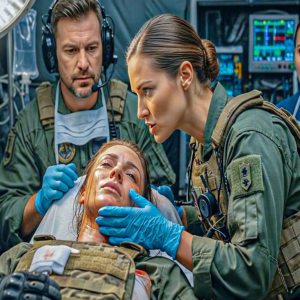
The Mavak helicopter shuddered. Not from the rotors, not from turbulence. From the mountain itself, the wind coming off the Hindu Kush like something alive and furious, hammering the aircraft sideways across the sky at 11,000 ft. Inside, the light was red. Red means critical. Red means move.
Red means you are already losing. On the center litter, strapped down with medical grade nylon and held in place by the hands of two Navy flight surgeons, lay a woman whose name was classified in four different databases. She had a bullet in her left lung. She had a collapsed right lung. She had 17 minutes of oxygen left in the portable tank and a blood pressure reading that made the senior physician close his eyes for exactly 2 seconds before he opened them and kept working.
Her heart rate was 41, dropping. The monitor beside her head pulsed with a sound like a clock winding down. Dr. Harrison Webb, 14 years in combat medicine, three tours, two commenations, turned to his colleague and said what he had never said out loud on a bird before. We are going to lose her. No one disagreed. No one argued because in the back of that helicopter, crammed between equipment racks and a defibrillator that had already fired twice, every person with a medical degree understood one thing.
The woman on the litter had decided to stop fighting. You can see it. 14 years teaches you what surrender looks like in a body. Not the visible collapse, not the flatline, but the moment before. The moment when something behind the eyes simply turns away. She was turning away. And then a voice cut through the engine noise from the rear bench. Quiet.
Certain. Two words. Move, please. The medic in the rear corner, the one nobody had introduced to Web because she had simply appeared at the forward operating base during the chaos of extraction and climbed onto this aircraft, stood up. She moved past Dr. Webb without waiting for his answer.
She knelt beside the litter. She put her mouth close to the dying woman’s ear and she whispered something, two words. The monitor changed. Heart rate 41 43 47. The dying woman’s right hand, finger slack, skin gray, closed into a fist. Dr. Harrison Webb had seen a lot of things in 14 years. He had never seen that. The mission had gone wrong at hour 4.
It had started as a reconnaissance package. Three operators, a support element, a 12-hour window. Standard deep penetration work in a province where standard was a word that meant nothing and everyone knew it. The mountains there had their own logic. Roads that appeared on maps dissolved into goat trails.
Buildings that intelligence marked as empty were not empty. Wind that the meteorology team predicted at 12 knots arrived at 40. Lieutenant Ava Kaine had been the overwatch. She had set her position on a ridge 1100 m from the objective, a low stone structure where the team needed to pull a hard drive from a dead communications array. 45 minutes in and out.
She would hold the high ground, cover their approach, cover their exit, and then collapse back to the extraction point where the medevac bird was staged. 45 minutes became two hours. Two hours became a problem. At hour four, a secondary element, not on any briefing sheet, not in any intelligence summary, came across the northern rgel line and engaged the team in the valley below.
Ava watched it happen through her scope from 1100 m. She made three shots in 90 seconds. Two connected. The third missed by 6 in because the wind shifted and she adjusted too slowly. and she would think about those six inches for a very long time afterward in the way that snipers think about the one thing they would do differently.
The one correction they did not make fast enough. The team got out, all three of them, because she held the ridge for 19 additional minutes while they moved to the extraction point, taking fire from a position 200 m to her northeast, returning it with a precision that the afteraction report would later describe as extraordinary under the given conditions.
That phrase extraordinary under the given conditions was the kind of bureaucratic understatement that the military uses when the accurate language would be something closer to. She should not have been able to do that and the three men who walked onto the extraction helicopter are alive because she did it anyway.
The round that hit her came from behind. She did not hear it. She did not see it. One moment she was prone on cold stone with her eye behind the scope and the next moment the world tilted 90° and the stone was against the side of her face and she could not breathe correctly. She had been shot before twice. She knew the specific quality of that silence.
The way sound becomes distant and close at the same time. The way your body suddenly seems to belong to someone else. The shock is a kind of dissociation. The experienced part of you watches the physical part manage the injury. And somewhere in the middle of that watching, you make a decision about what happens next.
She managed to key her radio. Overwatch is down. Overwatch is down. I’m at. She gave the grid. She did not lose consciousness. She thought that was important. She made herself breathe in short pulls because long breaths were not possible. She kept her rifle pointed at the northeast position until she heard rotors.
The medics found her still holding the weapon. They had to pry it out of her hands. She did not resist them. She simply did not voluntarily release it. There is a difference between those two things. The medics understood this in a practical sense. A patient who is not resisting is manageable. Whatever her hands are doing, and they worked around the rifle until they could deal with it.
The crew chief eventually got it free and secured it in the aft equipment bay. And later he would not be able to explain if asked why he did not simply set it aside on the floor. He secured it in its case like it mattered. Because somehow with this patient, it did. On the helicopter, as Dr.
Webb cut away her kit and assessed the wound, she had looked up at the red cabin light and thought about something very specific. She had thought about a voice she had not heard in 5 years, a voice she had believed she would never hear again. That was when she had started to turn away. Her name on the manifest was Colem, nurse specialist, attached to the forward operating base.
As of 72 hours prior, nobody at the FOB remembered processing her paperwork. This was not unusual. In the last 6 hours before an extraction package spins up, paperwork becomes secondary to everything. People appear, people leave. The base breathes in and out with a rhythm that has no time for administrative precision. The FOB’s intake log showed 12 new arrivals in the 48 hours preceding the mission support staff. intelligence attachments.
A logistics liaison from a contractor whose acronym nobody could expand. In that environment, a nurse specialist with the right credentials folder and the right demeanor simply registered as part of the operational texture. She had simply been there when the bird needed to depart. She had her kit.
She had her credentials folder. The loadmaster had pointed at the jump seat and she had taken it on the aircraft. She had stayed in the rear. Dr. Webb had registered her presence the way you register the position of furniture in a room. you’ve known for years, noted, filed, not examined. He had two surgeons and a pair of rescue jumper already working.
He did not need a fourth set of hands getting in the way. That had been his assessment for the first 40 minutes. Then she stood up and he watched her check the IV line in a way that told him something immediately, not the check itself, the grip, the angle of her wrist, the economy of the motion. There was no hesitation, no visual consultation with the drip rate, no second guessing.
She checked it the way you check something you have checked 800 times before in conditions far worse than a helicopter cabin. Combat medics develop a specific gestural vocabulary over years of fieldwork. A shorthand that compresses complex assessment into a few seconds of physical contact with the patient and the equipment. Web had that vocabulary.
He recognized it in her. Epinephrine dosage, she said. Not a question, a statement with an implicit flaw embedded in it. Excuse me. Dr. Webb said, “The epi, it’s going to spike her heart rate in about 90 seconds, and she doesn’t have the cardiac reserve for the crash that follows. You need to cut it by a third and add headstarch to the line.
” Web stared at her. Who are you? Someone who has treated a sucking chest wound at altitude before. She was already moving past him. The head of starch is in the orange case. Left wall, third shelf. She was right about the shelf. She was right about the epi. Web letter work. His surgical resident, a young physician named Doctor Patricia Sloan, who was on her first combat rotation and who had not yet developed the specific scar tissue that long-term combat medicine creates around the capacity for surprise. watched the exchange and then
watched Cole work and then said quietly to nobody in particular. She’s been in a lot of trouble before. Webb glanced at her. What makes you say that? Because she’s not just treating the wound. She’s triaging from three steps ahead. She’s already working on the problem after the next one. Sloan watched Cole’s hands.
I’ve seen that in exactly two people in this job. Both of them had been shot at. What none of them understood what Webb would not understand until much later was the other thing Cole did. The thing she did every time the patients vitals dipped toward critical. She put her hand on the woman’s arm and she spoke.
Not loudly, not for the benefit of the medical team. She pressed her lips close to the patients ear and she said things that Web, straining over the engine noise, could not fully parse. He heard fragments. Wind from the northwest. Hold your position. I have the range. The patients hand stopped trembling. The heart rate, which had been dropping like a stone, paused its descent.
“What are you saying to her?” Webb asked. Cole straightened up and looked at him. Her eyes were brown. They were very steady and very old in a face that was not the same thing she’s been saying to herself for the last 20 minutes. Cole said she just needed to hear it from outside. The file on Lieutenant Ava Kaine was 740 pages long.
460 of those pages were redacted. Of the 280 that remained accessible, accessible meaning available to personnel holding an SCI clearance with the appropriate compartment designations. The most striking section was not her marksmanship record, though that alone would have made her notable. It was the psychological assessment conducted after her third deployment.
Authored by a Navy psychologist named Dr. Robert Finch, who had evaluated hundreds of special operations personnel and who wrote in the clinical language of his profession, “Subject demonstrates an unusual capacity to subordinate personal survival instinct to mission objective. This is not trained behavior.
This appears to be dispositional.” What that meant in language that did not belong in a clinical report, Ava Kaine would die for the mission before the mission would die for her. The call sign came from Siberia. She had been 26 years old on her first rotation with a joint task force operating in conditions that the meteorology team had charted as unservivable for extended fieldwork.
Ambient temperature at night was minus 41. Visibility during the operational window was measured in feet, not meters. The kind of environment that kills people not through enemy action but through simple arithmetic. The body generates a fixed amount of heat. The environment removes it faster and eventually the math runs out.
The team had been compromised at their layup point and needed to move to the alternate extraction zone, a distance of 6 km through terrain that offered no concealment and no cover, just open frozen ground and a wind that could strip the warmth from exposed skin in under 2 minutes. Ava held a ridge position and engaged the pursuing element for 4 hours.
4 hours alone in minus 41° with a rifle. She had to work manually because the bolt mechanism had frozen twice and both times she had thought it with her hands and body heat. Not stopping, not withdrawing, not calling for early extraction, even when the option was presented to her over the radio.
Overwatch is staying, she had said. Get the team to the alternate. The team got out. She walked to the alternate extraction point afterward, 6 km alone. And when the helicopter arrived and the crew chief opened the door, she climbed in and sat down and did not speak for the entire flight. Her core temperature was 89 degrees Fahrenheit.
The flight surgeon on the extraction bird said it was the lowest he had ever recorded in a conscious ambulatory patient. Ambulatory was perhaps generous. She had walked because she refused to be carried. She had maintained consciousness because she decided to. Someone had looked at her face when they landed. the quality of it, the absolute lack of expression, the frost on her eyelashes, the stillness, and said quietly that she looked like something that had come back from somewhere very cold.
Frostbite, someone said it was not meant as a compliment. It was meant as an observation. She took it as a compliment. She always worked alone after that. Every team she attached to came to understand this instinctively. She was the gun on the ridge, the name in the radio, the 2-cond gap between the problem appearing and the problem being solved.
At 1100 m, there were stories. Special operations communities are small and insular, and information moves through them the way rumors move through any small community quickly with embellishment and with a kernel of accurate truth inside the elaboration. The stories about Frostbite were mostly accurate.
The one about the engagement in Helmond Province where she made eight shots in 6 minutes through deteriorating visibility and then walked off the mountain carrying a wounded operator she had found at the base of the rgeline on her way down. That one was accurate. The one about the shot in the Pactika district 1900 m crosswind targets moving.
That one was accurate too and the number had not been embellished because embellishment would have made it sound less real. Every sniper needs a spotter. Most snipers work with a series of spotters over a career, rotating through based on assignment, availability, compatibility. Ava Kane had worked with one, just one, in the years before she went fully solo.
One person who understood her shooting before she said a word, who read wind and range and angle with the same instinctive certainty that Ava read her targets. They had worked together for 3 years, and in that time developed a communication so compressed it was almost not language anymore. Coordinates and corrections and confirmations reduced to single words and sometimes single sounds.
A vocabulary built specifically for two people and legible to no one else. Call sign. Ghost echo status. Missing an action. Date 5 years, 2 months, 11 days ago. Ava had stopped counting after year 2 or she had told herself she stopped counting. The second time Ava went into cardiac arrest on the helicopter.
The defibrillator brought her back at 360 jewels. Her eyes opened for 40 seconds. They were not focused. They tracked nothing. The lights in the cabin were above her, and her eyes found them and did not move from them. And her lips moved without producing sound. And then she was gone again, not flatline, but gone in the other sense, retreating back to that dark interior space where people go when the body is deciding whether to continue.
Cole was cutting away the remainder of the field, dressing on Ava’s left shoulder to examine the entry wound when she stopped. “Just stopped.” The scissors in her hand did not move, Dr. Webb noticed. Problem with the wound? “No,” Cole said, but she did not move for another 3 seconds because under the field dressing, under the blood and the contaminants from the mountain dirt, there was a scar.
It was old at least 5 years, the kind of healed tissue that has gone fully white and smooth and incorporated itself into the architecture of the surrounding skin. It ran from the posterior edge of the left shoulder blade in a shallow curve toward the axilla 6 cm long with a specific profile of a through and through wound repaired under austere conditions without adequate irrigation or closure materials.
The profile of a wound closed by someone who knew what they were doing but did not have what they needed to do it properly. Cole knew the scar, not because she had seen it in a photograph or a report, because she had closed it herself. On a dirt floor in a building in a city she was not supposed to be in with a field kit containing two sutures, a partial vial of lidocaine and improvised lighting from a handheld flashlight held between her teeth.
The night before Cole had left, the night before everything had ended, the specific texture of that scar, the slight irregularity at the proximal end where she had been working at an awkward angle, the clean closure in the middle section where she had found her position and steadied her hands, the faint puckering at the distal end where the lidocaine had worn off, and Ava had held very still, while Cole finished and had not made a sound, was as familiar to her as her own hands. More familiar.
You do not forget the things you did while someone you trusted was bleeding and the city outside was deciding whether to kill you both. You okay? The par rescue jumper asked from behind her. His name was Marcus Dalton and he had been watching Cole work for the past 20 minutes with the weary attentiveness of someone who cannot decide if they are witnessing expertise or something else entirely. Fine, Cole said.
She finished removing the dressing. She worked, but her jaw was very tight for a long time after that. In the 43rd minute of the flight, Ava Kain began to speak. Not coherently, not in the way of someone who knows they are being listened to. She spoke the way people speak when the filters are gone. When the conscious mind has retreated far enough that the subconscious steps forward and uses the voice without permission.
This happens with head injuries, with extreme oxygen deprivation, with the specific neurological state that very severe shock produces. The clinical term is confusional speech. What it looks like from the outside is a person talking to someone who is not in the room. Elevation change. 15 m. Adjust. Dr. Webb leaned close.
Ma’am, can you hear me? What is your name? She did not respond to him. Wind has moved. 3°. You need to echo. I need your reading. Webb looked at Cole. Cole was already moving. She leaned over the litter and positioned herself at Ava’s left ear, the ear closest to her. The ear that was not pressed into the litter surface. And she spoke in a voice that Webb had to strain to hear over the engine.
Wind has shifted northeast. 030. Adjust 2 ms. Right. I have the range. 820 m. Call it when you’re ready. The cabin went very quiet. Or it felt quiet. The way things can feel quiet when something extraordinary is happening in front of you and your brain decides to filter out everything that is not that thing. Ava’s breathing which had been shallow and arythmic.
the ugly laborintensive breathing of a body working around a compromised lung smoothed. It was not full. It was not easy, but it was rhythmic. The difference between a rhythmic and rhythmic respiration in a trauma patient is the difference between chaos and a system under stress. Both are bad. One is manageable. Her heart rate climbed from 38 to 42. What? Dr.
Webb said are you doing giving her what she needs to stay in the scenario? Cole said, straightening. Her brain has defaulted to a high stress operational context. It’s the last fully safe environment she remembers. Not safe in the ordinary sense. Safe in the sense of a place where she knows exactly what to do and how to do it.
I’m keeping her there. You’re keeping a trauma patient in a simulated combat scenario. I’m keeping her conscious by giving her nervous system a problem it knows how to solve. Cole looked at the monitor. Watch the rate. That is not web stopped. It’s working. the cardiac monitor said. Because cardiac monitors do not lie. Webb stared at her.
How do you know the specific language? He asked. How do you know what to say? Cole looked at the woman on the litter. At the scar on the shoulder, at the hands, strong, calloused, stained with the mountain that had built over a career. The most precise record in a classified database that Web would never be allowed to access.
Because I was her spotter, Cole said. Then she went back to work. Dr. Sloan from her position near the equipment rack watched this exchange and filed it in the category of things she would think about for a long time after this tour was over. She had treated hundreds of patients. She had seen family members arrive and transform patients with their presence.
She had seen the specific phenomenon where a comeomaosse patient responds to a voice they recognize before they respond to any medical stimulus. She had never seen it work this way, this precisely, this intentionally. Whatever you’re doing, Sloan said quietly to Cole. Keep doing it.
Cole did not look up from the wound she was packing. I know, she said. The mission had a one-word designation that Cole had not spoken aloud in 5 years. She did not say it now. What she knew, what lived in the part of her mind that does not process in language, but in image and sensation, the limbic residue of things that happen to your body, was the following.
They had been in a city that does not appear in this story by name because names carry weight and this city carried enough of its own. They had been there for 6 days under unofficial cover, working a target package that required physical proximity to the objective and therefore could not be run from elevation.
They had been together spotter and shooter, the only team on the ground because the supporting element had been pulled for a higher priority action and nobody had told them until they were already inside the operational area. Six days, two people in a city that had been dissolving into factional violence for three years and had reached in that particular season a kind of terrible equilibrium in which everyone with weapons was watching, everyone else with weapons, and the streets were quiet in the specific way that only streets about to become very
loud can be quiet. They had stayed in a series of safe locations. The term was generous, moving every 36 hours, working the target during windows of movement that the urban pattern of life created, and then closed again without warning. Cole’s job during those six days was everything Ava’s wasn’t.
While Ava shot, Cole watched. While Ava moved, Cole covered. While Ava slept in the three-hour blocks they traded off in their various temporary shelters, Cole held the perimeter and thought about the next problem. The spotter’s job is to extend the shooter’s capabilities beyond what any one person can hold in their field of vision and their mind simultaneously.
Range, wind, elevation, the position and movement of everything within the operational area that might matter. The spotter is the context in which the shooter operates. Take away the spotter and the shooter is still dangerous. But they are working with incomplete information, working blind at the margins, dependent on their own perception without the second set of eyes that transforms raw data into actionable picture.
What Cole had been to Ava was not just technical. It was something harder to name. When you spend 3 years paired with someone in the specific intimacy of high-risk work, the kind of work where mistakes are final and trust is not a feeling but a survival mechanism, you develop a knowledge of them that is not reducible to data.
You know how they breathe when they are preparing a shot. You know the specific stillness that precedes their trigger pull. You know what their silence means when it is thinking silence versus worried silence versus the particular silence that means something has gone wrong and they have not yet determined how wrong. Cole knew Ava the way you know something you have staked your life on.
On day five, their cover location was compromised. On the night of day six, they were moving to an alternate Xfill point through the old market district when a secondary element cut off their route. Ava had taken a round through the left shoulder, the same shoulder, the same approximate anatomy as the scar. Cole had just touched on this helicopter and gone down behind a market stall.
Cole had gotten her upright. They had made it to a building. Cole had closed the wound on a dirt floor by flashlight. And then they had determined that the Xville point was untenable. The route was covered. The window had closed. The secondary element was methodically working through the block.
The radio had given them nothing useful for 40 minutes. Whatever support existed was not reachable in the time they had. There was one option that gave Ava a reasonable probability of extraction. It required one person to stay behind and create a diversion. Cole had laid out the logic. Ava had said no. Cole had said yes.
There was an argument that lasted 4 minutes and 20 seconds. Cole knew the exact duration because she had looked at her watch when it started and looked again when it ended. and the number had embedded itself in her in the way that numbers do when they mark something irreversible. Ava said, “This is not tactically necessary.
There are other options. We should move together to the secondary route and assess.” Cole said, “The secondary route takes you through the covered zone for 400 m and you’re bleeding and you cannot run at full speed and they will catch you.” Ava said, “Then we both go and we both take that chance.
” Cole said, “You have information on the drive and I don’t. That’s the calculus. We both know what the calculus says. Silence. 4 minutes and 18 seconds in. Ava said, “I’m not leaving you.” Cole said, “Yes, you are.” The argument ended because Cole left. She went out the rear of the building and moved east while Ava went north.
She heard gunfire behind her. She did not stop because stopping would make it meaningless. She reached a secondary network contact 3 hours later. She was extracted over the following 36 hours via a route that she was never permitted to document. She had been shot twice, once in the left thigh, once in the right hand.
The hand wound destroyed two tendons that controlled her trigger finger. There was a surgery. There was a long recovery. There was a period of time in a hospital room where the ceiling was white and still, and she lay underneath it and did what she always did when she was waiting. She worked the problem.
The problem was, was Ava alive? She could not solve it. She could no longer shoot. When she finally surfaced weeks later, after medical, after a debrief that lasted 11 hours across three sessions, she asked about Ava. The answer was delivered by a man in civilian clothes who looked at a point above her left ear when he spoke. Lieutenant Cain was extracted.
She’s been reassigned. What does reassigned mean? It means she’s operational. I need the operational security requirements of her current assignment do not permit contact. You understand what that means? It meant she is alive and you cannot reach her. It meant she does not know you survived. When had Cole had understood, she had requested a transfer to the medical track, a path her qualifications as a trained par rescue medic made plausible, and she had been granted it.
She had spent 3 years in field medical work, rebuilding a career around the hands she still had, the knowledge she still had, the particular quality of attention that 5 years in special operations had installed in her nervous system like firmware. She had not tried to find Ava. She had not tried to find Ava until the routing request came through the FOB’s medical assignment channel, anonymous, unsigned, bearing the signature mark of a directorate she recognized from the old days, assigning a nurse specialist named Cole M to a forward operating base that
happened to be staging the extraction of an injured SEAL Overwatch, who had been operating in the Hindu Kush under a call sign Cole had not seen written down in 5 years. Frostbite. Someone had decided it was time. Cole had gotten on the helicopter. The helicopter hit an air pocket at 47 minutes.
The drop was violent, 40 feet in approximately 1 second. The kind of turbulence that throws unsecured equipment against the roof and sends anything not strapped down airborne. The pares rescue jumper in the forward position took an elbow to the instrument panel hard enough to bruise two ribs, though he would not know that until later.
The IV stand came off its hook and had to be grabbed by the nearest hand, which was Kohl’s. In the aftermath of the drop, in the 3 seconds when the aircraft restabilized and the crew and medical team ran a collective rapid inventory of damage and personnel, the cardiac monitor spoke, not its normal intermittent pulse, the sustained tone, the single unbroken note that everyone in any medical context knows before they are ever formally taught what it means. Dr.
Webb was at the litter in one step. CPR now. Dalton positioned over the sternum. The rhythm began. Webb was on the airway monitoring the tube, counting. Cole did not move. Not because she was frozen, because she was watching Ava’s face. She had seen death before, real death, confirmed death, the definitive absence.
And she had seen this, the intermediate state, the physiological pause before the body commits one direction or the other. Ava’s face was not that Ava’s face was present. Something in the muscles, something in the set of the jaw was still organized in the way of a person who has not finished deciding. She thought she has been here before, not metaphorically.
Literally, Ava Kain had been in situations where dying was the easiest option, and she had chosen not to repeatedly over a career, and the mechanism by which she made that choice had not been destroyed by the bullet or the blood loss or the altitude. It was still there. It was simply waiting for the right input. 2 minutes, Webb said.
No response. I’m going to call. Don’t. Cole moved to the head of the litter. We are 2 minutes post flatline, Webb said, his voice carrying the particular controlled anger of a physician whose authority is being challenged in the middle of a resuscitation. The probability of neurological give me 30 seconds.
I am not giving you 30 seconds, Cole said, and then you call it something in the way she said it. the certainty of it. Not the desperation of someone bargaining for more time, but the certainty of someone who knows something the room does not know yet. Webb held up his hand. The compressions paused. Cole leaned over the litter. She put her lips at Ava’s ear, and in the loudest voice she had used on this entire flight, not a shout, not a cry, but something with edges in it, something that had weight and history and 5 years of silence behind it. She
said four words. Frostbite. Ghost echo reporting. The monitor flatlined. 1 second. 2 seconds. 3. 4. And then it did not. Heart rate. 22. The number moved on the screen with the halting quality of something just starting up. Not a confident rhythm, but a signal, an intention, a beginning. 22 became 26. 26 became 31. Dr. Web stood back.
He was not a man who was easily surprised. His career had been constructed on the elimination of surprise as a liability on converting every unexpected event into a protocol, every anomaly into a data point. He was good at this. He was very good at this. And in 14 years, he had seen resuscitations that defied the probability tables.
He had seen patients return from durations of cardiac arrest that the literature would have said were non-servivable. Medicine accumulates outliers. He knew this. He had no protocol for what he had just watched. Ava Kane’s eyes opened. Not the unfocused halfoping of hypoxic arousal, not the involuntary flutter of a brain stem executing its basic directives.
She opened her eyes and she looked at Cole directly with recognition. The kind of recognition that is not processed, that does not travel through the prefrontal cortex and the associative memory networks and arrive at a conclusion. The kind that is simply there, immediate and complete, like a circuit closing.
Her lips moved once. Webb, watching from 18 in away, read the shape of it. Echo. Cole’s hand found Ava’s arm. She did not say anything. She pressed her fingers into the muscle above the elbow. Not gently, not softly, but with the specific firmness of a physical confirmation. I am here. I am real. This is not your brain constructing something in the last oxygen starved moments before the end. Ava’s hand moved.
Three fingers closed around Cole’s wrist. The grip was weak, but it was intentional. Heart rate 39 climbing. She needs surgery the moment we land. Web said he said it to the aircraft to no one. He was already moving, already preparing, already doing what he knew how to do. The lung is still compromised. She is not out of danger. I know, Cole said.
She did not let go of Ava’s arm. Heart rate 44 48. Dalton at the forward position watched Cole hold Ava’s arm and Ava hold Cole’s wrist and thought about what he had just observed. He was not a sentimental person by training or temperament. He had spent 11 years doing a job that required him to be present and functional in conditions that most people cannot be present and functional in.
But he had also spent 11 years watching people. And what he was watching now was something he did not have a professional category for. It looked like two people who had not seen each other in a very long time. It looked like that was enough. Outside, through the small oval window at the aircraft’s waist, the mountains were falling away behind them.
The storm that had been building over the eastern rgeline was not following. The sky ahead, below the altitude they were flying, showed the color that appears in the east before dawn, not light exactly, but the absence of full dark. The specific transition that people who spend time in places with no artificial illumination learn to recognize by feel before they can see it.
something changing, something about to become something else. The surgical facility was 40 minutes from the FOB at rotor speed. They made it in 33. The pilot pushed the aircraft in a way that the maintenance log would later flag as excessive, but maintenance logs do not know what was on the litter in the back, and the pilot did. The landing was hard.
A running approach, the aircraft barely flaring before the wheels hit the pad, the crew chief throwing open the door before the rotors had fully reduced. The surgical team was waiting on the tarmac. They took the litter at the door. Cole moved with it, keeping her position at Ava’s side.
And for 30 ft, the surgical team accepted this. The woman in the nurse’s kit moving with the litter as if she were part of the transport chain. Then a senior surgical nurse said, “Ma’am, you need to stop here.” And Cole stopped. She stopped because Ava’s hand released her wrist, not because she was told to, because Ava let her go.
It was deliberate. The fingers did not slacken with unconsciousness. They released with intention a controlled release, a decision made by a woman who was operating on about 12% of her normal physiological capacity and still had enough left to communicate something that mattered. The litter went through the double doors.
Cole stood on the tarmac in the pre-dawn with the rotor wash dying around her and the cold coming in from the east and something in her chest that was not a medical condition and was not a wound and had no clinical designation. Dr. Webb appeared at her shoulder. She’s going to make it. He said, “The surgery is going to be long, but she’s going to make it.
” Cole nodded. “You want to tell me?” Webb said carefully. “Who you actually are?” Cole looked at the door that had closed behind the litter. “Someone who owed her a debt,” Cole said. “That’s not a name.” “No,” Cole said. “It’s not.” She reached into the front pocket of her kit vest and she took out the badge that the FOB had issued her 72 hours ago. Cole M.
Nurse Specialist, laminated standard format. She held it for a moment. Then she turned it over. On the back, in the small area below the printing, someone had written in black pen. Small letters, deliberately small, the handwriting of someone who had learned to keep things contained.
Webb tilted the badge to read it. Two words: ghost echo. He looked up, but Miracle was already walking, not toward the facility, toward the operations building. The one with the communications antenna on the roof. the one where the senior intelligence officer would be sitting at his desk in the pre-dawn working through the night’s events with the particular focused weariness of a man who has been doing this for 20 years.
She had things to say and for the first time in 5 years she had a reason to say them. 16 days later, Lieutenant Ava Kaine was moved out of intensive care. The surgery had gone 7 hours. There had been a complication in hour four, a secondary bleed from a vessel the bullet fragment had damaged but not severed, which had decided to finish the job on the table.
The surgical team had corrected it. The attending surgeon had described the correction afterward in language that meant it was very close and we were very good and she was very fortunate. Ava’s first coherent memory after surgery was the ceiling of the recovery room. white, smooth, still.
She lay there for a long time, taking inventory. Pain was present and accounted for, radiating from the left chest and left shoulder in a way that was actually reassuring. Pain meant alive. The tube in her throat had been removed, but her throat still felt constructed from sandpaper and old wire. Her hands were present.
Her legs were present. She had vague memories of the helicopter that were not quite memories, more like impressions. the way very cold water leaves an impression on skin rather than a distinct sensation. A red light, a sound like a clock, a voice, a voice that she had been so certain she would never hear again that hearing it had felt even in the compromised oxygend deprived state she had been in like something her body recognized at a level below thought, like a frequency that her nervous system was still tuned to. Even
after 5 years of silence, even after everything, she had asked for coal. On day three, the nursing staff had no record of a coal m attached to the facility. She had asked again on day five. Same answer. On day nine, a man she did not recognize came to her room. He was in civilian clothes. He looked at a point above her left ear when he spoke, which was a habit she recognized.
Cain, how are you feeling? I need to speak with someone. Ava said, “You’re speaking with me. I need to speak with Mera Cole. The man was quiet for a moment. The individual you’re referring to, he said carefully, has been reassigned. Ava looked at him for a long time. She had been shot in the chest and operated on for 7 hours and spent 16 days in various stages of medical consciousness, and she was still, even now, better at reading people than most people ever get. Is she alive? Ava said.
Yes. Does she know I’m alive? Another pause. Yes, he said. Ava turned back to the ceiling. “Okay,” she said. He waited as if expecting more. “There was no more because for Ava Kain, that was enough. For now, it was enough.” 3 weeks after the extraction, there was a debrief in a room with no windows. Present, Dr.
Harrison Webb, the parescue jumper Marcus Dalton, the facility’s senior medical officer, Dr. Evelyn Park, and a man from a directorate that the invitation simply listed as J2. The J2 man asked Web to walk through the events on the aircraft in clinical sequence. Webb did. He described the wound presentation, the treatment course, the two cardiac events, the resuscitation protocol, and the outcomes.
He described these things accurately and completely because accuracy and completeness were fundamental to who he was and because he understood that the people in this room needed the accurate version and not the version that had been simplified for an afteraction summary. Then he described the anomalies.
He described the woman who had appeared on the aircraft and the specific quality of her clinical knowledge, not just technically accurate but experientially integrated, the knowledge of someone who had acquired it in conditions that formal medical training does not replicate. He described the technique of using operational language to maintain patient engagement during hemodynamic instability.
Is this documented anywhere? The J2 man asked. The use of call signs as a resuscitation tool. Not that I found, web said. Did it work? Webb considered this. The patient is alive. He said there are multiple possible explanations for why the patient is alive. I cannot state with clinical certainty which variable was determinative.
But your professional judgment, Webb looked at the table. My professional judgment, he said, is that at the point when I was prepared to call time of death, the patient was from a purely physiological standpoint beyond my ability to retrieve. The subsequent return of cardiac function occurred in direct temporal correlation with a vocal stimulus.
A specific stimulus, one that appeared to have significance to the patient at a neurological level that I cannot fully explain, he paused. Two words, he said. She responded to two words in a way that our defibrillator could not achieve at 360 jewels. The room was quiet. What were the words? Dalton asked. Webb looked at him. Classified? The J2 man said.
Dalton looked at the J2 man. The words are classified. That is the situation. Yes. Dr. Park, who had been quiet through most of the debrief, said, “With respect, that’s not a medical finding. That’s an administrative designation applied to a medical phenomenon.” “Yes,” the J2 man said. “It is.” Park looked at him for a long moment, then wrote something in her notepad and did not raise the point again.
The debrief ended 30 minutes later. Webb gathered his notes. The J2 man gathered his folder. At the door, Dalton stopped Webb. “You were going to tell him,” Dalton said. “What stopped you?” Webb thought about it. “They weren’t mine to give,” he said. He meant the words. He meant some things belong to the people who earned them, and no debrief room, and no clearance level, and no man from a directorate with no windows in its name has the right to take them and file them and make them administrative.
” Dalton nodded like he understood. He did understand. They both did. Four months after the extraction, on a Tuesday morning in November, a woman walked into the rehabilitation facility at a naval medical center on the east coast and asked for the duty nurse. She was carrying two coffees. The duty nurse directed her to room 14.
At the door of room 14, the woman stopped. She stood there for a moment, coffee in both hands, door closed in front of her, and did something that anyone watching her from down the hall would have described as nothing. She was simply standing at a door. But the woman knew what she was doing. She was running the scenario.
She was accounting for all variables. She was determining the optimal approach. what she would say, what Ava would say, the silence in the middle, which would be substantial and necessary, whether to begin with the practical things, the reassignment paperwork, the medical update, the question of what comes next for both of them, or with the other thing, the thing that lived underneath the practical things, and had been waiting under the surface of 5 years of separate lives.
She decided there was no optimal approach. Some scenarios do not have one. Old habit. She knocked from inside. A voice. It’s open. Miracle Cole opened the door. Ava Kane was sitting up in the hospital bed, which had been cranked to its maximum incline. She was working through what appeared to be a rehabilitation exercise, specific deliberate shoulder rotations, the kind that a physical therapist specifies, and that patients perform with the controlled hatred of someone who understands the necessity and resents it anyway. She looked at Cole. Cole looked
at her. Four months and several decades worth of things that had not been said sat between them in the room. “You’re late,” Ava said. Cole held up the coffees. “Traffic,” she said. Ava looked at the coffees. “You still take it black?” Cole asked. 5 years and you’re going to ask me that. I’m asking you that. Ava was quiet for a moment.
Something in her face moved. Not a full expression. Not the kind of thing you could capture and name, but a shift. The way ice shifts when the temperature changes by a single degree. Nothing visible on the surface, everything changing underneath. Black, she said. Cole crossed the room. She put one of the coffees on the tray table.
She pulled the chair to the bedside and sat down. Ava looked at Cole’s right hand, the one wrapped around her own cup, the one with the scar along the lateral edge where the surgery had closed what the bullet had opened. Cole did not hide it. She had stopped hiding it years ago. It was simply part of the architecture now.
The way the scar on Ava’s shoulder was part of hers. You can’t shoot anymore, Ava said. No, Cole said the hand. Yes. Ava absorbed this the way she absorbed information that changed the operational picture completely without reaction. Filing it in the category of facts that cannot be changed and must be accounted for. You should have told me, Ava said.
I know. You should have. I know. Ava. Silence. Long silence. The kind of silence that two people create together when they have been through things that made them who they are and the things cannot be narrated only sat with the words. Ava said finally on the helicopter. Yes, I heard you. I know. Cole said that was the point.
Ava looked at the ceiling for a moment. Then back at Cole, the expression on her face was the same expression it had been in the recovery room when the man in civilian clothes had told her Cole was alive. the expression of someone who is processing a fact that changes everything and will not be rushed through the processing.
The doctors think it was a neurological anomaly. Ava said, “What do you think?” Ava picked up her coffee. “I think she said that I heard my spotter calling in and I had a job to do.” Cole looked at her. Ava looked at her. Neither of them smiled. That would have been the wrong note entirely.
What passed between them was something more precise than a smile, an acknowledgement, a recognition. the specific signal that passes between two people who have operated on trust in the dark and come out the other side still standing in the pale November light of a hospital room on the east coast 4 months after a helicopter over a mountain and 5 years after a city that does not appear in this story by name.
Two women who had each believed the other was dead drank their coffee. They did not speak for a long time. They did not need to. Outside the window, the sky was very clear. No wind, good conditions. There is a document that does not exist. Or rather, there is a document that exists in a file that requires a clearance level most people in military medicine will never hold.
Stored in a system that does not appear on any organizational chart maintained by a records division whose name cannot be spoken in any building that does not require a badge and a biometric. The document is a medical case study. It describes in the clinical language appropriate to its format a resuscitation event that occurred aboard a medevac aircraft over mountainous terrain at approximately 0 347 local time on an unspecified date.
It describes the patients presenting condition, the treatment course, the two cardiac events, and the clinical anomaly of the second resuscitation. It describes in a section marked with a classification header that fills half the margin the stimulus that coincided with the return of cardiac rhythm. It describes the subsequent survival of the patient. It does not name the patient.
It does not name the medic. It uses the terminology that the relevant community uses for its personnel. Call signs identifiers that are in the logic of that world more real than names. Names are administrative. Names appear on paperwork and personnel files and the letters that go to next of kin. Call signs are operational.
Call signs are what you are when you are doing the thing that defines you. The document uses two call signs. Frostbite ghost echo. It will never be published in a medical journal. It will never be presented at a conference. It will live in that system and accumulate access logs. And in 20 years, if anyone with the right clearance pulls it and reads it, they will read about a night when a defibrillator failed and two words succeeded, and they will not know what to do with that fact, and they will close the file and go back to their day.
In the rehabilitation facility on the East Coast, in room 14, the two coffees went cold before they were finished. Nobody was in a hurry. The morning light moved across the floor the way it does in November slowly without drama with the quality of light that does not make promises.
At some point, Ava said, “What happens now?” Cole thought about it. “I’m being posted to the medical training program at Ljun. 18 months and after that, unknown. That’s not a plan.” “No,” Cole said. “It’s an assessment. Plans come after assessments.” Ava’s mouth moved in a way that was not quite a smile, but had the same direction as one.
Still thinking like a spotter, she said. Old habits. Is that a complaint? No, Ava said. It’s not. The light continued its slow movement across the floor. Outside, a November wind came off the water and moved through the bare trees at the facility’s perimeter and was gone. Inside, two women who had been in the dark a long time sat in the light. It was enough. For now it was