They Asked for Reinforcements—They Got an Entire Human Battalion
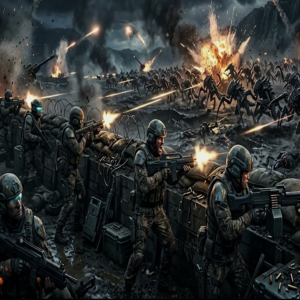
The dust on Vertara 9 never settled. It hung in the air like a red fog, making every breath taste like rust and blood. Commander Zalthor stood on the damaged wall of the garrison, his six arms gripping the metal rail as he watched the horizon. Somewhere out there, the Kresh were preparing another attack. They always were.
3 weeks ago, his force had numbered 2,000 soldiers from seven different species. Now barely 200 remained. The rest were dead, wounded, or missing. The coalition had promised this would be a simple mining operation. They had promised the crash wouldn’t dare attack a coalition world. They had been wrong. Commander, we have incoming fire on the eastern sector.
His communication officer called out. The young Vidian’s voice cracked with exhaustion. None of them had slept properly in days. Zthor moved quickly despite his fatigue. His species was built for endurance, but even he had limits. The eastern wall shook as crash artillery found its mark. Three more soldiers down. Three more families that would receive the news.
Three more reasons why this war needed to end. But it wouldn’t end. Not here. Not today. The Kresh wanted Vertara 9 for its rare minerals, and they were willing to throw endless warriors at the planet until the coalition broke, and break they would. Zhor had run the numbers. At their current rate of casualties, the garrison would fall in less than a week.
He made his way to the command center, a reinforced bunker that had seen better days. The walls were scorched black from a near miss 2 days ago. Half the screens were dead, showing only static. The other half displayed maps that grew smaller with each update as they lost more ground. “How much ammunition do we have left?” Zor asked.
His supply officer, a small tixian with gray skin, looked up from his data pad. 15%, commander. Maybe less. And that’s counting the damaged rounds. 15%. Zthor felt something heavy settle in his chest. It wasn’t fear exactly. He had accepted his death weeks ago, but the thought of his soldiers dying for nothing, of the crash claiming this world, of the coalition losing another battle, that hurt more than any wound.
Send a message to coalition command. Zthor said quietly. Emergency Channel, tell them we need reinforcements. Any species, any number, even a single squad would help us hold longer. The communication officer’s antenna drooped. They both knew it was pointless. The nearest coalition fleet was 3 weeks away. By then, there would be nothing left to reinforce, but they had to try.
It was all they could do. The message went out into the void, carried by faster than light communication across the galaxy. It reached a dozen worlds, was read by a dozen commanders, and was filed away by a dozen bureaucrats who marked it as unfortunate but unavoidable. But one world received the message differently.
On Earth, in a military base called Fort Bradley, Lieutenant Colonel Jake Morrison read the transmission three times. He was a tall man with gray hair starting to show at his temples and eyes that had seen too many battles. He had been a soldier for 24 years and he knew a desperate call when he heard one.
Sir, are we responding to this? His executive officer asked. Major Frank Chen stood at attention, waiting for orders. Morrison looked at the star map on his screen. Verta 9 was at the edge of coalition space, right where human territory met the rest of the galaxy. Earth had only joined the Galactic Coalition 6 months ago.
This would be their first real military deployment with alien forces. Get me, General Patterson, Morrison said. The conversation with the general was short. Earth wanted to make a good impression. They wanted to show the coalition that humans were reliable allies. They wanted to prove they belonged in the galactic community. And most importantly, they didn’t leave people behind when they called for help.
You’ll take the third battalion, General Patterson said over the video link. Full combat load. Show them what human soldiers can do. Morrison allowed himself a small smile. Yes, sir. How many did they ask for? The message said, “Any available reinforcements? Even a single squad,” the general replied. “I think 800 soldiers should be sufficient.
” 24 hours later, Morrison stood in the hangar bay, watching his battalion assemble. 800 men and women, all volunteers, all ready to deploy to a war zone they knew nothing about to help aliens they had never met. He felt a surge of pride watching them work. Captain Lisa Brennan approached with her usual confident stride.
She commanded Alpha Company and had a reputation for being tough as nails. All companies are ready for loading, Colonel. We’re bringing enough ammunition for a 3-month campaign, plus artillery, drones, and heavy weapons. If these Kresh want to fight, we’ll give them one. Good. Morrison said, “What do we know about the Kresh?” “Not much, sir.
They’re aggressive. They don’t negotiate and they fight in large numbers. The coalition usually deals with them by running away.” Morrison raised an eyebrow. Yes, sir. Apparently, most species in the coalition prefer to avoid casualties. They’ll abandon a position rather than take losses defending it.
That’s not how we do things, Morrison said firmly. No, sir, Brennan agreed. That’s not how we do things at all. Sergeant Firstclass Tony Martinez joined them carrying a data pad. He was Morrison’s senior enlisted adviser and had been with him for 6 years. Colonel, the Resolute is ready for boarding. They’re estimating a 4-day jump to Vertara 9.
Then let’s not keep them waiting. Morrison said the loading took 6 hours. 800 soldiers. Their equipment, vehicles, weapons, and supplies all had to be secured for faster than light travel. The Resolute was a massive transport ship, but even it felt crowded with a full battalion aboard. As the ship prepared to jump, Morrison stood in the observation deck, looking at Earth shrinking behind them.
Somewhere in the galaxy, 200 soldiers were holding a wall against impossible odds. They had asked for help. They had asked for a squad. They were going to get a battalion. Morrison didn’t know if it would be enough. He didn’t know if they would arrive in time. He didn’t know if his soldiers would come home. But he knew one thing with absolute certainty.
When Earth made a promise, Earth kept it. The Resolutees engines hummed. Reality bent around them, and they jumped into the unknown. 4 days to Verta 9. 4 days to prove that humanity belonged among the stars. 4 days until Commander Zthor got his reinforcements. The crash had no idea what was coming.
Commander Zalthor was checking ammunition counts when the alarm sounded. His communication officer jumped from his seat, all four eyes wide with surprise. Commander, we have a ship emerging from faster than light travel. It’s It’s huge, sir. Zthor felt his heart skip. If they were bringing in heavy equipment, the garrison wouldn’t last another day.
Battle stations. Get me a visual. The main screen flickered to life, showing a massive vessel hanging in orbit above Vertara 9. But it wasn’t crash. The design was unfamiliar, blocky, and functional rather than the flowing organic shapes the Kresh preferred. Sir, I’m receiving a coalition identification code, the communication officer said, his voice shaking.
It’s It’s the reinforcements, Zthor stared at the screen. That can’t be right. I asked for a squad. That ship could carry thousands. Sir, they’re requesting permission to land. They say they’re from Earth. Ah, Earth. Zor had heard of them. the newest member of the coalition, a species from a small world on the edge of explored space.
They had no military reputation because they had never fought alongside coalition forces before. Some species whispered that humans were weak, others that they were dangerous. No one really knew. “Grant them permission,” Zthor said. “And get me account of how many soldiers they brought. What happened next would be talked about in the garrison for the rest of their lives.
” The transport ship, which the humans called the Resolute, began deploying landing craft. Not one, not five, 24 landing craft, each carrying soldiers and equipment. The communication officer’s hands trembled as he read the sensors. Sir, I’m counting individual combat signatures. There are, commander. There are 800 of them. That’s impossible.
Zthor said, “Check the sensors again. I’ve checked three times, sir. 800 human soldiers are landing right now.” Zhor rushed outside to see for himself. The landing zone was chaos. Massive craft touched down one after another, ramps dropping before they even fully settled. Humans poured out in organized lines, wearing armor that looked heavy and practical. They moved with purpose.
Each one knowing exactly where to go and what to do. But it wasn’t just soldiers. Vehicles rolled down the ramps, low and armored with weapons mounted on top. Strange flying machines, smaller than shuttles, hovered overhead, cargo containers stacked up faster than Zthor could count.
In minutes, the humans had established a perimeter around their landing zone. that looked more secure than anything the coalition had built in 3 weeks. A human approached Zthor. He was tall, taller than most coalition species with gray hair and eyes that seemed to take in everything at once. He saluted in a gesture Zthor didn’t recognize but understood.
Commander Zthor, I’m Lieutenant Colonel Jake Morrison, Third Battalion, United States Army. We’re here to help. Zthor found his voice, though it took effort. Colonel Morrison, we we asked for reinforcements. Perhaps a squad to help hold our lines. Morrison smiled and there was something fierce in that expression. A squad commander, we don’t do half measures. You needed help.
You got a battalion, but but this is just a garrison action. We didn’t expect the crash to push harder now that we’re here, Morrison interrupted. Where do you need us? Zhor pulled himself together. He was still the garrison commander, even if he felt completely overwhelmed. The eastern perimeter is our weakest point.
We’ve lost half our soldiers there. Captain Brennan, Morrison called out. A human woman approached, her armor marked with symbols Zor didn’t understand. Take Alpha Company to the eastern perimeter. Fortify it. I want that position held. Yes, sir. Brennan said, and she was already moving before Zthor could explain the situation.
Colonel, you should know that the eastern perimeter is under constant artillery fire. Zthor tried to warn him. We’ve lost. Then we better get our counter battery radar set up, Morrison said calmly. He spoken to a communication device. Lieutenant Harris, I need your heavy weapons platoon ready to provide fire support within the hour.
A voice responded immediately. Already on it, sir. We’re unloading the artillery now. Artillery. Zthor’s mind reeled. The coalition force had lost their artillery in the first week. They had been fighting with just small arms for 2 weeks. These humans had brought artillery as if it was normal. Over the next 4 hours, Zthor watched something he had never seen before.
The humans didn’t just take up positions. They transformed them. They dug trenches deeper, built walls higher, created firing positions that interlocked to cover every angle. They strung wire that would slow down attackers. They planted devices in the ground that Morrison called mines. Those will explode when the crash step on them.
Morrison explained when Zhthor asked. That seems excessive. Zthor said carefully. Morrison looked at him with those calculating eyes. Commander, the Crash have been pushing you around for 3 weeks. That ends now. We’re not here to barely survive. We’re here to win. A young human soldier, his name tag reading Cooper, approached carrying medical supplies.
Sir, we’ve set up a field hospital. We’re treating the coalition wounded now. Coalition wounded? Zthor asked. Yes, sir. Cooper said. Corporal Blake, our medic, is checking everyone. She said some of your people have injuries that weren’t treated properly. Zthor felt something warm in his chest. You’re treating our soldiers? Morrison looked surprised by the question.
Of course, we’re all on the same side. That evening, Zthor walked through the garrison with Morrison. Everywhere he looked, humans were working. They didn’t stop. They didn’t complain. They just kept building, preparing, organizing. His own soldiers watched with amazement, and many had already started copying what the humans were doing.
I don’t understand, Zor admitted. Your planet just joined the coalition. This isn’t your fight. Why send so many soldiers? Morrison stopped walking and looked at the red sky of Vertara 9. Commander, on Earth, we have a saying. We leave no one behind. You called for help. That makes it our fight. But 800 soldiers for 200 coalition troops seems like exactly what you need to turn this around.
Morrison finished. Commander, I’ve read the reports. The crash have been using numbers against you. They attack in waves, wearing you down, making you spend ammunition you can’t replace. That strategy works against species that avoid casualties. He paused. It won’t work against humans. Why not? Zor asked. Because we’re willing to stand and fight.
Because we brought enough ammunition to fight for months, not days. Because when humans say they’ll hold a line, they hold it. Morrison’s voice was firm. The Kresh are about to learn something new about the galaxy. They’re about to learn what happens when they push humans. That night, Kresh scouts observed the human arrival from hidden positions in the hills.
They counted the soldiers, the vehicles, the weapons. They noted the strange way humans organized their defenses. Then they reported back to their commander. The crash commander looked at the report and laughed. More prey had arrived. Excellent. they would break just like all the others. He ordered an attack. For the next morning, 3,000 warriors, enough to overrun any position the coalition had ever held.
The Kresh had fought the coalition for 50 years. They knew how every species fought. They knew when they would run, when they would surrender, when they would break, but they had never fought humans before. On the eastern perimeter, Captain Brennan checked her rifle one last time and looked at her soldiers. They were ready.
They were always ready. Tomorrow, the crash would come. Tomorrow, they would learn that humans were different. Tomorrow, the war would change. The attack came at dawn, just as Captain Brennan expected. The Crash never changed their tactics. Why would they? Their tactics always worked. The sun was barely over the horizon when the sensors started screaming.
Brennan stood in the command post that her company had built in just 2 days, watching the screens. Red dots appeared on the display, hundreds of them moving toward the eastern perimeter in a massive wave. Contact 3,000 m and closing. Her radio operator called out. Looks like 3,000 enemy combatants. Maybe more. Brennan picked up her radio.
All alpha company positions, this is Brennan. Enemy force approaching from the east in strength. Hold your fire until they reach the markers. Make every shot count. On the wall beside her, Lieutenant Colonel Morrison watched through binoculars. Commander Zthor stood next to him, his six arms trembling slightly.
The coalition commander had seen this before. This was how the Kresh attacked. This was how they won. Colonel, you should prepare to fall back, Zor said quietly. When they hit the walls, the position will be overrun. “It’s better to retreat to secondary defenses.” Morrison didn’t lower his binoculars. “We’re not falling back, Commander, but there are 3,000 of them, maybe more.
Your force is 800.” The mathematics mathematics don’t account for training, discipline, and firepower. Morrison said, “Watch.” The crash force came into view. They were massive creatures, 8 ft tall with thick armor-like skin and four arms, each carrying weapons. They moved in a loose formation, roaring battle cries that echoed across the valley.
It was intimidating. It was supposed to be. Brennan watched them come closer. 2,000 m,500, 1,200. She keyed her radio. All positions, weapons free. Fire. The eastern perimeter erupted. Human rifles fired with a sharp crack that was different from coalition weapons. Crush warriors fell one after another, dropping before they even knew they were being shot.
The human weapons reached out further than anything the Kresh had faced before. “How are they hitting targets at this range?” Zor asked, amazed. “Coalition weapons are effective at 600 m. Your soldiers are firing at 1200. Better weapons, better training, Morrison said simply. Keep watching. Do men.
Lieutenant Paul Harris in charge of the weapons platoon spoke calmly into his radio. Fire mission coordinates marked. Five rounds high explosive. The human artillery positioned safely behind the walls fired. The shells arked through the air and landed in the middle of the Kresh formation. The explosions were devastating.
Dozens of Crush warriors disappeared in fire and smoke. The Kresh had never experienced artillery fire from defenders before. Coalition forces usually lost their heavy weapons early in any battle. The enemy force hesitated. Confused again, Harris said. Same coordinates. Adjust 200 m north. More shells fell. More crash died. The attack wave started to break apart as warriors looked for cover that didn’t exist in the open valley.
But the crash were brave. Brennan had to give them that. Despite their losses, they kept coming. They reached 1,000 m, then 800. Human rifles kept firing, steady and accurate. Every shot was aimed. Every shot hit. Coalition soldiers watched in disbelief as human soldiers fired, reloaded, fired again without panic or fear.
Sergeant Tony Martinez was on the northern section of the perimeter with a squad of young soldiers. Private Cooper was next to him, firing his rifle with the same rhythm Martinez had taught him in training. “Sergeant, there’s so many of them,” Cooper said, his voice tight. Then we have plenty of targets, Martinez replied calmly. Aim, breathe, squeeze.
You know how to do this. A coalition soldier, a Vidian named Crics, crouched behind the same wall. He had fought for two weeks, watching his friends die one by one. He had expected to die today, but the humans next to him weren’t dying. They were fighting. Why aren’t you afraid? Crics asked. Martinez glanced at him while reloading.
I am afraid. Fear keeps you sharp. But I’m more afraid of letting my squad down. He slapped a new magazine into his rifle. Besides, we trained for this. The crash didn’t. At 600 m, the crush charge hit the minefield. Explosions rippled through their ranks. Warriors fell, injured and confused. Their formation broke completely.
All units, target clusters, Brennan ordered. Pour it on. The human soldiers shifted fire to the groups of crash that had stopped, uncertain whether to advance or retreat. The artillery kept firing, methodical and precise. Warrant officer Greg Sullivan flew his combat drones overhead, marking targets and providing real-time intelligence.
Colonel, they’re starting to fall back. Sullivan reported over the radio. Morrison watched through his binoculars. The Crash warriors were indeed retreating, dragging their wounded with them. What had started as an overwhelming attack was now a route. Cease fire, Morrison ordered. Let them go.
I want our ammunition for the next wave. The guns fell silent. The valley was covered in smoke and blood. Human casualties. Three wounded, none killed. Crash casualties. Over 800 dead or wounded. Zthor couldn’t speak. In 3 weeks of fighting, the coalition had never inflicted such losses on the Kresh. In 4 hours, the humans had broken an attack that should have overrun the entire garrison.
How? He finally managed to ask. Morrison turned to him. Training, commander. Human soldiers train constantly for situations like this. We practice until shooting becomes automatic. Until following orders becomes instinct. The crash are brave, but bravery alone doesn’t win battles. A medical team brought in a wounded crash warrior who had been left behind.
Corporal Nina Blake, the company medic, started treating his injuries despite the alien size and appearance. The crash tried to resist. Confused why an enemy would help him. Hold still, Blake said firmly. I’m trying to save your life, you idiot. Morrison approached the prisoner through a translation device.
He asked, “Do you understand what happened?” Today, the crash warrior looked at him with something Morrison recognized. “Fear you. You are not supposed to fight like this. Prey species don’t hunt. They run, son,” Morrison said quietly. “Humans didn’t get to the top of our food chain by being prey. We’re predators who learn to think.
That makes us the most dangerous thing in this galaxy. The crush warrior said nothing, but Morrison could see understanding in his eyes. That evening, Crash High Command received the battle report. The commander, who had ordered the attack, insisted his warriors had faced at least 5,000 defenders with advanced weapons. He described artillery that never stopped firing, soldiers who couldn’t miss, and defenses that seemed designed by someone who understood warfare better than any crash warrior.
The high commander read the report and threw it aside. Impossible. The coalition doesn’t fight like this. No one fights like this. Oh no, no one fights like this. Commander, the survivors all say the same thing, her adviser said carefully. These humans are different. Then we send more warriors, the high commander said.
We send so many that even perfect accuracy won’t save them. The adviser bowed and left. Alone in her command chamber, the high commander looked at the casualty numbers again. 800 dead in 4 hours, more than they had lost in the entire previous month. For the first time in her long military career, she felt something unfamiliar.
Doubt. Back at the garrison, Morrison gathered his officers. Good work today. But this was just a probe. They’ll be back with more. How many more? Captain Brennan asked. All of them, Morrison said. Now they know we’re dangerous. They’ll want to crush us before we can dig in any deeper. Let them come, Brennan said.
And there was steel in her voice. Well be ready. Morrison nodded. they would be ready because that’s what humans did. They prepared, they trained, they planned, and when the moment came, they stood and fought. The crash were about to learn a lesson that would echo across the galaxy. Humanity had arrived, and they played by different rules.
The intelligence report arrived 6 days after the first battle. Lieutenant Colonel Morrison read it twice, then called his command staff together. Coalition intelligence says the crash are massing a force of 10,000 warriors. Morrison announced, “They’re coming at us with everything they have in this sector.” The room was silent. Major Frank Chen, Morrison’s second in command, studied the numbers on his data pad. Sir, that’s more than 12 to1 odds.
I can count, Frank, Morrison said dryly. The question is, what do we do about it? Captain Lisa Brennan leaned forward. We do what we came here to do. We hold. Commander Zaul Thor, who had been invited to the meeting, stood up. His six arms gestured in agitation. Colonel Morrison. Please understand. No coalition force has ever survived against those numbers.
Coalition high command is ordering a complete evacuation. Then they can pick up the crush survivors after we’re done. Morrison said. Colonel, you’re not listening. 10,000 warriors will overrun this position. I’ve seen it happen before. We must evacuate. Morrison stood and walked to the map on the wall. Commander, I appreciate your concern, but we didn’t come all this way to run at the first real challenge.
Besides, we’ve had 6 days to prepare. He pointed to the map. Six days to turn this garrison into a fortress. It won’t be enough, Zthor said. But his voice was uncertain. It will be, Morrison said with absolute confidence. Because humans don’t measure victory in casualties avoided. We measure it in objectives held.
And our objective is keeping Verara 9 out of Crash hands. Over the next 3 days, the human battalion worked around the clock. They dug trenches deeper than any coalition species would have thought necessary. They built firing positions that connected to each other through underground tunnels. They created kill zones where any attacker would be exposed to fire from multiple angles.
Combat engineers worked on the walls, reinforcing them with materials they had brought from Earth. They laid more mines, thousands of them, in patterns designed to channel attackers into specific areas. They positioned artillery to provide overlapping fields of fire. Captain Brennan walked the eastern perimeter with Lieutenant Paul Harris, discussing positions.
“I want your heavy weapons here, here, and here,” she said, pointing to spots on the wall. “When the crash come through the valley, they’ll bunch up. That’s when you hit them.” Harris nodded. What about the northern approach? Staff Sergeant Karen White has third platoon up there. I want her to hold until the crash are committed to the eastern assault.
Then hit them in the flank. That’s asking a lot from one platoon, Harris observed. White can handle it, Brennan said. Her people are solid indeed. Staff Sergeant White was already preparing her platoon. She walked each position with her soldiers, explaining the plan three times to make sure everyone understood.
Private Cooper was one of her machine gunners and she spent extra time with him. Cooper, when this starts, you’re going to be scared, White said. Everyone gets scared. The difference is what you do with that fear. Yes, Sergeant Cooper said. I won’t let you down. I know you won’t, White said. She clapped him on the shoulder.
You’re a good soldier, Cooper. Trust your training. Coalition soldiers watched the preparations with growing amazement. Some, like Crics the Vidian, volunteered to fight alongside the humans. Commander Zthor tried to discourage them, but his soldiers insisted. We’ve watched them prepare, Commander.
Cric said, “We’ve seen how they fight. If they believe we can win, then maybe we can, Crics.” Zhor looked at his soldier and saw something he hadn’t seen in weeks. hope. He gave his permission. The night before the battle, Morrison walked the entire perimeter. He stopped to talk with small groups of soldiers, asking about their families, their homes, their worries.
It was something his own officers had done for him when he was young, and he had never forgotten it. “Think we’ll hold, sir?” a young soldier asked. “I know we will,” Morrison replied. “Because that’s what we do.” Sergeant Tony Martinez found Morrison near the command post after midnight. Colonel, you should get some sleep. “Uh uh, in a bit, Tony,” Morrison said, looking at the stars.
“We will, sir,” Martinez said. “These kids are ready. They might be scared, but they’re ready.” The attack began at sunset. The crash had learned from their first assault, so they started with artillery of their own. Shells rained down on the garrison walls, but the humans had prepared for this. Most soldiers were in protected positions, and the ones who weren’t had cover close by.
“Counter battery fire,” Lieutenant Harris ordered calmly. His artillery crews had already calculated the firing positions. Human shells arked out and destroyed three crash gun positions in the first 5 minutes. Then the warriors came, 10,000 of them moving across the valley like a living wave.
They roared their battle cries, trying to intimidate the defenders. Inside the garrison, young soldiers gripped their rifles tighter. Steady, officers called out. Hold your fire. Wait for the word. Thurs. Morrison watched from the command post. The Crash were using the same tactics as before, just with more warriors. They hadn’t adapted. That was their mistake.
All units, fire at will. Morrison ordered. The battle began. For 14 hours, the fighting never stopped. The crash came in waves, trying to overwhelm the defenders through sheer numbers. But the human positions held. Soldiers rotated through the firing line, keeping fresh troops at the wall while others rested. It was a technique the coalition had never seen before.
Captain Brennan’s Alpha Company held the eastern wall, the main crash target. The fighting there was brutal. Crash warriors made it all the way to the walls three times, and three times they were thrown back. Brennan moved constantly along her line, directing fire, encouraging her soldiers, filling gaps where needed. Captain, we’re low on ammunition on the south section.
A lieutenant reported, “Runners, get ammunition from the reserve.” Brennan ordered without hesitation. Two soldiers sprinted to the supply point and returned with heavy crates. The ammunition never ran out because the humans had planned for sustained combat. On the northern perimeter, Staff Sergeant White waited until the Kresh committed their reserve forces to the eastern assault.
Then she led her platoon in a sudden attack on the enemy flank. The crash, focused on breaking the eastern wall, didn’t see the threat until it was too late. Private Cooper fired his machine gun in short, controlled bursts, just like he had been taught. Crash warriors fell and their attack faltered.
White’s platoon held for two hours under heavy pressure before falling back to their prepared positions, but the damage was done. The crash attack lost its coordination. Around midnight, Sergeant Martinez led a raid on the crash command post. 20 soldiers moved through the darkness using night vision equipment that turned the battlefield green and clear.
They reached the enemy headquarters and destroyed it with explosives, killing the crash commander directing the assault. Corporal Nina Blake worked throughout the night in the field hospital treating wounded from both sides. Human casualties were surprisingly light thanks to body armor and good tactics, but there were injuries and Blake treated each one with the same careful attention.
A coalition soldier was brought in with a serious wound. Blake worked on him while a crash warrior lay on the next table also being treated. The coalition soldier stared at his enemy. Why are you helping him? The coalition soldier asked. Because he’s wounded, Blake said, not looking up from her work on this table.
He’s just another patient. Commander Zthor fought alongside Captain Brennan for most of the night. He had never experienced combat like this. The humans never panicked. They never ran. When one position was threatened, others moved to support it. They fought as one unified force. How do your soldiers keep going? Zor asked during a brief lull.
Coalition troops would have broken hours ago, Brennan reloaded her rifle. Because we’re all counting on each other. If I break, I let down everyone in my company. If my company breaks, we let down the battalion. No one wants to be the weak link. But the casualties are lighter than they should be because we prepared properly, Brennan interrupted.
Commander, warfare isn’t about bravery alone. It’s about planning, logistics, training, and discipline. The crash have bravery. We have everything else. Dawn came slowly. As the sun rose, the crash attack finally stopped. The warriors pulled back, exhausted and broken. Of the 10,000 who had attacked, more than 4,000 lay dead or wounded in the valley.
The human battalion had held every position. Human casualties, 23 killed, 67 wounded. It was a miracle of modern warfare. Morrison stood on the wall, watching the crash retreat. Next to him, Commander Zthor was silent, trying to process what he had witnessed. We won, Zhor finally said, his voice filled with wonder.
We held, Morrison corrected. There’s a difference. But they both knew that something had changed. The Crash had thrown everything they had at the garrison and failed. Word would spread. The galaxy would know that humans didn’t fight like other species. The long night was over. The battle was won. And humanity had proven itself.
The crash high commander stood in her war room reading the battle report for the fifth time. The words didn’t change. 10,000 warriors sent to crush a small garrison. 4,000 dead, 2,000 wounded. The attack had failed completely. Her senior adviser stood silently, waiting for orders. He had never seen the high commander like this.
She was always confident, always aggressive. now. She just stared at the numbers. They lost 23 soldiers, she said quietly. We lost 4,000 and they lost 23. The humans fight differently than any species we’ve encountered, the adviser said carefully. Their weapons reach further. Their soldiers don’t break.
They plan for long battles instead of quick strikes. Then we cannot beat them. The high commander said it wasn’t a question. Not at Vertara 9. Not with the forces we have available. The high commander made her decision. It was the first time in her career she had ordered a complete withdrawal, but she hadn’t survived this long by being foolish.
Pull all forces back from Vertara 9. Send a message to Coalition Command. We wish to discuss peace terms. Quote, “Commander, the Council of Warriors will see this as weakness. The Council of Warriors didn’t see what happened on that planet.” The high commander said, “The humans didn’t just beat us. They made it look easy.
If one battalion can do this, what happens when they send more?” She looked at her adviser. “We must adapt or die. I choose to adapt.” On Vertara 9, Lieutenant Colonel Morrison walked through the battlefield with Commander Zthor. The valley was quiet now. Crews working to recover the dead from both sides. It was grim work, but necessary.
Coalition High Command is sending an investigation team. Zthor said, “They don’t believe the reports.” Morrison smiled slightly. “Can’t say I blame them. If someone told me a force of 800 held against 10,000, I’d want proof, too.” Quote, “It’s more than that, Colonel. The coalition has fought the Kresh for 50 years. No one has ever won a battle this decisively.
They need to understand how it’s possible. 3 days later, a coalition cruiser arrived carrying members of the High Council. They were a mixed group representing different species, all wearing official robes that marked their importance. Morrison met them at the landing zone in a clean uniform, flanked by Captain Brennan and Sergeant Martinez.
The council members looked around the garrison with obvious surprise. The walls were intact. soldiers moved with purpose and discipline. There were no signs of the desperate struggle the reports had described. I am council member Vextar of the Tixian Republic. The lead council member said, “We are here to investigate the events of the past 2 weeks.
Welcome to Vertara 9.” Morrison said, “What would you like to see?” What followed was 3 days of inspections, interviews, and demonstrations. The council members walked through the human positions, examining the fortifications. They interviewed coalition soldiers who had fought alongside the humans. They reviewed combat footage.
They studied casualty reports. Council member Vextar spoke with Private Ryan Cooper, who had been recommended for a medal by both human and coalition commands. “You’re very young,” Vexar observed. “This was your first combat experience?” “Yes, sir,” Cooper said. But we trained for 2 years before deploying. By the time we got here, I knew my job.
And you weren’t afraid. Cooper hesitated. I was terrified, sir. But Staff Sergeant White taught me that being scared is okay. It’s what you do when you’re scared that matters. Vexar interviewed dozens of soldiers and heard the same themes repeatedly. Training, discipline, teamwork, planning. The humans had taken concepts the coalition knew about and pushed them to levels that seemed excessive until they worked.
On the third day, the council requested a formal briefing. Morrison stood before them in the command center. A holographic display showing the battles. The crash employ mass assault tactics, Morrison began. They rely on numerical superiority to overwhelm defensive positions. This works against opponents who panic or who lack the ammunition for sustained combat.
He changed the display to show human positions. We countered by creating defense in depth, multiple fallback positions, interlocking fields of fire and stockpiles of ammunition at every position. When the crush attacked, they faced fresh troops no matter how long they fought. But the casualty ratio, Vextar interrupted. How do you explain losing so few soldiers? Morrison changed the display again.
Body armor that stops most small arms fire. Medical care within minutes of injury. Fire discipline that ensures every shot counts. And most importantly, training that makes combat second nature. Your soldiers train constantly? Another council member asked. Yes, a human soldier trains for months before joining a unit, then continues training throughout their career.
We practice until skills become instincts. The council members looked at each other. This explained the human performance, but it also revealed something startling, what they considered a strong military response. Humans considered basic readiness. Colonel Morrison, Vexar said slowly. When you received our request for reinforcements, what did Earth think this deployment would be? Morrison considered his answer carefully.
A chance to prove ourselves as reliable allies. We’re new to the coalition, and we wanted to show that when we make a commitment, we keep it. So, this was a small deployment by human standards, a single battalion. Yes, council member. This was a limited response to what we understood as a limited engagement. The implications hung in the air.
If this was a limited response, what could humanity do with a full effort that evening, the council met privately with Morrison? Vexar spoke for the group. Colonel, the coalition would like to offer Earth command of the entire border sector. Your military capabilities far exceed what we anticipated. Morrison shook his head. With respect, council member, we didn’t come here to take command of anything.
We came because someone asked for help, but surely you see the strategic value. I see that the coalition has dozens of species with their own military traditions, Morrison interrupted gently. What I’d suggest instead is a joint command structure. Let each species contribute what they do best. We don’t need to dominate.
We need to cooperate. Vextar studied the human kernel. You really believe that? I do. Humanity’s strength isn’t just our weapons or training. It’s our ability to work together toward a common goal. Why would we assume we’re the only ones who can contribute? The council agreed to Morrison’s proposal. In the coming months, human military advisers would work with coalition forces, sharing tactics and training methods, but command would remain joint with respect for each species contribution.
Two weeks after the battle, the human battalion prepared to return to Earth. Coalition soldiers gathered to watch them leave, many having formed friendships with their human counterparts. Crics, the Vidian soldier who had fought alongside Sergeant Martinez, approached with a gift. It was a traditional Vidian honor blade given only to proven warriors.
You taught me that fear is acceptable, Crick said. You taught me that training matters more than bravery. You taught me that surrender is a choice, not an inevitability. Martinez accepted the blade with genuine emotion. You were brave before we arrived, Cricks. We just showed you how to use that bravery effectively.
Martinez accepted the blade with genuine emotion. Commander Zthor stood with Morrison as the loading began. We did what any ally should do, Morrison said. “But you did more than stand. You changed how the galaxy sees warfare. Every species will be studying what happened here.” Morrison smiled. “Good. Maybe next time we won’t have to fight alone.
The news spread through the galaxy quickly. The crash, the species that had terrorized coalition borders for 50 years, had asked for peace. A single human battalion, had accomplished what decades of coalition warfare could not. Some species saw humans as a threat. Others saw them as salvation. Most saw them as something new and unpredictable.
But everyone agreed that the galaxy had changed the day humans decided to keep their promises. On the transport ship Resolute, Morrison sat with his senior staff as they prepared for the jump to Earth. Sergeant Martinez asked the question that had been on everyone’s mind. Sir, do you think they’ll remember what we did here? Morrison looked at his sergeant, at the soldiers around him, at the people who had stood on a wall against impossible odds and won.
Tony, we just taught the entire galaxy that when humans make a promise, we don’t send a token force. We send what’s needed to win. We sent 800 soldiers to save 200. We lost 23 people doing it, and we do it again tomorrow. The Resolute jumped to faster than light travel, leaving Vertara 9 behind. On the planet surface, construction crews were already building a monument.
It would be made of stone quarried from the valley where the battle was fought and it would stand for a thousand years. The inscription was simple. In honor of Earth’s third battalion, who came when called, fought when needed, and proved that humanity keeps its word. Below that, a single line in multiple languages.
They asked for reinforcements. They got an entire human battalion. They got victory. A V they they v Commander Zthor visited the monument every day for the rest of his posting on Vertara 9. He would stand there and remember the humans who had fought beside him. He would remember that courage without training was just bravery.
But courage with training, discipline, and planning was something else entirely. It was victory. Across the galaxy, militarymies added new chapters to their textbooks. The defense of Vertara 9 became required study for every officer candidate. The human battalion’s tactics were analyzed, debated, and adapted by dozens of species.
But the most important lesson wasn’t about tactics or weapons. It was about reliability. When Earth said they would help, they meant it. When humans made an alliance, they honored it. When someone asked for reinforcements, humans didn’t calculate the minimum response. They sent enough to win and the galaxy would never be the