“You’re Just a Contractor” – Navy SEALs Had No Idea She Was a Marine
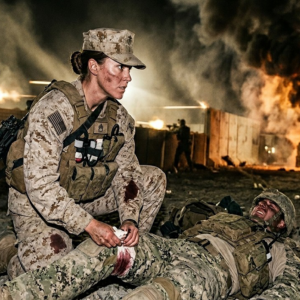
Dark, the smell of copper and antiseptic. Sarah Mitchell’s hands moved across skin slick with blood that wasn’t hers, the scalpel catching emergency light as she worked. Somewhere in the blackness beyond the surgical lamp, a voice cut through the silence like a blade. Who the hell are you? She didn’t answer.
Her finger stayed steady. The suture pulled through tissue with the practiced precision of someone who had done this a thousand times in places most people would never survive long enough to see. I asked you a question. Still nothing. Only the wet sound of her work and the shallow breathing of the man on her table. Mitchell, answer me.
But Sarah Mitchell had learned a long time ago that some questions don’t deserve answers until the person asking them is ready to understand. And Commander James Brennan wasn’t ready. Not yet. 96 hours earlier, she had been nobody to him. A name on a manifest. A problem he didn’t want. A liability waiting to happen.
96 hours earlier, everything had been different. The transport helicopter touched down at Ford operating base Rattlesnake at 4:15 in the morning. And Sarah was the only passenger who didn’t need to be woken up when the wheels hit Texas dust. She’d been awake since midnight. She’d been awake most nights since 2018 when the person she loved most in the world had died in her arms at 30,000 ft because someone else’s hands weren’t steady when it mattered.
The crew chief slid the door open and the desert heat slammed in like a fist. August in West Texas, 40 miles from the Mexican border, in a place the Department of Defense barely acknowledged existed. The kind of heat that made grown men reconsider their life choices. Sarah stepped out into it without blinking.
The base sprawled across the hard pan like a military installation pretending to be a contractor camp. Prefab buildings, concrete barriers, razor wire, guard towers watching the south where the border ran invisible through scrub and sand. Somewhere out there in the dark, the cartels owned everything the United States government couldn’t hold.
And what the government could hold, it held by force and the willingness to use it. Sarah carried one bag. Everything else she needed, she wore, or had memorized. The rest was weight. Dr. Alan Park met her at the medical building. A man in his late 40s with the shoulders of someone who’d been carrying things too heavy for too long.
His eyes were tired in a way that surgery couldn’t fix. Sarah recognized the look. She’d seen it in mirrors. “You’re early,” Park said. “I don’t sleep much. That’s going to be a problem. This posting requires rest. You can’t function on.” “I’ll function.” Park studied to her for a moment, then decided not to push. Smart man.
He let her inside where the air conditioning hit like absolution, and the smell shifted from dust to disinfectant. The medical bay was standard military issue. trauma beds, surgical equipment, supply cabinets organized with the obsessive precision of people who’d learned that chaos kills.
Sarah’s eyes moved across it all, cataloging, measuring, finding the gaps. Three beds, she said. We rarely need more than two. You will, Park turned. What makes you say that? Sarah didn’t answer. She was looking at the cabinet layout, the distance from the door to the trauma beds, the sightelines, the exits. Habits from another life.
habits that had kept her alive when other people died. Her quarters were an 8 by10 box with a cot, a foot locker, and a window that faced the perimeter fence. Sarah set her bag down and unpacked with the efficiency of someone who’d done this in forward operating bases from Fallujah to Kandahar. Clothes, toiletries, medical texts, and then the things that mattered. The photograph came out first.
Two women in desert digital camouflage, arms over each other’s shoulders, grinning at a camera somewhere in Syria three months before everything ended. Sarah on the left, shorter, darker hair, eyes that hadn’t seen what they were about to see. And on the right, First Lieutenant Maya Torres, United States Marine Corps pilot partner, the person who’d made Sarah believe the world was something other than chaos held together by violence and lies.
Maya had been wrong about that. The world was exactly what Sarah thought it was. But for 3 years, Maya had made it bearable. Sarah placed the photograph on the small shelf above her cot. Next came the bronze star in its case. The medal she’d earned carrying a wounded marine named Gutierrez 400 meters through a kill zone in Iraq while returning fire with her sidearm.
The citation said she’d refused to leave him. The truth was simpler. It had never occurred to her that leaving was an option. The last item was a dog tag on a broken chain. Sarah held it up to the light. The stamped letters read Torres Maya E1 Lu Smos. Sarah ran her thumb across the letters the way she’d done 10,000 times since the day Mia’s hand went cold in hers, and there was nothing on the other end of that grip but absence.
She set the dog tag next to the photograph and stood there for 10 seconds, letting the weight settle. Then she locked the foot locker, checked her watch, and went to work. The base came alive at 0530 with the sounds of men who’d learned to function on discipline when motivation failed. Sarah walked the perimeter of the medical compound, counting steps, memorizing distances, noting cover and concealment.
Old habits, dangerous habits for someone pretending to be a civilian contractor. She was on her second circuit when she heard boots behind her. Military cadence, confident, someone used to owning whatever ground they walked on. You’re the contractor. Sarah turned. Commander James Brennan stood 6 feet away.
A man in his late 30s built like someone who’d spent his adult life doing things that required carrying other men out of places designed to kill them. Navy Seal team leader. The kind of operator who’d seen enough combat to know exactly how fragile the line between alive and dead really was. His eyes were the color of winter ocean and just as welcoming.
Sarah Mitchell, she said, trauma specialist. I know who you are. I read your file. Two years nursing, civilian emergency medicine, contractor status with Meridian Defense Medical. His voice carried the flat affect of a man stating facts he didn’t find particularly interesting. What I don’t know is why you’re here. I was hired. That’s not what I asked.
Sarah held his stare. This was the test. This was always the test with men like Brennan. They needed to know if you’d break eye contact, if you’d defer. If you understood that in their world, hierarchy mattered and civilians were at the bottom of it. I’m here to keep people alive when they come through my door broken.
Sarah said, “That’s the job. That’s the only job. My last contractor got one of my men killed. There it was. The wound under the scar tissue.” Sarah could see it in the way Brennan’s jaw tightened. The [clears throat] way his shoulders carried tension that had nothing to do with the conversation and everything to do with someone who wasn’t there anymore. Daniels, Sarah said quietly.
Gunshot wound to the femoral artery. Bled out in transport because the medical contractor froze and couldn’t apply pressure correctly. Brennan’s eyes went cold. How do you know that name? I read files, too, commander. And I’m sorry for your loss. I don’t want your sympathy. I want competence. And I won’t know if you have that until it’s too late. He stepped closer.
So, let me be very clear, Mitchell. You stay in this building. You treat minor injuries, sprains, cuts, the kind of that doesn’t matter. My operators get hurt. They go to Dr. Park. You don’t touch them. You don’t advise on their care. You exist in this compound as furniture until your contract expires. Are we clear? Sarah could have said a dozen things in that moment.
She could have told him about the Bronze Star, about the two deployments. See? Yes, I am. about the 347 hours of combat medicine she’d performed in conditions that would have broken most surgeons. She could have told him exactly who she was and watched his face change. But trust earned from a file was just obligation wearing a mask.
And Sarah Mitchell had learned that the only trust worth having was trust earned in fire. Crystal clear. Commander Brennan held her eyes for three more seconds, looking for defiance or weakness or whatever he needed to confirm his judgment. Then he turned and walked away, boots hitting concrete with the rhythm of a man who’d already dismissed her from relevance.
Sarah watched him go, counted to 30. Then she went back inside and started preparing for the moment when Brennan would learn exactly how wrong he’d been. Petty Officer Secondass Marcus Webb found her 2 hours later standing in the supply room doing inventory with a clipboard in the focused intensity of someone conducting a hostage negotiation.
Webb was 22 years old, freckled, nervous energy leaking out of every movement. He had the look of someone who’d scored high on every written exam and failed every practical. Ma’am, I’m web Marcus Webb, hospital corman. I wanted to introduce myself and let you know I’ve been assigned to assist you during your rotation and I’ve studied every protocol and I scored 94 on my emergency medicine certification. And stop. Web stopped.
His hands were moving, adjusting his uniform sleeves, touching his collar, re-checking his name tape. Anxiety looking for an outlet. Sit down, Marcus. It’s Petty Officer Web, ma’am. It’s Sarah. And sit. He sat. Sarah put down the clipboard and pulled up a chair across from him. She’d seen a thousand Marcus Webs in her career.
Good kids, smart kids, kids who knew everything on paper and nothing about the moment when paper didn’t matter and all you had was your hands and someone else’s life in 3 seconds to decide what happens next. You nervous? Sarah asked. No, ma’am. I mean Sarah. I mean, yes, a little, but I’m trained and I know the procedures.
And Marcus, you’re terrified. His face did something between relief and shame. Is it that obvious? Only to someone who’s been there. Sarah leaned forward. Let me ask you something. A man comes through that door. Femoral artery is open. Blood is hitting the floor in pulses. Your hands start shaking.
What do you do? Apply direct pressure. Pack the wound with hemostatic gauze. Apply tourniquet. If No, before that, before your hands even move. Webb stared at her. You breathe, Sarah said. One breath. Just one. Because right now your brain is panicking and a panicking brain sends panicking signals to your hands. and panicking hands can’t pack a wound.
And a wound that doesn’t get packed kills your patient. One breath resets everything. That one breath is the difference between a phone call that says your husband is coming home and two Marines in dress blues knocking on a door. Web’s face changed. The eager puppy energy drained out and something serious moved in to fill the space.
Who taught you that? Sarah’s throat tightened for half a second. She pushed through it. Someone who isn’t here anymore. I’m sorry. Don’t be sorry. Be ready. Sarah stood and pulled a training dummy from the supply shelf. Pack this wound. Show me. Webb stood, positioned himself, reached for the gauze. His hands were already shaking.
Stop, Sarah said. One breath first, Webb breathed. His shoulders dropped half an inch, his fingers steadied. Again, he breathed again. Now pack it. His hands moved, clumsy at first, then finding rhythm. The gauze went in wrong and Sarah corrected his angle. He packed too loose and she made him do it tighter. He hesitated and she pushed him to commit.
40 minutes later, the dummy had been packed and repacked 17 times and Webb’s hands had stopped shaking entirely. “Good,” Sarah said. “Tomorrow we do it in the dark.” “In the dark? Bombs don’t wait for the lights to come on.” Webb looked at her with something new in his eyes.
Not the nervous eagerness of a kid trying to impress. Something closer to trust. Sarah, who are you really? I’m the person who’s going to make sure you’re ready. That night, alone in her quarters, Sarah opened the encrypted laptop she’d buried at the bottom of her bag. The screen glowed blue in the darkness. She typed a password that didn’t exist in any database and waited while layers of security peeled away like skin from a burn.
The interface was bare. No graphics, just a text prompt and a blinking cursor. Sarah typed, “Day 19. Target still unidentified. Brennan remains hostile. Risk of compromise increasing. No progress on primary objective. She hit send and watched the message disappear into whatever classified server was collecting her reports.
Somewhere in Washington or Langley or some bunker that didn’t officially exist. Someone was reading her words and deciding if she was still useful. The reply came back in 4 seconds. Continue mission. Maintain cover. Extraction not authorized. Sarah closed the laptop. She picked up Mia’s dog tag and held it against her chest, feeling the metal warm against her skin.
The tag had been in Mia’s boot when she died. Not around her neck where it was supposed to be. Maya had always been superstitious about that. Said wearing your tags on a helicopter was bad luck. She’d been right. Sarah whispered into the dark. I’m still here, still keeping the promise. The dog tag didn’t answer.
It never did. But Sarah held it anyway. The way you hold on to things that used to matter when there’s nothing left but the holding. The pattern revealed itself on day 23, but Sarah had been watching for it since day one. She’d learned a long time ago that violence had a signature.
It announced itself in small ways before it arrived in full. Informants going quiet. Surveillance patterns shifting. Probe attacks testing response times. The enemy didn’t just attack. They planned. They measured. They waited until they knew exactly where to put the knife. Sarah read the unclassified intelligence briefs every morning in the operation center.
Most medical staff walked past them without a second glance. Sarah stood in front of the threat board for 20 minutes every day, absorbing, cross- refferencing, building the picture that nobody else was looking for. Lieutenant Commander Sarah Chen noticed on day five. Chen was the base intelligence officer, early 30s, sharp enough to have made lieutenant commander before most of her peers made lieutenant.
She leaned against the door frame and watched Sarah trace patterns on the map with her eyes. Most medical contractors don’t read threat assessments. Most medical contractors haven’t buried friends. Chen pushed off the frame and walked closer. You read those briefs like you understand them. Not just the words, the patterns. Patterns keep people alive.
Where did you learn to read patterns like that? Sarah turned a page on the brief life. Chen wasn’t buying it. She was an intelligence officer. Reading people was the job. And this woman, this quiet contractor with the steady hands and the flat affect and the eyes that never stopped scanning, didn’t compute.
But Chen also knew when to push and when to wait. She waited. 3 days later, Sarah saw it. Three local informants who’d been providing regular intelligence updates had gone silent within 5 days of each other. Surveillance reports showed increased observation activity along the southern approaches.
Patrol routes had been probed four times in the past week. Short contacts followed by immediate withdrawal, testing response times, measuring reaction speeds. Sarah’s stomach went cold. She knew this sequence. She’d seen it in Iraq in 2007, right before the worst week of her first deployment. When your sources go dark and the watchers multiply, it means one thing. They’re not watching anymore.
They’re planning. She found Dr. Park in the surgical prep area. We need to stage for mass casualty. Park looked up from his paperwork. The threat assessment is low. The threat assessment is wrong. That’s a strong statement from a contractor. Sarah put both hands on his desk and leaned forward. Dr. park. I have stood in a room where the official assessment said low threat.
4 hours later, I was holding my best friend’s hand while she bled to death because nobody prepared. I’m asking you, not as a contractor, but as someone who has watched people die from unpreparedness. Let me stage this trauma bay for mass casualty. Park studied her face for a long time. He didn’t understand threat indicators.
He didn’t understand intelligence analysis, but he understood the look in her eyes. That wasn’t the look of someone guessing. That was the look of someone who’d been right before and ignored before and paid for it with someone they loved. What do you need? Extra blood products, double the chest seal inventory, surgical airway kits at every station, and 48 hours to drill the medical team until they can do this in their sleep.
That’s a significant resource expenditure for a low threat environment. It’s a significant waste of life if I’m right and we’re not ready. Park signed the authorization. Sarah transformed the trauma bay over the next 36 hours. She created three triage zones with color-coded equipment. She prepositioned surgical kits at each station.
She installed backup lighting that ran off independent batteries. She mapped every exit and entry point and calculated how long it would take to move patients under fire. And she drilled Marcus web until his hands move faster than his brain could panic. Sucking chest wound, Sarah said, pointing at the training dummy. What do you do? Marcus grabbed a chest seal.
His hands were steady now. 40 days of Sarah’s training had burned the shake out of him. Vented seal over entry wound. Monitor for tension pneumathorax. Prepare for needle decompression if oxygen saturation drops below 90. Show me the decompression. Marcus positioned the needle at the second intercostal space mid-clavicular line.
Perfect placement. Sarah had made him do it 200 times in the dark until his hands knew the anatomy better than his eyes did. Good. Again, they ran through 17 scenarios. Traumatic amputation, tension, pneumothorax, hemorrhagic shock, airway compromise. Each time, Marcus moved faster, cleaner, more confident.
Each time, Sarah found one more thing to correct, one more detail to refine. By hour 40, Marcus could work a three-patient trauma scenario in complete darkness with only verbal cues from Sarah. His hands didn’t shake anymore. They moved. You just saved nine lives. Sarah told him when they finished the final drill. Remember this feeling.
When the real thing happens, and it will happen, your hands will remember what your brain forgets. Marcus looked at her with something close to worship. Sarah, who taught you all this? Sarah’s chest tightened. She saw Maya in the helicopter, saw the corman’s hands shaking, saw the gauze falling, saw everything that mattered slipping away because one person couldn’t do their job when it counted.
Someone who died because the person next to her wasn’t ready. I became who I am, so that never happens again. Word reached Commander Brennan on day 26 that the contractor was running mass casualty drills and stockpiling trauma supplies. He came to the medical bay like a thunderstorm with boots. Who authorized this? Dr. Park.
Based on what intelligence? Mine. Brennan’s face went hard. Your intelligence. A civilian contractor is making threat assessments now. Someone has to. That someone is my intelligence team, not a contractor with a stethoscope. Sarah stopped restocking the supply cabinet. She turned to face him fully, and something in her posture changed. It was subtle.
The way her weight shifted, the way her shoulders squared, the way her eyes went from passive to locked on target. Commander Brennan, I have put people in the ground. I have held hands that went cold while someone told me everything was low threat and under control. And I promised myself I would never stand in a room and let that happen again because someone with authority told me not to worry.
So, you can question my credentials. You can question my background. You can question my place on this base, but do not question my judgment about when people are about to die. That’s the one thing I have never been wrong about. The room went silent. Somewhere in the building, a door closed.
Somewhere outside, a vehicle engine turned over. But in the medical bay, there was only the sound of two people who’d both seen combat staring at each other across a line that neither one was willing to cross. Brennan’s voice dropped low. If you’re wrong, you’ve wasted resources and time. If I’m right, I’ve saved your men. He held her stare for 10 more seconds.
Then he turned and walked out, but he didn’t order her to stop the preparations. And that was the first crack in the wall. Chief Warrant Officer Carlos Rivera found Sarah that night in the supply room. Rivera was the senior SEAL on Brennan’s team, a man in his mid30s who’d spent 15 years learning how to read situations and people.
He watched Sarah organize medical supplies with a precision that looked too practiced, too automatic. You move like military, Rivera said from the doorway. Sarah didn’t look up. I move like someone who’s done this before. Where? Places that don’t matter anymore. Rivera stepped inside. I ran your face through recognition. Came up empty.
No social media. No records before 2020. That’s not normal. Maybe I value privacy. Or maybe you’re scrubbed. Rivera crossed his arms. Who are you really, Mitchell? Sarah finally looked at him. I’m someone trying to keep people alive. That’s all you need to know. That’s not enough. It’ll have to be.
Rivera studied her for a long moment. Then he nodded slowly, not in agreement, but in acknowledgement that this conversation wasn’t going anywhere tonight. But as he left, Sarah saw him pull out his phone and start typing. He wasn’t letting this go. Sarah waited until he was gone. Then she pulled out her encrypted phone and sent a message. Rivera investigating.
Cover may be compromised. advise. The reply came back in 30 seconds. Maintain cover. Mission parameters unchanged. Do not engage unless forced. Sarah deleted both messages and went back to organizing supplies. Somewhere in her chest, her heart rate had increased by 8 beats per minute. Somewhere in her head, a countdown clock had started ticking.
She had time, but not much of it. The attack was coming. Rivera was getting too close. And Brennan still didn’t trust her enough to listen when she told him the truth. 3 days. That’s what the pattern said. 3 days until the cartels hit this base with everything they had. 3 days until Sarah would have to show Brennan exactly who she was.
3 days until the quiet contractor with the steady hands became something else entirely. But first, she had to survive the suspicion. She had to stay invisible just a little bit longer. Sarah checked her watch. 0230. She did 50 push-ups on the floor of her quarters, counting in her head, keeping her breathing steady.
Military cadence. The body remembers what the mind tries to forget. When she finished, she sat on her cot and picked up Maya’s dog tag, held it tight enough that the metal edges cut into her palm. Three more days, she whispered. Then they’ll know. Then everyone will know. The dog tag was warm from her hand.
It didn’t answer, but Sarah held it anyway. The way you hold on to promises you’re not sure you can keep. At 0247, her encrypted phone buzzed. Standby. Mission window. 36 hours. Parameters unchanged. Sarah stared at the message. 36 hours, not 3 days. Someone knew something she didn’t. Someone had intelligence that put the attack closer than her analysis predicted.
She typed back, “Acknowledge position prepared. Standing by.” The reply was immediate. “Do not compromise cover under any circumstances. Mission failure not acceptable.” Sarah deleted the messages. She lay back on her cot and stared at the ceiling, listening to the base settle into the quiet hours when most people slept, and the only sounds were guards walking perimeter and the wind moving across Texas hardpan.
She thought about Maya, about the helicopter, about the moment when she’d understood that all the training and all the preparation and all the promises in the world couldn’t fix what fear did to someone else’s hands. She thought about Marcus Webb, who could now pack a wound in the dark without shaking. about the traumabay stage for casualties that nobody believed were coming.
About Commander Brennan, who carried his deadlike weight he’d earned and couldn’t put down. And she thought about the mission, the real mission, the one that had brought her to this base under a contractor’s cover. The mission that nobody on this base knew about except maybe Rivera, who was starting to see the edges of something he didn’t understand. Sarah closed her eyes.
She didn’t sleep. She hadn’t slept through a full night since Maya died. But she rested the way Marines rest. Light alert, one sound away from standing. At 0415, the base loudspeaker crackled to life. All personnel, this is operations. Satellite imagery shows increased activity south of the border. Threat condition elevated to Bravo.
I repeat, threat condition. Bravo. This is not a drill. Sarah was on her feet before the announcement finished. She pulled on her boots, checked the Beretta M9 she kept in a concealed holster under her mattress, and walked calmly to the medical bay where Marcus was already starting to panic. “Sarah, they’re saying, I know what they’re saying, and we’re ready. Remember your breathing.
” Marcus breathed, his hands steadied. “Good. Now we wait.” In the operations center, Commander Brennan stood over a map with Lieutenant Commander Chen. Both of them staring at satellite feeds that showed vehicle movement and heat signatures clustering 15 mi south. How certain are we? Brennan asked.
70%, Chen said. Could be a smuggling convoy. Could be positioning for an assault. Mitchell called this 4 days ago. Chen looked at him. The contractor. She said we’d be hit within 72 hours. Said the pattern was unmistakable. How would a civilian contractor know? I don’t know, but I’m about to find out. Brennan Kea’s radio.
All SEAL elements gear up. Full combat load. We go weapons hot in 30 minutes. Across the base, men who’d been sleeping in their clothes started pulling on body armor and checking magazines. The machine of military readiness came alive with the practice deficiency of professionals who’d done this enough times to know that hesitation was the thing that killed you.
In the medical bay, Sarah watched Marcus check equipment for the fifth time. We’re ready, she told him. How do you know? because I’ve made sure we were. That’s what ready means. You don’t hope, you prepare until hope isn’t necessary. Marcus looked at her, really looked at her, and Sarah saw the question forming. But before he could ask it, the southern perimeter exploded in a column of fire, and the screaming started, and everything Sarah had been preparing for arrived exactly when she said it would.
And in that moment, as the base went from quiet to chaos in the space of a heartbeat, Marcus Webb saw something cross Sarah Mitchell’s face that he would remember for the rest of his life. She didn’t look surprised. She didn’t look afraid. She looked ready. And somewhere deep in his 22-year-old brain, Marcus understood that he was about to learn who Sarah Mitchell really was.
Not the contractor, not the nurse, but the person underneath all of that. The person who’d been here the whole time, waiting for this exact moment. The person who’d known it was coming because she’d seen it before. The person who moved toward the sound of gunfire instead of away from it. The person whose hands had never shaken.
Not once, not ever. And as Sarah grabbed her medical kit and started moving toward the trauma bay entrance, Marcus caught a glimpse of something metal under her scrubs. Something that looked like body armor, something that didn’t belong on a civilian contractor. But there was no time to ask. The wounded were coming, and Sarah Mitchell was already calling out triage instructions with the voice of someone who’d done this in places darker and bloodier than anything Marcus Webb had ever imagined.
The training was over. The war had begun, and the woman Marcus thought he knew was about to become someone completely different. The explosion that tore through the southern perimeter of forward operating base Rattlesnake measured 3.7 on seismographs 90 m away. Sarah Mitchell felt it in her bones before she heard it.
The way you feel thunder in your chest when lightning strikes close enough to taste metal in the air. The trauma bay windows shattered inward and Marcus Webb hit the floor with his hands over his head and every light in the building died in the same instant. Sarah was already moving. She’d been moving before the blast, her body responding to instincts that civilian contractors weren’t supposed to have.
The emergency generator kicked in after 4 seconds of darkness, flooding the trauma bay in red light that made everything look like the inside of a wound. Marcus was still on the floor, breath coming in short gasps, eyes wide with the specific terror of someone experiencing combat for the first time. Sarah grabbed him by the collar and pulled him to his feet with a strength that didn’t match her frame.
Breathe, she said. Not loud, not gentle. A command delivered with the absolute certainty of someone who expected to be obeyed. Marcus sucked in air. It rattled in his chest again. He breathed. The rattle smoothed out. Now listen to me very carefully. Everything we drilled, everything we practiced, it starts right now.
You remember your stations? I remember. You remember your breathing? I remember. Then you’re ready. Trust that you’re ready. Outside, automatic weapons fire erupted in staccato bursts that merged into a continuous roar. The sound of men trying to kill each other with industrial efficiency. Sarah’s eyes tracked toward the door, calculating distances, angles, timing.
Old calculations, dangerous calculations for someone who was supposed to be hiding. The first casualties came through 90 seconds after the initial blast. Chief Warrant Officer Carlos Rivera. Blood sheeting down his left leg from a wound in his thigh that was pumping arterial red with every heartbeat.
He was being half carried, half dragged by another SEAL named Bishop, a broad shouldered operator whose face was locked in the blank expression men wear when they’re watching someone they care about bleed out and can’t process it yet. Sarah was at Rivera’s side before they made it three steps into the trauma bay. Table two now.
Bishop lowered Rivera onto the table and Sarah’s hands were already on the wound. Fingers finding the source with the practice precision of someone who’d done this in the dark under mortar fire. femoral artery not severed but compromised. She could work with compromised Marcus tourniquet from the kit. Marcus moved. No hesitation, no shake in his hands.
He passed her the tourniquet and Sarah positioned it 2 in above the wound and cranked it until Rivera’s scream filled the trauma bay and the arterial spray slowed to a seep. Heatic gauze here. Sarah packed the wound. Rivera was still screaming, but his eyes were locked on her face, watching her work. And something in his expression changed. “This wasn’t panic.
This was controlled, methodical trauma care delivered with a speed that didn’t match anything in Marcus’ training or Sarah’s file.” “Jesus Christ,” Rivera said through gritted teeth. “Where did you learn to do that?” Sarah didn’t answer. She was taping the dressing, checking distal pulse, assessing for compartment syndrome.
30 seconds of work performed in 12. She’d done this exact procedure 47 times in Iraq and Syria. Rivera didn’t need to know that. Not yet. Bishop, how many wounded coming? Bishop was staring at her hands. What? How many wounded are coming through that door? I don’t know. We’ve got contact on three sides.
Brennan’s calling for QRF, but comms are jammed on primary frequency. Could be five casualties, could be 20. Then we prepare for 20. Marcus, activate the mass casualty protocol exactly how we practiced. Marcus moved to the supply stations Sarah had set up four days ago. The stations nobody thought they’d need. The stations that were about to save lives because one person had been paying attention when everyone else said the threat was low.
The second seal came through the door at a dead run, carrying another operator over his shoulder. The carried man was grayfaced and breathing wrong. That wet sucking sound that meant air was going somewhere it wasn’t supposed to go. Sarah processed the audio signature before she saw the wound. Table one, chest trauma. The seal lowered his cargo onto the table.
His name tape read Bishop and his hands were shaking as he stepped back. The wounded operator’s name tape read Sullivan. Sarah filed the information and forgot it immediately. Names didn’t matter right now. Only the work mattered. She ripped open Sullivan’s body armor and saw the entry wound.
Right side between the fourth and fifth rib. Small hole, clean edges, high velocity round. But the real problem was the sound. That terrible whistling every time Sullivan tried to breathe. Sucking chest wound. Textbook presentation. Survivable if you move fast and didn’t it up. Sarah grabbed a vented chest seal from the pre-position kit and placed it over the wound in one smooth motion. The whistling stopped.
Sullivan’s breathing evened out slightly, but his oxygen saturation was still dropping 68% and falling. She needed to decompress the chest or the lung would collapse completely and all the chest seals in the world wouldn’t matter. Marcus, what do I need? Marcus was at Rivera’s table maintaining pressure on the wound, but his mind was still tracking Sarah’s actions.
That was the training. That was 40 days of drilling until your brain could run two patients simultaneously. 14 gauge needle, second intercostal space, mid-clavicular line. Show me where. Marcus pointed at his own chest with his free hand, right side, exactly where Sarah had taught him. Perfect. Hold your patient.
Sarah grabbed the needle and palpated Sullivan’s chest wall, finding the anatomy by touch, second intercostal space, mid-clavicular line. She drove the needle through skin and muscle and into the plural space. And there was that beautiful sound of trapped air hissing out under pressure. Sullivan’s oxygen saturation started climbing. 72 78 84.
Bishop was still standing there watching. His mouth had come open slightly. Who taught you that? Sarah taped the needle in place and moved to start an IV line. Not important right now. That’s not standard civilian protocol. That’s combat medicine. And your friend is breathing because of it. Do you want to keep arguing or do you want to help me save him? Bishop closed his mouth. He grabbed the IV bag.
Sarah handed him and held it without another word. The trauma bay filled with wounded over the next 11 minutes. Seven men bleeding from shrapnel, gunshots, blast injuries. Sarah and Marcus moved between them with the synchronized efficiency of a team that had practiced this exact scenario until it became muscle memory.
Tourniquets, pressure dressings, airway management, IV access. Sarah called out instructions and Marcus executed them without hesitation. His hands steady, his breathing controlled. Everything Sarah had built into him over 40 days of relentless drilling, proving its value in the only laboratory that mattered.
At minute 14, a bullet punched through the trauma bay’s north wall and buried itself in a supply cabinet 6 in from Sarah’s head. The impact sprayed her with drywall dust and Marcus hit the floor again, the panic reflex overriding his training for just a second. Sarah didn’t move. She finished securing a chest tube on a marine whose lung had collapsed and only then looked at the bullet hole in the wall.
Marcus, get back on your feet. They’re shooting at us. They’ve been shooting at us since this started. You’re still alive. Your patients are still alive. Stay on your feet and keep working. Marcus stood. His hands found the pressure dressing he dropped and he went back to work on the shrapnel wound he’d been treating.
Sarah watched him for two seconds, confirming he was functional, then moved to the next patient. Staff Sergeant David Cruz from the Marine Security Force stumbled through the door carrying two M4 rifles and bleeding from a cut above his left eye that was sheeting blood down his face.
He was moving wrong, favoring his right side, and Sarah’s pattern recognition flagged possible ribb trauma. Crews, sit down. Can’t. We’re breached on the east corridor. I need to get back out there. You need medical attention. What I need is another shooter. We’ve got four hostiles pushing toward the hospital and only two Marines covering that approach.
He held out one of the M4s. You know how to use this? Sarah looked at the rifle. It had been 96 hours since she’d held a military weapon. It had been 6 years since she’d fired one in combat. every instinct in her body, every hour of training, every mission she’d run in Iraq and Syria was screaming at her to take that rifle and do what she’d been trained to do.
But taking that rifle meant breaking cover. It meant revealing exactly who she was, and her orders had been crystal clear. Do not compromise cover under any circumstances. Sarah reached for the rifle. I’ll take it. Cruz stared at her. You’re a contractor right now. Now I’m the only person standing between those Marines in a flanking attack they can’t cover alone.
Lady, do you even know how to Sarah took the rifle from his hands, dropped the magazine, checked the chamber, cleared the weapon, reinserted the magazine, charged it, and brought it to low ready in under 4 seconds. Pure muscle memory. The movements so ingrained that her hands executed them before her brain could consider whether this was tactically sound.
Cruz’s eyes went wide. What the Stay here. Get that head wound cleaned. Marcus will take care of you. Mitchell, I can’t let a civilian Sarah was already moving toward the door. She keyed the radio on her vest. The vest nobody had noticed she was wearing under her scrubs. Unknown friendly moving to support east corridor. Do not engage.
Commander Brennan’s voice came back immediately, tight with stress and confusion. Identify yourself. Sarah hesitated. 1 second. 2 seconds. The law or the truth? the cover or the mission. The person she was pretending to be or the person she’d always been. Mitchell medical staff moving to reinforce East position. She clicked off before Brennan could respond and push through the trauma bay door into chaos.
The east corridor was 100 meters of open ground between the medical building and the motorpool lit by burning vehicles and muzzle flashes. Two Marines were pinned behind a concrete barrier taking fire from four positions. Sarah could see the tactical problem immediately. The Marines were focused on threats to their front. They didn’t see the two hostiles flanking through the vehicle maintenance bay on their right.
Sarah moved low and fast, using the smoke for concealment. She’d covered 30 m before anyone noticed her. A SEAL operator near the command post caught movement and swung his rifle toward her, then hesitated when he saw the medical scrubs. That 1 second of hesitation was all Sarah needed to close the distance to cover.
She took position behind a burned out Humvee 20 meters from the flanking hostiles. They were moving with discipline, covering each other, weapons up, cartel soldiers, but trained. Maybe former Mexican military. Definitely not the usual Sakarios who fought with more courage than skill. Sarah shouldered the M4 and controlled her breathing.
One breath, the same breath she taught Marcus, the breath Maya had taught her in a different desert a lifetime ago. She fired twice. Controlled pairs center mass. The first hostile dropped. The second one spun toward her position and Sarah had already shifted, firing again, and he went down before he could acquire her. The two Marines behind the barrier heard the shots and turned, saw Sarah, saw the two dead hostiles.
One of them keyed his radio. Rattlesnake actual, we’ve got a civilian engaging hostiles on the east corridor. I say again, civilian engaging. Brennan’s voice came back, disbelief cutting through the professional calm. Say again last. Sir, the medical contractor just dropped two combatants. Professional pairs. This lady knows what she’s doing.
Sarah was already moving back toward the trauma bay. She’d spent exactly 43 seconds outside the wire. In that time, she’d killed two men, broken her cover, and changed everything about how Brennan and his team would see her from this moment forward. But the wounded still needed care, and mission parameters hadn’t changed just because she’d fired a weapon.
Sarah made it back to the trauma bay door and found Marcus staring at her with an expression that contained fear and awe and confusion in equal measure. You just you went out there and and now I’m back. Status on Sullivan. Marcus blinked, trying to reset his brain. Oxygen is stable at 91%. Breathing is easier.
I think the needle decompression is holding. Good. Rivera tourniquet is working. Bleeding stopped. He’s asking questions I don’t know how to answer. Sarah moved to Rivera’s table. The chief was still conscious, still watching her with eyes that were putting pieces together in ways that Sarah couldn’t afford right now. You’re not a nurse, Rivera said.
I’m whatever keeps you alive. That’s not an answer. It’s the only answer you get right now. The firefight outside began to fade. The initial assault had broken against prepared positions and superior training. The cartels had expected an easy target. What they’d found was a SEAL team that had been forged in places where hesitation meant death.
And these operators didn’t hesitate. By minute 47, the base was secure. 14 wounded, zero killed. The impossible math of combat when someone had been prepared for exactly what everyone else said wouldn’t happen. Sarah stood in the center of the trauma bay, surrounded by men she’d saved, covered in blood that belonged to at least six different people, holding a rifle she wasn’t supposed to know how to use.
And as the adrenaline faded and the clarity of aftermath set in, she understood that the next few hours would determine everything. Commander Brennan entered the trauma bay at 0600 hours, 6 hours after the attack ended. Sarah was still working, cleaning wounds, checking vitals, making sure the men she’d stabilized stayed stable. She saw him come through the door and didn’t stop what she was doing.
Brennan walked to Rivera’s bed. Rivera was conscious, doped on painkillers, but alert enough to track movement. Chief, how you doing? I’ll live, sir. Thanks to her. Rivera nodded towards Sarah. Brennan looked at Sarah. really looked at her, taking in the blood on her scrubs, the efficiency of her movements, the M4 rifle propped against the wall that she’d forgotten to put down. Mitchell, outside now.
Sarah set down the gauze she’d been using and followed Brennan into the quarter. He led her 50 ft from the trauma bay, far enough that nobody could hear them. And then he turned on her with the full weight of a man who just had every assumption he held challenged by reality. Start talking about what? About who the hell you are? About how a civilian contractor moves like an operator and shoots like she’s done it professionally.
About how you predicted this attack four days in advance when my intelligence team missed it. About all of it. Sarah met his eyes and made a decision. Not the whole truth. Not yet. But enough truth that Brennan would understand why his men were alive. I was military prior service. I left. Now I’m here under contract.
What branch? Marine Corps. Rank. Staff Sergeant, when I separated, Brennan’s face did something complicated. MOS 0231, intelligence specialist with secondary training and combat casualty care. The words hung in the air between them. Intelligence specialist. The people who built targeting packages. The people who found the enemy before the enemy found you.
The people who lived in the shadows and died there, too, if they made mistakes. How long? Eight years active. deployments. Iraq, Syria, twice each. Brennan took a step back. He was recalculating everything he thought he knew about the woman standing in front of him. You’ve been lying to me since you got here. I’ve been omitting.
There’s a difference. Don’t play word games. You showed up on my base as a contractor, and you’re actually a combat veteran with intelligence training. Why? Sarah’s jaw tightened. This was the edge. The place where she either told him about the mission or she kept lying and hoped he didn’t push harder.
Because I needed you to trust what I could do, not what I was. That’s not good enough. It’ll have to be. I can’t tell you more than that. Brennan’s eyes went cold. Can’t or won’t. Both. They stood there in the corridor. Two veterans who’d both learned that truth was a luxury and survival was a necessity.
Neither one willing to give ground. Lieutenant Commander Chen’s voice broke the tension. Commander, you need to see this. Chen was standing at the end of the quarter holding a tablet. Her face had the tight expression of an intelligence officer who just found something that changed the entire tactical picture.
Brennan looked at Sarah one more time. This conversation isn’t over. I know. He walked away. Sarah waited 30 seconds, then returned to the trauma bay where Marcus was still working on minor wounds with hands that had finally permanently stopped shaking. Sarah, yes. What he asked you out there? Were you really a Marine? Sarah looked at this kid who trusted her from day one.
who’d done everything she asked without question. Who’d saved lives tonight? Because she’d made him ready. Yes. Why didn’t you tell anyone? Because people trust paper until they see blood. I needed Brennan to see blood first. Marcus absorbed this. Did he? He saw it. What happens now? Sarah pulled off her gloves and dropped them in the medical waste.
Now we find out if he can see past what I didn’t tell him and focus on what I did. What happened instead was Lieutenant Commander Chen walking into the trauma bay 3 hours later with a file folder and an expression that said, “Privacy was about to become mandatory.” Mitchell, command post immediately. Sarah followed Chen across the base.
The sun was up now, painting the Texas desert in shades of amber and red. Smoke still rose from destroyed vehicles. Blood still stained the concrete. The specific geography of violence in the aftermath. The command post was a fortified building at the center of the base. Sarah had never been inside. Contractors weren’t cleared for the spaces where classified decisions got made, but Chen held the door open and Sarah walked through into a room where Commander Brennan, Colonel David Mercer, and three other officers were standing
around a map table covered in satellite imagery. Colonel Mercer was the base commander, a man in his 50s who’d spent 30 years learning how to read situations and people. He looked at Sarah the way you look at a problem that’s just become your problem. Miss Mitchell, have a seat. Sarah sat.
Chen placed the file folder on the table in front of Mercer, but didn’t open it. Mercer folded his hands. I’m going to ask you some questions. You’re going to answer them truthfully. If you lie to me, you’re off this base within the hour, and you’ll be lucky if that’s the worst thing that happens to you. Do we understand each other? Yes, sir. Good.
Let’s start with the easy one. Who are you really? Sarah took a breath. The mission was already compromised. Rivera had run her face. Chen had obviously found something. Brennan had seen her fight. The only question was how much she revealed and how much she protected. Staff Sergeant Sarah Mitchell, United States Marine Corps, separated in 2018, 8 years active duty service.
MOS 0231 intelligence specialist. Deployments: Two to Iraq, two to Syria. Total of 34 months in theater. Mercer opened the file. Sarah couldn’t see what was inside, but she could guess. Service record, commendations, maybe the classified parts of someone with enough clearance had pulled them. It says here, “You were awarded a Bronze Star with V device.
That’s valor. Combat action. What did you do to earn it?” Sarah’s chest tightened. She saw Gutierrez, saw the ambush, saw herself carrying him while firing her M9 with her off hand and his blood soaking into her uniform. I carried a wounded marine 400 meters through a kill zone while engaging hostiles. Corporal Anthony Gutierrez.
He survived. It also says you were the primary intelligence analyst for Operation Iron Fortress. Does that name mean anything to you, Commander Brennan? Sarah’s heart kicked up eight beats per minute. She kept her face neutral. Brennan was staring at her now with an expression she couldn’t read. Iron Fortress was my mission, Brennan said quietly. January 2018.
We were conducting reconnaissance in Anbar province when we intercepted chatter about a complex ambush being set for us. Someone had built an intelligence package that predicted the entire attack. Locations, timing, force, strength. We preempted the ambush and neutralized the threat. I received a silver star for that action.
Mercer looked at Sarah. According to this file, you built that intelligence package. You spent 11 days piecing together source reports and pattern analysis. The package you delivered allowed Commander Brennan’s element to avoid an ambush that would have killed his entire team. The room went silent. Sarah watched Brennan’s face as the information settled.
Watched him understand that 6 years ago, a Marine intelligence analyst he’d never met had saved his life and the lives of every man under his command. And for the past 96 hours, he’d been treating her like a problem he couldn’t wait to be rid of. “You saved my team,” Brennan said. His voice had gone flat, empty of everything except the weight of understanding.
I did my job. Why didn’t you tell me? Would it have changed anything? Would you have trusted me because of a piece of paper? Yes. Sarah shook her head. Then you would have trusted me for the wrong reason. I needed you to trust what I could do in front of you, not what I did 6 years ago for people you can’t see anymore.
Rivera’s voice came from the doorway. She’s right, sir. Everyone turned. Rivera was standing there on crutches, his leg heavily bandaged, looking like a man who dragged himself across the base against medical advice because this conversation mattered more than rest. With respect, Commander, if she’d told you day one that she built Iron Fortress, you would have given her access out of obligation. Debt.
But debt runs out. What doesn’t run out is watching someone work under pressure and seeing what they’re made of. Rivera looked at Sarah. She’s made of the right stuff. I saw it last night. We all did. Mercer tapped the file. There’s more here. Your record shows extensive work with joint special operations. You built targeting packages for 17 high-v value operations.
Three of those operations were conducted by SEAL teams. He paused. You were very good at your job, Staff Sergeant Mitchell. So good that I’m wondering why you left. And I’m wondering why you’re here now under a contractor’s cover when you could walk onto any base in this military and be welcomed. This was it.
The edge of the edge. The place where Sarah either told them about the mission or she walked out of this room and off this base and failed everything she’d been sent here to do. Sarah looked at Mercer, then at Brennan, then at Chen and Rivera and the other officers watching her like she was a puzzle they couldn’t solve.
I can’t answer that, sir. Can’t or won’t? Both. That’s not acceptable. It’s the only answer I can give you. Mercer leaned back. Let me be very clear about something, Staff Sergeant Mitchell. You’re sitting in a classified facility with people who died last night trying to overrun us. You predicted that attack with intelligence analysis that my own team missed.
You’ve got training and skills that don’t match your cover story. And now you’re telling me you can’t explain why you’re really here. He put both hands on the table. That makes you either an asset I don’t understand or a threat I can’t evaluate. Help me figure out which one you are. Sarah held a stare. I’m someone trying to keep people alive, Colonel.
That’s all you need to know right now. I need more than that. I understand, but I can’t give it to you. The room stayed silent for 10 seconds. Then Brennan spoke, his voice carrying weight that Sarah recognized from men who’d made impossible decisions in impossible circumstances. Colonel, I’d like to speak with Staff Sergeant Mitchell alone.
Mercer looked at Brennan, read something in his face, and nodded. Everyone out. The room cleared. Chen left last, giving Sarah a look that said they’d be having their own conversation soon. Then it was just Sarah and Brennan in a room designed for making decisions that got people killed or kept them alive. Brennan sat down across from her.
6 years ago, you saved my life and I never knew your name. Last night you saved my men and I spent the whole time thinking you were something you weren’t. He paused. I owe you two apologies and I’m not good at apologies. You don’t owe me anything. Let me finish. I judged you based on a contractor badge in a bad experience. That was wrong.
You earned trust the hard way, and I should have been watching for that instead of looking for reasons to dismiss you. He leaned forward. But here’s the thing, Mitchell. I believe you when you say you’re training to keep people alive. I believe you’re here for a good reason, but I also know classified admissions, and I know when someone’s operating under compartmented orders, you’ve got a handler somewhere.
You’ve got a mission that isn’t medical support, and until I know what that mission is, I can’t give you the access you might need to complete it. Sarah weighed her options. The mission required secrecy, but the mission also required trust from the people on this base. And Brennan had just given her an opening. What if I told you the mission involves keeping everyone on this base alive? I’d say that’s what you’ve been doing anyway.
What if I told you there’s a threat you haven’t identified yet? Something inside the wire. Brennan’s eyes sharpened. inside. You’re saying we have a security breach? I’m saying I was sent here to identify a problem. I haven’t identified it yet, but last night’s attack was too coordinated.
Someone knew our response patterns. Someone knew our weak points. You think we have a leak? I know you have a leak. I’ve been watching for it since I arrived. I haven’t found the source yet. Brennan sat back. He was processing, running scenarios, calculating risk. Sarah could see it happening behind his eyes. How long have you been looking? 93 days.
I’ve been on this base for 93 days under civilian cover trying to identify how intelligence is getting off this installation. And you didn’t think to tell me? I couldn’t. The operation is compartmented. If the leak knows we’re looking, they disappear and the breach continues. I had to stay quiet until I found proof.
Do you have proof? Not yet, but I’m close. Brennan stood and walked to the window. Outside, his men were cleaning up the aftermath of combat. bodies being tagged, weapons being collected, the specific work of violence in its administrative phase. If you’re right, if we have someone feeding intel to the cartels, that person got Americans hurt last night.
That person is responsible for every casualty we took. Yes, sir. And you’re going to find them. That’s the mission. Brennan turned back to her. What do you need from me? Access to communication logs, personnel files, movement records, and time. You’ll have it. Chen will coordinate with you. But Mitchell, understand something.
If you’re wrong about this, if you’re chasing shadows while the real threat is somewhere else, people could die. If I’m right and we don’t act, people will definitely die. Brennan nodded slowly. Then he extended his hand. Sarah took it. Welcome to the team, Staff Sergeant. For real this time. Sarah stood and moved toward the door.
She was almost out when Brennan’s voice stopped her. Mitchell, one more thing, sir. The person who trained you in combat medicine. The person who taught you that breathing technique you showed Marcus. Who was that? Sarah’s hand tightened on the door frame. She saw Maya. Saw the helicopter. Saw everything that mattered slipping away. First Lieutenant Maya Torres, Marine Corps pilot.
She died in my arms because the corman on her medevac froze and couldn’t pack a wound properly. I became a nurse because of her. I came here because of her. Everything I’ve done for six years has been because I won’t let anyone else die the way she did. Brennan absorbed this. I’m sorry. So am I. Every single day, Sarah walked out of the command post and into sunlight that felt too bright. Her cover was blown.
Her mission was partially revealed. But she had access now. She had support. And somewhere in the communication logs and personnel files, there was a pattern waiting to be found. A signature of betrayal that would lead her to the person who’d gotten Americans hurt. She had three days, maybe less. The cartels would attack again.
They always did after a failed assault. Pride and revenge and the need to prove they weren’t weak. And when they came back, they’d come harder. Sarah pulled out her encrypted phone and typed a message. Cover compromised. Mission exposed to base commander. Continuing operation with local support. Request guidance. The response came back in 40 seconds.
Proceed. Find the leak. Neutralize the threat. Extraction not authorized. Sarah deleted both messages. She looked across the base to where Marcus was emerging from the trauma bay. Looking exhausted and proud and fundamentally changed by 12 hours of keeping men alive under fire.
She thought about Brennan finally understanding who she was. About Rivera watching her with new respect. About Chen waiting to coordinate intelligence sharing. About the mission she’d been sent here to complete. And she thought about Maya, who’d believed that the world could be made better by people willing to stand in the gap between chaos and order.
Sarah had been standing in that gap for six years. Tonight, she’d stand there again. And this time, she wouldn’t be alone. The war wasn’t over. It had just changed shape, from external threat to internal compromise, from bullets to betrayal. And Sarah Mitchell, who’d been invisible for 93 days, was about to become the most dangerous person on forward operating base Rattlesnake.
Not because she could fight, not because she could heal, but because she could find the truth in places where people buried it deep. And truth in the hands of someone who knew how to use it was deadlier than any weapon the cartels could bring. The hunt was beginning, and the hunter was ready. Sarah Mitchell found the pattern at 3:47 in the morning on the fourth day after the attack.
Sitting in front of Lieutenant Commander Chen’s computer terminal with six monitors displaying communication logs that stretched back 90 days. Her eyes burned from lack of sleep, but her mind was sharp in the way it got when pieces started connecting when the chaos resolved into signal and the signal revealed intent.
The base was quiet at this hour. Most of the wounded had been evacuated to higher level care facilities. Marcus Webb was asleep in the barracks, dreaming whatever dreams 22-year-old Corman dreamed after their first real combat. Commander Brennan was in his quarters, probably not sleeping, probably replaying the firefight and cataloging what went right and what went wrong the way good officers do.
Sarah was alone with the data. And that’s when she worked best, alone, focused, hunting. The first anomaly appeared in the logs from 63 days ago. An encrypted message sent from a base terminal to an external server at 0200 hours. By itself, not unusual. Personnel sent messages all the time. But this message had been sent using a protocol that required administrative access.
The kind of access that only senior staff possessed. And it had been sent exactly 2 hours before a patrol route was ambushed 12 miles south of the base. Correlation wasn’t causation. Sarah had learned that in intelligence school. But correlation repeated became pattern and pattern repeated became proof. She found the second anomaly 11 minutes later.
Same terminal, same external server, same 2-hour gap before a logistics convoy was hit on Highway 83. Three wounded, one vehicle destroyed. Terminal IDME admin 7. Sarah’s pulse kicked up. medical [clears throat] administration that narrowed the suspect pool to four people. Dr. Park, two senior nurses who worked the dayshift, and Sarah herself, though she’d never used that particular terminal.
She pulled up the access logs for Med Admin 7 and started cross-referencing times and dates with base operations. The pattern emerged like a photograph developing in Chemical Bath. Every time a patrol or convoy or operation was planned, within 48 hours a message went out from that terminal and within 72 hours that operation was compromised. 12 incidents over 90 days.
12 times American personnel were put at risk because someone on this base was feeding operational intelligence to the enemy. Sarah pulled up the user authentication logs. Each access required a fingerprint scan and a password. She traced the fingerprints through the biometric database and the screen populated with a name that made her stomach turn cold. Dr.
Alan Park, the man who’d signed off on her mass casualty preparations. The man who’d worked beside her saving lives during the attack. The man who’d sutured wounds and performed surgery and done everything right while secretly being the reason those wounds existed in the first place. Sarah sat back from the monitors.
Her hands were steady, but her mind was running calculations. Park didn’t fit the profile of a traitor. He was a good surgeon, dedicated, professional. He’d been on this base for 18 months without incident. People didn’t just wake up one day and decide to betray their country, which meant someone was leveraging him. Blackmail, coercion, something that made betrayal feel like the lesser evil.
Sarah needed proof, not just logs, not just patterns. She needed to know why before she could know how to stop it. She pulled up Park’s personnel file. Married, divorced three years ago. No children listed, parents deceased, no obvious pressure points. She dug deeper, accessing medical records, financial statements, anything that might reveal the leverage point.
And there it was, buried in a classified attachment that required Chen’s access level to view. An intelligence report from 4 months ago. Dr. Alan Park’s son, Marco, aged nine, had been reported missing in Wuarez, Mexico while visiting extended family. Mexican authorities suspected cartel involvement. No ransom demand.
No body recovered. Case remained open. Sarah’s throat tightened. She understood now. Understood completely. The cartels had taken Park’s son and used him as leverage to turn a good man into an intelligence source. Every message Park sent, every piece of operational data he compromised, he did it believing he was keeping his child alive. He was wrong.
Sarah had seen this pattern before in Iraq. The hostage was already dead, had been dead for months. The cartels just kept using the threat of harm to maintain control over an asset who would do anything to protect someone he loved. Sarah stood from the terminal and walked to the window.
Outside, the base was beginning to wake. First light touching the eastern horizon, turning the Texas sky from black to deep blue. She had the proof now. She had the pattern. She had the name. What she didn’t have was the easy answer. If she reported this to Brennan, Park would be arrested, court marshaled, his career destroyed, his son, if by some miracle the boy was still alive, would lose his father, and the cartels would simply find another pressure point, another good person to corrupt.
But if she didn’t report it, more Americans would die, more patrols would be ambushed, more intelligence would leak. The base would remain compromised. Sarah pulled out her encrypted phone and typed a message. Leak identified. Dr. Alan Park, son held hostage by cartel. Recommend immediate but discreet action to avoid alerting enemy. Request guidance on next steps.
The response came back in 90 seconds. Do not report through normal channels. Confront subject directly. Assess whether he can be turned into double agent. If yes, use him. If no, neutralize quietly. Maintain operational security. Sarah read the message three times. Neutralize quietly. Military euphemism for making a problem disappear in ways that didn’t generate paperwork.
She deleted the message and made a decision that had nothing to do with orders and everything to do with the person she’d become after Maya died. She was going to give Allan Park a chance to do the right thing. Sarah found Park in the medical bay at 0600, reviewing charts from the wounded who remained on base.
He looked exhausted, the kind of tired that came from carrying weight nobody else could see. He glanced up when Sarah entered and something in his face changed. Recognition, maybe fear. We need to talk, Sarah said privately. Park sat down the chart. About what? About your son. About the messages you’ve been sending. about how we’re going to fix this before more people die. The color drained from Park’s face.
His hands, steady hands that had saved lives just days ago, started to shake. I don’t know what you’re talking about. Sarah closed the door and locked it. Dr. Park, I’ve been on this base for 93 days looking for the intelligence leak. I found it 3 hours ago. M D A D M I N S E V and terminal.
12 encrypted messages over 90 days. Each one sent before an operation was compromised. The biometric logs traced directly to you. Park sat down heavily in a chair. He looked like a man who’d been waiting for this moment and dreading it in equal measure. They have Marco. They have my son. I know. They said if I didn’t cooperate, they’d kill him. They sent me pictures.
They sent me his voice. They said as long as I gave them information, they’d keep him safe. They lied. Sarah said quietly. Marco is dead, Dr. Park. He’s been dead for 3 months. I’m sorry. Park’s face crumpled. The thing that had been holding him together, the desperate hope that his compliance was keeping his son alive shattered in an instant.
How do you know? Because I’ve seen this pattern before. The cartels don’t keep hostages alive once they have what they need. They use the threat of harm to maintain control. But the leverage only works if the hostage exists. Your son died within weeks of being taken, and they’ve been using his ghost to manipulate you ever since.” Park put his head in his hands.
His shoulders shook with silent sobs that came from somewhere deep, somewhere that had been locked down for months under the weight of impossible choices. Sarah gave him 30 seconds. Then she pulled up a chair and sat across from him. “I need you to listen to me very carefully. What you did, you did for a reason, I understand, but it got Americans hurt.
It got your colleagues hurt. Men you saved in surgery were wounded because you gave the enemy information they used to plan attacks. I know, Park whispered. God help me. I know. So now you have a choice. You can keep working for them. Keep sending information that gets people killed for a son who’s already gone. Or you can help me stop this.
You can turn this around and use their own system against them. Park looked up. His eyes were red, but his focus was sharpening. How? We feed them false intelligence. We make them think they’re still getting accurate information. But we control what they know. And when they plan their next attack based on what you tell them, we’re ready. We end this. They’ll know.
They’ll know I betrayed them. By the time they figure it out, it won’t matter. They’ll be dead or captured, and this base will be secure. Park wiped his eyes. What if Marco is still alive? What if I’m wrong and you’re wrong and he’s out there and doing this keeps him breathing? Sarah reached into her pocket and pulled out a photograph.
She printed it from the classified intelligence file an hour ago. She placed it on the table between them. The photograph showed a small body in a shallow grave. Mexican authorities had found it 6 weeks ago and DNA testing had confirmed identity. Marco Park, age 9, had been dead for 84 days. Park stared at the photograph.
Something inside him, some last piece of denial or hope or desperate belief finally broke. My son is dead. Yes. And I’ve been helping his killers. You’ve been helping the people who lied to you. Now you’re going to help me destroy them. Park’s hands stopped shaking. His jaw set. Something in his expression hardened into the look Sarah recognized from men who’ decided they had nothing left to lose and everything to avenge.
What do you need me to do? Over the next 48 hours, Sarah and Park built the trap. They used Park’s terminal to send a message to the cartel contact. [snorts] The message contained fabricated intelligence about a supply convoy that would be moving through an isolated section of Highway 83 at 2200 hours in 3 days.
Minimal security, high-v value medical supplies, easy target. The cartel took the bait. Satellite imagery confirmed movement of vehicles and personnel toward the ambush point. They were planning to hit the convoy with overwhelming force, but there would be no convoy. Instead, there would be Commander Brennan’s entire SEAL element supported by Marine Security Force, positioned in concealed locations with overlapping fields of fire, waiting for an enemy that thought they had the element of surprise.
The tactical plan was Brennan’s. The intelligence foundation was Sarah’s. And the bait that made it possible was Park’s willingness to weaponize his own betrayal. Sarah briefed Brennan in the command post the night before the operation. They’ll come with everything they have, she said, pointing at the satellite imagery.
15 to 20 fighters, vehicle-mounted weapons. They think they’re ambushing a soft target. What they’re walking into is a killbox. Brennan studied the map. And Park, you trust him? I trust that he wants them dead more than anything else in his life right now. That’s enough. What about you? You’re not medical support on this one. You’re operational.
Sarah met his eyes. I’m whatever the mission requires. That’s not an answer. It’s the only answer I have. Brennan almost smiled. Fair enough. You’re with my element. Third position, Overwatch with Chen. You’re our eyes on the approach. The operation launched at 2100 hours. Sarah moved out with Brennan’s team, dressed in full combat gear, carrying an M4 and enough ammunition to fight her way through a sustained engagement.
She’d done this before in Iraq and Syria. The muscle memory was there. The training was there. What was different was the context. She wasn’t hiding anymore. She wasn’t pretending to be something she wasn’t. For the first time in 6 years, Sarah Mitchell was exactly who she was supposed to be.
The killbox was a 200 meter stretch of highway flanked by low hills that provided perfect overwatch positions. Brennan’s team took the north hill. Marine security force took the south. Sarah and Chen positioned themselves at the eastern approach with night vision and thermal optics, watching for the enemy that satellite intelligence said was coming.
At 2215, headlights appeared in the distance. Three vehicles moving without running lights, trying for stealth in the darkness. Sarah counted heat signatures through her thermal scope. 18 fighters, four in each of the two lead vehicles, 10 in the trailing truck. Contact, Sarah said into her radio.
Three vehicles, 18 hostiles, range 1500 meters in closing. Brennan’s voice came back calm. Copy. Hold fire until they’re in the box. Sarah watched the vehicles approach. Watch them slow as they reached the kill zone, searching for the convoy that wasn’t there. Watch the moment when the lead driver realized something was wrong and started to reverse.
Now, Brandon said, the night exploded. 12 operators opened fire simultaneously from concealed positions. The lead vehicle’s engine block disintegrated under concentrated fire and the truck lurched to a stop, blocking the road. The trailing vehicles tried to maneuver, but they were boxed in, trapped between disabled transport in SEALs who’d spent their entire careers learning how to apply violence with surgical precision.
The firefight lasted 4 minutes. When it ended, 16 cartel fighters were dead and two were wounded badly enough that they’d never fight again. Zero American casualties. Sarah watched it happen through her scope, tracking targets, calling out positions, doing the work she’d been trained to do. And when it was over, when the guns went silent and the smoke cleared and Brennan’s voice came over the radio confirming the base was secure, Sarah felt something she hadn’t felt in 6 years.
She felt like maybe, just maybe, Mia would have been proud. The afteraction debriefing happened at 0200 in the command post. Brennan, Chen, Rivera on crutches, and Colonel Mercer standing around the map table where Sarah had planned the operation that had just decimated the cartel cell that had been targeting the base for months. Mercer spoke first.
Clean operation, zero friendly casualties. Enemy combat capability in this sector is effectively neutralized for the foreseeable future. He looked at Sarah. The intelligence that made this possible came from you. The tactical planning came from Commander Brennan. But the courage to weaponize a compromised asset came from Dr. Park.
Where is he? Medical bay, Sarah said. Processing. Processing what? The fact that his son is dead and he just helped kill the people responsible. Mercer nodded slowly. And the leak? Is it closed? Yes, sir. Park’s terminal has been isolated. The cartel contact thinks Park is dead. Killed in the ambush.
The intelligence channel is permanently severed. Good. Mercer turned to Brennan. Commander, you are assessment of Staff Sergeant Mitchell. Brennan didn’t hesitate. She’s the most capable intelligence analyst I’ve worked with. Her tactical instincts are sound. Her combat skills are professional grade, and she earned the trust of every man on this base by proving herself under fire.
I’d work with her again without hesitation. Rivera spoke up from his position against the wall. Seconded, sir. She saved my life. Saved a lot of lives. And she did it while running a counter inelligence operation none of us knew about. That skill, Chen added her voice. The intelligence work was textbook pattern recognition, data analysis, source assessment, and she had the patience to wait 93 days for the proof instead of jumping to conclusions.
That’s discipline. Mercer looked at Sarah. It seems you’ve made an impression, staff sergeant. Which brings me to my next question. What happens now? Your mission here was to identify the leak. You’ve done that. Are you staying or leaving? Sarah had been thinking about this question since the firefight ended. She had orders.
She had a handler somewhere who expected reports. She had a mission that technically was complete, but she also had Marcus Webb who still needed training. She had a trauma bay that needed a professional who understood combat medicine. She had Brennan’s respect and Rivera’s trust in the knowledge that this base, this mission, these people, they needed someone like her.
And she had Ma’s voice in her head, saying what she’d always said. Don’t run from the work, run toward it. I’m staying, Sarah said. If you’ll have me, Mercer almost smiled. I think we can find a place for you, Staff Sergeant. Commander Brennan, she’s assigned to your element. Whatever capacity you need her in. Understood, sir. The briefing ended and people filed out, leaving Sarah alone with Brennan in the quiet command post.
He poured two cups of coffee from the pot that had been brewing since midnight and handed her one. “You didn’t have to stay,” Brennan said. “I know.” “So why are you?” Sarah took a sip of coffee. It was terrible the way all military coffee was terrible. Burned and bitter and exactly what you needed at 3:00 in the morning when you were running on adrenaline and duty.
Because six years ago, I built an intelligence package that saved your life. And I never knew if it mattered. Never knew if the work I did from behind a desk in some plywood shack actually meant anything in the real world. And then I came here and I saved your men and I trained Marcus and I caught a traitor and I did it all because someone I loved died when someone else wasn’t ready. And now I know it matters.
The work matters. The preparation matters. The standing in the gap between people and the things that want to kill them, that matters, and I’m not walking away from that. Not again. Brennan sat down his coffee. He reached into his pocket and pulled out something small and metal. When he opened his hand, Sarah saw the Silver Star medal he’d earned for Operation Iron Fortress, the operation she’d made possible.
I’ve been carrying this for uh 6 years, thinking I earned it alone, but I didn’t. Half of this belongs to you. The intelligence that made that mission work, that was yours. So, I want you to have it. Sarah looked at the medal. I can’t take that. I’m not asking you to take it. I’m asking you to understand that what you did 6 years ago mattered then, and it matters now, and it’s going to keep mattering every time someone uses good intelligence to stay alive.
You don’t need the medal to know that, but I need you to know that I know. Sarah’s throat tightened. Keep your medal, Commander. Wear it for both of us. I will. They stood there in the command post, two warriors from different branches of the same war, understanding each other in the way that people who’d seen the same darkness could understand.
Then Sarah said the thing she’d been holding since the firefight ended. There’s something else. Something I haven’t told anyone. What? My orders included a secondary objective. Something beyond the leak. Brennan’s expression sharpened. What objective? There’s an American prisoner, Marine pilot, shot down 4 months ago.
Intelligence suggests the cartel has been holding him somewhere in their network, extracting tactical information. My mission was to identify the leak and locate the prisoner. Did you find him? The two cartel fighters we captured tonight. I need to interrogate them. One of them knows where the pilot is. I’m certain of it.
Brennan pulled out his radio. Chen, meet me in holding. We have subjects that need questioning. The interrogation took 3 hours. Sarah didn’t use torture. She used time and psychology and the certain knowledge that the two cartel fighters in custody were facing life in American prison unless they gave her something worth trading for leniency.
The younger one, a kid barely 20, broke first. He gave up a location, a compound 15 mi into Mexico, heavily guarded. The American prisoner was being held there, still alive, still being interrogated. Sarah took the information to Brennan. I need to go get him. That’s across the border. That’s not a legal operation.
It’s not, but it’s necessary. You can’t do this alone. I’m not asking for help. I’m telling you what I’m going to do. Brennan looked at her for a long moment. Then he keyed his radio. Rivera Bishop, prep for crossber operation. Full kit. We move in 30 minutes. Sarah shook her head. Commander, this isn’t your mission.
The hell it isn’t. You’re part of my team now. My team doesn’t leave people behind and we don’t let team members go into enemy territory alone. So, you can accept my help or you can watch me follow you across the border anyway. Your choice. Sarah felt something shift in her chest. The weight she’d been carrying alone, the mission she thought she had to complete by herself suddenly felt lighter because someone else was willing to share the load.
30 minutes, she said, “And thank you.” The compound sat in darkness 15 mi south of the border, surrounded by walls that looked more decorative than defensive until you noticed the gun positions in the guard’s walking perimeter with automatic weapons. Intelligence estimated 12 to 15 fighters inside, one American prisoner in the basement level.
Brennan’s element approached from the north at 0300 hours. Four seals, one marine intelligence specialist. Thermal imaging showed heat signatures exactly where Sarah predicted they’d be. The assault was textbook. Breach. Clear. Extract. Sarah moved with them. No longer the hidden analyst, but a full member of the tactical element.
She’d done this before in Syria, breaching compounds to pull out high-v value targets. The training was still there. The instincts were still sharp. They found Captain James Reeves in a cell that smelled like blood in desperation. Marine Corps F-18 pilot shot down during a classified mission, held for 123 days while the cartels extracted everything they could about American operations.
Reeves was barely conscious, both legs broken, malnourished, but alive. When Sarah knelt beside him and said, “Captain Reeves, I’m Staff Sergeant Sarah Mitchell, United States Marine Corps. We’re taking you home.” His eyes filled with tears. “I didn’t break,” Reeves whispered. They tried, but I didn’t break. I know, Sarah said.
And now you don’t have to be strong anymore. We’ve got you. Rivera and Bishop carried Reeves out while Sarah and Brennan provided security. The exfiltration took 14 minutes. They made it back across the border with zero contact. And by the time the sun came up, Captain James Reeves was in a medevac helicopter heading for a trauma center where Marcus Webb, trained by Sarah Mitchell to be ready for anything, would receive him.
3 days later, Sarah stood in Dr. Park’s office. Park had been cleared of criminal charges after his cooperation was documented. He’d never practice medicine again. Not really, but he wouldn’t go to prison. Mercer had seen to that. Brennan had supported it, and Sarah had testified that Park’s actions in the final operation had helped save American lives.
“What will you do now?” Sarah asked. Park looked out the window toward the base where his son’s death had been weaponized and his loyalty had been compromised and his career had ended. I’m going back to Mexico. I’m going to find where Marco is buried. I’m going to bring him home and then I’m going to spend the rest of my life making sure other parents don’t have to make the choices I made.
That’s good work. It’s the only work I have left. Park turned to her. Sarah, what you did giving me a chance to turn it around instead of just destroying me? Why Sarah thought about Maya, about second chances and redemption and the difference between justice and revenge. Because I’ve seen what happens when good people are pushed into impossible corners.
You didn’t betray your country because you wanted to. You did it because you were trying to save your son. I can’t forgive what that cost in American blood. But I can understand why you did it. And I can give you a chance to make it right. You took that chance. That matters. Park extended his hand. Sarah shook it.
Then she walked out of his office and across the base to where Marcus was conducting a training drill with three new cormen who’d arrived the week before. She watched him work, watched him teach them the breathing technique, watched him demonstrate wound packing with the confidence of someone who’d done it under fire and knew exactly why every detail mattered.
One breath, Marcus was saying, that’s all you need. One breath to reset everything. One breath between panic and performance. Sarah felt her chest tighten. Those were her words coming out of his mouth. Her training being passed to the next generation. Maya’s legacy continuing through people who’d never known her name but carried her wisdom.
Marcus saw Sarah watching and walked over. How’d I do? You did perfect. They’re ready because you made them ready. I learned from the best. No, you learned from someone who learned from the best. There’s a difference. Sarah reached into her pocket and pulled out Maya’s dog tag. The metal was warm from being against her skin for 6 years.
She held it out to Marcus. This belonged to First Lieutenant Maya Torres. She taught me everything I taught you. When you feel like you’re not ready, hold this. Remember that the training matters, the preparation matters, and someone somewhere is alive because you didn’t freeze when it counted. Marcus took the dog tag with hands that no longer shook.
Who was she? She was everything. and she died because someone wasn’t ready. You’re ready now because I made sure of it. And the people you train will be ready because you’re making sure of it. That’s how it works. That’s how we keep the promise. Marcus closed his hand around the dog tag. I won’t let you down. I know you won’t. That night, Sarah sat in her quarters with a phone to her ear.
She’d called Carmen Reyes, Maya’s mother, for the first time in 8 months. Carmen answered on the second ring. Sarah, is that you? It’s me, Carmen. How’s Emma? She’s 14 now, growing up too fast. She asks about you. Tell her I’m sorry I haven’t visited. Tell her yourself. Come home, Miha. You’ve been running for 6 years. Sarah looked at the photograph on her shelf.
Maya grinning at the camera like death was something that happened to other people. I’m not running anymore. I found where I need to be. Where’s that? Standing in the gap, making sure other people’s daughters come home. It’s what Maya would have wanted. Carmen was quiet for a moment. You’re right. She would have wanted that, but she also would have wanted you to be happy.
Are you happy? Sarah thought about the question. Thought about Marcus in his steady hands. Thought about Brennan’s respect in Rivera’s trust. Thought about Captain Reeves alive because she’d kept pushing. Thought about the work that still needed doing and the people who still needed protecting.
I’m getting there, Sarah said. I’m getting there. She ended the call and walked to the window. Outside the base was settling into nightw watch. Guards walking perimeter, lights burning in the command post where people were making plans that would keep Americans alive. The specific machinery of military readiness turning like it had turned for decades.
And Sarah Mitchell, who’d been hiding for 93 days and fighting for 6 years and mourning for longer than that, finally felt like she’d found the place where all of it made sense. She wasn’t the contractor anymore. She wasn’t the ghost. She was Staff Sergeant Mitchell, United States Marine Corps, serving with uh the SEAL team on a base that needed her skills and trusted her judgment and understood that sometimes the most dangerous person in the room is the one nobody saw coming.
Sarah pulled out her encrypted phone one last time and typed a message to her handler. Mission complete. Leak neutralized. P recovered. Request reassignment to permanent duty at current location. The response came back in 30 seconds. Request approved. Staff Sergeant. Welcome home, Ghost. Sarah deleted both messages. She looked at Maya’s photograph and whispered the words she’d been carrying for 6 years.
I kept my promise. Nobody died on my watch. And I’m not stopping. Not ever. The photograph didn’t answer. It never did. But Sarah didn’t need it to anymore. She knew what Maya would say. Knew it in her bones. Keep standing in the gap. Keep making people ready. Keep turning the chaos into order, one breath at a time.
And Sarah would for as long as the mission required it. For as long as people needed protecting, for as long as she had hands that could heal and skills that could fight and a heart that remembered what it meant to lose someone because someone else wasn’t ready. She was ready now, had been ready for 6 years, and the world was a slightly safer place because of it.
That would have to be enough. And somehow finally, it was. I’ve spent years researching military stories, but Sarah Mitchell’s case still gives me chills. 93 days she watched each seals dismiss her while hunting a traitor in their own ranks. The moment Commander Brennan learned the contractor he’d been ignoring had saved his life 6 years earlier in Iraq.
That’s when I understood why some veterans stay silent about their service. What hit you hardest in this story? The betrayal, Sarah’s patience, or that final moment when she passed Maya’s dog tag to Marcus? Drop your thoughts below. I read every comment. And if this story resonated with you, there’s more where this came from. Hit subscribe.