There is a particular kind of frustration that builds in a small body when no one around it can understand what it is trying to say. It does not look, from the outside, like much of anything dramatic. It looks like a child going quiet. It looks like small hands curling into fists, not from anger exactly, but from the particular helplessness of having something important to communicate and watching, again and again, as it fails to land.
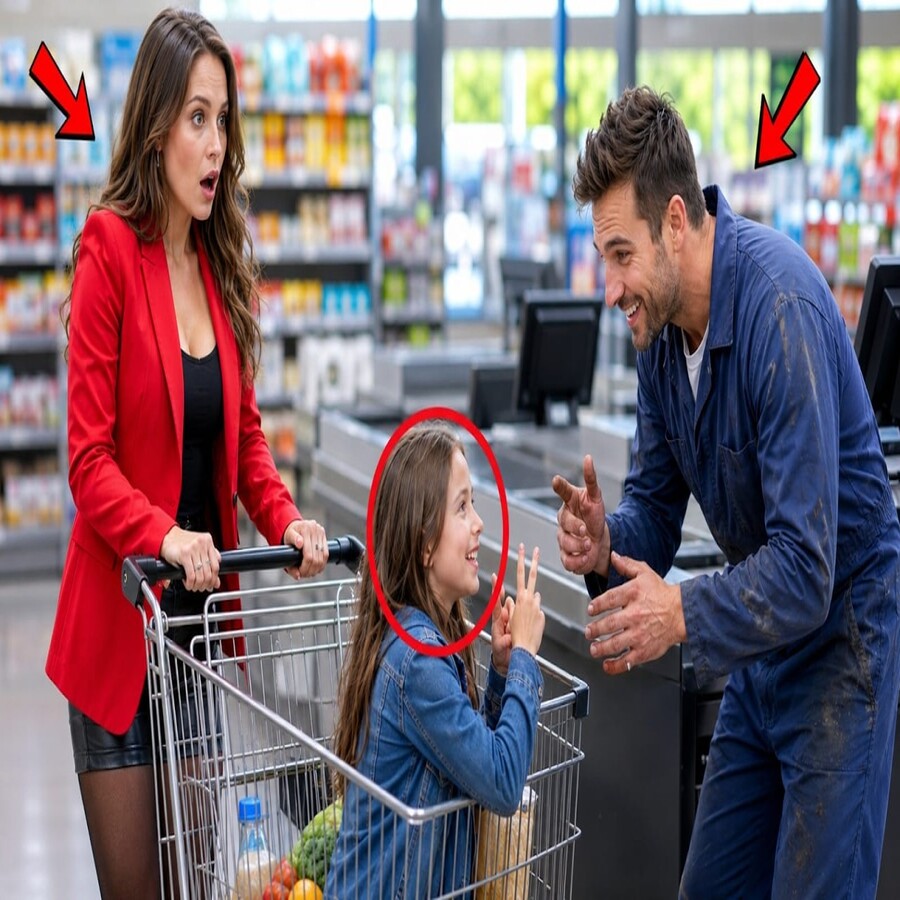
It was that particular frustration that had been building, quietly and for some time, in a nine-year-old girl named Cleo Ashby, as she sat in the front of a shopping cart on a Tuesday afternoon in the cereal aisle of a brightly lit grocery store, signing something urgent to her mother that her mother could not understand.
Cleo’s mother, Diane Ashby, stood gripping the cart handle with the particular tightness of a woman who has had a very long day and is now facing, on top of everything else, a problem she does not know how to solve. Diane was thirty-eight years old. She was the chief executive officer of Ashby Northfield Capital, a regional investment firm she had built carefully over twelve years into one of the most respected boutique firms in the state.
She was, by any professional measure, exceptionally capable. Sharp, decisive, accustomed to solving complicated problems quickly and well. But the particular problem in front of her now had nothing to do with markets or portfolios, and it was defeating her completely.
Cleo had been born with significant hearing loss, identified when she was eighteen months old, and had grown up primarily communicating through American Sign Language. A language Diane had committed herself to learning the moment the diagnosis arrived, attending classes for years, determined that her daughter would never feel unreachable inside her own home.
But Diane’s fluency, however hard-won, had limits. And Cleo, now nine, had reached an age where her thoughts had grown more complex, more nuanced, more layered than the vocabulary Diane had managed to master kept pace with. Most days, this was manageable. They found workarounds, repeated themselves, used gestures and context to bridge whatever gaps remained.
But today, in the cereal aisle, something had clearly gone wrong, and Diane could not, for the life of her, figure out what her daughter was trying to tell her.
Cleo’s hands moved quickly, urgently, her face carrying the particular tight frustration of someone repeating herself for the fourth or fifth time, watching the message fail to land each time in exactly the same way. Diane caught fragments. Something about school. Something about a name she did not recognize. Something involving a hand motion that might have meant “forgot” or might have meant “lost.” She genuinely could not tell which.
She signed back, slowly, carefully: “I don’t understand. Can you show me again? Slower.”
Cleo’s shoulders dropped. She signed the same sequence again, slightly slower this time, her small face tightening with the particular effort of trying to be patient with someone who loved her completely and still, in this moment, could not reach her.
Diane felt her own throat tighten. She had spent years building a company from nothing through sheer force of competence, and she could not, in this aisle, in front of strangers, understand her own daughter.
“I’m sorry, baby,” she signed, the words feeling inadequate even as her hands formed them. “I don’t know what you mean. Can we talk about it at home? With the dictionary app?”
Cleo’s face fell further. She shook her head, a small, defeated motion, and looked down at her lap, her hands going still.
It was at this exact moment that a man in a navy work jumpsuit, streaked with grease and the particular grime of a long shift, approached the end of the aisle, glancing up from a shopping basket containing not much more than bread, milk, and a box of crackers.
His name was Theo Marsh. He was thirty-four years old, a single father raising his own daughter, Wren, who was eight and currently waiting for him by the registers, having been promised, as a reward for good behavior during a long day, that they could pick out one treat each before checkout.
Theo had learned ASL six years earlier after Wren’s best friend at preschool, a profoundly deaf little girl named Greta, had needed a play partner who could actually communicate with her. Theo, watching his daughter try valiantly and ineffectively to connect with a friend she adored through gestures and guesswork alone, had decided, quietly and without much fanfare, that he was going to learn properly himself.
He had not expected, six years later, still in his work coveralls after a long shift at the auto shop, that this particular skill would matter to anyone in a grocery store on an ordinary Tuesday afternoon. But he noticed, the way attentive people notice things, the particular tightness in the small girl’s shoulders, the frustrated stillness of her hands, and the helpless, exhausted concern on her mother’s face.
He found himself stopping.
“Excuse me,” he said gently to Diane. “I don’t want to overstep, but I sign a little, if that would help. I noticed your daughter seemed to be trying to tell you something important.”
Diane looked up, startled. A complicated mix of hope and weariness moved across her face, the particular weariness of a mother who has learned, over years, that well-meaning strangers sometimes do more harm than good when they insert themselves into moments they do not fully understand.
“You sign?” she said.
“A little,” Theo said. “I learned from my daughter’s friend years ago. I’m definitely not fluent, but I might be able to help if you’d like.”
Diane hesitated only a moment before nodding. “Please,” she said. “I’ve been trying for ten minutes. I clearly need the help.”
Theo crouched down to Cleo’s eye level, a small but important gesture, the kind that signals respect before a single sign is exchanged, and asked, carefully and slowly: “Hello. Can you tell me what you were trying to say? I might understand a little.”
Cleo studied him for a moment, the particular careful assessment of a child deciding whether a new adult is actually safe to trust with something that matters. Then her hands began to move again, the same sequence, slightly slower this time, giving the unfamiliar adult a chance to follow.
Theo watched closely, his own ASL vocabulary working hard to keep pace. After a moment, something clicked into place.
“Your friend,” he signed back carefully, checking his understanding. “Your friend lost something.”
“Yes,” Cleo signed, relief flooding her face. “My friend, Petra. She lost her hearing aid at school today. In the gym. During P.E. She was so upset. The teacher didn’t understand what she needed and got annoyed instead of helping. I want to go to the school tomorrow before class and help her look for it before everyone gets there because I know what it’s like to lose something that important and have grown-ups not understand why it matters so much.”
Theo translated this carefully, slowly, to Diane, watching her face transform as the message finally landed in full.
“She’s been trying to tell you,” he said, “that her friend Petra lost a hearing aid at school today during gym class, and the teacher didn’t seem to understand how serious that was. Cleo wants to go in early tomorrow before everyone else arrives to help her friend look for it.”
Diane’s hand rose slowly to her mouth. She looked at her daughter, really looked at her, taking in the depth of empathy behind what had, ten minutes earlier, seemed like an impossible communication breakdown. She felt something in her chest crack open with a complicated mixture of relief, pride, and a particular grief she had been quietly carrying for years.
“Oh, baby,” Diane signed, kneeling down properly now, ignoring the cart, ignoring the aisle, ignoring everything except her daughter’s face. “I’m so sorry it took me so long to understand. That’s such a kind thing you want to do for Petra.”
“You understand now?” Cleo signed, her face hopeful.
“I understand now,” Diane signed. “Thank you for being so patient with me.”
She turned to Theo, her eyes bright with unshed tears she was visibly working to hold back in the middle of a public cereal aisle. “Thank you,” she said. “I don’t… I’ve been signing with her since she was eighteen months old. I thought I was keeping up. I didn’t realize how much I’d actually fallen behind until just now.”
“You’re not failing her,” Theo said gently, rising back to his feet. “Languages grow. Kids’ thoughts get more complicated faster than vocabulary classes can always keep pace with. Especially abstract ideas like empathy and urgency. That’s not a reflection of how much you love her. It’s just the natural gap that opens up sometimes.”
Diane wiped her eyes quickly, embarrassed but unable to fully stop the emotion from showing. “I’ve taken four years of classes,” she said. “I thought I was doing everything right.”
“You probably are doing everything right,” Theo said. “I’m not fluent either, honestly. I just happened to know enough of the specific signs she needed today. Next time it might be something I can’t follow at all.”
“How did you learn?” Diane asked. “If you don’t mind me telling you.”
Theo told her briefly about Wren’s old preschool friend, about deciding years ago that he was not willing to watch his daughter struggle to connect with someone she loved simply because nobody around her had bothered to learn the bridge. Diane listened, and something in her resolve visibly hardened.
“I need to find a better class,” she said. “A real immersion program. Not just weekly lessons I keep letting slip when work gets busy.”
“There’s a wonderful one through the regional deaf community center,” Theo offered. “My instructor, Loretta, actually teaches an advanced parent track now. It’s intensive, but it’s excellent. I could give you her information.”
Diane and Theo exchanged contact information in the cereal aisle, an exchange that felt, to both of them, considerably more significant than the ordinary mechanics of a grocery store encounter usually warranted. Wren, eventually wandering over from the registers to find her father, arrived just in time to find him deep in conversation with a stranger and a girl about her own age and introduced herself with the particular easy confidence of a child raised by a parent who modeled openness as a matter of course.
Cleo, delighted to discover an actual peer who signed comfortably, immediately launched into an enthusiastic conversation with Wren about something involving a television show neither adult could quite follow. Their hands moved rapidly between them with the particular fluid ease of children who have simply decided, instantly, that they are going to be friends.
Diane watched her daughter’s face open, animated, completely unguarded in a way she had not seen in some time and felt the last of her earlier tension dissolve into something closer to gratitude.
What followed, in the months after that Tuesday afternoon, unfolded the way meaningful change usually does. Gradually, through sustained effort rather than a single transformative encounter. Diane enrolled in Loretta’s advanced parent immersion program within the week, committing to twice-weekly sessions that she protected fiercely on her calendar, even during the firm’s busiest quarters, in a way she had not quite managed with her earlier, more casual lessons.
She grew, over the following year, into a fluency that finally matched the pace of her daughter’s expanding thoughts. Catching nuance, catching urgency, catching the particular complicated empathy that had been trying, that Tuesday, to find its way across a gap that had simply grown too wide.
Theo and Diane became, in the months that followed, genuine friends. Their daughters’ fast friendship providing ample occasion for shared dinners and weekend visits. The particular ease growing between two parents who had each, separately, decided that learning a new language for someone they loved was simply what care required, long before either of them imagined it would matter to anyone outside their own small households.
Petra’s hearing aid, as it turned out, was found that same evening by a janitor sweeping the gym and returned the following morning before Cleo and Diane even arrived early to search for it. But Cleo went anyway, sitting with her friend at recess, signing quietly about how frightening it had been to lose something so important, simply because she had wanted Petra to know that someone had truly understood.
Years later, Cleo would tell the story of that grocery store afternoon often, usually when explaining to new friends why her mother had become, somewhat unexpectedly, one of the most fluent hearing signers either of them had ever met.
“She didn’t understand me for almost ten whole minutes,” Cleo would say, signing the story as readily as speaking it, depending on her audience. “And instead of giving up, she went and learned properly. That’s the kind of mom she is.”
Diane, hearing this retold for perhaps the hundredth time, would simply smile and remind her daughter every time that the credit belonged equally to a stranger in a grease-stained work jumpsuit who had stopped in a cereal aisle on an ordinary Tuesday simply because he noticed a child struggling to be understood and decided that was worth a few minutes of his time.
The single sentence Theo had signed to Cleo that day, the one that had unlocked everything, was not complicated. He had simply asked her to tell him what she was trying to say. He had offered his attention without demanding anything else. He had not tried to fix her or her situation. He had simply made himself available to receive what she had been trying so hard to communicate.
And that, in the end, was everything.
Diane thought about this often in the years that followed. She thought about how many times she had been in a hurry, how many times she had assumed she understood something because she understood most of it, how many times she had let the gap widen just a little more because it was easier than doing the work of closing it.
She thought about the particular courage it took to admit, in front of a stranger in a grocery store, that she had fallen behind. That she could not understand her own daughter. That all her professional competence and hard-won success meant nothing in the face of a communication breakdown in the cereal aisle.
She thought about Theo, who had not been performing virtue or looking for recognition. He had simply noticed a child struggling and decided to offer what he had. A few signs. A few minutes of patient attention. The willingness to crouch down to a child’s level and actually listen.
He had not known that Cleo was his daughter’s best friend’s classmate. He had not known that Diane was a CEO. He had not known anything about them except that a small girl was frustrated and a mother was lost, and he had stepped in without hesitation.
That was the kind of person he was. And Diane, over the years, came to love him for it.
The wedding was small and quiet, held in the garden of the house Diane and Theo bought together two years after that Tuesday afternoon. Cleo and Wren, now teenagers, were co-maids of honor. They signed their speeches, one in ASL and one in spoken English, each translated by the other for the guests who needed it.
Petra was there, too, still wearing the hearing aid she had almost lost all those years ago. She had grown into a confident young woman who had become, in some ways, the connective thread that had brought them all together. Without Petra’s lost hearing aid, Cleo would not have been trying so hard to communicate in that grocery store. Without that frustration, Theo would not have noticed. Without Theo’s noticing, Diane would not have realized how much she had fallen behind.
One small moment, rippling outward.
Theo’s speech at the wedding was short and characteristically understated. He stood at the front of the garden, looking at Diane with the particular warmth that had grown between them over years of shared dinners and late-night conversations and the patient work of building a life together.
“I learned ASL because my daughter needed me to,” he said. “I thought that was the end of the story. I thought I was just doing what any parent would do. I didn’t know that learning a language would lead me to the person I was meant to spend my life with. I didn’t know that a cereal aisle could change everything.”
Diane, standing beside him, signed as he spoke, translating for the guests who needed it, a fluid, seamless collaboration that had become as natural as breathing.
“Sometimes,” Theo continued, “the most important thing you can do is simply show up and pay attention. You never know who might be trying to tell you something that matters. You never know what might happen if you just take the time to listen.”
Cleo, watching from the front row, signed to her mother: “That’s exactly what I was trying to tell you all those years ago. I just needed someone to understand.”
Diane signed back: “I understand now, baby. I understand everything.”
And perhaps that is the quiet truth tucked inside an afternoon like this one. That love, however deep, sometimes needs more than good intentions to truly reach another person. It needs ongoing effort, humility enough to admit the gaps, and occasionally the unexpected kindness of a stranger willing to bridge a moment they had no obligation to notice at all.
The most important conversations are not always the loudest ones. Sometimes they are the quiet, patient ones finally understood after someone simply takes the time to truly look.
In the end, Diane did not become fluent overnight. There were still moments of frustration, still moments when a new concept or a subtle nuance slipped past her grasp. But she had learned something essential in that grocery store aisle. She had learned that the gap was not a failure. It was simply a signal that she needed to keep learning, to keep growing, to keep showing up for her daughter in the ways that mattered most.
And she had learned that the people who help us grow are not always the ones we expect. Sometimes they are strangers in work jumpsuits who notice a child struggling and decide, without fanfare, to offer what they have.
The gift of that afternoon was not just the translation of a single sentence. It was the reminder that the world is full of people who are trying to say something important, and that sometimes the only thing standing between them and being understood is someone willing to actually pay attention.
That is what Cleo had been trying to tell her mother all those years ago. That is what Theo had helped them both understand. And that is what Diane carried with her, every day, for the rest of her life.
THE END.
Disclaimer : This content may be created by AI for entertainment purposes. Any resemblance to real persons, events, or places is coincidental.