Shot In The Arm But Still Silent — The SEALs Froze When The Medic Asked The Female Sniper’s Codename
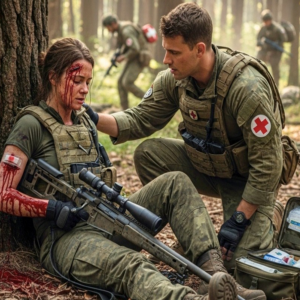
The blood was black in the dark. Not red, not the bright arterial red that medical textbooks showed in clean diagrams with neat labels and sanitized margins. Out here at 4 in the morning on the eastern ridge of Canar Province, with the temperature sitting at 31° and the wind coming down off the Hindu Kush like something that had never learned the meaning of mercy out here, blood went black the moment it hit the dirt.
Tessa Grant knew this. She had known it since she was 9 years old, kneeling beside her father in the pre-dawn dark of a Montana field, watching a white-tailed deer go still in the frostcovered grass 300 yards away. Her father had looked down at her, his breath fogging in the cold, and said something she had never forgotten.
The field doesn’t care how small you are. It only cares whether you’re steady. She was steady now. She had to be. Her left arm had been hit somewhere between the shoulder and the elbow. A through and through. She was almost certain, which meant the bone was probably intact, which meant she could still function, which meant she had no excuse to stop functioning. The pain was there.
She acknowledged it the way you acknowledge a dog barking two streets over. Present, noted, not relevant. Around her, three men in full combat kit stood in positions that would have looked to any outside observer like statues. large statues, the kind carved from stone by people who wanted to communicate something immovable and permanent about the nature of certain men.
Senior Chief Ray Donovan stood closest, 48 years old, 6’2, 18 years of naval special warfare printed into the way. He held himself, the slight forward lean, the weight distributed across the balls of his feet, even at rest, the eyes that never stopped moving, even when the rest of him was perfectly still.
He was looking at something on Tessa’s neck. She couldn’t see his face clearly in the dark, but she could read his body, and his body had gone very, very quiet. The fourth man was kneeling beside her. Petty Officer, Secondass Kieran Walsh, was 26 years old, the team’s assigned medic, and currently the most professionally composed person in the immediate vicinity.
His hands moved through the trauma kit with the efficiency of someone who had done this so many times that his fingers no longer needed his brain’s permission. Tourniquet, pressure dressing, assistment. He was good. Tessa recognized good work when she saw it and she was seeing it now. He looked up at her. I need your call sign, he said.
The wind nearly took the words for the medevac log. Standard protocol. Tessa said nothing. Walsh waited. His hands didn’t stop moving. Ma’am, your call sign. The silence that followed was not the silence of someone who hadn’t heard the question. It was something else entirely. Donovan had still not moved. His eyes were still fixed on that point just below her chin.
the dog tag she wore on a chain that hadn’t left her body in 7 years. He was reading them. She knew what they said. She had memorized those words a long time ago on a different kind of dark morning in a different kind of cold. Sergeant Hrant, USMC 0317. Walsh looked up at Donovan. Chief Donovan didn’t answer.
Somewhere behind them, Cole’s petty officer first class 11 years in the loudest voice on any given day was absolutely silent. That more than anything told you something had changed, Chief Walsh said again with a slight edge. Now ut the Hindu Kush answered first. Wind down the ridge, dust moving in small spirals across the rocks.
The smell of cordite still hanging in the cold air from what had happened 20 minutes ago. Donovan finally moved. He looked at Walsh. Then he looked at the woman whose blood was going black in the dirt. He crouched down beside her. When he spoke, his voice was low enough that only she could hear it. And what he said was not a question.
It was the sound of a man recognizing something he had spent a very long time trying not to think about. “I know those tags,” he said. Tessa looked at him. The mountain looked at both of them. And somewhere below in the darkness, the briefing they had been given 48 hours ago was already beginning to look like what it actually was.
48 hours earlier, the forward operating base was not much. Four pre-fabricated structures bolted to a hillside like an afterthought. a comm’s antenna, a fuel bladder, a plywood board nailed to one of the walls that someone had written, “Welcome to paradise on in black marker.” Because humor in isolated places tends toward the sardonic.
The elevation was roughly 8,000 ft, which meant the air had the thin sharp quality of something that hadn’t fully committed to sustaining human life. Alpha team had been here for 6 days. They were used to it. What they were not used to was the addition. She arrived on the Chinook with the resupply, which was itself a statement of sorts.
Resupply runs brought ammunition and food and batteries for the night optics and occasionally paperwork that nobody wanted. They did not typically bring CIA intelligence liaison. Tessa Grant stepped off the ramp at 0700 hours carrying a medical bag on one shoulder and a backpack on the other. She was 5′ 4 in tall and weighed 118 lb in full kit, which did not look like enough until you watched her move.
She wore no rank insignia beyond the basic identifier of her rate. HM2 Navy corman, hospital corman, second class, and she moved through the rotor wash with her head slightly down and her eyes taking in the perimeter with the quiet practice thoroughess of someone conducting an assessment they didn’t need anyone to know they were conducting.
Cole Briggs saw her first. Briggs had a gift for saying out loud what other people kept to themselves. And he exercised this gift with considerable consistency. He was leaning against the wall of the ops building with his arms crossed watching her walk across the landing pad. And when she got close enough, he looked at her the way someone looks at a forecast that doesn’t match the season.
We got a field medic, he said to nobody in particular. “Great,” he paused. “Who’s next, the cook?” The woman did not look at him. She did not change her pace. She walked past him and into the ops building as if he had not spoken, which was arguably the most effective response she could have given.
Briggs watched her go. Friendly, he said. Inside, Donovan was standing over the planning table with Chief Doyle Hatcher reviewing the wrote. Doyle Hatcher was 41 years old, quiet in the way that deep water is quiet, and had been with Donovan long enough that the two of them communicated in partial sentences and shared silences that meant more than most people’s paragraphs.
He looked up when she came in and said nothing, which for Hatcher constituted a complete assessment. She set her bags down, pulled out a tablet in a manila folder, looked at the map on the table. Tessa Grant, she said CIA intelligence liaison target assessment support. Donovan looked at her. We’ve been briefed. Not unfriendly, not welcoming.
Measured the way a man who has learned that most problems announce themselves early will measure new variables. Good, she said. That was it. That was her entire introduction. Donovan later said that the thing that stayed with him about that first moment wasn’t anything she said. It was what she looked at. When she scanned the map, her eyes paused for exactly 3 seconds on a particular ridge line to the east of the target compound.
Not the approach vector, not the Xfill route, the ridge line, the high ground with the best angles of observation. A target assessment analyst would have looked at the compound. She looked at the ridge. He filed it away. The mission itself had the shape of something straightforward, which in Donovan’s experience meant it was time to look harder.
The briefing had come through Langley the previous evening, authorized by Colonel Warren Hargrove, the senior CIA operations officer for the region. Hargrove, was 58 years old, spoke in the measured cadences of someone who had never made an imprecise statement in his professional life, and had the kind of institutional credibility that comes from four decades of uninterrupted service.
His voice on the laptop screen was calm and even and certain. The target was a man named Victor Drell, 55 years old, Eastern European background, had operated as a CIA asset in the region since the late ‘9s, cultivating contacts across networks that had existed here since the Soviet Afghan war. In recent months, according to Harrove, Drrell had gone off script.
He was in contact with parties unknown. He was believed to be preparing to sell sensitive information, information about American intelligence operations, about assets still active in the field to a third party that did not have American interests at heart. Neutralize him. Recover whatever he was preparing to transmit. Clean exit.
Alpha team had a 24-hour window. Authorization code Sierra 7 actual. Briggs had asked the question that Briggs always asked, which was why they needed a CIA analyst on a field operation. Hargrove’s answer had been brief. Miss Grant would be responsible for final target confirmation. Standard procedure for this classification of operation.
Non-negotiable. Briggs had not looked satisfied. But Briggs rarely did. After the briefing ended, Hatcher had stayed behind. He looked at the closed laptop for a moment, then looked at the door she’d walked out of. “She looked at the East Ridge,” he said. “I know, Donovan said.” Analysts, “Look at the target.
” Hatcher said. “I know.” Donovan said again. Neither of them said anything else. The hour before they moved out was the hour that mattered. Tessa Grant spent it the way she spent every hour before a movement checking her medical kit with a thoroughess that had nothing to do with anxiety and everything to do with the understanding that the difference between a good outcome and a catastrophic one was usually something very small that someone had failed to check.
This was also the hour that saved Aldridge. Specialist Conrad Aldridge was 29 years old, brought across the shoulders, and had the particular kind of physical confidence that comes from having been the most capable person in almost every room he’d entered since the age of 17. He was also at this specific moment in the early stages of exertional heat stroke, which he did not know and which nobody else on the team had noticed.
Tessa noticed she had been moving through the staging area when she saw him sitting on an equipment case drinking water in the methodical way that people drink water when their body is processing an alarm signal and they haven’t yet consciously received the message. His skin had a particular sheen. The color at the base of his neck was wrong.
His movements when he stood to adjust his kit had a very slight lag that wouldn’t have been visible to anyone not specifically trained to look for it. She set her bag down next to him. Sir, she said, may I check something? He looked at her with the expression that large, capable men sometimes produce when presented with a request from someone much smaller than themselves, who they have not yet established a reason to take seriously.
I’m fine, doc. I know, she said, and checked his pulse. Anyway, what followed was 4 minutes of work that Donovan watched from across the staging area without moving. She ran through the assessment with an economy of motion that he recognized not from medical training but from the field from the way people moved when they had done something so many times that it had stopped being a procedure and had become instead a reflex.
IV kit fluids cooling protocol. She spoke to Aldridge in a low steady voice telling him exactly what she was doing and why. And by the end of it, he was sitting straighter and his color was coming back and he was looking at her with an expression that had changed considerably from the one he’d started with.
Donovan walked over when she was packing up. “Caught it early,” she said without looking up. “He’ll be at full capacity in 30 minutes. I’d recommend he hydrate aggressively for the next 2 hours before movement.” “How bad would it have been?” Donovan asked. She considered this moderate to severe probably by kilometer 4.
She zipped the kit. Kilometer 4 is where the grade increases. That’s where it would have presented. Donovan looked at Aldridge, then back at her. Good catch, he said. Thank you, sir. She picked up her bags and moved on. Behind her, Hatcher appeared at Donovan’s shoulder. He didn’t say anything. He didn’t need to. What Hatcher had seen, and only Hatcher, because he had been standing at the right angle, was the moment after she finished with Aldridge’s arm.
Her hand had briefly come to rest on the grip of Aldridge’s sidearm where it sat holstered beside her. not intentionally muscle memory. Her fingers had settled onto the grip with the unconscious precision of something very old. And then in the span of a single breath, she had pulled them away. Her face had not changed.
She had not noticed that she had done it or had noticed and decided it didn’t matter, which was its own kind of information. Hatcher filed it away with the ridge line. Briggs from 20 ft away had watched her work on Aldridge with his arms crossed and an expression that suggested he was recalibrating something slowly and against his preferences.
Fine, he said mostly to himself. She’s a good doc. Still doesn’t explain why she’s here. They moved at 2,200 hours. 11 km of mountain terrain, no vehicle support, full kit darkness. The Hindu Kush does not accommodate movement. It permits it grudgingly on terms it sets unilaterally. The ground was loose shale in some places and compressed granite in others.
And the distinction mattered because loose shale announced you and compressed granite could fracture underweight if you hit it wrong. Night vision turned the world green and flat, collapsing depth perception at the exact moments when depth perception was most necessary. Tessa moved third in the column. Hatcher was behind her. He watched her feet.
In 11 years of special operations service, Doyle Hatcher had walked a very large number of kilometers in very difficult terrain, and he had learned things about movement that could not be found in any manual. One of those things was that footfall pattern told you more about a person than almost anything they might choose to say about themselves.
Where you put your foot, how much weight you committed before transferring, how you adjusted when the ground changed unexpectedly. These things came from somewhere deeper than training. They came from years. She was placing her feet in the footprints of the man ahead of her. Exactly. Not approximately, exactly.
Which was a countertracking technique that took most people months to develop into unconscious habit. She was doing it without appearing to think about it. She also read the ground ahead in the extended continuous way of someone assessing her attention, moving in arcs, checking high ground and shadow pockets and the spaces between rocks that could hold a person if a person wanted to be held.
At the 3 km mark, they stopped at a natural height in a fold of the ridge for a scheduled rest. Donovan moved forward to check the point element. Briggs found a rock to sit on. Walsh ran a quick check on everyone’s status. Tessa sat apart from the group facing north looking at the darkness. Hatcher sat down beside her.
She glanced at him but said nothing. He said nothing either. For a minute they both looked at the same darkness. First time in country. He said a pause. No. He nodded. The way she’d said it, not dismissive, not guarded, just factual. The way you state something that isn’t worth elaborating on told him more than the word itself.
You move like you’ve done this before. He said, “My father taught me to walk carefully.” She said it wasn’t an answer to what he’d said, but it was something. Before he could follow it anywhere, Donovan gave the hand signal to move. They stood up and became part of the darkness again. 6 km to go. The mountain said nothing.
The wind said less. The compound sat in a shallow depression between two ridges positioned in the way that someone tactically trained had positioned it with natural observation angles limited and the main approach requiring a 500 meter exposed crossing. It was a modest structure, mud walls, a main building, a smaller outbuilding to the north with a single low antenna on the roof.
Tessa had looked at photographs of this compound for 11 months, very quietly that he had information. She very quietly that he had information she might find significant. He had handed her the first page, and she had read it, and the kitchen had gotten very quiet. She had read her father’s name in an annotation in her father’s handwriting.
The same tight, precise lettering that had filled the notebooks he’d kept for 30 years. The notebook she still had in a box in her closet. The handwriting that had written her name in birthday cards when she was small. Confirmed. Hargrove burned my unit. 2007. She had read it three times. Then she had looked up at the man across the table and asked him one question.
What do you need? He had told her. It had taken 14 months to get herself positioned correctly. She was here now. Donovan was looking through his binos at the compound. Hatcher was beside him. Tessa was on Donovan’s other side doing the same. Count Donovan said quietly. Eight at minimum, Hatcher said, positioned professionally.
These aren’t militia. No, Donovan said. They’re not. Tessa said nothing. She was looking at the north out building, the one with the antenna. A light was on inside. Not the bright light of someone unconcerned, but the low specific glow of a laptop screen in a darkened room. Someone was awake. Someone was working.
The target is in the north structure, she said. Not the main building. Donovan looked at her. How do you know that? The antenna placement, the light frequency. Someone is running electronics in there, not sleeping. She lowered her binos. He’s getting ready. Donovan held her eyes for a moment. Something moved behind his expression that he didn’t show.
He turned back to the compound. We go at 0400, he said. Hatcher Stokes, western approach. Walsh, you’re with Aldridge on the south Xville. Briggs North approach with me. He paused. Miss Grant Eastern Ridge overwatch. She had been watching that ridge since she’d looked at the map two days ago. Copy, she said.
Briggs, lying to Donovan’s left, didn’t look up from his own binos. You’re putting the dock on a sniper position. I’m putting the person with the best eyes on the position that requires the best eyes, Donovan said. His voice was entirely even. Briggs said nothing more. But in the silence that followed, something was adjusting.
the early reluctant beginning of a question he wasn’t yet ready to ask. They settled in. The compound below sat quietly in its hollow, lit by the cold precision of the stars. Inside the north outbuilding, a man with 17 years of documentation was waiting for a satellite window that was still 6 hours away.
Tessa lay in the shadow of a rock formation and looked at the backpack she had carried 11 km over a mountain. Inside it was a medical kit assembled with the same care she applied to everything. hemostatic gauze, combat application turnets, IV fluid, a decompression needle, everything a corman needed. And underneath the medical kit, in a separate compartment with a foam cutout measured to the millimeter, the Remington 700, she had broken down and reassembled so many times in the dark that her hands knew the order of every component the way they knew the order of
her own fingers. The scope was a night force NXS 5.5 to 22 power 56mm objective set at 14 power for the current conditions. The elevation turret had a small strip of tape on the cap. Blue tape applied at a diagonal across the left corner. This was how her father had taped every rifle he had ever owned so his thumb would find it in total darkness without searching.
Always the same way he had told her. Muscle memory in the dark. She had not changed it. She lay very still in the dark and thought about nothing at all. The past was the past. The mission was the mission. The ridge was the ridge. She was ready. She had been ready for 17 years. The first shot came from the northeast, not from the compound, from the ridge to the right from a position that had not appeared on any of their surveillance photographs from someone who had been very patient and very quiet and very well prepared. It caught Stokes in the
right shoulder. He went down hard. His rifle hit the rocks. The sound of it was swallowed by the second and third shots which kicked up dirt and stone chips in a line across the hillside below the western approach. Walking toward where Hatcher had dropped flat. In the compound, the guards were moving, not panicking, moving with the purpose of people following a plan they had rehearsed. The gates opened.
Two vehicles in the courtyard came to life, headlights blazing. One of them turned toward the eastern ridge, toward Tessa. She was already moving, not away, down into position. She considered the bipod and reconsidered in the same breath the ground here had a natural hollow, a low depression in the rock that would give her better stability than bipod feet on loose shale.
She set the fore end directly on the stone. Old technique, hunter’s technique, her father’s technique. The vehicle was accelerating across the open ground between the compound and the rgeline. The gunner on the roof had his weapon up and was searching. She ran the numbers. 870 m. Downhill angle of approximately 4°. Target speed 30 mph.
Wind drift left at this range in current conditions 11 in. The margin her father had always said to allow was none. You don’t miss in the field. Practice is where you miss. She breathed in for 4 seconds. Hold. She squeezed. The round broke left 8 in. The vehicle kept moving. She did not curse. She did not tighten.
She processed the miss as information. nothing more. The recoil had confirmed what she’d slightly underweighted. The wind had shifted two knots in the last 90 seconds, a common event on mountain approaches after midnight. She adjusted the turret. Her thumb found the elevation cap in total darkness. Felt the tape at the diagonal.
Always the same way. She breathed again. When the trigger broke the second time, the vehicle lurched hard to the right and went into the drainage ditch at the edge of the compound wall and stopped. 4 seconds of silence so complete it had weight. Walsh’s voice came over the radio.
What was who? Just Hatcher’s voice. Flat and controlled Eastern Ridge. It came from the Eastern Ridge. Then Donovan, also controlled, but with something in it that hadn’t been there before. Something that was trying to understand what it had just witnessed. Miss Grant. A pause. Report. She was already reloading. Target vehicle is down.
She said, “Your western approach is clear. Move now before they reposition.” A silence, not a long one. Donovan was many things, and one of them was a man who did not waste seconds moving, he said. Below in the North out building, a man was sitting with a laptop and 17 years of documentation and 5 hours and 43 minutes left before his satellite window opened.
He did not know who had just cleared his approach. He did not know that the woman who had done it had been working toward this night since she was 14 years old, kneeling beside her aunt in a funeral home in Billings, Montana, listening to a folded flag change hands and making a promise she had kept right up until the moment that keeping it meant something worse than breaking it.
Senior Chief Ray Donovan was beginning to understand and the night had only just started. The compound went quiet in the way that dangerous things go quiet when they are reorganizing. Donovan had seen it before. or the moment after the unexpected variable, the shot from the wrong direction, the vehicle that stopped moving instead of the men inside it.
When the opposing force took 3 seconds to recalibrate, 3 seconds was a specific and finite number. It was enough time to breathe. It was enough time to move. It was not enough time to waste. He used all 3 seconds. The western approach was clear. He moved and behind him, Hatcher moved, and behind Hatcher. compound was still making up its mind about what had just happened on its eastern perimeter.
They covered the ground in the low, rapid crouch of people who had trained until the crouch was no longer a conscious position, but a mode of being. The gate in the north wall was 40 m, 30, 20. Behind them on the eastern ridge, the woman they had been told was an intelligence analyst was reloading a Remington 700 with the unhurried efficiency of someone for whom this was not the first time.
They made the wall. Donovan pressed his back to the mud brick and looked at Hatcher in the dark. Hatcher looked back. Neither of them said anything. There was no time, and things that deserve the most thought were best given the lease words until you had the space to think them through completely. The north out building was 12 m across the courtyard.
The light was still on inside. Donovan went first. Walsh had Aldridge on the south position and was watching the main gate and trying to understand what he was feeling. He had been on four deployments. He had worked alongside some of the most capable people in the United States military. He understood competence and he understood surprise and he understood the specific cognitive experience of watching someone do something that your existing framework had not prepared you to witness.
He had not been prepared for that. The vehicle had been moving at speed across broken ground in crosswind in near total darkness. And she had missed once, which told you the shot was genuinely difficult. and then she had hit, which told you the miss had been information, not failure. That distinction mattered enormously.
Anyone could get lucky on a second shot. What you could not fake was the quality of the adjustment. The turret cap moved in the dark without looking. The second round down range before the echo of the first had finished traveling up the ridge. Your father taught you she had told no one, but Walsh had heard it in the radio silence that followed in the way Donovan had paused before giving the order to move. Walsh kept his eyes on the gate.
They found drill where Tessa had said he would be. He was sitting at a folding table in the north out building with a laptop and three external hard drives in the expression of a man who had been waiting a very long time for something and was not entirely certain that something was going to arrive before something worse did.
He was 55 years old and looked older with a particular quality of aging that comes not from years but from the specific weight of certain kinds of knowledge carried for too long. He had thick gray hair and hands that were steady and eyes that moved to the door when it opened with the speed of someone for whom that reflex had been necessary for decades.
He looked at Donovan. He looked at Hatcher. He looked at the door behind them in accented but precise English. He said, “Where is the woman?” Donovan said on the ridge. Something in Drell’s face changed. Not relief exactly, more like the confirmation of something he had been told to expect, but had not fully allowed himself to believe.
Her father said she would come. Drell said. Donovan looked at him for a long moment. Then he looked at Hatcher. Hatcher looked at the hard drives. How long do you need? Donovan said. The satellite window opens in 5 hours and 40 minutes, Drill said. But that is not the urgent problem. What is the urgent problem? Drill turned the laptop toward them.
On the screen was a map. On the map were four moving indicators coming from the northwest approximately 3 km out and closing. Those men, Drill said, are not Taliban. They are not militia. They are contracted security operating under a private authorization. They have been positioned here for 4 days waiting. Donovan looked at the indicators, waiting for what drill looked at him with the patience of someone who had lived in the vicinity of the unsayable for too long to be surprised by the slowness with which other people arrived at it. For me, he said, and for whoever
came to reach me. On the ridge, Tessa had moved her position 30 meters north, not because she had been compromised, because the natural cover was better there, and because the angle on the northwest approach was cleaner from the higher ground. She had moved the way water moves, finding the lower ground without announcing the transition.
She lay flat on Cold Stone and looked down at the compound through the night force scope, and thought about her father, not the way she usually thought about him, compressed and controlled a discipline she had practiced since she was 14. She thought about him the way the night permitted when it was cold and dark and you were alone at altitude with nothing to occupy the front of your mind because the front of your mind was doing its bong and the back of it was briefly free.
He had been 6’ 1 in tall and had weighed 195 lb and had moved through the Montana hills like he had grown there. His hands had been large and everything he did with them had been precise. He tied knots with the same deliberate attention he gave to adjusting a rifle scope or braiding her hair when she was 5 years old and her mother was working late.
Precision was not a professional habit with him. It was a way of being. He had started teaching her to shoot on her 9th birthday because she had asked him to. She had asked because she had gone with him once to watch and had seen for the first time what a person looked like when they had mastered something completely.
When the body and the task were the same thing, when there was no visible effort and no visible hesitation and no gap between intention and outcome, she had wanted that, not the shooting, the mastery. He had put the rifle in her hands and knelt behind her in the Montana grass in the cold and talked to her for 40 minutes before she fired a single round.
About breathing, about patience, about the difference between looking at a target and understanding it, about what the wind was telling you if you were willing to listen. She had missed the first shot by two feet. He had not reacted. He had said, “What did you learn?” She had thought about it seriously, that the wind was stronger than I thought.
He had said, “Good. Now you know, fire again.” She had hit the second shot. He had said nothing. But his hand had come to rest briefly on top of her head, and she had understood that in the vocabulary of gunnery sergeant Hol Grant, that was the equivalent of a standing ovation. Below her, the lamp in the north out building was still on.
She pulled herself back to the present, checked the northwest quadrant, and listened to the mountain. Donovan’s voice came over the radio at 0437 hours. Cole, sitrep. Northwest quadrant 4 movers approximately 2.4 km, moving at tactical pace. These are trained personnel. A pause. Copy. We have the same picture from inside. Come down. We need to talk.
She read the compound once more, checked positions, counted sight lines and dead ground, and the angles that a repositioned force coming from the northwest would use for their approach. 4 minutes, she said. The inside of the outbuilding was lit by laptop glow in a single red lens flashlight that Hatcher had produced from somewhere.
It made everyone looked like they were underwater. Drill was still at his table. Donovan was standing. Hatcher was sitting on an equipment case with his elbows on his knees. Tessa set her rifle down against the wall and looked at the room. Donovan looked at her. Then he looked at the hard drives on the table. He says these contain 20 years of documentation on a CIA officer running parallel intelligence operations.
He said says he built the case over 9 years. Says your father was the first American who suspected the same officer. He let that land. He says the man who authorized this mission is the officer in question. The outbuilding was very quiet. Harrove, she said. Donovan watched her say it. Watch the way she said it. Not like a revelation, not like something landing from height, but like a word she had said many times in private and was now saying aloud in company for the first time. You knew, he said.
I knew, she said. Before the mission, before I applied for the posting, Donovan was quiet for a long moment. He was looking at the notebook that Hatcher had placed on the table between them. The notebook was the thing that had happened while Tessa came down from the ridge. Hatcher had not been looking for anything in particular when he moved her pack to make room at the table.
The outer pocket was unzipped. She had opened it herself when she pulled out her tablet earlier. And when he set the pack down, the pocket fell open, and a composition notebook slid halfway out. He picked it up. The cover was worn at the corners in the specific way that things worn by habit were not damaged, just used. He opened it to the first page.
The handwriting was tight and precise. Every letter formed with the deliberate intention of someone who believed that how you wrote a thing was part of how seriously you meant it. At the top of the first page, a date, 2006. He turned pages. Training logs, range notes, windage calculations written beside small diagrams of terrain features, the handwriting of a man who taught by writing things down so that other people could find them later.
He turned to the last tab section. The header read Canar compound designation grid 7741 asset drill. The date beside it was 4 months ago, but the handwriting below it, the dense careful annotations describing the compound’s layout, the antenna position, the satellite architecture was 17 years old. Hatcher stood with the notebook in his hands for a long moment.
Then he carried it to Donovan without a word and placed it open on the table and stepped back. Donovan had read it before Tessa arrived. Now he pushed it toward her. How long he said? 14 months. She said from the day they showed me what was in it. He wrote this 4 months ago. He wrote the Kunar section in 2006. She said he had located Drill.
He had identified the compound. He had built the architecture for the transmission relay. The 4-month date on the cover is when I added to it. The foundation is his. She paused. He died the year after he wrote it before he could use any of it. Donovan looked at the notebook, then at her. He found Harrove in 2006.
Donovan said it wasn’t a question. He found the first anomaly in 2006. She said he spent a year building a case. He was going to submit it through the inspector general’s office. Harrove found out before he could. The mission your father, the mission James died on, Donovan said, stopping himself. Tessa looked at him steadily.
The mission in 2007 that killed my father was authorized by Harrove personally. The intelligence that put him in that position was fabricated. The support element that was supposed to cover his egress was redirected at the last moment by a command order that traced back to Hargrove’s desk. She did not say this with visible anger.
She said it the way a person states something they have verified through multiple independent sources and no longer need to feel in order to know. By the time anyone understood what had happened, there was nothing left to investigate. No record, no accountability. Donovan turned away. He stood with his back to the room for a moment, looking through the cracked door at the courtyard in the cold, dark beyond it. Then he turned back.
“You put yourself on this team,” he said. “Yes, you positioned yourself here deliberately.” “Yes, you use this mission. I used the shape of the mission,” she said. “I needed operators who were good enough to survive an ambush and honest enough not to abort when command told them to. Both things had to be true.” She paused. “You fit.
” Hatcher looked up from the floor. He looked at her, then at Donovan, then back at her. Something moved behind his expression that was not quite surprise and not quite the absence of it. Donovan held out his hand. She shook it. We protect the transmission, he said. We get drill out. We go through every proper channel IG Senate committee, every whistleblower protection available.
This goes through legitimate process. No shortcuts. Agreed. She said immediately full transparency after everything. You know everything she said outside the mountain was getting lighter in increments too small to notice except that the stars above the eastern ridge were becoming visible as individual points rather than a mass of light.
Dawn was somewhere behind it calculating its arrival. The northwest approach was 2 km out. They had work to do. The backpack was open on the floor of the out building and Tessa was doing two things at once. Her left hand was going through the medical kit, reorganizing it for rapid access, moving the tourniquet to the outermost pocket, confirming the hemostatic gauze was where it needed to be.
Her right hand was checking the Remington, not because it needed checking, because her right hand needed to know where it was. Drell watched her from the table with the patience of a man who had waited 9 years and had decided that additional waiting was simply the nature of things. Your father, he said, was the only American officer I ever trusted completely.
She did not look up from the medical kit. He found the first anomaly in 2006, a payment that did not match any known operational budget routed through a shell account in Cyprus. He came to me because I knew the Eastern European financial architecture from the Soviet period. I confirmed it was Russian intelligence money, SVR. He paused.
He was building a file. He had names. He had account numbers. He had dead drop locations. He was killed before he could submit anything Tessa said. Yes, I spent 9 years building what he started. Everything on those drives is verifiable. Bank records, communication logs, names of SVR handlers currently operating under diplomatic cover in Washington. He looked at her directly.
He deserves this to mean something. She looked up in the red light. His face had the look of old photographs. It will, she said. Then Donovan’s voice came sharp over the radio. Movers at 800 meters. Moving faster. They know we’re here. She was on her feet before the last word landed. The geometry of the next 40 minutes was this.
Drill needed to remain in the out building with his equipment until the satellite window opened in 5 hours and 14 minutes. This was non-negotiable. The force coming from the northwest was not going to wait 5 hours. This left one viable option create enough cost in the approach to make a direct assault unacceptable. Donovan and Hatcher moved northwest along the compound wall.
Walsh held the south egress with Aldridge. Briggs moved to the main gate. Tessa took the eastern ridge with one arm that was fully functional and one foot that knew this ground now and a rifle that her father had assembled a thousand times in the dark before her, and she had assembled a thousand times in the dark after him.
The wind had changed again. It was doing this more frequently as dawn approached a meteorological reality in mountain terrain. the temperature differential between sun-facing and shadow-facing slopes beginning to equalize in the pre-dawn period, creating microcurrens that moved at angles bearing no relationship to the broader weather pattern.
You could not simply read the wind at your position. You had to read it at your position at the midpoint and at the target and triangulate between three simultaneous and divergent answers. Her father had a phrase for this. The wind doesn’t lie. It just tells three different truths at once. She was reading all three. The northwest force had split.
Standard technique for approaching a defended position. One element as the main effort. One is a flanking force to draw attention and fire. The flanking element was moving along the low ground to the south where Walsh and Aldridge were waiting. The main element was pushing directly toward the compound gate directly into the angle from the eastern ridge.
At 1,150 m, she recalculated. This was not a vehicle. This was a person. A person moved with intention. An intention was not predictable the same way physics was predictable. She accounted for pace for the probability of stopping for the cover ahead and the steps required to reach it. She ran the calculation. The lead element came into a gap between two rock formations, a natural channel in the terrain that anyone approaching from the northwest would use because it was the path of least resistance.
She had identified this gap from the map two days ago and confirmed it from the ridge an hour ago. Her father had taught her that patience was not passive. It was the most active thing a person could do. She waited for the center of the gap. She breathed. She fired. The shot was good. She knew it before the confirmation arrived. The group halted.
The flanking element hearing the report from the eastern ridge stopped advancing. In the south, Walsh and Aldridge had the opportunity they needed, and she heard the flat crack of their rifles below that told her they had used it. For 30 seconds, the approach from the northwest was stationary.
30 seconds was enough for Donovan and Hatcher to reposition. She was already calculating the second engagement when she felt the impact. It was not like the movies describe. There was no dramatic suspension of time. There was a sudden enormous pressure in her left arm. A sensation like being struck by something very heavy, moving very fast, and then a heat that spread from the point of impact outward in a wave that her nervous system took approximately one full second to correctly identify as pain.
She had been shot through and through, probably. The entry was high on the left forearm. If it was through and through, the bone was likely intact. The arm was compromised for support, but not for function entirely. A sniper in the rocks to the northeast had been patient enough and skilled enough to wait for her muzzle flash and take the counter.
This was professional. This was someone who knew what they were doing. She did not pull back from the position. She shifted the rifle. Her left arm could not support the fore end. She let the rifle rest directly on the stone using the natural hollow she had already chosen. The support was now the ground itself, which was the most stable rest available and required nothing from the left arm at all.
She rotated her body to change her visible profile from the northeast. She found the sniper’s position from the muzzle flash she had registered in the same peripheral second the round had hit her. 940 m northeast in the rocks above the drainage channel. She breathed. The pain was there. Over eight, she fired the Northeast Rocks.
Over eight, she fired. The Northeast Rocks went quiet. Then she pulled the medical kit from the pack one-handed and clamped her right knee over the wrist of her left arm and applied hemostatic gauze to the entry wound because the bleeding was real and the mission still had 4 hours and 57 minutes left in it.
And she was not done. Donovan’s voice came over the radio. Cole, report. Left arm through and through, bleeding controlled. Northwest approach has halted. Counter sniper is down. You have a window. A pause. The kind of pause that contained recalculation. How bad? He said manageable, she said. Keep moving.
She wrapped the gauze one-handed, held one end in her teeth, and pulled the other with her right hand tied it off. Not elegant, functional, it would hold. Below in the compound, the light in the north out building was still on. Victor Drrell was still at his table. The satellite window was still 4 hours and 53 minutes away.
She lay very still on the cold stone and breathed through the pain and the rhythm her father had taught her, not as a shooting technique, but as a coping technique on a winter morning when she was 12 and had fallen on the ice and broken two fingers and had cried hard for about 30 seconds and then had stopped and looked up at him and waited.
He had said 4 seconds in, seven hold, eight out. You can do anything for 8 seconds and then you do it again. She breathed in for 4 seconds. She held for seven. She let it out over eight. She did it again. Below, Donovan and Hatcher were moving. Below, Walsh and Aldridge had pushed back the flanking element.
Below, Cole Briggs was holding the gate with the contained professional intensity of a man who had stopped asking questions about who she was and started operating on the assumption that it didn’t change anything he needed to do. Dawn was beginning. The eastern horizon had started to separate itself from the sky in a thin pale line.
She had watched a thousand dawns in Montana in training in deployments she was not officially recorded as having participated in in the apartment in Arlington where she had spent 14 months building the case that had brought her here reading documents at 4 in the morning with a cold cup of coffee and her father’s notebooks open on the table beside her.
This dawn looked like all of them. She breathed. She watched. Donovan’s voice came again low and controlled. Cole, come down. Walsh needs to see that arm. She looked at the northwest quadrant one last time. Check the rocks above the drainage channel. Check the low ground to the south. Check the compound gate. Copy, she said. Coming down.
She assembled herself carefully. Left arm first reading what the pain told her, adjusting her grip on the rifle to a configuration that used the right arm as primary. She stood. The ridge held her. She went down below. Kieran Walsh was waiting with his medical kit open and the professionally calm expression of a man who had seen enough wounds to have stopped reacting to them as events and started reacting to them as problems to be solved.
He did not know yet what he was about to ask her. He did not know that the answer to his simple standard procedural question was the one thing she could not put into any log on any channel under any condition because the man who had sent them all here was still monitoring everything that moved through Langley’s communication architecture and was already in an office in Virginia beginning to understand that something had gone wrong with the clean, quiet eraser he had ordered.
He only knew that she was coming down the ridge with blood on her sleeve and a rifle over her shoulder in the flat-focused attention of a person who had not yet finished working. Walsh opened his kit. She sat down across from him on a flat rock and looked at the compound and breathed. Walsh worked with the efficiency of someone who had made peace with the fact that good medicine in the field looked nothing like good medicine anywhere else.
No sterile table, no overhead light, no margin for the kind of deliberate precision that training facilities spent years building into a person. Out here, there was cold rock and poor visibility and a patient who was going to tell him the arm was fine, regardless of what the arm actually was, which meant he had to make his own assessment and trusted over whatever she said about her own condition.
He cut the sleeve at the elbow. The entry wound was on the lateral aspect of the left forearm, approximately 4 in below the elbow joint. She had applied hemistatic gauze gauze correctly which told him several things at once. The exit wound was on the medial side slightly higher through and through as she had reported the round traveling at a slight upward angle. Bone likely intact.
She had taken a hit and kept shooting. He processed this without comment. He irrigated the wound with saline applied fresh combat gauze to both entry and exit and began wrapping with a compression bandage that would immobilize the forearm without cutting circulation to the hand. She watched what he was doing with the detached professional interest of someone who would have done the same thing slightly differently and was choosing not to say so.
Donovan was standing 3 ft away. Hatcher was watching the northwest approach. Briggs was at the gate. Walsh tied off the last wrap and sat back and looked at her. Then he looked at his medevac log, the laminated card he carried in his left breast pocket, the one with the fields that regulations required him to fill before any casualty report went anywhere.
name, rate, unit, injury, classification, call sign. He uncapped his pen. He looked at her. I need your call sign, he said. For the medevac log, standard protocol. She said nothing. He waited. His pen was on the card. Ma’am, your call sign. The silence that followed was not the silence of someone gathering words.
It was the silence of a decision already made and held. Walsh looked up. He had the expression of a man encountering a procedure that was not behaving the way procedures were designed to behave. And his professionalism was currently winning the contest against his confusion. But the contest was not without effort.
Donovan took a step forward. He got close enough to see what was on her neck and he stopped. The dog tags were outside her shirt. They had come loose from her collar during the movement down the ridge and were hanging free in the cold air. In the growing pre-dawn light, they were clearly readable to someone standing close enough. Sergeant Hrant, USMC0317.
He read them. He read them a second time. His face did something that Donovan’s face very rarely did. It showed something before he had decided to show it. Not much. A single compression of the jaw. A stillness behind the eyes that was different from his usual stillness because it was not the stillness of control, but the stillness of weight.
Walsh looked at Donovan. Chief. Donovan did not answer. Briggs had turned from the gate. He was looking at Donovan, then at the woman, then at Donovan again with the expression of a man watching something he does not have the context to interpret. Chief Walsh said again with the specific inflection of a junior operator watching his team leader leave the present moment. Donovan came back.
He looked at Walsh with the focused clarity of a decision being made in real time. Log her as unidentified contractor code red. He said, “I’ll sign off on the deviation.” Walsh held his eyes for two seconds. He was performing the calculation that every person in a chain of command eventually performs the assessment of whether the person above them has earned sufficient trust to follow without complete information.
He had been with Donovan for 3 years. He capped the pen. He wrote on the card. Then he looked at her with a straightforward assessment of a medic who had one more professional question before he was done. The arm will hold for approximately 6 hours before you need a surgical consult. You have partial functional use of the hand.
He paused. Can you work with the hat? She looked at him. Something moved in her expression that existed in the territory adjacent to gratitude without being its usual form. Yes, she said. Good, he said. He packed his kit and went back to his position without another word, which was one of the things about Walsh that Donovan had always respected.
Donovan crouched down beside her. Your call sign, he said low enough that only she heard it. If it appears in any log that goes through standard channels, she said it triggers a monitoring protocol at Langley that flags to the senior duty officer. Harrove has access to the senior duty officer’s alerts. She held his eyes. He finds out I’m here.
He knows what I’m here for. He moves. Drill’s transmission is intercepted. The drives are sanitized. Victor Drrell does not live out the week. He’s been watching for it. Donovan said for 3 years since the first time my name appeared in any document adjacent to his. He looked at the dog tags on her chest. Wraith, he said quietly.
Not a question. That was his call sign. Your father’s from 2003 until 2007, she said. When did you take it? The night I said yes, she said. Donovan stood. He looked at the North out building. He looked at the clock on his wrist. 4 hours and 31 minutes to the satellite window. We hold this position, he said.
We get the transmission out. Yes, she said. She stood, tested the left arm, felt the compression, the the heat, the specific quality of pain that told her the bone was intact and the muscle was compromised, but not severed, and the hand had approximately 70% of its normal grip strength. She picked up the rifle. She went back to work.
The next 4 hours had the quality of time that compresses under pressure, not into smallness, but into density. Each decision required more calculation than decisions made in safe places require. The body runs different calculations when the margin for error is measured in seconds. And the mind running those calculations uses a part of itself that does not have easy access to fatigue or doubt or the particular heaviness of personal history. Tessa was grateful for this.
She had learned early that the field was among other things arrest from certain kinds of weight, not from the weight itself. The wait was always there, but the field demanded your full present tense attention in a way that meant the weight had to wait. Had to cue behind the immediate had to accept that it would get its turn later and not now.
She had been giving certain weights their turn for 17 years. Later was almost here. The northwest force made two more attempts to advance, both of which failed against the combined pressure of Donovan and Hatcher on the outside and Tessa’s overwatch from the ridge. The flanking element to the south withdrew after Walsh and Aldridge held the low ground with a steadiness that belied the youth of both men.
By 0630 hours, the force had pulled back to a holding position approximately 800 m out. They were operating under orders that had a goal. They would try again. They tried again at 0748 hours with three vehicles and a heavier weight of fire coming from two directions simultaneously. She was on the ridge when the vehicles moved.
She engaged the lead vehicle at 940 meters cleanly on the first shot. The light was better now. The wind picture was established. The position was confirmed. The second vehicle was the problem coming from the south at the same moment, bearing directly down on Walsh and Aldridge’s position with a mounted weapon that their small arms could not effectively answer at speed.
She could see from the ridge what was about to happen. She shifted 940 m from a slightly compromised position with a left arm doing approximately 60% of what she was asking it to do and a right arm doing everything else. She breathed. She fired. The vehicle stopped. The left arm had a new opinion about the situation. She processed the opinion clinically.
The compression bandage had held. There was fresh bleeding, but the heatic gauze was still doing its job and the structural integrity of the arm had not changed. It was worse than before. It was not incompatible with continued function. She reloaded below Walsh had seen the vehicle stop. He looked up at the ridge.
He could not see her from where he was. He stood for a moment with that knowledge. Then he turned back to his position and continued doing his job, which was the correct response. The Northwest Force attempted no further advance. At 0912 hours, Donovan called the team to the out building. Drill was ready.
He had been ready for 40 minutes sitting at his table with the specific patience of someone who understood that additional anxiety was a pure cost with no benefit. The laptop was open. The hard drives were connected. The transmission software was initialized. The satellite window opened in 61 minutes. The team assembled in the red lit space. All of them.
Donovan, Hatcher, Walsh, Aldridge, Briggs, and Tessa, who came in from the ridge with the rifle over her right shoulder and her left arm held carefully away from her body, the compression bandage visible above the cuff of her sleeve dark at the edges where the wound had bled through during the last engagement. She did not favor the arm in her movement.
She did not perform not favoring it. It simply was not the thing she was thinking about. Briggs looked at her arm. He looked at her face. He looked at the rifle. Then he looked at the floor and in the looking at the floor there was something that was not quite remorse and not quite embarrassment but lived in the neighborhood of both.
Donovan briefed the final 60 minutes. Tessa would manage both Drill’s medical needs. He had a leg wound none of them had known about a grace. He had elected not to mention which was exactly the kind of thing you did not want to discover. 60 minutes from the end of a long night and the overwatch coverage from the window on the north wall. Both hands, she thought.
The phrase arrived without prompting. She set up beside the window. She checked Drell’s leg first, a graze across the lateral aspect of the left calf, more blood than structural damage. She dressed it efficiently with one hand and one arm and her teeth when necessary, and told him to tell her if the feeling in his foot changed.
He said he would. She believed him. Then she stood at the window with the rifle rested on the sill and watched the northwest approach and listened to the satellite software running its initialization sequence behind her. Walsh came to stand beside her, not to check the arm again, just to stand there.
After a moment, he said quietly, “Who taught you to do the gauze application one-handed?” “My father,” she said. “He said, if you’re working alone in the field, you have to be able to treat yourself. He made me practice until I could do it blindfolded.” Walsh nodded slowly. Good father, he said. She said nothing. But the jaw moved and Walsh, who was 26 years old and perceptive in the way that people who pay close attention to the bodies of others tend to become perceptive about everything else, saw it and did not push further. The transmission began at 10:14
hours, exactly when Dr. 8 minutes. The Northwest Force made one final attempt at 1017. They came hard and fast. A single vehicle pushed straight up the main approach. All or nothing. The kind of move you make when you understand that you have three minutes left before the window closes. And every second of delay is permanent loss. Tessa was at the window.
The vehicle was coming at the compound gate, not the ridge line. A crossing shot slightly downhill. The vehicle moving at speed across her line of fire at approximately 600 m. She breathed. Briggs was at the gate. She could see him in her peripheral vision. He had heard the engine and come to the opening of the building and was looking at the vehicle and then up at her doing the arithmetic. She fired.
The vehicle swerved, lost power, coasted to a stop 40 m short of the gate. Briggs looked at it. Then he looked up at where she was standing in the window. He held her eyes for a long moment. Something crossed his face that had nothing to do with tactics or assessment. He turned back to his position without a word, and the word he didn’t say was larger than most of the words Tessa had heard in the preceding 72 hours.
At 10:22 hours, the transmission completed. Drill closed the laptop with both hands and sat back and let out a breath that had been held in various senses for 9 years. Done, he said. The room was quiet for three full seconds. Then Donovan made two calls. The first was to the inspector general’s office at Langley, a direct line that bypassed the standard duty officer routing and went to a specific desk whose number he had been given by a man he trusted completely on a day 8 months earlier when he had begun to understand that something in his professional world
was badly wrong. The second call was to a direct contact on the Senate Select Committee on Intelligence. He made both calls in 4 minutes. He was precise and unemotional. He laid out every material fact in the order of its operational significance, confirmed that the transmitted data package was already in transit through the relay architecture Drill had established and would be in the hands of the relevant analytical teams within the hour.
When he was done, he set the handset down. Harrove will know within 30 minutes that the transmission completed. He said the marshals should have a warrant in approximately 2 hours. He’ll try to run. Hatcher said he’ll find he has fewer options than he believes. Donovan said Tessa was still at the window. She was looking at the northwest approach where the last vehicle sat stopped and silent in the morning light.
Beyond it, the force that had spent the night trying to prevent this moment had withdrawn. The mountain was quiet in the specific way that mountains become quiet when the human activity in them has resolved itself one way or another. She lowered the rifle. She turned. For the first time in the 72 hours she had spent in this building, in this compound on this mountain, she had no immediate task.
The weight that had been waiting found its opening. She stood very still and let it arrive. The Xville helicopter was an MH60M from the 160D the Soore, the Nightstalkers, which came in from the southwest at low altitude and set down in the open ground north of the compound in a rotor wash of red dust that turned the morning light amber for 30 seconds.
They moved to it in order. Drill first supported by Aldridge, Walsh with his kit, Hatcher, Briggs, Donovan last with the deliberateness of a team leader who did not board until he had confirmed that everyone else had boarded. Tessa was already on. She was sitting against the starboard bulkhead with the rifle across her knees and her left arm held carefully and her head back against the vibrating metal wall of the aircraft.
She was not asleep. She was somewhere adjacent to sleep in the specific zone of physiological and cognitive depletion that the human body enters when it has been running at full capacity for an extended period and has been given for the first time a moment in which full capacity is not required.
The helicopter lifted below Kunar Province fell away. The compound became a small rectangle in the dust. The ridge line where she had lain on cold stone became just another ridge among ridges. The Hindu Kush arranged itself into the abstract topography of something seen from above the topography of distance of aftermath of the view you could only get when you were leaving.
Donovan sat down beside her. He did not speak for a while. The helicopter was loud and the vibration was constant and both of these things provided a kind of privacy that did not exist at ground level. He reached into the chest pocket of his kit. He removed a plain white envelope, standard letter size.
The paper was slightly yellowed and the seal had been taped over at some point and the tape had gone amber with age. Her name was on the front in tight precise handwriting that she recognized before she had consciously processed why she recognized it. Tessa, one word, his handwriting. I was with him, Donovan said close to her ear so she could hear him over the rotors.
The night before his last operation, he gave me this. He said, give this to Tessa when she’s ready. He said I would know when. He held the envelope out. I’ve been carrying it for 17 years, he said. She looked at the envelope. She looked at her name and her father’s handwriting. She looked at the way the tape had gone amber and the paper had gone yellow and the edges had softened with the softening of something carried close to a human body for a very long time.
She took it with her right hand. He said you’d know when she said yes. What made you decide tonight was when Donovan was quiet for a moment. The helicopter banked slightly and the morning light came through the port hole at a new angle and for a moment it lit the envelope directly and her name in it and the tape that had held it closed through 17 years.
Because I watched you hold the ridge with a hole in your arm for 4 and 1/2 hours, he said, “And I watched you treat a man’s leg wound one-handed without being asked. and I watched you make a 600 meter crossing shot through a gate aperture on a moving vehicle three minutes before the most important transmission of the last 20 years completed. He paused.
And because you did all of it without anyone having to tell you to or ask you to or remind you why. She held the envelope. He would have done the same. Donovan said every bit of it. The same way. I know because I watched him do things that looked just like it for 12 years. She did not open the envelope.
She held it in her right hand and looked at her name. And the helicopter flew south and the Hindu Kush went from topography to abstraction to the general category of mountains behind them. Across the cabin, Cole Briggs was looking out the port hole. He had been looking out the port hole since he boarded with the focused inward expression of a man who has discovered that his existing model of a situation was wrong and is working through the implications with the seriousness they deserve.
He was not a man who performed introspection for an audience. He was doing it honestly, which in Tessa’s estimation was the only worthwhile way to do it. Walsh had Drill on his other side monitoring the older man’s vitals with the ongoing low-level attention of a medic who does not fully power down until the patient is in a hospital bed with someone else’s name on the chart.
Hatcher was asleep. She did not know how he did this. Fell cleanly and completely asleep in a helicopter after a combat operation. But she had concluded that it was not the absence of awareness but its highest form. You slept when you could sleep because the body knew what it needed and you listened to the body.
Aldridge was looking at her. When she met his eyes, he held them. He was 29 years old and had the look of someone who understood that he was sitting in the presence of a debt that could not be repaid in any conventional currency. He did not look away. He did not perform the looking. He simply held her eyes with the directness of someone saying something true in the most honest language available to them.
She nodded once, he nodded back. They looked away. The debrief happened in stages across three days at a facility in Germany that had the functional aesthetic of every building constructed for the purpose of extracting information and recording it carefully. Tessa sat across from two IG investigators and a woman from the Senate committee whose name she was not given and answered every question with the completeness she had promised Donovan she would provide.
She held nothing back. She explained the 14 months of preparation. She explained how she had positioned herself on the posting. She explained what she knew when she had known it and how she had come to know it. She explained Victor Drill. She explained the drives. She explained the annotation in her father’s handwriting and what it had taken for that annotation to survive 9 years in an ocean and the specific efforts of a man with 20 years of institutional authority to ensure it did not.
She explained Warren Hargrove. The woman from the Senate committee listened to all of it and wrote nothing down and asked very few questions which in Tessa’s experience meant either that you were not being believed or that everything you were saying was already known and was now simply being confirmed. The woman’s expression suggested the latter.
On the second day, Donovan came to the facility. He sat across from her in a small room with a window that showed a section of gray German sky and a section of gray German parking lot. And he reported that Hargrove had been taken into custody 18 hours after the transmission completed at his home in Mlan, Virginia by two US marshals and a senior FBI and counter intelligence agent.
Two SVR officers operating under diplomatic cover in Washington had been expelled within 48 hours. The kind of speed that suggested the intelligence had been immediately actionable. Drell was in a safe location with the protections he had been promised. The drives had checked out. Every document, every record, every annotation, her father’s handwriting had been verified by three independent analysts against samples from his military personnel file.
She listened to all of this in the same way she listened to everything with full attention and no visible reaction beyond the attention itself. Then Donovan said one more thing. Open the letter, Tessa. She looked at him. You’ve been carrying it for 3 days, he said. I can see it. She looked at the window at the gray sci at the parking lot.
She reached into her jacket and took out the envelope. She opened it. The handwriting was the same tight precise hand. The paper had the particular quality of paper written on with intention. The kind of letter where every word had been chosen rather than merely used. It was three pages. She read them.
We do not know what she read. We do not need to. Some things are only for the person they were written for, and their meaning lives between the writer and the reader in a space that belongs to neither and to both. We know that when she finished, she folded the pages back into the envelope and held it in both hands.
the left hand in its compression dressing, the right hand over it, both hands steady. We know she sat like that for a while. We know that Donovan did not speak. And we know that when she finally looked up the thing in her eyes that had been held and compressed and controlled through 14 months of preparation and 72 hours of mountain terrain and a rifle round through the left arm and a medevac log she could not sign and a call sign she could not speak.
It was not there in the same way anymore. It was still there. It would always be there. That was the nature of that kind of weight, but it was different. The way weight becomes different when you are finally allowed to set it down and rest before picking it up again. She said he said you were the best teammate he ever had. Donovan said nothing.
The parking lot outside was very gray and very still. He said you suspected Harrove and were told to stand down or face a court marshal. He said you made the right call with the information you had. He wanted you to know he never blamed you. She paused. He was specific about that. Donovan’s jaw moved.
He said, “Tell Marcus I would have made the same call.” Those exact words. The gray sky sat above the parking lot. A car moved across it slowly and disappeared. Donovan put his elbows on the table and put his face in his hands. He sat like that for a moment. Then he took his hands away and straightened and looked at the window with the eyes of a man who has put something down after a very long time and is now looking at the world from a slightly different height.
They did not say anything else for a while. They didn’t need to. On the third day, Briggs found her in the facility’s small courtyard. He came and stood beside her without preamble, and they both looked at the same gray sky for a moment. Then he said, “I was wrong from the beginning.” About all of it. She said nothing.
“I’m not going to explain it or contextualize it,” he said. Just, “I was wrong.” She looked at him. He was looking at the sky. His jaw had the honest set of a man doing an honest thing without an audience. I know, she said. He glanced at her. Something passed between them that was not forgiveness because forgiveness implies a debt and she had not been keeping track of his debt and not quite recognition because they had always seen each other clearly enough, but something in the space between those things.
Something like the specific respect that forms between two people who have stood in the same dangerous ground and understand each other for it. He nodded. He went back inside. She stayed in the courtyard alone in the gray German morning with the envelope in her jacket and the compression bandage on her arm and the satellite somewhere above her that had received 9 years of documentation through a window that had opened and closed in 8 minutes.
Her father had built the foundation of those nine years. She had built the structure together. They had put something in the hands of people who had the authority and the obligation to act on it. Legacy she had once read in one of her father’s notebooks is not the thing you build. It is the direction you point the people who come after you.
She had been pointed for 17 years. Now she was pointing. Six months later at the Naval Special Warfare facility in Damneck, Virginia, 18 people sat in folding chairs in a room that smelled like industrial floor cleaner and dry erase marker. The smell of every training room in every military facility in the country and which Tessa Grant had come to associate with the specific kind of optimism that attaches to beginning.
The whiteboard at the front of the room said integrated combat medicine session one. She stood beside it. The arm had healed. The surgeon in Germany had done clean work. And the physical therapist in Virginia had done thorough work. And the body, as it generally will when given adequate time and proper support, had returned to something close to what it had been, not identical.
The left forearm had a scar now that was visible when she wore short sleeves and which she had stopped actively thinking about within 3 weeks of its formation because scars in her estimation were simply information about where you had been. She looked at the 18 people in the folding chairs. Conrad Aldridge was in the front row.
He had enrolled the day the posting was announced before anyone else and had told the enrollment coordinator that the reason was personal and that he did not particularly want to discuss it. The coordinator had noted this and moved on. Aldridge sat with the posture of a man who had decided that this was important and was going to be present for it completely.
She recognized other faces, people who had heard things through the specific informal channels that military communities maintain in parallel to their official ones. people who had read the brief that had quietly circulated at the command level about an incident in Kunar Province and a transmission that had changed several things in the intelligence architecture of the United States government, integrated combat medicine. She said the room was quiet.
The premise is straightforward. In a field environment, the person most capable of providing trauma care is frequently also the person most capable of continuing to operate as a combatant. These two capabilities are not in opposition. They inform each other. A medic who understands tactics makes better decisions under fire.
An operator who understands medicine keeps people alive in the minutes before a medic can reach them. She paused. You will spend the next four weeks learning both, not one then the other. Both simultaneously, because in the field you will not have the luxury of sequence. She picked up a marker. She wrote one line on the board.
Heal when you can, fight when you must know the difference. My father told me that. She said he was right about most things. He was particularly right about that. She set the marker down. Let’s begin. 3 months after that, on a Tuesday evening in October, she called home. The phone rang four times.
Then her aunt’s voice, the woman who had raised her after 2007, who had taken the word mother and earned it through every subsequent year with the fidelity of someone who understood that love was not a condition but a practice. Hey baby. Hey mom. The window of her apartment in Arlington showed the PTOIC in the October evening light, which was the orange gold light that comes before the cold.
The light that is itself a kind of ending and a kind of preparation. How’s the arm good? Almost full range of motion. And the class 16 of the 18 passed final assessment. The VA called yesterday. They want to develop the curriculum for three additional states. A pause. The sound of the kitchen in Montana. the particular acoustic signature of that kitchen that she had known since childhood and which was among all sounds in the world, the one most reliably associated with the word safe.
Mom, she said, I need to tell you something. Okay. She looked at the PTOIC. I broke the promise about the gun. She waited. I’ve been breaking it for 3 years. I should have told you. I’m telling you now. The kitchen was quiet, baby. Her mother said. I know. I know. You know. A long pause. Did it matter what you did with it? Did it matter to someone? Yes, she said.
Then your father understood, her mother said. He understood it before you did. He always did. She held the phone and felt the weight of 17 years settling into the shape of something she could carry forward instead of carrying behind her. The difference between those two things was not small. He already did, baby. Her mother said.
He already did. Outside the PTOAC went orange and then gold. And then the long patient gray of early evening and somewhere above it the satellites moved in their orbits carrying signals and data and the specific weight of things that people had worked very hard for a very long time to put into the right hands. She sat in the apartment with her father’s letter on the table beside her and the river outside the window and her mother’s voice on the phone and for the first time in a very long time the different parts of the equation added up
to something other than the sum of what had been lost. Two weeks after that, her laptop was open on the kitchen table where the folder had been 3 years earlier, and she was reading a training report from the second cohort of integrated combat medicine. 16 new enrolles first session scheduled for the following Monday. Her phone buzzed.
Unknown number, area code 703, Northern Virginia, she answered. Grant, Miss Grant, the voice was measured and deliberate in the way that certain institutional voices become through long practice. This is Deputy Director Vickers, Carolyn Vickers, CIA. I apologize for the evening call. I’m reaching out because we have a situation that requires a very specific and unusual combination of capabilities.
A pause. I’ve been told you’re the person to call. Tessa looked at the training report on her screen. She looked at the letter in its envelope on the corner of the table. She looked at the window and the October dark beyond it, in the city that contained, as all cities do, the full weight of what people had built and broken and built again, in the space between what they promised and what the world eventually required of them.
She thought about her father in the dark on a Montana hillside, kneeling behind her, speaking in a voice that was barely louder than the wind. The field doesn’t care how small you are. It only cares whether you’re steady. I’m listening, she said. Outside, the night was quiet. The PTOAC moved in the dark the way it always moved, without announcement, without ceremony, carrying whatever was placed in it steadily forward.
The work was not done. It was never done. But the hands that would do it were steady, both of






