One rich woman mocked a poor child in front of 200 guests — seconds later, that child asked the most devastating question anyone in that ballroom had ever heard.
“I’m human too… Why are you so mean to me?” The three-year-old’s whisper silenced the entire room, and the billionaire’s fiancée felt something she’d never felt before: shame.
She only wanted to find her mother — she had no idea she was about to walk into the most important moment of her tiny life, and change everything for everyone in that mansion.
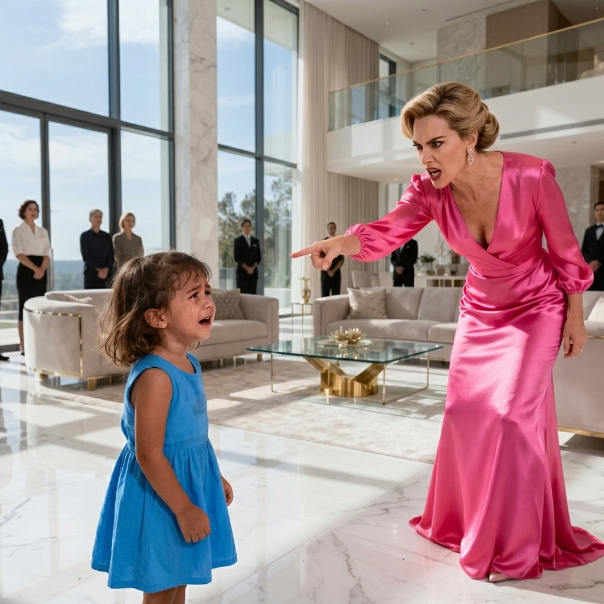
The Ballroom
The Harrington estate sat at the top of a hill like something out of a fairy tale. Twelve bedrooms, marble floors that reflected the chandelier light like still water, gardens that stretched so far you could get lost in them before dinner.
On this particular Friday evening in October, the estate was alive. Music floated through the tall open windows. Waiters in white gloves carried silver trays through crowds of people draped in designer clothes and expensive perfume. Laughter echoed off the high ceilings.
The kind of laughter that only exists when people feel completely untouchable.
This was the engagement party of Marcus Harrington. Thirty-four years old. Self-made. The kind of man that business magazines called “a force of nature” and people in his personal life called “complicated.”
He stood near the grand staircase in a perfectly tailored black suit. Shaking hands, accepting congratulations, smiling the way powerful men learn to smile. Carefully. Deliberately. Just enough.
Beside him, radiant and poised, was his fiancée, Vivian Callaway. Thirty-one years old. Beautiful in the way expensive things are beautiful. Polished. Deliberate. Impossible to ignore.
She wore a deep crimson gown that swept the marble floor. A diamond necklace that caught light from across the room. She laughed at the right moments. She touched Marcus’s arm at the right moments. She was, in every visible way, perfect.
The guests adored her.
Or at least they performed adoration. Because in rooms like this, the line between genuine feeling and social performance is very, very thin.
The Break Room
Down a long hallway at the back of the estate, past the catering station, past the staff entrance, past the world the guests never saw, there was a small break room.
Inside that break room, sitting on a folding chair with a cup of cold tea going untouched beside her, was Elena Vasquez. Thirty years old. Dark circles under her eyes. Hair pulled back in a simple bun. Hands that were red from cleaning and cooking and scrubbing.
Hands that told a story her face tried to hide.
Elena had worked for the Harrington estate for almost two years. She was quiet, reliable, invisible in the way that staff members are trained to be invisible. She arrived early. She left late. She never complained.
And tucked beside her on that folding chair, fast asleep with her head on her mother’s lap, was Mia.
Three years old. Teeny. Soft dark curls falling across her forehead. Clutching a worn stuffed rabbit that had lost one eye and most of its stuffing. But remained, to Mia, the most important object in the world.
Elena stroked her daughter’s hair and stared at the wall.
She had no choice but to bring Mia tonight. The babysitter had canceled last minute. Her sister lived two hours away. And Elena couldn’t afford to lose this job. Not with the rent increase coming. Not with Mia’s small medical bills sitting on the kitchen table at home.
So she’d brought her. Quietly. Kept her tucked away. Fed her a small meal from the staff kitchen. Whispered to her to stay close. Stay quiet. Stay invisible.
“Just like Mama, baby.” She had said softly. “We stay invisible tonight, okay?”
Mia had nodded seriously. The way three-year-olds nod when they’re pretending to understand things they don’t fully understand yet.
And for a while, it worked.
But three-year-olds don’t stay asleep forever.
Mia woke up slowly, blinking in the dim light of the break room. She looked around. Mama wasn’t there. She waited. One minute. Two. Her small bottom lip began to tremble.
She slid off the folding chair, bare feet touching the cold tile floor. She picked up her rabbit. She walked to the door, pushed it open with both small hands, and stepped into the hallway.
The music was louder out here. The lights were brighter. There were so many people. Tall people in shiny clothes moving in every direction. But none of them were Mama.
“Mama?” She called out softly. Her little voice disappeared under the noise. Nobody heard her.
She walked further, past the catering station, around a corner, and suddenly, she was no longer in the staff hallway.
She was standing at the edge of the grand ballroom. Every single chandelier in that room was pouring golden light down onto the marble floor. The music was swelling. There were hundreds of people in beautiful clothes.
And one little girl in a wrinkled yellow dress, holding a one-eyed rabbit, standing completely alone at the edge of all of it.
She didn’t know she wasn’t supposed to be there. She was just looking for her mother.
The Crimson Dress
Nobody noticed her at first. But one person did. And that was the worst possible person who could have.
Mia took a small step forward onto the marble floor. Then another. Her bare feet were silent on the polished surface. Her eyes moved from face to face. Too many faces. None of them the right one.
She was about to turn back when she bumped directly into the hem of a crimson gown.
She looked up. And up. And up.
Vivian Callaway looked down at the child at her feet. The way someone looks at a stain on a white tablecloth. Her expression didn’t shift dramatically. It didn’t need to. It was the kind of cold that doesn’t require a performance.
“What on earth?” she started. Then stopped. She looked around quickly, checking who was watching. Several guests nearby had already noticed.
Vivian straightened, composed herself, then looked back down at Mia with a tight, controlled smile that didn’t reach her eyes.
“Where did you come from?” she said. Her voice was low but sharp, like a door being closed firmly. “Who let you in here?”
Mia blinked. She didn’t fully understand the question. She held up her rabbit slightly. An unconscious gesture of comfort.
“I’m looking for my Mama,” she said softly.
Vivian’s smile tightened further. “Your Mama?” She glanced sideways at a woman nearby. One of her close friends. Equally polished. Equally cold. A look passed between them. The kind of look that doesn’t need words.
“Well, your mama,” Vivian said, crouching slightly so her voice was closer to Mia’s level, “should not have brought you here. This is a private event, for adults. You are not supposed to be in this room.”
Mia’s grip tightened on her rabbit. She didn’t fully understand the words. But children understand tone long before they understand language. And the tone told her everything.
You don’t belong here.
Her small eyes began to fill.
“But I just want my mama,” she whispered.
Vivian stood back up to her full height and looked at the nearest waiter. “Can someone please remove this child from here?”
“She’s just a baby, Viv,” someone near them said quietly. A man’s voice. Uncertain. Uncomfortable.
Vivian didn’t acknowledge it. “I don’t care how old she is,” she said. The controlled tone slipping just slightly at the edges. “She should not be in here. Where is the staff? Who is responsible for this child? This is completely unacceptable.”
Her voice had risen. Not to a shout, but enough. Enough that the music seemed a little quieter. Enough that a few more heads turned.
Enough that Mia, standing in the middle of the marble floor, felt every single eye in the room land on her tiny body.
And the tears that had been gathering in her eyes finally spilled over.
“Please,” she sobbed softly, clutching her rabbit to her chest. “I just want my mama. Sorry. I’m sorry I came in here. I didn’t mean to. I just want my mama.”
The sight of her — this tiny child in a wrinkled yellow dress, crying in the middle of a ballroom full of wealthy people — was the kind of image that lodges itself somewhere behind your chest and doesn’t let go.
But it was what came next that silenced the room entirely.
Through her tears, Mia looked directly up at Vivian. And with the most heartbreaking sincerity you’ve ever heard from a three-year-old, she asked the question that nobody in that room was ready for.
“I’m human, too,” she sobbed. “Why are you so mean to me?”
The Crack
The music stopped.
Not dramatically. The musicians simply reached the end of a measure. Sensing the sudden shift in the room, they let the last note fade without beginning the next one.
And in that silence, those words hung in the air like something sacred.
Marcus Harrington had been across the room. But he had heard every single word. And something inside him had just cracked open.
He crossed the room without fully deciding to. He arrived just in time to hear it.
“I’m human, too. Why are you so mean to me?”
He stopped three feet from Vivian. Three feet from the tiny girl in the yellow dress. He looked at Mia. Then he looked at Vivian.
His fiancée’s expression in that moment was something he had never seen on her face before. Or perhaps something he had always seen but never allowed himself to name.
Annoyance. Embarrassment. Irritation. Not guilt. Not one trace of guilt.
He crouched down slowly. He was a tall man, and he made himself as small as he could, bringing his face level with Mia’s.
“Hey,” he said quietly. His voice was different than it had been all evening. Softer. Unguarded. “Hey little one. What’s your name?”
Mia stared at him with red-rimmed eyes, still clutching her rabbit. She sniffled.
“Mia,” she whispered.
“Mia,” he repeated, like he was memorizing it. “That’s a beautiful name. Are you lost, Mia?”
She nodded. “I can’t find my mama.”
“Okay,” he said gently. “I’m going to help you find her. Is that all right?”
Another small nod.
He stood and looked at the nearest staff member. “Find whoever this child belongs to immediately. Bring them here.”
“Yes, sir.”
The young man was gone before Marcus finished the sentence.
Then Marcus turned to the room. The guests who were watching. The friends who were pretending not to watch. The whole beautiful, expensive, carefully constructed gathering.
He said nothing.
He simply picked up a small cloth napkin from the nearest table, crouched back down to Mia’s level, and gently offered it to her.
“For your eyes,” he said softly.
Mia looked at the napkin, then at him. Then, with the devastating trust of a three-year-old who has decided someone is safe, she took it and pressed it to her face.
Behind Marcus, Vivian had gone very still. She was watching her fiancé — this man she thought she knew completely — kneel on the marble floor of his own engagement party to wipe the tears from the face of a maid’s toddler.
And she felt something that she couldn’t quite identify. It wasn’t affection. It wasn’t warmth.
It was closer to unease. Like seeing a door in a house you’ve lived in for years, and realizing you never knew it was there.
The Mother
Elena arrived breathless two minutes later. She had been in the kitchen helping plate desserts when the young waiter found her. He had barely finished the sentence before she was running.
Not caring how it looked. Not caring about the rules about staff movement through guest areas. Not caring about anything except the word “crying.”
She burst through the edge of the ballroom and saw Mia immediately. She crossed the floor in seconds and dropped to her knees, pulling her daughter into her arms so tightly that Mia made a small sound of surprise before dissolving into fresh sobs.
“Baby, baby, I’m here. I’m right here.” Elena breathed into her daughter’s curls. “I’m so sorry. I’m so sorry, baby. Mama’s here.”
Mia gripped Elena’s uniform with both fists and didn’t let go.
Marcus watched the reunion. There was something about it. The rawness of it. The desperation of a mother’s love in those few seconds. It was more honest than anything else that had happened in the entire evening.
He looked at Elena carefully. He had seen her in the estate before, he realized. Briefly, in passing. One of many staff members he acknowledged with a nod, but had never truly looked at. He looked now.
“She was looking for you,” he said simply.
Elena looked up at him with wide eyes. The eyes of someone calculating exactly how much trouble she was in.
“I’m so sorry, Mr. Harrington. I’m so sorry. She was asleep in the back. She was never supposed to be out here. I had no choice but to bring her tonight. My sitter canceled. I know this is completely inappropriate, and I understand completely if you need to—”
“It’s fine,” he said.
“Do you—”
“She’s safe,” he said. “That’s what matters.”
Elena stared at him. Like she hadn’t understood English for a moment.
“She asked,” Marcus continued, his voice dropping slightly, “why someone was being mean to her.” Beat of silence. “What did she say exactly?” He asked quietly.
Elena swallowed. She looked at her daughter in her arms, then back up at Marcus.
“She said, ‘I’m human, too. Why are you so mean to me?'”
Marcus nodded slowly. He already knew. He had heard it himself. But something about hearing Elena say it, her voice quiet and aching, made it land differently.
He looked at Vivian. Vivian met his gaze. Neither of them said a word.
The Letter
Three days later, Elena was called to the estate manager’s office. Her heart dropped the entire walk down the hallway.
This is it, she thought. This is the letter.
But the estate manager, a kind older woman named Mrs. Park, looked at her with an expression Elena couldn’t immediately read.
“Sit down, Elena,” she said.
Mrs. Park placed a folder on the desk between them. “Mr. Harrington has asked me to speak with you.”
Elena’s hands folded tightly in her lap.
“He has made several decisions regarding your employment,” Mrs. Park continued.
Elena nodded once, bracing.
“Effective immediately, your salary is being increased by 40%.”
Elena blinked.
“Additionally, Mr. Harrington has arranged for Mia to be enrolled in the private daycare facility connected to Harrington Enterprises. The one used by other senior staff and executives. Effective next Monday. At no cost to you.”
The words were reaching Elena’s ears, but not quite landing.
“He has also,” Mrs. Park continued, glancing down at the folder, “allocated you a housing stipend to assist with your rent, and has arranged flexible working hours so that your schedule allows you to drop Mia off and pick her up each day.”
Silence.
“He wanted me to tell you,” Mrs. Park said, her voice softening, “that these changes are not charity. They are a correction. His word, correction. He said you have worked here for two years and he was not paying attention the way he should have been.”
“He said that someone who says good morning to a building but doesn’t know the names of the people inside it has missed something important.”
Elena’s throat had closed completely.
“There’s one more thing,” Mrs. Park said. She pushed the folder slightly forward. “He’d like you to read the letter inside.”
Elena looked at the folder for a long moment. Then she reached forward and opened it.
The letter was handwritten on heavy cream paper. The handwriting was deliberate and slightly uneven. Like someone who had written it slowly and carefully.
It said:
Elena,
I heard your daughter ask why someone was being mean to her. She said she was human, too.
I have spent three days thinking about that question. Not because it was directed at me, but because I realized, if I’m honest, it could have been.
I have lived in this estate for six years. I have worked in it, hosted events in it, made decisions in it. I have never, not once, asked the people who make it function every day whether they were all right. Whether they needed anything. Whether the life I was providing was actually livable.
Your daughter, at three years old, understood something my fiancée, at thirty-one, did not. That is not a small thing.
I am not offering these changes because I feel guilty, though I do. I am offering them because they are right. Because you have earned them twice over. And because Mia deserves a mother who isn’t exhausted to her bones trying to survive a system that was not designed with her in mind.
Please accept them without guilt.
Thank you for bringing her with you that night. It turns out she was exactly where she needed to be.
Marcus Harrington
Elena read it twice. Then she lowered the letter to her lap and pressed the back of her hand to her mouth. And she cried.
Not small, polite tears. Real ones. The kind that come from somewhere deep. From years of quiet struggle held together with willpower and love and not enough sleep and the constant low hum of anxiety that never fully goes away when you’re doing it all alone.
She cried because she was tired. She cried because someone had seen it. She cried because her daughter — her magnificent, bright, unafraid little daughter — had walked into a room full of powerful people clutching a one-eyed rabbit and had said the truest thing anyone said that entire night.
“I’m human, too.”
The End
As for Marcus, he ended his engagement to Vivian quietly. Without drama. Without public announcement.
He simply had a conversation. Honest and difficult and necessary. In which he said, “I think we have been performing something together rather than building something. And I can’t keep performing.”
Vivian did not take it well. Then she took it with grace. Then she left.
And Marcus, for the first time in perhaps years, sat in his enormous estate and felt something he had been too busy and too armored to feel before. He felt the size of his own silence.
He started showing up differently. He learned the names of everyone who worked in the estate. He asked questions. He listened to the answers.
He discovered in the weeks and months that followed that the people he had been walking past every day were carrying extraordinary lives. Full of love and difficulty and humor and grief and dreams that he had simply never thought to ask about.
And Mia. Mia started at her new daycare on a Monday morning. She walked in holding Elena’s hand, rabbit tucked under her other arm. She looked around at the bright room, the toys, the other children, the patient teachers.
She turned to her mother with wide, wondering eyes.
“Mama,” she said seriously, “is this for me?”
Elena crouched down. She smoothed her daughter’s curls.
“Yes, baby,” she said, her voice barely holding. “This is for you.”
Mia considered this for exactly one second. Then she walked in.
Adults spend their entire lives building walls to protect themselves from being vulnerable. We dress the walls up in expensive clothes and careful smiles and rehearsed confidence. And then a child walks in and says one true thing, and all the walls come down.
Maybe the real question isn’t why people are unkind. Maybe the real question is when did we forget that the person in front of us is human, too?
Disclaimer : This content may be created by AI for entertainment purposes. Any resemblance to real persons, events, or places is coincidental.