The Party
The microphone hissed.
Two hundred guests in black tie and champagne silk turned toward the stage. Crystal chandeliers scattered light like shattered diamonds across the ballroom floor. The Whitmore Hotel had never looked more beautiful. It had never felt more like a cage.
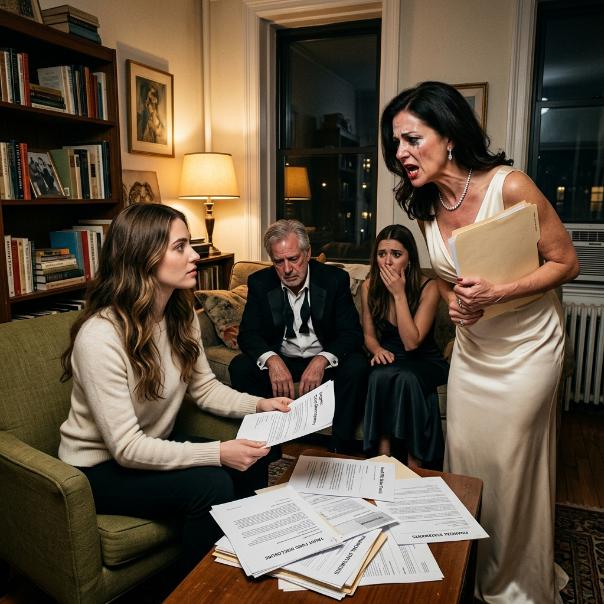
Diane Paxton stood at the podium in cream silk, diamonds at her throat, smile perfectly calibrated. She’d spent three weeks preparing this moment. Three weeks of seeding rumors. Three weeks of whispering to garden club wives and country club board members. Three weeks of building a narrative so complete that when she finally spoke, no one would question her.
“Security,” she said into the microphone. “Please remove this useless woman. She wasn’t invited, and she’s causing a disruption.”
The ballroom went silent.
I stood in the center aisle, midnight navy dress, mother’s Mikimoto pearls at my ears, a small velvet box in my hand. Inside, a restored brass compass. Inside, my mother’s initials. Inside, the last hope I’d carried for twenty-three years.
I looked at my father.
Richard Paxton stood three steps from the stage in his custom Tom Ford tuxedo. Three steps from his wife. Three steps from his daughter. The man who’d built an empire on commercial real estate, who’d shaken hands with governors and CEOs, who’d never once in my memory looked uncertain in a room full of power.
He looked at the floor.
He said nothing.
The two security guards materialized on either side of me. The one on my left spoke quietly. “Ma’am, we’ve been asked to escort you out.”
I set the velvet box on the nearest table. Gently. The way you’d set down something you loved and were leaving behind.
“I came for you, Dad,” I said. Quietly. Not for the room. For him. “Not for her. But I see your choice.”
I turned and walked toward the exit. Back straight. Eyes dry. My mother’s pearls catching the chandelier light one last time.
Behind me, Diane’s voice returned to the microphone. “I’m so sorry about that, everyone. Now, where were we?”
The jazz quartet started up again before the double doors closed behind me.
The Arithmetic
October air hit me like cold water.
I stood on the marble steps of the Whitmore Hotel and listened to the muffled music bleeding through the walls. Cole Porter. Laughter. The clink of champagne glasses.
Inside, two hundred people were dancing. Outside, I sat down on the top step and felt the stone cold through the fabric of my dress.
I gave myself sixty seconds.
Sixty seconds to feel it all. The humiliation. The silence where my father’s voice should have been. The knowledge that two hundred people had watched me be erased and then gone back to their champagne. Every swallowed word. Every Christmas at the small table in the sun room. Every time I’d driven home and told myself it didn’t matter.
Then I stood up.
Because my mother didn’t raise me to sit on other people’s steps.
I pulled out my phone and called Rebecca Stone. She picked up on the first ring. I’d warned her this call might come tonight.
“Rebecca, this is Laura Paxton. I’m ready to proceed with the segregated fund transfer.”
“Tonight?”
“Now.”
Her voice was steady, professional, unsurprised. “I’ll need your digital signature and the authorization code from Mr. Aldridge. I can execute within forty-five minutes of receiving both.”
“You’ll have them in ten.”
I hung up. The ballroom music swelled behind the glass doors.
I didn’t look back.
My laptop was already in the car. I’d brought it the way a surgeon brings a scalpel. Hoping not to use it. Prepared if she had to.
I opened it on the passenger seat. The screen lit the interior of my Subaru in pale blue light. In the building behind me, two hundred people were dancing. Out here, it was just me and a Wi-Fi hotspot and twenty-three years of silence finally reaching their limit.
I dialed a conference call.
Thomas Aldridge picked up first. Then Rebecca Stone.
“Authorization code,” Aldridge said. He read it off. Twelve alphanumeric characters. Calm and precise, as if he were reading a weather report.
“This authorizes the transfer of segregated funds from the Paxton family trust to the Laura Paxton irrevocable trust, per the trust agreement of 2004 and amendment of 2006.”
Rebecca confirmed receipt. “Miss Paxton, I’ll need your digital signature on the DocuSign document I’m sending now.”
My phone buzzed.
I opened the email. Read every line.
My mother taught me that everything beautiful starts with structure.
I signed.
“Processing,” Rebecca said. “Estimated completion, forty-five minutes.”
While I waited, I did the rest.
Three American Express Platinum cards. Diane and Meredith were authorized users on accounts linked to the trust’s collateral covenant. Country club membership. Supplemental insurance riders. All of it tethered to the same pool of funds that was about to shrink by seventeen million dollars.
When the trust balance dropped below the covenant threshold, the bank’s automated system would freeze every linked account.
I wasn’t canceling anything out of spite.
I was watching arithmetic do what arithmetic does.
At 9:47 p.m., Rebecca called back.
“Transfer complete. Seventeen million, four hundred twenty-three thousand, one hundred seventy-eight dollars and sixty-two cents. The funds are in your trust, Miss Paxton.”
I closed my laptop. Sat in the dark for a moment. Listened to my own breathing.
Then I turned off my phone, started the engine, and drove home to Brooklyn.
The Fifty-Six Calls
When I turned my phone back on forty minutes later, there were twelve missed calls.
By the time I set it on my kitchen counter, the number was twenty-nine.
By the time I finished making tea, it was fifty-six.
Fifty-six calls. They hadn’t called me fifty-six times in the last twenty-three years combined.
Here’s what fifty-six calls sound like from the other end.
At 9:52 p.m., five minutes after the transfer cleared, Meredith tried to buy a round of drinks for her friends at the ballroom bar. Her AmEx was declined. She laughed, embarrassed, and pulled out a second card. Declined. A third. Declined. The bartender’s smile went stiff. Meredith’s cheeks went red.
At 9:58 p.m., Diane’s phone buzzed with a notification from the fiduciary firm. The kind of notification that arrives in bold type with the word URGENT in the subject line. “Action Required. Significant Asset Movement in Paxton Family Trust. Please Contact Your Account Manager Immediately.”
Diane stepped away from the dance floor. She called Rebecca Stone directly.
Rebecca, professional, neutral, bound by fiduciary protocol, said, “A beneficiary has exercised their right to withdraw segregated funds under the original trust agreement. I’m not authorized to disclose further details by phone.”
Ellen Marsh told me later that she watched the color drain from Diane’s face in real time. It was like watching a screen go dark. First the smile, then the composure, then the certainty. All of it gone in the space of a single phone call.
Diane walked straight to Richard, gripped his arm, and pulled him to a quiet corner near the coat check.
“What did you do?” she hissed.
Richard stared at her. “What are you talking about?”
Diane pulled up the trust portal on her phone. Her fingers were shaking. The account balance, which that morning had read forty-two million dollars, now displayed twenty-four million, nine hundred fifty-seven thousand, six hundred eighty-three dollars and twenty-two cents.
And in the transaction log, one line.
Segregated Fund Withdrawal. Beneficiary: Laura C. Paxton.
Richard’s face went gray.
Diane’s champagne flute was still in her hand. She hadn’t set it down since the speech. Her fingers were trembling around the stem. And for the first time in twenty-three years, the woman who controlled every room she entered looked like she’d lost the floor beneath her feet.
“That little—” She caught herself. Lowered her voice. “She can’t do this. Richard, call her now.”
He called. I didn’t answer.
He called again. And again. And again.
I was already home by the time the calls started stacking.
My apartment in Brooklyn Heights is a third-floor walk-up in a brownstone built in 1891. Original moldings. Warped hardwood floors. A kitchen barely big enough for two people and a kettle.
I chose it because the ceilings are ten feet high and the windows face east. Every morning, the light comes through like it’s been filtered through honey.
I restored the built-in bookshelves myself. Floor to ceiling, white oak, filled with architecture books and novels and a few things that don’t have a category but felt right.
I set my phone on the kitchen counter and let it vibrate.
The messages came in waves.
Meredith first, frantic. “Laura, what did you do?”
Then Diane, no longer velvet, no longer measured. “You have no right. This is family money.”
Then Meredith again. “My cards aren’t working. Laura, this isn’t funny.”
Then Richard. The simplest. The one that hurt the most. “Laura, please call me. We need to talk.”
Then Diane, sharp as broken glass. “I’m calling our lawyer. You’ll regret this.”
I watched the screen light up and go dark. Light up and go dark. Like a heartbeat monitor for a family in cardiac arrest.
I didn’t answer.
Instead, I ran a bath.
I took off the midnight navy dress and hung it carefully on the back of the bathroom door. I unclipped my mother’s pearl earrings and set them on the vanity. I stepped into the hot water and stayed there until my breathing slowed and the steam softened the edges of everything.
When I got out, I put on a sweater and made chamomile tea and sat in my chair and looked at the photograph of my mother on the wall.
Catherine Hail, laughing on a construction site, covered in sawdust. Completely alive.
“I did what you asked, Mom,” I said to the empty room. “I found him. And I found what you left for me.”
The phone had stopped ringing. Fifty-six calls total.
I checked the time. 11:08 p.m.
Then the intercom buzzed.
The Doorstep
I looked at the intercom screen.
There they were. All three of them. Standing on the stoop of my brownstone at 11:15 on a Saturday night in October.
Richard in his tuxedo, tie loosened, face the color of wet concrete. Diane still in her cream silk gown, mascara tracked down both cheeks in dark rivulets, clutching her Hermès bag like a life buoy. Meredith half a step behind, hugging her phone to her chest with both hands, eyes swollen and red.
For twenty-three years, I had gone to them. To their house, their dinners, their parties, their terms. I had driven to Westchester and sat at the small table and smiled through comments designed to shrink me. I had rung their doorbell like a guest in my own family.
Now they were at mine.
I didn’t move right away.
I stood at the intercom and let myself look. Really look at the image on that screen. Diane Paxton, who had never once visited my apartment in seven years, was standing on my stoop with mascara on her face and panic in her posture.
There was something in that image I needed to absorb before I opened the door.
I walked to my desk drawer and pulled out the folder. The copies of the trust agreement and amendment. The transfer confirmation from Rebecca Stone. And one more document. Something I’d been carrying since my meeting with Aldridge. Something I hadn’t mentioned to anyone yet.
I tucked it at the back of the folder.
I checked my reflection in the hall mirror. Cashmere sweater. Hair down. No makeup. Clean. Simple. Mine.
I pressed the intercom button.
“Come up.”
I unlocked the front door and opened it before they reached the landing.
Diane was first up the stairs. Heels clicking on the old wood. Already drawing breath for whatever she’d been rehearsing in the car. She crossed my threshold and started.
“How dare you?”
I raised one hand. Not dramatically. Just enough.
“You are at my door, Diane. Lower your voice or leave.”
She stopped mid-word. Mid-breath. It was the first time in twenty-three years that anyone had said no to Diane Paxton on a doorstep. She looked at me as if I’d spoken a language she didn’t know I understood.
I stepped aside. “Come in. But I’ll be the one talking tonight.”
They sat in my living room the way people sit in a doctor’s office when the news is already bad.
Richard took the armchair by the window, the one I’d reupholstered in olive linen last spring. He looked shrunken inside his tuxedo. A man built for conference rooms, now compressed into a Brooklyn apartment that smelled like chamomile and old books.
Diane stood. She refused to sit. Standing was control, and she wasn’t ready to give that up.
Meredith perched on the edge of the sofa. Arms crossed. Phone clutched in one hand. Not looking at anyone.
Diane fired first.
“You stole from this family. That money belongs to your father.”
I opened the folder on my coffee table. I didn’t rush. I didn’t raise my voice. I’d spent my career uncovering the original structures of buildings, finding the load-bearing walls beneath decades of bad renovations. That’s exactly what I was going to do now.
“That money,” I said, “seventeen million dollars, never belonged to my father.”
I slid the trust agreement across the table. Forty pages. Leather bound. My mother’s signature in blue ink.
“It belonged to my mother. Catherine Hail Paxton. Your predecessor.”
The room contracted.
Diane’s eyes locked on the document like it was a weapon pointed at her chest.
“The trust agreement of 2004,” I continued, “drafted by Thomas Aldridge, executed by my mother before her diagnosis progressed. It designates seventeen million dollars, her family inheritance from the Hail estate, as segregated funds within the Paxton family trust. Legally separate. Walled off. Mine.”
Diane’s voice came out thin. “That’s a fake. Richard, tell her.”
She turned to my father.
Richard was staring at the document on the table. He didn’t look up. He didn’t deny it. The silence in the room was the loudest sound I’d ever heard.
“You knew,” I said. Not a question. “Didn’t you, Dad?”
My father’s throat moved. His hands gripped the arms of the chair. When he spoke, his voice had the cracked quality of something that had been sealed shut for a very long time.
“Your mother. She set it up before she got sick. I—” He stopped. Swallowed. “I should have told you.”
Diane turned to Richard as if she’d been struck. “You knew?”
He said nothing. But his silence was its own confession. Twenty-three years of it. Finally audible.
I placed the second document on the table. “Amendment of 2006. Signed by my mother six months before she died. It names me, Laura Catherine Paxton, as sole beneficiary of the segregated funds. Effective on my thirtieth birthday. No co-signature. No trustee approval.”
I sat back. “I’m thirty-four. I exercised my legal right tonight.”
The documents lay between us on the coffee table. Between my cup of chamomile tea and Diane’s trembling hands.
“I didn’t steal anything, Diane. I reclaimed what was always mine.”
The Amendment
Diane read fast.
I watched her eyes scan the pages. Flipping. Searching. Looking for the crack, the loophole, the mistake.
She didn’t find one.
My mother had been meticulous. Aldridge had been meticulous. Twenty-three years of legal architecture built to hold.
When Diane looked up, she’d shifted tactics. The fury was gone, replaced by something I’d seen a hundred times. The quiver in the chin. The careful widening of the eyes. The trembling hand pressed to her collarbone.
Victim mode. Her most practiced performance.
“Richard,” she breathed, turning to my father. “She’s tearing this family apart. After everything I’ve done for this family. For her.”
I cut her off. Not with volume. With information.
“Speaking of what you’ve done, Diane. I know about the trust amendment you’ve been drafting.”
The performance collapsed. Instantaneous. Like watching a mask crack down the center. Her hand dropped from her collarbone. Her mouth opened, then closed. The room went vacuum silent.
“Three weeks ago,” I said, “I was at the house. I saw the folder on your desk. A draft amendment from a law firm. Designed to remove me as beneficiary of the segregated funds and transfer them to Meredith.”
Meredith’s head snapped up. “What?”
“I also confirmed with the fiduciary firm that you’ve been calling them repeatedly, requesting access to my mother’s trust provisions. Details that Rebecca Stone correctly refused to share with you because you have no legal standing to receive them.”
Diane abandoned the tears. What replaced them was something raw. Genuine anger. Stripped of all the silk.
“So what? That money’s been sitting there for twenty years doing nothing. Meredith deserves it more than you. At least she contributes to this family.”
“Mom, stop.”
Meredith’s voice was small but sharp. A crack in a wall I hadn’t expected.
Diane didn’t hear her. Or chose not to.
I looked at my sister, then back at Diane.
“Meredith deserves what, exactly? Seventeen million dollars that my mother earned? That my mother’s parents built over three generations? For what—Instagram sponsorships charged to a trust that isn’t hers?”
Richard’s voice surfaced. Weak.
“Laura, that’s enough.”
I turned to him. I’d been waiting for this. The thing he always said. Enough. His favorite word. The word he used every time the truth got too close to comfort.
“No, Dad. You don’t get to say enough tonight. You lost that right when you watched two security guards walk me out of a ballroom and said nothing.”
The silence after that was different from the others. It wasn’t the silence of composure or control. It was the silence of a man hearing, for the first time, the cost of his own cowardice.
Diane’s hand moved to her Hermès bag. She pulled out the manila folder. The same one I’d glimpsed on her desk. Held it up like a shield.
“This amendment is perfectly legal. And Richard was going to sign it.”
“He can’t,” I said. “The segregated funds are already in my name. They have been since 2006. That amendment was drafted to alter something Diane had no authority over, for assets she had no claim to, using a provision that doesn’t exist. Your lawyer should have told you that. Unless you didn’t give them the full picture.”
Diane stared at me. The folder trembled in her hand. A weapon that had turned to paper.
I let the silence hold for a moment. Then I explained what was going to happen. Not with emotion, not with satisfaction. The way I’d explain load calculations on a restoration project.
Facts. Structure. Arithmetic.
“When I withdrew the seventeen million tonight, the trust balance dropped from forty-two million to twenty-five. But over the past several years, Diane, using her position as co-trustee, authorized loans against the trust’s full value. Real estate leverage. The total outstanding debt collateralized by the trust is approximately thirty-eight million dollars.”
Richard’s head lifted slowly. He hadn’t known the number. I could see it on his face. The specific expression of a man who’d signed things without reading them because his wife told him it was handled.
“The bank’s loan covenant requires the trust to maintain collateral coverage at a minimum of one-point-one. As of 9:47 tonight, the coverage ratio is roughly sixty-six percent. Thirteen million short. The bank’s automated compliance system has already frozen the linked accounts. Credit cards. The country club membership. The supplemental insurance riders. A formal margin call will follow within seventy-two hours.”
Meredith whispered, “That’s why my cards—”
“Yes.”
Diane’s voice was a blade. “You planned this. You planned this to destroy us.”
I looked at her across my coffee table. Across the trust documents. Across the cold tea. Across twenty-three years.
“No,” I said. “I planned to come to my father’s party, give him a compass that belonged to my mother, and hope for one evening to feel like his daughter. You planned a public humiliation. You planned to have me removed by security. You planned a fraudulent amendment to take my inheritance. I simply stopped waiting for you to do the right thing.”
Then I reached into the folder and pulled out the last document.
The one I’d been carrying since my meeting with Aldridge. The one I hadn’t shown anyone.
It was an email, printed on plain paper. Sent six months earlier from Diane’s personal account to her attorney. Accidentally CC’d to Thomas Aldridge, whose email address was still on file as the trustee of record in the firm system.
I read it out loud. Every word.
“We need to move quickly before Laura finds out about Catherine’s trust provisions. Richard doesn’t have the spine to stop us.”
The room went airless.
Richard reached for the printout. He read it once. Then again. Then he set it down on the table and looked at his wife as if he were seeing her for the first time.
Not the woman in cream silk who organized his life and managed his schedule and told him when to smile. But the woman who had written “Richard doesn’t have the spine” in a sentence designed to steal his dead wife’s money from his living daughter.
“Diane,” he said. His voice was barely audible. “Is this real?”
She didn’t answer. She didn’t need to. Her face answered for her. The specific, unmistakable expression of someone caught not in a lie, but in the truth.
“That’s not revenge,” I said quietly. “That’s arithmetic. And that—” I nodded at the email on the table, “is who she is.”
The Collapse
What happened next was the sound of a structure failing.
Not all at once. Not the dramatic collapse you see in movies. The slow kind. The kind I’ve seen in my work a hundred times. When a building has been standing on a compromised foundation for decades, and one day a single beam gives way, and everything above it shifts.
Diane reached for the email printout as if taking it off the table could undo the words.
Richard pulled it back.
She pivoted. And there it was again. The chin quiver. The glistening eyes. The hand at the throat.
“She’s manipulating you, Richard. Just like Catherine always did.”
My father stood up.
In twenty-three years, I had never seen Richard Paxton stand up against Diane. He’d yielded. He’d deferred. He’d looked at his plate and let silence do the work of agreement.
But something in that sentence—”just like Catherine”—hit a wall inside him that even he didn’t know was still standing.
“Don’t,” he said. His voice was shaking, but the words were stone. “Say her name.”
Diane stopped.
Her mouth was open. No sound came out. For perhaps the first time in their marriage, she had no response prepared. Because she had never imagined she’d need one.
Meredith stood slowly from the sofa. Her face was blotchy and wet, but her voice was steadier than either of her parents.
“Laura. I didn’t know about the trust. The amendment. Any of it.”
I looked at my sister. My half-sister. The golden child. The one who’d been handed everything I’d been denied. And I saw beneath the Tiffany necklace and the tear-streaked makeup: a twenty-six-year-old woman standing in the wreckage of the only story she’d ever been told about her family.
“I believe you didn’t know about the trust, Meredith. But you knew what it felt like to watch your sister get erased from family photos. You knew what it meant when I sat at the small table every Thanksgiving. You knew. And you said nothing.”
She closed her eyes. Nodded once.
My father took a step toward me.
“Laura, I’m sorry.”
I let the words settle. I didn’t rush to comfort him. I didn’t say it’s okay. Because it wasn’t okay. It hadn’t been okay for twenty-three years. And pretending otherwise would be one more form of silence.
“I know you are, Dad. But sorry isn’t enough anymore. I need you to do something.”
He waited.
I laid it out clearly. Simply. The way my mother would have.
Four conditions.
“First, the seventeen million stays in my trust. That is not negotiable. Second, Diane’s draft amendment is destroyed completely. Notarized confirmation that it’s been voided. Third, you retain your own attorney. Not Diane’s attorney. Yours. Someone who will explain your actual financial position without anyone editing the numbers. Fourth, I am willing to rebuild a relationship with you, but it will be on equal terms with clear boundaries. And it will not go through Diane.”
I paused.
“Those aren’t punishments, Dad. They’re the minimum conditions for me to trust you again.”
Richard looked at the trust documents on the table. At the email printout. At the compass box he hadn’t yet seen, the one I’d left behind at the party.
Then he looked at me.
“Okay,” he said quietly. Without negotiation.
Diane grabbed her bag. “This isn’t over, Laura.”
I met her eyes.
“For me, it is. What happens next is between you and your choices.”
She left. Heels clicking down my staircase. The front door closed hard enough to rattle the glass.
Meredith lingered a moment longer. She looked like she wanted to say something but couldn’t find it. Finally, she whispered, “I’m sorry, Laura,” and followed her mother down the stairs.
My father stayed.
He sat back down in the olive chair and stared at his hands. Neither of us spoke for a very long time. The radiator hummed. The brownstone settled. The photograph of my mother watched us from the wall.
The Foundation
The fallout arrived in waves over the next seventy-two hours.
Each one more precise than the last.
Monday morning, 9:00 a.m. The margin call came. A letter from the bank, sent via courier to Richard’s home office. Bold letterhead. Red urgent stamp. The kind of document that makes your hands cold before you finish the first paragraph.
The Paxton family trust was thirteen million dollars below the required collateral threshold. Richard had sixty days to either inject additional capital or liquidate assets.
Two commercial properties. An office complex in White Plains. A retail center in Stamford. They would need to be sold.
Richard hired his own attorney that same afternoon. Not Diane’s lawyer. His own. A woman named Patricia Hall from a midsize firm in Manhattan, recommended by a colleague Diane had never met.
Patricia pulled the full financial records of the trust. Something no one had done independently in over a decade.
What she found was the second detonation.
Over the past fifteen years, Diane had authorized approximately two point three million dollars in withdrawals from the trust’s operating account. Categorized in the records as “family expenses.” Patricia’s audit revealed they were anything but personal. Shopping. First-class travel. Spa retreats. Meredith’s lifestyle costs. A down payment on a vacation property in the Berkshires that was titled solely in Diane’s name.
None of it had been approved by the trustee of record. None of it had been disclosed to Richard.
All of it constituted a breach of fiduciary duty under the trust’s governing documents.
Diane was given a choice. Repay the two point three million through a structured plan, or face civil liability and potential removal as co-trustee.
The country club membership remained frozen. The insurance riders lapsed. Meredith’s credit cards stayed dark.
And two days after the margin call, Meredith Paxton quietly deactivated her Instagram account. No announcement. No farewell post. Just a single story that read, “Taking some time offline.”
It was the first honest thing she’d posted in years.
The Compass
One week after the party, my father called.
Not through Diane. Not through a secretary or a scheduling intermediary. He picked up the phone himself and dialed my number and asked if I’d have coffee with him.
We met at the French bistro on the Upper East Side. The one with the white tablecloths and the copper pots. The one my mother had loved.
He was already seated when I arrived. He looked older. Not in the gradual way that aging usually works, but in the sudden way. As if a decade had landed on him in seven days. His shirt collar was loose. His eyes were shadowed. He had not shaved well.
On the table in front of him was the velvet box.
“I opened it,” he said.
The brass compass lay in his palm. I’d spent weeks restoring it. Cleaning the patina. Repairing the hinge. Polishing the case until the engraved initials were legible again.
C.H. Catherine Hail.
My mother had given it to him in their second year of dating. When he’d told her he wanted to build things, and she’d told him he needed to know which direction he was facing first.
My father turned the compass over in his hands. The needle still worked. Trembling. Settling. Pointing true.
“She was my compass,” he said. “Your mother. And I let someone else steer.”
He was crying quietly. The way men of his generation cry. Jaw tight. Eyes spilling. No sound.
I hadn’t seen him cry since the funeral. Twenty-three years ago.
I didn’t say it’s okay. Because it wasn’t. Not yet. Maybe not for a long time.
But I said, “I’m glad you’re here, Dad. That’s a start.”
He told me he’d asked Diane to move out of the house temporarily. Not a divorce. Not yet. But a separation. She was staying at a hotel in Scarsdale. He needed space, he said, to understand what had happened to his life while he wasn’t paying attention.
We ordered coffee.
Then, without planning it, we both ordered the croque madame. My mother’s standing order, every Sunday at the same table.
Neither of us mentioned it. We didn’t need to.
The Bare Face
Two weeks after the party, Diane came to my door alone.
No mascara this time. No silk gown. She wore a gray cashmere coat over a simple black dress. Her face was bare. No foundation. No careful concealer work. Just the raw map of a fifty-eight-year-old woman who hadn’t been sleeping.
The Cartier Love bracelet was gone from her wrist. I learned later she’d sold it to begin repaying the two point three million.
She didn’t buzz the intercom. She must have followed someone through the front door.
I opened my apartment door and found her standing on my landing. Arms at her sides. Looking smaller than I’d ever seen her.
“You’ve ruined everything I built,” she said.
It wasn’t angry. It wasn’t performed. It was the flattest, most honest thing Diane Paxton had ever said to me.
I leaned against my doorframe.
“You built on someone else’s foundation, Diane. My mother’s money. My mother’s husband. Even my mother’s daughter. You tried to erase me so you could keep the stage to yourself.”
She flinched. Not the theatrical flinch. The real kind. The kind that happens in the muscles around the eyes before the brain can edit it.
And then she said something I didn’t expect.
“I was terrified, Laura. Every single day for twenty-three years. I was terrified that one day you’d show up and take it all away.”
Her voice cracked. “And you did.”
I looked at her. I understood the fear. Understood it the way you understand the rot inside a wall you’ve opened up. It doesn’t excuse the damage. But you can see where it started.
“I didn’t take anything that was yours,” I said. “I took what was mine. The difference is you never understood there was a difference.”
She held my gaze for a long moment.
No apology came. I didn’t expect one. Diane Paxton was many things, but she was not a woman who apologized. Not to me. Not to anyone she’d placed beneath her in the architecture of her life.
She turned and walked down the stairs.
I listened to her footsteps. Slower than I’d ever heard them. No click of designer heels this time. Just the quiet pad of flat shoes on old wood.
I closed the door. Leaned my forehead against it. Breathed.
The Gala
Three months later, I stood on a stage again.
But this time, no one asked security to remove me.
The National Trust for Historic Preservation held its annual gala in Washington, D.C. A black-tie event in a restored Beaux-Arts ballroom. Ironwork. Vaulted ceilings. The kind of craftsmanship that makes you believe people once built things to last.
I was there as a guest of honor. Invited to present the inaugural project of the Catherine Hail Foundation.
A nonprofit I’d established using a portion of the trust funds. To restore endangered historic buildings in underserved communities.
My first project: a community center in a formerly redlined neighborhood in Baltimore. Built in 1912. Abandoned in 1987. Condemned in 2014.
We were bringing it back. Load-bearing walls. Original tile. The whole skeleton saved.
I wore an emerald green dress that night. Simple. Well-cut. My mother’s Mikimoto pearl earrings.
Behind me on the screen, in letters six feet tall: The Catherine Hail Foundation. Preserving What Matters.
My father was in the audience. Front row. He’d driven down from Westchester alone. No Diane beside him. No entourage. Just Richard Paxton in a navy suit, sitting upright, watching his daughter speak.
I talked about buildings. About the ones everyone walks past without seeing. About the ones that get condemned because it’s easier to tear something down than to do the hard, slow, unglamorous work of finding out what’s still good underneath.
I talked about my mother. An architect I never knew was an architect. Who built things that held for decades because she understood that everything beautiful starts with structure.
When I finished, the room stood.
My father stood first.
Afterward, he found me near the coat check. He was holding something. A flat rectangular package wrapped in brown paper.
I opened it and went still.
It was the architectural rendering I’d given him at the retirement party. The original blueprint of his first building. The one I’d restored from the county archive.
He’d had it framed. Dark walnut. Museum-quality glass. Archival matting. The whole treatment.
“It’s been on my wall since the day you gave it to me,” he said. “I just never told Diane.”
I held the frame against my chest and looked at my father. This flawed, frightened, trying man.
I didn’t say it’s okay.
I said, “Thank you, Dad. That means more than you know.”
We walked out together into the cool D.C. night.
The Letter
Two weeks later, I received a handwritten letter in the mail.
No return address on the front. But I recognized the stationery.
Meredith.
Three pages, front and back, in careful handwriting. An apology. Not the performative kind. Not the kind that explains itself away. The raw, stumbling, honest kind that a twenty-six-year-old writes when she’s seeing her life clearly for the first time.
I haven’t replied yet.
The letter sits on my desk. Next to my mother’s letter. Next to the compass box.
Some things take time. Some buildings can’t be restored in a season. But the foundation—the real one, the one beneath everything—is sound.
The Architecture
That’s my story.
I didn’t win because I screamed louder. I didn’t win because I had more money or more power or more cruelty than the people who tried to erase me.
I won because twenty-three years ago, while she was dying, my mother sat down with a lawyer and a pen and a stack of legal paper and built something that would hold.
She didn’t do it with drama. She didn’t do it with anger.
She did it with structure.
The same way she built everything.
I used to think strength meant enduring. Showing up to every dinner. Sitting at the small table. Driving home in silence. Swallowing whatever was served and calling it family.
I thought if I was patient enough, quiet enough, good enough, someone would eventually see me.
No one was going to see me. Not because I was invisible. But because the people around me had decided that my invisibility was convenient.
And the only person who could change that was the one standing in the mirror.
My mother left me a letter. It said, “Find him.”
And what I found wasn’t just a lawyer or a trust document or seventeen million dollars.
I found the thing she’d really been protecting all along.
My right to take up space.
Thank you, Mom.
For the letter. For Mr. Aldridge. For the pearls. For teaching me that some buildings are worth saving.
Including the one I live in.
The Truth
If you’re listening to this and you recognize something—the whispers, the exclusion, the way your name gets misspelled on purpose, the way your accomplishments meet silence while someone else’s get a standing ovation—I want you to know something.
You’re not crazy.
You’re not too sensitive.
You’re not the difficult one.
And you do not have to set yourself on fire to keep someone else warm.
I used to think strength meant enduring. I thought if I was patient enough, quiet enough, good enough, someone would eventually see me.
No one was going to see me.
Not because I was invisible. But because the people around me had decided that my invisibility was convenient.
And the only person who could change that was the one standing in the mirror.
My mother left me a letter. It said, “Find him.”
And what I found wasn’t just a lawyer or a trust document or seventeen million dollars. I found the thing she’d really been protecting all along.
My right to take up space.
So that’s my story. I didn’t win because I screamed louder. I didn’t win because I had more money or more power or more cruelty than the people who tried to erase me.
I won because twenty-three years ago, while she was dying, my mother sat down with a lawyer and a pen and a stack of legal paper and built something that would hold.
She didn’t do it with drama. She didn’t do it with anger.
She did it with structure.
The same way she built everything.
Thank you, Mom. For the letter. For Mr. Aldridge. For the pearls. For teaching me that some buildings are worth saving.
Including the one I live in.
THE END.