They Sent Her To A Blood Hunter Apache To Die—But He Offered Her Food, Warmth, And His Protection
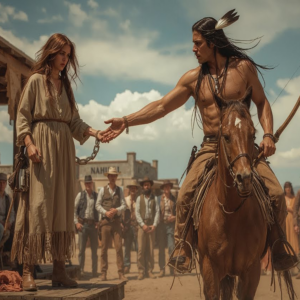
They dragged her to the trading post with iron shackles cutting into her wrists and the stench of three days without mercy clinging to her torn calico dress. But when the Apache known as the blood hunter stepped from the shadows to claim what the settlement offered him, he didn’t see prey. He saw a woman whose spirit hadn’t yet learned to break.
The morning sun beat down mercilessly on the dusty settlement of Copper Ridge, Arizona territory, casting harsh shadows between the weathered buildings that comprised what the locals generously called civilization. Cassandra Mitchell stood on the raised wooden platform outside Henley’s general store, her orbin hair matted with sweat and dirt, her green eyes scanning the hostile faces of the town’s people who had gathered not out of sympathy, but out of morbid curiosity to witness her final humiliation. Just 6 months ago, Cassie
had been the school mom, respected and needed, teaching the children of miners and ranchers in the one room schoolhouse that doubled as the town’s meeting hall on Sundays. She had arrived from Denver with letters of recommendation and a heart full of hope, believing she could make a difference on the frontier.
The children had loved her gentle way of explaining arithmetic and her dramatic readings from the worn copy of Shakespeare she’d carried west in her single traveling bag. But frontier settlements were unforgiving places where a woman’s reputation could be destroyed by whispers and circumstance. When cattle baron Harrison Wade’s youngest son started visiting the schoolhouse after hours, claiming he needed extra help with his reading, Cassie had seen only a struggling boy who desperately wanted to please his demanding father. The town’s
people saw something entirely different, a young woman of questionable morals corrupting the innocence of their children. The truth emerged too late to save her reputation. Young Timothy Wade had been stealing from his father’s safe, using his visits to the schoolhouse as an alibi while he gambled away hundreds of dollars in the saloons of nearby Tucson.
When Harrison Wade discovered the theft, Timothy, desperate to avoid his father’s legendary temper, claimed that Cassie had seduced him into stealing the money for her own purposes. No one questioned the boy’s story. A woman alone without family or connections was an easy target for blame in a community where men’s words carried the weight of law and women’s protests were dismissed as hysteria.
Within a week, Cassie found herself dismissed from her teaching position, evicted from the small room behind the schoolhouse and shunned by every respectable family in Copper Ridge. For 3 months she survived on odd jobs and charity that came with humiliating conditions. She cleaned floors at the saloon in exchange for table scraps, took in washing for wives who paid her a fraction of fair wages while treating her like a moral leper, and slept in whatever shelter she could find.
an abandoned chicken coupe, the back room of the blacksmith shop, sometimes just under the stars, with her few remaining possessions clutched to her chest. The final blow came when she was caught taking bread from behind the bakery. Mrs. Henley, the baker’s wife and self-appointed moral guardian of Copper Ridge, found her digging through the refues for stale loaves that would have been fed to pigs.
Instead of showing mercy to a starving woman, Mrs. Henley screamed, “Thief!” loud enough to wake the dead, bringing half the town running to witness Cassie’s ultimate disgrace. “Sealing food now, are we?” Sheriff Tom Brennan had said, more amused than angry as he snapped the iron shackles around her wrists.
Brennan was Harrison Wade’s brother-in-law, a man who enforced law based on who paid his salary rather than what justice demanded. It seems like this town’s been too generous with charity. Time to solve this problem permanentlike. The solution had come from an unexpected source. 3 days earlier, a lone Apache warrior had appeared at the settlement’s edge, riding a paint horse, and carrying a lance decorated with eagle feathers and what looked suspiciously like human scalps.
He had made no threatening moves, spoken no words, simply sat his horse, and watched the settlement with eyes that seemed to catalog every weakness, every fear. The town’s people knew who he was. stories of Nahuel called the blood hunter by white. Settlers had spread throughout the Arizona territory like wildfire. He was said to be a renegade who had rejected both his own tribes attempts at peace and the white man’s treaties, choosing instead to live alone in the harsh desert mountains, emerging only to exact terrible vengeance on those who had
wronged his people. Some claimed he could track a man across solid rock, that he could move through the desert without leaving footprints, that he could kill silently from impossible distances with arrows that found their target even in complete darkness. Others whispered that he collected trophies from his victims, scalps, fingers, sometimes entire heads, and that his mountain hideaway was decorated with the bones of those foolish enough to cross his path.
The truth was harder to separate from legend, but certain facts were undeniable. Seven cavalry patrols had been sent to capture or kill Nahuel over the past 2 years. None had returned. Ranchers who pushed their cattle onto lands he considered sacred had found their herds slaughtered and their cowboys dead, arranged in ritual, patterns that spoke of spiritual significance beyond mere revenge.
When Nahuel appeared at Copper Ridge, the settlement’s leaders faced a terrible choice. They could try to fight and likely see their entire community destroyed. Or they could try to appease him with an offering that might satisfy his appetite for vengeance without triggering allout war. Harrison Wigh, as the wealthiest and most powerful man in Copper Ridge, had called an emergency meeting in the back room of his ranch house.
The settlement’s leading men, Sheriff Brennan, Mayor Dalton, store owner Henley, and the mineforeman Mallister, gathered around WDE’s oak table like generals planning a desperate campaign. He’s waiting for something, Wade had said, his normally commanding voice tight with fear. Apache don’t just sit and watch. They scout before they strike, or they come with demands.
This one’s waiting for us to make the first move. Could be he wants to trade, suggested Mayor Dalton, a soft man who’d grown rich selling overpriced supplies to miners. Maybe cattle or horses or Apache don’t trade with whites anymore, Mallister interrupted. The mine foreman had fought in the Apache Wars and knew their ways better than most.
Not after what happened to Coochis’s people. Not after the broken treaties. This one’s here for blood, just like his name says. Sheriff Brennan had been quiet, but now he spoke up with the calculating tone of a man who’d found opportunity in crisis. Maybe we don’t have to fight him, and maybe we don’t have to give him what he wants.
Maybe we can give him something else instead. The other men had stared at him, waiting for explanation. Brennan had smiled, the cold smile of a man who’d found a way to solve multiple problems with a single solution. We got ourselves a thief sitting in jail, a woman who’s been nothing but trouble since she arrived. Apache take captive sometimes, especially women.
We offer her to him, payment for safe passage, call it tribute, and he gets what he came for without us losing anything we actually value. The silence that followed had been broken only by the ticking of Wade’s grandfather clock, and the distant sound of wind through the desert scrub. Finally, Wade had nodded slowly, his businessman’s mind recognizing the brutal efficiency of the proposal.
“She’s got no family, no connections, nobody who’ll come looking for her,” Wade had said, as if discussing the sale of livestock. “Apache gets his tribute, we get our safety, and the settlement gets rid of a problem that’s been festering for months.” And so, it had been decided. No trial, no formal charges, just a group of frightened men choosing to sacrifice a woman they’d already discarded in hopes of saving their own lives and property.
They had dressed it up in legal language, offering compensation to prevent hostilities, Sheriff Brennan had written in his official report, but everyone understood the truth. Now 3 days later, Cassie stood on the platform with her hands shackled and her fate sealed, watching the town’s people gathered to witness her delivery to a man they believed would torture her to death for his amusement.
Some looked ashamed, unable to meet her eyes as they shuffled their feet in the dust. Others stared with the fascination of people watching a public execution. Mrs. Henley stood near the front of the crowd, her round face flushed with righteous satisfaction. “Should have thought about consequences before you started stealing,” she called out loudly enough for everyone to hear.
“This is what comes of moral corruption and defying decent society.” Harrison Wade emerged from the general store, his expensive suit and polished boots marking him as a man of substance, even in this rough frontier settlement. Behind him came Sheriff Brennan, his hand resting casually on his gunbutt as he surveyed the crowd with the lazy confidence of a man who knew he held all the power.
“Folks,” Wade announced, his voice carrying the authority of someone accustomed to being obeyed. “We all know why we’re here. The Apache warrior has been watching our settlement for 3 days, and we’ve decided to offer tribute to ensure peaceful relations.” This woman convicted of theft and moral turpitude will be presented as compensation for our presence on lands the Apache consider their own.
A murmur ran through the crowd, some of approval, some of unease. Cassie noticed that several of the women looked uncomfortable, perhaps imagining themselves in her position, but none spoke up in her defense. In frontier communities, survival often trumped conscience, and challenging the decisions of powerful men was a luxury few could afford.
“Bring him out,” Wade commanded, gesturing toward the settlement’s edge, where Nahuel sat motionless on. His paint horse having maintained his silent vigil for 3 days without apparent need for food, water, or rest. Sheriff Brennan stepped forward, his voice artificially loud as he addressed the Apache warrior. We offer tribute for safe passage and peaceful relations between our peoples.
This woman convicted under our laws is presented as compensation for any grievances between us. Nahuel’s response was to simply dismount his horse and walk toward the platform with a fluid grace that seemed to cover ground without effort. Up close he was not the savage monster the stories had painted, but something far more unsettling, a man completely at ease with violence, whose very stillness suggested the coiled potential for explosive action.
He stood perhaps 6 ft tall with the lean hard muscled build of someone who lived entirely off the land. His skin was bronze from constant sun exposure, marked with scars that spoke of battle survived and wounds endured. His black hair was worn long, decorated with feathers and small bones that might have been trophies or spiritual talismans.
Most disturbing were his eyes, dark, intelligent, and completely without fear. The crowd had gone silent, every person holding their breath as they waited to see what the blood hunter would do with his offered prize. Some expected him to examine, Cassie, like Livtock, checking her teeth and muscle tone.
Others thought he might simply kill her on the spot to demonstrate his contempt for white men’s gifts. Instead, Nahuel looked directly into Cassie’s eyes for a long moment, his expression unreadable. Then he turned to Sheriff Brennan and spoke for the first time since arriving at Copper Ridge. “You offer me your garbage,” he said in English, that was accented but perfectly clear.
“A woman you have already thrown away,” thinking this will buy you safety from consequences you have earned, the crowd shifted nervously. This was not the primitive savage they had expected, but an intelligent man who understood exactly what was happening and why. The woman has committed crimes, Sheriff Brennan replied, his voice less confident than before.
Under our law, she must face punishment. We offer her to you as recognition of your authority over these lands. Nahil’s laugh was soft but somehow more frightening than any war cry. “Your law,” he said, “the law that says Apache land belongs to white settlers, that treaties signed in good faith can be broken when convenient, that my people must live on reservations while you take what was never yours to claim,” Harrison Wade stepped forward, his businessman’s instincts telling him to regain control of the negotiation.
We’re prepared to add other compensation, he said quickly. Cattle, horses, supplies. The woman is just part of our offering. Keep your a cattle, Nwell replied, his attention returning to Cassie. But I will take the woman, not as tribute, not as payment for your imagined safety, but because she is the only thing of value you possess, a person who has been wronged by the same injustice that destroys my people.
with movements too quick to follow. Now produced a knife and cut through the ropes binding Cassie’s shackles to the platform. The crowd gasped and several men reached for their weapons, but the blood hunter made no threatening moves toward anyone else. “Can you ride?” he asked Cassie directly, the first words anyone had addressed to her as a person rather than an object in weeks.
Cassie nodded, not trusting her voice. She had grown up on a ranch in Colorado before her father’s death forced her into teaching, and riding was as natural to her as walking. Nahuel whistled softly, and a second horse appeared from behind the buildings, a beautiful sorrel mare that moved with the same fluid grace as her master.
No one had seen him bring a second horse, yet there it was, as if summoned from thin air. You have a choice, Nahuel said to Cassie, his voice carrying a gentleness that contrasted sharply with his fearsome reputation. Come with me freely or stay here and face whatever justice these people have planned for you. But choose quickly. My patience with this settlement is nearly exhausted.
Cassie looked around at the faces of people who had condemned her based on lies, who had been willing to sacrifice her to save themselves, who had treated her like property to be disposed of when convenient. Then she looked at the Apache warrior, who had just offered her something no one else had in months, a choice.
Without hesitation, she walked to the sorrow mare and pulled herself into the saddle, her movements awkward due to the shackles still around her wrists, but determined nonetheless. The horse responded to her touch as if they had been partners for years. Nahuel mounted his paint horse in one smooth motion, then looked back at the crowd of white settlers who had thought they could buy their safety with human sacrifice.
Remember this day, he said, his voice carrying across the silent settlement like the whisper of wind before a storm. Remember that the blood hunter came to Copper Ridge, not seeking violence, but seeking justice. What happens next will be determined by your actions, not mine.” And with that, he wheeled his horse toward the desert mountains, Cassie following on the sorrel mare as the crowd watched in stunned silence.
Some expected to hear her screams echoing across the desert within hours. Others thought they would find her mutilated body left as a warning to the settlement. None of them imagined that she was riding toward the first real kindness she had experienced since arriving in Arizona territory, or that the blood hunter’s reputation for savagery might be as manufactured as the charges that had condemned her.
As Copper Ridge disappeared behind them in a cloud of dust, Cassie found herself alone in the vast desert with a man whose very name struck terror into the hearts of white settlers, heading toward an uncertain fate that somehow felt less frightening than the certain cruelty she was leaving behind. The D desert stretched endlessly before them, a hostile landscape of saguarro cacti and jagged rock formations that seemed designed to kill anything foolish enough to venture into its embrace.
Cassie had been riding for 3 hours now, her body aching from the unfamiliar saddle and her throat parched from the relentless Arizona sun, but Nahuel had not spoken a single word since they left Copper Ridge. The silence was beginning to unnerve her more than any threat could have.
She had expected violence, torture, perhaps a slow death designed to send a message back to the settlement. Instead, she found herself following a man who rode with the easy confidence of someone completely at home in this brutal environment, his paint horse, picking its way through terrain that would have challenged an experienced cavalry unit.
When they finally stopped, it was beside a cluster of red sandstone formations that provided blessed shade from the merciless sun. Nahuel dismounted with fluid grace and immediately began tending to his horse, checking hooves for stones, and running experienced hands along the animals legs for signs of strain.
Only after his mount was completely cared for did he acknowledge Cassie’s presence. water,” he said simply, producing a leather water bag from his horse’s gear and offering it to her. The gesture was matter of fact, without ceremony or expectation, of gratitude, as if providing water to a traveling companion was simply what civilized people did.
Cassie accepted the bag with trembling hands, surprised by how heavy it felt and how cool the water remained despite the desert heat. She drank carefully, knowing from her Colorado ranch childhood that water conservation could mean the difference between life and death in harsh country. But Nuel gestured for her to drink more. “Drink until your thirst is gone,” he said, settling into the shade with his back against the red rock.
“We have far to travel, and dehydration kills faster than Apache warriors in this country.” The comment might have been meant as dark humor, but Cassie wasn’t sure. Everything about this man contradicted the story she had heard. The blood Hunter was supposed to be a savage who delighted in inflicting pain. Yet he had just shown more consideration for her welfare than anyone in Copper Ridge had displayed in months.
“Where are you taking me?” she asked, when her thirst was finally satisfied. Her voice came out as a croak, roughened by dust and fear and the strain of holding back tears. Nahul studied her for a long moment before responding. That depends, he said, on whether you are guilty of the crimes they accused you of or whether you are simply another victim of white man’s justice.
The question caught Cassie off guard. She had expected many things from her captor, but not a judicial inquiry into her innocence or guilt. You want to know if I’m a thief? I want to know the truth, Nwell replied. In my experience, white settlements rarely sacrifice their valuable members to appease Apache warriors.
They offer us their criminals, their outcasts, their unwanted burdens. The question is whether you became unwanted through your own actions or through theirs. Something in his tone suggested that her answer would determine not just where they were going, but whether she would survive the journey.
Cassie found herself looking into dark eyes that seemed capable of detecting lies with the same skill they used to track prey across desert hard pan. “I never stole anything,” she said quietly. “I was the school teacher. I came to Copper Ridge from Denver with letters of recommendation and enough money to last until my first pay. I taught their children, read to them from books I bought with my own wages, stayed after hours to help the ones who struggled with their lessons.
But something happened to change their opinion of you, Nahuel observed. It wasn’t a question. He had clearly read the dynamics of her situation with the same precision he used to read animal tracks. Cassie told him the whole story then, beginning with young Timothy Wade’s visits to the schoolhouse, and ending with her discovery behind the bakery, scavenging for bread like a stray dog.
She spoke without self-pity or attempts to justify her actions, simply laying out the facts as they had unfolded. When she finished, Nahuel was quiet for several minutes, his gaze fixed on the distant mountains where heat waves danced like spirits above the peaks. Finally, he spoke. “Harrison Wade’s son,” he said thoughtfully.
“I’ve heard stories about that boy. Traders who pass through Apache country sometimes stop at my camp, and they talk about the settlements, the people, the problems.” Timothy Wade is known even among traveling merchants as a boy who cannot tell truth from lies. You know about him? Cassie asked surprised. I know about many things that happen in white settlements, Nahuel replied.
Information is survival in Apache country. A warrior who does not understand his enemies is a dead warrior. He stood and walked to where his horse was grazing on sparse desert grass, returning with a leather pouch that contained what looked like strips of dried meat. He offered some to Cassie, who accepted it gratefully, despite its tough texture and unfamiliar taste.
Venison, he explained, seeing her questioning expression, dried with salt and desert herbs, it will sustain you better than the soft bread you are accustomed to eating. As they shared the simple meal, Cassie found herself studying her captor with growing curiosity. The stories painted the blood hunter as a primitive savage.
But the man sitting across from her spoke educated English, understood complex social dynamics, and showed consideration for her comfort that many civilized men would have ignored. Stories about you, she said carefully. Are they true? about the scalps, the torture, the cavalry patrols that never returned.
Now’s expression grew distant, as if he were looking at memories rather than the desert landscape. Some are true, he said finally. Some are exaggerated, some are complete lies created by men who need an excuse for their own failures. Which parts are true? The cavalry patrols never returned,” he said matterofactly.
“But not because I killed them, because they were incompetent soldiers who died of thirst, snake bite, falls from cliffs, and their own poor judgment. I simply watched them destroy themselves. You watch them die. I watch them enter Apache country with no understanding of how to survive here. no respect for the land or its dangers, and no skill beyond following orders written by men who had never seen a desert.
Nahil’s voice carried no emotion, but Cassie detected an undercurrent of something that might have been disappointment. When white soldiers come to kill Apache, we do not always need to fight them. Sometimes we need only weight. The casual way he spoke about death made Cassie shiver despite the heat.
This was not a man who killed for pleasure, but one who understood violence as a practical tool, no different from his knife or his bow. And the scalps, she pressed, needing to understand exactly what kind of man held her fate in his hands. Nahuel smiled then the first expression of humor she had seen from him.
Coyote scalps, he said. Wolf scalps. Sometimes the scalp of a mountain lion or desert cat. White men see hair and feathers hanging from my lance and assume they are human trophies. They create their own nightmares. Why let them believe? It was because fear is a weapon, he replied simply. A reputation for savagery prevents many fights that would otherwise cost Apache lives.
Better to be feared for crimes you did not commit than to be constantly defending yourself against attacks you did not provoke. The logic was brutal but undeniable. In a world where Apache were vastly outnumbered by white settlers and cavalry, psychological warfare might be the only advantage available. What about the ranchers? Cassie asked.
The cattle that were slaughtered. The cowboys who were killed. Nahul’s expression hardened. “Those stories are true,” he said. “But you do not know the full truth. The ranchers who died were driving cattle onto sacred Apache burial grounds, letting their animals drink from water sources that had been protected by treaty for generations.
They were warned repeatedly to move their herds, but they chose to ignore Apache law in favor of white profit. So you killed them. I defended Apache land from invaders who refused to respect treaties they had signed. Notwell corrected. If Mexican soldiers crossed into Texas and began taking American land, would Texas Rangers be called murderers for defending their territory? Cassie found herself without an answer.
The moral complexity of frontier life was something she had never been forced to confront during her sheltered upbringing in Denver. You speak English very well, she observed, changing the subject to safer ground. Where did you learn? Mission school, Nahuel replied, his tone suggesting this was not a pleasant memory.
And when I was 7 years old, Apache children were taken from their families and sent to white schools to be civilized. We were forbidden to speak our own language, practice our own religion, or remember our own names. For 8 years, I was called Joseph and forced to live like a white boy. That’s horrible, Cassie said, genuine sympathy in her voice.
It was education, Nwell replied with bitter irony. I learned to read and write in English to understand white man’s law and white man’s thinking. When I finally escaped and returned to my people, I was no longer fully Apache, but I was also never truly white. I became something in between, useful to both sides, trusted by neither.
The afternoon sun was beginning its descent toward the western mountains, painting the desert in shades of gold and orange that made the harsh landscape seem almost beautiful. Nahuel stood and began preparing to resume their journey. We must reach water before dark, he explained. This country kills the unprepared, and night in the desert is not forgiving to those who cannot find shelter and warmth.
As they mounted their horses, Cassie realized that something fundamental had shifted during their conversation. She was no longer riding with a savage captor toward an uncertain fate, but traveling with a complex man who had shown her more honest consideration than anyone had in months. The terrain grew increasingly challenging as they climbed into the foothills of what Nahuel called the Dragoon Mountains.
The horses picked their way carefully along narrow paths that seemed invisible to Cassie’s untrained eyes, but which Nahuel followed with the confidence of long familiarity. “How do you know where you’re going?” she asked as they navigated. “A particularly treacherous section of loose rock and steep drops.” “This is my country,” he replied.
“I know every water source, every game trail, every place where a man can hide or make a stand. Knowledge like this cannot be learned from maps or books. It must be earned through years of living with the land. Before we jump back in, tell us where you’re tuning in from. And if this story touches you, make sure you’re subscribed because tomorrow I’ve saved something extra special for you.
They were climbing steadily now, the desert floor falling away below them as they entered a landscape of pine trees and granite. outcroppings that seemed to belong to a different world entirely. The air grew cooler with altitude, and Cassie found herself grateful for the relief from the crushing heat. “Are we going to your camp?” she asked.
“We are going to a place where you will be tested,” Narwell replied cryptically. “Where your character will be measured by actions rather than words.” The ominous nature of his statement made Cassie’s stomach clench with renewed fear. What kind of test? The kind that reveals truth. He said, “White people speak many words about their virtue, their civilization, their moral superiority.
But when survival is at stake, when comfort and safety are stripped away, what remains shows who they really are.” As the sun touched the western peaks, they entered a narrow canyon whose walls rose like cathedral spires on either side of a clear stream that sparkled in the fading light.
The sound of running water was like music after the harsh silence of the desert, and both horses moved eagerly toward the life-giving flow. We camp here tonight, Nwell announced, dismounting near a grove of cottonwood trees that provided both shelter and concealment. Tomorrow your education begins. Education in what? In what it means to survive without the cushion of civilization, he replied, beginning to unsaddle his horse with practiced deficiency.
In what it costs to live by your own strength and skill rather than the labor of others. As Cassie dismounted and began tending to the sorrel mayor, following Nahuel’s example, she found herself wondering what tomorrow would bring. The test he had mentioned sounded ominous, but she had already survived false accusations, social exile, and a journey into hostile territory.
I’m not afraid, she said, though her voice lacked conviction. Nahuel looked at her across the horses, his dark eyes reflecting the last light of day. “Fear is not weakness,” he said quietly. “Fear is intelligence recognizing danger. What matters is not whether you feel fear, but what you do despite feeling it.” As darkness settled over, the canyon and the first stars appeared in the desert sky.
Cassie realized that her real journey was just beginning. Whatever test awaited her in the morning would determine not just her survival, but her transformation from a woman who had been defined by others expectations into someone who discovered her own strength. The sound of the stream and the distant call of a nightbird were the last thing she heard before exhaustion claimed her.
But sleep brought dreams of challenges yet to come and a growing understanding that the blood hunter’s mercy came with a price that would test everything she thought she knew about herself. Cassie woke to the acrid smell of smoke and the sound of children crying. Her heart hammering against her ribs as she struggled to distinguish between nightmare and reality.
The dawn light filtering through the cottonwood trees revealed Nahuel crouched beside a small fire, but the smoke she smelled was not coming from their camp. It was drifting down the canyon from somewhere beyond the ridge, carrying with it the unmistakable stench of burning timber and something else that made her stomach turn.
“Get up,” Nahuel said quietly, his voice carrying an urgency that cut through her groggginess like a blade. quickly, but make no unnecessary noise. Cassie rose from her bed roll, her muscles stiff from sleeping on hard ground, but the expression on Nahuel’s face drove away any thoughts of complaint. He was staring toward the canyon’s eastern rim.
With the focused intensity of a predator detecting danger, his entire body coiled for immediate action. “What is it?” she whispered, moving to stand beside him. Trouble,” he replied, pointing toward a column of black smoke rising beyond the ridge. “That smoke is not from a campfire or a controlled burn.
Something large is burning and burning fast.” The sound of children crying came again, carried on the morning breeze like an accusation. Mixed with it now were adult voices, shouting, screaming, the harsh crack of gunfire. Cassie felt her blood turn to ice as she recognized the sounds of violence and terror.
“Someone’s under attack,” she said, stating the obvious. Because her mind could not quite process what her ears were telling her. “Apache,” Nahuel said grimly. “But not my people. These are reservation Apache, government Indians who have been pushed too far by broken promises and empty bellies. They have finally chosen war over slow starvation.
” He moved to his horse with swift efficiency, checking weapons and supplies with practiced movements. Cassie noticed for the first time that his arsenal was more extensive than she had realized. A rifle, a revolver, a knife that looked capable of skinning a buffalo, and a bow with a quiver of arrows that gleamed with metal points.
“We need to leave,” he continued, tightening his horse’s girth strap. When Apache go to war, they do not distinguish between guilty and innocent whites. Everyone becomes an enemy. But even as he spoke, the crying grew louder, more desperate. Cassie found herself thinking of the children she had taught in Copper Ridge, imagining their terror if armed men were attacking their homes while their parents lay dead or dying.
What about the children? She asked. Those are children’s voices. We can’t just ride away and leave them. Now paused in his preparations, his dark eyes meeting hers with an expression she could not read. You would risk your life for white children. The same white people who threw you away like garbage. They’re children, Cassie replied simply.
It doesn’t matter what their parents did. Children don’t deserve to die for adult mistakes. For a long moment, Nahuel studied her face as if searching for deception or hidden motive. Then he nodded slowly, a gesture that seemed to carry weight beyond simple agreement. This is your test, he said quietly.
Not the one I had planned, but the one the spirits have provided. If you come with me toward that smoke, you may die. If you stay here, you will be safe, but you will live knowing you chose your own survival over innocent lives. Cassie looked toward the rising smoke, then back at Nahul. What are you going to do? I’m going to see if there are lives that can be saved, he replied.
But understand, I am Apache. If reservation warriors see me helping whites, they will consider me a traitor to my own people. This is not a choice I make lightly. Then why make it at all? Because, Nahuel said, mounting his horse, children are children, regardless of the color of their skin or the failures of their parents.
Apache children, white children, all children deserve the chance to grow up. Cassie felt something shift inside her chest, a recognition that she was witnessing true courage. Not the reckless bravado of young men seeking glory, but the quiet determination of someone who chose to do right despite the cost.
Without another word, she climbed onto the sorrel mare. They rode hard up the steep canyon wall, following a narrow game trail that seemed barely wide enough for the horse’s hooves. Nahul led with sure knowledge of the terrain. But Cassie noticed that he paused frequently to listen, his head cocked like a wolf, testing the wind for danger.
When they crested the ridge, the full scope of the tragedy became clear. Below them lay a small homestead, a cabin, a barn, a chicken coupe, and vegetable garden that spoke of a family trying to build a life in the harsh Arizona territory. All of it was burning now. The buildings consumed by flames that leaped toward the morning sky like orange devils.
Bodies lay scattered around the yard. Two adults, a man and woman, who had clearly fought desperately to protect their home, and what looked like an older boy, perhaps 16, who had fallen near the corral with a rifle still clutched in his hands. But the children’s voices they had heard were coming from the root cellar where smoke was beginning to seep through the wooden doors.
“There,” Cassie pointed toward the cellar. “They’re trapped underground,” Nahul was already dismounting, his movement swift and purposeful. “The warriors are gone,” he said, scanning the area with practiced eyes. “This attack is finished. They took what they wanted and moved on to the next target. How do you know? Because I know how Apache war parties move,” he replied grimly. “Fast strike.
Take horses and supplies. Disappear before soldiers can respond. They will not linger here.” They ran toward the burning homestead, the heat from the flames hitting them like a physical wall. The cabin was beyond saving, its wooden walls and roof consumed by fire that would burn until nothing remained but ash and foundation stones.
But the root cellar was stonelinined and partially underground. If they could reach it quickly, there might still be time. The wooden doors were already smoldering when Nahuel reached them, the metal hinges beginning to glow red from the heat. He grabbed the iron handles, cursing in Apache as the hot metal burned his palms, and heaved the doors open to reveal a narrow stone stairway disappearing into smoky darkness.
Stay here, he ordered Cassie. If Apache warriors return, ride for the canyon and don’t look back. I’m coming with you, she replied, already moving toward the cellar entrance. You will only I taught children for 3 years, Cassie interrupted. Frightened children respond better to a woman’s voice. You know that’s true.
Nahil stared at her for a moment, then nodded curtly. Stay behind me. If the roof collapses, we all die. The cellar was a nightmare of smoke and terrified sobbing. Three children huddled in the far corner. Two girls who looked to be perhaps 8 and 10 years old, and a boy of maybe six, who was trying desperately to be brave despite the tears streaming down his dirt stained face.
“All three were coughing violently from the smoke that was growing thicker by the minute. It’s all right, Cassie called softly, moving carefully down the stone steps. We’re here to help. We’re going to get you out. The older girl looked up with eyes wide with terror and hope. Mama and papa, she whispered. Cassie felt her heartbreak, but forced her voice to remain calm.
“We need to leave right now, sweetheart. Can you help me with your brother and sister?” “Nahil was already lifting the youngest child, the little boy who seemed almost paralyzed with shock. The roof is weakening, he said urgently. We have perhaps 2 minutes before this cellar becomes a tomb. Cassie took the hands of both girls guiding them toward the stairs as quickly as safety allowed.
The smoke was so thick now that breathing had become an agony, and she could hear the ominous groaning of wooden beams above their heads as the fire consumed the support structure. They emerged from the cellar just as the cabin’s roof collapsed. In a shower of sparks and burning debris, Nahuel shielded the children with his body as they ran clear of the immediate danger, not stopping until they reached the relative safety of the horse corral.
My mama, the older girl sobbed, looking back toward the bodies in the yard. I want my mama. Cassie knelt beside the children, pulling them close while trying to shield them from the sight of their dead parents. I know, honey. I know this is terrible and frightening, but right now we need to keep you safe. Who are you? The middle child asked, a girl with blonde braids who was trying hard to be brave.
Are you soldiers? Before Cassie could answer, Nahuel spoke quietly from where he stood. Watch. We are people who believe children should not suffer for adult wars, he said. But we need to leave this place quickly. More Apache may come or soldiers, and neither will ask questions before shooting. He’s an Indian, the little boy whispered, his voice filled with the confused terror of a child whose world had just been destroyed by people who looked like this stranger.
Yes, Cassie said gently. But he’s the reason you’re alive right now. He could have ridden away and left you in that cellar, but he chose to save you instead. Nahuel had moved to where the family’s horses had been kept. Finding two animals that the war party had either missed or rejected, an old plow horse and a young mare that looked suitable for riding, he worked quickly to fashion crude bridles from rope found in the barn ruins.
Where will we take them? Cassie asked, joining him by the horses. Copper Ridge is the nearest settlement, but that’s a day’s ride with children. There is a cavalry patrol station half a day north, Nahul replied. Fort Bowie maintains an outpost near Sulfur Springs. The children will be safe there. You know about cavalry positions. I know everything that happens in Apache country, he said grimly.
including where soldiers can be found when children need protection. As they prepared to leave, the youngest boy suddenly broke away from his sisters and ran toward the burning cabin, crying for his mother. Cassie caught him before he could reach the flames, lifting him into her arms as he struggled and sobbed.
“I want mama,” he wailed. “I want to go home.” “I know you do, sweetheart,” Cassie whispered, holding him tight. “But your mama would want you to be safe. She would want you to take care of your sisters and be a brave boy. Now watched this exchange with an expression that might have been surprise.
“You are good with children,” he observed. “Better than most whites, I have a scene. Teaching was my calling,” Cassie replied, settling the boy on the old plow horse with his older sister. “I always thought I would have children of my own someday. What stopped you?” life,” she said simply. “My father died when I was 17.
I had to work to support myself, and teachers don’t make enough money to attract many suitors. By the time I was old enough to marry well, I was too old to marry at all.” They began the journey north, riding slowly to accommodate the children and the limitations of the older horse. Nahuel led, constantly scanning the horizon for signs of danger, while Cassie rode beside the children, talking quietly to distract them from their grief and fear.
“What’s your name?” she asked the oldest girl, who seemed to be about 10. “Sarah,” the child replied in a small voice. “This is Mary, and that’s little Tommy. We’re the Patterson family, except now it’s just us. Well, Sarah, Mary, and Tommy Patterson, Cassie said warmly. My name is Cassie, and this is Nuel.
We’re going to take you somewhere safe, where there are soldiers who will protect you. Why did the Indians kill Mama and Papa? Mary asked, her young voice filled with confusion that broke Cassie’s heart. Nuel answered before Cassie could speak. Because they are angry and afraid, he said honestly. because their own children are hungry on the reservation and they believe fighting is the only way to make the hunger stop.
That doesn’t make it right, Sarah said with the fierce moral clarity that only children possess. No, Nahuel agreed. It does not make it right, but understanding why something happens can help prevent it from happening again. As they traveled, Cassie found herself watching Nahuel with growing amazement. This man, whose reputation for savagery had terrified an entire territory, was now risking his life to save white children, speaking to them with patience and gentleness, making sure they had water and rest when they needed it. “Why
are you doing this?” she asked him during one of their stops when the children were resting in the shade of a large boulder. “Because it is right,” he replied simply. And because someone must break the cycle of violence that destroys both Apache and white children, your own people will consider you a traitor.
Perhaps, he acknowledged, “But I have lived long enough to know that hatred only breeds more hatred. These children did nothing to earn Apache anger. They are innocent of their parents’ choices and their government’s broken promises.” As the afternoon sun began its descent toward the western mountains, Fort Bow’s outpost came into view.
A cluster of wooden buildings surrounded by a stockade fence with the American flag flying from a tall pole in the center of the compound. Smoke rose from cooking fires and Cassie could see soldiers moving between the buildings. “We cannot go closer,” Nahuel said, raining in his horse. If soldiers see an Apache with white children, they will shoot first and ask questions later.
Then how do we get the children to safety? Now dismounted and walked to where the children sat on their horses. Sarah, he said gently, do you see that fort ahead of us? The girl nodded, her young face serious and attentive. I need you to be very brave now. Nahuel continued. You and your brother and sister must ride to that fort by yourselves.
Tell the soldiers what happened to your family, and they will take care of you. “What about you and Miss Cassie?” Tommy asked, speaking for the first time since they had rescued him. “We have to go a different way,” Cassie explained, though her heart was breaking at the thought of leaving these children alone again.
But the soldiers will keep you safe, and they’ll help you find relatives who can take care of you. Sarah, wise beyond her years, seemed to understand the situation better than her younger siblings. “You can’t come with us because you’re an Indian,” she said to Nuel. “And they might hurt you.” “That is correct,” Nahuel replied, impressed by the child’s intelligence.
“But you will be safe, and that is what matters.” As they prepared to part ways, little Tommy suddenly ran to Nwell and threw his arms around the Apache warrior’s legs. “Thank you for saving us,” he whispered. Nahuel knelt to the boy’s level, his expression gentle. “Thank you for being brave,” he replied.
“Your parents would be proud of how strong you have been today.” Cassie hugged each child in turn, promising them that everything would be all right, that soldiers would take good care of them, that someday the pain of this day would fade into memory. But as she watched them ride toward the fort, three small figures on horseback, orphaned and alone in a harsh world, she felt tears burning her eyes.
“They will survive,” Nahul said quietly, watching beside her. Children are stronger than adults believe. They bend instead of breaking, adapt instead of surrendering. Like you did, Cassie observed in the mission school. Like you did, he replied, in Copper Ridge. As they turned their horses away from the fort and rode back into the wilderness, Cassie realized that something fundamental had changed between them.
The test Nwell had spoken of was complete, and she had passed, not through words or promises, but through actions that revealed her true character. “Where do we go now?” she asked. “Now,” Nahil said. “We go home.” The entrance to Nahul’s stronghold was hidden behind a waterfall that plunged 60 ft down a sheer cliff face, the thundering cascade creating a natural curtain that concealed the narrow cave opening behind it.
Cassie would have ridden past the landmark a dozen times without suspecting its secret, but Nahuel guided his paint horse directly toward what appeared to be certain death against solid rock. Trust the horse, he called over the roar of falling water as they approach the wall of mist and spray.
She knows the way, and horses see paths that humans miss. The sorrel mare followed without hesitation, stepping carefully along a ledge barely wide enough for her hooves, the rock slick. With constant moisture from the waterfall spray, for a terrifying moment, Cassie felt nothing but empty air to her right and solid stone to her left.
the world disappearing in a chaos of sound and wetness that made breathing difficult. Then suddenly they emerged into silence so profound it felt like entering a cathedral. The cave opened into a natural chamber large enough to stable a dozen horses with smooth walls that showed evidence of careful shaping by human hands over many years.
Ancient pictographs covered the stone surfaces. Spirals and animals and human figures that seemed to dance in the flickering light from oil lamps set in carved niches. This is the sanctuary of the first people, Nahuel said, dismounting and beginning to unsaddle his horse with practice deficiency. My grandmother’s grandmother carved these walls when her people first came to this valley, fleeing Spanish soldiers who burned their villages and enslaved their children.
Cassie stared at the ancient artwork, recognizing immediately that she was looking at something sacred, something that connected this place to generations of people who had found refuge here. How many know about this place? living people. Perhaps a dozen Apache elders who remember the old stories. Nahuel replied, hanging his saddle on a wooden peg driven into the cave wall.
Dead people, hundreds. This cave holds the spirits of everyone who ever found safety behind these walls. As her eyes adjusted to the lamplight, Cassie began to notice details that spoke of long habitation. Shelves carved into the rock held pottery vessels, woven baskets, and what appeared to be carefully preserved bundles wrapped in deerhide.
A fire pit had been built with stones arranged in a perfect circle, its chimney disappearing into natural cracks in the ceiling that would disperse smoke without creating visible signs from outside. “You live here alone?” she asked following Nikwilled deeper into the cave system as narrow passages branched off in multiple directions.
Mostly alone, he confirmed, lighting a torch from one of the oil lamps and leading her through a passage that opened into another chamber. Sometimes relatives visit when they need to disappear from reservation life for a while. Sometimes young warriors come seeking training in the old ways, but this place chooses who may stay.
The second chamber was clearly his living space, a simple but comfortable arrangement that showed the practical mindset of someone who lived entirely by his own efforts. Sleeping furs were arranged on a raised platform built into the rock, while cooking implements hung from pegs driven into carefully selected cracks in the stone walls.
Books, actual printed books, sat on shelves beside traditional Apache crafts, creating a fascinating mixture of two worlds. You have books, Cassie observed, moving closer to examine titles that included works of philosophy, military strategy, and natural science alongside volumes in Spanish and what she assumed was Apache writing.
Knowledge is the greatest weapon, Nahuel replied, kneeling beside a fire pit to begin building a small blaze. White soldiers defeat Apache warriors with superior numbers and equipment, but they cannot defeat Apache minds that understand both worlds. As the fire caught and began to illuminate the chamber more fully, Cassie saw details that revealed the true complexity of the man who had rescued her.
Maps covered one entire wall, not just of Arizona territory, but of Mexico, Texas, and California, marked with notations in multiple languages. Weapons were arranged with military precision. But alongside traditional bows and knives, sat modern rifles and ammunition that could have equipped a small army. “Are you planning a war?” she asked, unable to keep concern from her voice. I am planning for survival.
Nahuel corrected. Apache people face extinction not from bullets alone, but from starvation, disease, and the slow death of our culture on reservations. Sometimes planning for survival looks very much like planning for war. He gestured for her to sit on a bench carved from a single piece of pine, then began preparing what appeared to be a substantial meal from supplies stored in the cave.
The efficiency of his movements suggested long practice, but Cassie noticed that he was preparing far more food than two people could reasonably eat. “Are we expecting company?” she asked. “We are always expecting company,” Nuel replied, checking the contents of various pottery vessels. “In Apache tradition, no one travels alone if it can be avoided, and no one arrives without being fed.
The spirits judge us by how we treat unexpected guests. As if summoned by his words, a low whistle echoed through the cave system, not a bird call, but clearly a human signal. Nakil paused in his cooking preparations, listened carefully, then whistled back in a complex pattern that reminded Cassie of musical phrases. friends,” he said simply, returning to his work.
“Relatives who have been watching our backtrail since we left the Patterson homestead, watching our back trail.” Cassie felt a chill of realization. “You mean we’ve been followed this entire time?” “Protected,” Nahuel corrected. “Apache, do not travel dangerous country without scouts. My cousins have been ensuring that no cavalry patrols or hostile war parties interfered with our mission.
Within minutes, three Apache warriors materialized in the chamber as silently as shadows given form. All were young men, perhaps in their 20s, but they carried themselves with the confident bearing of experienced fighters. Their clothing was a mixture of traditional Apache garments and practical items taken from white settlements, cotton shirts, leather leggings, boots that had clearly been acquired through trade or raid.
Preparing and narrating this story took us a lot of time. So, if you are enjoying it, subscribe to our channel. It means a lot to us. Now, back to the story. The oldest of the three, a man with intricate tattoos covering his arms, spoke rapidly to Nahuel in Apache while occasionally glancing at Cassie. His tone seemed to carry both question and concern, and Cassie caught enough of his body language to understand that her presence was being discussed.
“My cousin asks why I brought a white woman to the sacred valley,” Nahuel translated. He wants to know if you are prisoner, ally, or burden. What did you tell him? Cassie asked. I told him you are family, Nahuel replied. A statement that made all three warriors look at her with sudden attention. That you proved your heart when you chose to save Apache children, even though those children had white skin.
The tattooed warrior studied Cassie for a long moment, then spoke again. shorter phrases this time, but with obvious intensity. When he finished, Nuel nodded thoughtfully before responding. In Apache, “What was that about?” Cassie asked when the conversation ended. “He says the reservation Apache are planning something terrible,” Nahuel explained, his expression growing grim.
“The attack on the Patterson homestead was not random violence. It was preparation for a larger war that will bring cavalry troops from across the territory. What kind of preparation? Testing response times, identifying weak targets, gathering weapons and supplies, Nuel said, beginning to distribute the food he had prepared among his guests.
The reservation chiefs have finally decided that slow death on government land is worse than quick death in battle. One of the younger warriors spoke, his voice carrying obvious excitement. Now listened then translated with reluctance. He says the war party plans to attack Fort Bowie itself within the week.
They believe a successful assault on a military installation will inspire other tribes to join the rebellion. Cassie felt her blood turn cold. The children, she said, Sarah, Mary, and Tommy, they’re at the Fort Bowie outpost. Yes. Nahuel acknowledged grimly. Along with approximately 200 soldiers, their families and civilian workers who support the fort’s operations.
We have to warn them. The three warriors looked at her as if she had suggested flying to the moon. The tattooed cousin spoke sharply to Nell, his tone making clear that he considered her suggestion not just foolish but treacherous. My cousin says warning white soldiers would make us traitors to our own people.
Nahuel explained that Apache blood has been spilled by those soldiers and any Apache deaths in the coming battle will be justified revenge. And what do you say? Cassie asked, meeting Nwell’s eyes directly. For a long moment the cave was silent except for the crackling of the fire and the distant sound of the waterfall outside. Guidel stared into the flames as if seeking guidance from the spirits his ancestors believed lived in fire and smoke.
I say, he finally replied, that revenge is a luxury we can no longer afford. Every Apache warrior who dies attacking Fort Bowie is one less defender when the cavalry comes to punish the tribe. Every civilian killed in the fort is one more justification for soldiers to slaughter Apache women and children on the reservation.
His cousin responded with obvious anger, speaking rapidly and gesturing toward Cassie with clear hostility. The argument that followed was conducted entirely in Apache, but Cassie could read the body language easily enough. Passionate disagreement about the proper course of action, with her presence serving as a symbol of the larger conflict between traditional Apache values and practical survival.
What are they saying? She asked when the argument paused. They are saying I have been corrupted by white women’s influence, Nahuel replied without emotion. that I care more about protecting enemies than defending my own people. And what are you saying? I am saying that we face extinction if we cannot find a path between total war and total surrender. Nahuel answered.
That perhaps the spirit sent me a white woman who proved her worth by saving Apache children, just as I must prove my worth by preventing unnecessary Apache deaths. The youngest warrior suddenly spoke. his voice carrying a different tone than the others, less angry, more thoughtful. He gestured toward the pictographs on the cave walls while speaking, and Cassie noticed that Nahuel listened to him with obvious respect.
“What did he say?” she asked when the young man finished. He said, “The ancient drawings tell of a time when the first people survived by making alliances with former enemies.” Nahuel translated that survival sometimes requires wisdom that looks like betrayal to those who only understand traditional ways. Do you agree with him? I agree that survival is more important than revenge.
Nahuel replied. But I also know that my cousins will not help us warn Fort Bowie. We would have to go alone and we would probably die in the attempt. Probably. Fort Bowie is 30 miles through country that will soon be crawling with Apache war parties preparing for attack. We would have to travel at night, avoid all contact with both Apache and white patrols, and somehow convince soldiers to believe a warning delivered by the very Apache they fear most.
Cassie considered this, weighing the enormous risks against the potential consequences of inaction. The image of little Tommy Patterson’s trusting face kept appearing in her mind along with Sarah’s brave determination to protect her younger siblings. What if we’re caught by the war party? She asked.
They will kill me quickly because I am Apache, Narwell replied matterof factly. They will kill you slowly because you are white and because they will assume you corrupted me into betraying my own people. And if we are caught by cavalry patrols, they will kill me quickly because I am Apache,” he repeated with grim a humor. They will probably kill you too because soldiers in hostile territory do not usually pause to ask detailed questions about white women traveling with enemy warriors. So either way we probably die.
Either way we probably die. He confirmed the question is whether we die for something that matters or whether we live safely while children burn in their beds. The three warriors had been following this conversation despite the language barrier, reading tone and gesture with the skill of men who had spent their lives interpreting human behavior.
When Nahuel finished speaking, his tattooed cousin stood and spoke one final time, a short statement that sounded like either blessing or farewell. What did he say? He said, “We are both crazy, but that sometimes the spirits speak through.” “Crazy people,” Nahuel translated. “He and his companions will return to the reservation to warn our own people about the consequences of the planned attack.
We will go to Fort Bowie and try to prevent a massacre that will destroy both Apache and White families.” As the three warriors prepared to leave, each approached Cassie in turn and spoke briefly in Apache. She couldn’t understand the words, but their gestures seemed respectful, even approving. They are saying goodbye, Nahuel explained.
And they are saying that perhaps the spirits knew what they were doing when they brought you to Apache country. After his cousins disappeared back into the cave passages, Nahuel began gathering supplies for their journey. Weapons, food, water, and what appeared to be items of ceremonial significance. He worked with focused intensity, but Cassie noticed that his movements carried a new weight, as if he were preparing for a task that would fundamentally change his life.
“Are you sure about this?” she asked as he checked the action on a rifle that looked like military issue. Your own people will consider you a traitor and white people will never trust an Apache no matter what you do to help them. I am sure Nwell replied that some choices define who we are regardless of their consequences.
My grandmother used to say that the spirits judge us not by what we accomplish but by what we attempt when accomplishment seems impossible. “What was your grandmother like?” “She was the strongest person I ever knew,” he said, his voice, carrying warmth that Cassie had never heard before. “She survived the long walk when soldiers forced our people to march 300 m to a prison camp in New Mexico.
She watched her children die of starvation and disease, but she never stopped fighting to bring the survivors home. Is that why this place means so much to you? Because she’s buried here. She is not buried here. Nah, corrected. She became part of this place while she still lived. Her spirit joined with the spirits of all the people who found refuge in this valley.
And now she guides others who seek sanctuary from the storms of the world. As they finished their preparations, Cassie found herself looking around the cave chamber that had served as Nahil’s home, wondering if either of them would ever see it again. The pictographs seemed to watch their activities with the patient attention of ancestors who had witnessed countless departures and precious few returns.
“Will you miss this place?” she asked. I will carry it with me, Nahuel replied, extinguishing the fire with careful precision. Home is not a location. It is the place where your spirit feels safe. If we survive this journey, I believe both of us will discover that home can be found in unexpected places.
As they led their horses back through the narrow passage to the waterfall entrance, Cassie realized that she was leaving behind not just Nahuel’s sanctuary, but her own transformation from helpless victim to active participant in her own destiny. The woman who had been dragged to a trading post in chains was gone forever, replaced by someone who could choose to risk death for the sake of principle.
“Are you ready?” Nwell asked as they reached the thundering curtain of water that concealed the cave entrance. “No,” Cassie replied honestly. “But I’m going anyway.” “That,” Nahuel said with something that might have been a smile, “is exactly what being ready means.” The war party struck just as the first gray light of dawn touched the eastern mountains, turning the peaceful outpost into a hellscape of screaming horses, blazing buildings, and the deadly whistle of arrows cutting.
Through smoke-filled air, Cassie and Nuel lay flat on a rocky ridge overlooking Fort Bowie, having arrived too late by mere minutes to deliver their warning, now forced to watch helplessly as the nightmare they had tried to prevent unfolded below them. “8 warriors, maybe more,” Nahuel whispered, his voice tight with professional assessment and personal anguish.
They attacked from three directions simultaneously, caught the centuries asleep, set fire to the supply buildings first to create chaos and confusion. Through the growing smoke, Cassie could see soldiers scrambling from their barracks, some still in their undergarments, grabbing weapons and trying to form defensive lines while Apache warriors moved through the compound like deadly shadows.
The attack was coordinated, precise, devastating in its efficiency. These were not desperate reservation refugees, but seasoned fighters executing a carefully planned assault. “The children,” Cassie gasped, spotting the small building that served as quarters for officers families. Flames were already licking at its wooden walls, and she could hear the terrified screams of women and children trapped inside.
We have to help them. If we go down there, we die, Nahuel replied grimly. Apache warriors in battle will not pause to ask questions, and white soldiers will shoot any Apache on site. We cannot help anyone if we become casualties ourselves. But even as he spoke, Cassie was already moving, sliding down the rocky slope toward the chaos below, with desperate determination.
She could not bear to lie safely on a hillside, while children burned to death, especially when three of those children might be the orphans she had helped rescue just days earlier. “Cassie, no!” Now hissed, but she was already beyond reach of his restraining hand. After a moment of agonized hesitation, he followed, cursing in Apache, as he abandoned the tactical advantage of high ground for the moral necessity of protecting the woman who had proven herself worth dying for.
The outer perimeter of the fort was chaos incarnate. Dead soldiers lay sprawled where they had fallen, cut down before they could reach their weapons. Horses reared and screamed in terror as flames spread from building to building while Apache warriors continued their systematic destruction of everything that represented white encroachment on tribal lands.
Cassie ran toward the family quarters, her heart hammering against her ribs as she dodged burning debris and tried to stay low enough to avoid being targeted by either side. Behind her, she could hear Nahuel following, but when she glanced back, she saw that he had drawn his rifle and was scanning the chaos with the focused intensity of a predator selecting targets.
“The main barracks,” he called over the den of battle. “Apache will concentrate their attack there to prevent soldiers from organizing an effective defense. If we can reach the family quarters, we might be able to get civilians out before His words were cut off by the distinctive crack of a cavalry carbine, followed immediately by the wet thud of a bullet striking flesh.
Will stumbled, blood spreading across his left shoulder, but maintained his footing and continued moving toward their objective. You’re hit, Cassie cried, reaching for him. “Flesh wound,” he replied through gritted teeth. “Keep moving. Stopping in the open will get us both killed.” They reached the family quarters just as Sergeant Morrison, no relation to Cassie despite the shared name, kicked down the front door and began hering terrified civilians toward what he hoped was safety. The building was not yet fully
engulfed, but smoke was pouring through the windows, and the wooden structure would not survive much longer. “Sergeant,” Cassie called, waving her arms to attract his attention. this way. Get them away from the main compound. Morrison, a grizzled veteran of multiple Indian campaigns, took one look at Nahuel and raised his carbine with deadly intent.
A patchy bastard, he snalled, taking aim at pointblank range. No. Cassie threw herself between them, her arms spread wide to protect Nwell. He’s here to help. We came to warn you about the attack. Get away from him, lady. Morrison ordered, his finger tight on the trigger. That’s a war party leader. If I ever seen one, probably planned this whole attack.
I am not war party, Nahuel said clearly, despite the pain from his wounded shoulder. I am here to prevent massacre, not participate in it. But if you wish to waste time arguing while children burn, that is your choice. As if summoned by his words, the screams of trapped civilians grew louder. Through the smoke-filled doorway, they could see families huddled together, women clutching infants, elderly people too frail to move quickly, and yes, three small figures that made Cassie’s heart lurch with recognition.
“Sarah, Mary, Tommy,” she called, pushing past the startled sergeant into the burning building. The Patterson children were pressed against the far wall, their faces blackened with soot, but their eyes bright with desperate hope when they recognized her voice. “Miss Cassie,” Sarah cried, struggling to lift little Tommy in her arms.
“We thought you were dead. The soldiers said Apache warriors killed everyone who helped them.” “Ow! Not everyone!” Cassie replied, scooping up Mary while gesturing for Sarah to stay close. We’re going to get you out of here, but you have to trust me completely. Behind them, Sergeant Morrison was still arguing with Nwell, but practical necessity was overriding his prejudices as more civilians needed evacuation assistance.
The Apache warrior, despite his wound, was already helping an elderly woman navigate through the smoke toward the door. “Can you walk, Mom?” Nahuel asked gently, supporting the woman’s weight as she struggled with lungs damaged by smoke inhalation. Your Indian, she wheezed, staring at him with confused terror. Yes, Mom, he replied patiently.
But right now, I am also your best chance of surviving the next 10 minutes. They formed an unlikely rescue column. Sergeant Morrison leading, Cassie carrying Mary and guiding the Patterson children. Nahuel supporting injured civilians despite his own wound and a dozen terrified family members following behind like sheep trusting wolves to lead them to safety.
“Where can we go?” Morrison called back as they emerged from the burning building into the chaos of the compound. “Apache have the main gate blocked and they’re picking off anyone who tries to reach the ammunition depot.” There, Nahuel pointed toward a stone building set apart from the main structures. The root cellar where they store winter supplies, stone walls, underground chambers, only one entrance to defend.
How do you know about our supply storage? Morrison demanded suspiciously. Because I have been studying this fort for two years, Narwell replied honestly. Knowing your weaknesses was supposed to help me attack you. Now it will help me defend you. They ran across open ground under fire from warriors who were too busy with their primary objectives to focus on the small group of fleeing civilians.
Bullets winded overhead and arrows thudded into the dirt around their feet, but somehow they reached the stone building without losing anyone. Morrison kicked open the heavy wooden door and ushered everyone into the cellar, which was larger than Cassie had expected. A series of connected chambers carved into bedrock, stocked with barrels of flour, salt pork, and other supplies needed to sustain the garrison through winter months.
This will hold them, Morrison said, examining the door’s construction. Stone walls, narrow entrance, even Apache can’t burn. Who’s out of here? No, Narwell agreed. But they can wait until we starve or die of thirst. This is not a solution, only a delay. Then what do you suggest? Morrison asked, his hostility toward Nahuel gradually giving way to grudging respect for the Apache’s tactical knowledge.
I suggest, Nahuel said, checking his rifle’s ammunition. That someone needs to reach the telegraph office and send word to Fort Wuka that Bowie is under attack. Relief column could be here by tomorrow if they ride hard. Telegraph offices across the compound,” Morrison replied. “Might as well be on the moon.
Anyone who tries to cross that open ground will be target practice for Apache sharpshooters.” “Not anyone,” Nahuel said quietly. “Apache warriors do not shoot other Apache unless they are certain of treachery. I might be able to reach the telegraph building if I approach carefully.” “And then what?” Cassie asked.
Even if you reach the telegraph, you don’t know how to operate it. Actually, Nuel said with grim humor, mission school education included basic telegraphy. Brothers thought communication skills would help us become productive members of Christian society. Morrison stared at him with growing amazement. You can operate a telegraph.
Morse code, basic maintenance, emergency procedures. Nwell confirmed. Most reservation Apache know at least some telegraphy. It is how we communicate with government agents when they bother to listen. This is insane, Morrison muttered. I’m supposed to trust an Apache warrior to send for cavalry reinforcements to fight other Apache warriors.
You are supposed to trust your own judgment about whether I have proven my intentions. Nahuel replied, “I could have killed you a dozen times in the past hour or simply allowed these civilians to die in the fire. Instead, I have bled to help. Save them.” Through the narrow windows of the cellar, they could see that the battle was entering a new phase.
The initial assault had achieved its objectives. Most of the fort’s buildings were burning or destroyed. The garrison was scattered and disorganized. And Apache warriors now controlled the strategic positions that would allow them to prevent any coordinated counterattack. They’re setting up for siege, Morrison observed, watching warriors establish defensive positions.
planning to hold the fort until they’ve stripped it of everything useful, then disappear back into the mountains, which means, Nahuel added, they will eventually search every building, including this one. We have perhaps 2 hours before they decide to investigate the supply cell. Little Tommy Patterson, who had been unusually quiet during the crisis, suddenly spoke up in his small, brave voice. Mr.
Nahuel, he said, “Are you going to die trying to help us?” The question hung in the smoke-filled air like an accusation. Nahuel knelt to the boy’s level, his dark eyes serious, as he considered how to answer honestly without destroying a child’s faith in adult competence. I might die, he said finally.
But if I do not try, you will certainly die along with your sisters and everyone else in this cellar. Sometimes the choice is not between life and death, but between dying for nothing and dying for something that matters. Like my mama and papa did, Tommy said with the terrible clarity that only children possess. Like your mama and papa did, Nahuel agreed.
They died protecting what they loved. There is no shame in following their example. Cassie felt tears burning her eyes as she watched this exchange between a patchy warrior and a white child, seeing in it everything that was both tragic and hopeful about the frontier conflict that had consumed so many lives on both sides.
“I’m going with you,” she announced suddenly, the decision forming even as she spoke the words. “Absolutely not,” Nahuel replied immediately. One person might slip through their perimeter unnoticed. Two people become a target that will draw attention from every warrior in the compound. “You’re wounded,” Cassie pointed out.
“You might not make it to the telegraph office, and even if you do, you might pass out from blood loss before you can send the message.” “She’s right,” Morrison said reluctantly. “Shoulder wound like that, you’ll be weak as a kitten in another hour. If the lady knows telegraph operations, I don’t, Cassie interrupted. But I can learn enough to send a simple distress message, and I can watch for Apache while you operate the equipment.
Nahuel studied her face, searching for the fear that any rational person should feel when contemplating such a dangerous mission. When he found only determination strengthened by purpose, he nodded slowly. Very well, he said. But we do this my way using Apache tactics and Apache timing. One mistake will kill us both, and our deaths will accomplish nothing except to ensure these civilians die more slowly.
As they prepared to leave the relative safety of the cellar, Sergeant Morrison grabbed Nahuel’s arm with surprising gentleness. “Apache,” he said quietly, “I don’t understand why you’re doing this, but I want you to know. If you get us out of this, I’ll make sure people hear the truth about what happened here. Truth is a luxury that rarely survives battle, Nahuel replied.
But if we succeed, perhaps that will be enough. They slipped out of the cellar as the sun reached its zenith, using the harsh shadows cast by burning buildings to conceal their movement across the compound. Nahuel led with the fluid grace of a natural predator, moving from cover to cover with timing that seemed to anticipate enemy movement before it happened.
The telegraph office was a small stone building near the fort’s administrative center, chosen for its location rather than its defensibility. As they approached, Cassie could see Apache warriors moving purposefully through the compound, searching buildings for useful supplies and setting fires that would ensure nothing of value remained for returning soldiers.
Two guards at the her front entrance, Nahuel whispered, indicating warriors positioned to watch the main approaches. But Apache do not expect attack from behind, especially from other Apache. We circle around, approach from the blind side. They crawled through rubble and debris, using the chaos of battle as camouflage, while working their way toward the back of the telegraph building.
The structure had been built against a natural rock formation, making rear approach difficult, but not impossible for people desperate enough to attempt it. “Windo,” Cassie whispered, pointing to a narrow opening perhaps 8 ft above ground level. Can you reach it with that shoulder? Can reach it? Nahuel replied grimly.
Whether I can lift you up afterward is a different question. The climb was agony for both of them. Nahuel fighting dizziness from blood loss while Cassie struggled with muscles that achd from days of unaccustomed exertion. But somehow they managed to squeeze through the window into the telegraph office, a cramped room dominated by the complex brass and copper apparatus that connected Fort Bowie to the outside world.
“Can you make it work?” Cassie asked, staring at the bewildering array of switches, keys, and wire connections. Nahul sat heavily in the operator’s chair, his face gray with exhaustion and pain. Standard military telegraph, he said, his fingers moving over the equipment with practiced familiarity. Power source, transmission key, receiving apparatus, everything we need to send a distress signal.
As he began tapping out the urgent message that might save Fort Bowie, Cassie kept watch through the offic’s front window, her heart hammering as she counted Apache warriors moving past their position. They had perhaps minutes before someone decided to investigate the building they occupied. Message sent, Nwell announced, slumping back in the chair.
Fort Wuka acknowledges receipt. Cavalry column departing immediately. Estimated arrival dawn tomorrow. Can we hold out that long? Cassie asked. If we can reach the survivors and convince them to make a stand, Nahuel replied. We might survive until relief arrives. But first, we have to get out of this building alive. The sound of footsteps outside the front door ended, and the discussion, Apache voices called to each other in words Cassie could not understand, but their tone was clearly that of warriors conducting a systematic search of the
compound. Window, Nahuel whispered, struggling to his feet. “Same way we came in, but faster.” As they prepared to escape the way they had entered, Cassie realized that their mission had fundamentally changed both of them. She was no longer the helpless woman who had been dragged to a trading post in D chains, and Nell was no longer the solitary warrior whose reputation had been built on fear and isolation.
Together, they had become something new. partners bound by shared purpose and mutual respect, facing death with the knowledge that they had chosen principle over safety, honor over survival. The future remained uncertain, but their character had been tested by fire and proven strong enough to forge something worth fighting for.
The confrontation came at sunset when the Apache war chief Mangus finally discovered that one of his own people had betrayed the raid to the white soldiers and the sound of approaching cavalry hoofbeats on the desert wind confirmed his worst suspicions about treachery within the ranks. Nahuel stood alone in the center of the fort’s main courtyard, his wounded shoulder bound with strips torn from Cassie’s dress, facing 30 Apache warriors who had once considered him brother and now saw him as the ultimate traitor.
“You sent the message,” Mongus said, his voice carrying the weight of absolute certainty and infinite disappointment. The wararchief was a man of perhaps 40 years, his face marked with ritual scars that spoke of battle survived and honors earned in the traditional Apache way. His war paint had been carefully applied that morning according to ceremonies passed down through generations, each symbol representing spiritual protection and warrior courage.
I called for help to stop a massacre that would have destroyed both Apache and white families,” Nahuel replied calmly, though Cassie could see the pain in his eyes that had nothing to do with his physical wound. The children hiding in that cellar include Apache orphans taken in by white families, just as white orphans have been raised by Apache mothers.
Children grow into enemies, Mangas said coldly, his hand moving unconsciously to the scalp knife at his belt. Better to kill the snake while it is small than to face the viper when it has grown fangs and learned to strike from hiding. From her position, crouched behind the remains of the burned supply building, Cassie watched this confrontation with growing horror.
She understood enough of the situation to know that Nahuel was facing death, not just for helping white people, but for violating the deepest Apache codes of loyalty and tribal solidarity that had kept his people alive through centuries of warfare. The surviving cavalry soldiers, perhaps 20 men, led by Sergeant Morrison, had taken defensive positions around the courtyard’s perimeter, but they made no move to interfere with what was clearly an internal Apache matter.
Their carbines were ready and their eyes alert. But their immediate target was not Nahuel, who had proven himself an ally, but the war party that still controlled most of the fort’s strategic positions. The old ways are dead, Nahuel said, addressing not just mongers, but all the warriors who had gathered to witness his judgment.
Some were men he had known since childhood, warriors who had taught him to track deer through mountain forests and read weather patterns in cloud formations. Others were younger fighters who had grown up hearing stories of his legendary skills and fearsome reputation. The white man’s numbers are like stars in the sky. Too many to count, impossible to defeat through war alone.
We can choose to adapt and survive, or we can choose to die gloriously for principles that no longer serve our people’s survival needs. Survival without honor is not survival, replied a young warrior whose face was painted with symbols that marked him as one of the war party’s spiritual leaders.
His name was Ayana, and Cassie had heard Nahuel speak of him with respect during their journey. “It is slavery disguised as life, cowardice dressed in the clothing of wisdom, and honor without survival is vanity disguised as courage,” Nahuel countered, his voice growing stronger despite his physical weakness. Our children need fathers who live to teach them hunting skills and spiritual traditions, not martyrs who die to prove their devotion to lost causes that accomplish nothing but more apache graves.
Cassie found herself holding her breath as she witnessed this debate between two fundamentally different philosophies of resistance. She had seen enough of frontier life to understand that both men were right from their own perspectives. Survival often required compromises that felt like betrayal of everything sacred, while honor demanded sacrifices that seemed like suicide, but preserved something essential about human dignity.
The sound of hoof beatats grew closer, accompanied by the distinctive jingle of cavalry equipment and the shouted commands of officers preparing their troops for battle engagement. The relief column from Fort Wuka was perhaps minutes away, and every Apache warrior in the courtyard knew that their window for escape was closing rapidly, like a trap designed by fate itself.
You stand with the blue coats against your own blood, accused another warrior. This one older and bearing scars from battles fought before Nahil was born. Your grandmother weeps in the spirit world to see her grandson choose white gold over Apache honor. My grandmother taught me that the greatest honor is preserving life, not destroying it, Nahuel replied with quiet intensity.
She survived the long walk because she chose adaptation over destruction, compromise over glorious death. Would you call her a coward for keeping our people alive? The accusations struck deep and Cassie could see several warriors shifting uncomfortably. The long walk was sacred history to Apache people.
The forced march to internment that had nearly destroyed their nation survived only through the kind of difficult choices that Nahuel was now making. Choose,” Mangus said to his warriors, his voice carrying the authority of traditional leadership earned through decades of successful raids and tactical brilliance.
“Follow me back to the mountains where we can fight as free men until the spirits call us home, or stay here with the traitor and face white man’s justice that shows no mercy to Apache blood.” One by one, the warriors began moving toward their horses, which had been kept ready for quick departure since the raid began hours earlier.
But as they prepared to leave, several of the younger men hesitated, looking between their wararchief and Nahuel with obvious uncertainty that spoke of internal conflicts between loyalty and logic. What about the prisoners? asked Ayana, the spiritual leader, gesturing toward the cellar where civilians still sheltered in terror.
Do we kill them before we leave or let them live to tell stories about Apache mercy that will make us seem weak to our enemies? We kill the warriors who fought against us,” Mangus replied without emotion, his tactical mind already focused on the retreat that would carry them safely back to mountain strongholds. The women and children we leave alive.
Let the white soldiers find them and understand that Apache justice distinguishes between fighters and innocents even in war. “No,” Nahuel said quietly, stepping forward to place himself between the war party and the cellar entrance where families huddled in darkness. “The civilians are under my protection now. Any warrior who wishes to harm them must go through me first, and I will fight to my last breath to defend them.
The challenge was unmistakable, and Cassie felt her blood turned to ice as she realized that Nuel was prepared to fight his own people to protect strangers. The mathematics were impossible. one wounded man against 30 seasoned warriors armed with rifles, knives, and the kind of ruthless efficiency that came from years of survival warfare.
“Brother,” Manga said, and for the first time, his voice carried genuine sadness rather than the cold anger of betrayed leadership. Do not force me to kill you for the sake of people who will never accept you as anything but a savage enemy, no matter how many of their lives you save. “They already accept me,” Nahuel replied, glancing toward where Sergeant Morrison stood, with his carbine ready, but pointed toward the ground in a gesture of respect.
Not as a white man trying to become Apache, but as a human being who proved his worth through actions rather than blood inheritance. That acceptance is worth dying for. The young spiritual leader Ayana suddenly spoke, his words carrying a different tone than the harsh rhetoric of war that had dominated the conversation. The spirits have been sending dreams, he announced, looking directly at Mongus with the intensity of religious conviction.
Dreams of children who grow up speaking both Apache and English, who carry the strength of both peoples instead of the hatred of either. Dreams can lie when the dreamer wants them to tell pleasant stories, Mongus replied. But Cassie noticed that several warriors had stopped moving toward their horses and were listening intently to the spiritual leaders words with the respect that Apache traditionally showed to those who communicated with the spirit world.
These dreams do not lie, Ayana continued, his young voice carrying authority that transcended his years. They show a future where Apache survive not by defeating white soldiers in battle, but by becoming stronger than white soldiers ever imagined possible. Wararchief, the spirits say this man’s path leads to life for our people, while ours leads only to glorious death that accomplishes nothing.
Manga stared at Nahuel for a long moment, his scarred face reflecting the internal struggle between traditional duty and practical wisdom that had defined Apache leadership for generations. Around them, the sounds of approaching cavalry grew louder with each heartbeat, adding urgent pressure to a decision that would determine not just Nahuel’s fate, but the future direction of Apache resistance to white encroachment.
You choose the white woman over your own people, Manga said finally, his words carrying the weight of formal accusation. You put her safety above the blood of warriors who would die to protect Apache children. I choose survival over extinction, Nahuel corrected with patient strength. The white woman proved herself by saving Apache children when she could.
Have saved only herself and earned gratitude. Perhaps it is time for Apache warriors to prove themselves by saving white children when they could choose revenge instead. The cavalry column burst into view just as the war party made their final decision. Instead of fighting a hopeless battle against superior numbers and firepower, they wheeled their horses toward the eastern mountains, leaving their weapons behind as a gesture that spoke of tactical retreat rather than cowardly flight from battle.
But Mangers paused at the courtyard’s edge, calling back to Nahuel with words that carried both warning and blessing from a leader who understood the terrible cost of the choice his former warrior was making. The path you choose will be harder than war, he said. Enemies on both sides. Trust from neither.
Acceptance that must be earned new each day like water drawn from a poisoned well. Are you prepared for that burden? I am prepared. Nahuel replied with quiet dignity. To build something better than what we are destroying through endless cycles of revenge and counter revenge. The cavalry arrived in a thunder of hoofbeats and dust, led by a colonel whose weathered face spoke of decades spent fighting Apache warriors across the Arizona territory.
Colonel Hayes was a professional soldier who had learned to respect his enemies even while killing them. And his first assessment of the situation showed tactical intelligence rather than the blind prejudice that characterized many frontier officers. Sergeant Morrison, he called, dismounting while his troops secured the perimeter with practice deficiency.
Report on casualties and current status of the fort. 18 soldiers killed, sir, along with six civilian workers, Morrison replied crisply, his military bearing intact despite the chaos they had survived. But we saved 23 civilians, including three children who were orphaned in yesterday’s raid on the Patterson homestead approximately 15 mi southwest.
And that Apache Hayes asked, nodding toward Nahuel while keeping his hand near his sidearm out of professional caution. Is he prisoner or ally? His presence here requires immediate clarification. Ally, sir, Morrison said without hesitation, his voice carrying. The conviction of a man who had seen courage proven under fire.
He’s the one who got us to the telegraph office sent the message that brought you here in time to prevent complete massacre. Without him, every civilian in that cellar would be dead, and we’d have found nothing but burned buildings and mutilated corpses. Colonel Hayes studied now well with the careful attention of a man who had spent his career learning to read character through action rather than appearance or reputation.
You’re the one may call the blood hunter, he said finally, his tone carrying professional interest rather than hostility. Wanted for questioning and connection with seven cavalry patrol disappearances over the past 18 months. Yes, sir. Nejo replied honestly, meeting the colonel’s gaze with steady dignity. Though the patrols died of their own inexperience rather than Apache weapons.
I simply watched them make fatal mistakes in country they did not understand, then took their horses and equipment after the desert killed them. And why should I believe that explanation rather than assuming you murdered them? Because Nuel said with unshakable logic, “A man who wanted to kill cavalry soldiers would not risk his life to save them from Apache attack, nor would he send telegraph messages calling for cavalry reinforcements when he could have remained silent and allowed the massacre to continue uninterrupted.” Hayes nodded slowly, his
tactical mind recognizing the undeniable logic of Noel’s argument. Years of frontier warfare had taught him to distinguish between Apache who killed for pleasure and those who killed only for survival. “What do you want in return for your assistance?” he asked. “Safe passage back to reservation, amnesty for past actions.
A place in our scout program.” “I want nothing for myself,” Nahal replied with the dignity of a man who had already paid the price for his convictions. But I want these civilians to know that their lives were saved by cooperation between former enemies, not by the victory of one side over another in endless war. Cassie emerged from her hiding place, then moving to stand beside Nuel.
Despite the obvious danger of positioning herself between armed cavalry soldiers and an Apache warrior, her action drew surprised murmurss from the troops. But Colonel Hayes watched with professional interest as she demonstrated loyalty that transcended racial boundaries. You must be the school teacher, he said to Cassie with respectful courtesy.
Sergeant Morrison mentioned that you accompanied this Apache voluntarily, which suggests either remarkable courage or remarkable foolishness. Nahul saved my life,” Cassie replied clearly, her voice carrying across the courtyard so that every soldier could hear her testimony and then proved himself by helping save others when he could have escaped to safety.
Whatever crimes you think he committed, they’re outweighed by the courage he showed when it mattered most. Ma’am, he said gently, his tone suggesting genuine concern rather than condescension. Apache warriors are skilled at deception. When it serves their purposes, it’s possible you’ve been manipulated into believing things that aren’t true about his motivations.
Colonel interrupted a small voice from the direction of the cellar, cutting through adult skepticism with the clarity that only children possess. Little Tommy Patterson was walking toward them, his handh held trustingly in Sarah’s grip, his young face serious with the weight of adult concerns he should not have been forced to bear. Mr.
Nahul didn’t trick anybody, Tommy continued with the absolute certainty of childhood memory. He got hurt helping us and he could have left us to die lots of times when it would have been safer for him. But he didn’t. He stayed and fought to protect us. The simple testimony of a child carried more weight than any formal legal argument could have provided.
Hayes looked from Tommy to Nahuel, then back to the boy whose family had been destroyed in the violence that brought them all together in this unlikely alliance. son,” he said, kneeling to Tommy’s level with the gentleness of a man who had children of his own waiting at home. “Do you trust this Apache?” even knowing that other Apache killed your parents.
“Yes, sir,” Tommy replied without hesitation, his young voice carrying wisdom beyond his years. “He’s scary looking, but he’s not scary acting.” And Miss Cassie says people should be judged by what they do, not what they look like or what other people who look like them have done. Colonel Hayes stood and extended his hand to Noel, a gesture that sent ripples of surprise through the Kurin.
Assembled soldiers who had never seen their commanding officer treat an Apache as an equal. Apache, he said formally, “The United States Army recognizes your service in protecting American civilians during the attack on Fort Bowie. You have earned safe conduct and the thanks of a grateful nation.
” Noy accepted the handshake with dignity that spoke of royal bloodlines and warrior traditions stretching back centuries through generations of Apache leaders who had faced impossible choices with courage. I ask no thanks, he said. Only that you remember Apache and white children bleed the same color when they are wounded, cry the same tears when they are afraid, and deserve the same chance to grow up in peace.
As the sun set over the Arizona territory, painting the mountains in shades of gold and crimson that made even the harsh desert landscape seem beautiful. Cassie found herself standing beside a man who had risked everything to prove that honor transcended the boundaries of race and tribal loyalty that had divided the frontier for generations.
What happens now? she asked as soldiers began the grim task of burying their dead and cleaning up the destruction left by the raid that had changed all their lives forever. “Now,” Nahal replied, looking toward where Tommy Patterson was helping his sisters comfort other orphan children with the resilience that had always marked frontier survivors.
We build something new. Not Apache, not white, but something that includes the best of both peoples while rejecting the worst impulses of either. Do you think it’s possible? After all the bloodshed, all the hatred, all the reasons both sides have to distrust each other. I think, Nahul said, his voice carrying the quiet confidence of a man who had seen the impossible become reality through courage and sacrifice.
that children make hope possible even when adults have given up on the future entirely. Colonel Hayes approached them as preparations began for the journey back to Fort Wuka where the survivors would be cared for and the children placed with families willing to raise them despite the trauma they had experienced.
Miss Mitchell, he said formally, I’m prepared to offer you military escort back to Denver along with a letter of recommendation that should help you find new employment in a safer location. Thank you, Colonel, Cassie replied. But I think my place is here now in this territory that needs healing more than it needs teachers who run away when things become difficult.
The Arizona territory needs educators who understand that Apache children and white children both deserve education. And I believe I’m uniquely qualified for that work. And you, Apache? Hayes asked Newell with genuine curiosity about the the plans of a man who had just sacrificed everything familiar for uncertain principles.
What are your intentions now that you’ve chosen this path? I plan to help Miss Mitchell build a school where all children can learn together. Nahal said with quiet determination where Apache wisdom about survival and spiritual connection combines with white knowledge of reading and mathematics to create something stronger than either tradition alone could provide.
Hayes nodded approvingly, his military mind recognizing the strategic value of such an institution. The army will provide protection and support for such an endeavor. He said, “God knows this territory needs more bridges between our peoples and fewer walls built on fear and misunderstanding.” As they prepared to leave Fort Bowie behind, Cassie realized that her journey from disgraced school teacher to pioneer educator had required more than just survival.
It had required the courage to trust in human goodness despite overwhelming evidence of human cruelty and the wisdom to recognize that redemption came through service to others. The woman who had been dragged to a trading post in change was gone forever. Replaced by someone who understood that healing came not from forgetting the past, but from choosing to build a better future despite the weight of history and the resistance of those who profited from the vision.
And beside her stood a man who had earned a new name through his actions. No longer the blood hunter whose reputation had been built on fear and violence, but simply Nahuel, teacher and protector, bridgebuilder and peacemaker, living proof. That honor could triumph over hatred when courage was willing to pay whatever price justice demanded.
Together they rode toward an uncertain future, but one filled with the possibility that children like Tommy Patterson might grow up in a world where former enemies could become family, where survival and honor could coexist without contradiction, and where love could prove stronger than the fear that had divided their peoples for too many generations of unnecessary suffering.
Up next, you’ve got two more standout stories right on your screen. If this this one hit the mark, you won’t want to pass these up. Just click and check them out. And don’t forget to subscribe and turn on the notification bell so you don’t miss any upload from






