A Widow Offered To Cook For Shelter — The Cowboy Said: Only If You Season With Laughter Too…
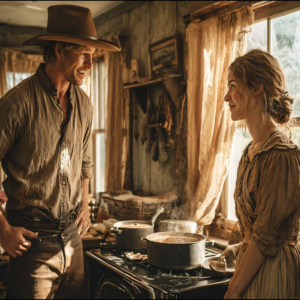
The dust rose in lazy spirals behind the stage coach as it rolled to a stop in front of Willow Creek’s general store. Margaret Sullivan clutched her worn carpet bag tighter, peering through the grimy window at the small frontier town that might or might not become her salvation.
At 43, with streaks of silver threading through her dark hair and lines etched by grief around her green eyes, she was far from the typical settler heading west. The driver’s gruff voice cut through her thoughts. End of the line, ma’am. Willow Creek. Margaret gathered her meager belongings, two carpet bags containing everything she owned in this world, and stepped down from the coach.
The red dust immediately coated her black traveling dress, the same one she’d worn to her husband’s funeral 8 months ago in Philadelphia. She’d sold everything else to afford the journey west, chasing a desperate hope sparked by a small advertisement torn from a newspaper. The town stretched before her in a single ruted street lined with weathered buildings.
The Merkantile, a saloon called the Lucky Strike, a boarding house that had seen better days, and various other establishments huddled together as if seeking protection from the vast emptiness beyond. Mountains loomed in the distance, their peaks already touched with early autumn snow. Though down here in the valley, the October sun still held warmth.
Margaret stood there, suddenly aware of how out of place she appeared. Her eastern clothing, though practical, marked her as clearly as a brand. Several men lounging outside the saloon stared openly, their expressions ranging from curiosity to suspicion. A woman alone in a frontier town was unusual enough.
A middle-aged widow with refined manners and soft hands was practically unheard of. She straightened her shoulders and walked toward the general store, her boots clicking on the wooden boardwalk. The advertisement, carefully folded in her reticule, seemed to burn against her palm. She’d read it so many times during the long journey that she knew every word by heart.
Circle M Ranch seeks cook room and board provided inquire at Morrison’s general store, Willow Creek. A bell jangled as she pushed open the door. The store’s interior was dim and cluttered, shelves packed with everything from flower sacks to ammunition. Behind the counter stood a thin man with spectacles perched on his nose, sorting through a ledger.
“Help you, ma’am?” His voice held the cautious tone reserved for strangers. “I’m inquiring about the position at the Circle M Ranch,” Margaret said, producing the advertisement. “The cook position?” The storekeeper Morrison, she presumed, looked up sharply. His gaze traveled from her neat bonnet to her city shoes, and his frown deepened.
“That advertisement’s been up for 2 months, ma’am. Ranch is 20 m out, rough country. Not exactly suitable for He gestured vaguely at her appearance. I assure you, Mr. Morrison, I’m quite capable of cooking.” The lie came easier than expected. in Philadelphia. She’d had servants to manage such tasks, but desperation had a way of expanding one’s claimed abilities.
Morrison scratched his jaw. It’s not just the cooking, ma’am. The Circle M is, well, it’s a hard place. Jake Caldwell runs it with a crew of cowboys. No other women folk out there, no towns nearby, just prairie and cattle and men who haven’t seen civilization in months. I understand. Margaret kept her voice steady, though her heart hammered. I’m a widow, a Mr.
Morrison. I have no family back east, no means of support. I need this position. Something in her tone must have reached him because his expression softened slightly. Can you ride a horse? I can learn. Ever cooked over a wood stove, baked bread from scratch, butchered a chicken? I’m a quick study. Morrison sighed and set down his pen.
Ma’am, I’ll be plain with you. Jake Caldwell is a fair man, but he’s not known for patience. That ranch has broken stronger folks than you appear to be. The last three cooks quit within a month. One just up and walked off into the prairie rather than stay another day. Margaret felt her resolve waiver, but pushed the doubt aside.
Perhaps they lacked sufficient motivation. I assure you, Mr. Morrison, I have nowhere else to go. The truth of those words hung in the air between them. Morrison studied her for a long moment, then nodded slowly. I send supplies out to the Circlem every 2 weeks. Next wagon leaves tomorrow morning at dawn.
You can ride along if you’re certain. I’m certain. There’s a boarding house down the street. Mrs. Patterson runs it. Tell her I sent you. She’ll give you a room for the night. He paused. then added more gently. “You might want to purchase some more practical clothing, ma’am. What you’re wearing won’t last a week on a working ranch.
” Margaret glanced down at her traveling dress, already dusty and wrinkled. “Thank you for the advice.” She turned to examine the store’s selection of women’s clothing, pitifully small and clearly meant for frontier life. simple calico dresses, sturdy boots, practical bonnets. With the last of her money, she purchased two dresses, a pair of boots that looked as if they could withstand anything, and a wide-brimmed hat to replace her city bonnet.
As Morrison wrapped her purchases, he said quietly. “Ma’am, if you don’t mind my asking, what brings a lady like you to Willow Creek? You’ve got education in your voice, refinement in your manner. This isn’t the place for you. Margaret met his curious gaze steadily. My husband was a doctor in Philadelphia. When he died, I discovered he’d been living beyond our means for years.
Debts took everything. The house, the furnishings, even his medical practice. I have no children, and my family, well, they have their own troubles. This advertisement was the only position that offered room and board along with wages. I’m sorry for your loss, Morrison said, and seemed to mean it.
But ranch cooking is hard work, dawned to past dark every day. Those cowboys eat like wolves and complain like children if something isn’t to their liking. Mr. Morrison, Margaret said with a slight smile. I have spent the last 20 years managing a household, navigating Philadelphia society, and maintaining appearances on an increasingly limited budget.
I believe I can manage a group of hungry cowboys. He chuckled despite himself. Well, ma’am, you’ve got spirit. I’ll give you that. Jake Caldwell might appreciate that, or it might rub him wrong. Hard to say with Jake. Margaret gathered her packages. What can you tell me about Mr. Caldwell? Morrison’s expression grew thoughtful.
Been running the Circle M for about 10 years now. Came out here from Texas. I heard though he doesn’t talk about his past. Keeps to himself mostly, fair with his men, pays honest wages, but expects hard work in return. Never married, far as anyone knows. Some say he’s got no use for women.
Others say he just hasn’t found one tough enough for ranch life. I see. Margaret tucked this information away. Thank you, Mr. Morrison. I’ll be here at dawn. She left the store and made her way to the boarding house, passing more curious stairs and whispered comments. The boarding house proved to be a two-story building that might have been white once, but had faded to a dusty gray. Mrs.
Patterson, a bird-like woman with sharp eyes, looked Margaret up and down before showing her to a small clean room. Heard you’re heading out to the Circle M. Mrs. Patterson said, lingering in the doorway. Brave or foolish? I can’t decide which. Perhaps a bit of both, Margaret admitted, setting down her bags.
You ever meet Jake Caldwell? Not yet, Mrs. Patterson snorted. Well, don’t expect much in the way of conversation. Man’s as tight-lipped as they come. Handsome enough if you like the weathered type, but cold as a mountain winter. Treats his men fair, though. Never heard of him raising a hand to anyone. Didn’t deserve it. After Mrs.
Patterson left, Margaret sat on the narrow bed and finally allowed herself to feel the full weight of her situation. The room was sparse but clean with a wash stand, a small mirror, and hooks on the wall for clothing. Through the window, she could see the vast prairie stretching endlessly under the afternoon sun. She pulled out the advertisement once more, smoothing its creases.
Such a small thing to have brought her so far from everything she’d known. But what choice did she have? The alternative was accepting charity from disapproving relatives or finding work in a factory, if they’d even hire a woman her age with no experience. No, this was her chance. Perhaps her only chance. That night, she lay awake listening to the unfamiliar sounds of the frontier town.
Piano music and rough laughter from the saloon. horses snorting in the street, the distant howl of what might have been a coyote. Tomorrow she would leave even this small outpost of civilization behind for a ranch 20 m into the wilderness to cook for a man nobody seemed to truly know and cowboys who hadn’t seen a woman in months.
Margaret Sullivan, who had once presided over elegant dinner parties and worn silk gowns to the Philadelphia Opera House, closed her eyes and tried not to think about what she’d gotten herself into. Instead, she focused on the one thing that mattered: survival. She would learn to cook. She would learn to manage a ranch kitchen.
She would do whatever it took to earn her keep and perhaps eventually find some measure of peace in this vast, wild land. The advertisement crinkled in her hand as she finally drifted off to sleep, still clutching that fragile promise of a new beginning. The supply wagon jolted over another rut, and Margaret gripped the wooden seat to keep from sliding off.
Old Pete, the driver Morrison had hired, hadn’t spoken more than 10 words since they’d left Willow Creek at dawn. The landscape had gradually transformed from the relative civilization near town to an endless sea of golden prairie grass, broken only by occasional stands of cottonwoods along dried creek beds. “That’s the circlem boundary,” Pete finally said, pointing to a wooden gate with the ranch’s brand burned into the crossbeam.
“Another 3 mi to the main house.” Margaret’s stomach tightened. She’d spent the long ride rehearsing what she would say, how she would present herself as capable and confident. But as the ranch buildings came into view, her carefully prepared words scattered like dust in the wind. The Circle M sprawled across a natural bowl in the prairie, sheltered by low hills.
The main house was built of logs and rough huneed planks, solid and unadorned. To one side stood a large barn and several corrals where horses milled about, a bunk house, smokehouse, and various outbuildings completed the picture. It was larger than she’d expected, more established, but there was a loneliness to it. No flowers, no curtains in the windows, no feminine touches to soften the harsh utility of the place.
Pete pulled up in front of the main house. Wait here, he said, climbing down with surprising agility for his age. I’ll fetch Jake. Margaret remained on the wagon seat, acutely aware of how she must look, dust covered despite her efforts to stay clean, wearing her new calico dress that still felt strange against her skin. Her hands soft and white where they clutched her carpet bag.
Through the kitchen window, she glimpsed a stove that looked like a black iron monster, nothing like the modern range she’d had in Philadelphia. The front door opened, and Margaret’s breath caught. Jake Caldwell was not what she’d expected. She’d imagined someone older, rougher, perhaps gone to seed from hard living. Instead, the man who emerged appeared to be in his late 30s, tall and lean, with the kind of strength that came from hard work rather than conscious exercise.
His face was weathered to a permanent tan, with lines around steel gray eyes that suggested he squinted into the sun more often than he smiled. Dark hair, a shade too long, showed threads of premature silver at the temples. He wore plain work clothes, denim pants, a blue cotton shirt, leather vest, but carried himself with an unconscious authority that would have been recognized in any Philadelphia drawing room.
He stopped at the bottom of the porch steps, thumbs hooked in his belt, and studied her with those penetrating gray eyes, the silence stretched uncomfortably. “Mrs. Sullivan,” Pete said, clearly feeling the need to fill the void. Come about the cook position. Jake’s gaze never left Margaret’s face. When he finally spoke, his voice was deep and measured with a slight Texas draw.
You ever cook for 15 hungry men? Mrs. Sullivan. No, Mr. Caldwell, but I’m willing to learn. This isn’t a schoolhouse. I need someone who can do the job, not someone who might learn to do it eventually. Margaret lifted her chin. Then why has the position been vacant for 2 months? Something flickered in his eyes. Surprise, perhaps, or approval.
Because most folks are smart enough to know better. Ranch cooking means up at 4:00. Breakfast on the table by 5. Lunch packed for the men who will be out on the range. Dinner ready when they return. It means baking bread, preserving meat, maintaining supplies, and doing it all on a wood stove that has moods like a fractious horse.
I understand. Do you? He stepped closer to the wagon and Margaret caught the scent of leather, horse, and open sky. Can you lift a full pot of stew, haul water from the well, kill and pluck a chicken because there’s no one here to do it for you. Margaret met his gaze steadily. Mr. Caldwell, 3 months ago, I buried my husband and discovered I was penniless.
2 months ago, I sold everything I owned to pay debts that weren’t even mine. One month ago, I slept in a railway station because I couldn’t afford lodging. I have learned, sir, that necessity is an excellent teacher. The words came out sharper than she’d intended, driven by desperation and pride.
Jake studied her for another long moment, then turned to Pete. Bring her bags to the kitchen. Does that mean, Margaret began it means you get a week to prove you can handle it? If you can’t, Pete will take you back to town when he brings the next supplies. He started back toward the house. Then paused. One more thing, Mrs. Sullivan.
The men who work here are good men, but they’re cowboys. They curse. They smell like horses, and they haven’t seen a woman in months. You’ll eat in the kitchen. Keep to the house after dark and maintain appropriate distance. Clear. Perfectly clear. Good. He was almost to the door when he turned back once more.
You said you were willing to learn. Are you also willing to laugh? The question caught her off guard. I beg your pardon. This is a hard life, Mrs. Sullivan. The work breaks backs, and the loneliness breaks spirits. The last cook spent every meal looking like she was attending a funeral. It affected the men, made everything heavier than it needed to be.
His expression remained serious, but there was something almost wistful in his voice. So, I’ll ask again. Can you cook with laughter? Can you bring something besides food to that kitchen? Margaret thought of the elegant dinner parties she’d hosted. The way she’d kept conversation flowing and guests smiling even when the roast was overdone or the wine ran low.
Mr. Caldwell. I once kept 20 Philadelphia Society matrons entertained for 3 hours when my cook quit without notice and I had to prepare the meal myself. If I could manage that, I believe I can handle cowboys. This time she was certain she saw approval in his eyes. The kitchen’s through here. I’ll show you the quarters and explain the routine. Dinner’s at 6 sharp.
That gives you He pulled out a pocket watch. Four hours to figure out that stove and feed 15 men. Still want the job? Margaret climbed down from the wagon, grateful her new boots gave her steady footing. Lead the way, Mr. Caldwell. The kitchen was large but primitive by her standards. The massive cast iron stove dominated one wall with a wood box beside it that was nearly empty.
A long wooden table occupied the center of the room, scarred from years of use. Open shelves held dishes, pots, and supplies. A pantry door stood a jar, revealing sacks of flour, beans, and other staples. Everything was clean, but utilitarian without a single touch of warmth or personality. Your room’s through there, Jake indicated a door off the kitchen.
It’s small but private. You’ll find water in the barrel by the stove. We haul it from the well each morning. Firewoods out back. The root sellers behind the house. Smokehouse is the small building to the left. We butcher our own beef. Cure our own bacon. There’s a kitchen garden, but it’s gone to weed since he trailed off.
Since the last cook left. Since before that. He moved to the stove. Checking the firebox. This beast takes some getting used to. Too much wood and she’ll burn everything. Too little and nothing cooks through. The dampers are temperamental and the oven runs hot on the right side. Margaret approached the stove cautiously, as if it might bite.
Any other peculiarities I should know about? The men like their coffee strong enough to float a horseshoe. Breakfast is always biscuits, bacon or salt pork, eggs when we have them, and gravy. Lunch for the range riders is usually cold biscuits, dried beef, and whatever else travels well. Dinner’s the big meal.
Meat, potatoes, vegetables if we have them, pie if you can manage it. Pie? Margaret’s voice might have squeaked slightly. The men work hard. Mrs. Sullivan, good food’s one of the few pleasures out here. He moved toward the door, then paused. “One week, if you’re still here after that, we’ll discuss wages and permanent arrangements.” “Mr.
Caldwell,” Margaret called as he reached the door. You asked if I could cook with laughter. “May I ask why that matters to you?” He stood silhouetted in the doorway, his face unreadable against the bright afternoon light. “Because I’ve lived 10 years in a house that forgot how to smile.” Mrs. Sullivan.
Sometimes a man gets tired of the silence. Then he was gone, leaving Margaret alone in the kitchen that would either become her salvation or her defeat. She set down her carpet bag and surveyed her new domain more carefully. 4 hours to produce dinner for 15 men. She’d hosted larger dinner parties. She reminded herself.
Of course, she’d had a cook, two kitchen maids, and a butler to help serve. She found an apron hanging on a peg and tied it around her waist. First things first, she needed to get that stove going. The matches were where she’d expect them to be, and after several attempts and some inappropriate language that would have shocked her Philadelphia friends.
She managed to get a fire started. The pantry inventory revealed plenty of basics. Flour, lard, salt, dried beans, potatoes, onions, and what looked like a quarter of beef hanging in the cold corner. She could make a stew, she decided. How hard could it be? Meat, vegetables, water, seasonings. Simple. 3 hours later, Margaret stood before the stove, fighting back tears of frustration.
The stew pot was too heavy for her to lift when full. She’d had to ladle water into it one cup at a time. The vegetables were unevenly chopped because the knives were dulled and her hands were already developing blisters. The fire kept dying down, then roaring back to life when she added wood, making the pots contents alternate between barely simmering and boiling over.
“You look like you’re wrestling a bear.” Margaret spun around to find a young cowboy standing in the doorway. hat in hand. He couldn’t have been more than 20 with sandy hair and a friendly freckled face. I’m sorry. I didn’t mean to startle you, ma’am. I’m Tom Bradley. Jake sent me to see if you needed firewood brought in.
Yes, please, Margaret said, then added impulsively. Tom, have you eaten many stews prepared by the previous cooks? Yes, ma’am. What made them good? Tom grinned. Well, ma’am, mostly that they were hot and there was plenty. Cowboys aren’t too particular after a long day, though. Jake’s got more refined tastes than the rest of us.
Comes from being raised proper, I expect. Mister Caldwell was raised properly. Margaret tried to keep her tone casual as she stirred the pot. So, they say herie came from a good family back in Texas. Maybe even went to one of those fancy colleges. But something happened. Nobody knows what. And he ended up out here. Tom started stacking wood by the stove.
He’s a fair boss, though. Expects hard work, but pays honest wages. Just don’t cross him. He’s got a temper when riled, though it takes a lot to rile him. Margaret filed this information away. A man of education who’d chosen or been forced into this isolated life. It explained the precise way he spoke, the air of authority that went beyond mere ranch ownership.
By the time the dinner bell rang, an actual bell mounted on a post outside the kitchen door, Margaret had managed to produce a pot of stew that looked edible, a batch of biscuits that were only slightly burned on the bottom, and coffee that could indeed float a horseshoe. She stood nervously as the cowboys filed in, each nodding politely and mumbling, “Ma’am,” as they took their seats.
Jake entered last, taking the chair at the head of the table. His eyes surveyed the simple meal, then rose to meet hers. “Gentlemen,” he said, “this is Mrs. Sullivan, our new cook. Mind your manners.” The meal passed in relative quiet, punctuated by the clink of spoons against bowls and requests to pass the biscuits.
Margaret watched anxiously as the men ate. No one complained, but no one complimented either. She noticed Jake ate more slowly than the others, as if evaluating each bite. When the last man pushed back from the table, Jake stood, “Mrs. Sullivan, a word.” She followed him onto the back porch where the setting sun painted the prairie gold and crimson.
Her hands twisted in her apron as she waited for his verdict. The stew was underseasoned, the biscuits were heavy, and the coffee could strip paint, he said bluntly. Then unexpectedly, one corner of his mouth quirked upward. “But you kept trying even when that stove was getting the better of you.
And you asked Tom for advice instead of pretending you knew everything. That shows sense. Does that mean I can stay? It means you get your week like I promised.” He looked out over the prairie, his profile sharp against the dying light. Can you read and write, Mrs. Sullivan? Of course. Good. The ranch accounts need keeping, and my penmanship’s terrible.
If you can manage the books along with the cooking, I’ll add extra to your wages. He turned back to her. But remember what I said about laughter. A good meal fills the stomach. A cheerful kitchen fills something else. something harder to name but just as important. As he walked away, Margaret called after him, “Mister Caldwell, what made you leave Texas?” He paused, but didn’t turn around.
“Same thing that brought you here. I expect sometimes a person needs to go where the past can’t follow.” Standing there in the gathering darkness, covered in flower and smelling of wood smoke, Margaret suddenly understood that this weathered tacitern man might be running from ghosts of his own. And perhaps that’s what the Circlem really was.
Not just a cattle ranch on the edge of nowhere, but a refuge for souls who’d lost their way and were trying to find it again. One day at a time, she returned to the kitchen to face the mountain of dishes, her back aching and her hands raw. But for the first time in months, she felt something besides despair. It might have been hope, or it might have simply been exhaustion.
Either way, she’d survived her first meal. Only 6 days and 18 meals to go. The second morning dawned with disaster. Margaret woke to the acrid smell of smoke and bolted from her small room to find the biscuits she’d set to bake had turned into charcoal bricks. The coffee pot had boiled over, dousing half the fire and filling the kitchen with wet ash and grounds.
In her panic to salvage something, she knocked over the milk pale, sending yesterday’s precious collection across the floor. “Lord have mercy,” she muttered, then louder. “Damn this infernal stove language, Mrs. Sullivan. She whirled to find Jake standing in the doorway, already dressed for the day’s work. Heat flooded her cheeks, whether from embarrassment or the still smoking oven.
She couldn’t say, “I apologize, Mr. Caldwell.” I set the dampers wrong and then everything just she gestured helplessly at the chaos. “The men will be here in 20 minutes,” he said, surveying the damage with those unreadable gray eyes. Margaret wanted to sink through the floor. 2 days and she was already failing. I understand.
If you want to send me back with Pete, I’ll gather my things. Did I say that? He rolled up his sleeves and moved to the stove. Watch and learn. First, bank the coals like this when you’re baking. The dampers need to be barely open, not wide. Second, always set something on the counter to remind you what’s in the oven.
A spoon, a cup, anything to catch your eye. His hands were sure and practiced as he adjusted the stove. Now, for salvaging breakfast, the men need to eat. Burned biscuits or no. You’ve got flour? Yes, but there’s no time for new biscuits. Pancakes, he said, already reaching for a bowl. Faster than biscuits and more forgiving. You mix while I get this fire sorted.
They worked side by side in surprising harmony. Jake handled the temperamental stove while Margaret mixed batter, sliced salt pork, and started fresh coffee. “When Tom Bradley appeared with the morning’s eggs?” Jake set him to cooking them in a massive skillet. “Since when do you know your way around a kitchen?” Tom asked, grinning at his boss.
Since I spent 3 months cooking for myself and the crew and we couldn’t keep help, Jake replied curtly. Sometimes a man learned skills he’d rather not need. The cowboys filed in to find a breakfast of pancakes, eggs, and salt pork waiting. If they noticed their boss wiping flour from his hands, they were wise enough not to comment. Margaret watched Jake take his usual seat, his expression giving away nothing of the morning’s chaos.
After the men left, Margaret faced the mountain of dishes with a heavy heart. Her beautiful hands, which had once played chopan on a rosewood piano, were already red and chapped from lie soap. Her back screamed from bending over the low sink. She’d been so confident yesterday, and now giving up already? She turned to find Jake had returned, carrying something wrapped in cloth.
I’m not giving up,” she said with more conviction than she felt. “I’m simply reconsidering my capabilities.” “Good. Doubt keeps us humble.” He set the bundle on the table and unwrapped it, revealing a worn cookbook. This belonged to my mother. She used it when she was first married before she had help. The recipes are simple but good.
Margaret picked up the book reverently. The pages were stained and notes filled the margins in a feminine hand. Texas receipts for the frontier wife read the cover. Your mother lived on a ranch. My parents had a small spread outside San Antonio. Nothing like this. They were what you’d call respectable folk. My mother was raised in New Orleans, came to Texas as a bride.
She used to say the stove nearly defeated her those first months. A distant look crossed his face. But she learned, even came to love it in time. What happened to them? Margaret asked softly. Jake’s expression shuddered. Comanche raided when I was away at college. I came back to ashes and graves. He cleared his throat. The book’s yours to use.
Mind you, take care of it. He was gone before Margaret could respond, leaving her holding the precious cookbook and understanding a bit more about the shadows in Jake Caldwell’s eyes. The morning flew by as she studied the book. The recipes were indeed simple with helpful notes. If the dough seems dry, add sweet milk one spoon at a time. This burns easy.
Watch close. Jake’s favorite extra cinnamon. That last note in fading ink made her pause. Jake’s favorite written by a mother who’d never seen her son grow to full manhood. By noon, she’d managed to pack lunches for the Range Riders. cold biscuits, properly baked this time, dried beef and dried apple slices she’d found in the pantry.
The kitchen was clean, and she’d even started bread dough rising for dinner. She was elbowed deep in flour, kneading the second batch when she heard commotion outside. Through the window, she saw several cowboys gathered around someone on the ground. Her heart lurched as she recognized Tom Bradley’s sandy hair. He was the one down. clutching his arm.
Without thinking, Margaret ran outside. What happened? Horse spooked and threw him. One of the men explained. Think his arms broke. Bring him to the kitchen, she ordered with an authority born of years as a doctor’s wife. Carefully now. They carried Tom in and set him on the bench by the table.
His face was pale, sweat beating on his forehead. Margaret gently examined his arm, feeling the unnatural angle of the bone. It’s broken, but cleanly, she announced. I can set it, but I’ll need help. You know how? Tom asked through gritted teeth. My husband was a physician. I’ve assisted him many times. She turned to the other men.
I need straight boards for splints, clean cloth for bandages, and someone to hold him steady. Jake appeared in the doorway, took in the scene with a glance, and began issuing orders. Within minutes, Margaret had everything she needed. Jake positioned himself behind Tom, holding the young man’s shoulders.
“This will hurt,” Margaret warned. “But it’ll hurt worse if we leave it.” “Just do it, ma’am,” Tom managed. Margaret felt along the break once more. Then, with a quick, sure movement, pulled and aligned the bones. Tom’s yell could probably be heard in the next county, but the arm was straight.
She splined it carefully, wrapping it with torn strips of clean petticoat, the last of her Philadelphia finery put to practical use. There, she said, tying off the bandage. Keep it still for 6 weeks. I’ll make a sling. Thank you, ma’am, Tom said weekly. Thought I’d have to ride all the way to town. You’d have been lucky to make it halfway, Jake said.
He looked at Margaret with something like respect. Where did Philadelphia lady learn to set bones? When you’re married to a doctor who drinks, Mr. Caldwell, you learn to handle things when his hands aren’t steady enough. The admission slipped out before she could stop it. Silence fell over the kitchen. Margaret busied herself making a sling from a dish towel, her cheeks burning.
She’d never spoken of Charles’s weakness to anyone. “Well,” Jake said finally. “We’re grateful for the skill. Whatever brought it, the men filed out, supporting Tom between them.” Jake lingered, watching as Margaret returned to her bread dough with shaking hands. “Your husband,” he said quietly. “Is that what broke you? The drinking?” Margaret’s hand stilled.
No, I could forgive the drinking. It was a weakness, but he was a good man despite it. What broke me was discovering he’d been hiding our debts for years, borrowing against future earnings, selling my jewelry, and replacing it with paste. He didn’t want me to worry, he said in his final letter. She laughed bitterly. Instead, he left me to face the creditors alone. He killed himself.
ldinum overdose, possibly accidental. He’d been taking it for pain. I choose to believe it was. She resumed kneading with perhaps more force than necessary. And now you know why a refined Philadelphia widow is burning biscuits in a Texas ranch kitchen. We all have our reasons for being here. Jake said, “Tom will heal clean thanks to you.
That matters more than perfect biscuits.” He started to leave, then turned back. There’s apple pie in my mother’s book, page 47. The men haven’t had pie in months. Might make them forget this morning’s breakfast disaster. A challenge and a kindness wrapped in one. Margaret found herself almost smiling. Assuming I can manage the oven temperature. You’ll manage.
You’ve got stubborn written all over you. After he left, Margaret attacked the bread with renewed energy. She would make this work. Not just because she had nowhere else to go, but because somewhere between burned biscuits and broken bones, she’d begun to feel something she hadn’t experienced in months. Useful. The apple pie turned out lopsided, but edible.
She’d forgotten to add sugar at first, remembered just in time, and probably added too much in compensation. The crust was thick in some places, thin in others. But when she set it on the table after dinner, a successful meal of beef stew, properly seasoned this time. Fresh bread and boiled carrots. The cowboy’s faces lit up like children at Christmas. Pie, someone exclaimed.
Hot damn. Excuse me, ma’am. Hot dog. We got pie. Even Jake’s stoic expression cracked slightly as he took a bite. Not bad, Mrs. Sullivan. Not bad at all. It’s too sweet, she said critically. It’s pie, Tom said from his place at the table. Eating left-handed. Could be made of sawdust and we’d still love it. The men laughed, and suddenly the kitchen felt warmer, more alive.
Margaret found herself smiling as she served seconds to eager cowboys, who complimented her with their enthusiasm more than any Philadelphia Society matron ever had with polite words. Save room for tomorrow, she warned. I’m attempting donuts if I can figure out the oil temperature. Donuts? A cowboy named Bill looked ready to weep with joy.
Ma’am, if you make donuts, I’ll marry you myself. Get in line, another said, and the table erupted in good-natured ribbing. Enough, Jake said. But Margaret caught the slight upturn of his mouth. Mrs. Sullivan isn’t here for your entertainment. As the men filed out, each thanking her more profusely than the last, Margaret felt a warmth that had nothing to do with the stove.
She’d fed them, tended their hurt, made them smile. It was harder work than she’d ever done, but somehow more satisfying, too. Jake was the last to leave. He paused at the door, looking back at her, standing amid the dinner debris, apron stained and hair escaping its pins. My mother used to say a kitchen without laughter was just a room with a stove, he said quietly.
Tonight felt like a kitchen again. Then he was gone, leaving Margaret to wonder at the lonely man who’d hired her to season his life with more than salt and pepper. She thought of the cookbook upstairs, filled with a mother’s love and notes for a son she’d lost too soon. Tomorrow she’d try the doughnut recipe, and maybe the day after that, the cinnamon rolls marked as Jake’s favorite.
For now, though, she had dishes to wash and bread to set for morning. But she hummed while she worked, an old hymn her grandmother used to sing, and didn’t notice the figure standing outside the window, listening to the almost forgotten sound of music in his kitchen, before he finally turned and walked back to his empty house under the vast Texas stars.
The weeks folded into each other like bread dough needed smooth. October gave way to November, and the kitchen that had once seemed foreign now moved to Margaret’s rhythm. She rose before dawn without the need for the rooers’s crow, her hands finding matches and kindling in the dark. The temperamental stove had become, if not a friend, at least a predictable adversary whose moods she could anticipate.
Small changes crept in gradually. Checkered curtains appeared at the window, sewn from a worn tablecloth she’d found in the storage room. A jar of late wild flowers sat on the table, gathered during her rare walks to the well. She’d discovered mint growing wild behind the smokehouse, and dried bunches of it hung from the rafters, filling the air with green freshness.
Smells like my grandmother’s kitchen, Tom Bradley said one morning, his arm still in its sling, but healing well. He’d taken to arriving early, sitting at the table while Margaret worked, keeping her company with easy chatter about ranch life. “Did she cook on a ranch, too?” Margaret asked, sliding a pan of biscuits into the oven.
Perfectly golden now, light as air. “No, ma’am. She had a little house in Missouri. But she grew herbs everywhere. Said a kitchen without growing things was like a church without hymns.” Margaret smiled, crimping the edges of a pie crust. She’d mastered Jake’s mother’s apple pie recipe and moved on to experimenting with dried berry fillings.
Your grandmother sounds wise. She was used to say you could tell everything about a house by its kitchen, whether folks were happy or just getting by. Tom accepted the cup of coffee she handed him. This place feels happy now. The observation warmed Margaret more than the stove’s heat. She’d noticed it, too.
How the cowboys lingered after meals now, talking and laughing instead of wolfing down food and escaping. How they’d started bringing her little gifts. A particularly nice chicken for the pot. Wild honey from a tree they’d found. A handful of pecans gathered on the range. Mrs. Sullivan, Tom said, suddenly serious. Can I ask you something? Of course.
What do you know about Jake’s past? I mean before the circle em Margaret paused in her work. Over the weeks she’d gleaned fragments, an educated accent that slipped through when he was tired, the way he handled the account books with easy familiarity. His knowledge of things no simple rancher would know. But Jake Caldwell guarded his secrets as carefully as she’d once guarded her husband’s reputation.
Only what he’s chosen to share, she said carefully. Why, do you ask? It’s just sometimes I catch him looking at you when you’re singing while you work or when you’re laughing with the men like he’s seeing a ghost, but not a bad one. A good memory he’d forgotten he had. Before Margaret could respond, the man himself appeared in the doorway.
Tom, if that arm’s well enough for gossip, it’s well enough for light work. The horses need tending. Tom scrambled up, flushing. Yes, sir. Sorry, sir. After he left, Jake remained, filling the door frame in that way he had of making the kitchen seem smaller. The boy talks too much. He’s young.
The young always talk too much. Margaret focused on rolling out pi dough, aware of his gaze, though sometimes talking helps. Keeps the silence from getting too heavy. Is that what you think? That it’s too quiet here? She looked up then, meeting those gray eyes. I think a man who asks for laughter with his meals might be tired of silence. Yes.
He moved into the kitchen, going to the stove to pour himself coffee. It was a new habit, these morning visits before the crew arrived. He never stayed long, but Margaret had come to treasure these moments of almost companionship. “My wife loved to sing while she cooked,” he said suddenly, staring into his cup.
Sarah. She’d been gone 2 years before I came here, but sometimes I still hear her voice in the wind. Margaret’s hand stilled. Wife. He’d had a wife. What happened to her? Kalera took her and our daughter both while I was away on business. His voice was flat. Matter of fact, his knuckles were white around the cup.
I was in Austin negotiating cattle prices. Thought I was building something important. came home to two graves in a house that echoed, “Jake.” Margaret began, but he shook his head. “It’s history now, but Tom’s right. You’ve brought something back to this place. Something I thought was gone for good.” He set down his cup and moved toward the door. Then paused.
“There’s going to be a dance in town next Saturday. The harvest dance. The men are all going.” How nice for them, Margaret said, returning to her pie. She’d heard the cowboys talking about it, their excitement palpable. You could come. The invitation hung in the air between them. Margaret’s heart did an unexpected flutter. Mr.
Caldwell, that would hardly be appropriate. I’m your employee. And And you haven’t left this ranch in 6 weeks. You need supplies from town anyway, don’t you? fabric for new curtains, perhaps some proper dishes since you’re always complaining about the tin plates. She looked at him in surprise. She had mentioned those things, but only in passing.
Usually to Tom or the other cowboys. She hadn’t realized Jake paid attention to her casual comments. I Yes, supplies would be helpful. Then it’s settled. We’ll leave at noon on Saturday. You can shop while the men get cleaned up. Then he paused, seeming to search for words. Then if you happen to stop by the dance hall and if I happen to be there and if the musicians happen to play something worth dancing to.
Despite herself, Margaret smiled. That’s quite a lot of happen stance, Mister Caldwell. Jake, he said quietly. In the evenings when it’s just conversation, call me Jake. He left before she could respond. But Margaret found herself humming as she finished the pies. A dance. She hadn’t danced since before Charles died.
Her good dress was long gone, sold to pay for travel. But perhaps she could do something with one of her calico dresses. That evening, after the supper dishes were done, Margaret heard a soft knock on her door. She opened it to find Jake holding a package wrapped in brown paper. This was my mother’s,” he said without preamble.
“It’s been in a trunk for years. Might need altering, but he thrust the package at her and stroed away before she could even thank him.” Inside, Margaret found a dress of deep blue wool. Simple, but beautifully made. The kind of dress a rancher’s wife would wear to church or to a dance. Nothing fancy by Philadelphia standards, but the fabric was quality, and the color would bring out her eyes.
She held it up to herself, noting it would need taking in at the waist and hemming, but otherwise she spent the next evenings altering the dress by lamplight, listening to the cowboys practice their harmonas and guitars on the bunk house porch. Jake had taken to sitting in the kitchen after dinner, working on his account books while she sewed.
They rarely spoke, but the companionship was comfortable, like an old married couple sharing the evening hours. You’re good with a needle, he observed on Thursday night. Another useless Philadelphia accomplishment that turned out to be useful after all, she replied, biting off a thread, along with piano playing, watercolors, and the ability to make small talk with boring people.
None of those sound useless to me. He looked up from his ledger. Especially the last one. You’ll need it if Mrs. Henderson corners you at the dance. That woman could talk the ears off a donkey. Margaret laughed. Duly warned. Any other social hazards I should know about? Well, there’s Samuel Morrison.
You’ve met him at the store. He’s sweet on the widow Patterson who runs the boarding house, but she pretends not to notice. Then there’s the usual collection of young cowboys who want to dance with anything in skirts. Oh, and avoid the punch. Charlie Benson always spikes it with rott gut whiskey when no one’s looking.
“You sound like you actually enjoy these events,” Margaret said, surprised. “I go because the men expected. A boss who won’t socialize with the community breeds resentment,” he paused. “But I usually leave early. Dancing alone gets old fast.” The words hung between them. An unspoken invitation, or perhaps just a statement of fact.
Margaret kept her eyes on her sewing. Well, if there happens to be dancing, and if partners happen to be scarce, more happen stance, Mrs. Sullivan. Margaret, she said softly. In the evenings, when it’s just conversation, et. Saturday dawned clear and crisp. Margaret packed her pies carefully in the wagon. She’d volunteered to contribute to the communal supper that preceded the dance.
Jake appeared in his best clothes, dark trousers, white shirt, black vest, and a coat that showed city tailoring despite its age. He looked, she thought with a flutter, quite distinguished. The ride to town passed quickly. Jake pointed out landmarks, told stories of the ranch’s early days, even laughed at her account of her first week’s disasters.
It was the most relaxed she’d ever seen him, as if leaving the ranch boundaries allowed him to leave some of his burdens behind in town. Margaret shopped with careful attention to her small savings. New plates would have to wait, but she bought fabric for proper curtains, some spices the general store had finally gotten in stock, and indulgence of indulgences, a small bottle of rosé water.
Jake had given her money for ranch supplies, but she kept careful track of every penny. The dance hall was already crowded when they arrived. Margaret’s pies disappeared quickly, earning her compliments from the ranchwives, who’d previously eyed her with suspicion. The widow from Philadelphia, who’d shown up to cook for Jake Caldwell, had been the subject of much speculation. She knew.
You’re doing a fine job out there, Mrs. Morrison said, her tone slightly warmer than their first meeting. The CircleM boys are looking wellfed for the first time in years. “Thank you,” Margaret said. “I had a good teacher,” she held up the cookbook Jake had loaned her. “Old recipes, but reliable.” “Is that Anna Caldwell’s book?” An older woman peered at it with interest.
I knew her years ago. Lovely woman. Terrible shame what happened. Before Margaret could ask more, the musicians struck up a lively reel. Cowboys descended on the gathered women like bees to flowers. Margaret found herself swept onto the floor by an enthusiastic young rancher who stepped on her feet more than the boards.
She endured two dances before begging off, retreating to the refreshment table. surviving the social world. She turned to find Jake beside her, amusement flickering in his eyes. He’d been dancing with Mrs. Henderson, who did indeed appear to have talked through the entire set. Barely, she admitted. I’d forgotten how exhausting it is to pretend your feet aren’t being murdered.
Here, he handed her a cup. Lemonade from the safe pitcher. They stood together, watching the dancers spin past. The musician switched to a slower waltz and Margaret felt Jake shift beside her. Would you? He cleared his throat. That is your feet have had time to recover. Are you asking me to dance, Jake? I’m suggesting that if you happen to be on the dance floor, and I happen to be there as well.
Enough happen stance, Margaret said, setting down her cup. Yes, I’d like to dance. He led her onto the floor with a hand at her elbow, then turned to face her. One hand settled properly at her waist. The other took hers. And suddenly Margaret understood why he’d been so careful with all his happen stances.
This was dangerous, not for propriety’s sake, but for the way her heart accelerated when he pulled her into the dance. Jake Caldwell could waltz, not the mechanical steps of a man who’d learned for duty’s sake, but with the natural grace of someone who’d once enjoyed it. He guided her through the turns effortlessly.
And Margaret found herself relaxing into the movement, trusting his lead. “You dance well for a cowboy,” she said softly. “You dance well for a cook,” he countered. Then more seriously, I haven’t walted since Sarah died. Didn’t think I remembered how. It’s like riding a horse. I suppose the body remembers even when the heart forgets.
His hand tightens slightly at her waist. Yes, exactly that. They danced two more waltzes, not speaking, just moving together while the town watched and whispered. Margaret knew there would be talk. The widow and the rancher dancing like they had the right, but wrapped in the warmth of Jake’s careful hold, she couldn’t bring herself to care.
The storm announced itself with a wall of black clouds that swallowed the horizon. Margaret stood at the kitchen window, watching the prairie grass bend flat under the advancing wind. She’d lived through eastern storms, but this this was something primeval, a force that made humanity seem small and temporary. It’s going to be a bad one, Tom said from the doorway, his newly healed arm still held carefully.
Jake’s got most of the men moving the cattle to the sheltered valley, but he didn’t need to finish. Margaret had learned enough about ranch life to understand. Cattle scattered in a storm like this could wander for miles, die in flash floods, or simply vanish into the vast landscape. And the men searching for them face the same dangers.
How many are still out?” she asked. “Eight, including Jake. Bill and Frank were riding the north pasture. That’s 15 mi out. They might not have seen the storm coming in time.” Margaret turned from the window, her mind already calculating. “How many staying here?” “Just me, old Pete and Charlie. He’s nursing a lame horse.
Everyone else is out.” Then we prepare. This kitchen stays warm and ready. Get Pete to help you fill every available container with water. If this storm’s as bad as it looks, the well might flood. Charlie can bring in extra firewood. I’ll start cooking. Tom grinned despite the worry in his eyes. Yes, ma’am. You sound like a general. I was a doctor’s wife.
Tom, I’ve managed through disasters before. As the men scattered to their tasks, Margaret attacked her own preparations with focused energy. She set beans to soak, mixed dough for multiple loaves of bread, and started a massive pot of stew that could feed 20 men if needed. Her hands moved automatically while her mind wandered to Jake somewhere out in that gathering darkness.
The storm hit just after 3:00. The first fat raindrops turned within minutes to a deluge that hammered the roof like rifle fire. Wind screamed around the corners of the house, finding every crack and crevice. The kitchen, usually Margaret’s warm sanctuary, felt suddenly fragile against nature’s assault.
“Mary, mother of God,” Pete muttered, peering out at the wall of water. “Ain’t seen a storm like this in 10 years. Last one took the old barn and half the herd.” “Margaret lit every lantern they had, creating a beacon of warmth and light. The stew simmerred, bread baked, and coffee stayed hot and ready.
She kept her hands busy to avoid thinking about men and horses struggling through mud and rising water, about the particular man who’d walted with her just a week ago and might now be. Riders coming, Charlie shouted from the porch. Four cowboys stumbled through the door, soaked to the skin and shivering. Margaret immediately handed out towels and hot coffee while they stripped off soden coats.
“Jake?” she asked, trying to keep her voice steady. “Still out?” One answered through chattering teeth. “He sent us back when the lightning started.” Said he and Hank would keep looking for Bill and Frank. Margaret’s heart clenched, but she kept her face calm. “Sit, eat. You need warmth and food.” The hours crawled by. The storm, if anything, intensified.
Water began seeping under the door despite their efforts to block it. The wind found a loose board somewhere and worried it like a dog with a bone. The banging adding to the cacophony. Two more groups of riders arrived, each time raising and dashing Margaret’s hopes. Each group told the same story.
Jake had sent them to safety while he continued searching. The man was stubborn as Granite and twice as hard-headed. she thought furiously, ladling out more stew. Nightfell, though it was hard to tell the difference in the storm’s darkness. Margaret had fed 13 men, some twice, and still maintained her vigil. The kitchen had become a refuge.
Men sleeping in shifts on the floor, others keeping watch at the windows. “He knows this land better than anyone,” Tom said quietly, appearing at her elbow. “He’ll find shelter.” “Of course he will,” Margaret replied. But her hands shook as she needed more bread. Her fourth batch. The action was automatic now.
Something to do while her mind painted terrible pictures. It was past midnight when Charlie’s shout brought everyone alert. Light. I see a light. Men crowded to the windows and door. Through the rain. A lantern bobbed like a will of the wisp. Then another. And another. Open the door. Someone yelled. They’re coming in.
The wind nearly tore the door from its hinges when they opened it. Four figures stumbled through Bill and Frank supported between Jake and Hank. All four were so covered in mud they looked like earth gollums come to life. Blankets, Jake ordered his voice. Hot water. Bill’s got a gash on his leg. Margaret flew into action.
Within minutes, she had the injured man on the table. His leg cleaned and examined. The cut was deep but clean. A branch or rock had caught him when his horse fell. She stitched it carefully while Jake held the lantern. His own exhaustion evident in the way he swayed. “You need to sit,” she told him firmly.
“Tom, get your boss some coffee before he falls over.” “I’m fine,” Jake protested. But he sank onto the bench when Tom pushed him down. Margaret finished with Bill, bandaging the wound tightly. Keep it clean and dry. You were lucky. No damage to the muscle. Lucky? Frank laughed shakily. Ma’am, we’d be dead if Jake hadn’t found us. Couldn’t see 5 ft in that rain.
We’d taken shelter under some rocks, but the water was rising. Would have drowned for sure. Enough talk, Margaret said briskly. But her eyes found Jake across the room. Everyone needs food and rest. The next hour was controlled chaos as she fed the exhausted men, distributed dry clothes from the rag bag, and tried to create sleeping spaces for everyone.
Through it all, she was aware of Jake watching her, a strange expression on his mud streaked face. Finally, when the last cowboy was settled, she approached him. He sat alone at the table, coffee growing cold in his hands. “You should rest,” she said softly. In a moment, he looked up at her. You did well tonight.
This kitchen, it was exactly what the men needed. A safe harbor. It’s just food and warmth. Jake, nothing special. No. His voice was firm. It’s more than that. Sarah used to do this. Turn the kitchen into the heart of things when trouble came. I’d forgotten how much it matters.
having someone who just handles things, who makes sure there’s light in the darkness. Margaret’s throat tightened. Anyone would have. No, he interrupted. They wouldn’t. The last three cooks hid in their rooms during storms. You turned this into a field hospital and refuge center without anyone asking. He stood swaying slightly. Thank you, Margaret.
The use of her given name here in the kitchen with his men sleeping all around felt dangerously intimate. “You should thank me by getting some rest before you fall over,” she said, trying for lightness. “Heroes who collapse from exhaustion are very inconvenient.” A smile ghosted across his face.
“I’m no hero, just a stubborn fool who couldn’t leave his men behind.” “Same thing in my book.” She steered him toward the door. Go sleep. I’ll keep watch and wake you if anything changes. He paused at the door, looking back. Margaret, at the dance, when we go to bed, Jake, she said gently. We can talk about dancing when you’re not dead on your feet.
After he left, Margaret surveyed her kingdom. The kitchen was a disaster. Muddy bootprints everywhere, dishes piled high, wet clothes dripping from every available surface. But it was warm and full of life with snoring cowboys and the smell of bread and coffee creating an oddly peaceful atmosphere despite the storm still raging outside.
She made herself a cup of tea and settled into the chair by the stove. Someone should keep the fire going. Make sure there was hot food when the men woke. It wasn’t heroic work, not like riding into a storm to save lost cowboys, but it was necessary work. And more than that, it was satisfying in a bone deep way she’d never experienced in her Philadelphia life.
The storm began to ease around dawn, its fury spent. Pale light crept through the windows, revealing a landscape transformed by water and wind. But the circle M had survived. all souls accounted for, and Margaret’s kitchen had played its part in that survival. Jake found her there as the sun broke through the clouds, still in her chair, but awake, fresh coffee already brewing.
“Did you sleep at all?” he asked. “Did you?” she counted. They looked at each other across the kitchen, the stern rancher and the Philadelphia widow, both exhausted, both exactly where they needed to be, and smiled. “I’ll make breakfast,” she said, rising. You wake the men and Jake, next time you decide to be heroic, try to do it before midnight.
These late nights are terrible for my complexion. His laugh, rusty from disuse, but genuine, followed her to the stove, and if her heart fluttered at the sound, well, that was probably just exhaustion. Nothing that a good breakfast and proper sleep wouldn’t cure. But as she mixed biscuit dough and listened to the ranch wake around her, Margaret knew she was lying to herself.
Something had shifted in the storm. Some barrier swept away by necessity and courage and the simple act of keeping faith through the dark hours. Jake had trusted her with his men, his home, his own exhaustion, and she’d proven worthy of that trust. The question now was what came next.
When the crisis passed and normal life resumed, could they go back to careful distance and proper boundaries? Did she even want to? The biscuits required her attention, and Margaret gratefully lost herself in the familiar routine. Whatever came next could wait for now. There were hungry men to feed and a new day to greet. In a life that had become uncertain, these simple truths were enough.
The days following the storm passed in a blur of recovery. Fences needed mending. Scattered cattle required gathering, and the damaged barn roof demanded immediate attention. Margaret barely saw Jake except at meals, where he ate quickly and spoke only of ranch business. But she felt his eyes on her sometimes, a weight of unspoken words that made her hands unsteady as she served.
It was Tom who finally voiced what everyone seemed to be thinking. “You two are dancing around each other worse than green colts,” he said. at one afternoon helping her peel potatoes. His arm had healed fully, but he still found excuses to visit the kitchen. “I don’t know what you mean,” Margaret said primly, though heat rose in her cheeks.
“Sure you don’t.” And Jake doesn’t spend half his time staring at the kitchen window when he thinks no one’s looking. Before Margaret could respond, they heard horses approaching fast, too fast for normal ranch business. Through the window, she saw Jake and Hank riding hard toward the house with something wrapped in blankets across Hank’s saddle.
“Get water boiling,” Jake shouted before they’d even reached the yard. “And clean cloths!” Margaret’s heart lurched. She’d heard that tone before in Charles’s voice when emergency cases arrived. By the time the men burst through the door, she had water heating and her makeshift medical supplies laid out.
They carried young Will Morrison, the storekeeper’s nephew, barely 16 and working his first season as a cowboy. His face was white as parchment, his breathing shallow and rapid. Blood soaked through the blanket around his middle, gored by a bull, Jake said tursily as they laid him on the table. “It’s bad, Margaret,” she peeled back the blanket and had to suppress a gasp.
The wound was deep, ragged, still bleeding freely in Philadelphia. Charles would have had proper instruments, chloroform, a sterile operating room. Here she had kitchen knives, whiskey, and desperate hope. I need more light, she said, her voice steadier than her hands. All the lanterns you can find. Tom, get my sewing basket.
The one with the silk thread. Hank, I need the whiskey from Jake’s office. The good bottle. Margaret, Jake said quietly. If it’s too much, it’s not too much. She met his eyes firmly. But I need everyone to do exactly as I say. This is beyond basic field medicine. For the next 2 hours, Margaret worked with focused intensity that would have impressed her late husband.
She cleaned the wound with whiskey, stitched internal damage with silk thread boiled in water, packed the area with clean cloth soaked in honey, an old remedy her grandmother had sworn by. Through it all, Jake stood at the boy’s head, holding him still, speaking in a low, calm voice when Will stirred toward consciousness.
You’re doing fine, son. Mrs. Sullivan’s got the best hands in Texas. You’ll be dancing at the Christmas social. Just wait and see. Margaret’s hands moved with remembered skill, making tiny, careful stitches. She was dimly aware of other cowboys gathering in the kitchen, of Tom keeping coffee hot, of the afternoon sun slanting through her cheerful curtains onto this desperate scene.
Finally, she tied off the last stitch and stepped back. Will’s breathing was stronger, his color marginally better, but she knew the real danger was still to come. Infection, fever, complications she couldn’t predict or prevent. He needs to stay absolutely still for at least a week. She told Jake, “The stitches could tear if he moves, and someone needs to watch him constantly.
If fever sets in, we’ll take shifts,” Jake said immediately. “Whatever he needs.” They moved Will carefully to Margaret’s own bed. It was closest to the kitchen and its warmth. She insisted, despite Jake’s protests. “I can sleep on the kitchen settle,” she said. “He needs the comfort more than I do.
” That night, sitting beside Will’s bed, monitoring his breathing and temperature, Margaret found herself speaking to Jake in the dim lamplight. He’d taken the first watch with her, refusing to leave. “You were remarkable today,” he said softly. “I have seen field surgeons with less skill. I was terrified.” She admitted in Philadelphia.
I only assisted. Charles made the decisions, held the responsibility. Today,” she gestured helplessly. “Today you saved a boy’s life. Maybe if infection doesn’t set in. If the stitches hold, if a dozen other things don’t go wrong.” She checked Will’s forehead again. Still cool. Thank God. I used to think Charles was weak for turning to Ldinum.
But carrying this weight, knowing someone’s life depends on your choices. I understand better now. Jake shifted in his chair, the lamplight casting shadows across his face. After Sarah died, I swore I’d never be responsible for another person’s life that way. Cattle, yes, ranch hands who knew the risks. Fine, but not. He paused.
Then you arrived. Margaret’s breath caught. Jake, let me finish, please. He leaned forward, elbows on his knees, not quite meeting her eyes. That first day, I told myself you were just another employee. Keep it business-like, distant, safe. But then you burned those biscuits and swore like a sailor.
And you set Tom’s arm without flinching. And you turned my kitchen into something alive again. It’s just cooking and basic medicine, Margaret said weekly. No, it’s hope. It’s caring whether these men have pie after dinner or flowers on the table or someone to stitch them up when they’re bleeding. He finally looked at her.
It’s making me remember why I wanted to build something here in the first place. Will stirred, mumbling something incoherent. Margaret quickly checked him. Still no fever, wounds still closed. When she settled back, Jake had composed himself again. The moment of raw honesty shuddered.
“You should rest,” she said gently. “I’ll wake you if anything changes. in a while. He pulled out a worn book. I’ll read for a bit. Sarah always said reading aloud helped the healing. He opened the book. Poetry, she realized with surprise, and began to read in his low, measured voice. Wordssworth, speaking of daffodils and clouds in the human heart.
Margaret found herself watching Jake’s face in the lamp light. Seeing the gentleness he kept so carefully hidden, the depth of feeling beneath the stern exterior. Three days passed in careful vigilance, Will’s fever rose the second night, sending them all into controlled panic. Margaret bathed him with cool water, spooned willow bark tea between his lips, and prayed harder than she had since Charles’s death.
Jake never left her side during those critical hours, fetching water, changing bandages, simply being present when she needed steadiness. When the fever broke near dawn, they both sagged with relief. Will opened clear eyes and whispered, “Ma’am, did I miss breakfast?” Margaret laughed through sudden tears.
Several of them, but I’ll make you the finest breakfast in Texas when you’re stronger. Later, standing on the porch in the cool morning air, she found herself swaying with exhaustion, Jake’s hands steadied her, and somehow she was leaning against his chest, feeling the solid warmth of him through his shirt.
“You did it,” he murmured into her hair. “You brought him through. We did it,” she corrected. “I couldn’t have managed without you,” she felt him smile. “We make a good team.” The words hung between them, waited with possibility. Margaret knew she should step away, return to proper distance. Instead, she let herself rest against him for one more moment, storing up the feeling for later examination.
“Margaret,” he said quietly, “when this is over, when Will’s recovered, we need to talk. Really talk about the future. about. He paused, seeming to search for words about whether you see this as just a job or if maybe it could be something more. Before she could respond, Tom’s voice called from inside. Mrs. Sullivan. Will’s asking for more of that tea.
The moment shattered. Margaret stepped back, smoothing her apron, not quite meeting Jake’s eyes. I should go, of course, but he caught her hand as she turned. Just think about it, please. She squeezed his fingers briefly. I’ve been thinking about it for weeks. Jake called well. Now, let me tend my patient.
His smile followed her back into the kitchen, warming her more than the stove. Will was indeed awake, weak, but lucid, complaining about the taste of willow bark tea with an energy that spoke of recovery. The other cowboys crowded around, careful not to jostle the bed, their relief palpable. “Did I really almost die?” Will asked, eyes wide.
“You had a close call,” Margaret said carefully. “But you’re going to be fine. Though you’ll have an impressive scar to show the girls.” “Really?” he brightened considerably. “Maybe I should get gored more often.” “Don’t you dare,” she said firmly, making everyone laugh. But even as she fussed over Will, brewing more tea and adjusting his bandages, her mind kept returning to Jake’s words.
Something more. The phrase terrified and thrilled her in equal measure. She’d come here seeking survival. Nothing more. To find the possibility of happiness, of home, of love. It seemed too much to hope for. Yet watching Jake joke gently with will, seeing how he managed his men with firm compassion, remembering the way he’d walted with her and read poetry in the lamplight, how could she not hope? That evening, as Will slept peacefully, and the ranch settled into quiet, Margaret stood at her kitchen window. The prairie
stretched endlessly under the stars, vast and wild and beautiful. Somewhere out there, Jake was checking the herds, doing the work that never ended, but he’d be back for dinner, would sit at the table and eat her cooking, and maybe, just maybe, they’d find the words for what was growing between them. She touched the window glass gently, her reflection wavering in the lamplight.
The Philadelphia widow was gone. She realized in her place stood a frontier woman, capable, strong, unafraid of hard work or hard choices. A woman who could save a life, run a kitchen, and maybe even love again. The transformation hadn’t happened in the storm, though that had crystallized it. It had been happening all along.
In small moments and daily choices, in laughter over burned biscuits and tears over wounded boys, this kitchen had remade her as surely as she’d remade it. Now she just had to find the courage to embrace what came next. Will Morrison’s recovery marked the passing of days toward December. The young cowboy, now able to sit up and complain about being confined to bed, had become a fixture in the kitchen as Margaret went about her daily work.
His uncle had visited from town, overwhelmed with gratitude, pressing payment on Margaret that she’d refused to accept. “You saved my nephew’s life,” Samuel Morrison had said, hat clutched in his hands. “There must be something I can do. Keep bringing those good supplies to the ranch.” Margaret had replied, “That’s payment enough.” Now, with Will finally strong enough to return to light duties, the kitchen felt strangely empty.
Margaret had grown accustomed to chattering at him while she cooked, to having someone appreciate her experiments with new recipes from Jake’s mother’s cookbook. The approaching end of her trial period weighed on her mind, 3 months since she’d arrived on that dusty October day. Desperate and uncertain, Jake had been oddly formal since their conversation during Will’s crisis.
He still came for coffee in the mornings, still worked on his ledgers while she sewed in the evenings. But there was a careful distance between them, as if he too was waiting for something. That morning, Margaret was needing bread when Jake appeared in the doorway, wearing his good jacket despite it being a working day. “Mrs.
Sullivan,” he said, and her heart sank at the formal address. “Could you spare a moment in the office?” She dusted flour from her hands, smoothing her apron nervously. This was it. Then the evaluation she’d both anticipated and dreaded. Following him down the short hallway to his office felt like walking to a trial. The office was purely Jake, functional, but with touches of refinement.
Books lined one wall, mostly agricultural journals, but with some literature mixed in. A painting of Hill Country hung behind his desk, and she wondered if it was a memory of his Texas home. Please sit, he said, gesturing to the chair across from his desk. He remained standing, pacing to the window that looked out over the corrals.
Your 3 months are up, he began without preamble. I believe it’s time we discussed your position here. Margaret’s hands clenched in her lap. If my work hasn’t been satisfactory, your work has been exemplary. He turned from the window, and she was surprised to see uncertainty in his eyes. The men have never been better fed or better cared for. The kitchen runs smoothly.
You’ve proven yourself capable of handling emergencies that would send most cooks running back to town. Then what? The question, Mrs. Sullivan Margaret, is whether you want to continue in your current position. She blinked. Of course I do. Unless you’re dismissing me. No. He moved to lean against the desk, closer to her, but still maintaining distance.
I’m asking if you want to remain as cook with wages increased to reflect your additional duties as ranch nurse and bookkeeper. Or the word hung between them. Margaret’s pulse quickened. Or Jake reached into his jacket and withdrew a small velvet box. Margaret’s breath caught as he opened it to reveal a simple gold band with a small sapphire.
Nothing ostentatious, but beautiful in its simplicity. Or you could consider a different position entirely, he said quietly. As my wife, the room seemed to spin slightly. Margaret gripped the chair arms, staring at the ring that caught the morning light. Jake, I know it’s sudden. I know you came here seeking employment, not this.
He set the box on the desk between them, then moved to crouch before her chair, bringing them to eye level. But these past months have shown me something I thought I’d never find again. You’ve brought life back to this place. Margaret, to me, I’m a widow, she said weakly. Older than you, set in my ways. You’re a woman who makes me remember why mornings are worth facing.
He interrupted gently. Who turns a house into a home without even trying? Who faces down charging bulls and temperamental stoves with equal courage? Despite everything, she laughed shakily. The stove was more frightening. Margaret, his hands covered hers where they gripped the chair. I’m not Charles. I won’t hide debts or protect you from hard truths. This life is difficult.
The ranch is successful, but it requires constant work. I can be moody and distant. I’ll never be a social man who enjoys town gatherings, but I can promise you partnership, respect, and if you’ll let me, love. Love? The word came out as barely a whisper. I’ve been fighting it for weeks. He admitted, telling myself it was too soon, too complicated.
But when Will was dying and you fought so hard to save him, when you looked at me with such trust during that storm, I realized I was being a fool. Life’s too short and too uncertain to waste chances at happiness. Margaret studied his face, weathered, serious, but with such hope in those gray eyes. She thought of her life in Philadelphia, the emptiness after Charles’s death, the desperation that had driven her west.
Then she thought of these past months, the satisfaction of honest work, the warmth of belonging, the way her heart lifted when Jake smiled. There’s something I need to tell you,” she said slowly about why I really came west. Jake’s hands tightened on hers, but he nodded. “Tell me.” Charles didn’t just leave me with debts.
He left me with knowledge that our entire marriage had been built on pretense. The drinking was just part of it. There were other women, gambling, lies upon lies that I was too trusting or too willfully blind to see. She drew a shaky breath. I came west not just for survival, but because I needed to go somewhere where nobody knew my shame.
Where I could discover who Margaret Sullivan really was when stripped of everything. And who is she? Jake asked softly. Margaret smiled through tears she hadn’t realized were falling. A woman who can burn biscuits and learn from it. Who can set bones and stitch wounds? who finds joy in feeding hungry cowboys and making curtains from old tablecloths.
Who? She paused, meeting his eyes. Who might be brave enough to love again? If the right man asked, “I’m asking,” Jake said simply. “Then I’m saying yes,” she whispered. His smile transformed his face. Years falling away to reveal the young man he must have been before loss hardened him. He reached for the ring, then paused.
There’s one condition. Margaret’s heart stuttered. What condition? You have to promise to keep seasoning our life with laughter. Even when the stove acts up or the cowboys track mud through your clean kitchen or I’m being particularly stubborn about something. Jake Caldwell, she said, tears giving way to joy.
I promise to season our life with so much laughter you’ll beg for quiet. Never, he said firmly. sliding the ring onto her finger. I’ve had enough quiet for a lifetime, he kissed her, then there in his practical office, with the morning sun streaming through the window and the ranch beginning its daily rhythm outside. It was a kiss that spoke of promise and partnership, of second chances and new beginnings.
When they finally parted, both breathing unsteadily, Jake rested his forehead against hers. The men are going to be insufferable when they find out. Tom’s been running a betting pool on when I’d finally propose. Who won? Margaret asked, laughing. Probably Tom himself. That boy’s too clever by half. Jake stood, pulling her up with him.
When would you like to marry? I know women like time to plan. Jake, Margaret interrupted. I’m 43 years old. I’ve already had the elaborate wedding with all the trimmings. What I want now is simple. You, me, and a life built on truth and partnership. We could marry tomorrow and I’d be happy. Christmas, he suggested. Give the men something to celebrate.
Give us a new beginning with the new year. Christmas, she agreed. Though you realize this means I’ll be cooking my own wedding dinner. I’ll help. He promised. We’ll make it together. Together? The word settled around her like a warm shawl. After months of facing everything alone, the promise of partnership was more precious than any ring.
They returned to the kitchen to find half the ranch hands mysteriously needing something from inside. Tom was the least subtle, grinning widely as he noticed their joined hands and the sapphire catching the light. “About time,” he declared. “Mrs. Sullivan, soon to be Mrs. Caldwell, you’ve made an honest man of our boss. Tom Bradley, Jake said sternly, though his eyes held amusement.
Don’t you have work to do? Yes, sir. Right away, sir. But Tom paused at the door. Congratulations, both of you. This ranch hasn’t felt like home in years. Now it does again. As the day progressed, cowboys found excuses to stop by the kitchen, offering congratulations and shy compliments. Margaret accepted their good wishes while managing her usual routine, though she found herself distracted by the unfamiliar weight of the ring on her finger.
That evening, as she served dinner to the assembled men, Jake stood and cleared his throat. Gentlemen, I have an announcement. Mrs. Sullivan has agreed to make an honest man of me. We’ll be married on Christmas Day, and you’re all invited to the celebration. The cheer that went up could probably be heard in town.
Men pounded the table, whistled, and called out, “Congratulations.” Bill raised his coffee cup in a toast. To the best cook and the bravest woman in Texas. Here, here, the others chorused. Margaret felt herself blushing, but also glowing with happiness. These rough cowboys had become her family over the past months. Their genuine joy at her happiness touched her deeply.
Later, as she washed dishes and Jake dried, insisting on helping despite her protests, they talked about practical matters, where she would move her things, how to arrange the house for two people instead of one, what changes she might want to make. Nothing major, she said, hands deep in soapy water. Though, perhaps curtains in the main room and a rug by the fireplace.
Oh, and we really should repaint the kitchen, Margaret. Jake interrupted, laughing. You can turn the whole house purple if it makes you happy. It’s your home now. Our home. Our home. Like together. The words held weight and promise. Not just a place to work and survive, but a true home built on love and choice rather than duty and desperation.
“I love you,” she said suddenly, surprising herself with a declaration. I should have said it earlier when you asked, but I was so overwhelmed. You said yes, Jake replied, setting aside the dish towel to pull her against him. Soap suds and all. That told me everything I needed to know. But for the record, I love you too.
Have for weeks. Probably from the first time you made the men laugh over dinner. They stood there in the kitchen that had witnessed so much. burned biscuits and perfect pies, medical emergencies and quiet evenings. The slow building of trust and love between two people who’d thought those chances were behind them. Outside, snow began to fall.
The first of the season, dusting the prairie white and clean. A new beginning, Margaret thought, watching the flakes drift past the window for the ranch, for the season, and for two hearts that had found their way home to each other. Merry Christmas, future Mrs. Caldwell, Jake murmured against her hair. Merry Christmas, Mr.
Caldwell, she replied, and knew that all future Christmases would be measured against this one. The year she came west, seeking work, and found everything she hadn’t dared to hope for. Christmas Eve arrived with a fresh blanket of snow that transformed the circle M into something from a fairy tale.
Margaret stood at the kitchen window, watching the sunset paint the white landscape in shades of rose and gold. Tomorrow, she would become Margaret Caldwell. The thought still seemed dreamlike, even with the sapphire ring catching the light as she rolled out one more batch of cookies. The kitchen was a symphony of sense.
Cinnamon, nutmeg, roasting meat, fresh bread. She’d been cooking for two days straight, preparing for the wedding feast. The cowboys had pitched in with touching enthusiasm. Tom had ridden to town three times for supplies. Bill and Frank had scrubbed the main room until it shown, and even gruff old Pete had contributed by carving a wooden cross to hang above the fireplace.
“You should be resting,” Jake said from the doorway. “It’s bad luck to exhaust the bride before the wedding.” Margaret turned, flower dusting her cheeks, and smiled at the sight of him. He’d been working to finish ranch business before their wedding day, wanting to give her his full attention afterward.
“I’m too happy to be tired. Besides, someone has to feed all those hungry cowboys tomorrow. The ladies from town are bringing dishes, too, he reminded her, crossing to steal a warm cookie. Mrs. Morrison insisted on a proper wedding cake. Mrs. Patterson is bringing her famous pickled vegetables. Even Mrs. Henderson promised to contribute, though Lord knows what that’ll be.
Probably talk, Margaret said dryly, making him laugh. Probably, he caught her around the waist, pulling her close despite her protests about flowery hands. Are you sure about this, Margaret? It’s not too late to change your mind. You could remain as Cook. Keep your independence. Jake Caldwell, she interrupted firmly.
I’ve been married to a man who tried to protect me from every harsh reality. I don’t need protection. I need partnership. I need you. She reached up to touch his face. Are you having second thoughts? Never. His arms tightened around her. I just want you to be certain. This life, this place, it’s not easy. Easy is overrated.
Margaret said, “I’ve had easy. It left me unprepared for hardship. This life, our life, has meaning, purpose, joy mixed with struggle. It’s real in a way my Philadelphia existence never was. He kissed her then, slow and sweet, tasting of stolen cookies and promises. When they parted, both were breathless. Tomorrow can’t come soon enough, he murmured.
Tomorrow will come exactly when it should. Margaret replied practically, though her heart raced. Now go. I have pies to finish, and you’re distracting me. Christmas morning dawned crystal clear, the snow sparkling like diamonds under a brilliant sun. Margaret woke in her small room off the kitchen for the last time, hearing the ranch stirring to life around her.
Today, she would move into the main house, into the room Jake had quietly prepared for them, not the one he’d shared with Sarah, but a different space honoring both past and future. Tom knocked on her door early, bearing a package. “From the boys,” he said, grinning. We all chipped in. Inside was a silver hand mirror and brush set engraved with MC.
Margaret’s eyes misted. It’s beautiful. Too fine for for the finest lady in Texas. I don’t think so. Tom’s young face was earnest. You saved my arm, Mrs. Sullivan. saved Will’s life, made this place a home again. That’s worth more than silver. The morning flew by in preparations. Mrs. Morrison and Mrs. Patterson arrived early to help, shoeing Margaret away from her own kitchen with good-natured bossiness.
A bride doesn’t cook on her wedding day. Mrs. Patterson declared, “Now go get ready. The preacher will be here by noon.” Margaret bathed and dressed carefully in the blue wool dress Jake had given her, altered now to fit perfectly, pressed with loving care, she pinned her hair up simply, adding a sprig of dried lavender from the bunches hanging in the kitchen.
In the mirror, she saw not the desperate widow who’d arrived in October, but a woman transformed by work and purpose and unexpected love. A knock at the door interrupted her thoughts. Margaret, may I come in? Jake entered, stopping short when he saw her. You’re beautiful, he said simply.
He was freshly shaved, wearing a black suit she hadn’t known he owned, looking every inch the gentleman she’d suspected him to be beneath the rough exterior. “You clean up rather well yourself, Mr. Caldwell. I have something for you.” He held out a flat box. It was my mother’s. I’d like you to have it. Inside was a delicate gold chain with a small locket.
Margaret opened it to find two tiny photographs. One of a young couple she recognized as Jake’s parents. The other empty waiting for our future, Jake said softly, fastening it around her neck. Whatever it brings. The ceremony was simple and perfect. The main room had been transformed with pine boughs and ribbons, crowded with cowboys in their cleanest clothes and towns people who’d made the journey despite the snow.
Reverend Matthews from town performed the service, speaking of second chances and the courage to love again. Margaret barely heard the words, lost in Jake’s steady gaze as they spoke their vows. His voice was strong and certain as he promised to love, honor, and cherish. Hers trembled only slightly as she made the same pledge, meaning every word with a depth that surprised her.
When Reverend Matthews pronounced them husband and wife, the cheer that went up shook the rafters. Jake kissed her while cowboys whistled and stomped, and Margaret laughed against his lips. Joy bubbling up like champagne. The feast that followed was everything Margaret had hoped. Long tables groaned under the weight of food.
Her contributions and those of the town ladies creating a spread worthy of any Philadelphia gathering, but the warmth and genuine celebration far exceeded any society event she’d attended. Speech, Tom called out as the meal wound down. Come on, boss. Say something romantic. Jake stood, pulling Margaret up beside him.
I’m not much for speeches, he began, earning good-natured groans. But I want to say this. 6 months ago, this ranch was just a business, a place to work and sleep and not much else. Then Margaret Sullivan arrived with her cityways and burning biscuits. You’re never letting me forget those biscuits. Are you? Margaret interrupted, making everyone laugh.
Never, Jake agreed, smiling down at her. She brought more than cooking skills, though Lord knows we’re grateful for those. She brought life back to this place. Laughter, hope, the reminder that a house is just wood and stone without someone to make it a home. He raised his glass. To my wife, who seasons everything with joy.
To the Caldwells, the crowd roared. Glasses raised high. As afternoon melted into evening, the party continued. Cowboys took turns playing fiddle and harmonica. Couples danced, and stories flowed as freely as the coffee. Margaret found herself pulled into dance after dance. Jake’s protective presence never far away.
During a quiet moment, she stepped outside for air, finding the world transformed by sunset and snow into something magical. Jake followed, wrapping his coat around her shoulders. “Happy?” he asked. Beyond words, she admitted, leaning into his warmth. I never imagined when I answered that advertisement. I was just trying to survive. I never dreamed I’d find this.
Neither did I, Jake said quietly. I’d resigned myself to solitude. Thought it was safer that way. Then you came along and reminded me that safe isn’t the same as living. They stood together, watching the stars emerge in the clear winter sky. Inside, someone started singing Silent Night.
Other voices joining in harmony. The sound drifted out to them. Beautiful in its simplicity. “Our first Christmas,” Margaret murmured. “The first of many.” “Many,” Jake agreed, turning her to face him. Filled with burned biscuits and perfect pies, difficult cving seasons and bountiful harvests. Arguments over account books and reconciliations in the kitchen. Real life.
Margaret, our real life. I can’t wait, she said, meaning it completely. As they returned to the warmth and light of their celebration, Margaret marveled at the journey that had brought her here. From desperation to hope, from loneliness to love, from stranger to essential part of this ranch family. The advertisement that had seemed like her last chance had become her greatest blessing.
Later that night, as the last guests departed, and the cowboys tactfully retreated to the bunk house, Jake and Margaret stood in their kitchen, their kitchen now. Truly and completely. Dishes waited for tomorrow, but tonight was for them. No more separate quarters, Jake said softly. No more careful distances. Just us. Just us, Margaret agreed, her new name singing in her heart. Margaret Caldwell.
I like the sound of that. I love the sound of that, Jake corrected, drawing her close, almost as much as I love you. Outside, snow began to fall again, blanketing the ranch in fresh white peace. But inside, the kitchen glowed with warmth and promise. The stove that had once been Margaret’s adversary crackled contentedly.
The curtains she’d sewn framed windows that looked out on land that was now hers, too. And the table where she’d served countless meals stood ready for all the meals to come. This was what she’d traveled west to find, though she hadn’t known it at the time. Not just employment or survival, but home. Not just partnership, but love that knew how to laugh through hardship and hold tight through storms.
In that kitchen where she’d learned to cook with joy, Margaret Caldwell embraced her husband and her future, knowing that whatever challenges lay ahead, they would face them together. The desperate widow who’d answered an advertisement was gone. Transformed into a ranch wife who knew her worth and her place in the world, and in the warm circle of Jake’s arms, with the circle M settling into peaceful silence around them.
Margaret understood that sometimes the greatest adventures begin not with grand gestures but with simple needs, a ranch that needed a cook, a kitchen that needed laughter, and two hearts that needed each other. The advertisement had promised room and board. It had delivered so much more, a new life seasoned with hope, partnership, and the kind of love that makes even the hardest days worthwhile.
In the wild Texas frontier, where anything could happen and often did, Margaret and Jake Caldwell had found their way home to each other, and that, as any good cook knows, is the perfect recipe for happiness. Thank you so much for listening to this Wild West love story. I hope Margaret and Jake’s journey touched your heart as much as it touched mine while sharing it.
Where are you listening from? I’d love to know. Please share in the comments below. Don’t forget to subscribe to the From Wild West channel for more authentic frontier tales of love, courage, and second chances. What did you think of Margaret’s transformation from desperate widow to beloved ranch wife? Share your thoughts.
I read every comment and love connecting with fellow western romance enthusiasts.






