Part 2: The Voice He Could Not Own
The golden cage had floor-to-ceiling windows, handmade furniture, cashmere blankets, and a security detail large enough to invade a small country.
Bea hated it on principle.
She also hated that the bed was the most comfortable thing she had ever touched.
For the first week, she wore the same Georgetown sweatpants and oversized hoodie because they were hers and almost nothing else in the penthouse was. Chefs cooked food she did not ask for. Guards stood outside doors she did not open. Lorenzo sent money every morning like guilt could be direct-deposited.
On the eighth day, he arrived with three tailors.
Bea stood in the living room, arms crossed over her chest.
“No.”
Lorenzo removed his leather gloves finger by finger.
“You have not heard the proposal.”
“Men like you do not propose. You declare.”
The tailors pretended not to hear.
Lorenzo’s eyes moved over her hoodie, her bare feet, the stubborn set of her shoulders. There was heat in his gaze, but no mockery. That unsettled her more than disgust would have.
“You are attending dinner with me tonight.”
“No.”
“The Irish will be there.”
“Still no.”
“They speak in coded Dublin slang.”
She paused.
He saw it.
The smallest betrayal of curiosity.
“I hate you,” she said.
“No, you hate being needed by me.”
“That is worse.”
He stepped closer but stopped before entering her space.
“I did not bring you off-the-rack clothes. I brought people who know how to build around a woman instead of cutting her down to fit a dress.”
Bea’s throat tightened.
She hated that too.
“All my life,” she said quietly, “men looked at me like I was too much.”
Lorenzo’s face changed.
He looked almost angry.
“Then they were small men.”
She looked away first.
The dress was emerald green.
Soft, structured, and made to move with her instead of fight her. It held her waist without punishing her stomach, draped over her hips like fabric had finally learned respect, and made her look less like a woman disguised as invisible and more like someone a room might have to survive.
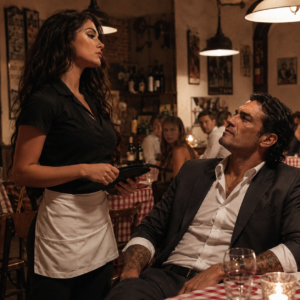
At the Hell’s Kitchen speakeasy that night, the Irish boss laughed when he saw her.
Ten minutes later, he stopped laughing.
Bea translated him with the same cold precision she had used in the Grand Continental penthouse, but this time she was not trembling. She caught the coded references to union skims, the hidden insult buried in a toast, the ledger threat dressed as nostalgia. Then she leaned forward and answered him in a working-class Dublin cadence so perfect that his face drained of color.
“Stop acting hard,” she told him calmly. “Either sign the deal, or I translate your ledger for people with badges.”
Lorenzo sat beside her, silent.
Proud in a way that felt dangerous.
The deal was signed before dessert.
In the armored car afterward, Manhattan neon slid across Lorenzo’s face. He poured champagne, but Bea did not take the glass.
“I am not your pet linguist.”
“No.”
“I am not your wife.”
“No.”
“I am not yours.”
His gaze moved to her mouth, then back to her eyes.
“Not yet.”
Her pulse jumped.
She hated that her body responded before her dignity could object.
Then his phone buzzed.
Whatever softness had entered the car vanished.
Lorenzo read the message, and the man beside her became all shadow again.
“What happened?” Bea asked.
“I intercepted a file from Brighton Beach. Russian underworld code. My people cannot read it.”
“But you think I can.”
“I know you can.”
The file took her three days.
Three days of coffee, highlighters, transcription notes, grammar trees, and the kind of obsession that made sleep feel rude. The code used corrupted Russian syntax, Brooklyn street slang, phonetic substitutions, and one recurring English idiom translated badly enough to become a signature.
At 3:00 a.m., she found the name hiding inside the pattern.
Vincent.
Lorenzo’s underboss.
She ran down the hall without shoes and shoved open Lorenzo’s door before remembering she should knock. He was awake in a chair by the window, shirt open, tattoos visible across his chest, a pistol disassembled on the table beside him.
Bea froze.
Then remembered the paper in her hand.
“It is Vincent.”
Lorenzo stood.
The room seemed to lose temperature.
“Explain.”
She laid the pages on the table, pointing to each highlighted phrase. The writer kept placing a translated English idiom at the wrong part of the sentence, the same verbal tick Vincent used whenever he spoke under pressure. More importantly, the final line included warehouse access codes and the arrival time of a shipment Lorenzo thought only his inner circle knew.
“It is an ambush,” Bea said. “Red Hook. Tonight.”
Lorenzo’s expression went empty.
That was worse than anger.
“Get dressed.”
Bea stepped back. “Absolutely not.”
“I need your ears on their radio channels.”
“You need therapy and better employees.”
“Both can be true.”
“I am not going to a mafia ambush.”
Lorenzo crossed the room in two steps, then stopped himself before touching her. That restraint hit her harder than his hands would have.
“If Gregori takes that warehouse, I lose the docks. If I lose the docks, the men who want you will no longer fear me.”
Bea heard what he did not say.
If he fell, she became prey.
Her stomach turned.
Lorenzo’s voice lowered.
“I cannot protect you from a throne I no longer hold.”
She looked at the gun parts on the table.
Then at the papers in her hand.
Then at the man who had trapped her, paid her, watched her, wanted her, and still had not learned that protection without permission became another form of violence.
“I go as your consultant,” she said.
His eyes sharpened.
“Not your property.”
“Agreed.”
“And if we survive, you give me a contract that says I can leave.”
Lorenzo went very still.
For a moment, she thought he would refuse.
Then he nodded once.
“If we survive.”
The Red Hook warehouse smelled like saltwater, oil, and old rust.
Bea stayed on the catwalk with a headset clamped over her ears and a tablet balanced against her knees. Below, shadows moved between crates. Lorenzo’s men waited with the stillness of wolves. Her sweater stuck to her back, and every old anxiety in her body begged her to run.
Then the Russian chatter started.
She listened.
Translated.
Mapped the room in language before the men below could move through it.
“They are setting a false entry point,” she whispered. “North stairs are the trap.”
Lorenzo looked at her once.
Trust.
Not possession.
Not command.
Trust.
Then everything went wrong.
A spotlight flashed across the catwalk. Men shouted below. Lorenzo’s guards moved, and the warehouse erupted into chaos. Bea dropped behind a steel beam, heart hammering so violently she could feel it in her teeth.
Through the headset, a Russian commander ordered a flank toward the north stairs.
If they reached that stairwell, Lorenzo would be boxed in.
Bea saw the radio beside her.
She grabbed it.
Her hand shook.
Her voice did not.
She transmitted in the deepest Moscow command cadence she could summon, barking an order to abort the north approach and move all units to the south gate. Below, the men hesitated, then obeyed the voice they believed belonged to their own.
Lorenzo looked up at her.
Bea pointed south.
“They are moving.”
He acted instantly.
Minutes later, the warehouse fell into a hard, ringing quiet. Vincent was on his knees below, surrounded by Lorenzo’s men. Gregori’s people had fled. Lorenzo stood in the middle of the room, dust in his hair and a cut along his cheekbone.
Then he looked at Bea.
She was still on the catwalk, shaking so badly she could not stand.
He dropped his weapon and climbed to her.
Not like a king.
Like a man who had almost lost the one thing he had not known how to ask for.
He knelt in front of her.
“You saved my life again.”
“I want pizza,” she said, voice breaking. “A very large one.”
A laugh tore out of him.
Then something worse.
A sound too close to relief.
He reached for her face, then stopped with his hands hovering near her cheeks.
“May I?”
Bea stared at him.
The question did what the penthouse, the money, the dresses, and the guards had not.
It made room.
She nodded.
Lorenzo touched her like permission was sacred.
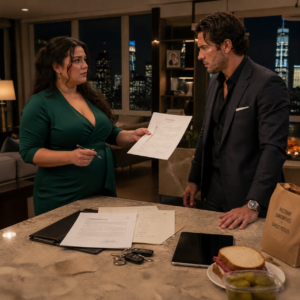
Later, after Vincent was taken away and the warehouse cleared, Lorenzo returned to the Tribeca penthouse with stitches along his cheek and exhaustion pulling at his shoulders. Bea sat at the marble island in the emerald dress, hair a mess, makeup gone, one shoe missing.
He placed a folder in front of her.
She did not open it.
“What is this?”
“Your contract.”
Her fingers tightened.
Lorenzo sat across from her, not at the head of the table.
Across.
Equal.
“It states you are an independent linguistic strategist retained by the Moretti organization at your chosen rate. It states you may leave at any time. It states no guard may stop you unless you request protection.”
Bea opened the folder.
He was telling the truth.
There were keys beside the contract.
Her old apartment.
The penthouse.
A car she did not want.
A bank card she had not asked for.
She looked up.
“And if I leave?”
Lorenzo’s jaw tightened.
“I protect you from a distance.”
“That sounds lonely.”
“It is.”
For the first time, she saw the physical weakness under the power. The tremor in his hand when he reached for his glass. The exhaustion behind his eyes. The wound on his cheek pulling when he tried not to wince.
He did not ask her to stay.
That was why she did not leave.
Not then.
Bea picked up the pen and crossed out one clause.
Lorenzo leaned forward.
“What are you changing?”
“The wardrobe provision.”
His brow furrowed.
“I like my hoodies.”
His mouth softened.
“Keep them.”
“And the catering debt.”
“I paid it.”
“You tipped badly.”
“I gave you two million dollars.”
“That was hazard pay.”
Lorenzo stared at her.
Then laughed under his breath.
She signed.
Not as his possession.
Not as his captive.
As Beatrice Gallagher, applied linguist, crisis strategist, and the first woman in Lorenzo Moretti’s life who had ever negotiated her own place beside him.
That night, he ordered pastrami from Goldberg’s.
Eighty sandwiches arrived with extra pickles and mustard on the side.
Bea stood in the penthouse kitchen, staring at the bags.
“You are unbelievable.”
Lorenzo looked at her from the doorway.
“You were hungry the night we met.”
“I was working.”
“You were saving my empire.”
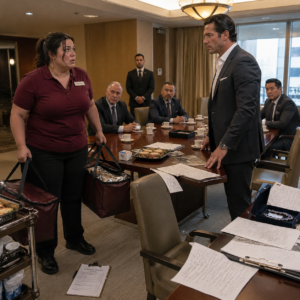
“I was delivering lunch.”
He walked closer, slower this time.
Always slower now.
“Both can be true.”
Bea took one sandwich and handed him the other.
No kiss.
No declaration.
No cage dressed as romance.
Just two people standing in a kitchen above Manhattan, eating pastrami while the city waited below for the woman who could own a room in five languages.
The first word Bea truly translated for Lorenzo Moretti was not Russian, Mandarin, Spanish, or Irish.
It was freedom.
THE END.