Part One: The Night Everything Shattered
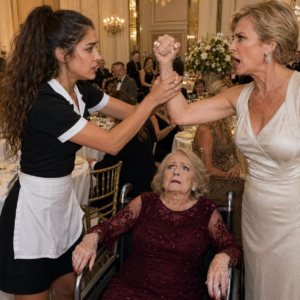
The slap never landed.
Sophia Reyes saw it coming three seconds before impact. The woman’s hand was already in the air, pale and ringed with diamonds, cutting through the warm glow of the ballroom like a blade.
The old woman in the wheelchair below her didn’t flinch.
She didn’t have time.
And not a single person in that gilded room moved to stop it.
Except Sophia.
Three weeks earlier, if someone had told Sophia that her life was about to be ripped apart and rebuilt from nothing, she would have laughed.
Not because it was funny.
Because she was too tired to do anything else.
She worked double shifts at the Harrove, New York’s most exclusive luxury hotel, five nights a week. She came home after midnight, slept for five hours, and woke up to give her younger brother Marco his medication before school.
Then she drove forty minutes to the hospital where their mother, Rosa, lay hooked to machines that kept her lungs working.
She would sit there for an hour holding her mother’s hand, talking to her about nothing. About the weather, about Marco’s grades, about how the cherry trees on Orchard Street were finally blooming again.
Then she drove back, changed her uniform, and did it all over again.
To the guests at the Harrove, Sophia was invisible.
She was the hands that refilled their glasses. The shadow that cleared their plates. A face with no name attached to no life worth imagining.
She had learned to be small in rooms like that.
Small and quiet and fast.
It was safer that way.
She had no idea that on the other side of the city, in a building without a public address, a man sat behind a desk reviewing surveillance footage of every person who would be working the hotel’s annual charity gala.
His name was Damen Valkov.
And he missed nothing.
Damen was thirty-eight years old, with a jaw cut from stone and eyes the color of a winter sea—pale gray, cold, unreadable.
He had built his empire over fifteen years of careful, ruthless work.
Politicians returned his calls on the first ring. Corporate boards adjusted their decisions after quiet dinners with him. Three rival organizations had tried to move against him in the last decade.
None of them existed anymore.
He was not a man who raised his voice.
He had never needed to.
But under all of it—under the black suits and the armored cars and the men who stood at every door with hands folded and eyes forward—there was one thing that Damen Valkov kept hidden from the world.
One thing that, if exposed, could destroy him more completely than any rival ever had.
His mother.
Elena Valkov was sixty-one years old and had not walked unassisted in four years.
The accident—a word Damen used through clenched teeth because it had been no accident at all—had left her spine damaged and her right side weakened. She lived in his mansion in a suite designed specifically for her comfort, with a full-time nurse named Petra and every luxury money could provide.
But Elena did not want luxury.
She wanted to feel like a person again.
When she asked Damen for the third time in two months if she could attend the Harrove Charity Gala—a night she had once looked forward to every year before her injury—he said no twice.
And then, watching her stare out the window at the city she used to move through freely, he said yes.
He would regret it.
And he would not regret it.
Both things would be true at once.
The night of the gala, Sophia arrived at the Harrove two hours early to help set up.
The ballroom was massive. Chandeliers like frozen waterfalls. Tables dressed in white linen and gold. Flowers flown in from somewhere that wasn’t New York.
The kind of room that reminded you exactly how far away you were from your real life.
She tied her apron, tucked her hair back, and got to work.
By eight o’clock, the room was full. Politicians and socialites and old money and new money, all circling each other with practiced smiles. Sophia moved through them like a ghost—refilling glasses, collecting empty plates, keeping her eyes down and her steps quick.
She noticed the woman in the wheelchair near the east side of the room almost immediately.
Not because she looked out of place.
But because of how carefully she was trying not to.
The older woman sat very straight, chin up, wearing a deep burgundy dress that had clearly been chosen with great care. Her silver hair was pinned elegantly at the nape of her neck.
She was watching the room with a kind of hunger. Like someone who had been kept away from something they loved for too long and was trying to absorb every detail before it disappeared again.
Sophia felt something tighten in her chest.
She recognized that look.
She had seen it on her mother’s face.
She didn’t know who the woman was. She didn’t know the man standing forty feet away, half-hidden in the shadow of a marble column, watching the room with the stillness of someone who was always watching.
She didn’t notice his security detail—six men positioned expertly, invisible to anyone who wasn’t trained to see them.
She just picked up her tray and kept moving.
It happened fast.
Elena had maneuvered her wheelchair slightly too close to the edge of the crowd, trying to get a better view of the orchestra warming up near the stage. A cluster of guests shifted suddenly—laughter at a spilled joke, someone stepping back.
The chair’s wheel caught the hem of a passing server’s jacket and lurched sideways.
The glass of red wine on the small table beside her toppled.
It caught Cassandra Vale directly across the front of her ivory gown.
Cassandra was the kind of woman who had never been told no by anyone who mattered. She was forty-four, beautiful in a hard and expensive way, and had built her social position on the understanding that the world arranged itself around her convenience.
She turned to face the source of the spill with the slow, terrible calm of someone who had already decided what was going to happen next.
She looked down at Elena.
“You,” she said.
Her voice was low and precise, designed to carry without seeming like it was raised.
“You clumsy, useless old thing.”
Elena’s jaw tightened.
“I’m sorry,” she said quietly. “It was an accident.”
“An accident?”
Cassandra’s lip curled.
She looked at the wheelchair, then back at Elena’s face with a kind of contempt that doesn’t bother to disguise itself.
“You shouldn’t be here. People like you. People who can’t even control themselves have no business being in a room like this.”
The guests nearby had gone still.
Not the helpful kind of still.
The kind where everyone is watching and no one wants to be the one who steps in.
Elena said nothing. Her hands were folded in her lap, perfectly still, but her knuckles had gone white.
Cassandra stepped forward.
And kicked the side of the wheelchair hard.
The chair rocked.
Elena grabbed the armrests with both hands to keep from tipping.
A soft gasp moved through the cluster of onlookers.
Still no one moved.
“Pathetic,” Cassandra said.
And then she raised her hand.
Sophia’s tray hit the floor before she had consciously decided to drop it.
Glasses shattered. Champagne spread across the marble. Every head in the room turned at the sound.
But Sophia was already moving.
Cutting through the frozen crowd with the kind of speed that comes not from training, but from something deeper. Something that bypasses thought entirely.
She stepped between them.
She caught Cassandra’s wrist with both hands, stopping the motion completely.
Cassandra staggered, startled. She had not expected resistance—and certainly not from a waitress. Her eyes went wide with pure, disbelieving fury.
Sophia held on.
Then she turned away from Cassandra and crouched beside Elena’s wheelchair.
The older woman was trembling slightly, though her face was composed with an effort that Sophia recognized immediately. The specific dignity of someone who refuses to fall apart in public.
“Are you all right?” Sophia asked quietly.
Elena looked at her. The kind of look that takes a person’s full measure in seconds.
“I think so,” she said.
Her voice was steadier than her hands.
Sophia straightened and looked at Cassandra.
The entire ballroom was watching. The orchestra had stopped. Even the servers along the walls had gone still.
“You don’t get to hurt someone just because they can’t fight back,” Sophia said.
Her voice didn’t shake. She hadn’t planned the words. They were simply true, and she said them.
Cassandra stared at her. Her face had gone through three different colors in fifteen seconds.
“Do you have any idea who I am?” she said. “Do you have any idea what I can do to you? You’re a waitress. You’re nothing.”
“Maybe,” Sophia said.
“But I’m still standing here.”
From the shadow of the marble column, Damen watched all of it.
He had seen the moment the wine spilled. Had seen Cassandra turn. He knew who Cassandra Vale was—knew her family’s finances, knew the favors she held over three city council members, knew things about her that would end her if they ever reached the wrong ears.
He could have ended it himself in ten different ways before it reached the point of a raised hand.
He hadn’t.
Because he needed to see what the room would do.
He had spent fifteen years learning that a person’s truest nature appeared not in how they acted when the world was watching, but in what they did when they thought no one important was looking.
The guests in that ballroom—politicians, executives, socialites—they all claimed virtue.
He wanted to see what their virtue was worth when it cost them something.
The answer was nothing.
Every single one of them had looked away. Or down at their phones. Or suddenly discovered something fascinating about their own shoes.
Not one of them had moved.
Except the waitress.
He watched her crouch beside his mother’s wheelchair. Watched her speak quietly, hands gentle, eyes checking Elena’s face the way a person checks on someone they actually care about.
Not performing concern.
Feeling it.
He watched her stand up and face Cassandra Vale alone in front of two hundred people—with no protection, no power, and nothing to gain.
He watched her hold.
And something shifted in his chest that he did not have a name for yet.
He stepped out of the shadow.
The room felt it before it saw it.
A change in atmosphere. A pressure drop. The way the air feels before a storm.
Conversations that had resumed after Sophia’s confrontation dried up again, one by one, as people registered the man walking slowly across the ballroom floor.
Damen moved without hurry.
He didn’t need to hurry.
The crowd parted for him the way water parts around a stone. Not because he asked it to, but because something in his bearing made people step back without knowing why.
He stopped in front of Cassandra Vale.
He didn’t raise his voice.
He never raised his voice.
“Cassandra.”
Just her name. Nothing else.
But the way he said it—quiet and even and without warmth—made two people near her visibly step away.
Cassandra had been preparing a response, building herself back up after Sophia’s defiance. The sight of Damen Valkov erased all of it.
Her color drained.
Her prepared words dissolved.
She was smart enough to know what his presence meant, even if she didn’t fully understand the depth of what she had done.
“I didn’t—I wasn’t—the old woman was—”
“Hi, Mother,” Damen said.
Still quiet.
“She is my mother.”
The silence in the room was absolute.
He pulled out his phone.
Made one call—less than thirty seconds, speaking in a low voice that no one else could hear.
He hung up.
Made a second call—twenty seconds.
A third.
He slid the phone back into his pocket and looked at Cassandra with the expression of a man who has already finished something and is simply waiting for the world to catch up.
By morning, the Vale family’s primary investment firm would be frozen, pending a regulatory review that had been quietly triggered by a tip from an anonymous source.
Cassandra’s personal accounts would show irregularities that her financial advisors would spend six months trying to explain.
And a series of photographs taken at a private party three years ago—photographs Cassandra had believed were destroyed—would be delivered in sealed envelopes to twelve specific people in New York’s social hierarchy.
None of it happened loudly.
None of it required Damen to raise a hand.
That was not the beginning of the revenge.
It was merely the opening line.
Damen crossed the room to his mother. He crouched beside her wheelchair the way Sophia had and took both of her hands in his.
They spoke quietly for a moment, too low for anyone nearby to hear. Elena shook her head once, then nodded, and something in her expression shifted.
Relief, maybe.
Or the particular exhaustion that comes after holding yourself together through something terrible.
Then Damen stood and turned to Sophia.
She was still there.
She hadn’t fled. Hadn’t tried to disappear back into the service corridors the way another person might have. She was collecting the broken glass from the floor with a cloth napkin—on her hands and knees, cleaning up the mess from the tray she had dropped.
He looked at her for a long moment.
“Stand up.”
Not harshly. But with the expectation of someone who was used to being obeyed.
Sophia looked up at him. She recognized something in his face. Not the danger, though the danger was there—quiet and certain underneath everything.
She recognized the way he had looked at his mother.
The grief in it.
The protectiveness.
She stood.
“What is your name?”
“Sophia. Sophia Reyes.”
He nodded, as if confirming something he had already looked up.
“I want to offer you a position,” he said. “Full-time care for my mother. Private residence. Your family’s medical expenses covered entirely. A salary that will solve whatever problems you’re carrying right now.”
He paused.
“And protection for as long as you need it.”
Sophia stared at him.
Around them, the ballroom had resumed a careful, muted version of its earlier noise. People talking again, but quietly, and with frequent sideways glances.
“Why?” she asked.
The question seemed to surprise him.
He was quiet for a second.
“Because in a room full of people who looked away,” he said, “you didn’t.”
She thought of Marco.
She thought of her mother in the hospital bed—the sound of the ventilator, the smell of antiseptic that clung to her clothes after visits.
She thought of the credit card debt and the second job she had been considering, and the look on her brother’s face when he thought she wasn’t watching.
The specific fear of a fifteen-year-old who understands more than he should about how fragile everything is.
“Okay,” she said.
“Yes.”
Disclaimer : This content may be created by AI for entertainment purposes. Any resemblance to real persons, events, or places is coincidental.