I’m a Sheriff in West Texas. We Don’t Patrol Between 3–4 AM. The Roads Change During That Hour.
If you clicked on this video, it means you’re curious about the story I’m about to tell. Now, I’m going to recount everything that happened to me in order without leaving out a single detail. I should warn you from the beginning that some of what you’re about to hear may be disturbing. If you enjoy this kind of content, don’t forget to like the video and subscribe to the channel.
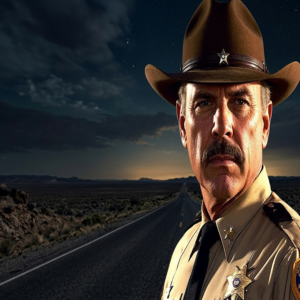
Thank you all in advance. Also, don’t forget to mention in the comments where you’re watching from and feel free to share any similar experiences you may have had. My name is Caleb Hartman. I’ve been the sheriff of Presidio County, West Texas for 14 years. Before that, I served for 8 years as a deputy sheriff under Sheriff James Whitfield, who had been in office for 29 years.
The county consists of high desert terrain, mountain ranges, and the occasional ranch road cutting through vast stretches of flat, empty land where you won’t see a single structure for 30 or 40 m at a time. The population is sparse. The geography is harsh, the distances are long, and being in law enforcement here is less about responding to a high volume of calls and more about covering an enormous area.
When I took over as sheriff, James had me sit in the office I use now, his former office, and walked me through the operational procedures, budget arrangements, personnel management protocols, and jurisdictional boundaries with neighboring counties. Most of it was standard administrative material, the kind of information you’d find in any rural law enforcement manual.
Toward the end of the meeting, however, he pulled out a patrol schedule template that divided the day into 30inut blocks. He pointed to the block between 3:00 and 4 a.m. and told me that this time period was always left blank, that no deputies were ever on active patrol during that hour.
He went on to add that this directive predated the office of the sheriff itself. I asked why. He said the roads were unreliable during that time frame. that GPS systems didn’t function properly, that there was unusual interference with radio communications, and that the department had learned through experience that completely suspending operations during that hour was more efficient than dealing with the complications caused by attempting to patrol.
I asked what kind of complications he meant. James explained that deputies had reported discrepancies between the distance they traveled and their vehicle odometers, that travel times didn’t align with any reasonable timeline, even when accounting for weather or road conditions, and that sometimes, only minutes after radioing in from one location, far too little time to physically cover the distance, they would appear somewhere entirely different.
He said these incidents didn’t occur every night, but they happened frequently enough during that specific time window that the department developed an informal protocol, passed down verbally and never entered into official records. He told me this protocol was handed from one sheriff to the next, and that once it was implemented, nearly all of the anomaly ceased.
He also warned me not to attempt to investigate or document it, explaining that doing so would attract the attention of state oversight agencies that would ask questions no one could answer. I asked whether anyone had ever tried to document or study what was happening during that hour. James said that early in his tenure, he had attempted to do exactly that.
He stationed deputies at fixed locations and instructed them to record their precise coordinates every 15 minutes using both GPS and manual map references. He contacted the county road maintenance supervisor to confirm there were no construction projects or temporary rerouts. He even spoke with the state department of transportation to verify that all signage and road markers were correctly placed.
The results, however, were so inconsistent that they made no sense. On some nights, everything appeared completely normal. On others, deputies reported coordinates that were physically impossible, described highway signs for roads that didn’t exist within the county or detailed intersections that didn’t appear on any map. James said he kept these reports internal and never submitted them to state agencies, explaining that presenting irrational documentation would have damaged the department’s credibility. After 3 months of attempted
documentation, James had discontinued the observation protocol and implemented the patrol suspension procedure. The anomalous reports stopped. The department’s operational efficiency improved. No one questioned the decision because the hour between 0300 and 0400 was statistically the quietest period for calls and incidents anyway and having deputies positioned on either side of that time frame.
One shift ending at 0300, the next shift beginning at 0400 provided adequate coverage without the complications. I asked James if he personally believed something genuinely unusual was occurring during that hour or if he thought the reports were the result of fatigue, equipment malfunction, or some other conventional explanation.
He looked at me for a long moment and said he’d driven through the county at that hour himself, multiple times, deliberately trying to experience whatever the deputies were reporting. He said that twice. He’d encountered situations where his vehicle’s odometer, his GPS unit, and his own sense of elapsed time all gave him different information about where he was and how long he’d been driving, and that both times he’d ended the drive feeling profoundly disoriented in a way that went beyond simple confusion. He said he
couldn’t explain what was happening, but he knew it was real, and he knew the smartest response was to avoid it. I accepted James’ guidance and maintained the patrol suspension protocol. For the first 6 years of my tenure as sheriff, the system worked exactly as he’d described. The hour between 0300 and 400 remained an operational gap.
Deputies scheduled their shifts around it. Dispatch knew not to assign calls during that time frame, and the handful of incidents that did occur during those hours were handled by having the responding deputy wait until 0400 to begin travel or by having the outgoing deputy extend their shift past 0300 if immediate response was critical.
The county residents who were aware of emergency services operations never questioned why response times might be slower during that specific hour. Most people were asleep during that time anyway. The protocol was invisible to everyone except the department personnel who implemented it. The first incident that challenged the protocol occurred in my 7th year as sheriff.
It was late September. Temperature had dropped into the 50s at night and we had clear skies with good visibility. Deputy Rose Mallister was working the 2200 to 0300 shift, covering the northern sector of the county along US Route 67 and the smaller farm roads that branched off it. At 0247 hours, she radioed dispatched to report that she was concluding her patrol and returning to the station.
Estimated arrival 0320 hours. Dispatcher Evelyn Brooks acknowledged and logged the communication at 0256 hours. Deputy Mallister radioed again, this time reporting that she was on County Road 2810, approximately 40 mi from the station and asking if dispatch had any updates on weather conditions because visibility had suddenly decreased.
Evelyn confirmed that weather stations were reporting clear conditions countywide, no fog or precipitation. Deputy Mallister said that was inconsistent with what she was observing, that the road ahead was becoming difficult to see despite her headlights, and that she was reducing speed as a precaution. At 0301 hours, Deputy Mallister radioed that she’d stopped her vehicle because she couldn’t see the road clearly enough to continue safely, that the darkness ahead seemed unusually dense, and that her headlights weren’t penetrating more than 20 or 30
ft. Evelyn advised her to hold position and wait for conditions to improve, and noted that it was now past 0300 hours. Deputy Mallister acknowledged. At 0307 hours, she radioed again, saying visibility had returned to normal, the darkness had cleared, and she was resuming travel to the station. She arrived at 03 for 3 hours.
When she entered the station, I was there completing end of shift paperwork. She looked disoriented, kept checking her watch against the wall clock, and asked me if the station clock was correct. I confirmed it was. She said that didn’t make sense, that according to her patrol log and her own sense of time, she should have arrived at least 20 minutes earlier.
I asked her to walk me through her exact route and timeline. She described leaving her last checkpoint on Route 67 at Uro240 hours, traveling south on County Road 2810 toward the station, encountering the visibility problem at approximately 0256, stopping at 0301, waiting until A307, and then resuming travel. She said the distance from where she’d stopped to the station was roughly 15 mi, which should have taken about 20 minutes at normal speed, meaning she should have arrived around 0327.
Instead, she’d arrived at 0343 16 minutes later than expected. She said she hadn’t stopped for any reason after resuming travel, hadn’t encountered any delays or detours, but somehow the drive had taken substantially longer than it should have. I asked if her odometer reading matched the expected distance.
She checked her vehicle log and said yes. The odometer showed she’d traveled the correct distance. I asked if her GPS had tracked her route accurately. She said her GPS unit had turned off during the visibility problem and hadn’t reactivated until she was almost at the station. And when it did reactivate, it had briefly shown her position as being on a road she’d never been on before correcting to her actual location.
I told Deputy Mallister to file a standard patrol report noting the visibility issue and equipment malfunction, but to not include speculation about the time discrepancy or GPS error, that I’d review the incident internally and determine if any follow-up was needed. She filed the report as instructed and went off shift.
After she left, I sat in my office reviewing what she described and comparing it to the incidents James Whitfield had mentioned years earlier. The pattern was clear. During or immediately adjacent to the 0300 to Zor 400 time frame, something about travel through the county became unreliable. distance, time, and position stopped corresponding in the expected ways.
I considered calling James to ask for additional context, but decided against it. He’d already told me everything useful. Avoid the hour. Don’t investigate. Don’t create documentation that invites external scrutiny. Over the following 3 weeks, I made a point of reviewing patrol logs more carefully, looking for any other incidents that might suggest similar problems.
I found nothing overt, but I noticed patterns in how deputies structured their shifts. They would conclude patrol routes by 0255 at the latest, ensuring they were either stationary or traveling on well-known direct routes back to the station by the time 0300 arrived. The few deputies who had extended shifts past 0300 due to active incidents always chose to remain at the incident location rather than travel during the problem hour.
It was as if the entire department had developed an intuitive sense of the danger without ever discussing it explicitly. When I asked Under Sheriff Luis Ortega about this pattern, he said it was just efficient shift management, that there was no point having deputies out on patrol during the statistically quietest hour, that it made more sense to have them transitioning between shifts during that time.
I asked if he’d ever experienced anything unusual while driving during that hour. He said no because he avoided driving during that hour. and then he looked at me directly and said I should probably do the same. In early November, I received a call from Henry Cole, the county road maintenance supervisor. He said he needed to discuss an issue with road signage on several county roads in the northern sector, that there had been reports of signs being in incorrect positions or displaying incorrect information, and that his crew had been out multiple times to verify
and correct the signage. But the reports kept coming in. I asked what kind of incorrect information. He said travelers were reporting seeing signs for roads that didn’t exist or seeing distance markers that didn’t match the actual distances to destinations or encountering intersections that weren’t marked on official maps.
I asked when these reports typically came in. He said he didn’t have exact times for all of them, but that the ones he’d been able to confirm with specific timestamps had all occurred between 0300 and 400 hours. He said his crew had gone out during daylight to check these locations and found all signage to be correct and properly positioned and that he was starting to think the reports were unreliable, possibly due to driver fatigue or inattention.
I thanked him for the information and said I’d look into it from the the law enforcement side to see if there were any patterns in who was reporting these discrepancies. I didn’t look into it. I knew what the pattern was. The roads were changing during that hour or traveler’s perception of the roads was changing or something about the relationship between the physical landscape and human observation was becoming unstable.
Signage that was correct during normal hours wasn’t necessarily correct during the problem hour. Routes that existed reliably at 0200 or 0500 didn’t exist reliably at 0330. Henry’s crew couldn’t find problems during daylight because the problems weren’t present during daylight. They were only present during that specific 60-minute window when whatever governed the normal rules of geography and time apparently suspended or modified its operations.
In mid- November, I was working late at the station, completing budget reports when Evelyn Brooks came into my office and closed the door behind her. She’d been the county dispatcher for 19 years, had worked under three different sheriffs, and had the kind of institutional knowledge that didn’t exist in any manual or database.
She asked if I had a few minutes to discuss something that wasn’t urgent, but was concerning her. I said yes. She sat down and said she’d been reviewing old dispatch logs, partly out of curiosity and partly because she was training a new dispatcher and wanted to show them examples of various call types and how they’d been handled.
She said she’d noticed something odd about the logs from 0300 to 0400 hours going back at least 15 years. There were almost no calls logged during that hour. not low numbers of calls, but essentially zero calls. She said that statistically that didn’t make sense. That even during the quietest hours, there should be occasional calls, accidents, medical emergencies, disturbances, wildlife on roads.
But the hour between 0300 and 0400 was consistently empty across years of records. I asked if she thought calls were coming in but not being logged. She said no, she didn’t think that because she’d been working dispatch herself for most of those years and she remembered the pattern. Calls would come in up until around 0255, then nothing until 0405 or 0410.
She said it was as if the entire county went into suspension during that hour, as if nothing happened that would require emergency response. I asked if she had a theory about why. She said she had a memory, not a theory. She said about 12 years ago, she’d taken a call at 0258 hours from a driver reporting that they’d broken down on County Road 2810 and needed assistance.
She’d dispatched the onduty deputy who had radioed back at 0303 saying they couldn’t locate the caller, that the road section where the caller said they were didn’t match any known landmark, and that GPS wasn’t providing reliable information. The deputy had searched for 20 minutes and found nothing.
At 3:28, the same caller had called back, angry, saying they’d been waiting for almost 30 minutes and asking why no one had responded. Evelyn had explained that a deputy had been searching for them, but couldn’t locate their position. The caller had given their location again, and this time, the coordinates matched a section of road that was 15 mi from where they’d originally said they were.
The deputy had driven to the new location and found the caller immediately. When asked why they’d given two different locations, the caller had insisted they’d been in the same spot the entire time, hadn’t moved, and didn’t understand what the confusion was about. Evelyn said she’d filed that incident as a communication error, but it had bothered her.
And over the years, she’d noticed that any call that came in right around 0300 tended to have similar problems, locations that didn’t match. Responses that couldn’t find callers, time discrepancies between when calls were placed and when assistance arrived. She said she’d eventually started a personal practice of when a call came in after a 0255, advising the caller that response time might be delayed due to patrol positioning and asking if their situation could wait until after 0400.
Most callers said yes. The few who said no that it was a genuine emergency, she would dispatch as required, but those situations almost always resulted in complications. She said she was telling me this because she wanted me to know that the problem wasn’t just with deputies driving during that hour.
It was with the entire operational environment during that hour. And that maybe the protocol of suspending patrol should be extended to suspending dispatch response as well, or at least having a formal policy that clarified how to handle calls during that time frame. I thanked Evelyn for bringing this to my attention and said I’d consider how to formalize the procedure, but I knew formalizing it would require documenting the reasons for it.
And documenting the reasons would require acknowledging that geography and time function differently during a specific hour, which was not something I could put in an official policy document. The current informal system, where dispatch and deputies simply avoided the hour through practiced habit, was probably the best available approach.
Making it official would only invite questions I couldn’t answer. By December, the protocol had been functioning smoothly for over a year since Deputy Mallister’s incident. No additional reports of time discrepancies, no complaints from road maintenance, no dispatch complications. The hour between 0300 and 400 remained an operational void that everyone worked around without discussing explicitly.
I’d come to accept this as a permanent feature of law enforcement in Prescidio County, something that simply had to be managed rather than solved. The county had strange characteristics. The distances were extreme. The isolation was profound. The landscape had qualities that weren’t entirely predictable.
Those were facts you learned to work with, not problems you could fix. On December 18th, I received a call from Mark Holloway, a state ranger with the Texas Highway Patrol. He said he was conducting a routine review of county law enforcement operational efficiency metrics and had noticed that Prescidio County consistently showed a gap in patrol coverage between 0300 and 0400 hours.
He said this gap was unusual compared to other rural counties with similar geography and resources. And he wanted to understand the reasoning behind it to determine if it represented a resource allocation issue that might benefit from state assistance or if there was some operational constraint he wasn’t aware of. I told him it was an operational efficiency decision, that the hour between 0300 and 0400 had the lowest incident rate and that concentrating personnel on higher traffic periods provided better overall coverage.
He said that made sense from a statistical standpoint, but that state guidelines recommended maintaining at least minimal patrol presence during all hours to ensure response capability for emergencies. I said we maintained response capability. The deputy’s ending shift at 0300 and deputy’s beginning shift at 0400 were both available for emergency calls if needed and that in practice the 1-hour gap had not resulted in any measurable decrease in public safety outcomes.
Mark said he appreciated the explanation, but that he’d need to review incident reports and response times for the past year to verify that the gap wasn’t creating problems. I said I’d provide the requested documentation. After ending the call, I pulled the relevant reports and confirmed what I already knew. There were virtually no incidents logged between 0300 and 0400.
And the handful that were logged showed response times that were either within normal parameters or in a few cases longer than expected but attributable to distance and road conditions. There was nothing in the documentation that would raise concerns from a state oversight perspective. But Mark’s inquiry worried me because it meant external attention was being directed at the very thing we’d been carefully not documenting for years.
If he pushed hard enough, if he demanded detailed explanation for why the hour was empty, I’d eventually have to either fabricate a more elaborate justification or admit that we avoided the hour because the roads didn’t work correctly during it, and neither option was acceptable. Mark Holloway’s inquiry remained on my mind through the end of December and into January.
He’d received the documentation I’d sent and hadn’t followed up with additional questions, which suggested he’d found nothing overtly problematic in the reports. But I knew that state oversight worked slowly and methodically, that agencies like the highway patrol would compile data across multiple counties before identifying patterns that warranted deeper investigation.
If Prescidio County’s patrol gap was flagged as an outlier in a larger analysis, Mark might return with more specific questions that would be harder to deflect with general statements about operational efficiency. I considered reaching out to James Whitfield to ask if he’d ever dealt with state inquiries about the protocol, but decided against it.
James had retired specifically to avoid these kinds of complications, and bringing him back into department business would be unfair. In late January, Deputy Rose Mallister requested a meeting with me to discuss her shift schedule. She’d been working the 2200 to0300 rotation consistently for 8 months and wanted to rotate to a different time frame, citing the difficulty of maintaining that sleep schedule longterm.
I understood her concern and agreed to adjust the rotation starting in February. But during the meeting, she mentioned something that made me reconsider her request. She said that over the past few months, she’d noticed that her drives back to the station at the end of shift, which should have been routine and familiar after so many repetitions, had started feeling disorienting.
She said she couldn’t point to any specific wrong detail, that the roads looked correct, and the landmarks appeared in the expected sequence, but that something about the experience of driving those routes between 2245 and 0300 had begun to feel subtly off, as if she was traveling through a landscape that was almost but not quite the one she knew.
I asked her to describe what she meant by almost but not quite. She said it was hard to articulate, that it was more a feeling than an observation, but that if she had to put it into words, it was like the distances between landmarks felt slightly compressed or stretched, like a drive that should take 12 minutes would feel like it took either 8 minutes or 16 minutes, even though the clock showed the correct 12 minutes had passed.
She said her odometer readings were always accurate. Her arrival times were always within expected parameters. and nothing about her vehicle or equipment suggested any malfunction. It was just her subjective experience that felt wrong. I asked if this sensation occurred every night or only occasionally.
She said it had started happening occasionally, maybe once every two weeks, but over the past month it had become more frequent, maybe three or four times per week. She said she’d started deliberately watching her odometer and GPS more carefully during those drives, trying to identify what was causing the sensation, but the numbers always matched expectations.
It was only her perception that suggested otherwise. I told Deputy Mallister that perception issues during late night driving were common, that fatigue and darkness could create illusions of altered time and distance, and that rotating to a different shift would probably resolve the problem. But I didn’t believe it was simple fatigue.
what she was describing matched too closely with the incidents James Whitfield had mentioned with the time discrepancies and position anomalies that had led to the patrol suspension protocol in the first place. The roads weren’t just unreliable during the 300 to 400 hour itself. They were becoming unreliable in the period immediately before that hour as if the boundary of the problem zone was expanding or softening, bleeding into adjacent time periods.
I made a note to review other deputies reports from late shift drives to see if anyone else was experiencing similar sensations. Over the following week, I casually asked the three other deputies who regularly worked late shifts if they’d noticed anything unusual about driving conditions between Zeru 30 and 300 hours. Two of them said no.
Everything seemed normal. The third deputy Travis Medina hesitated before answering and then said he’d noticed that his fuel consumption seemed slightly higher than expected on drives back to the station at end of shift, that he’d have to refuel more often than the distance traveled should require. I asked if he’d checked his vehicle for leaks or mechanical problems.
He said yes. Maintenance had inspected the vehicle twice and found nothing wrong. He said the fuel discrepancy was minor, only about 10% higher than expected, but it was consistent enough that he’d noticed the pattern. I asked when he’d first observed this. He said about 3 months ago. I asked if it occurred every night or only sometimes.
He said maybe half the time, and it seemed to be more common on nights when he was driving back to the station right around 0245 to 0255. Fuel consumption that didn’t match distance traveled was another form of the same problem. Physical measurements that should correspond but didn’t. If Deputy Medina’s vehicle was consuming more fuel than the odometer suggested it should, then either the odometer was under reporting distance or the vehicle was traveling through some condition that required more fuel than normal driving. Neither explanation made
conventional sense, but both suggested that the relationship between measured distance and actual travel was inconsistent during that time frame. I told Deputy Medina to continue documenting his fuel usage and to report any significant deviations, but I didn’t pursue the issue further. There was no point in investigating what I already understood.
The roads near the problem hour didn’t function reliably. In early February, I received an email from Mark Holloway asking if I’d be available for a phone call to discuss some follow-up questions about Presidio County’s patrol operations. I agreed, and we scheduled a call for the following afternoon. During the call, Mark said he’d been comparing patrol coverage patterns across West Texas counties and had noticed that Prescidio County’s approach of suspending patrol during the 0300 to0400 hour was unique.
He said other counties with similar geographic and demographic characteristics maintained continuous patrol coverage even during low incident hours. and he was curious about what specific local factors made Prescidio County’s approach more effective. I repeated my earlier explanation about resource allocation and incident statistics, but Mark pushed further.
He said he’d reviewed our incident reports and response times and agreed that the data supported the efficiency argument, but that he’d also noticed something unusual. Not only were there very few incidents during the 0300 to0400 hour, but there were also very few incidents reported as occurring during that hour, even if the report itself was filed later.
Most counties showed a relatively even distribution of incident occurrence times across the 24-hour cycle with only minor variations. Presidio County showed a significant drop in reported incident times, specifically between 0300 and 0400, as if nothing happened during that hour anywhere in the county.
I said that was probably a statistical artifact of low population density and the particular distribution of where people lived and traveled in the county. Mark said maybe, but that he’d compared our numbers to other low-density counties, and the pattern was still unusual. He asked if there was something about the county’s geography or infrastructure during that hour that made incidents less likely.
I said I couldn’t think of any geographic factor that would create such a specific temporal pattern. Mark said he wasn’t trying to criticize our operations, that he was genuinely curious from an operational research perspective, and that if we’d identified some factor that naturally reduced incidents during a specific hour, it might be valuable information for other counties.
I said I appreciated his interest, but that I didn’t have any insights beyond the basic statistics. He thanked me and ended the call, saying he’d continue his review and might follow up if he identified any other patterns worth discussing. After that call, I spoke with Under Sheriff Luis Ortega about Mark’s inquiry.
Luis said State Rangers periodically conducted these kinds of reviews and that they usually didn’t lead to anything significant as long as our operational metrics were within acceptable ranges. I said I was concerned that Mark was specifically interested in the Yo300 to0400 gap and might eventually ask questions we couldn’t answer without revealing the actual reason for the protocol.
Luis asked what I wanted to do about it. I said I wasn’t sure that we couldn’t change our operations just to avoid state scrutiny because that would potentially put deputies at risk during the problem hour, but that we also couldn’t afford to have external oversight demanding detailed explanations that would require us to document things that shouldn’t be documented.
Luis suggested we could gradually modify the protocol to have a single deputy on call during the 0300 to Zo 400 hour positioned at the station or another fixed location. Technically available for emergencies but not actively patrolling that would satisfy state guidelines about maintaining coverage while still avoiding the actual problem of road travel during that time frame.
I said that might work and that I’d draft a policy revision to formalize the on call procedure. While I was working on that policy revision, Deputy Mallister came to my office with a concern. She said she’d rotated to the 1,800 to 0200 shift as we discussed, and her last night on the 2200 to 0300 rotation had been the previous week.
She said that final night she’d had an experience that worried her and that she thought I should know about even though she wasn’t sure it was relevant to anything official. I told her to go ahead. She said she’d been driving back to the station at approximately 252 hours, traveling south on County Road 2810 as usual when she’d noticed what she thought was a road sign ahead that she didn’t recognize.
She’d slowed down to read it and found that it was a standard distance marker, but the distances it showed didn’t match any place she knew. The sign had indicated that Marfa was 37 mi ahead, but according to her GPS and her knowledge of the county, Marfa should have been at least 60 mi from her position at that time.
She’d stopped and taken a photograph of the sign with her phone, thinking maybe she’d misread it or misunderstood her location. When she reviewed the photograph later after arriving at the station, the image was corrupted, showing only gray static. She’d driven past the same location during daylight the following day and found a distance marker at that spot, but it showed the correct distance to Marfa, not the 37 mi she’d seen the previous night.
I asked Deputy Mallister if she documented this incident in her patrol log. She said no because she wasn’t sure it was real, that it might have been misperception or a trick of lighting. I asked if she’d experienced any other unusual observations during that drive. She said no, just the sign, but that the experience had left her feeling deeply unsettled, as if she’d briefly been in a version of the county where distances were different.
I thanked her for reporting it and told her not to include it in any official documentation that I’d make a note of it for internal reference. After she left, I sat with that information for a long time. A road sign showing incorrect distances was exactly the kind of phenomenon Henry Cole had mentioned months earlier.
The kind of thing his crew couldn’t verify during daylight because it only occurred during the problem hour. But this was the first time I had a firsthand account from a department employee, someone whose observations I trusted, describing a clear, specific detail rather than a vague sense of wrongness. I decided to drive the route myself.
Not during the problem hour, I wasn’t willing to do that, but during the approach to it, to see if I could observe anything unusual. On a clear night in midFebruary, I left the station at 0230 hours and drove north on County Road 2810, following the route Deputy Mallister had described. The road was empty.
The night was cold and still. Visibility was excellent. I drove at normal patrol speed, watching for road signs and landmarks, comparing what I saw to what I expected based on years of familiarity with these roots. For the first 15 minutes, everything appeared exactly as it should. The road stretched straight ahead.
The landscape was empty and dark. The occasional ranch entrance or utility marker appeared where I expected it. At 0247 hours, I checked my GPS and odometer and confirmed they matched. At 0252 hours, I approached the section of road where Deputy Mallister had seen the incorrect distance marker. The sign was there, a standard white rectangular marker with black text indicating distances to Marfa and Fort Davis.
I slowed down and read it carefully. The distances shown were correct. Marfa, 61 miles. Fort Davis, 38 miles. I stopped and examined the sign more closely with my spotlight. It was a standard Texas Department of Transportation sign, properly maintained. No evidence of vandalism or alteration. I took a photograph with my phone.
The image showed the sign clearly. Distances correct. No corruption. I continued driving south toward the station, checking my GPS and odometer every few minutes. At 0258 hours, I felt something I couldn’t quite identify. A subtle shift in the quality of the experience of driving, like a change in air pressure or a barely audible change in engine sound.
It wasn’t anything I could point to specifically, just a sensation that the environment had become slightly different. I checked my instruments. Everything read normally. I checked the road ahead. It looked the same as it had moments before. But the feeling persisted, a sense that I was now driving through a space that was subtly not the space I’d been in a minute earlier.
At 0301 hours, I was approximately 12 m from the station. According to my GPS, I was on County Road 2810. coordinates matched my expected position. Estimated time to station was 14 minutes. I maintained speed and watched the road carefully. The feeling of subtle wrongness intensified. It wasn’t fear exactly, but a profound discomfort, like being in a familiar room where the furniture had been moved slightly, but not enough to consciously notice what was different.
At 0384 hours, my GPS unit flickered and reset. When it reactivated, it showed my position as being on State Highway 170, which was impossible. I was clearly on County Road 2810. The landscape around me matched that road. There were no intersections where I could have turned on to 170. I checked my odometer.
It showed I’d traveled 18 mi since leaving the station, which was correct for my intended route. But my GPS insisted I was somewhere else. I continued driving, ignoring the GPS, navigating by familiar landmarks. At 0309 hours, the GPS corrected itself, showing me back on County Road 2810, position accurate. The sensation of wrongness faded.
By 03 and 15 hours, everything felt normal again, and I arrived at the station at 321 hours, exactly on schedule according to both odometer and clock. I sat in my vehicle in the station parking lot for several minutes after that drive, trying to process what I’d experienced. I’d felt the edge of the problem.
The boundary where normal geography started to become unreliable. I hadn’t been deep into the 300 to 400 hour had only touched the first few minutes of it, but that had been enough to encounter GPS malfunction and the sensation of spatial displacement that Deputy Mallister and others had described. If I’d continued driving deeper into that hour, if I’d been on the road at 0330 or 345, I suspected the anomalies would have become more pronounced.
Distance markers would show impossible distances. Intersections would appear that didn’t exist on maps. Travel time would decouple from odometer readings. The landscape would maintain its appearance of normaly while functioning according to rules that violated normal physics. I went inside and found Evelyn Brooks at the dispatch desk.
I asked her if there had been any calls between 0300 and 320 hours. She said no. The night had been completely quiet. I asked if that was unusual. She said no. It was typical that the hour after AO300 was almost always silent. I asked her how long she’d been working dispatch tonight. She said since 2200 hours. I asked if she’d noticed anything unusual about radio communications or equipment function. She said no.
Everything had been normal. I thanked her and went to my office to write a personal note about what I’d experienced. I didn’t file an official report because there was nothing official to report. My GPS had malfunctioned briefly. I’d felt subjectively uncomfortable. Those weren’t incidents. They were observations, and documenting them would only create questions about why I’d been driving during the period we normally avoided.
The following week, I received another call from Mark Holloway. He said he’d completed his operational review and wanted to share his findings. He said that overall, Prescidio County’s law enforcement operations met or exceeded state standards in all measured categories, but that he was recommending we modify our patrol gap procedure to include an on call deputy during the 0300 to 0400 hour, consistent with state guidelines about maintaining continuous emergency response capability.
I said we’d been planning to implement exactly that change and that I’d have a revised policy document to him within 2 weeks. Mark said that was excellent and that he appreciated our willingness to adjust operations based on state recommendations. He said his review was complete and that he’d have no further need to examine our procedures unless problems arose in the future.
I thanked him and ended the call feeling a mixture of relief and concern. Relief that his inquiry was concluded without requiring deeper explanation. Concerned that we’d now committed to having a deputy on call during the problem hour, which meant someone would need to be available to respond if an emergency occurred during that time frame.
I discussed the on call procedure with Luis Ortega. We agreed that the on call deputy would be positioned at the station, not on patrol, and would only respond to genuine emergencies that couldn’t wait until after EO 400. We’d add language to the policy stating that response during this hour was subject to equipment and communication reliability factors that might affect arrival times.
That language was vague enough to cover any anomalies that might occur without explicitly acknowledging what those anomalies were. We implemented the revised procedure starting March 1st with deputies rotating through the on call assignment on a weekly basis. For the first 3 weeks, there were no calls during the 0300 to 0400 hour, so the procedure remained untested.
On March 22nd at 03 and 17 hours, dispatch received a call from a driver reporting a single vehicle accident on US Route 67 approximately 35 mi north of the station. The caller said their vehicle had gone off the road, that they weren’t seriously injured, but needed assistance, and that they were concerned about exposure because the temperature was in the low 40s.
Evelyn Brooks consulted the on call deputy for that night. Deputy Travis Medina and explained the situation. Deputy Medina acknowledged and said he’d respond. I was at home but monitoring radio traffic as I sometimes did during overnight hours and I heard the exchange. I immediately called Evelyn and told her to instruct Deputy Medina to wait until EO400 to respond unless the caller reported a life-threatening injury.
Evelyn said the caller hadn’t reported serious injury, just requested assistance. I said to have Deputy Medina contact the caller, assess the situation more thoroughly, and provide instructions for staying warm until help could arrive in 43 minutes. Evelyn relayed the instruction. Deputy Medina called the stranded driver and determined that they had warm clothing.
the vehicle was stable and not in immediate danger and there was no medical emergency. He advised them to remain in the vehicle with the engine running for heat and said a deputy would arrive shortly after 0400 hours. The caller agreed. At 0402 hours, Deputy Medina departed the station to respond. He arrived at the reported location at 0438 hours and radioed that he’d found the vehicle and the driver was fine.
Response time from departure to arrival was 36 minutes for a 35m drive which was within normal parameters. The incident was resolved without complications. But I remained awake the rest of that night, thinking about what might have happened if Deputy Medina had responded immediately at 0317 instead of waiting.
He would have been driving through the county during the deep part of the problem hour 0330 to 0345 when the anomalies were presumably most pronounced. Would he have found the stranded driver? Would his GPS have functioned? Would the drive have taken 36 minutes or some impossible duration? Would he have arrived at a location that matched the caller’s description or at some variant location where distances and landmarks didn’t correspond? I called Deputy Medina the next morning and asked about his response to the accident call. He said everything had
gone smoothly, routine response, no complications. I asked if he’d had any concerns about responding during the Azure 300 to 400 hour. He said no. He’d waited until after 0400 as instructed, so there hadn’t been any issue. I asked if he understood why the instruction had been to wait rather than respond immediately.
He hesitated and then said he assumed it was related to the department’s practice of avoiding operations during that hour and that he appreciated being told to wait because he’d heard from other deputies that driving during that time frame could be disorienting. I asked what he’d heard specifically. He said just that GPS wasn’t reliable and that distance perception could be off, that it was better to wait if possible.
I thanked him and ended the call. The informal knowledge about the problem hour was spreading through the department naturally passed deputy to deputy through conversation and shared experience. That was probably safer than formal documentation, but it also meant the knowledge was fragmentaryary and subject to distortion. In early April, Henry Cole called me to report an issue that he thought might be relevant to law enforcement operations.
He said his road maintenance crew had been conducting routine inspection of county roads in the northern sector and had found several sections where the asphalt showed unusual wear patterns that didn’t match traffic volume or weather exposure. The wear appeared to be concentrated in specific areas, as if vehicles had been traveling over those sections far more frequently than records indicated, or as if the asphalt was aging at an accelerated rate in localized patches.
I asked which roads were affected. He listed three county roads, all of them roads that patrol deputies used regularly. I asked when the unusual wear had been first noticed. He said his crew had done a comprehensive inspection in September and everything had looked normal. And they’d done another inspection last week and found the wear patterns.
So sometime in the past 7 months, those road sections had degraded in ways that weren’t consistent with normal use. I asked if he had any theory about what was causing it. He said no, that his crew had checked for subsurface issues, drainage problems, material defects, and found nothing that would explain the localized accelerated wear.
He said it was as if those specific sections of road were experiencing more traffic or more time than they should be experiencing. I thanked Henry for the report and said I’d make note of it. After ending the call, I looked at a map and marked the locations he’d mentioned. All three were on routes that deputies traveled during the 0230 to 0300 time frame approaching the problem hour.
If the roads were aging faster in those locations, if the asphalt was experiencing more wear than traffic volume justified, that suggested those sections of road were being used more intensely than physical reality indicated. A deputy might drive over a section once, but perhaps in some temporal or dimensional sense that single passage was equivalent to multiple passages as if the road was being traversed repeatedly within a compressed time frame.
Or the road itself was experiencing accelerated time, aging faster than the surrounding landscape. Either explanation was impossible by conventional physics, but both fit the pattern of anomalies associated with the problem hour. By midappril, I’d accumulated enough observations about the 0300 to 0400 hour that I felt compelled to document them more systematically, even if that documentation remained private and unofficial.
I started a separate file on my personal computer at home, not connected to department systems, where I recorded incidents, observations, and patterns without the constraints of official report language. The file included Deputy Mallister’s experience with the incorrect distance marker, my own GPS malfunction during the approach to the problem hour, Deputy Medina’s fuel consumption discrepancies, Henry Cole’s reports of unusual roadwear, and Evelyn Brooks’s observation that virtually no emergency calls originated during that time frame.
I also included historical information from James Whitfield’s briefing when I’d first become sheriff. The incidents he described of deputies reporting impossible positions and time discrepancies. The compilation revealed a clear pattern between 0300 and 400 hours. The county’s geography became unreliable in ways that affected distance, time, position, and the relationship between physical measurement and experienced reality.
What I couldn’t determine from the available information was whether the problem was consistent every night or if it varied in intensity, whether it was localized to specific roads or affected the entire county, and whether it was truly confined to that single hour or if it was bleeding into adjacent time periods, as Deputy Mallister’s recent experiences suggested.
To answer those questions would require systematic observation during the problem hour itself. which would mean deliberately putting deputies at risk for the sake of gathering data that might never be useful. I couldn’t justify that approach. The protocol of avoidance had worked for decades. The fact that I now understood more about what we were avoiding didn’t change the fundamental calculus that staying away from the problem was safer than studying it.
In late April, I received a visit at the station from a traveler who’d been passing through the county two nights earlier. The man, who identified himself as Robert Keelso, a longhaul truck driver, said he’d had an experience on US Route 67 that had disturbed him and that he wanted to report to local law enforcement, even though he wasn’t sure anything criminal had occurred.
I invited him into my office and asked him to describe what had happened. He said he’d been driving south on Route 67 at approximately 0320 hours on the night of April 18th, making good time, no traffic, clear weather. He’d been using his GPS to monitor his route and estimated arrival time at his destination in El Paso.
At around 0325 hours, he’d noticed that his GPS was showing his position as being significantly further south than he thought he should be, as if he’d covered more distance in the past 20 minutes than seemed possible at the speed he’d been maintaining. He checked his odometer and found that it matched his GPS, showing he’d traveled approximately 35 m in 20 minutes, which would require an average speed of over 100 mph.
but he knew he’d been driving at his usual speed of around 65 mph and his cruise control had been set and active the entire time. I asked Robert if he’d experienced anything unusual during that drive. Any period where he’d lost awareness or couldn’t account for time. He said no. He’d been fully alert, had been listening to a podcast, remembered the entire drive continuously.
He said that’s what made the situation so disturbing, that he had a clear subjective experience of driving for 20 minutes at normal speed. But his instruments indicated he’d traveled a distance that should have required much more speed or much more time. He said he’d pulled over at the next rest area to check his truck for mechanical problems, thinking maybe his speedometer was malfunctioning or his odometer had somehow jumped forward.
But everything appeared normal. When he’d resumed driving after 0400 hours, his speed, distance, and time had all corresponded normally for the remainder of his trip. He said he’d driven that route dozens of times over the years and had never experienced anything like it. He said he was reporting it because he thought maybe there was something about that section of highway that created instrument errors, and if so, law enforcement should be aware in case it affected other drivers.
I thanked Robert for the report and told him I’d make note of it. I said we’d had occasional reports of GPS anomalies in the area and that we’d forward his information to the state transportation department for review. He seemed satisfied with that response and left. After he departed, I added his account to my private file.
This was the first report from a civilian traveler describing exactly the kind of time distance discrepancy that deputies had experienced. It confirmed that the problem wasn’t specific to department vehicles or equipment. Wasn’t some localized interference affecting our GPS units or odometers. The problem was the roads themselves or more accurately the relationship between travel and measurement during that specific hour.
Robert had driven at normal speed for a subjectively normal duration, but had covered an impossible distance according to his instruments. Either his perception of time had been compressed, making 20 minutes feel like 20 minutes while actually being longer, or the distance he’d traveled had been compressed, making 35 m of road somehow shorter during that hour.
Neither explanation was satisfactory from a physics standpoint, but both suggested that the county’s geography was genuinely unstable during the 0300 to 400 time frame in ways that affected anyone traveling through it, not just law enforcement personnel who were aware of the pattern. I wondered how many other travelers had experienced similar anomalies and had dismissed them as instrument errors or fatigue induced misperception.
I wondered if the problem was worsening over time, if the boundary of affected time periods was expanding, if the intensity of the spatial distortions was increasing. I had no way to answer those questions without conducting observations I wasn’t willing to conduct. In early May, Luis Ortega came to my office and closed the door, which usually indicated he had something sensitive to discuss.
He said he’d been reviewing department vehicle maintenance records and had noticed a pattern that concerned him. Over the past 18 months, vehicles assigned to deputies working the late shift, particularly those driving between 0230 and 0300 hours, showed higher than normal wear on brake components, suspension parts, and tires.
as if those vehicles were being driven over rougher roads or more challenging terrain than the county’s generally flat and well-maintained routes would cause. The maintenance supervisor had noted this pattern and had asked Luis if late shift deputies were taking different routes or responding to more off-road calls than dayshift deputies.
Luis had checked and found that late shift deputies were driving the same routes and responding to the same types of calls. there was no operational reason for the accelerated wear. He said he thought it might be related to whatever was happening during the problem hour, that if the roads were unstable in terms of distance and time, they might also be unstable in terms of surface condition, that a road that appeared smooth might somehow impose stress on vehicles equivalent to driving over rough terrain. I said that was
consistent with what Henry Cole had reported about unusual asphalt wear on certain road sections, that if vehicles were experiencing accelerated component wear, it made sense that the roads themselves would show accelerated surface wear. Luis asked if I had any idea what was actually causing this. I said no.
That I had observations but no explanation. That something about the county’s geography didn’t function normally during the 0300 to0400 hour and possibly during the approach to that hour. Luis asked if I thought the problem was getting worse. I said I didn’t know, but that the fact we were now seeing physical effects on vehicles and roads suggested either the problem was intensifying or we were simply becoming more aware of effects that had always been present.
Luis said we needed to be careful about how we address this with the maintenance department. that if we started formally documenting unexplained vehicle wear associated with specific time periods, it would create records that might eventually be reviewed by state oversight agencies. I agreed and said we’d continue handling vehicle maintenance as routine operational expenses without creating any documentation that linked the wear patterns to temporal factors.
Later that week, I received a call from James Whitfield. He said he’d heard through informal channels that the department was dealing with some operational issues related to the late night patrol gap and wanted to check if I needed any guidance based on his experience. I appreciated the call and gave him a summary of what had been happening.
The state rangers inquiry, the implementation of the on call procedure, the various incidents and observations that suggested the problem hours effects might be expanding or intensifying. James was quiet for a long time after I finished. Then he said that what I was describing sounded worse than anything he dealt with during his tenure.
That in his experience the problem had been confined to the single hour and hadn’t shown signs of spreading into adjacent time periods or causing measurable physical effects on vehicles and infrastructure. He asked if I’d considered the possibility that something had changed in the county, that some environmental or geological factor might have shifted in ways that were amplifying whatever caused the original problem.
I said I’d considered it, but had no way to investigate it. We couldn’t exactly call in geologists or physicists to study why our roads didn’t work correctly during a specific hour. James agreed and said that was the fundamental constraint we were operating under. That we were dealing with something that couldn’t be studied through normal scientific methods because acknowledging its existence officially would create more problems than it solved.
He said the best approach was probably what I was already doing. Maintain the avoidance protocol. Document as little as possible. handle incidents quietly when they occurred. He said if the problem was intensifying, it might eventually reach a point where it couldn’t be avoided or hidden. But until that point was reached, discretion was the only viable strategy.
I thanked him for his perspective and ended the call, feeling simultaneously reassured and troubled. reassured that I was handling the situation consistent with departmental precedent. Troubled by his suggestion that we might be approaching a threshold where the problem could no longer be managed through avoidance. In miday, Deputy Rose Mallister requested another meeting.
She’d been working the 1800 to so 200 shift for 3 months now and said she wanted to discuss something that had happened on her most recent shift. I told her to go ahead. She said that two nights ago she’d been driving back to the station at end of shift, departing her last checkpoint at 0145 hours, expecting to arrive at the station by sue 210 hours.
It was a routine drive on roads she’d traveled hundreds of times. At approximately 058 hours, she’d noticed a road sign ahead that looked wrong. not wrong in content, but wrong in position, as if it was placed several hundred yards further from an intersection than it should have been.
She’d slowed down to look at it more carefully and confirmed it was a standard intersection warning sign, but its position relative to the actual intersection didn’t match her memory, or the spacing guidelines she knew the transportation department followed. She’d continued past the intersection and for the next several miles had felt increasingly disoriented.
Not because anything looked overtly wrong, but because the spacing and positioning of landmarks felt subtly off, as if the road had been stretched or compressed in irregular ways. Deputy Mallister said she’d arrived at the station at 0227 hours, 17 minutes later than expected. Her odometer showed she’d traveled the correct distance, but according to the clock, the drive had taken 42 minutes instead of 25 minutes.
She’d checked her patrol log and confirmed she hadn’t stopped for any reason, hadn’t been delayed by traffic or road conditions. She said the experience had frightened her because unlike her previous incident with the incorrect distance marker, this time it wasn’t a single anomalous detail, but a sustained period where the entire landscape had felt spatially wrong and the time discrepancy had been significant enough to be undeniable.
She asked me directly if I knew what was causing these experiences. I said yes. I knew that there were documented problems with travel during the late night hours, particularly approaching 300, that the problems involved time and distance perception, and that the department had protocols in place to minimize exposure to these problems.
She asked why the protocols didn’t include warning deputies about what they might experience. I said because adequately explaining what they might experience would require acknowledging phenomena that couldn’t be explained through conventional frameworks and that acknowledgement would create legal and operational complications that would ultimately make everyone less safe.
Deputy Mallister said she understood, but that she wanted her experience on record, that even if it couldn’t be in an official report, someone should document that these incidents were occurring and were affecting personnel. I said I was maintaining private documentation of these incidents and that I’d include her account.
She said that wasn’t enough. That if the problem was worsening, as it seemed to be, there would eventually need to be formal documentation, so that when it reached a crisis point, there would be a record that the department had been aware and had attempted to manage it. I said she was probably right, but that I wasn’t prepared to create that formal record yet, that the threshold for official documentation was higher than the current level of incidents warranted.
She accepted that reluctantly and left my office. After she departed, I sat thinking about her point. At what level of incident frequency or severity would the calculus change? How many deputies would need to experience significant time discrepancies before I’d be obligated to create formal reports that acknowledged the problem? What magnitude of incident would cross the line from managed anomaly to crisis requiring external intervention? I didn’t have clear answers to those questions, but I knew we were moving closer to those thresholds.
The problem hour wasn’t just an operational inconvenience anymore. It was causing measurable effects that were accumulating in vehicle maintenance records, roadware patterns, deputy experiences, and civilian traveler reports. The boundary of avoidance that had worked for decades was proving less effective.
The hour between 0300 and 0400 wasn’t staying contained. It was bleeding into ZR230 to 300, affecting the approach period, creating situations where deputies following the protocol were still encountering anomalies. If that expansion continued, we’d eventually reach a point where no reasonable shift schedule could avoid the affected time periods, where maintaining operations would require either accepting regular exposure to the anomalies or suspending patrol for much longer periods than the current 1-hour gap. In late May, I received an
unexpected call from Mark Holloway. He said he’d been reviewing follow-up data on counties where he’d conducted operational reviews and wanted to check on how Prescidio County’s revised patrol procedure was working. I said the on call protocol was functioning well, that we’d had several incidents during the 300 to0400 hour that were handled appropriately with response times that met or exceeded state guidelines.
He said that was good to hear and asked if we’d encountered any complications with the procedure. I said no significant complications, just the normal challenges of late night response in a large rural county. He said he appreciated the update and then asked a question that made my concerns about external scrutiny intensify.
Had we noticed any patterns in the types of incidents that occurred during the 0300 to 400 hour, particularly any patterns that might be different from incidents during other time periods? I said I wasn’t sure what he meant. He said he’d been compiling data across multiple counties and had noticed that incidents during that specific hour tended to have unusual characteristics in terms of reported locations, response times, and resolution outcomes, and he was trying to determine if that was a statewide pattern or something specific
to certain regions. I asked what kind of unusual characteristics. Mark said he’d rather not bias my observations by describing what he’d found, that he wanted to know if Prescidio County’s data showed similar patterns independently. I said I’d review our incident reports from that time period and get back to him with any observations.
He thanked me and ended the call. I sat at my desk, feeling the situation narrowing around me. Mark had identified something in the statewide data. He’d noticed that the yo300 to0400 hour was anomalous not just in Prescidio County but across multiple counties. He was approaching the problem from a data analysis perspective which meant he might identify patterns that individual sheriffs had been quietly managing without realizing the problem was widespread.
If he compiled enough evidence of statewide anomalies during that hour, he’d eventually demand explanations that no individual county could provide without revealing that law enforcement across West Texas was dealing with something that violated conventional understanding of geography and time. I called several sheriffs in neighboring counties, people I knew through professional associations, and asked casually if they’d ever noticed anything unusual about operations during the 0300 to 0400 hour. Two of them said no.
Everything seemed normal across all time periods. The third, Sheriff Linda Watkins from Brewster County, was quiet for several seconds before saying she’d noticed some irregularities, but hadn’t documented them formally. I asked what kind of irregularities. She said her deputies occasionally reported time discrepancies during late night drives, particularly around 0300, and that she’d noticed unusual wear patterns on vehicles assigned to those shifts.
I said Prescidio County had experienced similar issues. She asked if I knew what was causing it. I said no, but that I’d implemented protocols to minimize exposure during that time frame. She said she’d been doing something similar, not formally, just encouraging deputies to schedule their shifts so they weren’t actively driving during that hour.
She asked if I’d heard from state oversight about this. I said yes. Mark Holloway had been reviewing operational data and seemed to be identifying patterns. She said that was concerning because she didn’t have any explanation she could provide to state agencies that wouldn’t sound irrational. After that conversation, I realized the situation was larger than I’d understood.
This wasn’t just a Prescidio County problem. At least one neighboring county was dealing with the same anomalies, managing them through informal protocols, avoiding documentation. If it was happening in two counties, it was probably happening in more. The 0300 to 0400 hour was problematic across a region, possibly across the entire state.
And now Mark Holloway was aggregating data that might reveal the pattern at a scale that couldn’t be dismissed as local equipment malfunctions or isolated incidents. If he pushed his investigation far enough, he’d eventually force counties to either explain what they were experiencing or appear incompetent for not having explained it already.
On June 3rd at 3:34 hours, I was at home monitoring radio traffic when I heard Deputy Travis Medina radio dispatch with a situation report. He was the on call deputy that night, had been positioned at the station as protocol required. He said he’d received a cell phone call directly from a stranded motorist who’d been unable to reach 911, reporting that they’d run out of fuel on County Road 2810, approximately 20 m north of the station, and needed assistance.
Evelyn Brooks, working dispatch, asked Deputy Medina if he’d confirmed the caller’s exact location. He said the caller had provided coordinates and that dispatch should have the information on their system. Evelyn said she hadn’t received a 911 call and didn’t have any record of the incident. Deputy Medina said the caller had told him they’d tried 911 multiple times without getting through and had looked up the sheriff’s office number online and reached him directly.
Evelyn confirmed she’d had no 911 calls during the past hour. Deputy Medina asked for guidance on whether to respond. Evelyn said to stand by while she contacted me. Evelyn called my cell phone and explained the situation. I told her to instruct Deputy Medina not to respond to call the stranded motorist back and advised them that assistance would be available after 0400 hours, approximately 25 minutes away.
Evelyn said she’d relay the instruction. I stayed on the line listening to radio traffic. At 0338 hours, Deputy Medina radioed that he’d spoken with the stranded motorist, that the caller had said they understood about the delay, but seemed confused about why assistance couldn’t be provided immediately, and that the caller had mentioned being concerned about the temperature and visibility conditions.
Evelyn acknowledged. At 0342 hours, Deputy Medina radioed again, saying the stranded motorist had called him back, now saying they’d been waiting for over an hour and asking why no one had arrived yet. Deputy Medina said he’d explained that response would occur after 0400 hours, which was less than 20 minutes away.
But the caller had insisted they’d been stranded since approximately oh 230 hours, and it was now well past the estimated arrival time they’d been given. I immediately called Evelyn and told her to have Deputy Medina confirm the current time with the caller. Evelyn relayed the instruction. At 0345 hours, Deputy Medina radioed that the caller had stated the time was 0444 hours according to their phone.
Evelyn confirmed the actual time was 0345 hours. Deputy Medina said the caller was insistent that their phone showed 044 and that they’d been waiting for assistance for over 2 hours. I told Evelyn to instruct Deputy Medina to remain at the station, to not respond to this call, and to document the incident as a probable hoax or confused caller.
Evelyn acknowledged and relayed the instruction. At 0402 hours after the problem hour had ended, Deputy Medina attempted to call the stranded motorist back. The call went to voicemail. At 0408 hours, Deputy Medina departed the station to check the reported location. He arrived at 0429 hours and radioed that he’d found no stranded vehicle.
No evidence of anyone having been at that location recently. He conducted a search of the surrounding area and found nothing. At 0445 hours, he returned to the station and filed a report documenting a false or mistaken call from an unknown party. I arrived at the station at 0520 hours and reviewed the incident with Deputy Medina and Evelyn Brooks.
Deputy Medina said the caller had sounded genuine, not like someone making a prank call, and that the confusion about time had seemed real rather than performed. He said the caller’s phone number had shown on his cell phone during the calls, and he’d documented the number. I asked him to call it again while I was present. He did.
The call went to a number not in service message. Evelyn checked our 911 system logs and confirmed that no calls had been received from that number. I asked Deputy Medina to describe the caller’s voice and manner. He said male, middle-aged, calm, but increasingly frustrated, speaking English with no accent, sounding exactly like someone who’d been stranded and was confused about why help was taking so long.
I asked if the caller had described their surroundings. Deputy Medina checked his notes and said the caller had mentioned being on a straight section of County Road 2810. No landmarks visible, just empty desert, clear sky, cold temperature. All of which was consistent with that location.
Except no one was there when Deputy Medina arrived. I told Deputy Medina and Evelyn not to discuss this incident with anyone else in the department and to not include certain details in any official documentation. Specifically, they should not document the time discrepancy, the callers claim that their phone showed a different time than actual time or the fact that the phone number later appeared to be not in service.
They should document only that a call was received reporting a stranded motorist. that response was delayed until after O400 per department protocol and that upon arrival at the reported location, no stranded motorist was found. Both of them agreed. After they left, I sat in my office trying to understand what had happened. The most straightforward explanation was that someone had made a false report, but the details didn’t fit that pattern.
The caller had provided specific coordinates. The caller had called Deputy Medina directly after allegedly being unable to reach 911. The caller’s perception of time had been wrong in a specific way, believing it was an hour later than it actually was. The caller’s phone number had worked during the calls, but not afterward.
The explanation that fit the patterns I’d been documenting was that someone had been genuinely stranded on County Road 2810 during the problem hour, had experienced time differently than objective time, had called for help from within that altered time frame, and had somehow reached Deputy Medina across the boundary between normal time and whatever time existed during the Yo300 to SO400 hour.
When Deputy Medina had arrived after 400 hours, normal time had reasserted itself, and the stranded motorist who’d been there in the altered time frame was no longer present in normal time, or had never been present in normal time, had only existed in the version of County Road 2810 that existed during the problem hour.
I couldn’t prove this explanation. I couldn’t even properly articulate it in language that made sense. But it was consistent with everything else I knew about how the county functioned during that hour. The incident with the stranded motorist marked a change in how I thought about the problem hour. Previously, I’d understood it as a time when travel through the county became unreliable, when distance and duration stopped corresponding in expected ways, when instruments gave inconsistent readings.
But the stranded motorist incident suggested something more fundamental. That the county might exist in two different states during that hour, one overlapping the other, and that people could be present in one state while being absent from the other. A traveler could be genuinely stranded on County Road 2810 in the altered version of the county that existed during the problem hour, could make phone calls that somehow crossed the boundary into normal time, but would be absent when someone from normal time arrived at their location.
This wasn’t just spatial distortion. This was temporal bifurcation or dimensional separation or some phenomenon that created parallel versions of the same geography occupying the same space but existing in different states of time or reality. I had no framework for understanding this that didn’t require accepting explanations that violated basic physical law.
But I’d reached a point where denying the reality of what was happening required more intellectual contortion than accepting it. The county’s roads didn’t work normally between 0300 and 0400 hours. That was simply true. Distance, time, position, and possibly the existence or absence of people and vehicles all became unstable during that period.
Why this occurred? What mechanism caused it? Whether it was natural or artificial, ancient or recent, those questions remained unanswerable. But the phenomenon itself was undeniable at this point. Too many people had experienced it. Too many physical effects had accumulated in maintenance records and roadware patterns.
Too many incidents had occurred that couldn’t be explained through conventional causes. On June 7th, Mark Holloway called me again. He said he’d completed his analysis of incident patterns during the 300 to 0400 hour across West Texas counties and wanted to share his findings and get my perspective. I agreed to a call later that afternoon.
When we spoke, Mark said he’d identified statistically significant anomalies in incident reports during that hour across at least seven counties. The anomalies fell into several categories. Incidents reported as occurring during that hour, but with response times that didn’t match expected travel durations.
Incidents where reported locations didn’t match GPS coordinates provided by responding officers. Incidents where callers described conditions or surroundings that didn’t match what officers found upon arrival, and a significant number of incidents that were logged as occurring during that hour, but were later noted as unfounded or unable to locate.
He said the pattern was consistent enough that it couldn’t be explained by random equipment error or reporting mistakes. Something systematic was affecting law enforcement operations during that specific time period across a wide geographic area. Mark asked if Prescidio County’s data showed similar patterns. I said yes.
We’d experienced incidents with time and location discrepancies, though we’d generally attributed them to GPS malfunction and communication errors. Mark said that attribution didn’t hold up when you looked at the data in aggregate, that the probability of so many counties experiencing similar GPS and communication failures during the same specific hour was vanishingly small.
He said he’d consulted with technical experts at the Department of Public Safety who’d confirmed that there were no known sources of GPS interference in West Texas that would create time-sp specific patterns, no communication infrastructure issues that would affect that particular hour. He said the only explanation that fit the data was that something about the geographic or atmospheric conditions in West Texas during that hour created genuine problems for navigation and communication equipment.
He said he was recommending a study by state transportation and geology departments to identify the cause and determine if infrastructure modifications could address it. I told Mark that I appreciated his thorough analysis and that I’d cooperate with any state study, but that I was skeptical about whether infrastructure modifications could address problems that appeared to be fundamental to how the landscape functioned during that time frame.
He asked what I meant by that. I said I’d been sheriff in Prescidio County for 14 years and had observed the problem firsthand multiple times and that in my assessment the issues weren’t caused by equipment malfunction or infrastructure deficiency but by something about the roads themselves becoming unreliable during that hour.
Mark was quiet for several seconds, then asked if I was suggesting the problems were environmental or geological rather than technical. I said I was suggesting the problems were beyond the scope of what conventional technical or geological analysis could address and that the most effective response was what counties were already doing, avoiding operations during that hour to the extent possible.
Mark said he understood I was trying to protect my operational flexibility, but that state oversight required more detailed explanation than the roads are unreliable. He said if I had specific observations about environmental or geological factors, I needed to document them and provide them for the study.
I said I didn’t have documentation that would be useful for a conventional study. That my observations were based on accumulated experience that didn’t translate into measurable data points. Mark said that wasn’t adequate. that if county law enforcement across a region was avoiding operations during a specific hour, there needed to be documented justification that state agencies could review and verify.
He said he’d be submitting his report to the Department of Public Safety within 2 weeks and that counties would be required to provide detailed incident reports and operational rationes for any timebased patrol modifications. I thanked him for the advanced notice and ended the call, knowing that the situation I’d been managing through informal protocols and minimal documentation was about to become formalized and scrutinized in ways I couldn’t control.
I immediately contacted Sheriff Linda Watkins in Brewster County and two other sheriffs I’d spoken with previously about the problem hour. I explained that Mark Holloway was pushing for a formal state study and that counties would be required to provide documentation. All three sheriffs expressed concern about how to document experiences that couldn’t be explained through conventional frameworks.
Sheriff Watkins said she’d been managing the problem informally for years, specifically to avoid creating documentation that would invite this kind of scrutiny. I said I’d been doing the same, but that we’d reached a point where the state was demanding explanation regardless of whether we had adequate documentation.
We discussed potential approaches. One option was to coordinate our responses, providing similar technical justifications that would make the pattern seem like a regional equipment issue rather than something more fundamental. Another option was to acknowledge that we didn’t have adequate explanation, but that accumulated experience had shown operations during that hour to be problematic.
Neither approach was satisfying, but both were better than attempting to document what was actually happening. On June 12th, I received an email from the Texas Department of Public Safety formally requesting that Presidio County provide comprehensive documentation of all incidents occurring between 0300 and 0400 hours for the past 5 years, including response times, officer reports, GPS logs, and any communications or technical data that might help identify the source of operational difficulties during that time frame. The request included a
deadline of 30 days for submission. I forwarded the request to Luis Ortega and asked him to coordinate the response. Luis said assembling 5 years of incident data would be time-conuming but straightforward for most of it, but that he was concerned about incidents where our documentation was deliberately incomplete or where officers had been instructed not to include certain observations.
I said we’d provide the documentation we had and would note gaps in records where appropriate, attributing them to equipment malfunction or communication errors. Over the following two weeks, Luis compiled the requested data. The resulting document package was substantial, hundreds of incident reports spanning 5 years, but it was also clearly inadequate for the purpose the state intended.
Response times were listed, but often didn’t include detailed route information. GPS coordinates were provided for some incidents, but not others, with notes that GPS had been unavailable due to technical difficulties. Officer observations were minimal, focusing on incident outcomes rather than conditions experienced during response.
The package documented that operations during the 0300 to 0400 hour had been problematic, but it didn’t document the nature of the problems in ways that would enable analysis. Luis asked if I wanted him to expand the documentation to be more comprehensive. I said no. that comprehensive documentation would require including observations that couldn’t be adequately explained and that it was better to provide minimal documentation and let the state interpret it as incomplete recordkeeping rather than as evidence of
phenomena that violated conventional understanding. On June 28th, I received a call from a Department of Public Safety analyst named Sarah Chen, who was reviewing the documentation counties had submitted in response to Mark Holloway’s request. She said Prescidio County submission was notable for having significant gaps in GPS data, communication logs, and officer observations compared to other counties.
She asked if there was a systematic reason for these gaps or if they represented random documentation failures. I said they primarily represented equipment malfunction during that time period. The GPS units and communication systems had been unreliable during those hours, which was part of why we’d implemented protocols to minimize operations during that time frame.
She said other counties had reported similar equipment issues, but that the pattern of failures was too consistent across different equipment types and jurisdictions to be explained by random technical problems. She said the analysis team was now considering whether there might be environmental factors, atmospheric conditions, electromagnetic interference, geological features that were creating systematic problems for electronic equipment during that hour.
I said that was possible and that I’d support any environmental study the state wanted to conduct. Sarah said they were planning to deploy monitoring equipment across multiple counties to measure atmospheric conditions, electromagnetic fields, GPS signal strength and communication reliability during various time periods including the 0300 to SO400 hour.
She said they expected to have initial results within 3 months. I thanked her for the update. After ending the call, I realized that an environmental monitoring study might actually be beneficial. If the study detected genuine atmospheric or electromagnetic anomalies during that hour, it would provide objective documentation of the problem without requiring law enforcement to describe subjective experiences that sounded irrational.
The problem would be defined in technical terms. GPS interference, communication degradation, atmospheric disturbance, which would justify the operational protocols counties had already implemented. What the study wouldn’t detect or explain was the fundamental strangeness of what was actually happening.
The way distance and time became unreliable, the way the landscape existed in multiple states simultaneously. But perhaps that level of explanation wasn’t necessary. Perhaps all that mattered was having objective evidence that something was different about that hour. In early July, I was reviewing department schedules when I noticed that Deputy Rose Mallister had requested a transfer to dayshift, citing ongoing difficulties with late night patrol work.
I called her into my office to discuss the request. She said that despite rotating off the 2200 to 0300 shift months ago, she’d continued to have experiences during late shift work that disturbed her and that she’d reached a point where she no longer felt confident operating during hours approaching or including the problem time frame.
I asked if she’d had recent incidents. She said yes. That three nights ago, working the 18,800 to0200 shift, she’d been driving back to the station at approximately 155 hours when she’d experienced what she could only describe as a discontinuity. She’d been on County Road 2810, a straight section she knew well, driving at normal speed, fully alert.
At 056 hours, she checked her GPS and noted her position. At what she perceived as Uro 157 hours, 1 minute later, she checked her GPS again and found that she was 7 mi further south than she should have been, and that her clock showed her 211 hours, 14 minutes later than she’d expected. Deputy Mallister said she’d pulled over immediately and spent several minutes trying to understand what had happened.
She checked her patrol log, her odometer, her GPS history. Everything indicated she’d traveled 7 mi and 14 minutes had elapsed, but she had no memory of that travel or that duration. It was as if she’d experienced 1 minute of subjective time while 14 minutes of objective time had passed and her vehicle had covered a distance she couldn’t account for.
She said the experience had terrified her because it suggested she’d been somehow absent or unconscious for 13 minutes while her vehicle continued driving itself, which was impossible. Or that time itself had skipped forward while she remained unaware, which was equally impossible. She said she’d filed a report noting equipment malfunction and possible medical episode, but that she knew it wasn’t equipment or medical.
It was the same phenomenon that affected all late night operations in the county, and she no longer wanted to work during hours when it might occur. I approved Deputy Mallister’s transfer to dayshift effective immediately. After she left my office, I added her account to my private documentation. This was the most severe temporal discontinuity I’d heard described by department personnel.
Not just time perception being off by minutes, not just distance measurements being inconsistent, but a complete gap in experience time where the officer had no memory of a significant duration that had objectively passed. If that was happening to deputies, if people were losing consciousness or awareness for extended periods while traveling through the county during those hours, then the problem was far more dangerous than I’d understood.
A deputy who lost 13 minutes of awareness while driving could easily have an accident, could fail to respond to emergencies, could endanger themselves and others. The avoidance protocol was more critical than ever, but it was also clearly insufficient if deputies were experiencing discontinuities even at 0156 hours, well before the official problem hour began.
On July 18th at 0343 hours, I was at home when I received a call from Evelyn Brooks at dispatch. She said Deputy Travis Medina had radioed in at 0332 hours, reporting that he was departing the station to respond to a reported vehicle fire on County Road 3490 and that she hadn’t heard from him since.
He should have arrived at the location by 0340 hours based on normal travel time. She’d attempted to radio him multiple times with no response. She tried calling his cell phone and it went to voicemail. She said she was concerned because he was traveling during the problem hour and she didn’t know if his lack of communication was due to technical issues or if something had happened to him.
I told her to continue attempting contact and to call me immediately if she reached him or if he didn’t report in by 0400 hours. At 0347 hours, Evelyn called back and said she’d received a brief unclear radio transmission from Deputy Medina. The transmission had been heavily distorted, but she thought he’d said something about wrong road or road not here, and then the transmission had cut off.
She’d attempted to respond, but received no acknowledgement. At 0352 hours, no further contact. At 0358 hours, no further contact. At 0401 hours, Evelyn called to say that Deputy Medina had just radioed in, sounding disoriented, saying he was returning to the station and would explain when he arrived.
I told her I was coming to the station immediately. I arrived at the station at 0435 hours. Deputy Medina was in the breakroom with Evelyn drinking coffee, looking exhausted and confused. I asked him to walk me through what had happened. He said he’d departed the station at 0332 hours to respond to the vehicle fire report, heading north on County Road 3490, as dispatch had instructed.
The route was straightforward, a road he’d traveled dozens of times. As he’d driven, he’d noticed that his GPS was showing his position updating normally, but the landscape around him didn’t look quite right. The road seemed narrower than he remembered. The terrain on either side seemed closer, and there were no landmarks he recognized, despite being on a route he knew well.
At approximately 0340 hours, he tried to radio dispatch to confirm his position, but got no response. He’d continued driving, assuming communication was temporarily down, but that he’d reached the reported fire location soon. At what he thought was around 0343 hours, he’d come to an intersection that shouldn’t have existed.
County Road 3490 didn’t have any intersections for at least 30 m in the section he was traveling, but there was clearly an intersection ahead with road signs indicating routes he didn’t recognize. He’d stopped at the intersection and tried to use his GPS to determine where he was, but the GPS had frozen, showing his last known position from several minutes earlier.
He tried his radio again, and this time had gotten through briefly, had attempted to tell dispatch that he was on the wrong road, or that the road wasn’t where it should be, but the connection had failed before he could clarify. At that point, he’d realized he was deep into the problem hour and that he needed to stop traveling and wait for it to end.
He’d pulled off to the side of the road and waited in his vehicle, watching the clock. He said he’d waited what felt like 5 minutes from approximately Zo 3:45 to Zo 35day, but when he’d checked his clock, it had shown 0358. He’d immediately turned around and headed back toward the station. And as he driven south, the landscape had gradually started looking correct again.
Landmarks had appeared in expected positions, and his GPS had reactivated, showing accurate position. He’d reached the station at 0420 hours. I asked Deputy Medina if he’d returned to the location of the reported vehicle fire after exiting the problem hour. He said no. that when he’d turned around and headed back to the station, he’d lost track of where the fire had supposedly been, and by the time he was in normal geography again, he was too far south to locate it.
I asked Evelyn if there had been any follow-up reports of a vehicle fire. She said no. The original call had come from a cell phone number that didn’t respond when she tried to call it back, and there had been no other reports of fire in that area. I told Deputy Medina to file a report documenting equipment malfunction and inability to locate the reported incident and to not include detailed descriptions of the wrong road or the time discontinuity.
He agreed and went to complete the paperwork. After he left, I sat with Evelyn and discussed what had happened. She said this was the worst incident involving department personnel that she’d seen in her 19 years as dispatcher. Deputies had experienced time discrepancies and position confusion before, but Deputy Medina had described being in a version of the county where roads existed that shouldn’t exist, where geography was fundamentally different from the mapped and known territory.
She said she was frightened by the implication that the problem hour didn’t just distort travel through the normal county, but potentially led to travel through a different version of the county entirely. I said that interpretation was consistent with other observations, particularly the stranded motorist incident, where someone had been present in one version of the county but absent from another.
Evelyn asked what we should do about this. I said the same thing we’d been doing. Avoid the hour, minimize exposure, document as little as possible. But I knew that approach was increasingly inadequate. The problem was intensifying. Deputies were being pulled into altered versions of the county’s geography. Time was skipping forward in unpredictable ways.
The boundary of the problem hour was expanding. On July 23rd, I received a call from Mark Holloway. He said the environmental monitoring study had deployed equipment in six counties, including Prescidio, and had begun collecting data. Initial results were expected in 6 weeks. He also said that his office had received reports from multiple counties describing operational incidents during the problem hour that were more severe than the equipment malfunction issues he’d been investigating and that he needed to conduct site visits to several
counties to interview personnel directly. He said he’d be visiting Prescidio County on August 4th and wanted to interview me and several deputies who’d had experiences during that time frame. I said I’d make personnel available for interviews, but that I wanted to be clear that many of the incidents deputies had experienced involved subjective perceptions that couldn’t be objectively verified, and that creating formal documentation of those perceptions might not be useful for his analysis. Mark said he understood, but
that the pattern of reports was consistent enough across counties that he needed to gather detailed accounts, even if they were subjective. He said multiple deputies in different counties had described similar experiences. GPS malfunction, perception of being on wrong roads, time discontinuities, communication failures.
He said the consistency suggested these weren’t random misperceptions, but were systematic responses to some genuine environmental factor. I said I agreed there was a genuine environmental factor, but that I was uncertain whether conventional monitoring equipment would be able to detect or measure it. Mark asked what I meant.
I said I meant that the problem might be outside the range of what conventional instruments were designed to measure, that it might involve temporal or spatial phenomena that current scientific frameworks didn’t adequately account for. Mark was silent for a long moment, then said that if I was suggesting the problems were somehow beyond scientific measurement, he needed me to be very clear about what evidence I had for that position.
I said I didn’t have evidence in the conventional sense, just 14 years of observations that had led me to conclude the problems weren’t explainable through normal technical or environmental factors. Mark said he appreciated my cander, but that from a state oversight perspective, he needed explanations that fit within established frameworks.
If the problems were GPS malfunction, there were technical solutions. If the problems were atmospheric interference, there were infrastructure modifications. If the problems were something else, something outside conventional explanation, then he didn’t have procedural pathways for addressing them, and counties would be on their own to manage them however they saw fit.
I said I understood and that Prescidio County would continue managing the situation as we had been. Mark said that was fine for now, but that if incidents continued to escalate, state intervention might be required, regardless of whether adequate explanations existed. I thanked him and ended the call. On August 4th, Mark arrived at the station and conducted interviews with me, Luis Ortega, Deputy Rose Mallister, and Deputy Travis Medina.
He recorded the interviews and took detailed notes. Each of us described our experiences as accurately as we could while trying to use language that sounded measured and professional rather than irrational. Deputy Mallister described her time discontinuity as a possible brief loss of awareness due to fatigue. Deputy Medina described his experience with the wrong road as probable GPS error and misidentification of landmarks in darkness.
I described the various incidents I’d observed as consistent with equipment malfunction exacerbated by the specific geographic and atmospheric conditions in West Texas during late night hours. Mark listened carefully to all of it and asked clarifying questions that made it clear he wasn’t satisfied with our explanations, but also wasn’t prepared to challenge them directly.
After completing the interviews, Mark asked to speak with me privately. We went to my office and he closed the door. He said he’d been conducting these interviews across multiple counties and had heard variations of the same story everywhere. Deputies experiencing time distortions, wrong roads, impossible intersections, communication with people who couldn’t be found afterward.
He said the consistency was remarkable and troubling. He said he’d been trained to identify patterns in law enforcement operations, and this pattern was unmistakable, but it was also unlike anything he’d encountered before. He asked me directly, “What did I think was actually happening during the 0300 to 400 hour in West Texas?” I looked at him and considered how to answer.
I could continue deflecting, attributing everything to equipment and environment, maintaining the official position. Or I could tell him what I actually thought, acknowledging that I’d be saying something that would sound irrational, but that accurately described my observations. I chose honesty.
I said I thought the county’s geography existed in multiple states during that hour. That the roads people traveled during that time period weren’t always the same roads that existed during other hours. That distance and time functioned according to different rules than normal physics predicted, and that people who traveled during that hour might encounter versions of the landscape that were real, but not part of the standard mapped territory.
I said I’d been managing this situation for 14 years by implementing protocols that minimized exposure to the affected time period and that those protocols had been largely successful at preventing serious incidents while acknowledging that the underlying phenomenon couldn’t be prevented, studied, or explained through conventional approaches.
Mark was quiet for a long time after I finished. Then he said that what I’d described was consistent with what other sheriffs had told him when he’d asked them the same question privately. He said seven different sheriffs across West Texas had given him variations of the same answer. The roads don’t work normally during that hour.
Geography becomes unreliable. Time and distance stop corresponding in predictable ways. He said as a state ranger he was supposed to investigate these claims, determine their validity, and recommend solutions. But he’d reached the conclusion that investigation wasn’t possible. Validity couldn’t be established through conventional means, and solutions didn’t exist.
He said the best approach was probably what counties were already doing. avoid the hour, minimize documentation, manage incidents quietly. He said his official report would note that counties had implemented reasonable operational protocols in response to documented equipment and communication difficulties during late night hours and that the protocols appeared to be effective at maintaining public safety.
His report wouldn’t include the explanations sheriffs had given him privately about altered geography and temporal distortions. Those explanations would remain unofficial, shared knowledge among law enforcement personnel, but not part of any state record. I thanked Mark for his understanding and discretion. He said he hoped the environmental monitoring study would provide some technical data that could justify the protocols counties had implemented, even if that data didn’t fully explain what was happening.
He said he’d submit his report in September and expected no further state intervention unless incident frequency increased significantly. We shook hands and he departed. I sat in my office afterward, feeling a complicated mixture of relief and resignation. Relief that Mark understood the situation and wasn’t going to force counties to defend irrational sounding explanations through formal channels.
Resignation that the problem was now explicitly acknowledged at the state level, but still couldn’t be addressed through any official mechanism. We were going to continue avoiding the hour, continue managing incidents quietly, continue operating with protocols that everyone understood were necessary, but no one could adequately justify in writing.
On August 29th, I received the results of the environmental monitoring study. The report noted several anomalies in GPS signal strength and atmospheric electromagnetic readings during the YO300 to0400 hour across multiple monitoring sites. The anomalies were statistically significant but small in magnitude.
Not large enough to explain the operational difficulties law enforcement had reported. The report concluded that there were minor environmental factors affecting electronic equipment during that time frame. but that these factors alone didn’t account for the pattern of incidents. The report recommended continued monitoring and suggested that counties maintain operational protocols that minimized reliance on GPS and electronic communication during that hour until more comprehensive data could be gathered.
In other words, the study had detected that something was unusual about that hour, but couldn’t identify what or why. and the recommendation was to keep doing what we were already doing. I filed the report and sent a copy to all department personnel. The existence of objective data showing anomalies during the problem hour, even if those anomalies didn’t fully explain the experiences deputies had reported, provided some validation for the protocols we’d maintained.
It gave us something to point to if state oversight ever questioned our operational decisions again. It wasn’t adequate explanation, but it was enough documentation to justify continued avoidance of that time frame. In September, operations returned to normal routines. The problem hour remained a gap in patrol coverage.
Deputies continued to schedule shifts around it. Dispatch continued to delay response to any calls that came in during that period. The protocols that had been informal for decades were now semiformal, documented in internal memos and shift schedules justified by reference to the environmental monitoring studies findings.
The situation wasn’t resolved, but it was stable. On September 14th at 0327 hours, I received a call at home from Evelyn Brooks. She said Deputy Rose Mallister had been involved in an incident and I needed to come to the station immediately. I dressed and drove there, arriving at 0352 hours. When I entered the station, I found Luis Ortega and Evelyn in the conference room.
I asked where Deputy Mallister was. Luis said that was the problem. She wasn’t anywhere. I asked him to explain. He said that Deputy Mallister had been working a special assignment covering a shift gap due to another deputy being on medical leave. She’d taken the 000 Zazen to0400 shift which she’d specifically requested not to work anymore, but had agreed to cover as an emergency.
At 03 and 14 hours, she’d radioed dispatch that she was concluding patrol and heading back to the station from her last checkpoint on County Road 2810. Estimated arrival also 335 hours. At 0322 hours, she’d radioed again, saying something was wrong with the road, that it didn’t look right, that she was pulling over to wait until the hour ended.
That was the last communication anyone had received from her. Luis said that at 0402 hours after the problem hour ended, he tried to raise Deputy Mallister on radio with no response. He’d tried her cell phone and it went directly to voicemail. At 0410 hours, he’d dispatched another deputy to drive the route she should have taken and look for her vehicle.
The deputy had searched the entire route and found nothing. No vehicle, no sign of Deputy Mallister, no evidence she’d been in that area. At 04 and 25 hours, Louise had expanded the search to include alternate routes and surrounding areas. At 0345 hours, when I’d arrived, the search was still ongoing with no results.
Deputy Mallister and her vehicle had disappeared. I asked Evelyn to replay the last radio transmission. She pulled up the recording. Deputy Mallister’s voice came through, strained but controlled. Dispatch, I’m pulling over. The road doesn’t look right. I’m going to wait here until after 0400. Don’t send anyone until then.
Then static, I asked if there had been any other transmissions, even partial or corrupted. Evelyn said, “No, just that one message.” I asked Luis what he thought had happened. He said he thought Deputy Mallister had encountered the same thing Deputy Medina had encountered in July, that she’d been pulled into an altered version of the county’s geography during the problem hour.
But unlike Deputy Medina, she hadn’t found her way back. I authorized a full search of the county, multiple deputies covering all possible routes, checking every location. Deputy Mallister might have traveled to or stopped at. The search continued through the day with no results. By evening, we’d confirmed that Deputy Mallister was simply gone.
Her vehicle’s GPS tracker showed her last position as being on County Road 28 and 10 at 0322 hours. And then no further position updates. Her cell phone’s last ping to cell towers was at 0323 hours from the same location. After that, nothing. She’d vanished from all tracking systems at the exact moment she’d radioed that she was pulling over because the road looked wrong.
I filed a missing person report and notified state agencies. Mark Holloway called me later that day asking what had happened. I gave him the basic facts. Deputy disappeared during the problem hour. Last known position documented. Extensive search conducted with no results. Mark asked if I thought her disappearance was related to the temporal and geographic anomalies we’d discussed. I said yes.
I thought she’d entered a version of the county that existed during that hour and hadn’t returned. Mark was quiet for a long time. Then he said this was exactly the kind of incident he’d been worried about. that as long as the problem stayed manageable with minor time discrepancies and equipment malfunction, counties could handle it.
But if people started disappearing, state intervention would be required. I said I understood, but that I didn’t know what form state intervention could take. Mark said he didn’t know either. The search for Deputy Rose Mallister continued for 3 days with no results. On the fourth day, I made the decision to scale back to a monitoring status where we’d maintain alertness for any sign of her, but wouldn’t commit resources to active searching.
There was nowhere left to search. She wasn’t in the normal county. She was somewhere else, somewhere that over overlapped our geography during that specific hour, but that couldn’t be accessed from normal time and space. I wrote this account over the following weeks documenting everything I’ve observed and experienced regarding the 0300 to0400 hour in Prescidio County.
This document won’t be filed officially. It won’t be submitted to state agencies or included in any case reports. It will remain sealed with my personal records, available only if someone in the future needs to understand what happened here and why we managed the situation the way we did. The roads in Prescidio County don’t work normally between 0300 and 400 hours.
Distance becomes unreliable. Time becomes elastic. Geography exists in multiple states. People can be pulled into altered versions of the landscape and may not return. We’ve managed this through avoidance and minimal documentation, maintaining protocols that keep personnel and the public as safe as possible while acknowledging that complete safety isn’t achievable.
Deputy Rose Mallister disappeared on September 14th at 0322 hours while traveling on County Road 2810. She radioed that the road looked wrong and that she was pulling over to wait. She never returned. Her vehicle was never found. The official report lists her as missing under unexplained circumstances. This document notes that she was lost to whatever exists in this county during the hour when geography stops being stable and the landscape opens into versions of itself that follow different rules.
The protocol remains in effect. We don’t patrol between 0300 and 400 hours. The roads change during that hour. Now we know the cost of forgetting that.