“PRECISION IS ARROGANCE” | The Master’s Secret Weapon & The Shot That Changed Everything
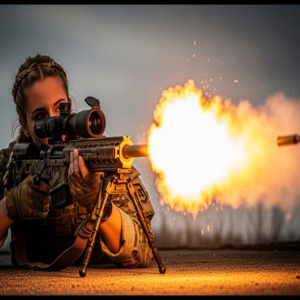
The round hit the rock six inches from Emily’s face. She didn’t flinch. She
pressed her cheek harder against the stock and held her breath. Beside her, Corporal Reyes made a wet sound that
wasn’t a word. Reyes. She kept her eye on the scope. Talk to me. He didn’t
answer. The wind had shifted. She’d called 3 to five knots left. Now it was
something else entirely. And the enemy shooter had already known that. He’d adjusted before she did. She swept the
ridge line. Nothing. Rock, shadow, wind. Then she stopped. The angle of entry,
the patience between rounds, the doctrine behind it. She knew this. She
had been taught it. 3 months earlier, Fort Benning, Georgia.
The bus smelled like diesel and other people’s ambition. Emily Carter sat in the third row with her rucks sack
between her boots and her eyes on the Georgia tree line moving past the window. Pine trees, red clay catching
early light and turning at copper. A hawk riding a thermal above the fence line of Fort Benning’s outer perimeter.
patient and unhurried, watching the ground below with the focused attention of something that understood waiting as
a form of work. She had requested this assignment twice. The first request was
denied. Insufficient field time in current MOS. The second was approved
without comment, which she’d learned in 9 years of Army service meant someone senior had made a call they didn’t want
documented. Approvals without comment were either gifts or tests. She had
learned not to distinguish between the two until she understood the situation fully. She was 27 years old. Two tours
in Iraq. One commenation she didn’t discuss. One incident she discussed even
less. She was here because she was good with a rifle. She was also here because
being good with a rifle had once gotten someone killed who shouldn’t have been.
And those two facts existed simultaneously inside her without resolving into anything clean or
manageable. Fort Benning in August felt like breathing through a wet sock. The
humidity came off the Georgia lowlands and settled on everything, skin, uniform
fabric, the inside of the lungs with a persistence that the body eventually stopped fighting and simply
accommodated. By the time the bus stopped at the gate and an MP checked the manifest against 17 IDs with
methodical efficiency, Emily’s collar had already darkened. She noted the MP’s
precision without comment. Old habit. She cataloged competence the way others
catalog threats, not from suspicion, but from the understanding that competence and threat were deeply related concepts
in her line of work. 17 candidates assembled on a concrete pad outside the
Sniper School building in the August heat. 14 men, three women. She noted the
ratio without emotion. She had been noting ratios like that for her entire
career. A sergeant major read names from a clipboard. Nobody spoke. There was a
particular quiet that gathered in places where people understood the next few weeks were going to cost something
significant and were privately calculating whether they had enough to spend. Emily recognized this quiet from
a runway in Kuwait in 2018 and from a street corner in Mosul in 2020. Then
Master Sergeant Jack Donovan walked out of the building and the quiet changed register. He was not a large man. In
Emily’s experience, the ones who had actually done the work at the highest level rarely were 510, lean with old
muscle rather than gym muscle. The density that came from decades of moving through difficult terrain with heavy
equipment, closecropped gray hair, the kind of tan that came from outdoor
operations across multiple climates over multiple decades with nothing
recreational about it. He moved with a slight drag in his left leg, not a limp.
A limp implied the injury was still winning. This was something else. A
deliberate integration of limitation into movement. You accounted for the
tool. You did not apologize for it. He stood before the group and looked at
each candidate for approximately 2 seconds. When his eyes reached Emily, they stopped for three. She held his
gaze without moving. 40% of you will not finish this course. He said flat
functional the flatness of a weather report, not a threat. That is not a
scare tactic. That is a statistic I have watched hold for 11 consecutive classes.
The ones who leave do not leave because they are bad shooters. Every one of you can shoot. You are here because someone
in your chain of command believes you can shoot under conditions that would make most people’s hands shake so badly
they could not operate a zipper. He paused and let it settle. I do not care
what you believe about yourselves. I care what you do when I am watching and when I am not. There is no difference
between those two states in this building. Clear? Clear, Sergeant. 17
voices ragged. Say it like you mean it or don’t say it at all. The group found
the register. Clear, Sergeant. Donovan nodded once. Acknowledgment of a minimum
threshold, not approval. Get your gear. 6 minutes. He walked back inside without
looking at them again. The barracks smelled like old wood and cleaning solvent and the institutional history of
people who had slept here and left nothing personal behind. Emily took a
top bunk near the window, better air flow, sight lines to the door, proximity
to the fire escape, automatic, not deliberated. Her bunkmate was Staff
Sergeant Tara Voss, combat controller on a joint service crossraining slot. Red
hair in a severe braid. The unhurried confidence of someone who had spent years being the most dangerous person in
rooms where everyone else held the same belief about themselves. Not arrogance.
Arrogance required insecurity as its foundation. Voss simply knew what she knew. Carter, Voss said, extending a
hand. Voss. Firm, brief, no performance. Voss organized her kit with the easy
efficiency of long practice. Everything placed by muscle memory, not thought.
You hear anything about Donovan before you got here? Some my SF contact said he
wrote three chapters of the current field manual. More confirmed long range kills in operational environments than
anyone on active duty or recently retired. She laid out her cleaning kit
in a precise row. Also said he’s been recalled from retirement twice in 8 years because nobody else knows what he
knows. And Emily said, “And he failed his own son out of this course four
years ago.” Voss paused. Don’t know if it’s true, but it’s the kind of story
that gets repeated because it feels true. What makes it feel true? Voss
considered. The fact that you can believe it of him after five minutes of watching him. Whether he actually did it
is almost beside the point. That night, Emily lay on her bunk and stared at the
ceiling joist and thought about a street in Mosul and a figure in a doorway and the half second that preceded a decision
she had spent 2 years trying to correctly understand. She rotated the memory like a problem she was looking
for the right angle on. Faster would have been wrong. slower had been impossible given the situation geometry.
The answer was neither. The answer was something else she hadn’t found a word for yet. I care what you do when I am
watching and when I am not. She was asleep in 4 minutes. Her body had
learned to take sleep when it was available. Conditions were rarely right. Sleep was still necessary. The first
stalking exercise began at 0430. Donovan briefed in pre-dawn darkness
with a red lens flashlight and a topographic map that flexed in the morning wind. 800 meters of mixed
terrain, scrub brush, low native grass, two creek beds running perpendicular to
the objective, 40 m of gradual elevation change, two observers on a rgeline with
binoculars, spotting scopes, and unlimited patience. You have 4 hours,
Donovan said. If I can see you move, you fail the lane. If I can see equipment
shine, you fail the lane. If I can see your barrel against the sky, you fail
the lane. If you cough, sneeze, or breathe in a pattern I can hear at 200
m, I will factor that into your evaluation. He refastened the map. The
ground is wet from last night’s rain. You will be covered in Georgia clay before you are 20 m in. If that bothers
you, there is a bus to the airport every two hours. Nobody moved toward the bus.
A green flare popped against the lightning sky. 17 candidates began moving in whatever direction training in
instinct directed them. Emily did not move. She lay in a shallow depression
behind a clump of native grass she had identified during the brief. 18 in of
profile reduction, wet and cold, and she watched the ridge line. She was looking
for the observer pattern. The two senior NCOs Donovan had positioned, Staff
placement barely visible in the pre-dawn light. She could see the slight rhythmic
movement of optics sweeping left and right with the regularity of train behavior. She began timing 40 seconds
left, 11 seconds right, brief center pause. repeat. She timed it seven
consecutive cycles to confirm stability. People believed they were being random when they were being rhythmic. Rhythm
was habit. Habit was exploitable. She began to move in the left window slow 3
m in 10 minutes. Silhouette below the grass line. Rifle across her forearms in
low crawl configuration. The clay was cold against her elbows and knees. It
soaked through her uniform within the first 100 meters and smelled like iron in old rain. She was not thinking about
the cold. She was thinking about the window. Donovan materialized in her
peripheral vision without sound. 2 m. He was in a low crouch that produced no
noise and had arrived with no detectable approach. Close enough that she could
hear his controlled breathing. Why are you stopped? Pattern recognition, she
said, matching his register exactly. They sweep 42 left, 11 right. I’m in the
left window. A pause. How long did it take you to time it? 40 minutes. Another
pause. Longer. Most candidates move in the first five. They get detected in the
first 10. Already moving away. Silent as fog off water. Don’t get arrogant about
your 40 minutes. Timing the pattern and successfully exploiting it are not the
same skill. She filed that distinction. She made it to 200 meters before
Harold’s scope caught a reflection off her bolt handle in the strengthening daylight and she was called out third
talked about the two candidates detected inside the first 100 meters and the one who had increased pace in the final
approach. when the objective was close enough to feel reachable and patience was most psychologically difficult to
maintain. The correct thing, Donovan said, looking at no one specifically, is
always inconvenient. If it were convenient, it would not require discipline. Two weeks in, Donovan ran
what the candidates had taken to calling the philosophical session. A classroom,
chairs, fluorescent lights humming off pitch, a whiteboard. He stood in front
of them and wrote without preamble. One shot changes a war. Not one battle, he
said, capping the marker. A war. Tell me why that’s true, if it is. Candidates
offered answers in order of confidence. He listened to each with complete neutrality, high value target
elimination, psychological pressure on enemy units, force multiplication.
He nodded without validating which created its own kind of pressure in the room. When it came to Emily, she said
because of what it doesn’t do. He gave her his full attention. Explain.
Indirect fire kills in patterns. Area weapons create destruction across a zone. A single precision shot delivers
something different. Information at lethal velocity. It tells the enemy, “We
know exactly where you are, what you’re doing, and we chose this moment from all
available moments.” She kept her voice level. That’s not just a kill. It
changes how the enemy moves, plans, and what positions they’re willing to hold.
One shot can make a battalion act like they’ve already lost because they understand they’re being watched with
precision they can’t match or defend against. The room was quiet. And the
liability, Donovan said, proportional to the power. Precision requires certainty,
and certainty is a form of arrogance. She found the words carefully. Get it
wrong, and you haven’t just missed. You’ve told the enemy, “Your intelligence is bad. Your shooter
hesitates, your capability is overstated. You’ve handed them information about your weakness at the
moment you tried to demonstrate strength.” The next part came out flatter than the rest. Or you’ve hit
something you shouldn’t have, and that has its own kind of cost. The sentence landed in the room and stayed there.
Donovan held her gaze for a moment that extended past assessment. Then he turned
and wrote on the board. Precision requires certainty. Certainty is a form
of arrogance. Write this down, he said to the room. This is both your purpose
and your permanent liability. Not a tension you resolve, a tension you
manage for the rest of your career. He set the marker down. Anyone who tells
you there’s a resolution hasn’t been doing this long enough. The message arrived on a Tuesday, 3 weeks before
course end. Emily was field stripping her M4A6 at the cleaning station, bolt
out, barrel clear, when Sergeant Major Ror appeared in the doorway and said
Donovan wanted her. She set the components down in their spatial relationship on the mat and followed
without asking why. The administrative building was airond conditioned aggressively, too cold in summer,
retrofitted, and never properly calibrated. Donovan stood over a laptop at the central table. Beside him, a man
in civilian clothes, government fit, neither too casual nor too tactical,
hard eyes, practiced stillness. A folder on the table with Defense Intelligence
Agency routing stamps on the cover. Sit down, Carter. She sat. What I’m about to
tell you doesn’t leave this room without authorization. He waited for her nod. We
have had three KIA in the last 6 weeks at FOB Salerno Helman Province. All head
shot all between 800 and 1100 m. All during daylight transitional periods,
dawn or dusk when light is ambiguous and shadows are long. All single shots, no
follow-up fire. She was already building the picture in her head, not from what
he was saying, but from what the data implied about the shooter’s patience, discipline, and situational awareness.
The ballistic analysis came back 48 hours ago. His jaw was tight in the way she’d learned to read as controlled
anger, not rage, something more disciplined. The methodology is
specific. Not just good shooting, a particular system, a particular sequence
of environmental calculations that produces a distinctive signature in the
shot pattern in impact data. He placed a document in front of her. She recognized
the field manual formatting before she recognized the content. This is curriculum material, she said. This is
my curriculum, Donovan said. Written 2003 to 2007,
classified until 2019, declassified as part of a NATO doctrine
sharing initiative. He sat down across from her for the first time. The act of
sitting changed the register. This was no longer a briefing. Someone is using
my methodology to kill American soldiers. The DIA man cleared his throat. We assess the shooter was
trained using these documents during the Allied access window. Probably Georgian
Army sniper training 2020 or 2021. What we can confirm is the ballistic
signature, the way they calculate, the way they pace shots, the patience
between engagements. Why are you telling me? Emily asked. Donovan looked at her directly. Because
combat background in theater adjacent operations. He paused. And because you
asked me last week after the wind call exercise whether patience was a virtue
or a technique, she remembered asking it standing in the shadow of the rangehouse. The question finding its way
from thought into speech almost accidentally. I want you on the deployment rotation,
Donovan said. Voluntary. You can decline without affecting your evaluation.
Emily looked at the document. Three soldiers dead at ranges requiring extraordinary patience and a specific
studied methodology created to save American lives. When do we leave? She
said he found her that evening at the range running dry fire in the last of the daylight. She was working trigger
control, slow, consistent squeeze, natural respiratory pause. consistent
cheek weld. She heard him approach from 30 meters out, the compression of gravel
under his boot and kept working. He sat on a sandbag 20 m behind her and watched
without speaking. You have a tell, he said. She lowered the rifle. What tell?
Left shoulder drops 2 mm before you break the shot. compensatory, developed
in urban operations where you were indexed against a wall. At short range, it’s invisible. At a thousand meters,
two millimeters of inconsistency in your mount is the difference between a hit and a miss that tells the enemy exactly
where you’re lying. She brought the rifle up, anchored the left shoulder deliberately, drove it into the stock,
ran five dryfire repetitions with specific attention to the contact point
she’d been unconsciously neglecting. Better, he said, not fixed. The habit is
old. 3 weeks of deliberate correction before the new pattern begins to compete with it. She lowered the rifle and
looked at him. The light was going amber at the treeine. When you found out someone was using your doctrine to kill
Americans, what was the first thing you felt? The question sat in the warm
Georgia air. Donovan picked up a piece of gravel and turned it in his fingers,
looking at it with the attention of someone really considering something else. Responsible, he said. That’s not a
feeling. That’s an assessment. No, he agreed. He set the pebble down
carefully. It’s not a feeling. The feeling underneath doesn’t have a clean word. He was quiet. Pride that the
methodology worked exactly as designed. Horror at what it was working on both at
once, which English doesn’t handle gracefully. He stood, the left leg
taking its additional beat. In 40 years of service, I have never felt anything
cleanly. Everything arrives mixed. He moved toward the building. 0530 at the
armory. bring everything for 60 days. She sat in the last of the light and
thought about what it meant to build something well enough that it could be turned against you. The C17 was loud and
cold and smelled like hydraulic fluid and institutional coffee. Emily slept 3
hours over the Atlantic. She woke to turbulence and lay still in the cargo webbing, feeling the aircraft move
through unstable air, and thought about what she was flying toward, not with dread, but with the specific alertness
of a system coming online for a task requiring everything she had. Donovan
didn’t sleep. She woke to find him at the fold down table near the cargo ramp, reading by a green shielded notebook
light, a thick sheath of densely annotated pages. After a moment, she
recognized the format. Afteraction reports, Army standard, his own by the
thickness, decades of them. He was reviewing his own operational history,
turning pages with deliberate care, pausing at some, moving quickly through
others, looking for something. She didn’t disturb him. They landed at Bram,
transited to Kandahar, caught a rotary flight to FOB Salerno as the sun dropped
toward the western ridge line and turned the landscape the color of old brass. Salerno was smaller than the
intelligence brief had suggested. A compact arrangement of Hesco barriers
and prefab structures on a flat plane with mountains rising sharply to the north and east. Terrain that made
overwatch positions obvious. approach routes predictable and a skilled,
patient shooter, very comfortable. Colonel Marcus Webb met them at the landing pad, 50 years old, compressed
with the energy of a man who hadn’t slept adequately in weeks and had stopped hiding it. Donovan, a handshake
that communicated genuine respect. Appreciate you coming. In the TOC, Webb
pulled up the incident map. Three red pins in a rough northern ark. He walked
them through the timeline, the casualty reports, the terrain analysis. Emily
listened and watched Donovan simultaneously. He was not looking at the map. He was looking at the space
around it, the relationships between terrain features, the way elevation and
light angle and distance intersected at the times of each incident. Pull up the
ballistic reconstruction on the second incident. Donovan said Webb brought it
up. Donovan leaned in. His eyes moved across the data with the speed of someone reading a language they were
fluent in. He stopped at a margin notation. There the shooter corrected
for corololis effect at 900 m. Most don’t bother below 1,200. The correction
is small, but this target was moving laterally, which amplifies the apparent
deviation enough to make the correction meaningful. He straightened that
specific calculation. Correcting coriololis for lateral target movement at under a thousand meters is not in the
published manual. Where is it? Emily asked. A supplemental document 2015
NATO SOF cross trainining program classified 12 copies to senior NCO
sniper instructors at Allied commands. He looked at web distribution list 11
copies accounted for. Web said 12th went to a Georgian Army sniper school in
2016. The school was compromised in 2019. Several instructors subsequently
recruited by a private military company operating across Central Asia. The company dissolved on paper in 2022.
We’re still tracking personnel. The TOC was very quiet. Emily looked at the
three red pins. The patience required three separate operations. three
separate windows, the selection of timing, position, target, each a
calculation, and a deliberate choice. “He’s not done,” she said. Both men
looked at her. “Three kills in 6 weeks. Space to avoid establishing a predictable response pattern. That’s a
campaign with a logic behind it, not opportunistic shooting.” She studied the
terrain overlay. He’s making a point, building towards something, or he has a
specific reason to maintain position in this operational area. Probably more than one of those simultaneously.
She looked at Donovan. He’s going to shoot again, and based on the Corololis correction, he knows things about your
methodology that you didn’t publish. He’s been studying more than the document. Donovan held her gaze. So have
we, he said. Now, the mountain air at this altitude tasted like metal and
cold. Emily noticed it the first morning she climbed to the overwatch position, a
flat shelf of rock 2 km northeast of Solerno, accessible only by a goat path
that took 40 minutes to navigate in daylight and twice that in darkness. She
made the climb three times in the first 5 days. twice at night, once in a wind
that came off the peaks with enough force to require leaning into it. From the shelf, she could see the valley
floor where the second KIA had occurred. She could see the supply road connecting Solerno to the district center 8 km
north. She could identify four potential firing positions that offered the
correct combination of elevation, concealment, and egress, exactly the
criteria Donovan had taught her in Benning’s classroom. While Georgia Heat pressed flat against the windows, she
marked all four on her map and cross-referenced each with the incident timings. None of them lined up cleanly.
The shooter had not used any of the obvious positions, which was itself information. Her spotter was Corporal
Danny Reyes, 24, from Albuquerque, with competitive shooting background that
made him technically proficient and an eagerness to call shots that outpaced his certainty. She’d told him on their
first morning together, “Don’t confirm until you’re certain. Wrong confirmation
is worse than silence.” He’d nodded seriously. She wasn’t sure he’d
internalized the distinction yet. Some things required contact to internalize.
Winds 12 knots off the eastern ridge, Rehea said lying prone beside her on
their fourth morning. Variable in the lower valley, hard to call below 800 m.
“I know,” Emily said. She was watching the northern ridge line through her scope, not looking for a specific shape
or movement, watching the way the terrain breathed, where shadows moved in patterns that didn’t match the wind,
where dust lifted at angles that didn’t match the surrounding air. The small
inconsistencies that a patient observer produced without intending to. Nothing
resolved into anything. He’s not there today, Rehea said. the confidence of
someone who’d been watching for 4 hours and found nothing. You don’t know that.
We’ve been here since before dawn. Donovan held a position for 31 hours in
Alanbar Province. Emily said he mentioned it the way someone mentions a commute. She kept her eye on the scope.
The fact that we haven’t seen anything means nothing except that we haven’t seen anything. Reyes was quiet for a
while. Then do you think the guy we’re hunting was actually trained from Donovan’s manual? Yes. That’s messed up.
Yes, she agreed without moving her eye from the scope. She kept watching. The
mountain kept its silence with the particular patience of geography that had been doing exactly this without
interruption for 10,000 years before anyone had arrived to watch it and would
continue for 10,000 more after everyone had left. The fourth casualty happened
was moving between buildings inside the FOB perimeter. a transit he’d made dozens of times at a time of day he’d
crossed that same ground before when the round came. Clean entry, rear left
quadrant of the helmet, 800 m, dawn light, the sun just clearing the eastern
ridge and throwing long specific shadows westward across the open ground. The
shooter had found a position inside the FOB’s established blind spot, a low
ridge to the northwest that their terrain analysis had rated as low threat
because of its angle relative to the primary activity areas and because the elevation differential made it a harder
technical shot. It was not a low threat position. It was a patient position, one
that required waiting for a specific combination of sun angle and target exposure that only existed for
approximately 40 minutes each morning when the light was right and the shadows pointed in the useful direction. Someone
had done that math probably days before the shot. Emily stood in the TOC with
Donovan and Webb and said nothing while the intelligence officer briefed the timeline in the ballistic
reconstruction. She was running the geometry in her own head, the northwest
ridge, the sun angle, the specific window during which Sims’s transit had
been visible from that position. the fact that their observation posture had been oriented entirely toward the
northern ark based on the previous three incidents. He had repositioned while
they were watching the wrong direction. He’d let them establish a focus and then operated in the space that focus
created. He changed position, she said when the brief ended. Donovan nodded.
He’d been nodding slowly the entire time, she realized the slow nod of someone confirming a developing picture
rather than receiving new information. Northwest Ridge, she continued, he moved
there after the first three shots established our attention on the northern ark. He was probably already in
the new position while we were still orienting on the north. She looked at
the map. The terrain made its geometry visible. He used our attention as cover.
He understood what we would watch and move through what we weren’t watching. He used our attention against us.
Donovan said, “That’s in your manual,” she said. “Chapter 7.” A pause, page 93.
Webb looked between them. “Can you find him?” Donovan looked at Emily. She said,
“We need to stop reacting to where he was and start predicting where he’s going.” Donovan set up a session in the
briefing room that evening. He pulled every incident, every ballistic reconstruction, every terrain photograph
and satellite overlay and arranged them on the wall in chronological order. Then
he walked Emily through them with the same methodical patience he’d applied to stalking lane debriefs at Benning, not
pointing at the obvious features, but at the spaces between them, the relationships, the logic. What does he
always have? Donovan said elevation advantage over the target. Emily studied
the incident photographs. Every position is uphill from the engagement point. And
she looked at the terrain. Egress. Every position has at least two concealed exit
routes. He never commits to a position without a minimum of two ways out. She
moved to the next photograph and concealment from the direction he’s shooting from. He’s never silhouetted
against the sky from the target sighteline. What doesn’t he have? She thought about
it carefully. Wind advantage. He’s consistently shooting crosswind or into
the wind, never with it behind him. She looked at Donovan. Why? Speculation. He
said he’s avoiding positions where the wind gives him a natural advantage because those positions are the obvious
ones. A shooter at his level avoids the obvious on principle. She worked through
it or he’s not comfortable with downwind ballistic compensation. It’s a more
complex calculation and if he wasn’t trained on it specifically, the supplemental document I wrote in 2015,
Donovan said carefully, did not include a section on downwind compensation. I
intended to add it in a revision that was never completed. Emily stared at him. So, whoever has that document has a
specific gap, a gap they may not know they have. He tapped the incident map,
which is why he’s consistently chosen crosswind positions, even when downwind
options offered better concealment. He’s steering around a hole in his training.
Donovan sat down. For the first time since Serno, his expression was something close to predatory, not angry,
focused in the way that preceded action. We know something he doesn’t know. We know. We can predict where he won’t go,
Emily said, which tells us where he will. The supply route interdiction the
following morning confirmed the methodology. A convoy attempting to bring fuel and medical resupply from the
district center encountered fire at a narrow pass 6 kilometers north. Two
vehicles disabled, one soldier wounded. The round had clipped the door pillar instead of finding the window, which was
the difference between a casualty and a fatality and was also information about
the shooter’s current position and angle. The firing position was exactly where Donovan’s analysis said it would
be. He was already gone by the time the QRF arrived, but he had been exactly
where they predicted. That was something. Reyes got hit on the 12th day. They were on the overwatch shelf
positioned before first light in the darkness that preceded dawn by nearly an hour. Emily had the scope on the
northern rgel line running her standard scan. Reyes was beside her, his spotting
scope working the same arc. The round came from the southsoutheast, lower
elevation than their position. An uphill shot, technically more demanding,
presenting greater atmospheric challenges, requiring a more complex holdover calculation. She had assessed
uphill shooting from that angle as unlikely. The difficulty toreward ratio
made it a suboptimal choice for a shooter who had other options available.
She had been wrong. She had been wrong about the assumption that an expert shooter would take the easier shot. The
round took Reyes through the left shoulder below the clavicle, exiting cleanly on the backside. It missed his
lung by 4 cm. He didn’t lose consciousness. He made a compressed
involuntary noise and then said, “I’m okay.” in a voice that was doing its
best to be convincing. Emily was on the radio before he finished the sentence. She called for QRF, called in the grid,
pressed her off hand against the entry wound with direct pressure while keeping her firing hand on the rifle and her
eyes sweeping the southern ark. She did not find him. He was already gone. She
told herself the clinical facts. Reyes would survive. The wound was serious but
not life-threatening. If they got him treatment within the hour, which they would, he would be medevaced and he
would heal and he might come back to operational status. She also told herself the tactical fact. She had made
an incorrect assessment and Reyes had paid part of the price for it. She kept the two facts separate. They were both
true. Combining them into something emotional was a luxury she didn’t have on a Ridgeline where there might be a
follow-up shot. She told Donovan when she returned to the FOB with Reyes, sat
in the medical station while the PA worked on the shoulder and spoke in the flat precise language of a debrief. The
uphill shot, her prior assessment of it as unlikely, the angle, the elevation
differential, the additional ballistic complexity that she had calculated as a deterrent. Donovan listened without
interrupting. His left leg was extended at the specific angle it required, and
she could see the fatigue in the set of his shoulders. Not weakness, accumulated
effort. He’d been on terrain that was asking more of his body than his body was currently designed to give. When she
finished, he was quiet for a moment. He practiced the edge cases, he said. Yes,
the gaps in your document, he filled them in himself. He didn’t just absorb the methodology, he extended it. He’s
better than I expected. Donovan said it with the neutrality of an honest assessment, not a concession. That’s not
useful to me right now, Emily said. No, he agreed. It’s not. He looked at his
hands resting on his knees. We need to change our approach. She found Donovan at 0200 sitting
outside the TOC with a cup of coffee gone cold in his hands. She sat beside
him on the sandbag. The half moon had cleared the eastern ridge and was throwing pale silver light across the
mountain faces, turning them to something lunar and abstract. The FOB
was quiet in the specific way of military installations at this hour, not silent, but reduced. Generator hum. a
dog barking twice on the perimeter and then going quiet. The sound of the mountains being what they had always
been. “You’re second-guessing your doctrine,” she said. He looked at the
mountains rather than at her. “I’m asking whether a methodology that can be reverse engineered by an adversary is
worth teaching.” Every methodology can be reverse engineered with enough time
and access. Not every methodology kills four American soldiers when the access
occurs. She let that sit. There was no good answer to it, and she knew better
than to manufacture one. You’ve been treating yourself as the cause since the TOC briefing at Benning, she said,
before you’d even assess the situation. I wrote the document. I authorized the
distribution. You shared methodology with allied forces because it worked and
you believed in the alliance and the mission required it. She paused. That’s not a mistake. That’s a correct decision
that produced an outcome you didn’t anticipate. The gap between those two things is where soldiers die. The gap
between those two things is where soldiers always die. She said that gap never closes completely. It narrows with
better intelligence, better doctrine, better training. It never reaches zero.
She turned to face him. You know that. You’ve known it for 40 years. Donovan
turned his cold coffee cup slowly in his hands. Knowing it and watching it happen
are not the same experience. No, she said, they’re not. They sat in silence
for a while. The generator cycled up. The dog did not bark again. The
mountains held the moonlight with complete indifference to what was happening at their base. He’ll move
again soon. Donovan said he’ll want to apply pressure before we can adapt our
observation posture. I know. I’ve been thinking about positions he hasn’t used yet, ones that fit his criteria, but
that we haven’t included in our threat assessment because they’re outside our habitual observation arc. She spread her
map on the sandbag between them. He leaned in, reading it in the moonlight with the ease of someone for whom map
reading had become a sense rather than a skill. He’ll try to get inside your pattern, Donovan said. After the
Overwatch shelf, after Reyes, he knows you’re the shooter and he’s been observing your observation habits the
same way you’ve been analyzing his. Emily looked at him. How would he know my habits? Because he’s patient enough
to watch you. Donovan straightened. He doesn’t just shoot. He observes. He
gathers intelligence the same way we do. He’s been studying your patterns, your timing, your preferred positions. He
paused. You’ve been watching the terrain. He’s been watching you. The cold came off the mountains with the
directness of something that had been waiting for the temperature to drop. Emily thought, “I’ve been looking in the
right direction and watching the wrong thing.” Webb called her in the next morning with the logistics situation
laid out in plain language. The northern supply route was now effectively closed.
Two more convoy attempts in the previous 48 hours had been turned back by threat assessment. The actual threat didn’t
need to materialize if its presence was established credibly enough to make movement prohibitive. The ghost of the
shooter’s presence was doing the work of several active shooters. FOB Salerno was
running on reserve fuel. Medical resupply at 60%. Ammunition adequate for
current operations but not for a sustained escalation. If the situation continued for another 10 days without
resolution, Webb said they would be in an operational bind that would require either reinforcement or consolidation.
We need this resolved. He said, not pressure, fact. the kind of flat
statement that military officers made when they trusted the people they were talking to and didn’t need to add force
to the information. Emily looked at Donovan. Give us 72 hours. Donovan said,
“You have 60.” Web said outside the TOC, walking toward the briefing room in the
morning heat, Emily said. We don’t have a plan yet. We have the beginning of
one. Donovan said, “What’s the beginning? We know he’s been watching
you, so we let him watch something we want him to see. He pushed open the briefing room door. We show him a
pattern, and then we exploit the pattern we’ve shown him. They spent 12 hours
building the deception operation. Emily ran observation patterns from two established positions, positions she’d
actually used, visible in the terrain analysis, authentic enough to register as genuine behavior to anyone watching.
She moved at specific times, establishing a rhythm that had the right amount of variation to seem natural.
Dawn observation return before 0800. Evening observation from 17:30 to dark.
On the third repetition, she varied the timing by 20 minutes. On the fourth, she shortened the evening window. She was
constructing the impression of a shooter adapting to threat while actually creating a baseline predictable enough
to be calculated. Donovan coached from the TOC via encrypted radio. He’ll need
three full cycles before he commits to the pattern as reliable, Donovan said, possibly four. He’s not going to make
assumptions on insufficient data. He’s patient, Emily said. Patient and careful
are related, but not identical. A pause. He’ll verify before he acts. On the
fifth day, Donovan called her back to the briefing room with new information. A local source, Pashto speaking, 4-year
working relationship with the FOB, verified through two separate intelligence channels, had reported a
single man with a large military-style pack moving through the eastern ridge trail two nights earlier, moving slowly,
resting at intervals. The source described him as western in build and equipment, not tribal, not local
contract worker, not consistent with anyone. The source recognized Emily
studied the red notations Donovan had added to the map. That’s the Kareem Baba
ridge line. Yes. 4 km from any of my established observation positions. Yes.
She looked at him. That’s not where I predicted. No, Donovan said. It’s not
where I predicted either. He paused. It’s where I would have gone. She
understood it immediately. He’s not just using your doctrine. He’s thinking like you. He may have studied more than the
technical documents. Donovan’s voice was level in the way that preceded something significant. In the distribution package
to the Georgian school, there was a biographical and contextual note about
the development of the methodology. Operational case studies. I wrote them
myself. They’re detailed, specific enough to illustrate the reasoning behind the doctrine, not just the
mechanics. He knows how you think. He knows how I thought 15 years ago.
Donovan looked at the map. The question is whether my thinking has changed enough to be genuinely unpredictable to
him or whether what he knows is current enough to still work. Emily thought
about that for a moment. Has it changed? He looked at her. It was a long look.
That’s what we’re about to find out. The night infiltration was Donovan’s concept
and Emily’s execution. They moved at 0100 under 60% cloud cover. Black on
black, no moon visible, the stars present but not useful for the kind of light she needed. Emily had the M4A6 in
the padded drag bag slung across her back, balanced, secured, ready to be
brought up in under 40 seconds from full carry. Donovan moved with her for the first kilometer on the lower terrain,
then fell behind as the gradient increased and his left leg began making its demands. At the point where the
trail turned vertical, he stopped her. Three approach routes to Kareem Baba. He
handed her a GPS overlay. The screen dimmed to minimum. He’ll have
observation on two of them, probably the most obvious two. He’ll expect us to
approach from the east or the north because those roots provide the best cover in the final approach. Which one
won’t he watch? Donovan’s finger found a route on the overlay. A dry creek bed
running along the western face, below tree line, under natural overhead cover,
poor sightelines from above, exposed to flash flooding if the weather changed,
and technically the most physically demanding approach available. It was the worst route by almost every standard
metric. He won’t expect anyone to use it, Donovan said, because it’s genuinely
bad. A bad route chosen deliberately looks different from a bad route chosen through poor planning. He’ll have
eliminated it from his threat assessment. You’re not telling me to use it, Emily said. I’m showing you where he
isn’t watching. The decision is yours. She took the creek bed. 400 m took 3
hours. The rocks were unstable in the darkness, and she moved by feel more than sight. the GPS on her wrist at
minimum brightness, giving her bearing but not detail. She stopped every 20
minutes and lay completely still for five, listening to the terrain, the wind through the rock formations, the shift
of loose shale, the absence of any sound that had human intention behind it. On
the third stop, she heard something distant, stone on stone, the particular
sound of weight shifting on loose rock rather than windm. She froze. She counted. 60 seconds, 2
minutes. The sound did not repeat. Donovan, minimum volume. Copy. Contact
sound possible. Souths southwest of my position. Single occurrence did not
repeat. Hold. She held for 22 minutes in the cold creek bed, breathing slowly,
listening to everything. Nothing repeated, she continued. She reached the
eastern approach to the Kareem Baba Rgel line at 0430. 2 hours until first light. Time enough
to get position before the shooter would logically be active. If Donovan’s read on the pattern held, she moved up the
final approach with the drag catching on rocks. She had to work free with careful, quiet deliberation. At the
crest, she found the hide exactly as Donovan had described in his classroom lectures. Low profile, rear covered by a
natural rock formation that suppressed her silhouette from three directions. Two egress roots visible from the
position. Overhead cover from aerial observation. Scrape marks in the dirt where a body
had lain for extended periods. the depth of the depressions suggesting repeated
occupation rather than a single stay. A shallow excavation for the bipod legs.
Three plastic water bottle caps arranged with unconscious neatness at the right margin of the position. A folded
rectangle of cloth. A shooting mat, she confirmed by texture, tucked into a rock
crevice for retrieval. Empty. She went completely still and assessed. He had
been here recently, the scrape marks fresh enough to retain tool marks that hadn’t yet been eroded by wind. But he
wasn’t here now. He had moved before she had, which meant one of two things. He
had better intelligence on her movement than she’d accounted for, or he had simply been operating on a timeline that
preceded her arrival for reasons unrelated to her. Either possibility was
concerning. She radioed Donovan. He’s gone. Position still warm. 8 to 12
hours, maybe less. A pause that was longer than the tactical situation required. He moved before we did,
Donovan said. Yes. Another pause. She could hear him thinking. Not the silence
of someone with nothing to say, but the specific silence of someone recalculating a picture that had just
changed. Emily stood up carefully and looked at the valley below. The FOB
lights were visible to the west, pale in the pre-dawn. She could see three
natural approach corridors to Solerno. From this elevation, she could see the Shepherd Trail running along the valley
floor, a centuries old path between villages that local families used to move livestock between pastures,
predictable in its timing because the animals set the schedule. And from this elevation, she could see something that
hadn’t been visible on the two-dimensional terrain map. A second ridge line, closer to the FOB than
Kareem Baba, lower elevation, technically a harder shot, longer
crosswind calculation, less concealment from behind, but with direct
unobstructed sightelines to the main gate, the medical station, and the helicopter landing pad. Three high value
targets in a single observation window, and the Shephard Trail ran directly
along its base. Daily traffic, consistent timing, entirely civilian,
entirely legitimate. She understood what he was planning. A shooter approaching
that ridge line along the Shepherd Trail with a large pack, moving slowly, would
be indistinguishable from a local farmer or herder to anyone observing at distance. He could access a firing
position in full daylight in plain sight because he would appear to belong there.
And once positioned, he would have access to three targets of significant psychological and operational value.
Donovan, her voice was controlled. I found his next position. She described
the ridge line, the sightelines, the shepherd trail, the geometry of the
approach. Silence, then the civilian path. Yes,
Emily. Another pause. From where you are, do you have a shot at that ridge line? She was already ranging it. 1240 m
cross wind at her current elevation. The full read was incomplete. She hadn’t had
time to properly assess the wind gradient between her position and the target. The Shepherd traffic would begin
at first light, which was 90 minutes away, possibly less. The shot is
possible, she said. Not confirmed. I need more wind data. It’s a long shot
under incomplete conditions. I know. If you take it and miss, you alert him and
he relocates. We lose the position intelligence. He moves to something we
can’t predict. I know. If you wait, he reaches that ridge line with civilian
cover and the shot becomes legally and operationally impossible. I know. She
lay down behind the M40 A6, settled her cheek against the stock with a consistency of 10,000 repetitions,
range the ridge line again, 1,243 m. The wind up here was northwest, 8
knots, but she could see from the dust movement in the valley that the wind down there was different, variable in
the transition zone between the ridges, running in a direction she couldn’t confirm from her current position. She
thought about the classroom. Precision requires certainty. Certainty
is a form of arrogance. She thought about Mosul, the figure in the doorway,
the half second. She thought about what she’d said to Donovan that afternoon in August in a classroom with fluorescent
lights humming and a whiteboard behind her. I’m not taking the shot, she said.
A beat on the radio. Explain your reasoning. 1,200 m plus unread wind
from the scope. That’s not a precision shot. That’s an educated guess at a
range that doesn’t allow for educated guessing. If I miss, I lose him and
possibly warn him. And the wind transition means I might hit something else. She kept her voice level. I’m not
taking that shot. The radio was quiet. Not the silence of disagreement,
something else. He won’t approach along the Shepherd trail in daylight, she said, working through it as she spoke.
He’ll use it as cover for an approach in low light, before first light, or at
last light, which means he’s either on approach right now, or he comes in
during the evening window, or he’s already positioned and waiting. If he’s
already positioned, we have a different problem. She was already moving to her feet. I’m not going to sit on this ridge
line and wait for him to reach a position that gives him every advantage and gives us nothing. I’m going to find
him on approach. A pause. Then Carter. Sergeant, that is not what I taught you.
My doctrine teaches you to hold position and acquire the target, not to maneuver
toward it. Your doctrine also teaches that patience is about waiting for the right moment. She said, not waiting in
the right place indefinitely. I’m done waiting in the wrong place. She was moving, keeping low along the Karim Baba
crest line heading north toward the descent. I’m going to hunt him. The
longest pause yet. Then use the secondary creek drainage as cover. It
runs parallel to the Shephard Trail and brings you within 400 meters of the lower ridge line. At 400 m, you’re
inside your confirmed engagement envelope and out of the worst of the wind transition zone. She stopped.
You’re not telling me not to go. She said, “No,” Donovan said. “I’m not a
beat that had weight in it. I’m telling you how to do it right.” She moved differently now. Not the careful
Something older. The particular movement that emerged when the hunter stopped thinking about the target and started
thinking like it. Where does it want to be? What does it need? Where will it
feel safe? She descended the eastern face of Karim Baba by feel, keeping her
weight back on the slope, testing each footfall before committing. The drag bag
rode tight against her back, balanced. If she fell, the rifle would survive.
That was the priority, and she did not argue with the priority. The creek drainage Donovan had identified was 30 m
below the Shepherd trail, invisible from it, running between walls of compressed shale that muffled sound and broke line
of sight in both directions. She found the entrance in the darkness by almost stepping into it, the ground simply
dropping away into a channel 2 m deep and barely wide enough for her shoulders
and the drag bag. She lowered herself and started moving north. The drainage
smelled like old water and mineral deposits in the specific cold stone smell of a place that saw sunlight only
briefly each day. She moved in a low crouch, the rifle across her forearms in
the drag position, placing each foot with deliberate care on the compressed shale floor. The shale gave under
pressure rather than cracking. Useful radio check, Donovan said. Solid copy.
Minimum volume. Lips close to the handset. Wind at the valley floor is 4
to 6 knots souths southwest. Variable dust movement near the lower ridge line
suggests it’s picking up below the rock shelf. Account for it. Copy. Emily. A
pause with weight in it. He’s good. Don’t underestimate the approach. I
know. I’m saying it anyway. another pause. It’s what I say when I’m worried
and I don’t have a better way to say it. She almost smiled. She did not smile. It
was not the moment, but she filed it away. The image of Jack Donovan, 62
years old with a bad leg and 40 years of operational history, admitting to worry
in the language of someone who’d spent those 40 years not having words for what he felt. Everything arrives mixed. She
kept moving. The drainage curved north and then west. Following the old water logic of the mountain, and after 40
minutes of movement, she felt the terrain change. The walls shallowed, the
floor widened. The ambient sound of the open valley returned around her in stages. She went to her stomach. She
inched forward until she could see over the drainage lip without exposing her silhouette. The lower ridge line was 280
m to the northwest, closer than she’d calculated. She covered more ground than
the GPS suggested, probably because the drainage curved had taken her northwest
as well as north. The ridge line was a rough shelf of darker rock 20 m wide
with natural backs stop cover from a boulder cluster that would suppress sound from below and provide visual
concealment from the valley floor. She studied it for 3 minutes, then four,
then five. On the fifth minute, she saw him. Not clearly, not a full figure, a
shape at the left edge of the boulder cluster that had the specific quality of
controlled stillness, the outline of something deliberately motionless, which
was paradoxically more visible than natural movement. Because nothing in nature achieved the sustained, precise
immobility of a trained human being choosing not to be seen. He was already
in position. He was ahead of her timeline. Either he had moved faster than she’d predicted or he had been in
position longer than her reconstruction of his movements suggested. Both options
meant he was operating at a higher level than her current model accounted for. She filed that assessment and did not
let it become fear. She went completely motionless. She radioed Donovan at
minimum volume, lips against the handset. He’s there. Left edge boulder
cluster already down. Range 280. Wind
southswest 5 knots at my position. Probably less at his. The boulder cluster will break it
on his side. A pause in which Donovan was doing the complete calculation, not
just the math, the full operational picture. Range, wind, elevation
differential, her position, the shepherd trail below, the FOB lights to the west,
the angle of approach, the egress geometry if the shot was missed or the target was missed. You have the shot, he
I know a shape in a boulder cluster. Military stillness. A drag bag she could
now see against the rock with the tags in a military format she could identify in style if not in specific number. He
was in the prone position. She was certain from the angle of his body relative to the rock shelf in front of
him. The way his silhouette compressed against the ground. He was waiting for light. He was waiting for the FOB to
show him targets. And there was still a shepherd on the path below. An elderly
man with two goats moving westward at the pace that goat set, which was their pace and not his. He would be out of the
impact zone in approximately 7 minutes. Possibly less if the goats cooperated,
possibly more if they didn’t. She watched the shape in the boulder cluster. She thought about Mosul. She
thought about the figure in the doorway, the half second, the decision that had been technically correct and humanly
imperfect, and that she had been carrying for 2 years in the particular way of something that was not going to
put itself down voluntarily. Precision requires certainty. Donovan,
still minimum volume. The supplemental document from 2015.
Does it include protocol for target confirmation in low light conditions?
Yes, a beat. Why? He was trained to do a pre-engagement terrain sweep to confirm
isolation before he shoots. It’s in the document. He’ll sweep the approach terrain before he engages the FOB. She
kept her eyes on the shape. When he sweeps right, his scope face will catch the ambient light from the eastern sky.
Even minimal, it’ll reflect. Silence on the radio. That’s a very thin
confirmation threshold, Donovan said finally. It’s what the conditions give me. A longer silence. She could feel him
working through it. the ethics, the doctrine, the risk calculation, the fact
that he was two kilometers away with a bad leg and a radio tracking this on encrypted audio while she was 280 m from
the man who had killed four American soldiers using his methodology.
Your call, Donovan said, I’ve given you everything I have. The decision is
yours. She breathed out slowly, completely. The shape in the boulder
cluster moved. A micro adjustment of the shoulders. The preparatory shift of a
shooter settling into final position, confirming cheek weld, confirming stock
contact. As the shoulders rotated through the adjustment, the scope face caught the first gray light coming off
the eastern ridge. A flash, brief, unmistakable. She saw the reticle reflection, the
bipod legs against the rock shelf. The drag bag tag in military format, close
enough to read the style, if not the number. A man in a prone position with a long rifle waiting for light to bring
him targets. Confirmed. She held. She held for 3 minutes and 40 seconds. This
was not in any doctrine she had been taught. The manual addressed when to shoot, the conditions, the confirmation,
the wind calls, the range data, the moment when all factors were within acceptable tolerances. It did not
address the specific circumstance of having a confirmed target in your reticle at 280 m and choosing to wait.
She was waiting because she needed to understand what he was going to shoot before she stopped him. A body and a
rifle told Web’s people that the threat was neutralized. They did not tell them whether there was a network, a handler,
a secondary shooter, or a contract that would simply be fulfilled by the next
person in line. She needed him to demonstrate his target selection, to
reveal his operational priority before she ended the operational question. She
also needed the shepherd to clear the impact zone. The shepherd was still moving. One of the goats had stopped to
investigate something in the path with the complete commitment of an animal that had no schedule and no awareness
that schedules existed. The old man was coaxing it forward with the patient
persistence of someone who had been doing exactly this for many years and had stopped expecting speed from animals
or from anything else. Move, she thought without urgency. Take your time. Just
move. The shape in the boulder cluster went completely still. Final position.
He had identified his first target. She could tell from the specific quality of his stillness, the last micro movement
before a shot, the sessation of all the small adjustments of positioning and
settling into something absolute. He was going to engage the main gate. She could
read it from his body angle relative to the FOB geometry below. The shift change
was his target window. She had 2 minutes, maybe less. The goat moved. The
shepherd moved with it. They rounded the western curve of the path and passed behind an outcropping that put 50 m of
solid rock between them and the ridge line. He’s about to engage, she told
Donovan. I know. I can see the gate feed from the TOC. Webs held the shift
change. A pause. When you’re ready. She hadn’t known Webb was holding the shift
change. Something loosens slightly in her chest. The specific relief of
discovering that the people around you had been thinking and moving while you were executing. That you were not
operating alone even when you were operating alone. She put the reticle center on the shape in the boulder
cluster. She made her final wind call. Souths southwest four knots with the
boulder cluster reducing it at his position. Adjusted accordingly. She read
the range 278 m. She confirmed her cheek weld, checked her left shoulder,
released the compensation she’d been unconsciously holding. She thought about the classroom in August, the fluorescent
lights. One shot changes a war. She thought about Donovan saying, “I care
what you do when I am watching and when I am not.” She thought about Mosul. She
acknowledged it, the full weight of it, the permanence of what a trigger pull meant. The fact that this weight would
not leave and was not supposed to leave. And then she set it to one side, not
down, to one side. It would be there when she was done. She broke the shot.
The round hit. She knew it before she heard it. The shape in the boulder cluster dropped in the specific way of a
body going suddenly inert. Not a fall, not a dramatic collapse, simply a
sensation of all the controlled, deliberate stillness that had preceded it. One moment it was a person choosing
to be motionless. The next it was weight obeying gravity with no will behind it.
The distinction was absolute invisible even at this range. Emily held her
position. She stayed down for four full minutes, sweeping the surrounding terrain in slow, deliberate arcs. She
was looking for a secondary shooter, a spotter, a reaction element, any
indication that he had not been operating alone. She checked the ridge line to his east and west. She checked
the slope below the boulder cluster. She checked the sheepard trail, now empty,
and the approach drainage she’d used. She checked the sky. Nothing moved with
human intention. “Impact confirmed,” she said into the radio. The words came out
level and controlled. She noted her own steadiness with the distant clinical interest of someone monitoring a system.
She could hear the TOC in the background of Donovan’s transmission. Voices,
movement, the controlled activation of a command element that had been waiting and held breath and was now moving into
action. Then his voice close. Copy. Are you clear? Clear. Stay down five more
minutes, then fall back on the drainage. Copy. She stayed down for seven. Donovan
had taught her in the first week at Benning. The number you give yourself is always optimistic. Add 30%. She had
internalized it as a number. She applied it as a principle. When she finally
moved, she went at the same pace as the approach. Not because the primary threat
remained, but because threat geometry didn’t change based on what you just done. There could be observation she
hadn’t detected. She moved back into the drainage and traveled 200 meters north
before she allowed herself to stand fully upright. The sun was clearing the eastern ridge. It turned the shale walls
of the drainage gold and amber and through long shadows pointing west. She
followed the shadows out of the drainage and began the return movement toward the FOB. And she thought about almost
nothing for the 45 minutes the movement required. She let the terrain do the thinking. She put one foot after the
other on the rocks and the packed earth and the goat trail that eventually connected to the gravel road that led to
the FOB gate. She thought, “This part is done.” Then she thought, “This part is
done.” Not all of it. There was a difference, and the difference mattered.
The QRF reached the lower ridge line 40 minutes after she called it in. Emily
was back at the FOB by then, in the briefing room with a cup of coffee she was drinking without tasting and her
M4A6 field stripped on the table in front of her. She was cleaning it not because it
needed cleaning urgently, but because her hands needed something to do while her mind processed the morning. Cleaning
was automatic. The process ran on one track while everything else ran on another. The QRF sergeant radioed his
initial assessment at 0712 1 KIA male approximately 40 to 50 years
western physical profile militaryra equipment suppressed boltaction rifle
custom bipod laser rangefinder weather meter full optics suite. No
identification documents. No phone or communication device consistent with a
professional operating in denied status. Colonel Webb looked at Donovan. Donovan
was standing at the map with his arms crossed, looking at the northern rgeline positions they had spent two weeks
watching. The wrong positions, as it turned out. But that had been part of the design, too. Rifle, Donovan said.
The QRF sergeant described it in detail. Donovan listened with his eyes still on
the map. Georgian manufacturer military contract post208
production configuration. He looked at Web. That confirms the supply chain and
the timeline both. We need biometrics before we can confirm identity. Webb
said, “Give us 72 hours. You’ll get a name.” Donovan said the name will trace
somewhere. That somewhere will trace to whoever contracted him. He paused. That
part is yours to work. The threat here is resolved. Webb looked at Emily. Good
work, Sergeant Carter. She nodded in the way that communicated professional acknowledgement without either false
modesty or performance of confidence. Then she looked back at the barrel she was running the bore brush through. Webb
left. The TOC staff filtered back to their stations. After a moment, Donovan
sat down across the table from her and watched her work without speaking. She ran the patch. She ran it again. She
held the barrel to the light and checked the boar with the headlamp. The boar was clean. She checked it again. You held,
Donovan said. She set the barrel section down. I held. Confirmed shot at 280 m.
You held for nearly 4 minutes. The shepherd wasn’t clear. That’s one
reason. He rested his forearms on the table. What were the others? She looked
at him. Intelligence value. If there was a network or a secondary element in
theater, taking him before he committed to an action meant Web’s people would have a body with no operational context
to work from. The site exploitation, the equipment signature, the biometrics, the
target selection, all of that required him to demonstrate intent before I ended
it. She picked up the barrel again. A dead shooter with no confirmed operational picture is worth less than a
dead shooter who just revealed exactly what he was doing and how. Donovan
nodded slowly. And she ran the patch again. and I needed to be certain. Not
probable, not highly likely, certain. She set the patch down. After Mosul, I
made a rule for myself. If the tactical situation permits waiting for certainty,
I wait. If it doesn’t permit it, I accept the risk and act. But if it
permits it, you wait, he said. Yes. He was quiet for a long moment. The
briefing room was quiet around them. the generator hum coming through the walls.
The distant sound of the QRF helicopters returning to the pad. The ordinary
sounds of a forward operating base that had just had something resolved that had been unresolved for 6 weeks. In 40
years, Donovan said, I have never had a student hold a confirmed shot at under
300 m for operational and confirmation reasons and still make the follow-on
shot clean. He paused. I don’t know if that’s something I can teach. You did
teach it, Emily said. You taught me that patience is about the right moment, not
just the right place. She reassembled the lower receiver. I just applied it to
a situation you didn’t design the lesson for. That’s the definition of mastery,
he said quietly. She looked up at him. He was not being rhetorical. He was
stating an assessment. She looked back at the rifle. Let’s not get ahead of ourselves. The name came back in 61
hours. Alexi Marchuk, Ukrainian national, 43 years old, former military
trained through the Georgian Army Sniper Program in 2020 under the NATO capacity
building initiative. Recruited by a private military company called Sentinel
Arc Solutions in late 2021. The company dissolved on paper in 2022, but its
operational network remained intact, operating through a constellation of contracting shells across Central Asia
and the Middle East. Marchuk’s prior operational record, reconstructed through biometric databases and allied
intelligence sharing, showed 11 confirmed kills in three theaters before Afghanistan. All precision, long range,
all attributed post hawk to various insurgent groups. Attributions that had never fully satisfied the intelligence
analysts who wrote them, but had been accepted because the alternative raised uncomfortable questions about the origin
and training of the shooters involved. Webb briefed it in the TOC with the DIA analyst, who had been quiet in the
background since Benning and was now doing the opposite. and two additional intelligence officers who had flown in
from Bram overnight. Sentinel Ark is the third private military company in 18
months we’ve tracked exploiting advanced sniper doctrine derived from allied
training programs. The analyst said Marchuk’s operational profile reconstructed from site exploitation
trajectory analysis and the pattern of his prior confirmed engagements is
consistent with at least two other source documents beyond the Georgian school materials. He was a student who
studied broadly. Donovan stood at the back of the room with his arms crossed. Emily watched him. She could see what he
was doing with his face. the specific work of processing something that had ethical weight and no clean resolution.
Not guilt exactly, something more complicated. The recognition that the problem was
larger than the specific instance they just resolved. It’s not just your manual, Emily said to him quietly after
the brief when the room was clearing. No. He looked at the door the DIA analyst had walked through. It’s the
doctrine sharing framework at a systemic level which is the correct policy.
Sharing methodology with allies makes the alliance genuinely stronger. It also
creates risk surface that we haven’t been adequately tracking. He paused. The
policy isn’t wrong. The monitoring of where the doctrine goes after distribution, that’s what’s inadequate.
Can it be fixed? Better than it is now. He looked at her with the particular
directness that preceded something important. That’s going to require people who understand both sides of the
problem, the creation and the exploitation. People who’ve been trained in the methodology and have seen what it
looks like when the methodology is turned against them. He paused. People who can sit in a briefing room
and know from personal experience exactly what the other side knows. She
understood what he was saying. She didn’t respond to it directly. There would be time for that conversation, and
this was not the moment for it. The moment required something else. Not decisions about what came next, but the
acknowledgment of what had just been completed. “You want coffee?” she said.
He looked at her. “Yes,” he said. “I want coffee.” They flew out of Serno on
a Thursday. The helicopter banked east over the mountains as it gained altitude. And Emily watched the ridge
line scroll past below through the cargo window. The Kareem Baba shelf. The
Shepherd trail along the valley floor catching the morning light. The secondary creek drainage she’d moved
through in darkness. The lower ridge line with its boulder cluster which from this altitude was just rock. one
formation among many, identical to the geography around it in every observable
way, except for what had happened there four hours ago. She looked at it until
the helicopter’s angle took it out of her sighteline. Donovan was across from her in the cargo hold, head back against
the webbing, eyes closed. His left leg was extended at the angle it needed. Not
quite a natural position, a specific accommodation. She had watched him move
through this terrain for 2 weeks. The extra weight each slope demanded. The
specific technique he used on loose rock to minimize stress on the old shrapnel damage. The things he had never
mentioned, never used as a reason or an excuse, never let anyone see as a
limitation. He had simply accounted for them and kept moving. She thought that’s
not in any manual either. She thought about what was in the manuals and what wasn’t. The doctrine captured the
mechanics, the calculations, the positions, the confirmation protocols,
the wind calls. It captured the what and the how. It did not capture the why that
operated underneath those, the weight that made the why matter. The reason you
waited for certainty, the reason you held a confirmed shot for four minutes in the dark, because a shepherd was
still on a path below, the reason the difference between a hit and a wrong hit
was not a technical problem, but a moral one with technical dimensions. None of
that was in any document. It was in proximity. It was in sitting beside
someone at 0200 while they turned a cold coffee cup in their hands and told you
that everything arrived mixed. It was in watching someone manage a bad leg across
difficult terrain for 2 weeks without once making it someone else’s problem.
The helicopter moved south through clear morning air and the mountains fell away and Afghanistan became a series of brown
shapes and then a general abstraction and then nothing visible at all. Bram
smelled like jet fuel and institutional food and the particular staleness of a
place processing too many people in too little space. They had a 6-hour layover.
Emily found a stretch of wall between a vending machine and a fire door, sat on the floor with her back to the concrete
and her knees up and looked at the middle distance. The terminal moved around her. soldiers in transit,
contractors in civilian clothes, the occasional family with a specific look of people trying very hard to appear
normal in a place that was not normal. Donovan found her 20 minutes later. He
assessed the floor, made his calculation, and lowered himself down with the careful economy of someone who
had long since made peace with what his body required. They sat without speaking
for a while. A flight was announced over the PA. Neither of them moved. Can I ask
you something? Emily said, “You can ask. In the TOC, when Webb gave us 60 hours,
you asked for 72 first. Did you actually think 60 was enough?” He considered the
question. “No,” he said. “I thought we needed 90.” “Why did you say 72?”
“Because asking for 90 would have told Web we didn’t have a plan. asking for 72 said we had a plan with a
margin. The margin was a fiction, but the plan became real because we had to
make it real in 60 hours. He paused. Sometimes the deadline is the plan. She
thought about that. Is that in your manual? No. Should it be? He considered
seriously. The things that should be in the manual and aren’t are usually the things that can’t survive being written
down. Doctrine captures what can be repeated, what can be taught in a controlled environment and replicated
under stress. It does not capture what you did in that drainage. The moment
when you read the terrain in the situation and made a decision that my doctrine would have counseledled
against, but that was correct. He looked at her. I cannot write that. I can only
be near it until the proximity is enough. Emily looked at the terminal ceiling, exposed duct work, fluorescent
panels, a long water stain that had dried into the shape of a river on a map or a ridge line depending on the angle.
Donovan, she said, “Sergeant, the judgment, the part that isn’t
transferable through text,” she paused. “Where did yours come from?” He was
quiet. This was different from his other silences. Not calculating, not
assessing, something else. The quality of silence that preceded something true
being said for the first time. A village in Kuwait, he said. 1991.
I was 28 years old and I had a perfect shot on a man who I had identified as a
threat based on what I could see at 600 m in transitional light. He paused. I
didn’t take the shot because something felt wrong that I could not articulate at the time. It was not doctrine. It was
not training protocol. It was something in the pattern of his movement that didn’t match my threat model. The way he
was carrying the object, the direction of his attention, something I processed below the level of conscious thought. He
was quiet. He was digging a well, Donovan said. The object was a shovel.
Emily said nothing. I have never told that to a student before. Donovan said, “I was not certain
it was useful. I thought it might read as a reason not to shoot rather than a reason to be precise. A story about
hesitation rather than a story about the thing beneath hesitation.” He looked at
her. But you said in the classroom that precision requires certainty and that certainty is a form of arrogance. And
that is exactly what I felt in Kuwait in 1991. and I had never had a word for it
before. She held that the civilian in Mosul. Emily said it was the first time
she had named it directly to another person since it happened. It wasn’t a misidentification.
I identified correctly and the situation changed in the interval between identification and the shot. He moved
into the doorway. He wasn’t a threat. He was someone who opened a door at the
wrong moment. The investigation found the shoot within doctrine
justified under ROE technically correct. She paused. Technically correct in a man
who opened a door at the wrong moment is dead. Donovan said nothing. I’ve been
asking myself for 2 years whether I needed to be faster or slower. She said
whether I should have compressed the decision cycle or extended it. I’ve been treating it as a technique problem. She
looked at her hands. It’s not a technique problem. No, he said quietly.
It’s a weight problem. You carry it correctly or you don’t. And carrying it
correctly doesn’t mean it gets lighter. It means you get stronger. She paused.
It means the weight becomes part of your structure instead of something you’re working against. Another flight was
announced on the PA. Their flight. Neither of them move for a moment. Then
Donovan began the process of getting himself off the floor. The specific sequence his leg required. The sequence
he had never made anyone else’s problem. Emily stood first and offered a hand without making anything of it. He took
it without making anything of it. They walked toward the gate. Carter, he said,
“Sergeant, for what it’s worth,” he didn’t look at her, just walked with the
rhythm his leg made. the man who opened the door in Mosul. He would not want you
to stop pulling triggers. He would want you to pull them correctly. She said nothing. You already know that. Donovan
said, “I’m saying it anyway. It’s what I say when I’m worried and I don’t have a better way to say it.” Fort Benning in
October was different from Fort Benning in August. The humidity had broken. The
tree line had changed. The native pines stayed green, but the hardwoods along the creek beds had gone amber and rust
and a particular deep red that looked in the right afternoon light that had been
set on fire and was burning slowly and completely at peace with burning. Emily
noticed this from the window of the administrative building where she was completing her afteraction paperwork 3
weeks after returning from Serno and she thought, “I didn’t see the trees when I arrived. I wasn’t looking at them. She
had passed. She’d expected that. Of the 17 who’d started, 11 had finished. Two
fewer than Donovan’s 11-year statistical average of the 40% attrition rate
holding. The two additional losses were probably explained by the disruption to the training schedule that Donovan’s
temporary departure had caused, though the record would show no such explanation. Donovan had returned to
Virginia, retired status officially for the third time. She’d received two
emails from him in 3 weeks, both brief, both containing information that was
technically unsolicited, but precisely relevant to things she was currently working through. The first was a
reference to a wind compensation study from the Army marksmanship unit that addressed a gap in the cross- wind
calculation protocol she’d identified during the Solerno deployment. The
second was a three-line observation about inconsistencies in how different sniper schools were teaching the
Corololis correction in lateral movement scenarios. She had responded to both
within the hour. The paperwork she was completing was the formal operational afteraction report, standard army
format, objective and third person and deliberately incomplete in the ways that
operational security required. She had also written a different version, a
personal version in her own notebook in the particular cramped handwriting she
used when she was writing for herself rather than for a record. She had burned that notebook the day she completed it,
which was not a doctrine recommended records management procedure, but had served its purpose. Beside the formal
AAR on her desk, was a second document, a position recommendation form. The
position was newly created. Senior sniper instructor with additional duties in doctrine, security, and allied
training risk assessment. US Army Sniper School, Fort Benning, Georgia. It had
been newly created for 11 days, which was exactly how long it had taken Web to
route the proposal through the appropriate channels after Emily had submitted it. She had not consulted
Donovan before submitting it. She had written it herself, gotten Webb and two
other senior officers to co-sponsor it, and routed it through the system before she told anyone that the position
existed. She wanted it to be an established fact before it became a
conversation. She knew he would say yes. He would make a performance of considering it carefully. He would raise
practical objections. The leg, the age, the fact of being recalled twice
already, the question of whether the work was his to do anymore. He would use
the word unnecessary at least once, possibly twice, and then he would say
yes because the work wasn’t finished because the gap between doctrine and
doctrine security was still open. Because there were people coming through this school who needed the proximity and
the proximity was the thing that couldn’t be written down. And the thing that couldn’t be written down was the
only thing that actually transmitted what needed to be transmitted. She signed the recommendation form and put
it in the routing envelope and set it in the outgoing tray. Then she picked up her rifle and went to the range. The
accepted after a 40-minute conversation with the school’s commanding officer that had included the phrase, “You’re
exactly what this course needs right now, delivered without embellishment by someone who had already decided and was
informing rather than persuading.” Donovan stood at the front. He had
arrived 2 days earlier, driving himself from Virginia in a truck that had more miles on it than made sense for someone
who officially described himself as retired. On his first morning, he had
stalking exercise without saying a single word to any of them. The candidates had found this unnerving. The
other instructors had found it familiar. That evening, he had found Emily at the range house after the day’s evaluations
were logged. He had looked at her the way he looked at everything with complete attention and no excess. The
third candidate in the first stalking lane, he said she has your tell. Left
shoulder drop before the break. I’ve been watching it develop. Emily said,
why I’m working it. He had nodded and gone to find his quarters. Now he stood before 11 newly certified US Army
snipers in the November air. He looked at them with the expression Emily had spent 4 months learning to read.
Something between respect and warning. You have been given something that costs
more than you currently understand, and the cost will arrive at times you don’t expect. He spoke briefly. He was not a
graduation ceremony man and made no effort to become one. He said the
certificate they were receiving was not a credential. It was a starting point.
He said the most dangerous moment in a sniper’s career was immediately after qualification when confidence exceeded
experience. He said time was the only antidote to that gap and time could not
be compressed or substituted. Then he looked toward the back of the formation.
The instructor standing at the back of this formation was 8 months ago a candidate in this course. She completed
the course under conditions I cannot discuss in a public setting and did something I would not have predicted
possible under those conditions. He paused. She also told me something in a
classroom in August that I have thought about every day since. She said, “Precision requires certainty, and
certainty is a form of arrogance.” Another pause. That is the most accurate
single description of this work that I have encountered in 40 years of doing it. I want you to carry it. Emily stood
in the back of the formation and kept her face neutral, which required some effort, but was within her current
capabilities. Afterward, in the parking lot, Donovan stopped beside her on his way to his
truck. They stood in the November light, which was thin and clear and threw long
shadows. “The recommendation form,” he said. “You got it. You submitted it
without telling me.” “Yes, I would have told you it was unnecessary.” “I know,”
she looked at him. “And then you would have said yes.” He was quiet for a moment. You’re more arrogant than you
were in August. I’m more certain,” she corrected. “There’s a meaningful
distinction.” He made a sound that was close enough to a laugh that the distinction didn’t matter much. He
opened the truck door and stood with one hand on the frame. “I’m going to need the curriculum documents by Monday. I
want to restructure the environmental compensation section. It’s missing downwind scenarios, and that gap has
been in the material long enough. You’ll have them Monday. And I want to add a
unit on doctrine exploitation risk. How allied sharing can create adversarial
capability. How to recognize your own methodology being used against you. He
paused. It’s not in the current curriculum. I’ve been drafting it, Emily
said. Serno, he looked at her. Of course you have. He got into the truck with a
careful economy of someone who had made peace with what his body required and didn’t make anyone else participate in
that negotiation. Monday, Carter. Monday, Sergeant. She
watched him drive out of the parking lot and turn east toward the highway and disappear into the treeine where the
autumn hardwoods were still burning slowly with their particular patient fire.
She ran the range alone that evening. No formal evolution, no data cards, no log
book, no wind calls recorded for anyone’s review. She set up prone on the
thousandy line in the last of the afternoon light with the M4A6. And she
breathed in the way she’d been taught. Respiratory pause natural, not forced,
not held breath. Held breath created pressure and pressure created tremor.
and tremor at a thousand yards created outcomes that defeated the purpose. Natural pause in the space between
exhale and the next inhale where the body was momentarily at rest in its own rhythm. The reticle floated over empty
downrange space. No target, nothing to acquire. She let it float and she
watched the floating. the small involuntary circles that even the best shooters could not fully eliminate
because the human body was not a machine and had never been one. And the gap between machine precision and human
precision was where everything interesting lived, where the discipline was, where the judgment was, where the
weight was. She thought about what she’d carried to Fort Benning in August. two tours in Iraq, one commenation, one
incident. A particular hesitation that she had spent two years misdiagnosing as
a flaw in her technique when it had actually been a correct instinct operating on information that had
arrived fractionally too late to be useful. She thought about what she was carrying now, the same two tours, the
same commenation. The incident still there, still permanent, still the weight
it had always been, but sitting differently inside her now. Not a wound
she was navigating around, a scar she was navigating with. part of the structure rather than an obstacle to the
structure. Marchuk, the boulder cluster, the four minutes, the shepherd and his
goats rounding the rock outcropping, the optic flash in the pre-dawn gray, the
shot that she had taken with full certainty and full weight and full understanding of what it meant and what
it cost. Donovan at Bram on the floor of the terminal talking about Kuwait in
1991. The man with the shovel, the instinct he hadn’t had a word for until August. He
would not want you to stop pulling triggers. He would want you to pull them correctly. She thought about the
candidates who would arrive at Fort Benning in January. 17 of them probably,
maybe 18. men and women who could shoot, who’d been sent here because someone in
their chain of command believed they could shoot under conditions that made most people’s hands shake badly enough
that they couldn’t operate a zipper. She would be the one who told them that. standing in front of them at 0530 with a
topographic map and a red lens flashlight in the Georgia pre-dawn. She
thought about what she would say in the spaces between the doctrine in the classroom at the range. In the moments
when a candidate did something they hadn’t been taught, some instinct coming through that was better than the
training that had been developed in places the training couldn’t reach. and she had to find a way to name it so they
could find it again deliberately. She already knew what she would start with. Precision requires certainty. Certainty
is a form of arrogance. She would start there. She would always start there. The
light failed. The thousand-yd line went from visible to theoretical, existing as
a known fact rather than an observable one. She held the position for another 8
minutes in full darkness, which was itself a kind of training. The body learning to be still, not because it
could see the target, but because stillness was the habit, and the habit was the foundation, and the foundation
was what held when everything else was stripped away. Then she rose, cleared the rifle, slung it, and walked back
toward the building in the dark. Six months later, a candidate named Reyes
completed the stalking exercise. Not Corporal Danny Reyes from Albuquerque. He had healed fully. She’d gotten a
brief email that said, “Shoulders good, Sergeant. Thank you.” With nothing else appended, which she’d appreciated for
San Antonio, who had the natural economy of movement that indicated real talent
and the barely suppressed urgency that natural talent almost always produced as
its liability. Reyes had gotten within 50 m of the observer’s position before
being spotted. 50 m. Donovan told Emily afterward in the flatformational
register he used for facts he found genuinely significant that only three
candidates in 11 years had gotten closer. Emily found Reyes cleaning her rifle in the barracks after the debrief.
She sat on the sandbag across from her and watched for a moment without speaking. You got spotted at 50, Emily
said. I know, Sergeant. Do you know why? Reyes set down the bore brush. I was in
the correct window. I read the observer pattern. 42 second left sweep, 11 right.
I moved in the left window. She paused. I think my final approach was too fast.
Your pace was fine, Emily said. Your left shoulder dropped before every movement initiation. It threw your
silhouette 2 cm outside your grass cover at the point where Harold’s scope was positioned. Reyes stared at her. It’s a
compensatory pattern, Emily said. Developed in training environments where you were indexed against a surface on
your left side. It’s invisible at short range. At observation range, 2 cm is a
flag, she stood. We’ll work it. How long does it take to fix? Reyes asked. Emily
thought about that. About the range at Benning in August, the last of the summer light. a man sitting on a sandbag
behind her saying, “Better, not fixed.” About the three weeks he’d given her as
a timeline for the new pattern beginning to compete with the old. “3 weeks of deliberate correction before the new
pattern starts to compete with the habit,” she said. “Then another three before the habit starts to lose,” she
paused. “But you can’t unfeill a habit. You can feel it happening and choose
differently. That’s most of what this work is. Not the elimination of error,
but the recognition of error and a deliberate choice. Reyes nodded, processing it seriously. She was the
kind of candidate who received information as something to be used rather than something to be
acknowledged. Emily approved of that. Sergeant Carter. Reyes looked up. Can I
ask you something? You can ask. Did you always know that the recognition and
choice thing? Emily thought about August, about Georgia humidity and a
concrete pad and a man who’d stopped for 3 seconds on her face when everyone else
got two. About a classroom with fluorescent lights and a whiteboard and a sentence that had been true before
she’d said it and had become truer in the months since. about a drainage in
darkness in Afghanistan and a 4-minute hold at 280 m and a shepherd and his
goats rounding a rock outcropping in the pre-dawn gray. “No,” she said. “Someone
taught me.” She left Reyes with her rifle and walked out onto the range where the evening light was long and
gold and the pine trees were throwing shadows east and the thousand-y line stretched into a distance that was clear
and readable and full of wind. She could already feel and already calculate and
already in some way she had stopped trying to fully articulate trust. She no
longer pulled the trigger to end lives. She pulled it to teach others when not






