My Parents Abandoned Me at My Baby’s Funeral for a Pool Party and Never Saw What Came Next…
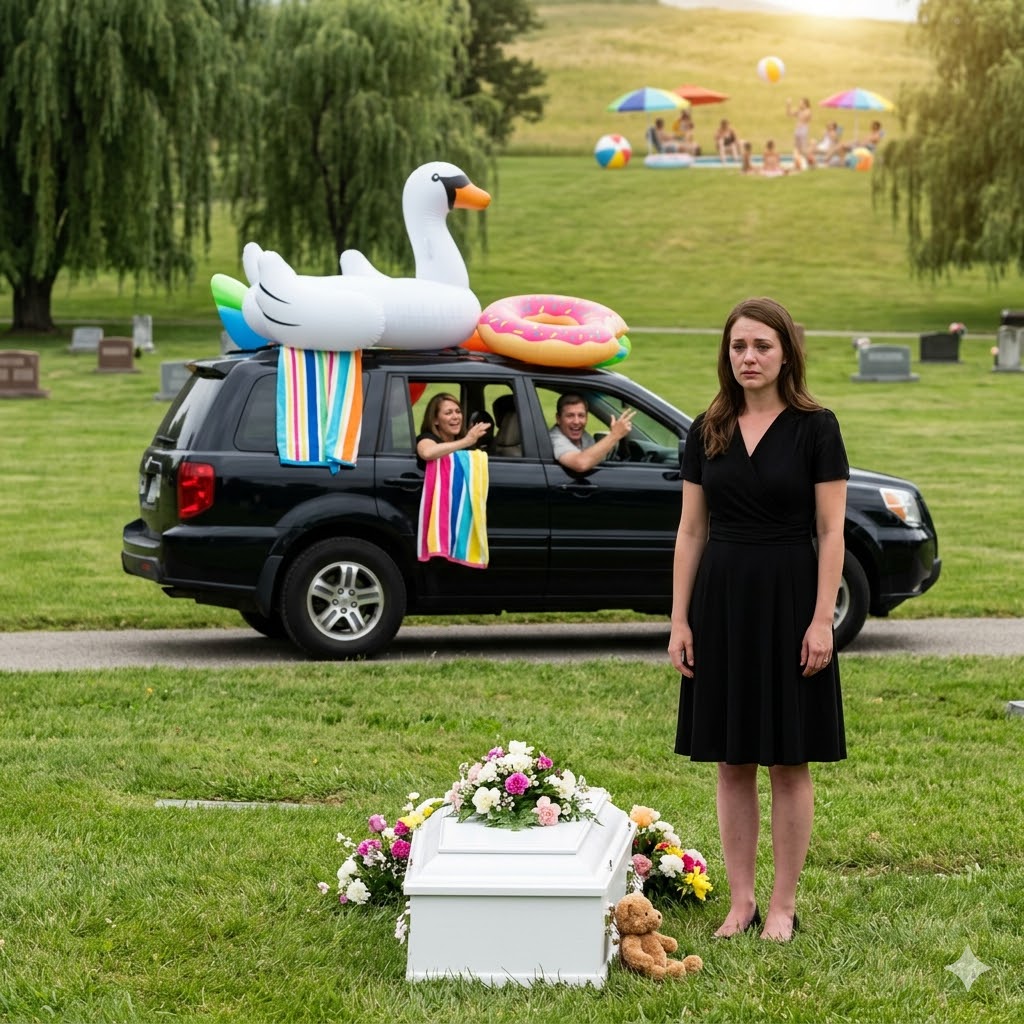
My name is Claire Mercer. I’m 31 years old. And the day I buried my baby girl, I stood beside a tiny white casket, completely alone, while my phone kept vibrating in my coat pocket with messages I refused to open. I already knew what they were. Laughter, music, sunlight bouncing off blue water, a pool party.
Less than an hour earlier, my mother had left me a voicemail that turned my blood cold. She told me to stop making everything so dramatic. She told me my brother’s event had important guests and that people were counting on the family to show up. Then she said the words that split my life into before and after. It’s just a baby. My hands didn’t shake when I heard it. They went still.
I signed the funeral papers, listened to the pastor ask whether I wanted a private family moment, and almost laughed because there was no family behind me. There was only me, one folded blanket that still smelled like baby lotion and a grief so sharp it felt cleaner than anger. All my life I had been the daughter expected to understand, forgive, and stay quiet.
the easy one, the dependable one, the one who never made a scene, never ruined anyone else’s good time, never demanded more than scraps of attention. But when I watched strangers lower my four-month-old daughter into the ground while the people who should have stood beside me chose cocktails and pool floats instead, something inside me finally went cold. They thought I would go home and cry.
They thought grief would make me weak. They had no idea that burying my child alone was the last time I would ever protect them. If your own family chose comfort over your pain, would you forgive them? Or would that be the day you stopped making excuses for them forever? Growing up in Scottsdale, Arizona, I learned early that in our house, love was measured in applause.
And applause always followed my younger brother, Chase Mercer. My father Daniel used to say Chase had the kind of confidence that made people trust him with anything. While my mother Susan loved calling him our little star in front of church friends, neighbors, teachers, anybody who would listen. Chase smiled easily, spoke like every room belonged to him, and somehow turned even average achievements into family celebrations.
If he made junior varsity, there was a steak dinner. If he sold raffle tickets for school, my parents told the story for weeks. If he forgot to do something important, my mother called it a learning curve. I was different. I was quieter, more observant. The girl who drew for hours, got straight A’s, and learned not to expect much when I did something well because there was always a reason it mattered less than whatever Chase had going on. When I won a statewide youth art competition at 17, my mother hugged me in the auditorium lobby, took one
quick photo, then whispered that we had to leave early because Chase had a charity golf mixer with some country club kids. And those connections matter. I remember standing there with my certificate still in my hand, watching my parents rush me through a side exit while other families stayed to celebrate their daughters.
A year later, when I got accepted into Arizona State and announced I wanted to study education and art, my father smiled the way people smile when they’re trying not to be rude and said, “That’s nice, Claire, but I hope you know teaching won’t exactly make you independent.” Two days later, Chase mentioned that he might try real estate one day because he liked talking to people. And suddenly my parents were telling everyone he had natural business instincts.
That was our family in a sentence. I did the work. He got the mythology. By the time I became an elementary school art teacher in Scottsdale, I was already used to being called practical, sweet, reliable. All the words people use when they want your labor but not your spotlight. My job fit the role perfectly.
I spent my days helping children feel seen, noticed, encouraged, and then came home to a family that treated me like I should be grateful just to be included. Meanwhile, Chase, now a luxury real estate agent who sold Desert View homes to people with more money than taste, became exactly the kind of son my parents had always imagined.
He wore tailored shirts, drove a leased BMW, posted photos beside infinity pools and million-doll listings, and talked about building a network the same way preachers talk about faith. My mother loved introducing him at every gathering. This one’s going places. She’d say, “Hand on his arm, eyes shining.” About me, she said things like, “Claare is so nurturing.
” which sounded kind until you heard the difference. Chase was the future. I was useful. That old imbalance followed us into adulthood so naturally that by the time I noticed how deeply it still shaped my life, I’d already spent years adapting to it. I stopped sharing good news unless someone asked. I learned to smile through interruptions.
I got very good at shrinking my own feelings to keep the peace. And the worst part was that I kept hoping one major milestone, one undeniable life event would finally force my family to see me clearly. I just never imagined the milestone would be motherhood or that even that wouldn’t be enough. When I got pregnant with my daughter, I was 29, newly separated from a man who had proven he could disappear.
The second responsibility stopped being romantic and terrified in ways I didn’t always admit out loud. But beneath the fear, there was hope. Real humiliating hope. I thought maybe this baby would change the shape of my family. I thought maybe my parents would soften when they saw me becoming a mother.
I thought maybe Chase would stop treating every conversation like a competition once there was an actual infant in the room. I thought a lot of foolish things back then because I still wanted to believe blood meant something sacred. My daughter Rosie was born early after a difficult pregnancy and spent her first weeks under careful medical supervision.
She was tiny, red-faced, stubborn, and perfect. The first time she curled her fingers around mine, I felt a kind of love so fierce it made every old wound look smaller. Suddenly, I understood what protection was supposed to feel like.
I sent my parents photos from the hospital, videos of Rosie yawning, her first soft noises, the way she scrunched her nose in her sleep. My mother always responded eventually, but never the way I hoped. Cute little thing, she texted once, then followed it with, “Don’t forget Chase’s open house brunch on Saturday.” Another time, I sent a video of Rosie smiling in her bassinet, and Susan replied with a heart emoji before asking if I could help address envelopes for Chase’s upcoming client appreciation event because my handwriting looked classier than his.
My father was slightly better in tone, but not in substance. Daniel would say, “How’s the baby?” And then, 30 seconds later, pivot into a story about Chase showing a house to a former NFL player. It was as if Rosie existed in their minds as a sentimental side note, while Chase’s social calendar remained the main plot. I tried to ignore it.
I was exhausted, recovering, grading art projects, waking every few hours to feed a fragile newborn, and still somehow making excuses for people who could not be bothered to prioritize me. But the pattern became impossible to miss. When Rosie had a breathing scare and I spent an entire night in the emergency room, my mother told me she was sorry but couldn’t leave because she had promised to help organize a poolside networking celebration for Chase at a Paradise Valley estate the next day. You know how important these clients are, she said as if that explained anything. When I asked
my father if he could at least stop by the hospital for an hour, he answered, “Claire, your mother is overwhelmed and Chase has a lot writing on this. Keep us updated. Keep us updated like I was a weather app. Not their daughter, not the mother of their grandchild lying under fluorescent hospital lights.
Rosie came home, but she remained medically vulnerable. I learned to live with monitors, specialist appointments, the constant pulse of lowlevel fear. Through all of it, Chase kept orbiting through family life like a man convinced the universe should never dim his lighting. He had recently started dating the daughter of a wealthy developer.
And suddenly, everything in my parents’ world revolved around whether this relationship would lead to bigger clients, bigger circles, better status. Susan talked about the girlfriend’s family the way people talk about winning lottery numbers. Daniel started calling Chase, the one who’s finally going to elevate this family.
I remember hearing that while bouncing Rosie on my shoulder after a hard feeding and thinking, “So, what am I then? What is she?” Still, I kept reaching. I invited my parents to Rosy’s 4mon blessing at church. Susan said she had a conflict with one of Chase’s listing launches. I asked Daniel if he could come by to hold her so I could shower after a rough week.
He told me his back was acting up, then posted a photo that afternoon from a rooftop lunch with Chase and some investors. By the time Rosy’s health began to worsen for real, some stubborn part of me already knew I was going to be alone. The doctors warned me as gently as they could that her condition was unstable. I sent that update to the family group chat.
Chase responded three hours later with a thumbs up and praying, then posted a story from a luxury pool install at a client property. Susan called that night, but not to ask what I needed. She wanted to know whether I thought moving the date of Chase’s poolside celebration would look weak to the kind of people he was trying to impress.
I stared at the wall while she talked and realized she wasn’t even hearing herself anymore. My daughter was fighting to live and my mother was asking me to weigh in on the optics of a party. A few weeks later, Rosie died in my arms just before dawn. The world did not shatter the way movies promise. It narrowed. The nurses were kind. The room was too quiet.
My body still expected her weight even after they took her from me. I called my parents first because some reflex older than logic made me do it. Susan didn’t answer. Daniel did listened for exactly 6 seconds, then said, “Your mother’s in the middle of final setup for Chase’s event. Clare, we’ll figure something out.” That was the moment Hope finally started to rot. Rosy’s funeral was set for 2 days later.
I texted the date, the time, the chapel address, the cemetery location. Susan replied with a single message. We’ll try. Chase never acknowledged it at all. On the morning of Rosy’s funeral, the sky over Phoenix was hard and bright in that cruel Arizona way, like even sunlight had no mercy left.
I dressed in black with hands that felt detached from the rest of me, wrapped Rosy’s blanket into my coat bag because I couldn’t stand the thought of leaving it behind, and drove to the chapel in silence. All the way there, I kept checking my phone, not because I truly expected my family to come, but because some pathetic part of grief still bargains with reality, even after reality has made itself clear. The first missed call came from a florist asking about a ribbon on the arrangement.
The second came from Megan Walsh, my closest friend and fellow teacher, who was already at the chapel waiting for me. Then 23 minutes before the service, Susan’s voicemail arrived. I still remember every word because they branded themselves into me. Her voice was crisp, impatient, almost distracted by background chatter and splashing water.
Claire, please stop calling. We can’t just abandon Chase’s event now. Important people are here. You need to stop making everything harder than it already is. It’s just a baby and your brother’s party matters more today than another scene. We’ll talk later when you’re calmer. I listened once, then twice.
Then I locked my phone because if I’d heard it a third time in that parking lot, I might have screamed. Instead, I walked into the chapel with my face numb and let Megan take my elbow without saying a word. The service itself passed in fragments. the pastor’s softened voice, the white flowers, the tiny coffin that looked impossible and obscene, the feeling of strangers being gentler with my daughter’s memory than her own blood family had been.
When the pastor asked whether the family wanted a final private moment before the burial, there was a pause long enough to make everyone understand. Megan stepped closer. One of my older colleagues stood behind me. No Mercer moved. I buried my child with friends, co-workers, and two women from church who barely knew me, but came anyway because they said, “No, mother should stand alone.” That fact alone told me everything I needed to know about what family really was.
After the burial, while I was still staring at the fresh dirt like my brain hadn’t caught up to the finality of it, Megan touched my arm and asked if we could sit in her car for a minute. The moment the doors closed, she turned her phone toward me with a face I’d never seen on her before. Part fury, part disbelief.
On the screen was a social media story from one of Chase’s guests. A long pool glittered under the sun. Champagne flutes clinkedked. Chase stood shirts sleeved and smiling near a catered brunch table. Susan laughed beside him in a wide sun hat. Daniel held court near the grill. Over the video, the guest had written, “Perfect family, perfect day.
” I think the only reason I didn’t vomit was because grief had already emptied me out. Then Megan showed me something worse. Someone at the party, probably trying to sound sympathetic, had posted, “Keeping the Mercers in our prayers while Clare requested a private goodbye today.” requested a private goodbye. My mother hadn’t just skipped Rosy’s funeral. She had lied about it.
She had turned my abandonment into my preference, my isolation into her excuse. That lie changed something in me more sharply than the voicemail had. Cruelty was one thing. Cruelty performed as innocence was another. I sat in Megan’s passenger seat, still in my funeral clothes, and listened to the air conditioner hum while my mind suddenly became very clear. Not louder, not wilder, just coldly precise. I opened my phone and saved Susan’s voicemail to three places.
I screenshotted my funeral texts with the date and time. I screenshotted the unanswered calls I had made that morning. I took a photo of Rosy’s memorial program in my lap. I saved the pool party. Then I asked Megan to send me every screenshot she had from guests claiming I wanted privacy. She did it instantly.
“Claire,” she said carefully. “Whatever you’re thinking, make sure it’s for you, not for them.” I looked down at the folded blanket in my hands and realized that for the first time in my life, those two things were the same. This wasn’t about causing drama. This wasn’t about revenge in the childish sense. It was about refusing to let the people who abandoned my daughter also control the story of her funeral.
It was about truth, and truth, I had finally learned, can ruin the right people faster than any scream. The service ended just afternoon. Chase’s event, according to the tagged stories, was still in full swing. Important guests were still there. His girlfriend’s family was there. Potential clients were there. The church crowd my mother cared about was there.
My family had chosen the place where appearances mattered most. Fine. That was where the truth would meet them. I did not drive home. I sat with Megan in the cemetery parking lot, built one message, tore it apart, rebuilt it, then saved it as a note until I could breathe without shaking. It was not a rant. It was not theatrical.
It was simple, documented, impossible to dismiss. By the time I finally turned the key in the ignition, I knew exactly what I was going to do. They had spent my daughter’s funeral protecting a pool party. I was about to make that choice cost them everything they valued most. I waited until the hour when parties are loudest and people are least prepared to be ashame
d. At 27 p.m., parked under a mosquite tree outside a pharmacy because I needed somewhere ordinary to do something irreversible. I opened the Mercer family group chat, the extended relatives thread Susan used for holidays, and a contact list Megan had helped me build from names tied to the pool party posts. I didn’t send different messages. I sent one.
It read, “Sus, since several people were told I requested privacy today, I wanted to share what was actually said to me when my parents chose Chase’s pool party over Ros’s funeral. My daughter was buried at noon. I buried her without her grandparents.
Attached are the funeral program, the time I sent the details, the unanswered calls, and the voicemail my mother left while I was on my way to the chapel. Underneath, I attached the photo of Rosy’s memorial program, the screenshots of my texts with the funeral date and chapel address, the missed calls from that morning, and the audio file. Then I pressed send. For 5 seconds, nothing happened. Then the message showed delivered, then read.
Then chaos moved faster than thought. My phone lit up first with Susan’s name. I let it ring once and decline. Daniel called next, then Chase, then three relatives, then Susan again. I ignored them all and watched the incoming message thread begin to split open. My aunt Linda replied first with, “Susan, please tell me this is fake.
” A cousin wrote, “What voicemail?” Another relative, one of the church women who adored my mother, sent, “Claire, surely there’s been some misunderstanding.” Before I could even decide whether to answer, a new story appeared online from the party. The camera was shaky now. No music. Someone had panned toward a cluster of guests standing still with phones in hand.
In the background, I could hear a woman say, “Oh my god.” And another voice whisper. She said, “What?” I didn’t need a front row seat to imagine the rest. Somewhere beside that pool, one guest had opened my message, then another, then another, until the lie my parents had been floating through that afternoon dissolved all at once.
I finally answered Chase on the fourth call because I wanted at least one of them to hear how calm I was. He didn’t bother with hello. “What the hell is wrong with you?” he shouted, his voice cracking with panic more than grief. “Do you have any idea who is here? Do you know what you’ve just done?” I leaned back in my seat and stared at the strip mall pharmacy sign across from me.
“Yes,” I said. I told the truth. He swore, then dropped his voice as if moving away from guests. You couldn’t wait. You couldn’t have handled this privately. The nerve of that almost made me laugh. Privately, I said like Ros’s funeral. Like the private moment where your mother said she mattered less than your party.
He started to say it wasn’t his fault, that this had nothing to do with him, that important people were hearing things out of context. I cut him off. It had everything to do with you, I said. Everything always does in this family. Today was just the first time I stopped protecting that. He went silent for a beat, then snapped, “You’re ruining my life.” over one voicemail.
And there it was, the purest thing he’d said all day. Not over a dead child. Not over what his parents had done. Over one voicemail. Over consequences. No, I answered. Your life is being ruined by the truth your family told when they thought I would stay quiet. I hung up before he could answer. 10 minutes later, Megan texted me a screenshot from someone still at the party.
Susan stood near the shallow end of the pool with her face white and stretched. one hand over her mouth, while Daniel argued with a tall man in linen beside the catering table. Chase’s girlfriend, Hadley, was nowhere near him. Another guest had posted a single line over a blank black story. Some things are too ugly to celebrate through. I won’t pretend I felt joy in that moment. Revenge stories always make it sound like vindication tastes sweet.
Mine tasted like adrenaline and ash. My daughter was still gone. No message could change that. But what I did feel was release. The kind that comes when truth finally leaves your body and stops poisoning you from the inside. My phone buzzed again. This time it was Hadley, Chase’s girlfriend, whose number I only had because she once texted me about a baby shower registry.
Her message was short. Did Susan really say that? I sent the audio file alone, nothing else. Three minutes later, my phone rang from Susan again, then Daniel, then Susan, then Hadley, then Daniel once more. Finally, a text came through from my mother, stripped of all her usual polish. Take that down right now. You are humiliating this family in front of everyone. We were going to explain later.
Explain what? that my child deserved less because Chase had potential investors by a pool. That grief should wait until after appetizers. I typed back one sentence. You had your chance to explain when I called from the cemetery. She replied instantly, “You are vicious.” That word settled over me more gently than she intended because it proved she still didn’t understand.
Telling the truth about what someone did to you is not vicious. Expecting silence after cruelty is. The next hour turned into a public unraveling. Relatives messaged me one after another, some apologizing for believing Susan, some asking if I was safe, some trying to soften things with, “Surely they didn’t mean it that way.
” But the audio made softening impossible. There is a limit to how far image can stretch once people hear contempt in the original voice. Megan kept feeding me updates from contacts at the party. Hadley had confronted Chase in front of her parents. One older client family left without eating.
A church friend apparently told Susan, “I don’t know how you come back from that.” Daniel had tried to gather guests for a toast and almost no one had lifted a glass. Somewhere between the catered shrimp and the expensive floral centerpieces, my family’s perfect afternoon had curdled into something they could neither control nor deny. I stayed exactly where I was until the sun began to angle lower and the flood of calls slowed just enough for silence to reach me. Then one final voicemail arrived, this time from Daniel.
His tone had changed completely. No anger, no authority. Just strain Claire. He said, “Please, people are leaving.” Chase is saying Hadley went home with her parents. Your mother’s falling apart. Whatever point you wanted to make, you’ve made it. Call us so we can fix this. I listened once, then deleted it. That was the line, wasn’t it? Fix this.
Not fix what was done to me. fix the damage to them. They still thought the emergency was the party. They still thought my role was cleanup. I turned off my phone for the first time all day and drove home with Rosy’s blanket on the passenger seat. While behind me, somewhere in Paradise Valley, a pool party built on my daughter’s funeral was collapsing under the weight of one simple thing my family had never respected enough. The truth.
I didn’t hear the rest of the fallout in real time because I left my phone off until after midnight, showered in silence, sat on my kitchen floor with Rosy’s blanket in my lap, and let the adrenaline drain out of me in waves. But the next morning, when I turned my phone back on, the story came together fast.
There were 62 messages, nine voicemails, and one email from the funeral home asking whether I was okay because apparently Susan had tried calling there looking for me after I stopped answering. Megan came over with coffee, sat across from me at the table, and helped me sort through what mattered and what was just noise. Hadley’s mother had taken her, and left the party almost immediately after hearing the voicemail.
One of Chase’s biggest prospective clients, a developer whose wife chaired multiple charity boards, left right behind them, and later texted someone that they didn’t do business with families who treat dead children like scheduling conflicts. Susan had apparently tried to corner guests and insist I was mentally unstable from grief, but the audio made that angle collapse before it could breathe.
Daniel got into a shouting match with one of his church friends who told him flatly that if he could stand by those words, he was not the man everyone thought he was. Chase, in the middle of all this, started blaming everyone except himself. First, Susan for leaving the voicemail, then Daniel for not stopping me, then me for weaponizing grief, and finally Hadley for making a scene when she refused to stay.
By the end of the afternoon, according to three separate messages from different guests, the party had emptied out in embarrassed fragments. Half-runk glasses sat sweating on side tables. Food trays went untouched. A pool full of reflected sunlight kept glittering as if the day were still beautiful.
While everything my family valued about that event, status, admiration, momentum, image, bled out around it. The most revealing call came from my cousin Erica, who had never once taken my side in any family conflict before. She left a voicemail saying, “Claire, I don’t know if you want to hear from me, but I need to say this. I was there.
We were all told you wanted privacy. Your mom said coming would only upset you and that the baby’s service was very small and intimate. Then your message came through and everyone listened. Nobody knew. I’m so sorry. That apology mattered less than people think apologies should, but it did confirm the truth I already knew. Susan and Daniel hadn’t simply chosen Chase’s event. They had actively rewritten the story to protect themselves.
That lie was why I didn’t answer when my parents showed up outside my condo at 10:00 the next morning. I saw them through the building camera, my mother in oversized sunglasses despite the shade. My father looking 10 years older than he had two days earlier and for one weak second some old habit in me almost opened the door.
Then I remembered the cemetery, the voicemail, the poolside lies and stayed where I was. They rang three times. Daniel called from the lobby. Susan texted, “Please, we need to talk face to face. People are saying horrible things again. Not about Rosie, about themselves. Megan, who was still with me, looked toward the door and asked softly, “Do you want me to tell them to leave?” I shook my head and let the silence do it.
Eventually, Daniel left a handwritten note with the concierge. It read, “This has gone too far. Whatever happened, we can work through it as a family. Don’t punish your mother forever for one terrible mistake. One terrible mistake.
That phrase enraged me more than any yelling could have because it reduced the whole architecture of my life into a single unfortunate moment. As if Rosy’s funeral were a random slip rather than the predictable climax of decades of favoritism. I didn’t respond to the note. I shredded it and put the pieces in the trash under coffee grounds. Over the next week, the consequences deepened in ways my parents could not spin away. Hadley broke off her relationship with Chase.
Not publicly, but decisively enough that it still got around. One of the women from her family’s church circle told Megan’s aunt that no decent family would tie themselves to people who called a dead infant just a baby. Chase lost at least one major listing opportunity after the developer’s wife quietly told others they found his family socially radioactive.
Susan stopped showing up to the women’s ministry meetings at church because too many people had heard the voicemail. Daniel tried to keep acting as if everything were normal, but apparently no one at his golf club wanted to sit with him without mentioning what happened. A family like ours can survive private cruelty for generations. Public consequence is what shocks them.
And still, through all of it, they reached for me, not in remorse, but in desperation. Susan sent long texts about her blood pressure, her humiliation, the whispers she had to endure. Daniel wrote that Chase’s future was being destroyed over something between us. Chase himself sent me a voice note so raw with resentment it almost impressed me.
If Hadley is gone for good, that’s on you. If I lose business because you wanted attention, that’s on you, too. I listened to that one twice, not because it hurt, but because it clarified the entire family system in a single breath. My grief had never been an emergency to them. Their inconvenience always was. So, I made a decision that would have seemed impossible to the version of me who still chased approval.
I blocked Chase permanently. I blocked Daniel. I blocked Susan after sending one final message. I buried Rosie alone. You don’t get access to me after that. Then I contacted an attorney and wrote formal instructions limiting any future contact to email through legal representation if necessary. I wasn’t doing it for drama.
I was doing it because grief already exhausted me enough without allowing the architects of that grief to keep entering my space. Two weeks later, there was a memorial donation drive at my school for berieved mothers. something Megan had quietly organized in Rosy’s name with the principal’s help. We gathered diapers, blankets, gas cards, and meal vouchers for a local infant loss foundation.
I stood in the art room after dismissal, watching parents I barely knew drop off supplies and murmured condolences. And it struck me that compassion kept finding me from directions my own blood never bothered to look. That same evening, Erica called from a borrowed number and told me Susan had been sobbing to relatives that she lost everything over one sentence.
I surprised myself by answering with perfect calm. No, she lost everything over the truth in that sentence. That was the difference my family would never understand. They thought the collapse started when I hit send. It started when they taught themselves that my pain ranked below Chase’s convenience. I just refused to keep carrying the lie.
Months later, I heard through extended family that Chase had moved to a smaller brokerage. Susan had withdrawn from most of the social circles she once controlled, like Oxygen, and Daniel had become the kind of man people politely nodded to without inviting anywhere. I don’t celebrate those details the way some viewers might want revenge to be celebrated.
I don’t dance around my living room because their reputation’s cracked. But I also don’t mourn it. A consequence is not a tragedy just because it finally lands where it belongs. The truly satisfying part, if I’m honest, wasn’t watching them fall. It was realizing I no longer needed them to rise.
The day I stopped trying to rescue their image, was the day I finally began rescuing my own life. And for a daughter like me raised to disappear behind everyone else’s needs, that felt more radical than revenge ever could. The first holiday after Ros’s funeral was Thanksgiving. And for the first time in my adult life, I did not spend a single second wondering whether I should be the bigger person.
That urge had died with the old version of me, the version who believed endurance was the same thing as goodness. Instead, I spent the day at Megan’s house with her noisy extended family, helping her nieces paint place cards at the kitchen table while casserles baked and football blared in the living room.
At one point, her grandmother, who knew enough of my story to be kind, but not intrusive, squeezed my hand and said, “Laws shows you who brings soup and who brings excuses.” I carried that sentence home with me because it was simple and brutally true. In the months after everything happened, I rebuilt my life in quiet, practical ways.
I went to grief therapy and learned that rage can be clean when it’s finally pointed at the people who earned it. I started a small scholarship fund at my school for students who needed art supplies and named it Ros’s Corner because I wanted my daughter’s short life attached to beauty, not only pain. I volunteered once a month with a support group for mothers who had lost infants.
And every time I sat in those circles, I understood more clearly that my real revenge had never been humiliating my family. It had been refusing to let their cruelty define the last word of my daughter’s story. Susan still tried now and then through relatives or awkward emails sent from new addresses to frame what happened as a misunderstanding swollen by grief. Daniel once wrote that age had given him perspective and that life was too short to stay divided.
Chase attempted one final message through Erica claiming he had been collateral damage in a conflict between me and our parents. I never answered any of them. Not because I was still burning with fury every day, but because peace got easier once I stopped reopening the door. That’s the part people outside situations like mine rarely understand. They think closure means reconciliation.
That healing must involve restored relationships, holiday photos, a soft soundtrack, and some dramatic apology at your doorstep. But healing can also look like changed locks, blocked numbers, and the sacred decision to believe what people showed you the first time. My parents did not lose me because I exposed them. They lost me the morning they left me to bury my child alone. and then lied about why.
Everything after that was just consequence catching up. And consequence, unlike family myth, doesn’t care about who was favored growing up or who gets to smile in the Christmas card. It only cares about what was done. If there’s one lesson I would drag out of all this for anyone listening, it’s this. Being related to someone does not entitle them to your silence, your labor, or your forgiveness.
Blood is not a permission slip for neglect. Shared history is not a free pass to step over someone’s pain and then demand access once the crowd turns against you. For years, I thought being a good daughter meant absorbing hurt gracefully. I thought love looked like patience without limits.
I thought family required endless understanding from the person who asked for the least. I was wrong. Love shows up. Love listens. Love does not rank one child’s social calendar above another child’s dead baby. And when people reveal that they are incapable of that kind of love, protecting yourself is not cruelty. It is wisdom bought at a terrible price. Sometimes I still think about the exact moment I hit send on that message from the pharmacy parking lot.
I think about how quiet the world was inside my car compared to the chaos it caused beside that pool. If I could speak to the woman I was just before that moment, the one still shaking from the cemetery dirt on her shoes, I would tell her this. You are not ruining anything that wasn’t already rotten. You are not too harsh.
You are not too emotional. You are finally standing where the truth can see you. Rosie should have had grandparents who rushed to her side, who held me up, who knew there are moments in life when every party, every client, every guest list becomes meaningless. She didn’t get that. I can’t change it.
But I can make sure her life is remembered alongside one clear truth. She was never just a baby. She was my daughter. She was loved completely. And the people who treated her death like an inconvenience did not lose me because I was vindictive.
They lost me because I finally loved myself and my child enough to stop calling their cruelty normal. That is the core of this story. The part I hope stays with anyone who hears it. Revenge may grab attention, but dignity is what lasts. The most satisfying ending is not that my parents were embarrassed or that Chase’s polished little world cracked. It’s that I no longer live inside their version of who I was.
I carry my daughter’s blanket, my grief, my boundaries, and my hard-earned peace into a future they don’t get to touch. And after everything, that peace feels less like an ending than the first honest beginning of my life.