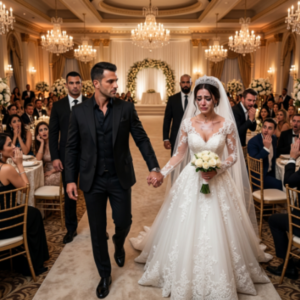
The rain came down hard on Meridian Avenue. It hit the black marble steps of Hartwell Tower like it had something to prove sheets of it. Cold and relentless, bouncing off the brass railings and flooding the gutters in front of the revolving doors.
The street lights had already switched on, though it was only 4:00 in the afternoon. October in this city didn’t ask permission. Emily Carter stepped out of the black SUV without waiting for the door to be opened. She never did.
She moved across the wet sidewalk the way she moved through every room like the space already belonged to her, like the people in it had already made their adjustments. She was 36 and she wore it the way some people wear armor, upright, deliberate, not a line out of place. Dark wool coat, low heels, hair pulled back so tight it could have been drawn on. She carried nothing in her hands. Her assistant Marcus jogged behind her with an umbrella she didn’t take. The Vantage group call is at 5, he said breathless.
And Shelby from PR wants 10 minutes before that. She gets five. The board has pushed the Thursday. Tell them Thursday doesn’t work. She pushed through the revolving doors without breaking stride. The lobby swallowed her. marble floors, high ceilings, the low hum of a building that cost more to cool each year than most people made in a lifetime.
She had built this not the physical structure, the architecture firm had taken credit for that, but everything else. The company that filled it, the reputation that made competitors lower their voices when her name came up in meetings. Hartwell Analytics, 700 employees, offices in four cities, and Emily Carter at the center of all of it, holding it together with both hands, and a silence that people mistook sometimes for serenity. It wasn’t serenity.
The East Service elevator was out of order again. A maintenance cart sat beside it, tilted slightly against the marble wall, a yellow wet floor cone beside it that nobody seemed to have noticed was blocking the main foot traffic path. Emily stopped. She looked at the cone. She looked at the cart. She looked for the person responsible. He was crouched near the elevator panel with his back to her. Work uniform gray institutional.
The kind of thing you stopped seeing after a while. He had tools spread on the floor beside him. A wrench, a panel key, a small light clipped to his collar. His shoulders were broad and still, and he worked without any apparent urgency. which was either professionalism or indifference, and she didn’t currently have the time to determine which. This is blocking the main corridor, she said.
He didn’t look up immediately. He finished what he was doing. She couldn’t tell what. And then he turned. The man was somewhere in his mid-30s. Dark hair cut short, a jaw that needed a shave. His hands, she noticed immediately, were the kind that belonged to a person who had spent years actually using them. Not a gym, not a sport, but real work.
There was a fading bruise along his left knuckle. His eyes were steady, not apologetic, not aggressive, just steady. I’ll move it in a few minutes, he said. The part isn’t seated yet. I need the corridor clear now. I understand. He looked at her evenly. I need the elevator working by end of shift. We can both have what we need.
Emily held his gaze for a moment. There was something in his face. She didn’t know how to categorize. Not defiance exactly, but a kind of settled refusal to be rearranged. She had seen that expression before once a long time ago in a mirror. She’d worked very hard to lose it. “Move the cart to the service corridor,” she said, “and finish the rest from there. That’s not how the panel access works.
” Marcus appeared at her shoulder, ready to smooth things over. She held up one hand without looking at him. The man on the floor stood up. He was taller than she’d expected. He picked up his tools with the quiet efficiency of someone who had been interrupted many times and had learned not to make it about anything. I’ll have it done in 20 minutes, he said. I’m sorry for the inconvenience.
He didn’t sound sorry. He sounded like a person who had said the required thing. Emily Carter turned and walked toward the stairwell, heels ringing on the marble without another word. She didn’t ask his name. She didn’t need to. She forgot about him entirely before she reached the second floor landing. 3 days later, the elevator broke again.
This time, it stopped between the 14th and 15th floors with six people in it, including Emily’s vice president of operations, Gregory Haynes, who was due to present to the Vantage Group delegation in 40 minutes. The lobby descended into the particular kind of organized chaos that happened in expensive buildings when expensive things stopped working. Facilities managers appearing from nowhere.
Security radioing on behalf of people who couldn’t hear them. One junior assistant clutching a laptop like it was the only solid object in the world. Emily heard about it from her assistant at 9:52 a.m. She was in her office on the 19th floor working through a contract amendment that should have taken her lawyers 3 days and had taken them 6 when the call came in. She was in the lobby by 9:56.
The situation was already being managed. The doors to the service elevator were open. A technician inside working on the release mechanism. A small crowd had gathered at a respectful distance. respectful because two Hartwell security officers were maintaining it. And in the center of everything, calm as a fixed point, was the same man from 3 days ago. He was on a radio.
He had a second technician relaying from the top of the shaft. And he was coordinating the two with short, precise instructions, not wasting a syllable. He’d clearly done this before. There was nothing frantic in his movements. if the six people trapped in the elevator were frightened. His calmness was the thing that was keeping the fear from spreading to everyone else in the lobby. Emily watched him for a moment longer than she’d intended to. “How long?” she said.
He turned. He registered her. His expression didn’t change. “Maybe 15. Gregory Haynes is in there. He has a presentation at 10:40. I know.” He turned back to the radio. 12 minutes. Gregory made it out in 11. He was disheveled and slightly pale, but he had his laptop and he made the presentation.
Emily made sure of that herself, walking him to the conference room, positioning herself at the back of the room for the opening 5 minutes so that the Vantage group delegation would understand from the texture of the room that this matter had Emily Carter’s attention. It did. The meeting went well. She should have left it there.
She found the maintenance man on the 14th floor at 11:15 a.m. closing up his equipment case. She hadn’t planned to go there. She’d intended to check on the auxiliary power unit in the electrical room, which was three floors above. She didn’t examine the route she’d taken. “The elevator is running,” she said. “Running.
” He closed the case. Looked at her. The cable guide was misaligned. Third time this quarter. Someone approved the wrong replacement part. I’ll look into it. It’s been in the work order for eight weeks. She stopped. What? I submitted a work order in August. Flagged it as a priority issue. He picked up the case. Nobody in facilities approved the replacement. They were waiting on a budget review.
Emily looked at him. Your name? Daniel Ward. How long have you worked here, Daniel? 14 months. She said nothing for a moment. She was running a calculation the gap between what she’d assumed was managed and what Daniel Ward had apparently been watching go wrong for two months.
The work order is approved, she said. He nodded. He didn’t thank her. He didn’t smile. He picked up his equipment and walked toward the service stairwell with the unhurried gate of a man who had more to do and didn’t plan to stand around talking about it. She watched him go and felt for the first time in years like she had been the one who came up short in an interaction.
She didn’t like the feeling. She would think about it later that night in her apartment with a glass of wine she barely touched. She would think about the fact that she hadn’t thought the feeling was possible anymore. It was a Tuesday and Hartwell Tower was quiet in the particular way a building gets quiet at 5:15 p.m. The day shift mostly gone.
The evening cleaning crew not yet started. A handful of people in the upper floors finishing things that should have been finished at 4:00. Emily was one of those people. She was always one of those people.
She came down to the ground floor to get a file from reception, a physical file, actual paper, because the vendor who’d sent it apparently hadn’t heard of digital transmission, and that was where she saw her. The girl was sitting on the bench beside the main entrance, the kind of bench that existed mostly to fill space. She was small, maybe seven or eight years old, with her backpack on her lap, wearing a dark blue coat with a hood that had fallen back.
She had a paperback book open in her hands. She was reading it with the focused attention that children occasionally bring to things that genuinely interest them, blocking out everything else. Emily almost walked past her. She was two steps beyond the bench when something made her stop. She stood there for a second, trying to identify the thing that had snagged her attention.
The way a person stops midstride when they’ve heard something they can’t quite place. She turned back. The girl looked up. brown eyes, a spray of freckles across her nose, a certain quality to her gaze, patient, direct, a little older than her face. “Are you waiting for someone?” Emily said, “My dad.” The girl’s voice was clear. Unw worried.
“He’s finishing. Does he work here? He fixes things.” She said it the way people say things that are simply true. The elevator broke again today. Emily was quiet for a moment. Are you all right sitting here? I’m fine. The girl held up the book. I’m reading about the ocean.
Did you know there are fish that live so deep that they’ve never seen light? They make their own. Emily looked at her. Something moved in her chest, slow, structural, like a shift in weight. I did know that, she said, which was almost true. She’d read something about it once long ago in a magazine in a waiting room. My teacher says that’s adaptation.
The girl said, “When you change to survive where you are, Emily said nothing.” The phrase sat in the air between them for a second longer than it should have. “What’s your name?” Emily asked. “Zophie, I’m Emily.” “I know,” Sophie said. “You’re the boss.” Dad pointed to your picture in the lobby. She said this without effect, just as fact.
Returning her gaze to the book, Emily stood there another moment. There was something in the girl’s face, the specific architecture of it, the way the brow line sat, the shape of her cheek that Emily found herself cataloging without meaning to, as if running a comparison against something she couldn’t quite access.
She felt a faint, sourceless unease, the kind that lives at the edge of recognition. “Has your father been here long?” she said. waiting. I mean, he doesn’t wait, Sophie said. He finishes what he starts. She turned a page. Emily left before Daniel Ward came down. She didn’t sleep well that night.
She told herself it was the vantage contract. She was lying. The memories came back the way buried things. Always do not all at once, but at an angle, sideways, in pieces. A smell, a texture. A child’s face. 20 years ago, Emily Carter was Emily Novak. She was 19 in her second year at Penfield University on a scholarship so thin that a single missed shift at the cafe could threaten it. She had nothing.
She had everything ahead of her. She had made herself believe those two things were the same. He had been a year ahead of her. Bright, kind, full of laughter she’d trusted because it seemed to cost him nothing to give it away. His name didn’t matter anymore. It had stopped mattering very quickly when she’d found out she was pregnant.
And he’d looked at her with something in his face that was neither cruelty nor care, just the careful distance of a person who had already decided. He left. She stayed. Her mother, when she told her, had cried, not with sympathy, with the exhausted grief of a woman who had made her own sacrifices, and could not understand why her daughter was about to throw away everything she’d given her. You have a full ride, Emily. You have one chance.
The counselor at the student health center had been gentle. The adoption broker her mother found had been professional. The paperwork was handled in 3 weeks. She didn’t know who received the baby. She was told it was a strong, healthy match, a closed adoption. She signed on a Tuesday morning, 4 days after giving birth, and she went back to the dormatory. And she didn’t cry.
Not that day. She cried much later. Alone once. And then she put it somewhere deep and didn’t go back. She had never gone back. The girl’s face. Emily sat in her office at 10:30 at night with a glass of water untouched on the desk beside her. And she pulled up the personnel file for Daniel Ward, maintenance technician, grade three, 14 months employed.
The photo was the standard building ID shot, flat light, white background, that same steady expression. She stared at it for a long time. Then she opened a separate search interface, one her IT team would never see, and she typed a name she hadn’t typed in 20 years. She typed her own name, the old one, and a date. What came back was almost nothing. an archived record from a private agency.
A reference number, a closing note that said placement confirmed. 2004. She sat very still. She opened a second document. She began to build a list. Sophie’s approximate age 8. Sophie’s last name unknown. Father’s name Daniel Ward. Relationship to child. described on his employee file as parent guardian biological relationship not confirmed.
Emily Carter closed her laptop at midnight. She sat in the dark for a while. Then she stood up, straightened her coat, and took the elevator down to the parking garage. She didn’t know yet what she was going to do. She only knew that the thing she had buried was not, in fact, buried. It had been standing in the lobby reading a book about deep sea fish.
Over the following two weeks, Emily watched. She told herself it was due diligence, caution. She was not a person who acted on incomplete information. It was the one rule she had never broken in business or in anything else. She would verify before she moved. She was also afraid. She didn’t allow herself to use the word, but the thing that kept her at a distance that kept her circling without landing.
Was fear the oldest kind? The kind you carry from the moment you make a choice, you can’t take back. She learned things. Sophie was in third grade at Castleton Elementary, seven blocks south. She played violin beginner level, but her teacher apparently considered her serious. She came to Hartwell Tower on days when school ended early or when the afterchool program was full, which happened twice a week on average.
She sat on the same bench and read. Sometimes she did homework. Once she fell asleep against her backpack, and Daniel Ward came out of the service corridor at 5 20 and stood over her for a moment before gently lifting her coat from her lap and folding it under her head. Emily had watched that from across the lobby, pretending to check her phone. She also learned what she didn’t want to know. Sophie’s adoption records.
She had a researcher she trusted, a former HR director named Patricia Lane, who asked no questions, showed a placement in 2004 through a now dissolved agency called Rceden Family Services. The receiving party was listed as a couple in Connecticut, not Daniel Ward, not anyone named Ward. So, how did Sophie come to be in his care? That question she couldn’t answer from a distance. She began to engineer proximity.
This was the part she was least proud of. Not because it was dishonest exactly, but because it required her to use skills she reserved for negotiations, for adversaries, for situations where she needed an outcome that the other party would resist. Using them on a child felt like a category violation. She did it anyway.
She arranged through Marcus for Hartwell to sponsor a STEM workshop at Castleton Elementary, citing community engagement commitments that were technically already planned but had never been prioritized. She attended the first session herself. Sophie was in it. When Emily arrived, the girl looked up from a robotics kit and said with complete unsurprise, “I told my dad you’d do something like this.” Emily stopped. “What?” He said, “You were the kind of person who figured things out on your own schedule.
” Sophie turned back to the kit. He’s not wrong about most things. Emily sat down at the table across from her. She spent 40 minutes there helping with a small motor assembly, saying very little. Sophie talked about torque and about a book she was reading and about a cat she wanted and didn’t have. She didn’t once ask Emily anything personal.
At the end of the session, Daniel Ward appeared in the doorway of the classroom. He looked at Emily sitting at the table with his daughter. His expression didn’t change, but something in it, in the stillness of it, went very quiet. “Time to go,” he said to Sophie. Sophie collected her things, she said to Emily without looking up. “I think the next workshop should be about circuits.” “I already understand motors,” she walked out.
Daniel Ward watched Emily for a moment before following. Emily sat at the empty table alone for a while. She had the feeling for the first time in her adult life that she had stepped into something she did not know how to manage. Not everyone in Hartwell Tower was paying attention to Sophie. Some people were paying attention to Emily.
Raymond Hollis had been CFO of Hartwell Analytics for 3 years. He was good at it, methodical, meticulous, the kind of financial mind that found errors in other people’s work before they found them themselves. He was also Emily had sensed for some months without having confirmed it. quietly in conversation with the Vantage group about terms that had nothing to do with the legitimate deal on the table.
What she hadn’t known what Patricia Lane delivered on a Friday afternoon in a sealed envelope was that Raymond Hollis had known about Emily’s past for at least 6 months. He had a contact at a records firm, someone who’d found the Ardan placement file, someone who had traced it not to Sophie, not yet, but to Emily Novak, 2004, and back to Emily Carter, and had placed that information in Raymond’s hands as leverage for a conversation that had not yet happened. It was going to happen soon.
The envelope also contained something else, a partial paper trail suggesting that the Connecticut couple from the original placement. A couple named Beal had died in a car accident in 2017 and that the child, then 13, had been taken in by a family friend, a man who’d known the Beals, a man who worked at the time in building maintenance. Daniel Ward had not adopted Sophie through the formal system.
He had been her stability first informally, then through a guardianship arrangement that was legally modest and practically total. He had raised her for 5 years, and he had known for some portion of those 5 years who her biological mother was. Emily read the report twice. Then she sat very still. He knew he had looked at her in the lobby on the 14th floor in the elementary school classroom, and he had known the whole time. She thought about the way he watched her.
The steadiness, not the steadiness of a man who didn’t know. The steadiness of a man who was waiting, testing, making a decision that wasn’t hers to rush. She thought, “He’s been deciding whether I’m worth telling her about.” She picked up her phone. She put it down. She stood up and went to the window and looked at the rain darkened city for a while.
And then she said out loud to no one, “He’s right to wait.” Raymond Hollis moved first. The call came to Emily’s office at 8:47 a.m. on a Wednesday. He was smooth about it. He’d always been smooth, framing it as a private financial concern he thought she should be aware of, something that touched on a past liability that might affect the current board relationship.
He didn’t say the word blackmail. People like Raymond never did. He said there are things about the arcedan placement that the board might find relevant. Emily was quiet. She had been expecting this and she had prepared for it and she was still not ready for the sound of her buried life being spoken by someone else’s mouth.
Is that a threat? She said it’s a concern. He paused. I think we should talk in person. We are talking in person. I mean off site. another pause. I think it would be better for everyone. She agreed. She set a time. She ended the call. Then she called Patricia Lane and told her to find out everything about Raymond Hollis and the Vantage Group site arrangement in the next 24 hours.
She called her legal team and asked them to prepare a briefing on misuse of confidential personnel records under state data privacy law. She did not call Daniel Ward. She wasn’t ready for that conversation. She didn’t know if she would ever be ready for it. She was wrong about having time. The off-site meeting was a private dining room at the Langfield Club, one of those downtown rooms that existed specifically for conversations that couldn’t be overheard, where waiters moved like furniture, and the walls absorbed everything. Emily arrived at the time she’d agreed to. She was not early. She was not late. Raymond was already there.
He had a glass of water he wasn’t drinking and a manner that was doing its best to look casual. Beside him, to Emily’s surprise, was a man she didn’t recognize. Heavy set, well-dressed, with the bland confidence of someone paid to be present rather than to participate. “This is Gerald Marsh,” Raymond said. “He works for the Vantage Group’s acquisition team.” Emily sat down.
She placed her phone on the table, face up. You brought someone, she said. I thought it might help to have You brought someone to a meeting you told me was private. She looked at Gerald Marsh and you’re the person who ran the record search on our sedan. Gerald Marsh’s face did something complicated. The information we have, Raymon said carefully, is legally sensitive. We’re not proposing anything.
You’re proposing to use records pertaining to my private medical and personal history obtained without my consent as a negotiating instrument in a business transaction. Emily’s voice was very quiet. I want you to say that in one sentence so we’re clear on what’s happening. Raymond opened his mouth. The door opened. Daniel Ward was in the doorway. Emily turned. He was still in his work uniform.
He looked like he’d come directly from the building. No coat, tools still clipped to his belt. His face was very controlled. He looked at the room, at Raymond, at Gerald Marsh, at Emily. How did you? She started. Your assistant called me. He walked in. He’s worried about you. He’s been worried for 2 weeks. He looked at Raymond.
I’m not part of your arrangement. But I know what you have and I know where you got it. Raymond stood up. This is a private sit down, Daniel said. It was two words, the quiet kind, Raymon sat down. Something in the room changed. Emily felt it a redistribution of weight.
The way a room shifts when the actual center of gravity becomes apparent. The arcadin file, Daniel said, was sealed under state privacy statute. Any third party who obtained it without court order committed a felony. your records contact. His name is Victor Alice and he works out of a document services company in White Plains.
Has already been referred to the state AG’s office. That happened this morning. He paused. You should probably call your lawyer. Raymond looked at Gerald Marsh. Gerald Marsh was looking at the table. This is Raymond started. Done. Daniel said it’s done. He looked at Emily. She was looking at him the way she hadn’t looked at anything in years, with something open in her face that she couldn’t close in time. Then Gerald Marsh stood up abruptly.
And in the small confusion of the room, his chair scraped back. His hand caught the edge of the table. Something knocked toward Emily and she stepped back sharply. Her heel caught the leg of her own chair and she stumbled backward. And in the single confused second before she caught herself with Gerald Marsha’s arm still extended and Daniel Ward stepping forward.
Please, her voice came out small, reflexive, raw. Don’t don’t hit me. Silence. Daniel was close now. His hands were open, palms out, not reaching for her, just present. Still, he said nothing for a moment. Then quietly, Olivia, Emily stopped breathing. The word was not loud. It wasn’t accusatory. It was something closer to a key turning in a very old lock. That was the name you chose, he said.
Before the placement, it was in the file. The one note they included that you’d chosen a name. Emily put her hand on the back of a chair. The room was very still. Sophie doesn’t know it. He said, “I never told her. I thought if she ever had a reason to know, it should come from you. Raymond Hollis and Gerald Marsh had ceased to exist.
The room had contracted to the two of them. You knew, Emily said, for 3 years. Why didn’t you? Because I didn’t know what you were. He said it without cruelty. I needed to know if you were the kind of person worth knowing about, worth having in her life. He looked at her steadily. I’ve been watching you, not looking for reasons to keep her away, looking for reasons to let you in.
Emily pressed her lips together. For a woman who had not cried in a board meeting in 11 years, in negotiations that had lasted days through professional setbacks that would have broken other people, her eyes were doing something extremely embarrassing. And she said, “He didn’t answer immediately. She likes you.” He said, “That matters more than what I think.
They left Raymond and Gerald Marsh in the private dining room and they walked out into the street. The rain had stopped. The city smelled like wet pavement and cold air. Emily walked without any direction and Daniel walked beside her and for a while neither of them said anything. “How did you find out?” she said eventually. Sophie’s records.
When I became her guardian, I went through everything. The Beal family’s papers, the original placement documents. There was a contact number for the biological mother. It had been disconnected. He paused. A few years later, I was reading a business section. Your picture Emily Novak going by Emily Carter. Hartwell Analytics. And you didn’t do anything. I thought about it.
He was quiet for a moment. I was angry for a while. That seemed right. And then I thought about Sophie and what she actually needs. He looked at the street ahead. She doesn’t need me to be angry on her behalf. She needs people in her corner who have earned it. I haven’t earned anything. No, he agreed. You haven’t. She stopped walking.
He stopped a half step later and turned to face her. I want to say I want to say that I had reasons and that I was 19 and that the person who made that choice isn’t who I am now. She paused. All of that is true. None of it helps. Daniel looked at her. His expression wasn’t forgiving. It wasn’t condemning either.
It was simply present the face of a person who had sat with a complicated thing long enough to stop needing it to be simple. You’re not asking for forgiveness. He said, I’m not sure I get to. He was quiet for a moment. She lost the Beals in 2017. He said she was four. She doesn’t really remember them. I’ve been I am her parent. That doesn’t change.
He met her eyes. But she’s 8 years old and she has questions I can’t answer about her biological mother. Why she was placed? What she looked like? Emily didn’t move. I’ve been keeping your existence from her for 3 years. He said, “Not to protect you. To protect her. I needed to be sure you were something worth knowing about. not someone who would come into her life and then leave again because it got complicated.
How do you know I won’t? I don’t, he said simply. I’m deciding to find out. They stood in the street for another moment. Somewhere ahead, a bus went past its lights smearing on the wet pavement. She’s going to have questions, Emily said. Yes. I don’t have all the answers. I know. I might say the wrong things probably. He put his hands in his pockets. “She’ll tell you when you do.
” “She’s direct,” Emily exhaled. Something in her chest had been tight for so long she’d forgotten it was there. And whatever had been holding it, not this moment, not this conversation, but the slow accumulation of weeks of Sophie’s face of old paperwork and cold rain let go. It wasn’t relief. It was something more complicated than relief. It was the beginning of an accounting. The next 72 hours were a controlled demolition.
Emily went to her board before Raymond could. She told them everything, not because she was required to. Not because Patricia Lane’s legal briefing had told her it was the safest strategic option, though it was both those things, but because 20 years of not telling the truth had cost her something she hadn’t fully measured until now.
And she was done with the arithmetic. The boardroom went very quiet when she was done. Connor Walsh, the chair, 61 years old and not a man given to visible emotion, looked at her for a long time before he spoke. Did you authorize the disclosure to Raymond Hollis? No. Did you provide the records to any party? No. Is the Vantage Group deal in jeopardy? Not because of this. She met his eyes.
The side arrangement between Raymond and their acquisition team is a separate matter. I’m recommending we pause the deal pending an independent review of Vantage’s internal communications and that we refer Raymond Hollis to the board’s disciplinary committee this afternoon. Silence. Walsh nodded slowly. You should have told us this existed, he said. Yes, she said. I should have. He looked at the rest of the table.
Nobody said anything. Give us the room, he said to Emily. She waited outside for 40 minutes. She stood by the window at the end of the corridor and looked at the city and didn’t check her phone. She thought about a girl falling asleep against a backpack in a marble lobby and a father folding a coat under her head without waking her. Walsh came out at the end of 40 minutes.
We’ll accept your recommendation on Raymond. He said, “The deal review will proceed. Your position is not affected.” Emily nodded. Emily. He stopped. For what it’s worth, the company you’ve built is real. That doesn’t disappear because you were 19 and frightened. She looked at him. She didn’t know what to say to that. She said, “Thank you.
” She took the elevator down to the lobby. Daniel Ward was there because she had called him that morning and he had come because he was the kind of person who came. “It’s done,” she said. He nodded. Raymond referred to disciplinary criminal referral likely to follow on the records breach. He nodded again.
She looked at the lobby, the marble, the high ceilings, the bench by the entrance where Sophie sat on Tuesdays and read about deep sea fish. I don’t know how to do this, she said quietly. I want you to know I know that I’m not going to come in. And she stopped started again. She has a father. You are her father. I’m not looking to replace that or compete with it. Or I just want to know her. If she’ll let me. If you’ll let me.
Daniel was quiet for a long moment. She already likes you. He said, “I told you that. That was before she knew it was.” He looked at Emily. I’m going to tell her tonight. Just in simple terms, the kind you can tell an 8-year-old. He paused. She’s going to have questions you won’t be able to answer. You’ll have to sit with that. I know. And she’s going to have feelings that don’t make sense.
Good ones and hard ones, and some that take a while to sort out. I know. He studied her face. Whatever he was looking for, he either found it or decided to act as though he had. Violin recital, he said. Third Saturday of November, 6:00, Castleton School auditorium. She looked at him. Come to that, he said. Well see what happens after. The third Saturday of November was clear and cold.
The kind of November evening that feels like the city has finally exhaled. The Castleton School auditorium smelled like floor wax and the specific anxiety of parents. And it was decorated with construction paper banners that said things like, “Music is for everyone in carefully uneven lettering.” Emily arrived at 5:45. She had not told anyone at work where she was going.
She wore her hair down. She wasn’t sure why that felt important. It just did. She sat in the third row on the right side. And she looked at the stage where a music stand had been set up and a small chair adjusted to the right height for someone small, and she thought, “I don’t know how to be here. I’m going to be here anyway.” Daniel Ward came in at 552 with Sophie beside him.
Sophie was in a dark green dress and her hair had been done with a level of care that suggested Daniel had consulted someone or a video or possibly both. She was carrying her violin case with both hands. She was scanning the audience when she found Emily. She stopped scanning. Emily raised one hand. Sophie held her gaze for a moment. Then she turned to Daniel and said something Emily couldn’t hear.
Daniel looked over. He looked at Emily. He nodded. Sophie walked down the row and sat beside Emily. Not close. A few inches of velvet seat between them. But beside her. I know, Sophie said without looking at her. Dad told me. Emily was very still. “Do you have questions?” Emily said. She had practiced this question. She wasn’t sure it was the right one. Yes. Sophie was looking at the stage. But not right now.
I have to play in 10 minutes and I can’t play well if I’m sad. Okay, maybe after. Okay. Sophie looked at her direct brown eyes with the capacity for judgment that children sometimes have before the world teaches them to be more careful about it. Are you going to leave again? She said. Emily didn’t rush the answer.
She thought about what was true. No, she said I’m not. Sophie looked at her for another moment. Then she stood up, straightened her dress, picked up her case, and walked toward the stage entrance. Emily watched her go. Beside her. After a moment, Daniel Ward sat down. They didn’t speak.
The auditorium filled with parents and noise and the slightly chaotic energy of a school event where the children outnumber the adults and everyone is pretending otherwise. The lights dimmed. The music teacher said some words about growth and community and the importance of perseverance. Sophie came out third. She stood at the stand with the particular stillness of a child who has decided to be serious about something.
She placed her bow. She looked at the music and then she looked away from it because she’d memorized it. She played. It wasn’t perfect. She stumbled on one passage in the middle. But the playing had something in it that perfection wouldn’t have added to a quality of attention of being fully present in the sound she was making that made the room go genuinely quiet.
Emily had been to hundreds of performances in her life, concerts, gallas, events at which she’d applauded because the occasion required it. Her eyes stung now. She didn’t do anything about it. When Sophie finished, the room applauded. Sophie looked up. She found Emily in the third row. She gave a small, serious nod, the kind that means, “I saw you here.” And then she turned and walked off the stage. Daniel Ward was looking at the stage.
His expression was the expression of a man who has been watching his child become herself for 8 years, not surprised by any of it. Just grateful in the steady, quiet way that becomes the texture of a life. She’s good, Emily said. She practices every morning at 7. He paused. Before school, before breakfast. Who does she get that from? He glanced at her sideways. Probably you, he said.
It was the first thing that had sounded anything like warmth. It wasn’t much, but it was a beginning. After the performance in the lobby with other parents and children and the particular chaos of velvet dresses and instrument cases, Sophie found them. She still had her violin in her hand. She stood in front of Emily.
I have a question, she said. Emily looked at her. Ask it. Did you name me something else before? Emily’s breath was very controlled. “Yes,” she said. “What was it?” A pause just long enough. “Olivia.” Sophie was quiet considering this. The lobby moved around them, noise and color. Entirely indifferent. “I don’t feel like an Olivia,” she said finally. “No,” Emily said. “You feel like Sophie.” Sophie thought about this.
Then she looked at Emily with that direct brown gaze. You can come to the next one, she said if you want. She walked back toward her father. Daniel Ward met Emily’s eyes over Sophie’s head. He didn’t smile. He didn’t need to. The fact that he was there was the whole thing. Emily Carter stood in the lobby of Castleton Elementary School on the 3rd Saturday of November.
And she didn’t move for a moment. She thought about the word adaptation about deep sea fish that make their own light because no other light reaches them. About the things you become in the dark, whether you choose them or not. She thought about the fact that it was possible to come back from the places where you’d left yourself.
Not without cost, not without sitting with the weight of what you’d done and what you’d failed to do, but posib. She picked up her coat from the chair beside her. She went home. The weeks that followed were not smooth. She hadn’t expected smooth. Sophie was 8 years old, which meant she processed things in layers. The first layer quick and pragmatic. All practical questions.
Who are you? What does this mean? Does this change anything? And the deeper layers surfacing later, at odd times, unpredictably, the way children’s grief does. Emily learned to be available without being present in a way that felt like pressure. She learned the difference between being asked a question and being asked a question.
And the way Sophie’s silences could mean I’m thinking or I’m not ready or simply I don’t have the words yet and neither do you, so let’s just be here. She made mistakes. The first one was a gift. She sent Sophie a violin case, a good one, better than the battered one she’d been carrying, and received a text from Daniel 3 days later that said simply, “She appreciated it, but she liked her old case. Emily had written back, I understand.
I’ll know better.” Daniel had not responded, which was also she was learning a form of communication. The second mistake was volunteering her opinion about Sophie’s school schedule. In a conversation with Daniel that had not invited her opinion, he had been quiet for a moment and then he’d said very calmly, “She’s eight.
I’ve been making these calls for 5 years. I’m not looking for a co-CEO.” And she’d said, “You’re right. I’m sorry.” And they’d moved on because he was not the kind of man who held things past the point of usefulness. The third mistake she didn’t know she’d made until Sophie told her. They were walking to Daniel’s car after an afternoon at a natural history museum.
Sophie’s idea, which she had presented to Emily as though assigning homework. You should know about the deep ocean exhibit. I’ll explain the parts you get wrong. At some point during the walk, Emily had reached for Sophie’s hand out of pure instinct, the way a parent does without thinking, and then caught herself and pulled back.
Sophie looked up at her. You can, she said. Emily looked at her. I was just Emily stopped. I know what you were doing. Sophie’s voice was matter of fact. You were trying not to push. She looked ahead, but it felt like you didn’t want to. Emily was quiet. I did want to, she said. Then next time, just do it. Sophie said. I’ll tell you if it’s wrong.
That was the last mistake of that particular kind. December came. The Vantage Group deal was restructured after the independent reviewed different terms. No Raymond Hollis, a cleaner arrangement that took three more weeks to close. The board’s confidence in Emily held.
Connor Walsh told her at the year-end meeting that the way she’d handled the disclosure was the most honest thing he’d seen from an executive in a decade. She thanked him and went back to work because that was what she did and because she was still who she was only with an additional responsibility now that had nothing to do with quarterly figures. Raymond Hollis resigned under pressure. The state’s attorney general was investigating Victor Alice. Emily didn’t follow the proceedings closely.
It wasn’t where her attention lived anymore. Her attention lived increasingly in a second direction. in the violin practice at 7 a.m. she now knew about because Sophie sent her voice memos, sometimes unedited, just the sound of a morning practice, errors and all.
in the weekend afternoons that had become loosely regular, not scheduled, not official, just possible. In the way Daniel Ward watched those afternoons from a careful distance that was not distrust, but something more like stewardship, making sure the thing developing between Sophie and Emily was the right shape before he stopped supervising it. She respected that.
She had come to understand that his steadiness, the quality that had irritated her in the beginning, that she’d read as obstinacy was actually something much rarer. It was the steadiness of a person who had organized his entire life around someone else’s well-being without resentment, without performance, without any apparent need for recognition. She respected it more than almost anything she’d seen in 20 years of professional life.
She told him so once in January standing outside the school after a parent teacher conference that Sophie had insisted Emily attend because you should know what her teacher thinks and also because her teacher is very dramatic about the violin and I need someone who will also think it’s funny.
I want you to know Emily said that I see what you’ve done what you do not just for her for this whole situation. Daniel looked at her. I’m not doing it for credit. He said, “I know. That’s why I’m saying it.” He was quiet for a moment. The air was very cold. Their breath was visible. She’s easier to love than most things. He said finally. “That’s not me. That’s just who she is.” Emily nodded. She thought she gets that from somewhere.
She didn’t say it. She wasn’t sure yet what she was allowed to claim and what she needed to earn, but she was learning. The second violin recital was in March. This time, Emily arrived early enough to save a seat. When Daniel and Sophie came in, Sophie walked directly to where Emily was sitting, sat down beside her, and leaned over to tell her an urgent, focused whispers everything she needed to know about the three other violinists performing that night, and why the second one was technically more advanced, but less interesting to listen to. Daniel sat on Sophie’s other side.
Three people in a row. The lights went down. Emily had spent 20 years alone in every room she was in, surrounded by people, covered in professional relationships, held up by a company and a reputation and an image she’d built like infrastructure. She had been very good at alone.
She had made it look like strength, and sometimes it had been strength, and sometimes it had been the only option, and sometimes it had just been what you do when the choice to be otherwise feels too late or too dangerous. This was not alone. This was something with no name she’d been trained to use. Something that asked nothing of her except that she stay. Sophie played second to last.
The same careful stillness, the same quality of full attention she brought to everything she did. The piece was longer this time, more technically demanding, and she executed the difficult passage in the middle cleanly, and Emily felt something in her chest that was not sorrow and not happiness, but the particular feeling of a thing being made right, that cannot be fully made right and the grace of it happening. Anyway, when Sophie came off the stage, she looked for Daniel first and found him, and then found Emily. And the fact that she looked for both of
them, that both were part of the visual landscape she scanned for before she could fully relax, was a thing so small it wouldn’t register on any measure Emily had ever used to understand the world. It registered on her. It registered the way depth registers. Suddenly, all at once, you played the hard part, Emily said. When Sophie reached them, I practiced it 400 times. Sophie said.
She sat down. I counted. Sounds right. Dad says anything worth doing takes more practice than you think. Emily looked at Daniel over Sophie’s head. He met her eyes. He’s not wrong about most things, Emily said. Sophie made a sound that was almost a laugh.
She leaned back in her chair between the two adults still holding her bow and she looked at the stage where the last performer was setting up and she seemed for a child who processed the world and careful measured layers to be at ease. Emily sat very still. She didn’t reach for anything. She didn’t manage the moment or evaluate it or plan for what came next. She let it be what it was. The last performer began to play.
The three of them sat in the auditorium in the dark and listened. She picked up her coat from the chair beside her on the 3rd Saturday of November. She did not sleep well that night, but it was a different kind of not sleeping, not the empty circling kind.
The kind that happens when something has shifted, when the work ahead is real and the ground beneath it is also finally real. She would come back for the next recital and the one after that. And in March, she would arrive early enough to save a seat. And in the row beside her, there would be a father who didn’t need credit for anything.
And between them, a girl who practiced the hard parts 400 times, who had named the thing between them before Emily had the language for it, who looked for both of them when she came off the stage. There are mistakes that can’t be undone. Emily Carter knew that. She had known it for 20 years in the part of herself that kept accurate records of everything, including the losses she’d refused to name.
But there are also days when you sit in the third row and watch someone you failed, become extraordinary without your help. And instead of that being only grief, it is also something like grace. Sophie Ward played violin every morning at 7. Before school, before breakfast, Emily started setting her alarm for the same time. She didn’t know why that felt like the most important thing she’d done in years.