The Harrington Grand Ballroom did not welcome everyone equally. That was, in fact, its primary function. Daniel Hayes understood this the moment he stepped through the service entrance on the east side of the building, badge clipped to the lapel of a blazer that was clean but visibly three seasons behind the current fashion cycle.
The regular entrance, the one framed by a pair of uniformed doormen and flanked by a floral arrangement that probably cost more than his monthly grocery budget, was not for him. It never had been. He walked through the narrow corridor that smelled of industrial cleaning fluid and steamed linen. Past the racks of folded tablecloths and the towers of polished silver serving trays and emerged into the back edge of a room that was, by any objective standard, extraordinary.
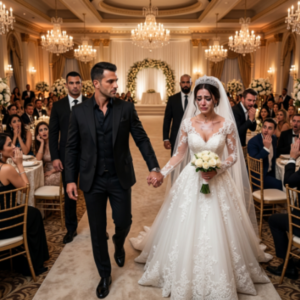
Crystal chandeliers hung at three different heights, staggered like frozen waterfalls. The ceiling above them was painted in the style of a Renaissance fresco, cherubs and cloudscapes rendered in soft gold and ivory. Every table was dressed in white linen, so stiff it held its folds like origami. The guests moved between their seats with the particular looseness of people who had never once worried about the cost of anything on the menu.
Daniel stood near the far wall and watched. He had been assigned this event as a last-minute addition to his duties. His official title at Arcadia Capital Solutions was Fleet and Logistics Coordinator. A name that meant, in practice, that he drove people places, carried boxes when asked, and handled whatever logistical problem fell through the gaps of the regular support staff.
He had held the position for eight months. Nobody on the executive floor knew his last name. He was Dan, usually. Sometimes the driver. Once, memorably, that quiet one. Tonight’s assignment had come through at 2:00 in the afternoon via a terse email from the events coordinator. “Mr. Hayes, standby at the Harrington Gala, 7:00 p.m.
, as available transport and general support. Formal attire required.” He had not owned formal attire. He owned a dark blazer he’d bought for his wife’s funeral 3 years ago. It still fit, mostly. The gala was a fundraiser and investor showcase hosted by Arcadia Capital Solutions. The guest list included 12 board members, four institutional investors, a pair of technology journalists from well-regarded publications, and assorted senior staff.
At the center of it all, moving between tables with the precision of someone who had mapped every social interaction in advance, was Emily Carter. He had seen her in the building before. Everyone had. Emily Carter was 36, CEO of Arcadia Capital Solutions for the past 4 years, and the kind of leader who generated strong opinions simply by entering a room.
Her presence was not loud. She did not raise her voice, did not fill silences with unnecessary words, but there was a quality to her stillness that read as authority so thoroughly it had become indistinguishable from the woman herself. Tonight, she wore something dark blue and understated. She was shaking hands with a man Daniel recognized as Douglas Whitfield, one of the larger institutional investors, a man with the particular smile of someone who has decided in advance that he is the smartest person in any given room.
Daniel watched Whitfield lean in slightly as he spoke. He watched Emily’s expression not change, but her chin lift by approximately 2°. He looked away. It was not his conversation. Around him, the support staff moved with practiced invisibility. Servers circulated with trays. The sommelier hovered near the bar with professional attentiveness.
A cluster of junior staff from Arcadia’s communications team stood near the east wall, talking quietly. One of them, a young man in a perfectly fitted suit whose name tag read Brandon, glanced over at Daniel and then said something to the woman beside him. She laughed, covering her mouth. Daniel did not react.
He had stopped reacting to things like that a long time ago. What he did do was continue watching the room, which was something he did habitually, reflexively, the way some people tap their fingers or check their phones. He watched the movement of people between tables. He watched the service doors and the distance between the main exits.
He watched Douglas Whitfield refill Emily Carter’s glass himself, waving away the approaching server with a casual gesture that was so smooth it would have been easy to miss. Daniel did not miss it. He did not do anything with what he observed, not yet. He simply filed it, the way he had been trained a long time ago, in a different life, to file things.
A fact, a detail, a small irregularity in the pattern of a room. The evening progressed. Speeches were made. A string quartet played something tasteful near the far window. The conversations grew louder as the bar continued to circulate. By 10:00, the first cracks in Emily Carter’s composure were visible, though only if you knew what to look for.
Her responses slowed by a fraction of a second. Her left hand rested on the table between exchanges rather than staying in motion. When she rose to follow Whitfield toward the smaller meeting room adjacent to the ballroom, her balance shifted in a way that was not quite right, not dramatically, not noticeably to anyone scanning the room casually, but often the way that Daniel recognized immediately.
He crossed the room in 30 seconds. Nobody stopped him. Nobody was watching the quiet man near the wall. The corridor outside the meeting room was empty. Through the glass panel beside the door, he could see Emily in a chair, her head tilted forward slightly, one hand on the table for support.
Whitfield stood across from her, still talking. The other two men in the room, advisers from their body language, appeared to be wrapping up. Daniel did not open the door. He waited. When Whitfield and the two advisers emerged 4 minutes later, absorbed in their own conversation, Daniel stepped aside and let them pass. They did not look at him.
He went into the room. Emily Carter’s eyes were open, but unfocused. She was fighting it. He could tell by the deliberate way she was pressing her fingernails into her palm, but she was losing the fight. Whatever was in her system was past the point where willpower was useful. “Miss Carter,” he said, keeping his voice level. “I’m Daniel Hayes.
I work for Arcadia. I’m going to help you leave.” She looked at him. Something in her expression, some fraction of professional reflex engaged. “I don’t,” she began. “You don’t have to explain anything,” he said. “Can you stand?” She stood and nearly didn’t, and he caught her arm at the elbow with a grip that was firm and impersonal and exactly sufficient.
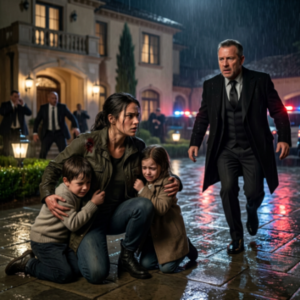
He walked her out through the service corridor. Nobody saw them go. The rain had started while they were inside. It was not a gentle rain. It came down in the solid, indifferent way of late autumn storms that have no interest in being picturesque, straight, and cold, and plentiful. The awning above the service exit provided about 4 ft of shelter.
Beyond it, the street ran dark and wet, the street lights fragmenting across the puddles in long orange streaks. Daniel had called for a car from the building’s approved transport list before they’d reached the exit. The wait time had come back as 47 minutes. He looked at Emily Carter, who was now leaning against the wall with her eyes closed, and he canceled the request.
He had parked his own vehicle two blocks north in a lot that charged by the hour. He did the math. He looked at the rain. He took off his blazer, draped it over her shoulders, and said, “Hold on.” She did not respond verbally, but when he crouched and she registered what he was doing, she complied, arms around his neck, with the passive cooperation of someone who had stopped having opinions about logistics.
He lifted her, adjusted, and stepped out into the rain. Two blocks was not a long distance. He had covered longer distances under considerably more difficult conditions. He kept his breathing steady and his pace even, and he thought about what he had observed. The dilation of her pupils when he’d turned the lights on in the meeting room.
The faint discoloration at the crook of her left elbow, visible for a moment when her sleeve had shifted, a small mark, darker than a bruise, precise in the way that pressure point injections tended to be. The asymmetry of her impairment. Her speech was slow, but her fine motor control retained some function. Her eyes tracked. She was not simply drunk.
He had seen this before. Not in this context, not in an elegant ballroom surrounded by investors, but the signature was familiar enough to identify. The sedative was fast-acting and relatively mild. She would sleep. She would wake with a headache and fragmented memory of the evening. She would not be in medical danger, provided she was kept on her side and her airway was clear and she was monitored through the night.
He did not take her to her home address. He knew it, it was in the company database, attached to her emergency contact file, but he did not go there. Taking her to her own home meant unknown variables. Who might have access? Whether anyone was watching the building? Whether whatever had been done to her tonight was part of something larger and ongoing. He took her to his apartment.
It was a decision he made in 3 seconds standing in the rain outside his car while he settled her into the passenger seat. He was aware with the clarity of someone who has spent years thinking about the consequences of decisions that this choice would look bad to almost anyone who encountered it without context.
He made it anyway. The apartment was a rental in a building that was clean but not impressive. Three floors, a buzzer system, a landlord named Phil who fixed things within a reasonable timeframe and asked no unnecessary questions. Daniel lived on the second floor. He had lived here for 2 years.
His daughter, Lily, had her own room with a window that looked out at a maple tree that she had decided at age 7 was a friendly maple tree specifically and had named Archibald. He parked, got out, went around to the passenger side. Emily Carter had not moved. Almost there, he said to no one in particular and lifted her again.
The buzzer for the front door responded to his building key. The elevator was out of service which it frequently was. He carried her up two flights of stairs with the particular focus of someone who has learned not to waste energy on frustration with things that cannot be changed. He had texted Lily from the parking lot. Coming up.
Not alone. Don’t worry. When he reached the landing, the door opened before he could knock. Lily Hayes was 8 years old and possessed in Daniel’s private assessment of an unusually sophisticated emotional intelligence for her age. She had inherited her mother’s eyes, dark gray, observant, and her father’s tendency towards stillness.
She looked at the woman in her father’s arms with the particular careful attention of someone taking inventory of a situation before deciding how to feel about it. She’s sick, Lily said. It was not a question. She needs to sleep it off, Daniel said. Go back to bed. Is she hurt? No, she’s going to be fine. Lily looked at the woman, really looked at her, and then looked at her father.
And whatever she concluded from this, she kept to herself. She stepped back. The couch folds out, she said, and went to her room. Daniel put Emily Carter on the fold-out couch which he had already set up with a spare pillow and the extra blanket from the closet. He positioned her on her side. He checked her pulse steady, 62 beats per minute.
He confirmed her breathing was unobstructed. He set the small side table lamp to its lowest setting, left the bathroom light on with the door cracked, and sat in the chair across the room. He sat there for a long time. At some point past midnight, he let himself fall into the light half sleep that was the best he managed on most nights. Present enough to register any change in the room, absent enough to let the fatigue lift slightly. At 3:47 a.m.
, Emily Carter’s breathing shifted. She moved. She didn’t wake, but something in her relaxed that had been tense before and he understood she had passed through the worst of it. He allowed himself a full exhale. Outside, the rain was tapering off. The maple tree Archibald was visible through the window, wet and dark.
Its last autumn leaves clinging with decreasing conviction to the branches. The knock came at 6:12 a.m. Not a knock, precisely. A pattern of blows that fell into the particular cadence of official authority. Firm, evenly spaced, designed to communicate that waiting is not among the available options. Daniel was already awake.
He had been awake since 5:30, moving quietly through the kitchen, making coffee, checking Emily Carter’s breathing one more time unchanged, steady, and then sitting at the small kitchen table with his coffee and the particular silence that he had learned to inhabit since his wife died. The mornings were the hardest. They always had been.
He set down his mug. He went to the door and opened it. Three officers, two in uniform, positioned at slight angles to the doorframe in the instinctive geometry of people who have been trained to manage exits. A third in plainclothes detective shield clipped to a belt standing directly in front, hands loose at his sides. Behind them, on the stairs, another uniformed officer.
In the parking lot below, visible through the window at the end of the landing, two marked vehicles with their lights running silently, the blue and red flickering in the gray morning air. The detective was a man in his late 40s, broad-shouldered, with the careful neutral expression of someone who has learned to reveal nothing in the first 30 seconds of an encounter.
His name tag read Foster. Daniel Hayes, he said. Yes. We’d like to ask you some questions. There’s been a complaint. Behind Daniel, down the short hallway, Lily’s door opened. She appeared in the doorframe in her pajamas, small, quiet, her dark eyes moving from her father to the officers with the controlled calm of a child who has been frightened before and has learned that showing it makes things worse.
Daniel did not look away from Foster. What kind of complaint? We’d prefer to discuss that at the station. We’re also going to need to speak with the woman. She’s asleep on the couch, Daniel said. She was sedated last night. Not by me. Foster’s expression did not change. We’re still going to need to go into need to go I know, Daniel said.
He turned to Lily. Get your backpack. You’re going to spend the morning with Mrs. Harris downstairs. He said it in the same voice he used when telling her to put on her shoes, calm, direct, already decided. Lily looked at him for one long second. Okay, she said. She went back into her room. She did not slam the door.
She did not cry. She had her backpack in 45 seconds and walked past the officers to the stairs without looking at any of them with a dignity that was, to anyone paying attention, extraordinary in a child her age. Daniel watched her go. Then he turned back to Foster. Let me get my jacket, he said.
The room was exactly what interrogation rooms always are, a table, three chairs, a one-way window, a recording device on the table with a small red light. Daniel sat in the chair facing the window. Detective Foster sat across from him. A second detective, a woman named Reyes, mid-30s, precise, with the quality of attention that had nothing performative about it, sat at the end of the table with a legal pad and a pen she hadn’t used yet.
They had explained the allegation on route. Someone had called the department’s tip line at 2:17 a.m. anonymous reporting that a female executive had been removed from a corporate event without her consent by a male employee. Daniel listened to the full explanation before responding. Removed without her consent, he repeated. She was sedated.
She wasn’t in a position to consent to anything. And how do you know she was sedated? Foster said. Injection mark at the antecubital fossa, the inside elbow. Left arm. Small gauge needle, pressure point contact consistent with a fast-acting benzodiazepine class compound. Her symptom pattern was wrong for alcohol motor control better than expected relative to impairment.
Vertical nystagmus absent, no vomiting reflex. He paused. I’ve seen it before. A silence. You’ve seen it before, Foster said with precisely the tone of a man who has decided to let a sentence sit in the air rather than respond to it. I’ve seen it before, Daniel confirmed. He did not elaborate. Reyes had written two lines on her legal pad.
She underlined something. Mr. Hayes, can you walk us through your movements from the time you left the event to the time you arrived at your apartment? He did. He was specific about times, specific about routes. He described carrying Emily Carter two blocks in the rain, the parking lot, the two flights of stairs.
He described putting her on the fold-out couch. He described his position in the chair across the room for the remainder of the night. You stayed in the same room with her the whole night, Foster said. Yes. Why didn’t you call 911? Because I assessed that she was not in immediate medical danger. A hospital visit for a sedative of this class administered at the dosage I estimated would have been cautionary rather than necessary.
And taking her to the hospital would have created a paper trail that whoever did this could potentially monitor or manipulate. He looked at Foster directly. Someone called your tip line at 2:17 a.m. They knew where she was. They knew I had her. The silence this time was different. Reyes looked up from her legal pad. They knew where she was, she repeated.
Someone at that event. Someone who knew I’d taken her out of the building and tracked my parking record or followed the car or both. He kept his voice level. I made a decision to take her somewhere that wasn’t her home address. It was the right decision. You’re making a lot of unilateral decisions for a logistics coordinator.
Foster said. I know, Daniel said and did not say anything else. Foster leaned back slightly. He looked at the one-way window which meant he was looking at whoever was watching from the other side. He looked back at Daniel. Someone edited the event security footage, Reyes said. It was the first thing she had offered.
“We pulled the files this morning. There are 11 minutes missing starting approximately when you would have entered the meeting room. The deletion is clean, professional.” “I know.” Daniel said again. “You know because you did it, or you know because it’s what you’d expect?” “I know because it’s what I’d expect.” he said.
“Whoever set this up was prepared. They had time to plan the dosage, access to the event layout to get close enough to administer it, and enough inside knowledge to adjust the security system. This wasn’t opportunistic.” Reyes was writing. She wrote without looking up. “What’s your background, Mr. Hayes?” It was the question he’d been waiting for.
“Logistics.” he said. “Prior to that, federal security consultation. I’ve been out of that field for 3 years.” He let the word federal land without embellishment. It landed the way he’d known it would. “3 years.” Foster said. “My wife died. I have a daughter. I needed a different kind of work.” The room was very quiet.
Reyes set down her pen. “Ms. Carter is at St. Francis General. She regained consciousness approximately 40 minutes ago.” She paused. “She’s asking about you.” The room at St. Francis was private and very white. Emily Carter sat up in the bed with the particular careful movements of someone who has taken inventory of her own body and found most of the results acceptable.
Her head ached a steady pressure behind her eyes that was unpleasant but manageable. Her mouth was dry. Her left arm, where the IV line was attached, felt mildly tender. The doctor, a resident with the exhausted competence of someone on hour 22 of a shift, had given her a brief rundown. Benzodiazepine compound in her bloodstream, consistent with external administration rather than voluntary ingestion.
She would be fully clear in another 4 to 6 hours. No lasting effects anticipated. She had listened to this information and then sat quietly for a while. Working backwards through the night, the gala. The conversation with Whitfield, which had been, as she’d predicted in advance, a performance of concern masking a much simpler agenda. His two advisors, the way he’d poured her drink himself.
She had accepted it without thinking because she had been watching him and trying to parse the real message beneath his surface message. And because it had not occurred to her that a man of Douglas Whitfield’s position would take a risk that crude. She remembered the meeting room, the chair, the table, a creeping slowness in her thoughts that she had attempted to override with sheer stubbornness and found impossible to override. She remembered a voice.
“I’m Daniel Hayes. I work for Arcadia. I’m going to help you leave.” She remembered rain. She remembered, and this was the fragment that felt most vivid, that had the texture of a real thing rather than a dream. The steadiness of it, the evenness of breathing she could feel against her shoulder. No urgency, no hesitation, just movement calibrated and unhurried through the cold and the wet.
She remembered a child’s face. Dark eyes. Careful. “She’s sick.” said without alarm. She remembered being positioned on her side, the pillow adjusted, a lamp set low, a door left open, the particular quality of light that means someone has arranged things so you won’t be frightened if you wake in the night.
She had not been afraid. It was the detail that struck her most now that she had the cognitive space to examine it. She had not been afraid. Whatever part of her brain had continued processing throughout the night had not sent up the emergency signal that it would have sent if something was wrong. It had kept her calm, and she was a woman who trusted her own threat assessment more than almost anything else she relied on.
A police officer came in at 8:45 and asked her questions. Standard questions, chronological, delivered with professional neutrality. She answered them as precisely as she could. “The man who brought you to his apartment.” the officer said. “Daniel Hayes.” “Do you have any knowledge of him from your professional context?” “He’s in logistics, fleet and transport.
” She paused. “He’s been with the company 8 months. And you had no prior personal relationship?” “No.” “Is there anything you can tell us about your interactions with him prior to last night?” She thought about it honestly. “I knew his face. I don’t think I ever learned his name before last night.” She stopped. “That’s I should have known his name.
” The officer wrote something. “Ms. Carter, is there anything you want to add regarding the events of last night? Any detail you think might be relevant?” She considered the question carefully. “He kept a distance.” she said. “From the moment he found me to the moment I don’t know. I was going in and out. There was always appropriate space.
He treated me like a person who needed help, not like a situation that needed managing.” She looked at the officer. “I’ve been managed by a lot of people. It’s different. It feels different.” The officer looked up. “And the distinction in your mind, the distinction is that he was trying to keep me safe.” she said.
“Not trying to do something with me. Those two things do not feel the same.” She sat with that for a moment. “Where is he now?” The board room on the 14th floor of Arcadia Capital Solutions was not intended for this kind of meeting. It was intended for quarterly reviews and partnership presentations and the careful performance of institutional confidence.
Today, it had been requisitioned by Reyes and a second detective from the Financial Crimes Division, a quiet man named Aronson, and it smelled of fresh coffee that no one was drinking. The CFO of Arcadia Capital Solutions was named Gregory Albrecht. He was 51 years old, had been with the company for 9 years, and had spent the last two of those years in the particular state of frustration that comes from watching a younger person succeed in a role you believe you are better qualified to hold.
He did not consider himself a bad person. He had donated money to several charitable foundations. He drove his daughters to their weekend sports activities and had a dog he genuinely loved. He had constructed a series of arguments in his own mind that were internally coherent and sufficient to sustain the belief that what he had arranged was less a crime than a correction.
He sat across from Reyes and Aronson and looked at the surface of the table. The head of building security, a man named Townsend, had been interviewed separately in a smaller room on the third floor. Townsend had held out for 45 minutes, which was roughly 40 minutes longer than most people managed, and had then provided the following.
Gregory Albrecht had approached him 6 weeks prior. The arrangement had been specific. Townsend would ensure that the relevant section of the gala’s security footage was edited during a precise window and would coordinate access for a medical professional hired by Albrecht to administer the compound. In exchange, a transfer to an account Townsend believed to be untraceable had been arranged. It was not untraceable.
Aronson had found it in under 3 hours. The original security footage, the actual original, backed up automatically to Arcadia’s cloud server at 15-minute intervals by a system Townsend had not known to disable, showed Gregory Albrecht himself approaching Emily Carter’s glass at the pre-reception cocktail period, 7:42 p.m.
, with a small addition that was visible to anyone who knew what to look for, which Aronson did. What Albrecht had not anticipated in the architecture of his plan was Daniel Hayes. He had anticipated a scenario in which Emily was found in an embarrassing condition by the press, or in which she woke in an unfamiliar location with no clear account of the night, or in which the police received a tip about improper conduct by someone at the company.
Any of these outcomes would have been sufficient to create the kind of institutional uncertainty that Albrecht needed, doubt about Emily’s judgment, questions about her fitness to lead, an opening for the board to reconsider the succession question that had been settled 4 years ago, but never, in Albrecht’s mind, truly resolved. Daniel Hayes had removed Emily Carter from the environment before any of these scenarios could materialize.
He had taken her somewhere private and unmonitored. Albrecht’s man had tracked the car, as Daniel had guessed, and the tip to the police had been designed to generate the scandal by other means and had kept her safe and coherent and in a position to tell her own story accurately, as soon as she was capable of telling it.
The plan had required Emily to be unavailable and discredited. Instead, she had been available and articulate. Reyes set a printed photograph on the table in front of Albrecht. It showed a timestamp. It showed his hand. “Mr. Albrecht.” she said in a tone that contained no drama whatsoever. He looked at the photograph for a long time.
“I want to speak to my attorney.” he said. “Of course.” she said. “You’ve had that right since we sat down. There is a file, several files, technically. Some of them classified and several of them not that describes a career in federal security consultation that lasted 11 years. The man described in those files is technically Daniel Hayes.
But the name feels somewhat abstract to Daniel himself at this point. The way any version of yourself from 11 years ago feels abstract. He had been good at the work. He had been good at it in the particular way that people are good at things that make use of everything. They are not just the skills that can be trained, but the underlying disposition, the patience, the ability to remain present in situations where most people’s nervous systems send the unambiguous message leave.
He had done protective intelligence work primarily, the assessment and mitigation of threats against persons of interest, executives, politicians, diplomatic personnel before those threats materialized. The job was 90% observation and 10% intervention. And the observation was the harder part because observation required absolute stillness of the self while the world moved around you, and very few people were built for that.
He had left when Sarah died. It was not a dramatic decision. He did not have a breakdown or a crisis of faith in the work or a scene. He submitted his resignation on a Thursday afternoon, cleaned out his desk, and drove to the house where his daughter was being cared for by his mother-in-law who had flown in from Portland and who looked at him with an expression that contained everything anyone needed to understand about grief.
He had told himself, and it was true, that Lily needed a father who was present. The work he had done required a particular kind of absence. Not physical, usually, but the deeper absence of someone whose attention is always partly elsewhere, scanning, assessing, keeping watch. You could not do that work and also be fully in the kitchen while your daughter told you about her day at school.
The two states were incompatible. He had chosen his daughter. He would make the same choice again. What he had not been able to entirely shed was the seeing, the observation, the pattern recognition that 11 years had etched into something more fundamental than habit. He watched rooms. He watched people’s hands.
He noticed the small asymmetries that precede problems the way a conversation shifts when someone is afraid, the specific quality of a pause that means a decision has been made. He had noticed Douglas Whitfield pouring Emily Carter’s drink. He had noticed her balance in the corridor. He had noticed the injection mark. He had responded to these observations not because he had decided to, but because the response was simply the next thing, the obvious and necessary thing that followed from seeing what he had seen.
He had not planned to tell anyone any of this. He was sitting in the hallway outside the interview room waiting to learn whether he was being charged with anything when Reyes came out and stood in the hallway and looked at him with the expression of someone reassessing a situation they thought they understood.
“We have the original footage,” she said, “the cloud backup. It shows the CFO.” Daniel nodded. “We’re releasing you. Ms. Carter has already confirmed your account.” “Albrecht’s counsel is on the phone.” He nodded again. “Mr. Hayes.” She paused. “The federal file.” “How much of it is relevant to what happened last night?” He considered the question.
“The observation was relevant,” he said. “The training was relevant. The rest is” He looked at the wall across the corridor, which was painted a specific shade of institutional gray that he had spent enough time looking at in his life to have formed opinions about. “The rest is history.” She studied him for a moment. “Your daughter is with Mrs.
Harris in 2B.” “I know. She made Mrs. Harris coffee and told her she didn’t need to worry.” He looked at the wall. “She does that,” he said. “The thing about evidence is that it does not care about narrative.” Albrecht had constructed a narrative. It was a reasonable narrative, a contingent, opportunistic accounting of events that placed Daniel Hayes as its villain and Emily Carter as its incidental victim.
The narrative had a certain coherence if you accepted its premises, and it had been designed to be introduced into a media environment at a moment when Emily’s credibility was lowest and Daniel’s was nonexistent. What the narrative could not accommodate was the cloud backup. Arcadia Capital Solutions had upgraded its security infrastructure 14 months ago following a minor data incident that had prompted the board to authorize a significant investment in redundant systems.
The upgrade included automatic, encrypted, offsite backup of all building security footage at 15-minute intervals. The backup server was located in a facility in Denver that had no connection to Arcadia’s in-house IT administration. Townsend had edited the onsite footage. He had not known about Denver. The 15-minute interval meant the backup captured everything up to 7:45 p.m.
in its final pre-edit segment. 7:42. Gregory Albrecht at the cocktail reception facing Emily Carter’s position at the bar, his right hand briefly near the drink she had set down to gesture with while speaking. Aronson had isolated the frame. He had run it through enhancement protocols that were, in his words to Reyes, routine.
The result was clear. The medical professional Albrecht had contracted a man named Whitmore who had lost his pharmaceutical license in Connecticut 3 years prior and had since operated in the particular gray market of people willing to provide services that cannot be purchased through legitimate channels had been identified through Townsend’s testimony and located at a hotel near the airport.
His kit, which was still in his possession because he had not had reason to dispose of it in the hours since the event, contained the compound. Toxicology from the hospital confirmed the compound in Emily Carter’s bloodstream was the same compound. This was not complicated. It was thorough, methodical, and irreversible.
Aronson presented it to the board’s legal counsel in the conference room on the 14th floor at 11:45 a.m. with the particular unhurried precision of a man who has learned that the pace of the presentation conveys as much as its content. Gregory Albrecht was placed under arrest at 12:02 p.m. In the lobby of the building, Daniel Hayes was sitting on a bench waiting for the paperwork that would confirm he was no longer required.
He had his phone out. He was looking at a text from Lily that read, “Mrs. Harris made pancakes. She makes them really thick. You should taste them.” Below this, a follow-up. “Also, she has a cat named Stewart. He’s okay.” He read these messages twice. He sent back, “Coming to get you soon.” Her reply was immediate. “Okay.
Take your time.” He looked at his phone for a moment after that. Then he put it in his pocket. And he sat in the lobby of the building he had driven people to and carried boxes for and handled problems in quietly for 8 months, and he waited for the world to finish doing what it was doing.
The emergency board meeting was called for 3:00 p.m. 11 members were present in the room. Two more joined by video screen from their respective cities. The Arcadia Capital Solutions boardroom had floor-to-ceiling windows on the south side and a view of the city that had been specifically chosen for its confidence-inspiring quality. This afternoon it was overcast.
The city spread below a low gray sky, everything muted and considered. Emily Carter stood at the head of the table. She had been discharged from St. Francis at 12:30, had gone home, had changed, and had arrived here with a clarity of purpose that was visible in every line of how she held herself. She had spoken to the company’s legal team for 40 minutes. She had spoken to Reyes.
She had read Aronson’s summary report. She presented the facts in the order in which they had occurred. She did not editorialize. She named Gregory Albrecht and described in precise terms what he had done and what he had intended. She presented the evidence in the order it had been assembled. And she was conscious of the particular quality of silence in the room as she did, a silence that had texture to it, the texture of 12 people recalibrating their understanding of the last 9 months of decisions, of conversations that had
seemed straightforward and were now available for reinterpretation. She did not perform anger. She did not perform injury. She conveyed information. When she was finished, there was a pause. Then Robert Hadfield, who had been on the board for 6 years and had the reputation of speaking last and saying the most, said, “What do you need from us?” “I need authorization to initiate an independent external review of our governance protocols,” she said.
“I need the board to issue a statement to institutional investors within 24 hours that is factually accurate and does not minimize what occurred. And I need to discuss with HR the implementation of anonymous reporting channels for conduct concerns at every level of the organization.” She paused. “There’s one more thing.
” She looked at Hadfield, then moved her gaze along the table. “A member of our logistics staff identified the threat, removed me from a dangerous situation, spent the night monitoring my condition, and cooperated fully with police despite being presented as a suspect in a crime he did not commit. He did this at significant personal cost and with no expectation of recognition.
” She let that settle. “I want to know how a man with that level of competence and integrity ends up carrying boxes and driving people to events. I want to know what our hiring and talent practices are actually doing, and I want to make changes.” Hadfield nodded. Several other board members nodded. Who is he? One of them asked.
His name is Daniel Hayes, she said, and the room held that name carefully. The way rooms hold information that has suddenly become important. Emily Carter came to the apartment on a Saturday morning. She had not called ahead. She had not been certain until she was standing at the bottom of the two flights of stairs that she was going to come at all.
She had drafted and discarded several versions of what she intended to say. None of them had felt adequate. She had decided, finally, that adequacy was not really the point. Lily opened the door. This was something Emily had not anticipated. The child opening the door, looking up at her with those precise gray eyes, taking her in with the complete undefended attention of someone who had not yet learned to mask their assessment.
You’re the lady from the couch, Lily said. Yes, Emily said. I am. Dad said you might come. Lily considered this. He made extra coffee. She stepped back from the door in a way that constituted an invitation, and Emily stepped inside. The apartment was smaller than she had expected and better than she had expected in the specific way of spaces that are cared for without being curated.
There were books stacked horizontally on top of other books on shelves that had run out of vertical space. There was a child’s drawing of what appeared to be a tree with a face taped to the refrigerator. There was a chess set on the coffee table mid-game with a sticky note on one of the white pieces that read your turn in a handwriting that was clearly not a child’s.
Daniel Hayes was in the kitchen. He was wearing a gray sweater and looked, for the first time since she had seen him, like a person who was in a place he recognized as his own. Ms. Carter, he said. Emily, she said. He nodded, accepting the correction without making anything of it. She sat at the kitchen table. Lily sat across from her proprietorially.
In the manner of a child who has decided that the management of this situation is partially her responsibility. Daniel poured coffee and set the mugs down and then sat, and there was a moment in which none of them said anything, which was, Emily realized, not uncomfortable. I want to thank you, she said. I’ve been She stopped.
Started again. I’ve spent the last four days trying to find the adequate version of this, and I don’t think there is one. You made a decision to help me at significant risk to yourself. And you carried that decision through the entire night without asking for anything, and I want you to know that I understand what that cost, and I’m She stopped again.
I’m grateful. I’m genuinely and completely grateful. Daniel looked at his coffee mug. He turned it once in his hands. You didn’t need to come in person, he said. I know. You could have sent a letter or had HR do something formal. I know that, too. He looked up. She held his gaze without looking away. You’re all right, he said.
It was not quite a question. I’m all right, she said, completely. He nodded. Lily, who had been watching this exchange with the focused intensity of a documentarian, said, Dad taught me chess. I’m getting pretty good. She looked at Emily. Do you play? I have in the past, Emily said. Not recently.
The person on that sticky note hasn’t moved in 6 days, Lily said, with a pointed look at her father. In case you want to know. Daniel looked at the ceiling briefly. Lily, I’m just saying. Emily looked at the chessboard. She looked at Daniel. Something in the careful distance he maintained, the precise, considered space between himself and everything around him was, she thought, not entirely about professionalism.
It was the posture of a person who has learned that attachment creates vulnerability and who has made peace with that lesson and who is perhaps, possibly, in the early stages of reconsidering it. I spoke to the board, she said. We’re creating a senior advisory role in operational security and intelligence. Liaise on between executive leadership and our physical and digital security infrastructure. She paused.
It’s part-time, if preferred. Flexible scheduling, school hours compatible. He looked at her. I’m not trying to recruit you under the guise of gratitude, she said. I want to be clear about that. The role exists because we identified a genuine gap, and you are the most qualified person I know of for it.
Those are separate things from what happened last week. Are they? Yes. He was quiet for a moment. Part-time, he said. Part-time, school hours compatible. Yes. Lily had stopped pretending to look elsewhere. She was watching her father with the total openness of a child who has not yet learned to hide hoping.
Daniel looked at the chessboard. He looked at his daughter. He looked at the mug in his hands. I’ll think about it, he said. Emily nodded. She did not push. She understood, she thought, something about the difference between an offer and a pressure, even though she was still, on this particular skill, a work in progress.
They sat with their coffee in the small kitchen while the Saturday morning arranged itself around them, the maple trees’ bare branches visible through the window, the city making its distant weekend sounds, a cat that appeared to be visiting from somewhere walking across the chessboard and dislodging one of the pieces with an air of supreme indifference.
That’s Stewart, Lily said. He’s Mrs. Harris’s. He comes up sometimes. Does he play chess? Emily said. He thinks he does, Lily said seriously. But his strategy is very chaotic. Daniel made a sound that was not quite a laugh, but was adjacent to one. And Emily realized she had not heard him make any sound remotely like it in any of the contexts she had encountered him in before, and that this was the most clarifying information she had received all week.
Three weeks later, the city had moved fully into November. The mornings were cold now in the definitive way that means cold for a while, and the maples were bare except for Archibald, who retained three leaves with what Lily characterized as sheer determination. Daniel walked her to school at 7:45. This was the thing he had organized his entire adult life around the walking to school, the knowing of the teachers’ names, the awareness of which lunch items she would actually eat versus which ones she would trade away, the ordinary, accumulating substance of
being present for a person’s life. On the way back from school, he took the long route past the park, where the early joggers moved in their focused loops and the benches collected frost in their wood grain. He thought, as he walked, about the board meeting he would be observing in an advisory capacity on Thursday.
He thought about the security infrastructure review he had been asked to initiate. He thought about the recommendation he intended to make regarding anonymous conduct reporting channels, which was both a good idea in itself and a direct response to the fact that no one in the building had felt safe enough to tell anyone what Gregory Albrecht had been doing for the better part of a year.
He thought about a chessboard with a sticky note that read your turn. He thought about Lily’s face at the breakfast table that morning when she had told him about a project her class was doing on architecture, and the way she had described a building she wanted to design someday with a door that looked like nothing from the outside, but opened into somewhere completely different.
He had listened to her describe it with the complete, unreserved attention that was the most important thing he knew how to give. He was not the same person he had been 11 years ago. In the files, he was not the same person he had been 3 years ago when he had been learning, in the most painful possible way, how to reorganize a life.
He was someone slightly different from both of those people, someone who had learned, slowly and imperfectly, that being present for the people you love and being capable of action in the world are not, in the end, incompatible things. That the skill of watching, of paying attention, of seeing what is actually there rather than what is convenient to see, this could be used gently in the service of small and specific goods without requiring the return of everything he had set down.
He walked home through the cold morning. He made coffee. He sat at the kitchen table with Stewart, who had apparently let himself in through the window at some point and was now on the table examining the chessboard with his usual sovereign contempt for the rules of the game. Daniel looked at the board.
He moved the white bishop two squares. He put the sticky note back. He wrote, in handwriting that was clear and unhurried, then he picked up his phone and started on the morning’s work. And outside, the city went about its ordinary life, present, specific, ongoing in all the ways that matter most.