The building had 42 floors, and Daniel Carter knew every square foot of the first three. He knew which stretch of marble in the lobby ran slightly cold at 2:00 a.m. because the ventilation duct above it had a slow leak that nobody had fixed in 8 months. He knew that the second men’s room on the north corridor smelled faintly of mildew on Tuesdays and Thursdays, which meant water was pooling somewhere behind the tile.
He knew the service elevator took 11 seconds longer than it should when loaded above 200 lb and that the security guard named Felix always fell asleep between 3 47 and 4 12 without exception. Daniel Carter was a man who noticed things. He had learned a long time ago that noticing things was not always useful.
Sometimes it was a weight, but he carried it anyway. He had been working the night shift at Vantage Capital Group for 14 months. The job was simple. Clean the floors, empty the bins, replace the soap in the restrooms, and disappear before the morning staff arrived. He was good at it. Not because cleaning required talent, but because disappearing did.
His cart smelled like lemon disinfectant and rubber. He pushed it through the corridors the way a surgeon moves through a ward quietly, purposefully without wasted motion. His uniform was gray. His shoes were soft sold. He was to anyone who bothered to look furniture. Most people didn’t bother to look. His daughter was named Lily.
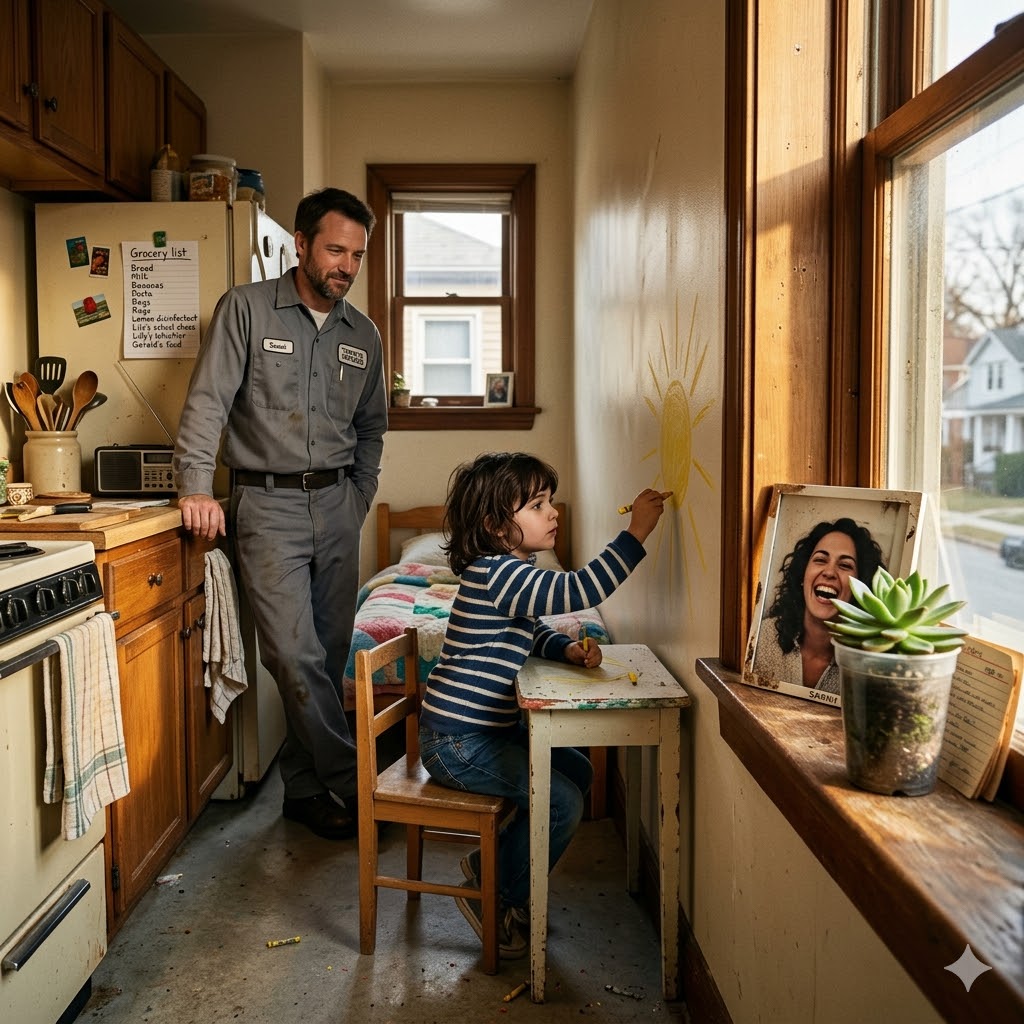
She was six years old, had her mother’s dark eyes, and spoke less than most children her age, which worried some people and didn’t worry Daniel at all. Lily watched. She listened. She filed things away. In that way, she was her father’s daughter. Their apartment was on the fourth floor of a building on Crescent Street, 15 minutes from downtown on a good morning, 25 in traffic, two bedrooms, a kitchen with a window that faced west, and caught good light in the evenings.
Lily had drawn a sun on the wall above her bed in yellow crayon, and Daniel had left it there. He had a system for everything. The grocery list lived on the same corner of the refrigerator door. Lily’s school shoes lived by the left side of the front door. His work boots lived on the right. Dinner was at 6:00, bath at 7:30, lights at 8:15.
The system held things together. He understood this about systems. They did not solve problems. They simply kept the problems in their correct compartments where they could not bleed into each other. His coworker advantage, a broad-shouldered man named Terry, who had worked the building for 6 years, sometimes looked at Daniel with a squinting kind of curiosity.
You ever going to tell me what you used to do? Terry asked one night, watching Daniel angle a mop head into a bathroom corner with geometric precision. I cleaned, Daniel said. Before that, I cleaned other things. Terry shook his head. Man, you look at this building like you’re reading it, like you’re doing math on it. Daniel said nothing.
He pushed the mop back into the bucket and watched the water turn gray. You ever think about doing something else? Terry asked. All the time, Daniel said. He didn’t explain what he meant by that. What he meant was the thinking and the doing had become for him two separate operations. He thought about a great many things.
He had thoughts about systems design and organizational behavior and the specific ways that institutions failed their own people. He had thoughts that would have been in a different chapter of his life. Worth money, worth influence. He had for 12 years been paid well for those thoughts and had given them freely and had watched what happened to some of them afterward and had decided eventually that thinking was not the problem.
The problem was the space between thinking and doing and who controlled that space. So he cleaned floors. The space between noticing a dirty floor and cleaning it was zero. There was no committee. There was no timeline. There was no risk assessment. You saw the problem and you addressed the problem and the floor was clean. He found this more satisfying than people expected him to.
He had a photograph on the window sill in the kitchen half hidden behind the succulent. Lily had planted in a plastic cup and never thrown away even after it died. The photograph was of a woman laughing, genuinely laughing, eyes half-cloed, caught in the middle of something funny. Her name had been Sarah. She had taught fourth grade and made very good soup and had a habit of reading the last page of a book before she started it, which had driven Daniel completely insane, and which he would have given anything to be driven insane by again. He did not look
at the photograph in a griefstricken way. He looked at it the way you look at a compass to check your bearing. Some mornings Lily would come into the kitchen and look at the photograph and then at Daniel and say nothing, which was the right thing to do. She understood somehow that grief lived in a specific compartment, and that the correct response was to leave the door alone.
It was a Thursday in October, the kind of afternoon where the sky was the color of old pewtor, and the wind off the street carried the smell of rain that hadn’t arrived yet. Daniel had picked Lily up from the after school program at 4:45. She walked beside him with her backpack on, holding his hand in both of hers the way she did when she was thinking about something.
The intersection at Fifth and Heartley was always backed up at this hour. six lanes, two crosswalks, a bus stop that blocked sight lines, and a traffic light that had a broken pedestrian signal on the east side. Daniel knew the timing of the light by heart. 40 seconds on the main avenue. 22 on the crossing street, a 4-second overlap where both could run.
He stopped at the corner and waited. That was when he saw her, a girl around 10 years old, standing at the edge of the curb with a white cane. She had a blue wool coat and a knit hat pulled down over her ears. She was facing slightly left of the crosswalk, not enough to be obviously lost, but enough that someone paying attention would notice.
She was turning her head in small increments, listening. Nobody stopped. People moved around her the way water moves around a stone, adjusting briefly, then resuming their direction. Daniel looked down at Lily. Lily was already looking at the girl. He walked to her. He didn’t rush. He didn’t call out from 10 ft away.
He came close enough to be heard over the street noise and said quietly, “I’m going to your left. I’ll walk you across.” The girl tilted her head toward him. Her face was still, not afraid, just processing. “Okay,” she said. “My name’s Daniel. I have my daughter with me. She’s six. I’m Emma, the girl said. I’m 10. Okay, Emma. When you’re ready, give me your hand.
She shifted her cane to her left hand and reached out with her right. He took it. His grip was firm, but not tight. The grip of someone who understood that confidence communicates through the hand more clearly than words. He looked at the light, counted, stepped off the curb at the moment the walk signal appeared.
3 seconds before the audible cue. His pace was measured, not slow enough to be patronizing, not fast enough to be alarming. He kept his body slightly ahead of Emma’s, just enough to intercept any hazard without her having to feel it. Lily walked on his other side, quiet, watching her father. They crossed in 14 steps.
On the other side, Daniel stopped and waited while Emma oriented herself with her cane. “Thank you,” Emma said. She was very composed for 10 years old. You’re welcome. She tilted her head. You didn’t talk the whole way across. Didn’t need to. She considered this. Most people talk when they’re nervous. I wasn’t nervous. No. Emma agreed. You weren’t.
She seemed to find this interesting. What do you do for work? Daniel looked down at her. The question was simple, and the answer was simple. I clean floors, he said. Emma nodded slowly as if this were exactly the right answer. She adjusted her cane and walked on, leaving him at the corner with his daughter and the gray autumn sky.
Lily looked up at him. “Your face was different,” she said. “Different how?” She thought about it like when you’re doing something important. He looked down the street after Emma, who had already folded herself into the crowd without difficulty. “Come on,” he said. “It’ll rain.” They walked. Lily still held his hand in both of hers.
The vehicle had been parked on Hartley Street for 40 minutes. Inside, Clare Whitmore watched the intersection feed from a laptop mounted to the center console. The image was sharp. The city had upgraded the intersection cameras 6 months ago. 4K resolution, 40 frames per second, AI enabled behavior tracking. Clare had access to the feed through a security contractor her company kept on retainer.
The system had flagged a behavioral anomaly at 5:30 p.m. Not the anomaly she was looking for. The one she was looking for involved a data trail, not a pedestrian crossing, but the flag had caught her attention because of its classification, non-standard navigation assistance. Subject displays trained situational awareness protocol.
She had almost dismissed it. Then she had watched the crossing. It wasn’t the act of helping the girl that caught her attention. Plenty of people helped blind pedestrians cross streets. It was the method. The way the man had approached from the correct angle without advertising his presence. The way he had timed the crossing to the light with 2 seconds precision while holding a child’s hand with his other arm.
The way his body had angled at the midpoint of the crossing briefly in response to a bicycle that had appeared from a side street. Not a dramatic movement, barely perceptible, but a clean intercept and absorbed posture that took training to produce unconsciously. The system had tagged him as unusual.
Clare agreed with the system. She opened a secondary window and pulled up the building’s night shift employment records. The intersection at Fifth and Hartley was four blocks from Vantage Capital. She had been investigating a data breach for 6 weeks. She had not found the source. Her internal security team, which was expensive and thorough and had thus far produced nothing useful, had suggested an external actor.
Clare did not believe in external actors. In her experience, the wound was almost always self-inflicted. She expanded the face match query. The man’s name returned in 11 seconds. Daniel Carter, age 34. Current employment, Vantage Capital Group, facilities management, night shift. Prior employment classified. That last word sat there on the screen.
Classified. Claire closed the laptop. Find out what’s behind the classification. She told the contractor in the driver’s seat. Timeline tonight. She looked back at the empty intersection. The man and his daughter were gone. The girl with the cane was gone. The pedestrian light ticked through its cycle like nothing had happened.
Clare thought. In six weeks, no one on my security team noticed what I just watched a man do while carrying groceries and holding a child’s hand. She thought, “That’s a problem.” Then she thought, “Or it’s a solution.” Daniel’s life ran on two tracks that never touched. The first track was Lily. Breakfast at 7:1 sliced banana, which she preferred not to be touching the oatmeal until she was ready to mix them herself.
School drop off at 8:15, pickup at 4:45, dinner at 6:00. He cooked simply pasta, rice, chicken in various configurations. Lily ate without complaint and sometimes asked questions about the food in the sober, curious way she had. “Why does salt make things taste more like themselves?” she asked one Thursday over pasta. “Because it is,” he said.
“Some things need a push to be what they already are.” She considered this and went back to eating. The second track was the building. At 1000 p.m. each weekn night, Daniel came through the service entrance on the south side of Vantage Capital, scanned his badge, collected his cart, and began.
He had memorized the building’s rhythms the way a navigator memorizes currents. The cleaning was routine. What wasn’t routine was what he noticed along the way. He didn’t think of himself as still working. He thought of it as the way some people are still musicians even when they’re not playing. The pattern recognition doesn’t switch off.
It was wired in 3 weeks before the Thursday with Emma. He had noticed the cameras. Vantage Capital had a standard commercial security array. 36 cameras across three floors positioned at coverage optimized angles. updated two years ago to highresolution units. He had memorized the angles in his first week. The way he memorized most things that could become relevant.
On a Tuesday in September, camera 7, which covered the corridor leading to the CFO suite, was off by.5°, not broken, not obviously tampered with, just rotated barely at the mounting bracket. The field of coverage now had a blind spot of approximately 14 in at the 6 ft height range. which corresponded to a door access panel on the east wall. He noted it.
He didn’t report it. Then 11 days later, service elevator B ran at 2:17 a.m. The elevators logged automatically, and Daniel was not supposed to have access to those logs. But in month two of the job, during a plumbing emergency, a frantic facilities manager named Greer had handed him her master tablet and told him to pull the HVAC records while she handled the water.
He had pulled the HVAC records. He had also memorized the tablet’s access structure. The elevator log showed a descent from floor 31, the executive data center, to floor B2, which was the building’s archive basement. The descent lasted 4 minutes. Floor 31 required level four clearance. The access log for floor 31 showed no entries. The elevator ran.
The access log showed nothing. That was a contradiction. He wrote it in a small notebook he kept in his left breast pocket. Not in detail. In shorthand. If anyone found the notebook, they would see what looked like household notes. By the time the Thursday with Emma happened, the notebook had 11 entries. He had not acted on any of them.
He was building a picture, and a picture required patience. He had once spent 4 months mapping a data architecture that everyone told him was stable before he found the single threading error that had been silently corrupting records for 2 years. Nobody had noticed because the corruption was elegant, small enough to fall within acceptable variance, consistent enough to pass audit checks.
The person who built it had understood that the best way to hide something in a system was to make it look like the system working correctly. He thought about that person sometimes. He wondered if they were still at it somewhere. He suspected they were. Lily asked him about it once.
What’s in your notebook? Things I notice, he said. What kinds of things? Patterns. When something doesn’t fit. She seemed to understand this. Like when the teacher says it’s free reading time, but there’s a timer on the board. Exactly like that, he said. She went back to her drawing. He went back to his notebook.
There was a rhythm to her evenings that he had constructed carefully because he understood that children needed structure. the way structures needed loadbearing walls, not as a cage, but as a frame, something to push against and trust simultaneously. Homework at the kitchen table while he made dinner. Dinner together, always with the television off because he wanted to know what she was thinking, and she was more likely to tell him without the competition.
30 minutes of whatever she wanted to do, usually drawing, occasionally reading. Once a deeply concentrated effort to teach herself to whistle, which had lasted three evenings, then the bath, then the reading together, then sleep. It was not an exciting life by the measures most people applied to such things. It was, he thought, an honest one, and honesty was underrated as a design principle.
Clare came to him on a Monday. She didn’t announce herself. She was simply there at 11:30 p.m. in the lobby. sitting in one of the chairs near the security desk with a tablet in her lap as if she had every right to be there, which she did. She was wearing a dark blazer and no lanyard, which meant she didn’t want to be identified by rank.
Her posture was the posture of someone who had decided the meeting would go a certain way. Daniel came through the lobby with his cart and stopped. She looked up. Mr. Carter, she said, I’m Clare Whitmore. I’m the CEO of this company. He had known that already. He had seen her twice before at a distance, once boarding an elevator, once crossing the lobby at pace with three people behind her.
Both times she had moved with the controlled economy of someone who didn’t waste motion. “I know who you are,” he said. She looked at him without changing expression. “Then you know I’m not here without a reason,” I assumed. “Sit down.” He left his cart at the lobby column and sat in the chair across from her. The lobby was empty except for Felix at the security desk who was awake and pretending not to listen.
“We’ve had a security issue,” Clare said. “Internal. I don’t work in security. I know what you work in.” She tilted the tablet toward him slightly, not enough for him to read it, just enough to indicate she had information. “I also know what you worked in before. He said nothing. I’m not here to threaten you.” She said, “I’m here because you’ve been in this building for 14 months, and in that time, nobody on my security team noticed anything.
” “You apparently have.” She paused. “I want to understand why.” He looked at her steadily. “What makes you think I’ve noticed anything? Because camera 7 in the east corridor was rotated approximately half a degree at the mount 6 weeks ago. My team didn’t log it. You didn’t report it. That means either you didn’t notice or you noticed and decided to wait. He was quiet for a moment.
Outside, a bus passed. The lobby windows trembled faintly. I waited, he said. Why? He looked at her. I wanted to see who moved it. Clare was still for a moment. Something shifted in her expression. Not warmth exactly, but the faintest recalibration. And did you? Not yet, he said.
She looked down at her tablet, then back up. I have a question. Hypothetical. Go ahead. If you identified a flaw in a system, a serious one, what would you do? He thought about it. Not because he didn’t know the answer, but because he was deciding how much of it to give her. Depends on who built the flaw, he said. She looked at him for a long moment.
I’m going to offer you a temporary consulting role, she said. confidential off the org chart. The pay is substantially higher than your current role. What would I be consulting on? I need someone to look at this building the way you’ve been looking at it, she said, but with full access. He was quiet.
My daughter is six, he said finally. I know. My hours are fixed. They’d stay fixed. He looked at the lobby floor, the marble he cleaned every night, the faint wax sheen under the fluorescent lights. He had buffed that floor 420 times approximately. He knew where it scuffed more quickly near the east entrance because of the angle of foot traffic.
He knew the grout lines that had begun to gray in a way that would become a maintenance problem in another 8 months. He knew this floor the way he had once known certain data sets and without particular attachment. I’ll think about it, he said. He stood, collected his cart, and continued his round. He did not look back. He didn’t need to.
He could hear Clare Whitmore sitting very still behind him, and he understood that she was not a woman accustomed to hearing, “I’ll think about it.” He thought about it all night. He thought about it while he mopped the corridor outside the server room on the third floor, listening to the cooling units run two tones higher than they should.
He thought about it while he emptied the bins in the executive lobby and noticed, as he always did, the framed photographs of each year’s leadership team on the wall, 12 years of groups in professional attire, smiling with the specific satisfaction of people who believed in what they were building. He did not look for Web’s face. He already knew where it was.
He thought about it on the bus home at 6:00 a.m. Lily would be awake. She was always awake before he got home, sitting on the kitchen floor with her drawing paper, the apartment filling with the slow gray light of early morning. He would make her breakfast and they would sit together and she would tell him something she had noticed the day before.
Some small observation she had filed and waited to share, and he would listen the way she listened to him completely and without interruption. He had decided before he got off the bus he would help. Not for the company, not for the money, because the camera had been moved, and the elevator had run, and the logs had been altered.
And a system that was supposed to be honest had been made dishonest by people who were trusted to maintain it. And that, in his experience, was the thing that required correction above all other things. The attack, if you could call it, that happened on a Wednesday. It was 9:40 p.m. Daniel had just arrived. Was still at the service entrance signing in.
When he heard it, a shift in the building’s ambient sound. Buildings spoke if you understood their language. The HVAC changed pitch. The elevator bay went quiet in an unnatural way. Through the glass doors of the lobby, he could see lights on three floors that were not normally lit at this hour. He clocked in, collected his cart, and proceeded normally.
By the time he reached the second floor corridor, he could hear it properly through the walls. The specific murmur of a large room full of people who were trying not to panic and failing, the sound of a crisis being managed badly. He kept cleaning. At 11:15, Clare appeared in the corridor. She had changed into a different blazer. Her hair, which had been neat the last time he saw her, was slightly compressed on the left side.
She’d been pressing a phone to her ear for hours. She looked at him the way people look at landmarks when they’re lost. With sudden irrational relief, “The breach is active,” she said without preamble. “I know,” she stopped. “How?” The server room on three runs a background cooling hum at a specific frequency. “It’s been running two tones higher than normal for the past 90 minutes.
” “Something is working harder than it should,” she stared at him. My team has been on it for 2 hours, she said. External firewall breach, they think. Incoming vector. It’s not incoming, he said. She became very still. What? He said his mop against the wall. Your system is being modified, he said. Not attacked. There’s a difference. An attack leaves a wound.
What you’re describing, data adjusted in place, records altered, triggers fired at correct intervals. That’s maintenance. Whoever is doing this has legitimate credentials and knows your systems internal logic better than your security team does. Clare looked at him. A long look. How long have you known something was wrong? 6 weeks, he said.
She exhaled slowly through her nose. It was not an angry exhale. It was the exhale of someone recalculating. “Come upstairs,” she said. Lily gets out of the overnight program at 6:00. I’ll have you back by 5. He picked up his mop. He leaned it carefully against the wall. He followed her to the elevator.
The war room, as it was called by Clare’s security director, was a glasswalled conference room on the 31st floor. Six people were in it when they arrived. Daniel looked at the room, the glass walls, the visible server racks through the window. The keypad access panel propped open for convenience, and said nothing. He sat at the end of the table.
Clare placed a laptop in front of him and gave him access credentials. He spent 20 minutes reading without speaking. The security team, a director named Marcus, and two analysts who had been awake since noon, watched him with the specific discomfort of specialists, watching an outsider move through their domain.
He pulled up three logs simultaneously. The access history for floor 31, the elevator service log for building B, and the financial systems change log. These are three separate logs. He said they’re supposed to be isolated, but they share a timestamp infrastructure. They all sync to the same internal clock on server node 7. If you know that, and you know how the system tags authenticated actions, you can insert a legitimate looking transaction that the audit trail will accept as valid, Marcus leaned forward.
That would require deep familiarity with the original architecture, Daniel said. not hacking familiarity, design familiarity. The person doing this was involved in building the system or had access to the original architecture documents. Silence. Your CFO, Daniel said, has been accessing building B2 via service elevator B on seven non-logged occasions over the past 6 weeks.
The elevator log shows the trips. The access log doesn’t. The discrepancy was created by the same timestamp manipulation. He looked up The archive basement holds hard copies of acquisition documents and pre- merger due diligence files. He turned the laptop to face Clare. She looked at the screen. Her face was very still.
He’s preparing to sell, she said. He’s already sold, Daniel said. Or committed to selling. The data alterations make the company’s exposure look smaller and its growth projection look larger. The documents in B2 are the paper trail he needs to keep in a place your digital audit can’t reach. Clare stood. She walked to the window that faced the city.
Below the streets were bright and indifferent. Why did you wait 6 weeks? She asked. She was not accusing him. She genuinely wanted to know. Daniel was quiet for a moment. Because I needed to understand who built the vulnerability, he said. not just who exploited it,” she turned to look at him. “And because,” he said more quietly.
“I’ve seen what happens when you surface something before you understand it completely. The people responsible don’t get caught. They just get warned.” He closed the laptop. “My wife,” he said, died four years ago. She was in a vehicle that had a sensor failure, a known failure documented internally by the manufacturer. never disclosed.
The engineers who found it were told to wait for the next model cycle. He paused. They waited. She didn’t get to. The room was quiet. Clare looked at him for a long time. I’m sorry, she said. Not the performative kind of sorry. The real kind. He nodded once. I don’t tell you that for sympathy, he said. I tell you so you understand why I don’t surface things halfway. At 1:00 a.m.
, everyone else took a break. Marcus went for coffee. The two analysts stepped out to make calls. Clare stayed, but she sat back from the table and watched rather than interfered. She had recognized in the first 20 minutes that the most useful thing she could do was provide access and stay out of the way. Daniel worked. He worked the way he cleaned without waste, without theater.
He moved through log files the way he moved a mop through a corridor systematically. Each pass covering new ground, each movement building on the last. He used two laptops and a legal pad. His handwriting was small and precise. At one point, Marcus came back with coffee and set a cup near Daniel’s elbow. Daniel didn’t look up.
He reached for the cup, drank, set it back, kept reading. Marcus looked at Clare. She gave the faintest headshake. Leave him. The analysts drifted back in around one 30 and sat quietly watching him work. They were not unintelligent people. They were good at their jobs in the way that specialists are good at the specific thing they have been trained for.
What they were watching now was something different. Not a specialist, but a synthesist. Someone who moved between systems the way a good editor moves through a manuscript. Seeing not just the individual sentences, but the structure that held them together and the places where the structure was lying, one of the analysts, a young woman named Priya, who had been with Vantage’s security team for 2 years, leaned toward the other analyst and said quietly, “He’s not searching for the breach.
He’s reading the building.” The other analyst, his name was Cole. He had a mechanical pencil he kept clicking, watched for a moment, and said, “Yeah.” Neither of them said anything else. They just watched. At 1:40, Lily was brought in. This had not been planned. The overnight program had a cut off and Daniel’s emergency contact, his neighbor, Mrs.
Pollson, who usually covered, had not answered. Clare had made calls. The program director had driven Lily to the building personally, which was not a standard service, but had happened anyway, because Clare Whitmore had requested it in a tone that did not invite refusal. Lily arrived in her pajamas with her backpack. She looked at the conference room, the screens, the people, the sprawl of documents with her usual careful consideration.
She looked at her father. He had looked up when she came in, and something in his posture, which had been very still and focused, became slightly different, not softer exactly, but wider, the way a room feels different when a window is opened. “Is this where you work?” she asked Daniel. “Tonight,” he said.
He cleared space on the sofa in the corner. The room had a sitting area as these rooms did and laid his jacket over the armrest. Lily climbed up, arranged herself, and pulled a small picture book from her backpack. It was one she had read many times, a story about a lighthouse keeper who tended a light for 30 years without seeing a single shipwreck, and who considered his career a perfect success.
For that reason, she read for 20 minutes. Then she fell asleep. Clare sitting at the far end of the table, watched the child sleep for a moment. Something moved across her face brief, unguarded before her professional expression closed back over it. She looked at Daniel, who had not stopped working. “She’s good at that,” Clare said quietly, adjusting to the situation.
“She’s been adjusting since she was two,” Daniel said without looking up. Clare said nothing. She opened her own laptop and went back to work. Priya slipped out at 2:00 a.m. and came back with a bottle of water and a wrapped granola bar, which she placed beside Lily on the sofa within reach. She didn’t say anything about it. She just went back to her chair.
Clare noticed but said nothing. At 3:15 a.m., Daniel set down his pen. I have it, he said. He walked Clare through it in 8 minutes. Not a presentation, a transfer of information, clean and sequential. The timeline, the method, the paper trail in B2, the seven elevator trips, the names on the architecture, documents from 12 years ago that matched the signature in the timestamp code.
It’s not just Marcus Webb, he said, using the CFO’s name for the first time. Clare’s expression didn’t change, but her posture did a slight tightening across the shoulders. There’s a second signatory, he said. He turned the laptop on the original server architecture. Someone who knew the timestamp infrastructure from the inside.
That person has been inactive for 8 years officially. He paused. They were reactivated 6 months ago under a consulting contract. HR record shows it as a cyber security audit. Clareire looked at the screen for a long time. That’s my predecessors higher, she said before I took the chair. Yes. She closed her eyes briefly. One second.
Then they were open again. Okay. She said board meeting is Friday. Web is presenting the acquisition proposal. I know. Can you have the full documentation packaged by Thursday evening? I’ll have it by tomorrow afternoon, he said. She looked at him. You haven’t slept. I’ll sleep tomorrow. On the sofa, Lily stirred, pulled the jacket more tightly around her shoulders, and went still again.
The boardroom was on the 32nd floor, and had a long mahogany table and 12 chairs and a window wall that faced east, which meant on clear mornings, it was full of light. Friday was clear. Marcus Webb arrived at 9:00 a.m. with a leather portfolio and the settled confidence of a man who had done his preparation and trusted his numbers.
He had been with the company 11 years he had built the financial architecture that Daniel had spent a night dismantling. He had in the past 6 weeks arranged the sale of Vantage Capital to a private equity group at a valuation that depended on data he had altered. He sat at the head of the table. The board took their seats.
Clare sat to his left, which was unusual. She normally sat at the opposite end. Webb noticed but did not adjust. He opened his portfolio. He talked for 18 minutes. His presentation was polished and confident and built on numbers that were wrong. When he finished, he looked around the table with the mild satisfaction of a man who had given a good performance.
Clare said, “Thank you, Marcus.” She opened her laptop. I want to look at a few of these numbers, she said. She began projecting. The first slide was the change log for the financial system. With Web’s credentials highlighted in yellow. The second was the elevator log for building B.
The third was the timestamp code, the original architecture document, Web’s name in the signature block, and the reactivation record for his consulting partner. She went through six slides in 4 minutes. She did not raise her voice. She did not editorialize. She simply displayed the evidence in chronological order and let it speak. Webb said nothing for a long time.
Then he said, “Where did you get this? Does the source matter?” Clare asked. He looked down at his portfolio. “The leather was very fine.” He had carried it for a decade. “The numbers aren’t fabricated,” he said. “They’re projections. their projections based on altered baseline data, Clare said, which is fabrication. The board was silent.
11 people looking at the table or the window or somewhere that was not Marcus Webb. Webb looked at Clare. You’ve been building this for weeks. No, she said, I’ve been looking for it for weeks. Someone else built it. He looked around the room. He seemed briefly to be searching for something and exit. an ally, a different outcome.
And finding none of them, I want to speak to legal, he said finally. Of course, Clare said. She closed her laptop. The meeting is adjourned. She did not look at Web as he gathered his portfolio and left the room. She looked at the window. The morning light was very bright and very clean and fell across the table in long rectangles.
She thought of a man working alone at a laptop at 3:00 in the morning with his daughter asleep on a sofa behind him. And the thought was different from most thoughts she had in this room. It was smaller. It was human. It stayed with her. She found him outside on the bench at the east entrance. He was eating a sandwich. His cart was parked at the service door.
It was 10:15 a.m. and he had stayed past his shift because she had asked him to stay available and he had. And now he was eating a sandwich in the October sun as if the previous 18 hours had not happened. Lily was in school. He had texted the program at 8 to say she would arrive late. The program director had replied with a smiley face which Lily would have found undignified.
“Clare sat on the bench.” “It went through?” he asked. The board voted to suspend the acquisition and initiate an internal investigation. Webb is on administrative leave. legal has the documentation. She paused. You’ll need to make a formal statement. I know it’ll be on record. I know. She looked at him. He was eating his sandwich. He did not seem troubled.
I want to offer you a position, she said. Head of systems integrity. It’s a new role. I’m creating it because it doesn’t exist and it should. You’d have full access. small team if you want one. The salary is no, he said. She stopped. No, she repeated. No. She was quiet for a moment. She had been prepared for negotiation.
She had not been prepared for no. Can I ask why? He finished his sandwich and folded the wrapper neatly. He looked at the street, the traffic, the people, the ordinary machinery of the city. I left that world for a reason, he said. Not because I couldn’t do the work, because the work kept asking me to move faster than the truth could travel. Somebody finds the flaw.
Somebody else decides when to disclose it. Somebody else decides whether to disclose it at all. And somewhere in that chain, the flaw stays in the system longer than it should. He looked at her. I’m not saying your company is like that. I’m saying I’m not built for the middle of those decisions anymore.
I do better at the edges. Cleaning floors, she said not unkindly being in the building, he said. There’s a difference. She looked at her hands. Clare Whitmore was not often without a response. What do you want then? She said, not a title, not money. What do you actually want? He was quiet for a moment.
A system where the people who find the truth don’t have to wait for permission to say it, he said. where the log isn’t adjusted to protect the person doing the logging. He paused. That’s not a job. That’s a condition. And you can either build toward it or you can’t. And if I told you I want to build toward it, he looked at her.
A long level look. Then I’d say, don’t offer me a title. Change the architecture. He stood, collected his wrapper, and dropped it in the bin by the entrance. The next person who finds a camera off by half a degree, make sure they have somewhere to put that information. That’s the work. He went back inside. Clare stayed on the bench.
The city moved around her. The buses, the pedestrians, the traffic at the intersection half a block down. A woman with a stroller paused at the corner and waited for the light. Two teenagers in headphones threaded through the crowd without looking up. An older man in a long coat stopped to hold a door for someone he didn’t know.
The light changed. People moved. She thought about what he had said. A system where the people who find the truth don’t have to wait for permission to say it. It was not a complicated idea. It was not a new idea, but most people who talked about it were looking for credit or for a title or for the particular relief of having stated a principle in a room full of people who agreed with it.
He had said it the way you say something you have already decided and already paid for. It was not a position. It was a scar. She thought about his wife, about the engineers who had found the flaw and waited. About the specific terrible patience of a man who had learned the cost of doing things halfway and had decided afterward that he would only do things completely or not at all.
She thought about Lily asleep on the conference room sofa, one small hand tucked under her cheek, entirely trusting that her father’s world, whatever it looked like on a given night, was safe, she stood. She went back into the building. There were calls to make. The restructuring of the systems integrity function could not wait.
She had already drafted a framework for a reporting channel that sat outside the standard management hierarchy. A clean line short with a clear terminus that wasn’t subject to executive override. It was not a radical idea. Every institution that had ever failed had failed in part because the people who noticed the failing had nowhere to put that information or had somewhere to put it but didn’t trust where it led.
She had been the CEO of this company for 3 years. She was good at her job. She had grown revenue and retained talent and navigated two market corrections without significant damage. She was by any reasonable measure successful. She had also in 6 weeks of investigating a data breach missed what a janitor with a notebook had been documenting for 2 months.
She did not allow herself to be defensive about this. Defensiveness was a form of self-p protection that interfered with learning. She sat with it instead. She had missed it. Her team had missed it. The systems they had built to catch exactly this kind of thing had not caught it. That was not a personal failing. It was a design problem and design problems had solutions.
The solution in this case began with the architecture that Daniel had described. Not a surveillance architecture, not a hierarchy of reports and approvals, but a simple condition, a channel, an assurance that the person who noticed something would have somewhere to put it that didn’t require them to trust the very system they were questioning.
She thought about the camera off by half a degree. She thought about a man who had noticed it, recorded it, and waited, not because he was unsure, but because he was thorough in a different world, a world with a cleaner architecture. He would have had somewhere to send that observation the same week. The breach would have been caught in October, not after weeks of escalation.
In a different world, she was in this one. That was what work was for. She got into the elevator. The doors closed. She watched the floor indicator tick upward 26, 27, 28, and thought about a small girl asleep on a sofa in a glass conference room, a lighthousekeeper story tucked under her arm, entirely certain that her father’s world, however strange it looked on a given night, was a place she could trust.
The following Thursday, Daniel was at the same intersection at the same time. The pewer sky had returned. The wind was the same wind, or close enough. The intersection smelled of exhaust and bakery bread from the shop on the south corner, which opened at 5, and ran the ovens all morning. He had never gone in.
He thought sometimes that he would take Lily on a Saturday when they had nowhere to be. He and Lily stood at the corner, waiting for the light. Across the street, a man in a red jacket paused beside an elderly woman with a shopping cart, said something to her, and then walked with her through the crosswalk, slow and steady. No theatrics.
The woman looked up at him once and said something, and he nodded, and they finished crossing, and he continued on his way without looking back to see if anyone had noticed. Lily watched. Did you see that? She said, “Yes, he did what you did with Emma.” “He did,” Daniel said. She thought about this. Does everyone do that? When they see someone who needs it, he looked at the intersection.
The light moved through its cycle. The city turned. Not everyone, he said. But more people than you’d think. She considered this with the gravity she applied to most things. I want to do that, she said. When I’m older, you already do it, he said. You just don’t know the name for it yet. The light changed.
He took her hand and they crossed. 50 yards back, a dark car was parked at the curb. In the passenger seat, Clare Whitmore watched the crossing on her phone, not through a security feed this time, but through the simple front-facing camera of the car, which she had raised without quite knowing why. She watched the man and the small girl cross the street.
She put her phone down. She had been on her way to the office. She had three calls before 10:00 and a restructuring meeting at noon and a press briefing at 2 about the web investigation. Her schedule was not flexible and she was not a person who sat in parked cars watching strangers cross streets.
And yet she thought of what he had said, a condition, not a job. She thought of it because she had spent two days trying to translate it into something actionable, something she could put in a policy document or an org chart. and she had found that it wouldn’t translate. It was the kind of thing that lived below the level of policy.
It lived in the architecture, not of systems, but of people. In the decision a security guard made about whether to report a small anomaly in the 18 months a man spent cleaning floors in a building because the work was honest and he could see clearly from the edges. You couldn’t put it in an org chart. You could try to deserve it. She told the driver to go.
The intersection filled and emptied and filled again. The city moved through its cycle like a system that had been running for so long no one remembered designing it. And somewhere in it, invisible and attentive, a man was taking his daughter to school. Noticing everything, saying nothing that didn’t need to be said, that was enough.